



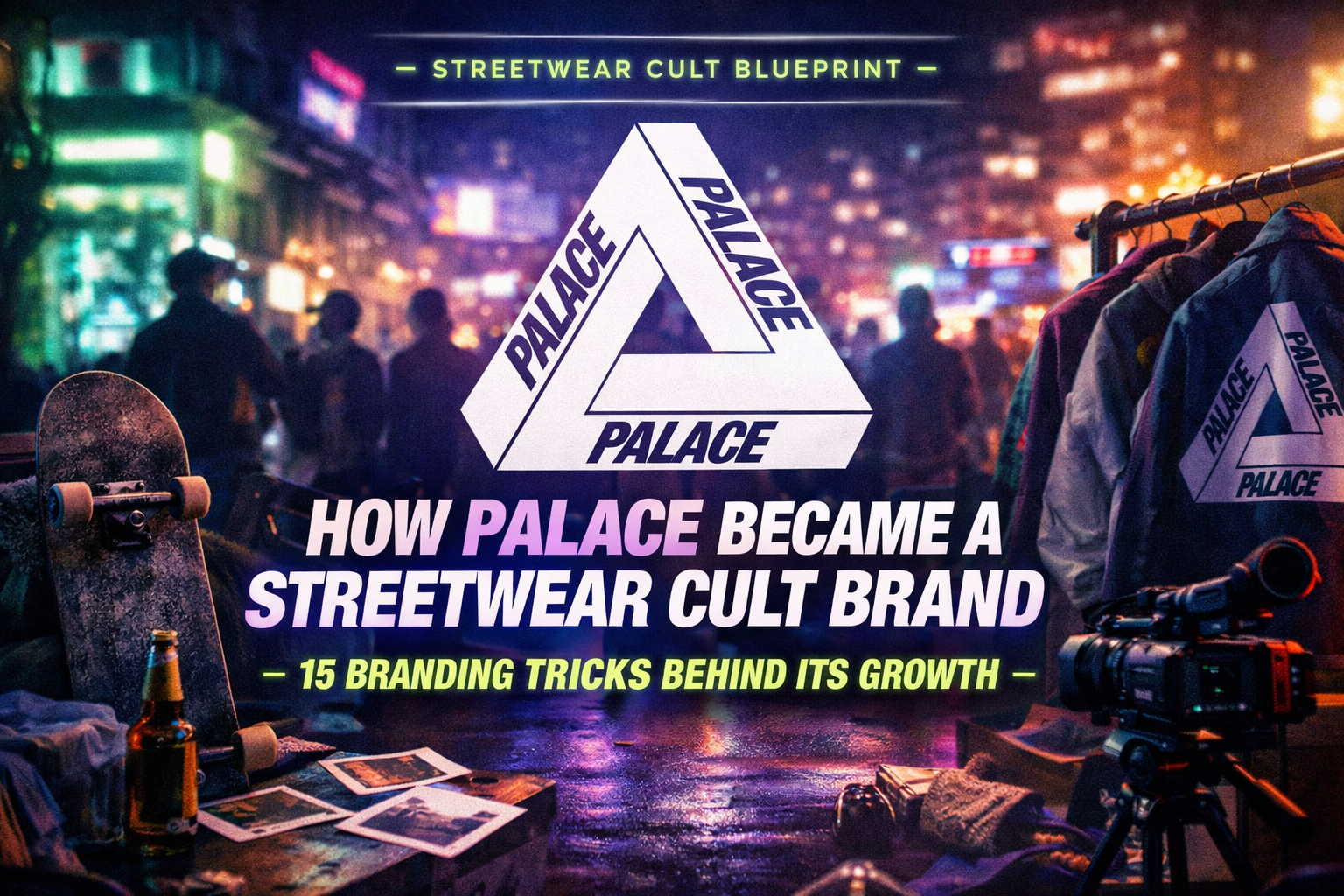
20 Dec How Palace Became a Streetwear Cult Brand: 15 Branding Tricks Behind Its Growth
How Palace Became a Streetwear Cult Brand: 15 Branding Tricks Behind Its Growth (Editor’s Choice)
Brand Breakdown
How Off-White Became a Streetwear Icon
15 branding secrets behind Virgil’s vision—packaged as a fast, scroll-stopping reference.
| # | Branding Secret | Why it worked | How you can apply it |
|---|---|---|---|
| 01 | The “3% Rule” | Small tweaks created “newness” without losing familiarity. | Refresh best-sellers with subtle upgrades (materials, trim, naming, story). |
| 02 | Quotation Marks as a Brand Language | Turned products into ideas and sparked conversation. | Create a recognizable “verbal signature” (labels, phrases, naming system). |
| 03 | Industrial Design as Identity | Belts, zip ties, stripes = instant visual recognition. | Develop 1–2 ownable design codes you repeat across touchpoints. |
| 04 | A Logo That Scales Everywhere | Looked strong on sneakers, runway pieces, and social content. | Design flexible brand assets that work in tiny and massive formats. |
| 05 | Streetwear × High Fashion Bridge | Legitimized streetwear in luxury spaces and vice versa. | Borrow credibility from adjacent worlds through partnerships + placement. |
| 06 | Collabs as Cultural Expansion | Nike/IKEA/Rimowa unlocked new audiences while staying “Off-White.” | Choose collabs that extend your story, not just your distribution. |
| 07 | Limited Drops, Maximum Desire | Scarcity turned launches into events. | Use timed releases, waitlists, and “chapters” instead of constant restocks. |
| 08 | Social Media as a Design Tool | The brand evolved in public, building intimacy and momentum. | Test narratives and visuals on social before scaling campaigns. |
| 09 | Youth Culture as Creative Director | Stayed relevant by treating youth as co-creators, not targets. | Build feedback loops: community drops, creator councils, IRL listening. |
| 10 | Anti-Luxury Transparency | Exposed construction and “unfinished” cues felt honest and modern. | Show process: behind-the-scenes, prototyping, material provenance. |
| 11 | Education Built Into the Brand | Explaining references made fans feel smart and included. | Create explainers: “why we made this,” micro-content, annotations. |
| 12 | Milan Roots, Global Voice | Craft + culture blended into a borderless identity. | Anchor in one strong origin story while speaking to multiple scenes. |
| 13 | Storytelling Over Seasons | Collections read like chapters, not random releases. | Run campaigns as series: themes, arcs, recurring motifs, “episodes.” |
| 14 | Credibility First, Sales Second | Cultural authenticity created demand naturally. | Invest in taste-making (PR, creators, community) before scaling spend. |
| 15 | Virgil as the Brand’s Medium | A multidimensional creator made the brand feel alive and open-ended. | Humanize your brand: founder POV, creative direction, strong voice. |
How Off-White Became a Streetwear Icon: 15 Branding Secrets Behind Virgil’s Vision
How Palace Became a Streetwear Cult Brand: Branding Tricks Behind Its Growth #3 — Create a Logo That Behaves Like a Symbol
The Tri-Ferg works because it doesn’t try to be clever—it’s confident. It’s bold enough to stand alone and flexible enough to be distorted, shrunk, flipped, or half-hidden. Palace understood that cult logos don’t beg for attention; they reward recognition. The symbol becomes shorthand for everything else the brand stands for, allowing the wearer to speak without saying much at all.
How Palace Became a Streetwear Cult Brand: Branding Tricks Behind Its Growth #4 — Treat Video Like the Core Product
Palace videos aren’t content; they’re context. They show you how the brand moves, what it values, and what kind of attention span it respects. The pacing is imperfect, the editing is intentional, the music choices feel instinctual rather than strategic. The clothes exist inside these moments, not the other way around. By making video the emotional anchor, Palace lets the product inherit meaning instead of manufacturing it.
How Palace Became a Streetwear Cult Brand: Branding Tricks Behind Its Growth #5 — Turn Drops Into Rituals
There’s a familiarity to Palace drops that feels almost ceremonial. The timing, the anticipation, the collective online presence—it all signals that this isn’t just shopping, it’s participation. Rituals build loyalty more effectively than persuasion ever could. Palace didn’t train its audience to buy; it trained them to show up.
How Palace Became a Streetwear Cult Brand: Branding Tricks Behind Its Growth #6 — Practice Effortless Scarcity
Palace understands something many brands overcomplicate: scarcity only works when it doesn’t look like it’s trying. There’s no dramatization, no language engineered to trigger urgency, no countdowns screaming at you to care. The product appears, it sells out, and the brand moves on without sentiment. That indifference is magnetic. It signals that demand isn’t something Palace needs to manufacture—it’s something that naturally follows. In a culture obsessed with “drops,” Palace makes scarcity feel like a side effect of taste, not a tactic.
How Palace Became a Streetwear Cult Brand: Branding Tricks Behind Its Growth #7 — Repeat Until It Becomes a Signature
Palace doesn’t chase novelty for novelty’s sake. Instead, it refines a recognizable visual language—fonts, silhouettes, graphic placement—that builds familiarity over time. This repetition is intentional. When a brand repeats itself with confidence, it teaches the audience how to recognize it instinctively. You don’t need to read the label; you already know. That kind of visual muscle memory is what separates cult brands from seasonal ones. Palace proves that consistency isn’t restrictive—it’s liberating when it’s anchored in identity.
How Palace Became a Streetwear Cult Brand: Branding Tricks Behind Its Growth #8 — Make Humor Your Moat
Palace’s humor doesn’t ask permission, and it doesn’t explain itself. Sometimes it’s clever, sometimes it’s childish, sometimes it’s just weird—and that unpredictability is the point. Humor becomes a filtering mechanism. If you laugh, you’re aligned. If you don’t, the brand isn’t concerned with converting you. This kind of humor is incredibly difficult to replicate because it’s rooted in confidence, not performance. Palace uses irreverence as armor, protecting the brand from dilution while keeping it human.
How Palace Became a Streetwear Cult Brand: Branding Tricks Behind Its Growth #9 — Collaborate Like You’re Curious, Not Desperate
Palace collaborations feel exploratory rather than opportunistic. They don’t arrive with loud explanations or forced narratives; they simply exist as shared taste moments. Whether the pairing is obvious or unexpected, the brand never compromises its own voice to accommodate a partner. That balance—openness without surrender—is rare. Palace treats collaboration as a conversation between equals, not a strategy for borrowed relevance. The result is credibility that compounds instead of spikes.
How Palace Became a Streetwear Cult Brand: Branding Tricks Behind Its Growth #10 — Gatekeep Through Taste, Not Exclusion
Palace never declares who it’s for—and that silence is deliberate. The brand relies on references, humor, and cultural signals to quietly define its audience. If you recognize them, you stay. If you don’t, the brand doesn’t pause to onboard you. This form of gatekeeping doesn’t feel hostile; it feels selective. Taste becomes the entry requirement, not money or access. And that’s why belonging feels meaningful rather than transactional.
How Palace Became a Streetwear Cult Brand: Branding Tricks Behind Its Growth #11 — Show the Humans, Skip the Influencer Gloss
Palace shows people without turning them into content. There’s no over-sharing, no polished vulnerability, no influencer cadence. The humans behind the brand appear casually, almost incidentally, which makes their presence feel credible. This restraint creates trust. It signals that the brand exists beyond algorithms and optics. In an era where authenticity is often performed, Palace practices it quietly—and that subtlety is disarming.
How Palace Became a Streetwear Cult Brand: Branding Tricks Behind Its Growth #12 — Let Mystery Do the Heavy Lifting
Palace doesn’t over-communicate, and that restraint feels luxurious. Teasers are minimal, captions are sparse, and explanations are rare. The brand trusts its audience to sit with ambiguity, to lean in rather than be spoon-fed. Mystery creates space for interpretation—and interpretation creates emotional investment. By resisting the urge to explain itself, Palace keeps its narrative open, fluid, and endlessly interesting.
How Palace Became a Streetwear Cult Brand: Branding Tricks Behind Its Growth #13 — Make Physical Space Feel Mythical
A Palace store is less about retail efficiency and more about symbolic presence. The queues, the locations, the atmosphere—they all reinforce the idea that this brand exists in the real world, not just online. Physical space becomes proof, grounding the mythology in something tangible. Visiting a Palace store feels like participation, not consumption, which deepens loyalty in a way e-commerce alone never could.
How Palace Became a Streetwear Cult Brand: Branding Tricks Behind Its Growth #14 — Embrace Controlled Chaos
Palace isn’t afraid to confuse its audience a little. Some collections feel polished and precise; others feel chaotic, loud, even polarizing. That tension keeps the brand alive. Controlled chaos signals creative freedom—it tells the audience that Palace isn’t optimizing for universal approval. By allowing experimentation within a strong identity, the brand avoids stagnation without losing itself.
How Palace Became a Streetwear Cult Brand: Branding Tricks Behind Its Growth #15 — Stay Adjacent, Not Attached, to Culture
Palace doesn’t chase cultural moments—it hovers near them. Close enough to feel relevant, distant enough to remain autonomous. This positioning allows the brand to respond rather than react, to participate without pandering. That distance preserves integrity and ensures longevity. Palace proves that the most powerful brands don’t cling to culture—they coexist with it on their own terms.