



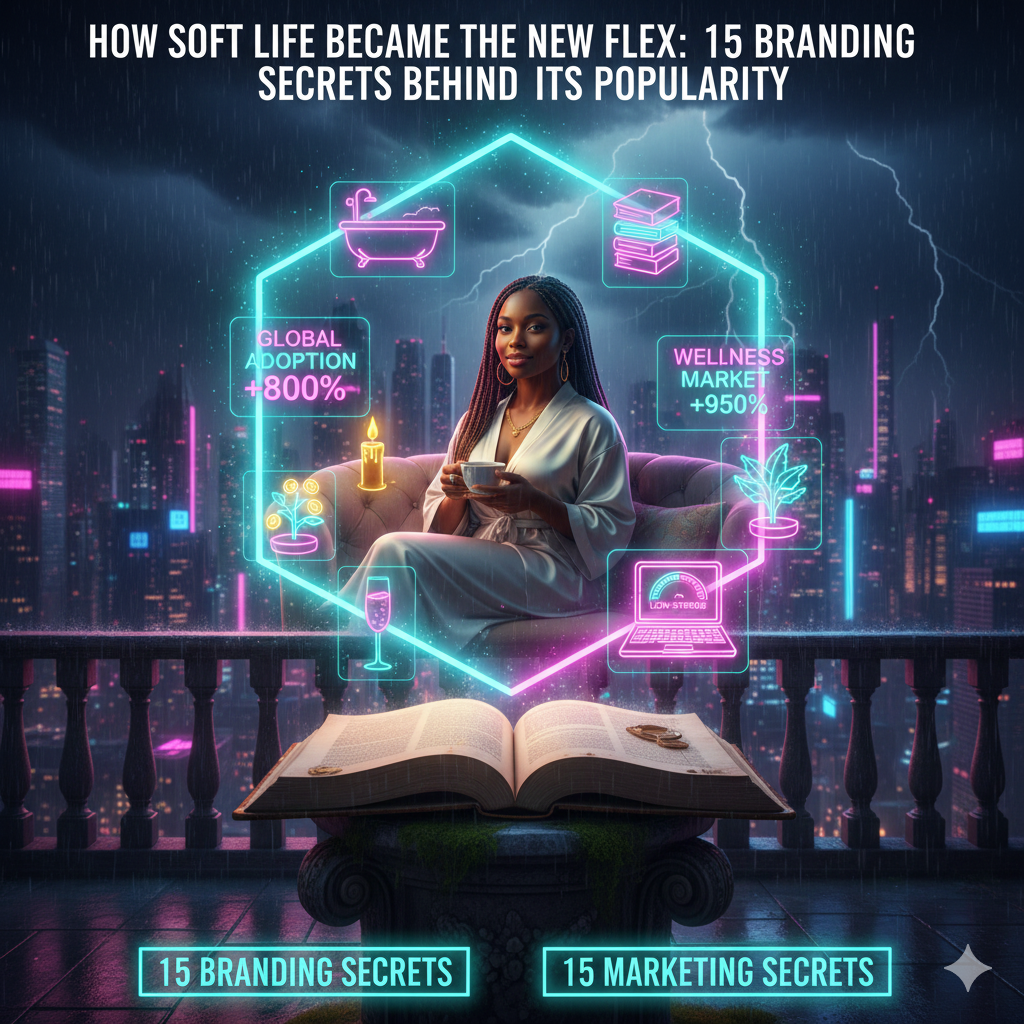
21 Dec How Soft Life Became the New Flex: 15 Branding Secrets Behind Its Popularity
How Soft Life Became the New Flex: 15 Branding Secrets Behind Its Popularity (Editor’s Choice)
| # | Branding Keyword | Why It Matters in the Soft Life Economy |
|---|---|---|
| 01 | Rest as Power | Repositions rest as agency, not escape—signaling control over energy and boundaries. |
| 02 | Quiet Luxury | Signals status through restraint, taste, and subtlety rather than overt consumption. |
| 03 | Strategic Femininity | Reclaims softness as discernment, emotional fluency, and quiet leverage. |
| 04 | Aesthetic Consistency | Creates emotional safety and brand trust through calm, predictable visual language. |
| 05 | Selective Visibility | Builds authority through privacy, restraint, and intentional absence. |
| 06 | Time Wealth | Positions unhurried living as the ultimate form of modern luxury. |
| 07 | Emotional Intelligence | Turns regulation, boundaries, and self-awareness into cultural capital. |
| 08 | Intentional Domesticity | Frames home as sanctuary and pleasure, not obligation or performance. |
| 09 | Opting Out Quietly | Signals confidence by disengaging without justification or debate. |
| 10 | Visual Slowness | Uses calm pacing and minimal edits to counter attention fatigue. |
| 11 | Gentle Wellness | Removes moral pressure from self-care, making wellness feel invitational. |
| 12 | Romanticizing the Ordinary | Transforms everyday moments into aspirational touchpoints. |
| 13 | Soft Ambition | Allows growth without burnout by redefining success as sustainable. |
| 14 | Curated Calm | Turns peace and regulation into a recognizable personal brand. |
| 15 | Quiet Authority | Uses silence, restraint, and timing as the ultimate power signals. |
How Soft Life Became the New Flex: 15 Branding Secrets Behind Its Popularity
How Soft Life Became the New Flex: Branding Secrets Behind Its Popularity #1 Reframing Rest as Power, Not Escape
The first masterstroke of the Soft Life narrative was a linguistic pivot: rest stopped being positioned as a reward for burnout and started being framed as a form of self-governance. This wasn’t about opting out of ambition—it was about choosing how ambition shows up in your life. The Soft Life aesthetic didn’t whisper laziness; it spoke fluency in boundaries. Brands and creators who leaned into this understood something crucial: power today doesn’t need to look loud or exhausted. It looks selective. It looks intentional. It looks like someone who knows they don’t have to prove anything anymore. In branding terms, this is classic status signaling—those with real agency don’t rush, overexplain, or justify rest. They normalize it.
How Soft Life Became the New Flex: Branding Secrets Behind Its Popularity #2 Luxury Without Logos
Soft Life branding thrives on understatement. No screaming labels. No maximalist proof of wealth. Just space, light, and the confidence of someone who doesn’t need to announce arrival. This taps into a long-standing fashion truth: true luxury has always been quiet. The Soft Life aesthetic borrows from old-money restraint and translates it into lifestyle content—neutral palettes, slow mornings, linen robes, ceramic mugs. The genius here is that it democratizes aspiration while maintaining exclusivity. You may not own the estate, but you can borrow the language of calm affluence. Brands that adopted this stripped-down elegance weren’t selling objects; they were selling taste, which is far harder to copy.
How Soft Life Became the New Flex: Branding Secrets Behind Its Popularity #3 Femininity Rebranded as Strategic
Soft Life didn’t invent softness—it reclaimed it. What once was dismissed as fragile or unserious became reframed as emotionally intelligent, discerning, and deeply strategic. The branding genius lies in how femininity was repositioned not as performance but as leverage. Softness became a filter: what you allow in, what you refuse, where you invest your energy. This resonated because it countered years of “masculine-coded success” messaging without swinging into rebellion. It simply opted out. In brand storytelling, this is subversion without aggression—a far more seductive move.
How Soft Life Became the New Flex: Branding Secrets Behind Its Popularity #4 Aesthetic Consistency as Emotional Safety
The Soft Life isn’t just visual—it’s regulated. The muted tones, slow pacing, and repetitive rituals create a sense of emotional predictability, which is deeply attractive in unstable times. From a branding perspective, this consistency builds trust. When everything feels chaotic, people gravitate toward brands and creators who feel calm, steady, and non-reactive. The Soft Life aesthetic functions almost like a visual exhale. It’s not trying to shock you; it’s trying to hold you. That emotional safety is the product.
How Soft Life Became the New Flex: Branding Secrets Behind Its Popularity #5 Selective Visibility
Soft Life branding understands the power of absence. You don’t see everything. You aren’t invited into every moment. This controlled access signals self-worth and discernment. In branding psychology, scarcity always increases value—but here, it’s emotional scarcity, not material. Creators stopped oversharing chaos and started curating calm. What’s left unsaid does the heavy lifting.
How Soft Life Became the New Flex: Branding Secrets Behind Its Popularity #6 Time as the Ultimate Status Symbol
If wealth once announced itself through accumulation—cars, homes, titles—Soft Life branding suggested something far rarer: unclaimed time. The languid mornings, the midday errands done without apology, the absence of urgency in both tone and posture all signal a kind of privilege that cannot be fast-tracked or faked. In branding terms, time abundance operates as the most aspirational form of capital because it implies control over one’s labor, schedule, and nervous system. Soft Life content doesn’t glamorize idleness; it elevates autonomy. The message is subtle but unmistakable: I am not late, I am not rushing, and nothing bad will happen if I move slowly. That calm confidence becomes contagious. Brands and creators who leaned into this weren’t offering productivity hacks—they were offering relief from the tyranny of constant availability.
How Soft Life Became the New Flex: Branding Secrets Behind Its Popularity #7 Emotional Intelligence as Cultural Capital
Soft Life branding thrives on a fluency that isn’t academic or performative—it’s emotional. Naming feelings, anticipating burnout, choosing distance instead of drama: these behaviors became aspirational not because they’re new, but because they were framed as evidence of self-mastery. Emotional intelligence here functions as cultural capital. It signals someone who has done enough internal work to no longer need external validation. In a branding landscape once dominated by “hard truths” and hyperconfidence, Soft Life made regulation desirable. The calm response. The delayed reply. The refusal to escalate. This wasn’t softness as vulnerability—it was softness as skill. And like all skills, it quietly separates those who have it from those who are still trying too hard.
How Soft Life Became the New Flex: Branding Secrets Behind Its Popularity #8 Domesticity Without Obligation
One of the most sophisticated pivots of Soft Life branding was its reclamation of domestic space—without tethering it to sacrifice, duty, or gendered expectation. The home was no longer a site of invisible labor; it became a curated refuge. Candles, freshly made beds, quiet kitchens bathed in morning light—these visuals weren’t about productivity or caretaking. They were about pleasure, containment, and choice. Branding-wise, this worked because it removed moral obligation from domesticity. You weren’t “being good”; you were being intentional. The Soft Life home isn’t efficient—it’s indulgent in its calm. And that distinction matters. It reframes care not as something owed to others, but as something you give to yourself first.
How Soft Life Became the New Flex: Branding Secrets Behind Its Popularity #9 Opting Out Without Explaining
Perhaps the most radical branding decision of the Soft Life movement was its refusal to justify itself. There is no manifesto. No debate. No defensive framing. Soft Life doesn’t argue with hustle culture—it simply disengages. This is an advanced form of confidence. In brand psychology, the need to explain often signals insecurity; silence, when paired with consistency, signals authority. The Soft Life creator doesn’t announce boundaries—they embody them. They stop responding. They stop reacting. They choose absence where noise is expected. That restraint reads as power because it mirrors how high-status individuals operate: they don’t need consensus. They decide, and life reorganizes around that decision.
How Soft Life Became the New Flex: Branding Secrets Behind Its Popularity #12 Romanticizing the Ordinary
Soft Life branding understands that aspiration doesn’t have to live in the extraordinary. In fact, its power comes from locating beauty in repetition: morning light on a kitchen counter, a quiet walk, a cup of coffee taken seriously. This is not naïveté; it’s narrative control. By romanticizing the ordinary, Soft Life content dissolves the gap between “the life you have” and “the life you want.” From a branding perspective, this is genius—it creates accessibility without dilution. You don’t need transformation; you need attention. And attention, when practiced daily, becomes a form of luxury. The Soft Life doesn’t promise escape. It promises presence.
How Soft Life Became the New Flex: Branding Secrets Behind Its Popularity #13 Anti-Grind Without Anti-Ambition
Soft Life branding never rejects ambition—it interrogates its form. This distinction is crucial. The movement doesn’t advocate for less desire, but for better discernment. Success is still welcome, but not at the expense of self-erasure. In branding terms, this nuance prevents the Soft Life from being dismissed as escapism. It positions softness as a sustainability strategy. Burnout is no longer proof of commitment; it’s evidence of misalignment. The Soft Life reframes ambition as something that can be quiet, paced, and selective. You can want more without wanting everything. That recalibration resonates deeply in a culture exhausted by all-or-nothing success narratives.
How Soft Life Became the New Flex: Branding Secrets Behind Its Popularity #14 Curated Calm as Identity
At its most potent, the Soft Life is not an aesthetic—it’s an identity choice. Calm becomes a personal brand. This is where lifestyle shifts into self-definition. The way someone moves through the world, responds to conflict, structures their day—these choices form a coherent narrative: I protect my peace. From a branding standpoint, this is powerful because it creates coherence across touchpoints. The visuals, the tone, the absence of chaos—all reinforce the same message. The Soft Life individual is recognizable not by what they display, but by what they refuse to entertain. That consistency reads as self-knowledge, which is always aspirational.