



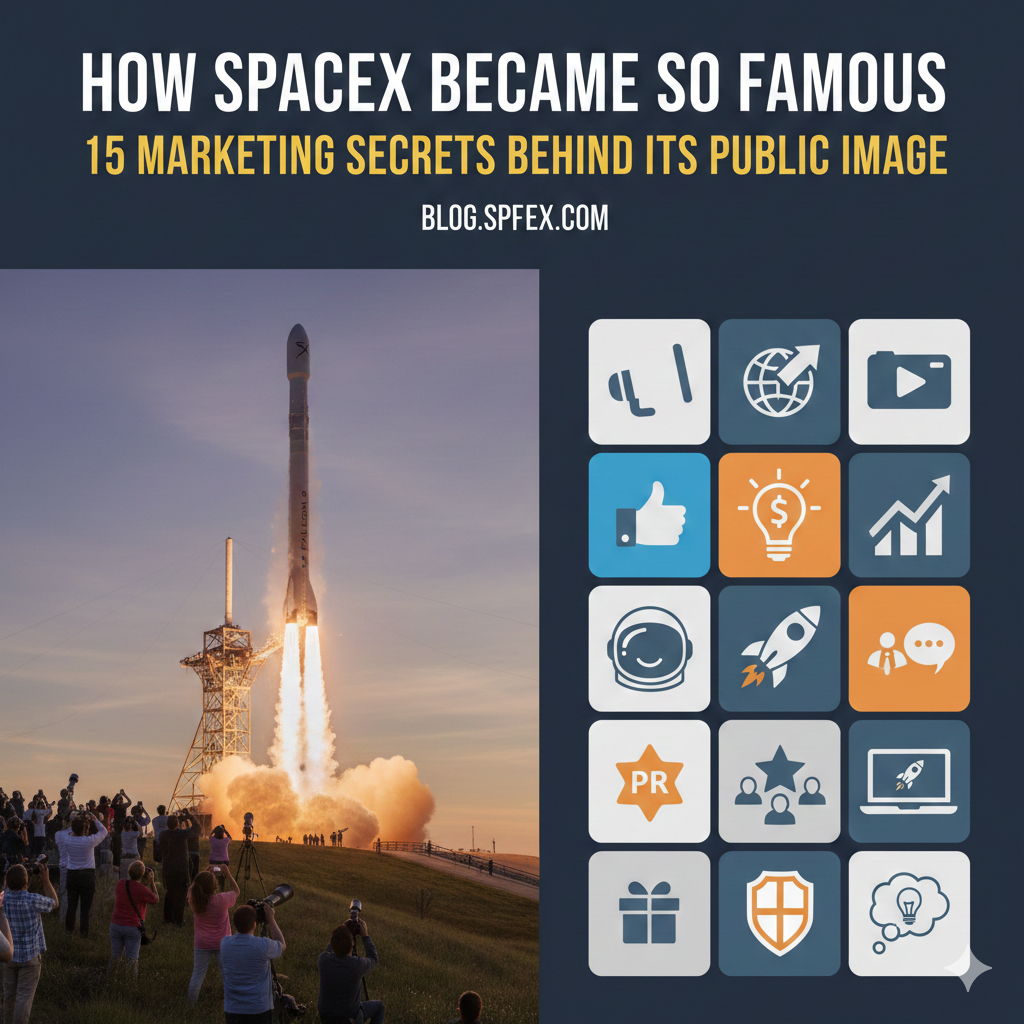
23 Dec How SpaceX Became So Famous: 15 Marketing Secrets Behind Its Public Image
How SpaceX Became So Famous: 15 Marketing Secrets Behind Its Public Image (Editor’s Choice)
SpaceX’s Public-Image Playbook 🪐
15 marketing secrets that turned rocket science into pop culture.
| Secret | What SpaceX Does | Why It Works |
|---|---|---|
| 1 🌍 Mission > Marketing “Make life multiplanetary” is the headline. | Frames everything through a bold, human-scale mission—not just launches or contracts. | People root for purpose. It turns viewers into believers. Big mission = automatic attention. |
| 2 🧠 Inevitable Progress The impossible becomes “next on the roadmap.” | Shows consistent iteration and measurable progress (even when it’s messy). | Repetition builds belief: “They’ll get there.” Momentum beats hype. |
| 3 💥 Failure in Public They don’t hide explosions—they learn from them. | Livestreams tests and accepts setbacks as part of the story. | Transparency builds credibility and makes wins feel earned. Risk makes it real. |
| 4 🧑🚀 Founder Visibility A mission with a main character. | Uses founder-led storytelling to keep vision and narrative tight. | People follow people. A human anchor makes it stick. Narrative needs a narrator. |
| 5 🎥 Engineering as Entertainment Cinematic launches, dramatic landings. | Produces launch visuals like a blockbuster—angles, audio, timing. | Spectacle makes complex science instantly shareable. Make it watchable → make it viral. |
| 6 📺 Livestream Culture Launches become appointments. | Treats launches as must-watch events with real-time commentary. | Shared suspense turns viewers into a community. Event energy = built-in buzz. |
| 7 📡 Direct Narrative Control No middleman, no spin. | Communicates through its own channels: streams, posts, updates. | Speed + clarity keeps the story consistent and credible. Control the channel, control the narrative. |
| 8 📸 Visual Proof Show the landing. Don’t over-explain it. | Leads with compelling visuals (landings, reentries, scale shots). | Proof bypasses skepticism and sparks instant sharing. Seeing = believing. |
| 9 🧪 Making Science Aspirational Smart is cool again. | Makes advanced engineering accessible without talking down. | Curiosity becomes contagious—and fans feel “in on it.” Invite people into the wonder. |
| 10 🎟️ Scarcity of Access Rare moments feel valuable. | Creates limited, high-stakes viewing windows (launches, tests, milestones). | Scarcity sharpens attention and boosts “I was there” energy. Rare = share-worthy. |
| 11 📰 Earned Media Magnet Headlines come to them. | Builds moments so newsworthy they spread without paid pushes. | Big outcomes create free distribution at global scale. Be the story, not the sponsor. |
| 12 👥 Superfan Ecosystem Breakdowns, threads, reaction videos. | Inspires creators to explain, remix, and analyze every milestone. | Participation creates ownership—and ownership creates loyalty. Fans become the distribution engine. |
| 13 🕰️ Long-Term Vision Mars isn’t tomorrow—and that’s the point. | Communicates long timelines confidently, reinforcing ambition and seriousness. | Patience signals confidence. Big vision makes the brand feel historic. Long game = legacy energy. |
| 14 ⚠️ Risk as Identity High stakes = high attention. | Doesn’t sugarcoat danger—space is hard, and that’s respected. | Risk creates suspense; suspense creates obsession. Stakes make people watch. |
| 15 📍 “I Was There” Moments History, in real time. | Creates cultural milestones people want to witness and share. | Emotional ownership turns viewers into lifelong followers. Participation = devotion. |
How SpaceX Became So Famous: 15 Marketing Secrets Behind Its Public Image
How SpaceX Became So Famous: Marketing Secrets Behind Its Public Image #2 – Making the Impossible Look Inevitable
Reusable rockets once sounded like sci-fi fan fiction. SpaceX treated them like a checklist item. Test. Fail. Repeat. Improve. Repeat again—publicly.
That repetition is the magic. Progress became predictable, and predictability built belief. SpaceX didn’t promise miracles; it showed momentum. And momentum is far more convincing than hype.
How SpaceX Became So Famous: Marketing Secrets Behind Its Public Image #3 – Failure as Public Theater
Most brands panic at the thought of failure going viral. SpaceX live-streams it in HD. Explosions, crashes, aborted landings—nothing hidden, nothing sugarcoated.
Here’s why that worked: risk makes success feel earned. When audiences see what’s at stake, they respect the wins more. SpaceX turned failure into proof of ambition, not incompetence.
How SpaceX Became So Famous: Marketing Secrets Behind Its Public Image #4 – Founder-Led Visibility
Let’s be honest—this story has a main character. And whether people admire or side-eye him, the founder’s presence gave SpaceX a human face.
Founder visibility turned a complex aerospace company into a narrative people could follow. People don’t emotionally connect with press releases. They connect with people chasing something outrageous—and refusing to let go.
How SpaceX Became So Famous: Marketing Secrets Behind Its Public Image #5 – Turning Engineering Into Entertainment
SpaceX didn’t just launch rockets—it produced them. Cinematic camera angles. Dramatic countdowns. Rockets landing to music like it’s the final scene of a movie.
This wasn’t flair for ego—it was strategy. When engineering becomes entertainment, it stops being niche. SpaceX made science watchable, shareable, and oddly addictive.
How SpaceX Became So Famous: Marketing Secrets Behind Its Public Image #6 – Live Streams as Cultural Events
SpaceX trained people to set alarms for launches. Think about that. Rocket science became appointment viewing.
Livestreams created collective suspense. Millions watching together, holding their breath at the same moment. That shared tension turned launches into cultural moments—not just technical milestones.
How SpaceX Became So Famous: Marketing Secrets Behind Its Public Image #7 – Owning the Narrative Directly
No filters. No intermediaries. SpaceX speaks to the world through its own channels—streams, posts, updates.
That directness keeps the message fast, raw, and emotionally intact. When you own your distribution, you don’t lose momentum to interpretation. SpaceX didn’t let others tell its story—it told it live.
How SpaceX Became So Famous: Marketing Secrets Behind Its Public Image #8 – Visual Proof Over Explanation
SpaceX doesn’t over-explain. It shows. Rockets landing upright. Heat shields glowing. Massive scale shots that make humans look microscopic.
Visual proof bypasses skepticism. You don’t need to understand orbital mechanics to feel awe. And awe? Awe is marketing rocket fuel.
How SpaceX Became So Famous: Marketing Secrets Behind Its Public Image #9 – Making Science Aspirational
SpaceX never talked down to its audience. It invited them in. Complex ideas were explained, dissected, debated—without dumbing anything down.
This made intelligence aspirational again. Curiosity became cool. Suddenly, knowing what a booster stage is felt socially acceptable—desirable, even.
How SpaceX Became So Famous: Marketing Secrets Behind Its Public Image #12 – Superfans as the Distribution Engine
SpaceX didn’t just attract viewers—it cultivated analysts, creators, and obsessives. Threads breaking down launches. YouTube explainers. Reaction videos. Fan diagrams. The brand inspired people to participate, not just watch.
That participation is everything. When fans invest time explaining your work, they emotionally invest in your success. SpaceX turned curiosity into community, and community into free, credible distribution. Marketing didn’t scale because of ads—it scaled because of devotion.
How SpaceX Became So Famous: Marketing Secrets Behind Its Public Image #13 – A Long-Term Vision That Signals Seriousness
Mars isn’t happening tomorrow, and SpaceX is very honest about that. The timeline is long, the challenges are massive, and the journey is uncertain. Instead of weakening the brand, that patience strengthens it. Long timelines signal confidence.
In a world obsessed with instant wins, SpaceX’s willingness to play the long game feels refreshing—and trustworthy. It tells audiences, “We’re not here for hype cycles. We’re here for legacy.” That kind of vision makes a brand feel historic before history is even written.
How SpaceX Became So Famous: Marketing Secrets Behind Its Public Image #14 – Risk as Part of the Brand Identity
Space is dangerous. SpaceX doesn’t soften that truth. Risk isn’t hidden behind polished messaging—it’s acknowledged, respected, and built into the narrative. Every launch feels high-stakes, because it is.
From a branding perspective, risk creates suspense. Suspense keeps people watching. SpaceX made danger part of the drama, and drama fuels obsession. When the stakes are real, attention follows naturally. Safe brands are easy to ignore. Brave ones aren’t.