



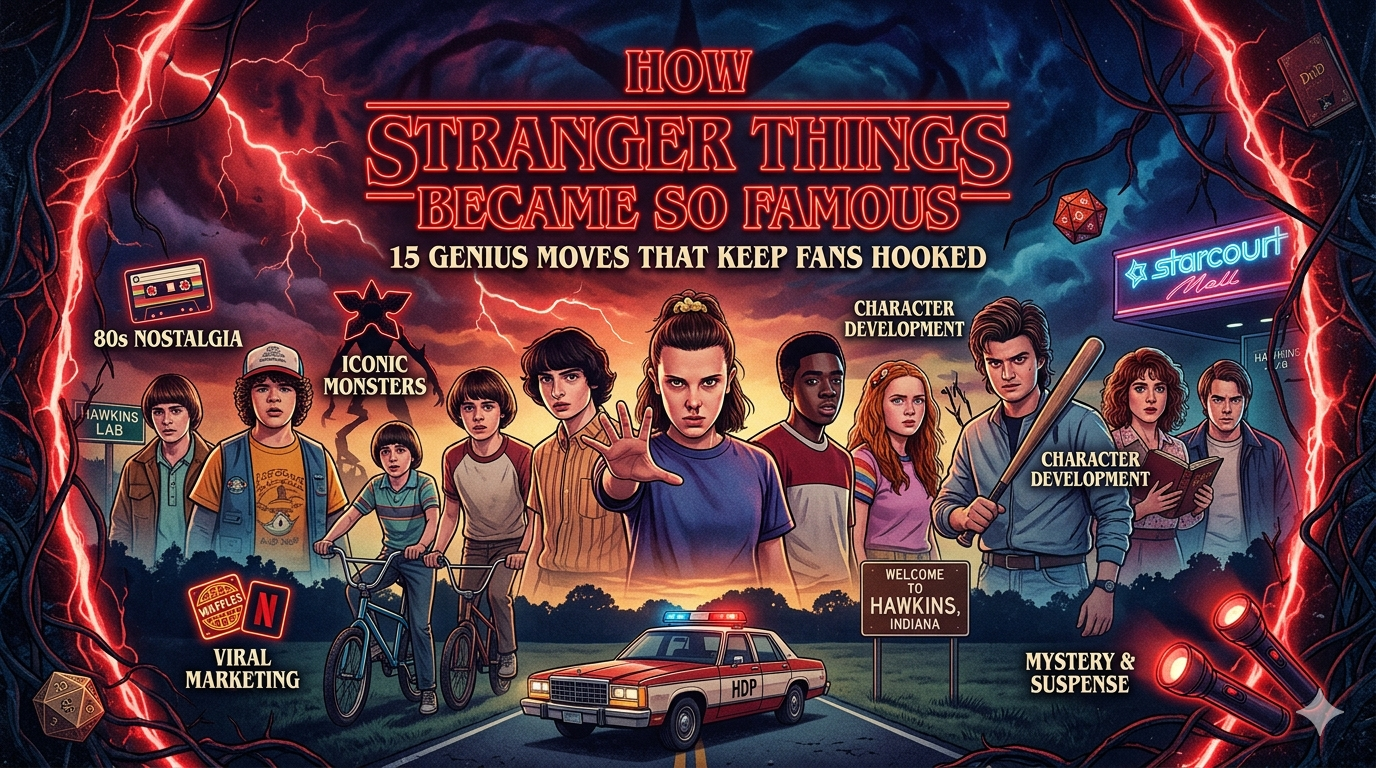
12 Dec How Stranger Things Became So Famous: 15 Genius Moves…
If there’s one thing Stranger Things has taught us—aside from the fact that bike-riding kids possess supernatural levels of bravery—it’s that cultural phenomena don’t just happen; they’re engineered with the kind of intention a leading marketing agency in New York would applaud. The show didn’t merely slip into our screens; it strutted in wearing vintage denim, humming a synth soundtrack, and brandishing the emotional gravitas of a coming-of-age classic. It’s nostalgic without being dusty, cinematic without being pretentious, and somehow manages to make demonic entities feel like the cherry on top of a perfectly curated narrative sundae. In other words: it’s marketing magic disguised as monster mayhem—and that’s exactly what we’re diving into.
How Stranger Things Became So Famous: 15 Genius Moves That Keep Fans Hooked (Editor’s Choice)
How Stranger Things Became So Famous: 15 Genius Moves That Keep Fans Hooked
A breakdown of the strategic storytelling, cinematic choices, and cultural triggers that turned Stranger Things into a global phenomenon.
| # | Genius Move | Why It Worked | Impact on Popularity |
|---|---|---|---|
| 01 | 80s Nostalgia Done Right Retro without feeling outdated | It tapped into a collective cultural memory—classic movies, neon, arcades, Walkmans, and D&D. | Created instant emotional connection across generations. |
| 02 | Cinematic Filmmaking on TV Movie-level quality each episode | The show used blockbuster lighting, pacing, sound design, and production value. | Made it feel bigger and more premium than typical streaming series. |
| 03 | The Mystery-Box Formula Built-in suspense generator | Each season drops clues slowly, encouraging theories, rewatching, and discussion. | Drove massive online buzz and binge-watching behavior. |
| 04 | Iconic, Lovable Characters Emotional anchors of the story | Diverse personalities—Dustin, Eleven, Steve, Hopper—resonate deeply with viewers. | High fan attachment = long-term loyalty and engagement. |
| 05 | Realistic Friendship Dynamics Kids who act like real kids | Relationships evolve naturally—awkward, hilarious, heartfelt. | Added authenticity and relatability across age groups. |
| 06 | Breakout Performance by Millie Bobby Brown The heart of the show | Eleven became instantly iconic through vulnerability, power, and emotional nuance. | Boosted early word-of-mouth and gave the show a signature persona. |
| 07 | Legendary Music Moments Kate Bush, The Clash, synth waves | Music amplified emotion and nostalgia, creating unforgettable scenes. | Revived classic songs and fueled viral trends worldwide. |
| 08 | Villains That Evolve Each Season Demogorgon → Mind Flayer → Vecna | Escalating stakes kept the series fresh and unpredictable. | Maintained excitement and deepened the lore of the Upside Down. |
| 09 | Genre Fusion Mastery Horror + sci-fi + coming-of-age | Offered something for everyone without feeling chaotic. | Expanded the show’s appeal to multiple audience types. |
| 10 | Easter Eggs & Pop Culture References A playground for superfans | From Spielberg nods to Stephen King energy—rich layers of homage. | Encouraged repeat viewing and endless online analysis. |
| 11 | The Hawkins Small-Town Formula “Ordinary meets extraordinary” | The small, cozy town amplifies the supernatural chaos. | Creates intimacy and amplifies suspense. |
| 12 | Memorable, Viral Moments Eddie’s guitar solo, Max levitating | Scenes crafted to explode across social media. | Expanded reach beyond Netflix into global pop culture. |
| 13 | Binge-Release Strategy Netflix’s secret weapon | Full-season drops fuel collective hype and fast-paced discussion cycles. | Created massive premiere-week spikes and community excitement. |
| 14 | Multi-Generational Appeal Kids, teens, adults—all hooked | The storylines speak to different life stages and emotional experiences. | Ensures huge demographic range and shared family fandom. |
| 15 | Deep Emotional Core Friendship, trauma, loyalty, loss | The heart outweighs the horror, creating lasting resonance. | Transforms viewers into lifelong fans — not just watchers. |
How Stranger Things Became So Famous: 15 Genius Moves That Keep Fans Hooked
How Stranger Things Became So Famous: Genius Moves That Keep Fans Hooked #3 — The Mystery-Box Formula That Keeps Us Guessing
Let’s talk about the art of giving just enough… because Stranger Things has mastered it like a flirt who knows exactly when to look away. Every season drops a fresh mystery in your lap — missing kids, freaky labs, shadow monsters, portals that absolutely no one asked for — and then has the audacity to reveal clues in tiny, maddeningly perfect doses. You’re not just watching; you’re participating in a slow-burn treasure hunt that hijacks your brain at 2 a.m. And the best part? You’re not alone — fans are out here writing Reddit dissertations, fighting lovingly in comment sections, and building theories that deserve their own TED Talks. That collective chaos becomes the show’s most powerful marketing campaign… and Netflix doesn’t even have to pay for it.
How Stranger Things Became So Famous: Genius Moves That Keep Fans Hooked #4 — A Cast You Want to Adopt, Befriend, or Marry
Be honest — at some point, you’ve wanted to either protect these characters with your whole chest, grab ice cream with them at Scoops Ahoy, or adopt them like the emotionally invested TV parent you’ve become. Every single one of them is built with this delicious mix of quirks, flaws, and surprising hero moments — Eleven’s quiet power, Dustin’s sunshine-in-a-human energy, Steve’s legendary glow-up, Hopper’s “grumpy exterior, gooey center.” They don’t feel written; they feel lived in, like people you already know and low-key root for more than your own cousins. And once a character feels real, emotionally messy, and deeply lovable, guess what? You’re hooked — not just on the plot, but on them. That fierce attachment is the kind of brand loyalty marketers dream about, and Stranger Things nails it season after season
How Stranger Things Became So Famous: Genius Moves That Keep Fans Hooked #5 — Friendship Dynamics That Feel Delightfully Real
Tell me why these kids argue, storm off, come back, and save each other like they all signed an emotional prenup? Because their friendships are refreshingly messy, the way real friendships are when you’re young and dramatic and fueled by snacks and questionable decisions. Nothing about their dynamic feels polished for TV — it feels lived-in, like the chaotic sleepover friendships we swore would last forever. And because it feels real, you don’t just watch their relationships; you invest in them like you personally helped raise the group. That kind of authenticity is marketing gold — it makes fans root, attach, and come back for more… even when the monsters in the Upside Down have no chill whatsoever.
How Stranger Things Became So Famous: Genius Moves That Keep Fans Hooked #6 — Millie Bobby Brown’s Insanely Magnetic Performance
Let’s just say it: Millie Bobby Brown didn’t come to play — she came to emotionally lasso you by the heart and drag you into the Upside Down with her. Eleven isn’t just a character; she’s the show’s pulse, the soft center wrapped inside an explosive superpower shell. Millie brings this wild combination of vulnerability and steel that feels way too sophisticated for someone who was basically still figuring out algebra when she filmed it. She gives the series its emotional compass — the kind that quietly pulls you in before you even realize you’re fully invested. And that’s the marketing magic right there: when a single actor elevates the entire narrative, the show doesn’t just rise… it becomes unskippable.
How Stranger Things Became So Famous: Genius Moves That Keep Fans Hooked #7 — A Soundtrack That Rewrites the Charts
Let’s be honest: Stranger Things doesn’t just use music — it weaponizes it. The moment “Running Up That Hill” came soaring back onto global charts like it had unfinished business in 2022, you knew this show had unlocked a cheat code most marketers could only manifest on mood boards. The soundtrack isn’t background filler; it’s the emotional undercurrent that sneaks up on you, wraps itself around your nostalgia receptors, and whispers, “Feel something.” Every track does double duty — storytelling on one side, cultural callback on the other — giving viewers goosebumps and giving marketers a gold-plated case study in emotional branding. And let’s be real: when your song placement becomes a TikTok trend, a meme, AND a chart revival? That’s not just good TV… that’s pure marketing wizardry.
How Stranger Things Became So Famous: Genius Moves That Keep Fans Hooked #8 — Villains That Evolve Like Your Favorite Horror Franchise
Let’s be honest: Stranger Things doesn’t just give you villains — it gives you character-building trauma in 4K. We went from the Demogorgon (aka “monster but make it mysterious”) to the Mind Flayer (big, shadowy, and definitely not paying taxes) to Vecna, who showed up like, “Hi, I’m here to ruin your childhood and your sleep schedule.” Each villain levels up the stakes without repeating the same scare tactics, which makes the whole universe feel like a horror franchise with a growth plan. And you know what happens next — fans jump into detective mode, expanding Pinterest boards, TikTok theories, and X threads like it’s their part-time job. Speculation keeps the internet buzzing, and buzzing keeps the franchise alive… it’s villain-driven marketing at its absolute finest.
How Stranger Things Became So Famous: Genius Moves That Keep Fans Hooked #9 — A Genre Fusion That Shouldn’t Work but Absolutely Does
Stranger Things is basically the entertainment equivalent of someone handing you a milkshake made of sci-fi, horror, teen angst, government conspiracies, dad-jokes, and first-crush butterflies — and you taking one sip and going, “Wait… why is this delicious?” The show bends genres with zero shame and somehow manages to be thrilling, funny, terrifying, heart-squeezing, and nostalgic all at once. One minute you’re laughing at Dustin being Dustin, the next you’re clutching a pillow like it’s a life raft, and then out of nowhere you’re hit with a tender moment that feels illegally emotional for a monster show. That kind of emotional ping-pong becomes the series’ secret flavor — unpredictable but deeply satisfying. And the beauty of it? Multi-genre storytelling pulls in multi-generational fans, which is basically the marketing version of hitting the jackpot… twice.
How Stranger Things Became So Famous: Genius Moves That Keep Fans Hooked #10 — Easter Eggs That Make Fans Feel Like Insiders
Stranger Things sprinkles Easter eggs the way your favorite friend sprinkles drama into a group chat — intentionally, sparingly, and always with maximum impact. One minute you’re casually watching, and the next you’re pointing at the screen yelling, “Wait, isn’t that straight out of E.T.?” These tiny pop-culture breadcrumbs — from The Goonies to Alien to blink-and-you’ll-miss-it set details — make older fans feel gloriously seen and younger fans feel like they just unlocked a vintage cultural cheat code. It’s the ultimate viewer reward system: pay attention, get a dopamine hit. And marketers? We live for this. Easter eggs spark rewatches, fan theories, freeze-frame TikToks, and the kind of obsessive shareable content that keeps a franchise alive long after the credits roll. Secret nods don’t just create fans — they create insiders.
How Stranger Things Became So Famous: Genius Moves That Keep Fans Hooked #11 — The Cozy-Small-Town Setting That Makes the Weird Feel Wilder
Hawkins is the kind of town where nothing should happen — which is exactly why everything does. It’s all picket fences, quiet streets, and neighborly nods… until something slithers out of a dimension it absolutely does not belong in. That contrast is the secret sauce: the sweeter and cozier the setting, the more outrageous the supernatural chaos feels. It’s storytelling psychology 101 — anchor the bizarre in the familiar and suddenly the stakes feel personal, like danger is creeping into your cul-de-sac. Small-town charm isn’t just a backdrop here; it’s the amplifier that makes every strange moment hit ten times harder.
How Stranger Things Became So Famous: Genius Moves That Keep Fans Hooked #12 — Scenes Designed to Go Viral Before Going to Air
Stranger Things doesn’t just create scenes — it creates moments, the kind your group chat will send you before you even finish the episode. From Eleven’s signature death-stare that could wither a grown man to Eddie Munson shredding “Master of Puppets” like he’s auditioning for the apocalypse, these are not accidental cultural explosions. They’re engineered with the precision of someone who understands the algorithm better than they understand their own sleep schedule. These scenes practically beg to be clipped, memed, remixed, TikTok-ified, and turned into fandom currency. And that’s the magic: when your show creates shareable visuals before the audience has even seen them, you’ve built a marketing engine that runs itself long after the credits fade.
How Stranger Things Became So Famous: Genius Moves That Keep Fans Hooked #13 — Release Schedules That Fuel Binge Culture
Netflix doesn’t just release Stranger Things — it drops it, like a glitter bomb onto the internet’s unsuspecting lap. No slow, week-by-week tease. No “see you next Thursday” energy. Instead, we get delicious, oversized batches designed for pajama-clad marathons and collective emotional devastation. The result? Entire weekends where the world goes quiet except for group chats exploding with theories, spoilers (the bad friends always slip), and “I finished the whole thing at 3 a.m., send help.” This binge-first strategy turns every season premiere into a global cultural festival — and when something becomes a festival, it becomes a tradition. And traditions? They’re marketing gold, my friend.