



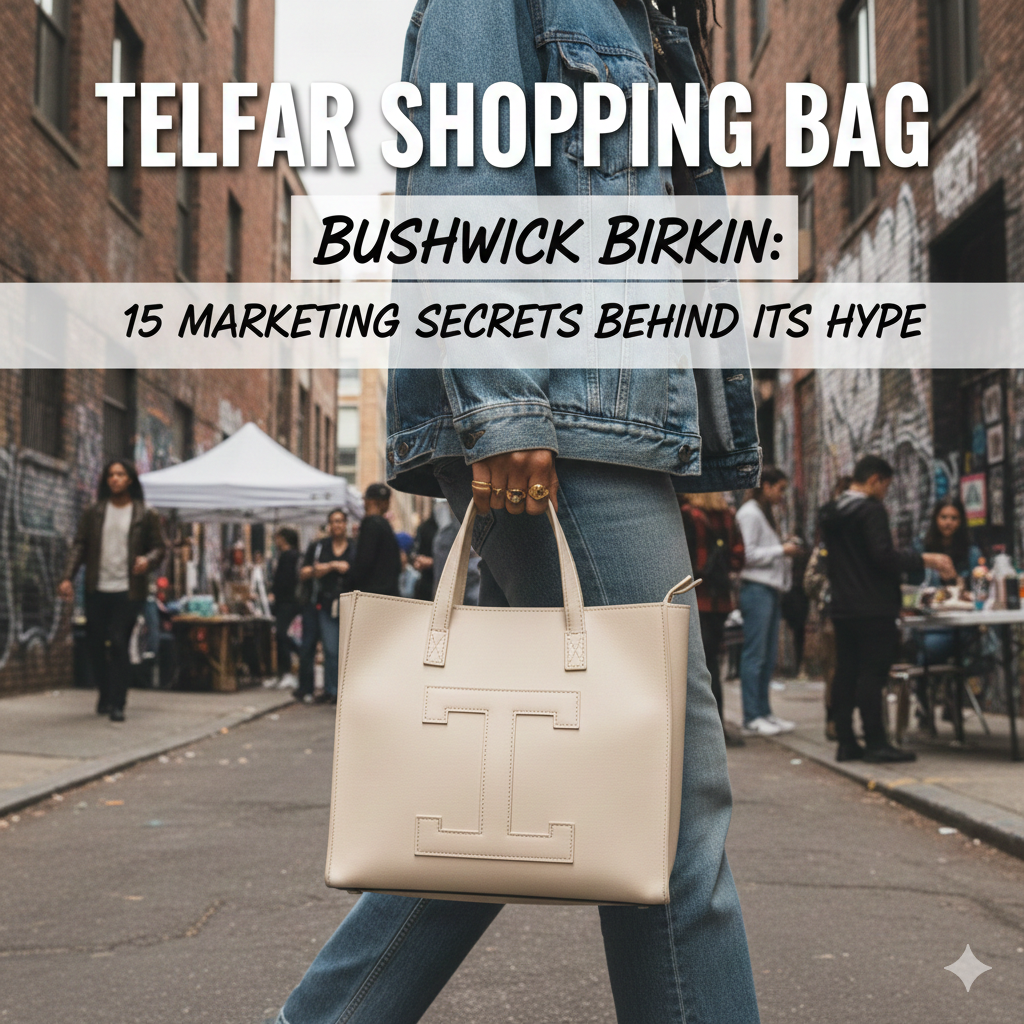
21 Dec How Telfar Shopping Bag Became a Bushwick Birkin: 15 Marketing Secrets Behind Its Hype
How Telfar Shopping Bag Became a Bushwick Birkin: 15 Marketing Secrets Behind Its Hype (Editor’s Choice)
How the Telfar Shopping Bag Became the “Bushwick Birkin”
15 marketing moves that turned a simple tote into a cultural signal — built on community, clarity, and perfectly engineered hype.
| # | Marketing Secret | Why It Works | Hype Trigger |
|---|---|---|---|
| 1 | Make the product instantly legible |
A clean silhouette + bold logo reads in seconds, so it’s easy to recognize, remember, and share. |
Instant recognition |
| 2 | Create a name that travels |
“Shopping Bag” is plain in a way that feels intentional—easy to repeat, meme, and reference. |
Shareable language |
| 3 | Build a values-first brand |
“Not for you—for everyone” sells belonging, not hierarchy—fans wear the message as much as the bag. |
Identity & belonging |
| 4 | Turn community into your media channel |
Customers become the distribution engine—street sightings and social posts do the heavy lifting. |
Social proof |
| 5 | Let “access” be the flex |
The brand’s moral center (fairness & inclusion) makes people root for it—and buy into it. |
Values credibility |
| 6 | Price it for aspiration without apology |
Premium-enough to feel special, attainable enough to repeat—perfect for first-time “designer” buyers. |
Attainable luxury |
| 7 | Use limited drops to convert attention into action |
Drops create deadlines—people stop “thinking about it” and start checking out. |
Urgency |
| 8 | Make missing out part of the story |
Sellouts become proof—each “gone in minutes” moment raises perceived demand. |
FOMO |
| 9 | Engineer the hunt |
Alerts, group chats, and drop rituals turn buying into a game—effort increases attachment. |
Chase mechanic |
| 10 | Design for street visibility |
The bag “reads” from across the room—high signal for real life and photos. |
IRL billboard |
| 11 | Create collectability through colorways |
Colors turn one purchase into a set—collectors buy identity in multiple shades. |
Completion drive |
| 12 | Embrace resale (without centering it) |
Above-retail resale signals heat—even non-resellers absorb the message: this has value. |
Price signaling |
| 13 | Collaborations that add legitimacy & reach |
Smart collabs expand the audience while keeping the brand’s cultural core intact. |
Borrowed equity |
| 14 | Make the founder narrative part of the brand |
The creator story functions like “heritage,” but modern—people buy the vision, not just the product. |
Story trust |
| 15 | Solve the backlash with fairness (Bag Security Program) |
Turning chaos into a promise builds loyalty—fair access is the rarest luxury. |
Trust & loyalty |
How Telfar Shopping Bag Became a Bushwick Birkin: 15 Marketing Secrets Behind Its Hype
How Telfar Shopping Bag Became a Bushwick Birkin: Marketing Secrets Behind Its Hype #3 — Build a Values-First Brand, Not a Status-First One
Luxury usually works by exclusion. Telfar worked by invitation. “Not for you—for everyone” isn’t just a tagline; it’s a cultural reset. It reframes desire around belonging instead of hierarchy, and suddenly the bag isn’t aspirational because it’s rare—it’s aspirational because it’s fair. In a moment when consumers are fluent in authenticity and allergic to posturing, values become the new velvet rope.
How Telfar Shopping Bag Became a Bushwick Birkin: Marketing Secrets Behind Its Hype #4 — Turn Community Into the Media Channel
Telfar didn’t chase traditional fashion approval—it built something louder. The brand understood early that real cultural power doesn’t live in magazines alone; it lives in group chats, sidewalks, and Instagram Stories taken in bad lighting. When your customers become your distribution, marketing stops being something you buy and starts being something you earn. That kind of visibility compounds.
How Telfar Shopping Bag Became a Bushwick Birkin: Marketing Secrets Behind Its Hype #5 — Let Access Be the Flex
Traditional luxury flexes by denying entry. Telfar flexes by opening the door. The radical idea here is that access itself can feel premium when it’s done with intention. The brand’s commitment to fairness created emotional loyalty long before scarcity ever entered the picture. When people believe in how you operate, they forgive almost anything—including sellouts.
How Telfar Shopping Bag Became a Bushwick Birkin: Marketing Secrets Behind Its Hype #6 — Price It for Aspiration Without Apology
The genius of the Telfar Shopping Bag price point is that it never flinches. It doesn’t apologize for costing money, but it also doesn’t weaponize price as a barrier. Instead, it sits confidently in that liminal space where buying it feels intentional, not reckless—a considered decision rather than a financial identity crisis. This is the kind of pricing that invites people into luxury without making them feel like imposters once they arrive. You’re not buying entry into a club; you’re buying something you’ll actually use, carry, scuff, live with. From a marketing perspective, this creates repeat behavior rather than one-off splurging. From a cultural perspective, it signals respect for the customer’s intelligence. And respect, it turns out, is an underrated growth strategy.
How Telfar Shopping Bag Became a Bushwick Birkin: Marketing Secrets Behind Its Hype #7 — Use Limited Drops to Convert Attention Into Action
Attention is easy to collect and even easier to waste. Telfar understood early that what matters isn’t eyeballs—it’s decisiveness. The drop model doesn’t just create urgency; it creates a moment. A calendar entry. A reminder alarm. A brief suspension of scrolling inertia where someone has to ask themselves, Do I want this enough to act right now? That friction is intentional. It transforms passive admiration into commitment, and commitment is where brands are built. Psychologically, drops reward preparation and punish hesitation, which subtly trains customers to stay engaged. Marketing-wise, it’s efficient. Culturally, it feels participatory. You’re not shopping—you’re showing up.
How Telfar Shopping Bag Became a Bushwick Birkin: Marketing Secrets Behind Its Hype #8 — Make Missing Out Part of the Narrative
Missing a Telfar drop doesn’t feel like rejection—it feels like initiation. The disappointment is communal, oddly bonding, and most importantly, temporary. Instead of eroding trust, the sellouts reinforce demand because the brand has already proven its intentions are clean. When scarcity exists without cynicism, people interpret it as momentum, not manipulation. The emotional alchemy here is subtle but powerful: frustration turns into anticipation, and anticipation turns into loyalty. From a storytelling standpoint, every “sold out” moment becomes a chapter, not a dead end. You didn’t lose—you just arrived early for the next one.
How Telfar Shopping Bag Became a Bushwick Birkin: Marketing Secrets Behind Its Hype #9 — Engineer the Hunt
The hunt is where attachment is forged. When people coordinate alarms, share links, and sit refreshing a page together, the object becomes charged before it’s even owned. Telfar didn’t accidentally create this ritual—it allowed space for it to exist. The brand didn’t over-automate the process or strip away the friction entirely, because friction is where meaning forms. Effort turns consumption into participation, and participation into pride. By the time someone finally secures the bag, the purchase feels earned, not transactional. And earned things? Those stay longer in closets and conversations.
How Telfar Shopping Bag Became a Bushwick Birkin: Marketing Secrets Behind Its Hype #10 — Design for Street Visibility
The Telfar Shopping Bag doesn’t disappear into an outfit—it completes it. Its proportions are assertive, its logo unmistakable, its colors unapologetically present. This is design that understands how people actually move through cities, not just how they pose in lookbooks. From a marketing standpoint, this turns every owner into a walking billboard, but one that feels organic rather than forced. From a cultural standpoint, it allows the bag to live in the wild: on subways, at bodegas, in office kitchens. Visibility isn’t vanity here—it’s strategy disguised as style.
How Telfar Shopping Bag Became a Bushwick Birkin: Marketing Secrets Behind Its Hype #11 — Create Collectability Through Color
Color is the quiet expansion strategy. Without redesigning the product or diluting the brand, Telfar turned shades into desire multipliers. One bag becomes a gateway to another mood, another version of yourself. Black for work, green for summer, pink for personality. This taps into a collector’s mindset without ever feeling extractive. Psychologically, it reframes buying as curation rather than accumulation. You’re not hoarding—you’re editing. And marketing-wise, it creates sustained demand without exhausting the core idea.
How Telfar Shopping Bag Became a Bushwick Birkin: Marketing Secrets Behind Its Hype #12 — Let Resale Signal Cultural Heat
Telfar never positioned itself as an investment piece, but the resale market did that work anyway. Seeing a bag resell above retail reframes the purchase from emotional to intelligent, even if subconsciously. It tells buyers they’re not just participating in a trend—they’re tapping into something with real demand. Importantly, the brand didn’t chase this narrative or design around it. That restraint preserved credibility. The resale market became a byproduct, not a goal, which made it far more persuasive.
How Telfar Shopping Bag Became a Bushwick Birkin: Marketing Secrets Behind Its Hype #13 — Collaborate Without Losing Yourself
Collaborations can either sharpen a brand or blur it. Telfar’s worked because they felt aligned, not opportunistic. Each partnership expanded reach while reinforcing the same cultural values—access, identity, credibility. That’s rare. The brand didn’t chase relevance; it partnered where relevance already existed. The result is growth that feels additive rather than desperate. From a marketing lens, this protects long-term equity. From a fashion lens, it keeps the brand legible even as it scales.
How Telfar Shopping Bag Became a Bushwick Birkin: Marketing Secrets Behind Its Hype #14 — Make the Founder the Proof
In an era of brand anonymity, Telfar Clemens’ visibility acts as reassurance. His consistency, values, and restraint make the brand feel anchored rather than trend-chasing. He doesn’t overshare, overexplain, or overexpose himself—and that discipline mirrors the brand’s tone. From a marketing standpoint, a founder like this becomes a living case study of integrity. From a cultural standpoint, it humanizes success without turning it into spectacle. The brand doesn’t shout because the proof already exists.
How Telfar Shopping Bag Became a Bushwick Birkin: Marketing Secrets Behind Its Hype #15 — Fix the System, Don’t Ignore the Backlash
The Bag Security Program is where Telfar crossed from hype brand to trust brand. Instead of dismissing frustration around access, the company engineered a solution that aligned perfectly with its values. This wasn’t damage control—it was systems thinking. By formalizing fairness, Telfar proved that growth doesn’t have to come at the expense of principles. Marketing often treats backlash as something to smooth over. Telfar treated it as data. That decision didn’t just protect the brand—it future-proofed it.