



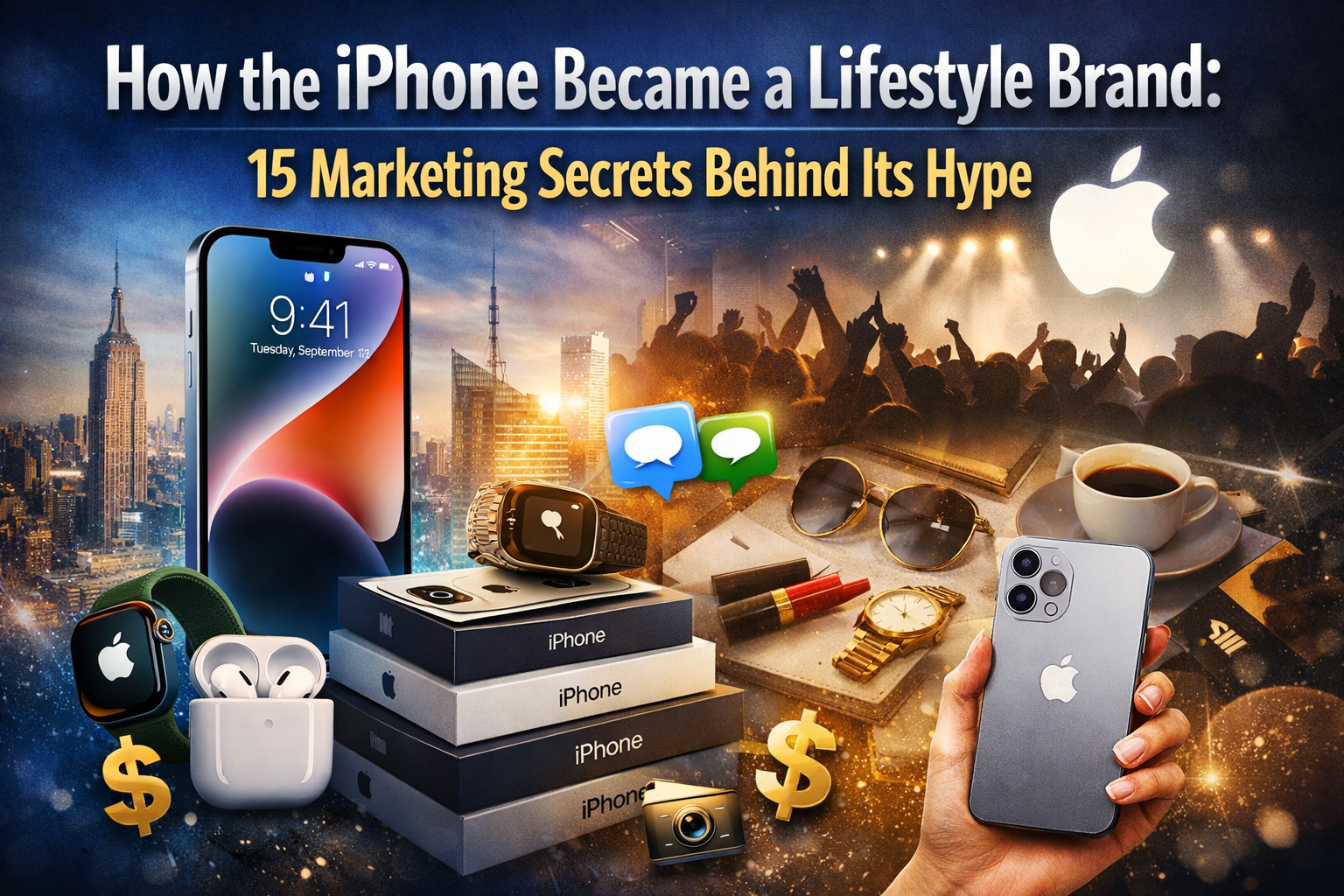
22 Dec How the iPhone Became a Lifestyle Brand: 15 Marketing Secrets Behind Its Hype
How the iPhone Became a Lifestyle Brand: 15 Marketing Secrets Behind Its Hype (Editor’s Choice)
The 15 Core Marketing Strategies That Built the iPhone Lifestyle
A high-level strategy map showing what Apple did — and why it worked.
| # | Strategy | Why It Worked |
|---|---|---|
| 1 |
Identity-first branding
|
People didn’t buy a phone — they bought a reflection of who they wanted to be.
|
| 2 |
Minimalist design philosophy
|
Simplicity communicated confidence, quality, and calm in a noisy tech market.
|
| 3 |
Aspirational positioning
|
Premium cues made ownership feel like a personal upgrade.
|
| 4 |
Cultural product launches
|
Launches became moments people planned around, not ads they skipped.
|
| 5 |
Engineered scarcity
|
Waiting increased perceived value and social proof.
|
| 6 |
Ecosystem-first thinking
|
Convenience and comfort made switching away emotionally costly.
|
| 7 |
User-led marketing
|
Real people became trusted brand messengers.
|
| 8 |
Emotion-driven storytelling
|
Feelings outlast specs in memory and influence.
|
| 9 |
Social signaling features
|
Belonging and status reinforced loyalty without direct selling.
|
| 10 |
Relentless consistency
|
Trust compounds when brands stay coherent over time.
|
| 11 |
Human-centered technology
|
People felt comfortable using the product immediately.
|
| 12 |
Privacy as a value
|
Trust became a differentiator in a data-anxious world.
|
| 13 |
Normalized upgrade cycles
|
Upgrading felt natural, not forced.
|
| 14 |
Distinct visual language
|
Recognition happened instantly, even without logos.
|
| 15 |
Generational loyalty
|
The brand became part of personal history, not just commerce.
|
How the iPhone Became a Lifestyle Brand: 15 Marketing Secrets Behind Its Hype
How the iPhone Became a Lifestyle Brand: Marketing Secrets Behind Its Hype #1 — Apple Didn’t Sell a Phone, It Sold an Identity
From day one, the iPhone was never positioned as just a device—it was positioned as a reflection of who you are. Apple understood something most brands miss: people don’t buy products, they buy symbols. The iPhone became shorthand for taste, ambition, creativity, and modernity. Holding one subtly communicated that you were “in the know,” aligned with innovation, and living in the present tense. Apple’s marketing never screamed features—it whispered belonging. Every ad, keynote, and product shot reinforced the same idea: this isn’t a phone for everyone—it’s a phone for you, if you see yourself as forward-thinking.
How the iPhone Became a Lifestyle Brand: Marketing Secrets Behind Its Hype #2 — Minimalism Wasn’t an Aesthetic Choice, It Was a Positioning Strategy
Apple’s commitment to minimalism was never about looking clean—it was about signaling confidence. In markets crowded with features, buttons, and noise, Apple chose subtraction. Fewer visual elements. Fewer words. Fewer distractions. This restraint communicated something powerful: we’ve already done the thinking for you. Minimalism became a promise that the product would not demand cognitive effort. You wouldn’t need to decode it. You wouldn’t need to master it. You could simply live with it.
Over time, this design philosophy bled into meaning. Minimalism began to feel like intelligence, taste, and control. Owning an iPhone suggested that you valued clarity over chaos and intention over excess. Apple didn’t just simplify interfaces—it simplified decision-making. And in a world overloaded with choices, that simplicity felt like relief. The brand became synonymous with calm authority: not louder, not busier, just better. That’s why Apple’s minimalism aged well—it wasn’t decorative, it was ideological.
How the iPhone Became a Lifestyle Brand: Marketing Secrets Behind Its Hype #3 — Apple Made Aspiration Feel Subtle, Not Showy
Apple never screamed luxury, yet it consistently felt premium. This was aspiration without arrogance. The pricing, the materials, the way the phone was photographed—all of it suggested elevation without excess. Apple understood that modern consumers don’t want to look rich; they want to look refined. So the iPhone was positioned as quietly superior. No flash. No spectacle. Just assurance.
This subtle aspiration made the iPhone universally desirable. It wasn’t aspirational in a way that excluded—it invited. The message wasn’t “this is for the elite,” but “this is what good taste looks like.” Over time, owning an iPhone felt like aligning yourself with a certain standard—of quality, of discernment, of being up to date with culture. Apple sold the idea that choosing an iPhone meant choosing well. And when aspiration feels like good judgment rather than indulgence, people justify the purchase long after the checkout screen fades.
How the iPhone Became a Lifestyle Brand: Marketing Secrets Behind Its Hype #4 — Apple Turned Product Launches Into Shared Cultural Rituals
Apple didn’t treat launches as announcements—it treated them as moments. Carefully staged, meticulously timed, and emotionally paced, each keynote felt like an event you didn’t want to miss, even if you weren’t buying anything. The secrecy beforehand. The slow build. The “one more thing.” Apple transformed anticipation into a communal experience.
What made these launches powerful wasn’t just spectacle—it was consistency. Every year, people knew where to look, what to expect, and how it would feel. That predictability created trust, while the surprises created delight. Watching an Apple launch became part of participating in modern culture. Even skeptics tuned in. Even competitors paid attention. Apple didn’t just release products—it marked time. And when a brand can turn its calendar into a ritual, it stops competing for attention and starts owning it.
How the iPhone Became a Lifestyle Brand: Marketing Secrets Behind Its Hype #5 — Scarcity Was Engineered to Feel Earned, Not Forced
Apple didn’t use scarcity as a loud marketing tactic—it used it as a quiet psychological architecture. The limited availability of iPhones at launch never felt like a gimmick; it felt like demand naturally outpacing supply. Long lines outside Apple Stores weren’t framed as inconvenience—they became proof of value. Waiting became part of the story. Ownership felt deserved, almost ceremonial. Apple understood that scarcity only works when it feels organic. By never explicitly saying “limited edition,” Apple let consumers come to that conclusion themselves. And when people reach conclusions on their own, they defend them more fiercely.
Scarcity also reframed time. The moment you got your hands on a new iPhone, you felt ahead—early, informed, chosen.
How the iPhone Became a Lifestyle Brand: Marketing Secrets Behind Its Hype #6 — Apple Didn’t Build Products, It Built a Closed World That Felt Comforting
Apple’s ecosystem strategy is often described as lock-in—but that framing misses the emotional truth. The ecosystem didn’t feel like a trap; it felt like continuity. Everything talked to everything else. Your messages flowed from phone to laptop. Your photos followed you automatically. Your AirPods knew when you needed them. This seamlessness wasn’t accidental—it was intimacy by design.
Once you entered the Apple ecosystem, friction disappeared. And when friction disappears, loyalty deepens. Switching away didn’t feel impossible—it felt disruptive. Apple didn’t punish users for leaving; it gently reminded them how easy life had been inside. The ecosystem wasn’t about control—it was about comfort. And comfort is one of the strongest forces in consumer behavior. People don’t leave environments where they feel understood.
How the iPhone Became a Lifestyle Brand: Marketing Secrets Behind Its Hype #7 — Apple Understood That the Loudest Marketing Is the One You Don’t Control
Apple mastered restraint. Instead of flooding timelines with aggressive messaging, it stepped back and let users do the talking. Unboxings. Camera tests. Casual iMessage screenshots. Everyday moments captured on iPhone. This wasn’t accidental virality—it was structural. Apple built products that begged to be shared.
By trusting users to tell the story, Apple positioned itself as confident. Brands that over-explain feel insecure. Apple didn’t need persuasion; it needed presence. When people organically document their lives through a product, that product becomes invisible—and therefore powerful. The marketing disappears, and what’s left is lived experience.
How the iPhone Became a Lifestyle Brand: Marketing Secrets Behind Its Hype #8 — Apple Chose Emotion Over Explanation, Every Single Time
Apple understood something most tech brands ignored: specs don’t move people—stories do. Instead of telling consumers what the iPhone could do, Apple showed what life looked like with it. A moment captured. A memory saved. A creative breakthrough happening quietly on a subway ride. Technology became the background, not the headline.
By stripping away technical language, Apple made innovation feel accessible. You didn’t need to understand the chip—you just needed to feel the result. This emotional framing made the iPhone feel less like a machine and more like a companion. Something that adapted to you, not the other way around.
How the iPhone Became a Lifestyle Brand: Marketing Secrets Behind Its Hype #9 — Apple Turned Social Signals Into Invisible Brand Armor
Apple’s most powerful marketing wasn’t official—it was social. Blue bubbles. FaceTime norms. AirDrop jokes. These weren’t features; they were signals. Owning an iPhone subtly communicated belonging. And once a product becomes socially encoded, opting out feels like exclusion.
The brilliance here is that Apple never publicly emphasized these divisions. The culture did it for them. Users enforced the norms. Jokes became boundaries. Preferences turned into identity markers. Apple didn’t manufacture loyalty—it let social dynamics do the work.
How the iPhone Became a Lifestyle Brand: Marketing Secrets Behind Its Hype #12 — Privacy Was Positioned as Character, Not a Checkbox
When Apple leaned into privacy, it wasn’t reacting to regulation—it was making a values statement. At a time when consumers were growing uneasy about surveillance, data misuse, and digital overreach, Apple chose to take a moral stance. Privacy wasn’t marketed as a feature you toggle on and off; it was framed as a fundamental right.
This repositioned Apple from a tech company into a trusted custodian. Choosing an iPhone became a quiet act of alignment with principles—control, dignity, and respect. Apple didn’t ask users to understand encryption or security architecture; it simply promised to protect them. In doing so, it transformed trust into a competitive advantage. And in markets saturated with features, trust is one of the few things that truly differentiates.
How the iPhone Became a Lifestyle Brand: Marketing Secrets Behind Its Hype #13 — Apple Made Upgrading Feel Like Growth, Not Consumption
Apple never framed upgrades as indulgence. Each new iPhone was presented as a natural evolution—slightly better, slightly faster, slightly more capable. The improvements were incremental, but the narrative was continuous. This normalized the idea that upgrading wasn’t excess; it was progress.
By positioning each release as the next logical step, Apple removed guilt from consumption. Consumers weren’t “buying again”—they were keeping up. Staying current felt responsible, even necessary. This reframing softened resistance and extended customer lifetime value without overt pressure. Apple didn’t rush its audience; it walked beside them. And when a brand grows with its users rather than ahead of them, loyalty becomes habit.
How the iPhone Became a Lifestyle Brand: Marketing Secrets Behind Its Hype #14 — Apple Built a Visual Language That Spoke Without Words
Apple’s design wasn’t just recognizable—it was readable. Packaging, product photography, interface animations, even the way icons moved on screen all shared a common visual grammar. You could recognize an Apple product instantly, even stripped of its logo. That’s not aesthetics—that’s authorship.
This visual consistency worked at a subconscious level. It signaled precision, care, and intention. Nothing felt accidental. Over time, Apple trained users to associate certain visual cues with quality and trust. The brand became visually fluent. And when a company controls its visual language this tightly, it doesn’t need explanation. Recognition does the work. Familiarity breeds comfort, and comfort breeds loyalty.