



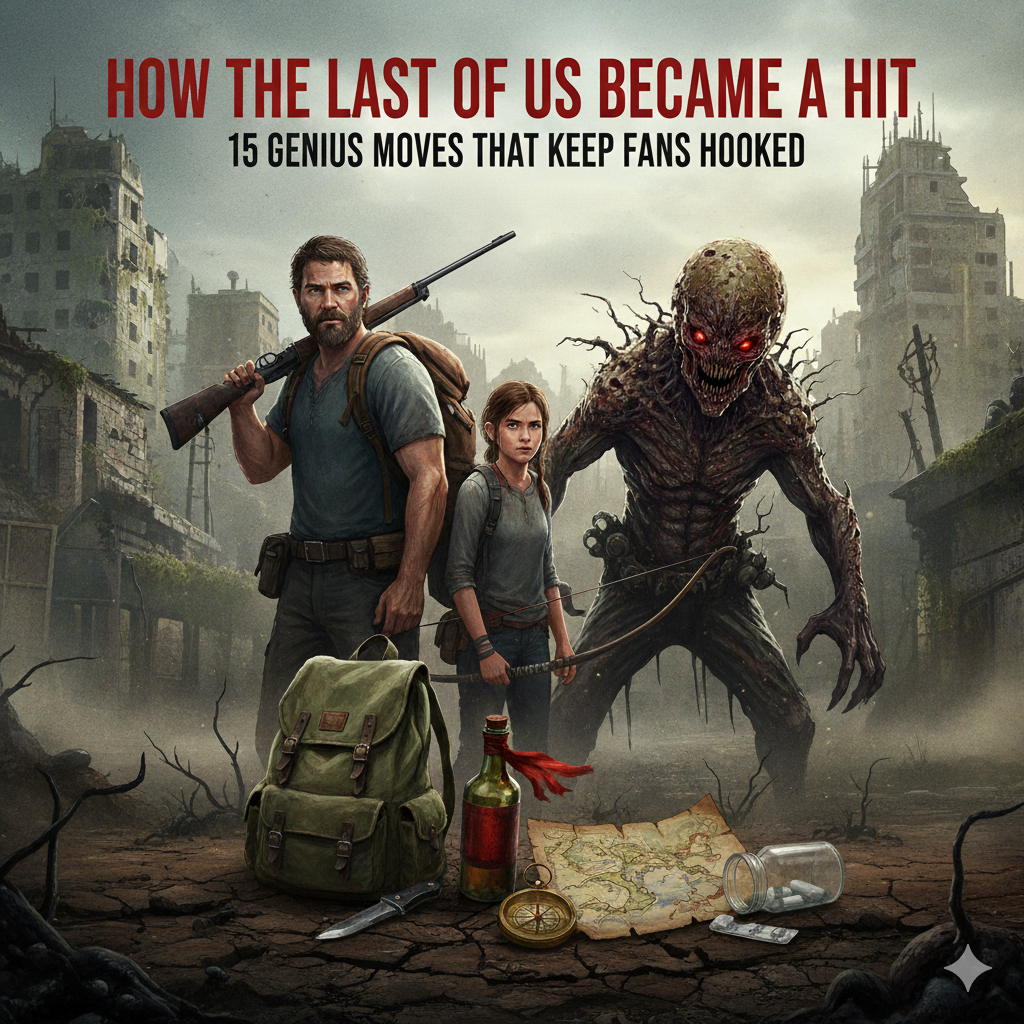
13 Dec How The Last of Us Became a Hit: 15 Genius Moves That Keep Fans Hooked
How The Last of Us Became a Hit: 15 Genius Moves That Keep Fans Hooked (Editor’s Choice)
How The Last of Us Became a Hit
Fifteen genius storytelling and marketing moves that turned a gritty apocalypse into a global obsession — and a masterclass in audience loyalty.
| # | Genius Move | Why It Hooked Viewers | Brand & Marketing Takeaway |
|---|---|---|---|
| 1 |
Emotion
Emotional Storytelling That Makes You Forget You’re Watching a Zombie Show
|
The show centers on grief, love, and moral gray areas — not just monsters. Viewers aren’t just scared; they’re gutted in the best way.
|
Lead with feelings, not features. If your audience feels seen, they’ll stay — even if the “category” isn’t their thing.
|
| 2 |
Opening
A Gut-Punch Opening That Refuses to Be Forgotten
|
The first episode hits like a truck emotionally, instantly raising the stakes. It signals: this isn’t background TV; this is an experience.
|
Your opening touchpoint — first ad, first scroll, first scene — should make people stop, feel, and remember you.
|
| 3 |
Characters
Flawed, Multifaceted Characters Who Feel Like People, Not Pixels
|
Nobody is purely “good” or “bad.” Fans see bits of themselves in Joel, Ellie, and everyone in between, which fuels debate and devotion.
|
Show your brand’s flaws, growth, and humanity. Perfect is forgettable; honest is magnetic.
|
| 4 |
Casting
Casting That Felt Less Like Hollywood, More Like Live-Action Destiny
|
Pedro Pascal and Bella Ramsey didn’t just “fit” the roles — they expanded them. Fans felt like the universe had chosen them on purpose.
|
Who carries your message matters. Partner with talent and creators who embody your story, not just pad your reach.
|
| 5 |
World-Building
World-Building So Immersive It Became a Character of Its Own
|
Cracked streets, overgrown cities, tiny visual details — viewers felt transported into a decaying world that still felt eerily alive.
|
Every channel you use adds to your “world.” Make your website, socials, emails, and packaging feel like one cohesive universe.
|
| 6 |
Plot
Plot Twists That Reward Attention, Not Just Reaction
|
Twists weren’t there just for shock value; they grew organically from character choices. Rewatches and rewinds became almost mandatory.
|
Reward people who lean in. Layer your content so superfans always discover more — and stay longer.
|
| 7 |
Representation
Queer Love Stories That Didn’t Apologize — They Rewrote the Genre
|
Episodes like Bill and Frank’s offered tender, nuanced storytelling that felt groundbreaking in a genre usually dominated by macho survival.
|
Don’t “tokenize” representation. Tell full, rich stories for underrepresented audiences — they’ll show up and bring their communities.
|
| 8 |
Realism
Cordyceps Realism — Making Horror Feel Uncomfortably Plausible
|
By grounding the outbreak in real mycology and science-adjacent explanations, the horror felt disturbingly possible — and therefore unforgettable.
|
Anchor big stories in real insights, data, or truths. The closer something feels to reality, the harder it hits.
|
| 9 |
Structure
Episode Structure That Treated Side Characters Like Main Characters
|
Standalone-feeling episodes gave side characters rich emotional arcs, making the world feel bigger than just Joel and Ellie’s journey.
|
Spotlight the “supporting cast” around your brand — customers, team members, partners. They’re stories, not footnotes.
|
| 10 |
Leadership
A Showrunner Duo Who Kept Authenticity as Their North Star
|
The collaboration between the original game creator and the HBO showrunner kept the adaptation emotionally faithful while still surprising fans.
|
Put custodians of the story at the helm. Strategic leadership + creative guardianship is how you scale without losing soul.
|
| 11 |
Community
Fan Theory Fuel That Turned Viewers into Story Detectives
|
Hidden clues, ambiguous choices, and open-ended questions encouraged fans to fill in the gaps, not just passively consume.
|
Leave room for interpretation and speculation. Let your audience co-create meaning — it builds obsession and organic chatter.
|
| 12 |
Sound
Soundtrack That Haunts Your Emotional Echo Chamber
|
Gustavo Santaolalla’s score doesn’t just sit in the background; it lingers, making scenes feel like emotional timestamps in viewers’ lives.
|
Don’t underestimate sonic branding — from music choices to voiceovers. Sound is memory glue.
|
| 13 |
Culture
Recap Culture That Helped Everyone Emotionally Decompress Together
|
Post-episode breakdowns, podcasts, and explainers became part of the ritual — a shared processing space for all the feelings.
|
Build rituals around your content. Encourage recaps, reviews, and community conversations to extend the life of every drop.
|
| 14 |
Transmedia
Transmedia Magic — Extending the Story Beyond HBO
|
The game, series, behind-the-scenes features, interviews, and social content wove together one giant, layered universe fans could live inside.
|
Think beyond a single channel. The smartest brands (and every leading marketing agency in New York worth its retainer) architect ecosystems, not one-off campaigns.
|
| 15 |
Ending
A Finale That Didn’t Tie Things Up — It Set the Internet on Fire
|
The ending didn’t soothe; it provoked. Viewers were left arguing about morality, loyalty, and “what they would’ve done” long after the credits rolled.
|
Not every story needs a neat bow. Sometimes the best CTA is a question that keeps your audience thinking — and talking — about you.
|
How The Last of Us Became a Hit: 15 Genius Moves That Keep Fans Hooked
Anyone else feeling emotional after that episode of #TheLastOfUs? 😭
— Naughty Dog (@Naughty_Dog) January 30, 2023
@m6yfld the way they ripped my heart out #thelastofushbo #thelastofus #tlou #tlouhbo #sarahmiller #joelmiller #joeltlou #thelastofusedit #tlouedit #tlouhboedit #tlouhbomax ♬ original sound - sophh ᖭི༏ᖫྀ
How The Last of Us Became a Hit: Genius Moves That Keep Fans Hooked #3 Flawed, Multifaceted Characters Who Feel Like People, Not Pixels
Joel isn’t a hero. Ellie isn’t a saint. Abby isn’t a villain. The characters that populate this universe are disgustingly real—full of moral gray zones and contradictions, which fan forums have been debating since 2020. Time Magazine, GameSpot, and Polygon have published think pieces unpacking their motives like college lit students. Audiences stuck around because these characters forced them to feel unsure—and they cared enough to stay confused.
How The Last of Us Became a Hit: Genius Moves That Keep Fans Hooked #4 Casting That Felt Less Like Hollywood, More Like Live-Action Destiny
Let’s talk about casting, because HBO did not come to play cute—they came to turn Pedro Pascal into your reluctant father figure, apocalypse edition. The way they chose actors for this show wasn’t “How many followers do they have?” — it was “Whose face is already carrying emotional baggage?” And baby, it showed. Bella Ramsey didn’t just play Ellie; she inhabited her, like she had a permanent lease in Joel’s messy heart from day one. This whole series feels perfectly cast but not Instagram-engagement cast. The creators didn’t go for Hollywood gloss—they went for deeply human, complicated faces that make you lean forward.
How The Last of Us Became a Hit: Genius Moves That Keep Fans Hooked #5 World-Building So Immersive It Became a Character of Its Own
Oh, honey, let’s talk about the real influencer in this series—no, not Pedro Pascal (though… swoon)—I’m talking about the world of The Last of Us. It’s like wandering through an abandoned Anthropologie if Anthropologie suddenly became a post-apocalyptic time capsule. Those mold-kissed walls? They’re whispering stories. Every decrepit playground, every sun-bleached “Quarantine Zone” sign feels like a diary entry that was never meant for you… but you can’t look away.
How The Last of Us Became a Hit: Genius Moves That Keep Fans Hooked #6 Tension So Well-Served, Even Silence Is a Villain
You ever watch something where literally nothing is happening—and your heart is pounding like it’s Day 3 of Fashion Week, and you’re late? That’s The Last of Us, darling. The show serves tension like it’s a curated multi-course tasting menu. Joel and Ellie will just be walking silently through a hallway and you’re suddenly hyper-aware of every tap, breath, and dust particle. It’s not a jump scare—it’s a slow-burn psychological sauna.
And let’s not ignore the genius here: this isn’t your typical “boom” and “flash” zombie drama. This is a series seducing you with dread. A masterclass in pacing where quiet moments feel like they’re screaming.
How The Last of Us Became a Hit: Genius Moves That Keep Fans Hooked #7 Bold Story Deviations That Turned Side Characters Into Main-Character Moments
You want to know if a show is bold? Watch what it does with its “side characters.” The Last of Us didn’t just give Bill and Frank 15 minutes of on-screen chemistry—it gave them a full-course, candle-lit emotional symphony in Episode 3. I mean, an apocalypse love story? In a bunker? This is gay tenderness served with a side of wild mushrooms and conspiracy-ridden radio chatter. Game purists were shook, and newcomers were suddenly Googling, “Was Bill this emotional in the game?” (Spoiler: no, but HBO said, “Let’s make Emmy bait.”)
How The Last of Us Became a Hit: Genius Moves That Keep Fans Hooked #8 Universal Themes That Hit Like Emotional Bombs (No Clickers Required)
Let’s be honest: The Last of Us isn’t really about fungal zombies—it’s about people trying their best to love, forgive, and destroy each other in emotionally complicated ways (on brand for all of us, tbh). Whether you’re a queer teenager watching Ellie find joy in the ruins of a mall, or a jaded adult watching Joel slowly crumble into fatherhood again, the show hits your soft spots like Jordan almond at a wedding—hard, sweet, and slightly painful.
How The Last of Us Became a Hit: Genius Moves That Keep Fans Hooked #9 A Perfect HBO Glow-Up That Made Gamers Feel Seen and Skeptics Obsessed
Remember when game adaptations were the cinematic equivalent of low-rise jeans in 2007 — why are we doing this to ourselves? And then HBO said: “Hold my fungus.” They didn’t just adapt The Last of Us — they escalated it. Cinematic lighting. Character-driven pacing. A Pedro Pascal-shaped emotional wound. They took everything gamers loved and then sprinkled it with just enough prestige-TV fairy dust to seduce viewers who’ve never held a controller (or pretended they were too cool for it).
The secret sauce? Respect. The creators didn’t roll their eyes at the source material — they expanded it. Expanded the world, the quiet glances, the queerness, the nuance. And in doing so, they created one of those rare unicorns: a series both gamers and HBO purists could cry over together… often at the same moment. It’s almost like HBO built a bridge and handed everyone tissues on the way across.
How The Last of Us Became a Hit: Genius Moves That Keep Fans Hooked #10 Authentic Queer Storytelling That Said “Nope” to Tokenism
Let’s get one thing fabulously straight: The Last of Us didn’t just “include” queer characters — it centered them with elegance and grit. Episode 3 didn’t just give us Bill and Frank’s story — it gave us a tender, heart-wrenching, beautifully lived-in portrait of gay love in the apocalypse. No trauma porn. No rainbow-washed commercials. Just real middle-aged men finding strawberries and soulmates in a world that stopped believing in softness. Beautiful. Radical. Necessary.
How The Last of Us Became a Hit: Genius Moves That Keep Fans Hooked #11 Fan Theory Fuel That Turned Sunday Night TV into Monday Morning Group Chats
Let’s be honest: half the joy of The Last of Us isn’t even watching it — it’s texting your smartest friend a string of emojis afterward and saying, “Wait… are we sure Joel’s the hero here?” This show is basically a graduate course in moral ambiguity wrapped in mushroom-scented existential dread. Every episode drops breadcrumbs that refuse to dissolve, leaving fans crawling through Reddit threads like they’re studying for a final they’ll never take.
Most theories about #TheLastofUs Season 2 “are incorrect”, says Craig Mazin
— The Last of Us News (@TheLastofUsNews) March 13, 2024
“Some of them are half ways correct, some of the conjecture is like 28% correct. But I do enjoy it all, I like the interest, it's fun.”
via Scriptnotes on Spotify pic.twitter.com/RDOcU1W1EA
How The Last of Us Became a Hit: Genius Moves That Keep Fans Hooked #12 Soundtrack That Doesn’t Just Underscore Scenes — It Haunts Your Emotional Echo Chamber
If you didn’t cry during Episode 3’s use of Linda Ronstadt’s “Long, Long Time,” did you even watch the show? The Last of Us series doesn’t treat music like background noise — it treats it like an emotional weapon. The soundtrack is a playlist of aching nostalgia, soft dread, and “let me run to Spotify at 2am” urgency. Every track is engineered to smash your heart like fine china on a Brooklyn sidewalk.
It’s understated, devastating genius — the kind that turns a scene into a cultural moment and sends TikTok into sobbing clip compilations.
How The Last of Us Became a Hit: Genius Moves That Keep Fans Hooked #13 Recap Culture That Reminds Us We’re All Just Trying to Emotionally Process Each Episode Together
You know a show has us by the metaphorical throat when every Monday feels like a post-apocalyptic group therapy session. The Last of Us isn’t just delivering television—it’s delivering a cultural event that must be unpacked like a suitcase full of emotional ticking bombs. Enter: recap culture. An entire sub-economy of YouTube analysts, TikTok criers, and Twitter philosophers who post things like, “Pedro Pascal’s eyes in Episode 6 deserve their own Emmy.”
How The Last of Us Became a Hit: Genius Moves That Keep Fans Hooked #14 Emotional Storytelling
Here’s the thing: we didn’t come for the infected — we came for the feelings. Sure, there are clickers lurking in the background like the world’s most aggressive party crashers, but it’s the emotional undercurrent that sends us spiraling into Sunday-night existentialism. HBO didn’t just adapt a game — they built a storytelling cathedral around grief, love, and trauma that feels like therapy you didn’t ask for but absolutely needed.
How The Last of Us Became a Hit: Genius Moves That Keep Fans Hooked #15 A Finale That Didn’t Tie Things Up — It Set the Internet on Fire
If you’ve ever watched a show finale that felt like awkward small talk at a dinner party (cough, looking at you, Game of Thrones Season 8), you know how deeply disappointing a rushed ending can be. The Last of Us said, “not today, serotonin,” and instead delivered a finale that was emotionally rich, thematically bittersweet, and morally chaotic in a way only Pedro Pascal whisper-acting his way through a lie can be.
That’s not just a good finale — that’s brand engagement at an existential level. Because when your audience is still arguing about your ending long after it drops, you haven’t just made content. You’ve made culture.
Good TV Doesn’t Just Entertain—It Embeds Itself in Culture
The Last of Us didn’t just give us a show—it gave us a shared language of grief, wit, grit, and absolutely unhinged audience discussions about morality. It’s not often that a series comes along and says, “Look, we’re going to emotionally ruin you… and also win awards while doing it.” But this one did. Flawlessly.
From strategic casting choices to deeply researched world-building, from queer love stories to morally ambiguous finales—it wasn’t just a hit. It was a masterclass in how to take intellectual property and evolve it with respect, intention, and a dash of chaos we didn’t see coming.