



20 Jul How to Build an Operations Framework That Actually Scales
I am going to tell you something that most agency owners will never admit out loud: for the first stretch of running Amra & Elma, I was the operations framework. Every client deliverable, every influencer contract, every campaign report, every invoice — at some point, all of it passed through my hands or my sister Elma’s. We were working with some of the most demanding brands in the world, and behind the polished campaigns was a business held together by memory, adrenaline, and a truly heroic number of late nights.
It worked, until it didn’t. The day I realized we had turned down a six-figure retainer because we simply didn’t have the internal capacity to absorb it — not the talent, the capacity — was the day I stopped treating operations as boring back-office stuff and started treating it as the actual product. The campaigns are what clients buy. The operations framework is what lets you sell more of them without the quality collapsing.
What follows is the exact system we built, step by step, with the mistakes left in. This isn’t theory from a business school case study. This is what it actually looks like when a founder who loves the creative side of the business is forced to become good at the operational side — and discovers that operations, done right, is the most creative work of all. Read it like I’m telling you across a table, because that’s how I wish someone had told me.
How to Build an Operations Framework That Actually Scales: The 7-Step System I Used to Grow My Agency to 7 Figures
First, Understand Why Most “Frameworks” Fail
Amra & Elma · Founder Playbook
The 7-Step Operations Framework That Scales
Tap each step to open it. Track your progress as you go.
List every recurring process, then rate each one: Red = only one person can do it, Yellow = a backup could do it badly, Green = documented and transferable. Document the reds first — record a screen-share video while doing the task, then turn the transcript into a one-page checklist.
The 3 / 30 / 300 rule: done 3+ times → checklist · 30+ times → template · 300+ times → tool.Whiteboard every stage from first inquiry to renewal, and write the real elapsed time next to each. The bottleneck is rarely the hard work — it's the boring work nobody owns.
The handoff rule: no client moves between team members without a written brief + a 15-minute live call. The client never repeats themselves.| Ritual | Cadence | Its One Job |
|---|---|---|
| Daily pulse | Daily · 10 min | Surface blockers, assign owners |
| Client health review | Weekly · 45 min | Rate accounts green / yellow / red |
| Pipeline & capacity | Weekly · 30 min | Match deals to team capacity |
| Numbers meeting | Monthly · 60 min | Review 5 metrics, kill 1 thing |
| Ops audit | Quarterly · half day | Stress-test every process |
Total cost: under two hours per person, per week — less than everyone's "quick question?" interruptions.
Cameras, lighting rigs, inventory shelving, the office itself — physical assets fail without warning emails. Give them what every process gets: an owner, a checklist, and a preventive schedule.
30-minute exercise: list every asset, then note what one bad day of its failure would cost you. "Boring maintenance" becomes cheap revenue insurance.| Function | The Number |
|---|---|
| Sales | Qualified inquiries / month |
| Delivery | On-time deliverable rate |
| Client health | Retainer renewal rate |
| Team | Utilization vs. capacity |
| Cash | Months of runway |
Forty metrics can't all matter — so none of them do. Five numbers, reviewed monthly, no exceptions.
A task owned by two people is owned by zero. Put one name — a Directly Responsible Individual — next to every process. Then watch your own name disappear from the list, month after month.
Founder's final three: vision, key relationships, standards. Everything else gets someone else's name.Every quarter, half a day: re-run the yacht test, audit five SOPs at random against reality, ask the newest hire what confused them — and delete at least one process, report, or meeting.
Why it works: a planned fix always costs a fraction of an emergency one — for machines and for companies.From "How to Build an Operations Framework That Actually Scales" · amraandelma.com
Before the steps, one uncomfortable truth. Most operations frameworks fail for the same reason most diets fail: they’re designed for the person you wish you were, not the business you actually run. Founders download a 40-page SOP template, spend a weekend filling it out, feel incredible for two weeks, and then quietly go back to doing everything from memory because the framework was built for a 200-person company and they have nine people.
A framework that scales has three properties, and only three: it survives without you in the room, it makes the next hire productive faster than the last one, and it tells you something is breaking before the client tells you. Every step below exists to serve one of those three properties. If you ever find yourself building a process that doesn’t, delete it. Complexity is not sophistication — it’s just deferred chaos.
Step 1: Run the “Hit by a Yacht” Test on Every Process You Own
In corporate life they call it the “hit by a bus” test. In Miami, I upgraded it to a yacht. The question is the same: if you disappeared for thirty days starting tomorrow, which parts of your business would keep running and which would quietly catch fire?
I ran this test honestly for the first time years ago, and the results were humiliating. Client reporting? Fire. Influencer contract negotiations? Fire. Even something as basic as knowing which photographer we used for a specific campaign lived entirely in my head. So here’s what we did, and what I’d tell you to do this week:
- List every recurring process, no matter how small. Ours ran to 60+ items — everything from “onboard a new luxury client” to “ship product samples to an influencer” to “publish an article on the site.”
- Mark each one red, yellow, or green. Red means only one person can do it. Yellow means a second person could do it badly. Green means it’s documented and transferable.
- Document the reds first — but record, don’t write. This is the trick that actually made it happen. Nobody has time to write SOPs. What we did have time for was recording a screen-share video the next time we performed the task, narrating out loud, and having a junior team member turn the transcript into a one-page checklist.
A real example: our influencer outreach process was pure “founder folklore.” When we finally documented it — how we segment contacts, how we verify engagement quality, what a first message must and must not say — outreach stopped being a bottleneck attached to one person’s calendar. The same campaign structure that once required me now runs whether I’m in the office or on a plane. That single documented process is a large part of why we can run gifting and ambassador programs for client brands at a scale that would have been unthinkable in year one.
Amra & Elma · 2-Minute Diagnostic
How Scalable Are Your Operations, Really?
Answer honestly. Your score appears after the last question.
Q1. Could your business run for 30 days without you touching a single deliverable?
Q2. Are your three most important processes documented well enough that a new hire could run them in week one?
Q3. Does every client handoff include a written brief — or do clients ever have to repeat themselves?
Q4. Do you have a fixed weekly meeting where every account gets rated green, yellow, or red?
Q5. Are your physical assets — equipment, office, inventory — on a preventive maintenance schedule with an owner?
Q6. Can you name the five numbers you review every month — without opening a dashboard?
Q7. Does every process in your company have exactly one named owner — and is your name on fewer than five of them?
| Score | What It Means | Start Here |
|---|---|---|
| 0–2 | You are the operations framework — growth is capped at your calendar. | Step 1: the yacht test, this week. |
| 3–5 | Partial systems. Things work until they get busy — then they don't. | Steps 3 & 6: rhythm + single owners. |
| 6–7 | You've built a machine. Now protect it. | Step 7: quarterly audits, forever. |
From "How to Build an Operations Framework That Actually Scales" · amraandelma.com
Step 2: Map the Client Journey Like a Supply Chain — Because It Is One
Here’s a mental shift that changed how I run the agency: a service business is a factory. The raw material is a signed contract. The finished product is a delighted client renewing their retainer. Everything in between is an assembly line, and every assembly line has stations where work piles up.
We physically mapped our client journey on a whiteboard — from first inquiry email to signed contract, kickoff, strategy, execution, reporting, and renewal. Then we did the part most people skip: we wrote the actual elapsed time next to each stage, not the time we told ourselves it took. The gap between the two was where all our margin was leaking.
Two discoveries from our own map that might save you months:
Discovery one: the bottleneck is almost never where the work is hard. Our slowest stage wasn’t campaign strategy — the intellectually demanding part. It was campaign reporting, the mechanical part, because it required pulling data from six platforms and nobody owned it end to end. Hard work attracts attention and gets staffed. Boring work hides and rots.
Discovery two: handoffs kill more deals than competitors do. Every time a client moved from one team member to another — sales to account management, account management to creative — information evaporated. We fixed it with a rule so simple it’s almost embarrassing: no handoff happens without a written brief and a fifteen-minute live call between the two people involved. The client should never have to repeat themselves. Ever. When a Fortune 500 marketing director tells you something once, your entire company should know it forever.
Step 3: Install an Operating Rhythm — the Heartbeat Your Business Doesn’t Have Yet
If Step 1 is the skeleton and Step 2 is the circulatory system, this is the heartbeat. An operating rhythm is a fixed calendar of short, non-negotiable meetings where specific decisions get made. Not status updates — decisions. The difference between a scaling company and a chaotic one is rarely talent. It’s that in the scaling company, everyone knows exactly when and where a problem will get resolved, so problems don’t ricochet through Slack at 11 p.m.
Step 4: Treat Your Physical Operations Like a Client Account
This is the step nobody writing about “agency operations” ever includes, and it’s cost me real money, so lean in.
We are a digital business, but we are not a weightless one. There’s the office. There’s photo and video equipment that a single failed shoot day can turn into a five-figure problem. There’s product inventory for our e-commerce brand — shelving, storage conditions, shipping stations. When we started producing photoshoots for clients, the physical footprint grew again: lighting rigs, backdrops, steamers, studio bookings. Every one of those objects can fail, and physical failures don’t degrade gracefully the way software does. A camera body that dies mid-shoot doesn’t send you a warning email.
For years my “system” for all of this was noticing something was broken when we needed it. Then a shoot for a skincare client nearly fell apart over a lighting failure we could have caught with a five-minute check the week before, and I finally gave physical operations the same treatment as everything else: an owner, a checklist, and a schedule. What I learned is that maintenance planning software is a mature discipline with real software behind it — there are dedicated platforms that let you schedule preventive checks, log every asset, and assign work orders the same way we assign campaign tasks, and some of the best have free tiers that fit a small team perfectly. The moment equipment checks became scheduled work orders instead of vibes, shoot-day emergencies essentially disappeared from our calendar.
If your business touches anything physical — an office, a studio, inventory, even just expensive laptops and a server closet — give it thirty minutes this month. List the assets. Note what failure of each one would cost you in a single bad day. You will be shocked how quickly “boring maintenance” reframes itself as cheap insurance on your revenue.
Step 5: Pick Five Numbers and Ruthlessly Ignore the Rest
Early on, I tracked everything. Follower growth, engagement rates, open rates, website sessions, proposal win rates — I had dashboards the way other people have houseplants: many, and mostly neglected. The problem with tracking forty metrics is that forty metrics can’t all matter, so effectively none of them do. Data you don’t act on is just anxiety with a chart attached.
The fix was choosing five numbers — one per critical function — that we review at the monthly meeting, every month, no exceptions.
Step 6: Give Every Process Exactly One Owner — and Make It Never You
Here is a law of organizational physics I have never seen violated: a task owned by two people is owned by zero people. When something at our agency fell through the cracks, the post-mortem almost always surfaced the same sentence: “I thought she was handling it.”
So we adopted the DRI model — Directly Responsible Individual — for every process on the Step 1 list. One name next to every line. Not a department, not a duo, a name. The DRI doesn’t do all the work; she makes sure the work happens and is the single person I ask when I want to know its status. Our senior team members each own entire domains this way — client communications, PR outreach, content production — and the clarity is addictive. Meetings get shorter. Excuses get impossible. Talented people, it turns out, love unambiguous ownership; it’s the mediocre ones who prefer the fog.
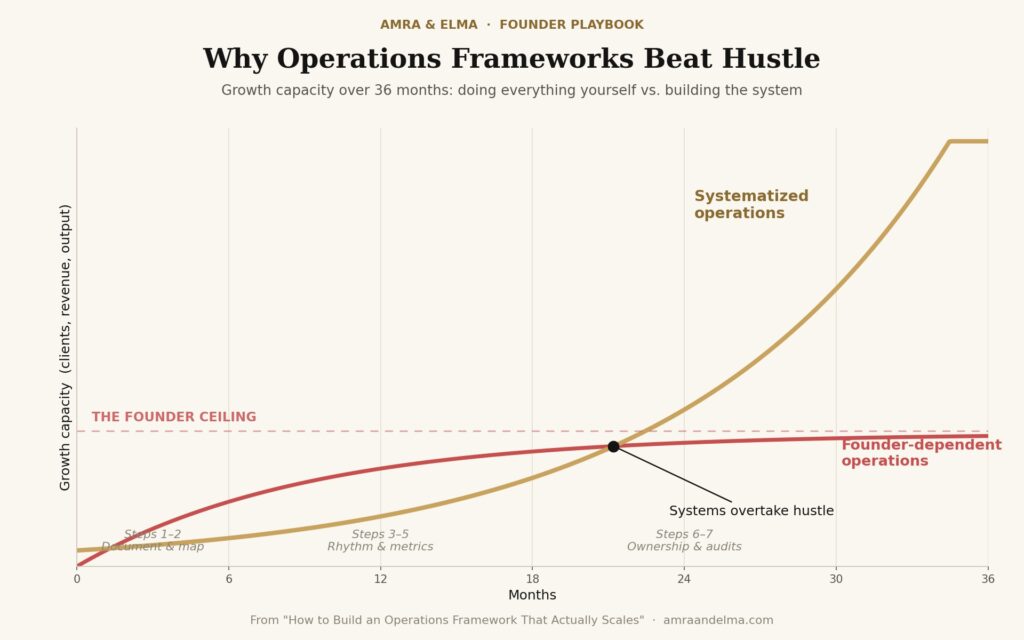
And the second half of this step matters more than the first: your name should be disappearing from that list, month after month. Every process still owned by the founder is a ceiling on the company’s growth, priced at exactly your calendar’s capacity. I now aim to own only three things: vision, key relationships, and standards. Everything else has a name on it that isn’t mine — which, not coincidentally, is what made it possible to build new brands and take on bigger clients without the wheels coming off the existing ones.
Step 7: Audit Quarterly — Preventive Maintenance for Your Whole Company
Everything above will decay. That’s not pessimism; it’s entropy. Processes drift, checklists go stale, and the SOP that was perfect in January quietly stops matching reality by June because the team found a better way and never wrote it down. A framework you build once and never revisit isn’t a framework — it’s a museum exhibit.
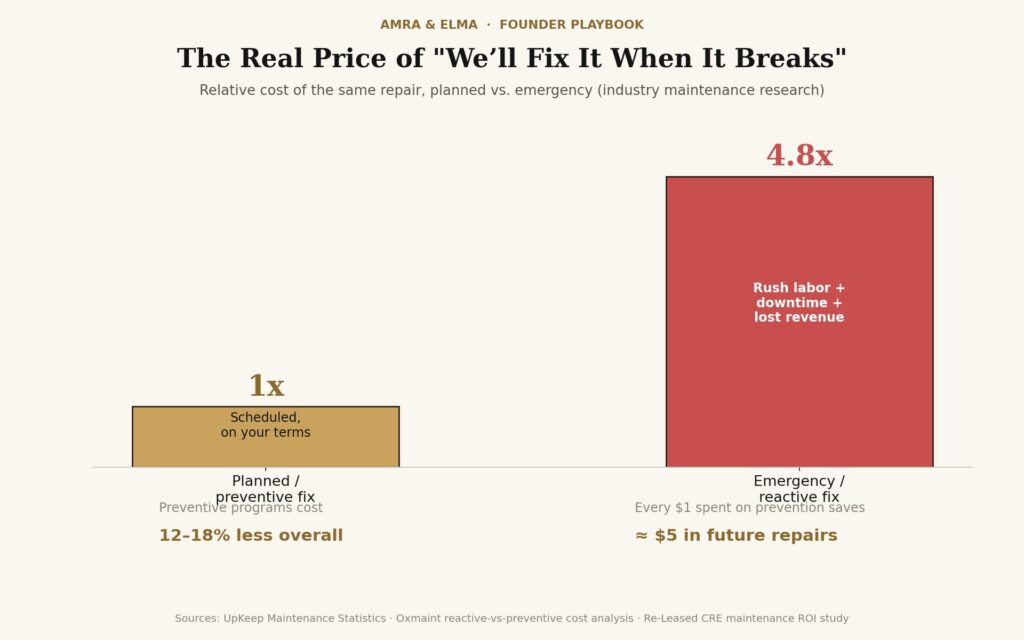
The mindset that finally made this click for me actually came from the physical world. While setting up our equipment program in Step 4, I went down a rabbit hole reading about facilities management and maintenance, and the core philosophy stopped me cold: professional maintenance teams don’t wait for machines to break — they inspect on a schedule, because a planned fix costs a fraction of an emergency one. I realized every word of that applies to business processes too. So once a quarter, we take half a day and run planned inspections on the company itself:
- We re-run the yacht test. Which processes have quietly slid back to red because of turnover or growth?
- We audit five SOPs at random. The DRI performs the task exactly as written while someone watches. Where reality and the document diverge, the document gets fixed that day.
- We kill something. Every quarter, at least one process, report, or meeting gets deleted. If nothing deserves deletion, we’re not looking hard enough.
- We ask the newest hire what confused them. New eyes see the broken steps that veterans have learned to route around. Their confusion is your most honest audit report.
The quarterly audit is also where scaling actually happens. When we decide to launch a new service line or take a brand into a new channel, the audit tells us whether the machine can absorb it. Growth decisions made against a freshly inspected operation are strategy. Growth decisions made against an unaudited one are gambling with your reputation.
The Five Mistakes That Will Sabotage You (Because They Sabotaged Me)
Every one of these is a scar, not a hypothesis.
Mistake #1: Building the framework in secret. The first time I tried to systematize the agency, I did it alone over a long weekend and presented the finished product to the team like a gift. They nodded politely and ignored all of it within a month. The second time, each DRI documented her own processes and presented them to the group. Adoption was instant, because people don’t resist systems — they resist other people’s systems. The framework has to be built by the hands that will run it.
Mistake #2: Systematizing the wrong things first. It’s tempting to start with whatever annoys you most. Resist that. Start with whatever touches revenue or client trust most directly. A messy internal filing system costs you irritation; a messy client onboarding costs you renewals. We ranked every red process by “what does failure here cost us in dollars and reputation” and worked strictly down the list. The satisfying-but-trivial stuff waits its turn.
Mistake #3: Confusing tools with systems. I have paid for project management platforms the way some people buy gym memberships in January. A tool without a defined process underneath it just digitizes your chaos and charges you monthly for the privilege. The sequence that works is unglamorous: define the process on paper, run it manually until it’s stable, then pick software that matches it. Every time I’ve reversed that order, the shiny platform became an expensive graveyard of half-filled boards within a quarter.
Mistake #4: Writing SOPs for readers who don’t exist. Our first documents were beautiful — long, thorough, and completely unused, because nobody consults a twelve-page PDF while a client is waiting on the phone. The versions that survived are ugly and effective: a one-page checklist, a link to a five-minute video, a template to copy. Write for the panicked person at 4:55 p.m. on a Friday, not for an auditor.
Mistake #5: Treating exceptions as failures of the system. Luxury clients are, by definition, exceptional — they will always ask for things no checklist anticipated. Early on, every exception made me doubt the whole framework. Now I understand the framework’s real job: it handles the 80% that is predictable so flawlessly that your best people have the time and energy to be brilliant on the 20% that isn’t. The system doesn’t replace judgment. It protects the space where judgment lives.
Your First 30 Days: The Exact Rollout Plan
If you’ve read this far, you’re motivated, and motivation has a shelf life of about a week. So here is precisely how to spend the next thirty days, calibrated for a founder who still has a full-time job running the actual business:
- Days 1–5: Run the yacht test. Just the list and the red/yellow/green ratings. Two hours, one spreadsheet, brutal honesty. Don’t fix anything yet — diagnosis before surgery.
- Days 6–12: Record videos for your three most expensive red processes as you naturally perform them. Have someone turn each into a one-page checklist. Assign a DRI to each while the ink is wet.
- Days 13–19: Whiteboard your client journey with the team, with real elapsed times next to each stage. Circle the single worst bottleneck and give it an owner and a deadline. Walk your physical space the same week and list every asset whose failure would cost you a bad day.
- Days 20–26: Launch the operating rhythm — but only the daily pulse and the weekly client health review. Adding all five rituals at once is how rhythms die. Layer the rest in over the following two months.
- Days 27–30: Choose your five numbers, build the ugliest possible one-page dashboard, and book your first monthly numbers meeting and your first quarterly audit on the calendar right now, before the momentum fades.
That’s it. Thirty days, maybe twelve total hours of work, and you will have more operational infrastructure than most businesses twice your size. The framework won’t be finished — it’s never finished — but it will be alive, and alive is the only thing that matters.
What Changes When the Framework Finally Works
I want to end with what this actually feels like, because the payoff is not what I expected. I thought good operations would feel like control. It feels like quiet. The 11 p.m. panic messages stop. Client emergencies become client conversations. You stop being impressive for surviving chaos and start being impressive for the absence of it — which, I promise you, is what enterprise clients are silently evaluating in every interaction long before they sign.
And here is the part that surprises everyone: the framework didn’t make us more corporate. It made us more creative. Every hour we stopped spending on preventable fires went into the work clients actually pay premium retainers for — strategy, storytelling, relationships. Structure isn’t the opposite of creativity. Structure is what creativity looks like when it wants to survive contact with growth.
So start with Step 1 this week. Not the whole framework — just the yacht test, one honest list, one recorded video of one red process. Six months from now, when a huge opportunity lands in your inbox, you’ll say yes without doing the frantic mental math about whether your company can survive its own success. That yes is what the entire framework is for.
Sources:
Preventive maintenance & physical operations (Steps 4 & 7):
- https://upkeep.com/learning/maintenance-statistics/ — preventive maintenance saves 12–18% over reactive, and every $1 spent on PM saves ~$5 later Upkeep
- https://oxmaint.com/blog/post/blog-post-reactive-vs-preventive-vs-predictive-maintenance — emergency repairs cost roughly 4.8x more than the same work done as scheduled maintenance OXMaint
- https://www.re-leased.com/property-operations/preventive-maintenance-vs.-reactive-maintenance-costs-roi-best-practices — reactive programs run 25–30% more expensive, with preventive delivering ~400% ROI Re-Leased
Client retention (Step 5’s renewal metric):
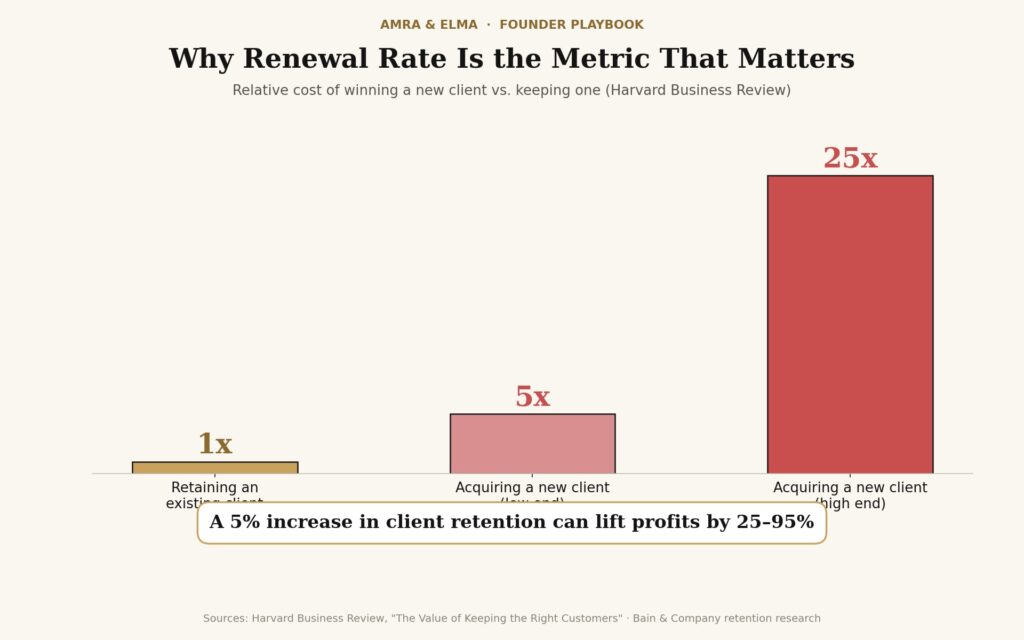
- https://hbr.org/2014/10/the-value-of-keeping-the-right-customers — the original HBR piece behind the stat that acquiring a new customer costs 5–25x more than retaining one Invesp
- https://www.invespcro.com/blog/customer-acquisition-retention/ — supporting data roundup
Interruptions & operating rhythm (Step 3):
-
- https://ics.uci.edu/~gmark/chi08-mark.pdf — Gloria Mark’s original UC Irvine study on interrupted work
- https://news.gallup.com/businessjournal/23146/too-many-interruptions-work.aspx — Gallup interview where Mark reports interrupted work takes an average of 23 minutes and 15 seconds to resume