




01 Jun How Top Brands Turn Every Employee Inbox Into a Marketing Asset
The highest-frequency, zero-cost channel in your company has been sitting untouched at the bottom of every outgoing email. Here’s how to change that.
There is a channel your marketing team controls that reaches real decision-makers — prospects mid-cycle, existing clients, journalists, potential partners — with zero ad spend, zero algorithm risk, and zero cost per impression. It fires tens of millions of times a year at even a mid-size company. And almost nobody in marketing is touching it.
That channel is employee email signatures.
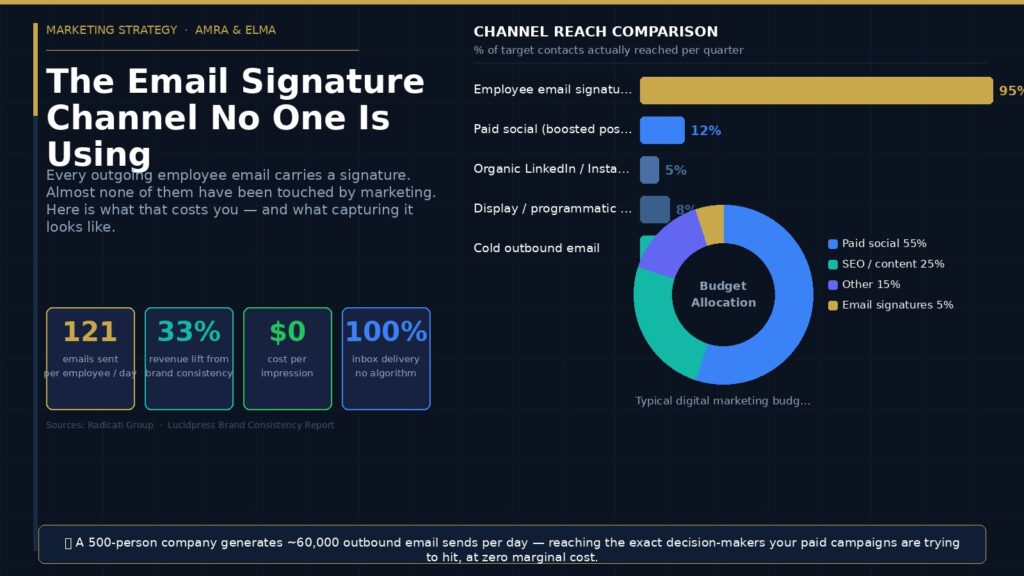
Before you scroll past that sentence: stay with the math for a moment. The average professional handles around 121 emails per day, according to widely cited data from the Radicati Group. A company of 500 people is generating roughly 60,000 outbound email sends every single day. Compounded over a quarter, you are looking at millions of touchpoints with exactly the humans you are trying to influence — not spray-and-pray audiences on a programmatic exchange, but the specific contacts your sales team, your account managers, and your executive assistants are actively working.
Every one of those sends carries a signature. And in most companies, those signatures haven’t been reviewed by marketing since someone from IT pushed out a new logo template three years ago. Since then: rebrands, campaign launches, new product lines, awards won, events announced, influencer partnerships activated. None of it reached the signature. The channel ran on autopilot while marketing spent its budget on paid social that reached a fraction of that audience at a cost that keeps climbing.
This is the opportunity. It is hiding in plain sight, on every laptop in the building, sending all day.
Key statistics behind the email signature marketing opportunity. Sources: Radicati Group, Lucidpress Brand Consistency Report.
Why the Channel Got Ignored in the First Place
Email signatures sat for a long time at the awkward intersection of IT’s territory and HR’s onboarding checklist. Marketing rarely entered that room. When the CMO wanted a new campaign banner pushed to every employee signature, the request went into an IT queue, emerged six weeks later half-implemented, and landed in inboxes just as the campaign wrapped. The friction was too high, the results were invisible, and the channel dropped off everyone’s radar.
What changed is software. A dedicated signature management platform — the most established category leader being Exclaimer — decouples deployment from the IT queue entirely. Marketing sets the creative. Marketing sets the campaign calendar. The platform pushes updates across Microsoft 365, Google Workspace, and Exchange automatically, without touching individual machines or waiting on anyone’s help desk. The result is that every employee in a 5,000-person enterprise wakes up on Monday morning with a signature that reflects the campaign that launched over the weekend.
That operational shift — marketing ownership of a channel that routes through IT infrastructure — is what unlocks everything else.
The Brand Consistency Problem Nobody Is Measuring
Pull a random sample of fifty employee emails from your outbox right now. Screenshot every signature side-by-side. What you will find, in virtually every company that hasn’t adopted signature management, looks like a brand identity yard sale: four different logo treatments, three typefaces, two color palettes, job titles that haven’t matched the org chart in eighteen months, and banners for webinars that ran in Q1 still rotating out in Q3.
This isn’t a design preference. It is measurable revenue leakage.
Lucidpress’s widely cited brand consistency research found that companies presenting a unified identity across every customer-facing channel see revenue impacts in the 23% to 33% range. The variable that makes that number feel abstract is scale — but email signatures are the one place where scale is already built in. The moment you look at the volume of external sends your company generates in a quarter and imagine a portion of them arriving with a signature that undercuts your current brand, the cost of inaction becomes concrete.
Consider the most expensive scenario: your top enterprise account executive is three weeks into a deal on a six-figure renewal. Every email she sends carries a signature with last year’s logo and a job title she hasn’t held since the reorganization. It signals, quietly and persistently, an organization that doesn’t sweat the details. That signal is not neutral.
“The companies pulling real returns out of employee email tend to share one habit. They noticed it was a channel at all. Owned, free, sitting on every laptop in the business, sending all day. The rest is execution.”
— Amra & Elma, Digital Marketing & PR Agency
Once the Signature Is Managed, It Becomes Inventory
Here is where the strategy gets genuinely interesting. Fixing brand consistency is table stakes — important, measurable, and worth doing on its own. But the real upside isn’t the defensive play. It’s what becomes possible once marketing owns the signature layer.
When every outgoing email at a mid-market company of five hundred employees carries a managed signature, you now control a media placement that fires millions of times a quarter. That placement is not hypothetical reach — it is contextual, permission-based contact with people who are already engaged enough to be in an email thread with someone at your company. The targeting is pre-built by the nature of the relationship. All that’s left is deciding what to put there.
A promotion banner for an upcoming webinar on Zoom or ON24. A registration link for an industry conference. A case study download. A product launch announcement timed to coincide with the outreach push from your sales team. A thought leadership piece timed for a news cycle you want to ride. None of this requires a separate distribution budget, a new platform, or an approval from legal every time because the framework — legal sign-off, brand guidelines, deployment mechanics — is set once and reused across every campaign that follows.
Platforms like Exclaimer take the personalization a step further. Campaign banners can be segmented by department, geography, job function, recipient domain, or sales-cycle stage. Your sales team sends a signature carrying an ABM play targeted to 200 named accounts. Your customer success team sends a signature promoting a new product feature. Your executive team sends a signature with the award you just won from a Forbes recognition. Nobody outside those segments sees the irrelevant banner. The message matches the relationship — which is the only thing that makes a banner worth putting there.
The ABM Angle: Why This Is the Sleeper Use Case
Account-based marketing teams have spent years building targeting infrastructure to reach named accounts through LinkedIn ads, programmatic display, and direct mail. Those channels work — but they also announce themselves as advertising, which means buyers treat them with the mental friction that comes with being pitched. There is an inherent skepticism gap between “an ad from a company I’ve heard of” and “an email from the account manager I spoke with last Tuesday.”
Email signatures sit inside the second category. The signature rides on a real business email, from a real human your prospect already knows and trusts. The banner below it lands in a context of inherent credibility. It does not look like an ad because it isn’t one — it’s brand communication embedded inside operational correspondence.
For companies running 6sense, Demandbase, or a homegrown ABM motion, the workflow integration is straightforward. Take your named account list. Configure signature segments for the reps covering those accounts. Drop in the banner — case study, event invitation, product deep-dive, whatever is relevant to where those accounts sit in the buying cycle. The cost of that impression rounds to zero. The targeting precision rivals anything you’re running on paid channels. And the contextual trust premium is something paid media cannot buy.
HubSpot’s marketing benchmarks research consistently flags email as one of the highest ROI channels in the digital stack — and that framing typically applies to nurture sequences, not the signature channel. The signature is a quieter, more ambient version of the same principle: a real send, with a real relationship behind it, carrying useful content to someone who is already paying attention.
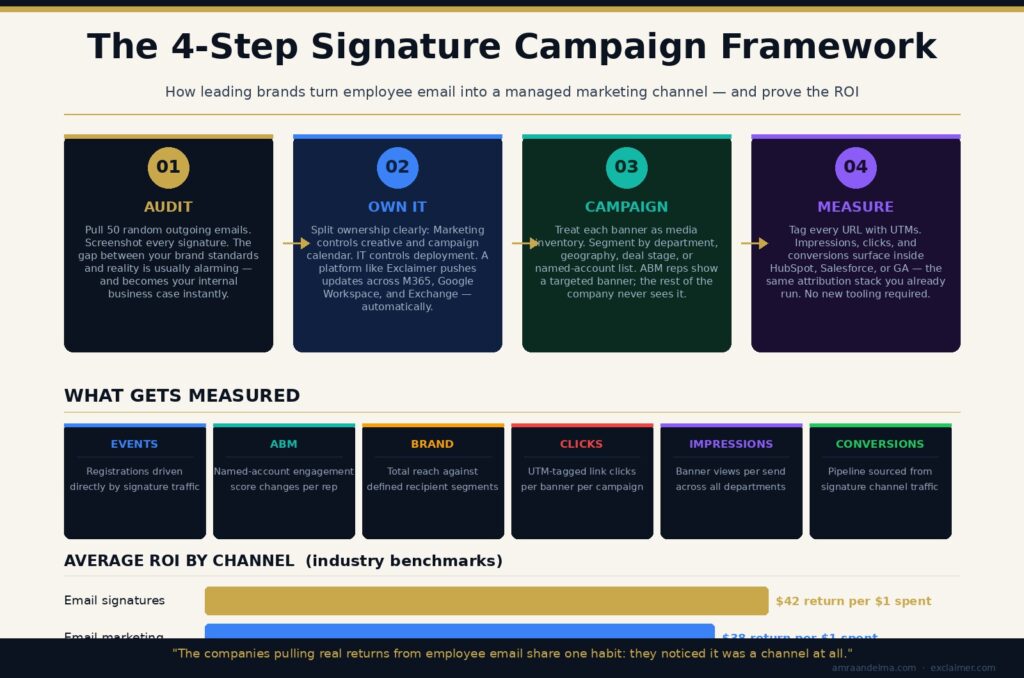
The four-step framework for turning employee email signatures into managed marketing media. Measurement integrates directly into HubSpot, Salesforce, and Google Analytics.
Proving the ROI: The Measurement Case
The objection every performance marketer raises immediately is measurement. If we can’t prove it’s working, we can’t justify the resource allocation — even if the resource required is modest. This is a fair challenge, and it has a clean answer.
Signature analytics operate on the same mechanics as display and email marketing attribution. Impression counts are available per banner. Clicks are tracked. Every link can carry UTM parameters — source, medium, campaign, content — that surface the traffic inside Google Analytics, HubSpot, Salesforce, or whatever attribution layer the team already runs. Nothing exotic is required. The measurement stack you use for every other digital channel applies here without modification.
The metrics align naturally to campaign type. For events: registration volume sourced from signature traffic, measured against overall event pipeline. For account-based work: engagement score changes on named accounts that received signature impressions from their active reps. For brand campaigns: estimated reach against defined recipient segments, click-through rates on content offers, downstream conversion from traffic that entered the funnel through the signature placement.
What makes this unusually clean from a reporting perspective is the absence of confounding variables that complicate paid attribution. There is no auction dynamic, no audience overlap with other channels to account for, and no frequency cap behavior to model. The send happened. The impression occurred. The click either happened or it didn’t. The UTM tells you where the conversion came from. The cadence of that reporting fits whatever cadence the CMO is already running — weekly pipeline reviews, monthly marketing dashboards, quarterly attribution analyses. Signature performance is just another row.
Organic Reach Is in Structural Decline. Email Isn’t.
This point deserves its own section because it is the structural argument for why the email signature channel will only become more valuable over time, not less.
Organic reach on every major social platform has been in decline for years. Meta’s own data has documented the erosion of page-level organic distribution as algorithm priorities shifted toward paid amplification and creator content. LinkedIn’s organic reach curve follows a similar trajectory, particularly for brand pages versus individual posts. Instagram’s non-Reel content has seen consistent engagement decline as the platform pushed toward short video. The implication for brand marketing is that every channel dependent on an algorithm is a channel where you are renting reach at an ever-increasing price, and the landlord reserves the right to change the terms at any time.
Email doesn’t work that way. An email from your enterprise account manager still lands directly in the buyer’s inbox. Every time. No boost required. No algorithm to beat. No policy change to accommodate. The channel’s reliability is built into its architecture — it is a protocol, not a platform, and no single company controls whether your email reaches its destination.
Adobe’s long-running research on email behavior found that recipients are more receptive to relevant brand content arriving in email than in almost any other digital format. The key word is relevant — a well-targeted signature banner, calibrated to the recipient’s relationship with the sender and their position in the buying cycle, lands very differently from a generic blast. The signal-to-noise ratio of a real email from a real person is simply higher than almost anything else in the digital marketing stack.
The Operational Playbook: Where to Start
The tactical starting point is deceptively simple: run the audit before you shop for technology. Pull fifty outgoing emails from across the company. Screenshot the signatures. The variance you find between what the brand standards document says and what’s actually going out is usually startling enough to build the internal business case without any further analysis. That audit is the argument. That audit is the proposal.
The second step is settling ownership before settling on a vendor. This sounds procedural, but it’s actually where most signature initiatives stall. If IT owns the deployment and marketing owns the creative but there’s no explicit agreement on who controls the campaign calendar, every update becomes a cross-functional negotiation. The split that works is clean: marketing controls what goes into the signature and when. IT controls how it gets deployed and what security constraints govern that deployment. With that division clear, a platform like Exclaimer handles the rest — the authentication, the push across Microsoft 365 or Google Workspace, the reporting, the segmentation logic.
Third: build the campaign calendar before the tooling is in place. Decide which three campaigns earn signature placement next quarter. What does success look like for each? Which audience segments does each banner need to reach? What UTM structure will you use to track results? Making these decisions before the platform is live means the first quarter of signature campaigns is already designed and ready to deploy the moment the technical setup closes. It converts a rollout into a launch.
Quick Wins to Target FirstEvent registration banners during the four-week window before a webinar or conference. ABM banners for reps covering named accounts in active deal cycles. Product launch announcements pushed company-wide on launch day. Award or media recognition banners for executive team signatures. Each of these is measurable, time-bounded, and requires no ongoing creative lift once the initial template is set.
The Luxury Brand Perspective: Consistency as Prestige Signal
For brands operating at the premium or luxury tier — and for the agencies and consultancies that serve them — the brand consistency argument carries an additional dimension that purely performance-focused framing tends to underweight.
In luxury marketing, the experience of the brand is not separable from the product. Every touchpoint either reinforces or erodes the perception of quality and deliberateness that premium positioning requires. A client receiving a proposal from a luxury hospitality brand, a high-end consultancy, or a premium B2B vendor and seeing a mismatched signature — old logo, outdated contact, irrelevant campaign banner — reads it as a signal about what working with that company actually feels like. The inference is not charitable.
Email signature management, viewed through this lens, is not primarily a marketing efficiency play. It is a quality assurance mechanism for one of the most frequent touchpoints in the client relationship. Every outgoing email from every employee is a micro-moment of brand expression. Managed signatures ensure those micro-moments compound into the perception you are intentionally building, rather than the one that accumulates through neglect.
For agencies presenting this case to Fortune 500 clients and luxury brands — organizations that will immediately recognize the brand equity argument — framing signature management as a precision quality tool rather than a cost-reduction play tends to land significantly better. The pitch isn’t “you’re leaving clicks on the table.” It’s “every email your company sends is either reinforcing your brand or quietly undermining it, and right now you’re not controlling which one.”
Scaling the Program: From Pilot to Company-Wide Media Strategy
The natural entry point for most companies is a single-team pilot — sales signatures first, because the volume is high and the recipient targeting is already well-defined. Running a quarter of signature campaigns through the sales team gives you clean data: impressions by rep, clicks by banner, conversions attributable to signature traffic, any lift in named-account engagement scores during ABM pushes.
With that data in hand, expanding to the full company is a budget conversation, not a technology conversation. The platform can handle the scale. The question is just which campaigns justify the incremental creative effort of producing department-specific banners versus running a unified company-wide push. In most organizations, the answer breaks down naturally: sales and account management get segmented banners calibrated to deal stage and account type; the rest of the organization runs unified campaign banners tied to the company’s content and brand calendar.
At full scale, you are looking at a media operation that runs largely on autopilot. The creative production cycle — brief, design, legal review, upload, deploy — happens once per campaign, and the platform handles distribution automatically. The reporting feeds into existing dashboards. The only ongoing management is the campaign calendar, which you already run for every other channel in the stack.
The economics are, by any reasonable benchmark, exceptional. Cost per impression rounds to zero because the fixed cost of the platform is distributed across a volume of sends that would require a significant paid media budget to replicate, and the contextual quality of each impression — a real email, from a real person, to a specific recipient who has a relationship with your company — is not available at any price on a programmatic exchange.
The One Thing That Changes Everything
The companies that are already doing this well share a single cognitive shift: they looked at their employee email stack and recognized it as a channel. Not a utility. Not an IT function. A channel — owned, free, audience-defined, algorithmically invulnerable, and firing all day at the exact decision-makers their paid campaigns are trying to reach.
Every other advantage flows from that realization. The brand consistency discipline. The campaign segmentation. The measurement rigor. The ABM integration. The luxury brand quality signal. None of it is particularly complicated once the channel is visible. It was always there. The rest really is just execution.
If your organization hasn’t yet centralized signature management, the audit is the place to start. Pull the fifty emails. Look at what’s going out. Then decide what you want going out instead — and recognize that the technology to close that gap, purpose-built for exactly this use case, has been available for years. Exclaimer’s marketing solution is the category leader for a reason: it was designed to give marketing teams full control of the signature channel without adding IT complexity to every campaign cycle.
The inbox has been waiting. It’s time marketing showed up.
Sources
- Radicati Group — Email Statistics Report: https://www.radicati.com/wp/wp-content/uploads/2023/01/Email-Statistics-Report-2023-2027-Executive-Summary.pdf
- Lucidpress — The Impact of Brand Consistency: https://www.lucidpress.com/pages/resources/report/the-impact-of-brand-consistency
- Exclaimer — Email Signature Marketing for Marketing Teams: https://exclaimer.com/solutions/team/marketing/
- HubSpot — Email Marketing Statistics and Benchmarks: https://www.hubspot.com/marketing-statistics
- Adobe — Adobe Email Usage Study (Consumer Email Survey): https://www.adobe.com/content/dam/acom/en/modal-offers/pdfs/Adobe-Email-Usage-Study.pdf
- Meta Business — Understanding Organic Reach on Facebook: https://www.facebook.com/business/help/327177774295571
- LinkedIn Marketing Solutions — B2B Marketing Benchmarks and Trends: https://business.linkedin.com/marketing-solutions/b2b-institute/b2b-marketing-benchmarks
- Demandbase — The ABM Strategy Guide: https://www.demandbase.com/resources/ebooks/the-account-based-marketing-strategy-guide/
- Google Analytics — Campaign URL Builder and UTM Parameter Guide: https://ga-dev-tools.google/campaign-url-builder/
- Salesforce — State of Marketing Report (Email ROI and Channel Attribution): https://www.salesforce.com/resources/research-reports/state-of-marketing/