



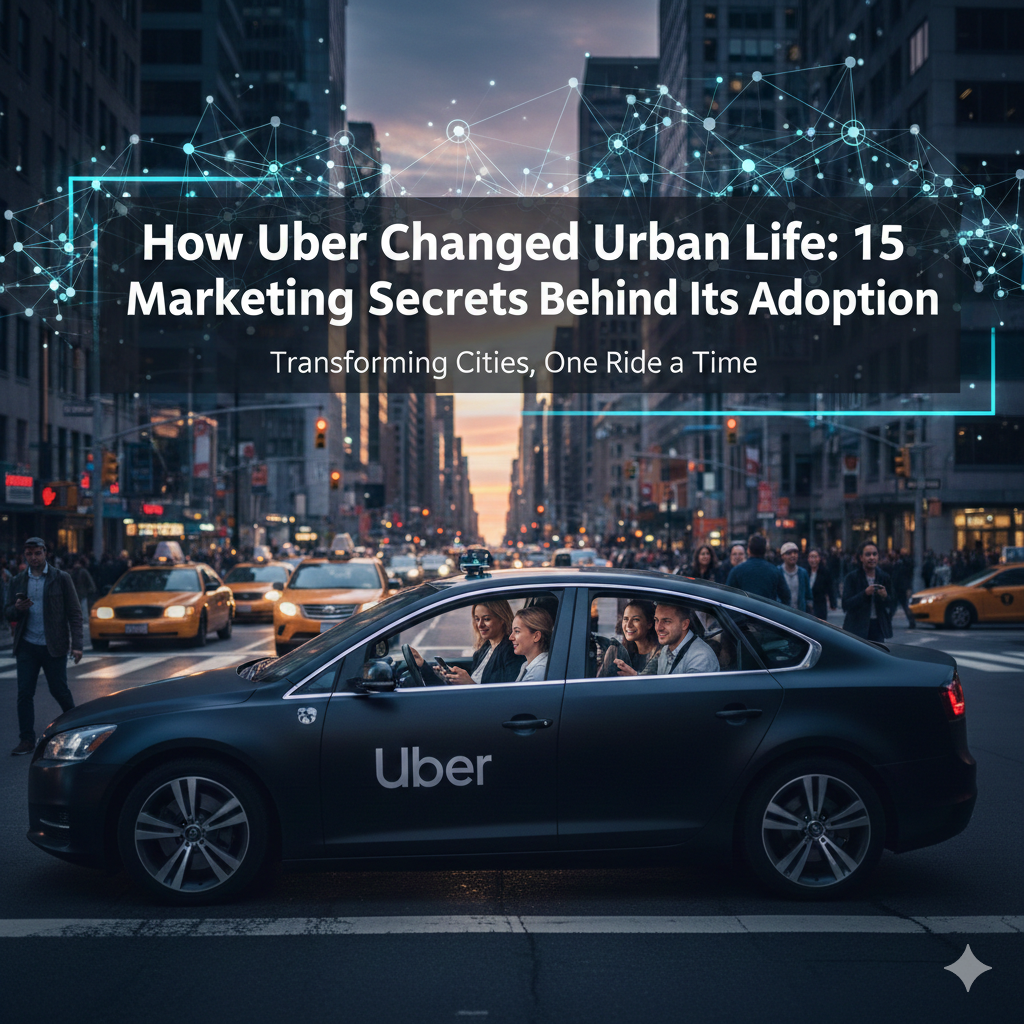
23 Dec How Uber Changed Urban Life: 15 Marketing Secrets Behind Its Adoption
How Uber Changed Urban Life: 15 Marketing Secrets Behind Its Adoption (Editor’s Choice)
✨ Uber’s 15 Marketing Secrets That Changed Urban Life
Clean, modern, and scroll-friendly—designed to feel editorial, not corporate.
| Marketing Secret ✨ | How It Worked 🧠 |
|---|---|
|
😩➡️😌 Solved a universal urban pain
#1
|
Positioned Uber as instant relief from unreliable taxis, turning shared frustration into immediate trust. |
|
📲 Sold convenience, not cars
#2
|
Framed the service around effortlessness—one tap, no friction—making it a daily habit, not a decision. |
|
🗺️ Hyper-local city launches
#3
|
Customized messaging and promotions per city so Uber felt native, not imported. |
|
🕶️ Targeted elite early adopters
#4
|
Leveraged aspirational users to create social proof before expanding to the mainstream. |
|
💅 Lifestyle branding over utility
#5
|
Made transportation feel elevated, stylish, and desirable—turning function into fashion. |
|
🤝 Product-led referrals
#6
|
Embedded growth into the experience, transforming users into brand advocates. |
|
🎯 Frictionless first ride
#7
|
Removed cash, confusion, and anxiety so the first interaction felt seamless and repeatable. |
|
🌧️💸 Surge pricing explained
#8
|
Educated users on supply and demand, preserving trust even during peak pricing. |
|
🧑💼🚗 Driver-as-partner narrative
#9
|
Marketed flexibility and independence to scale supply and humanize the platform. |
|
🌍 Consistent global experience
#10
|
Delivered familiarity across cities, making Uber instantly trustworthy anywhere. |
|
⛈️ Perfect timing marketing
#11
|
Appeared when urban transport failed—late nights, rain, holidays—cementing reliance. |
|
🍦🚁 Experiential campaigns
#12
|
Created moments people wanted to share, turning marketing into entertainment. |
|
🔍 Upfront pricing transparency
#13
|
Reduced decision anxiety with clear estimates, outperforming traditional taxi meters. |
|
⚡ Positioned as the future
#14
|
Aligned the brand with progress and modernity, making adoption feel inevitable. |
|
🚘📣 City-level visibility
#15
|
Turned everyday presence into passive marketing, normalizing usage citywide. |
How Uber Changed Urban Life: 15 Marketing Secrets Behind Its Adoption
How Uber Changed Urban Life: Marketing Secrets Behind Its Adoption #2 – Selling Convenience, Not Cars
Uber never tried to romance us with engines, leather seats, or car models. Instead, it sold a feeling: effortlessness. One tap, zero negotiation, no mental math. That’s not transportation—that’s emotional efficiency. Uber understood that urban consumers don’t want options, they want clarity. By marketing convenience as the hero, Uber slipped into routines so seamlessly it became muscle memory. The lesson? When you sell ease, you become habit—and habits are marketing’s holy grail.
How Uber Changed Urban Life: Marketing Secrets Behind Its Adoption #3 – Hyper-Local, City-by-City Seduction
Uber didn’t shout one global message and hope cities adapted. It flirted locally. Each city got its own tone, timing, pricing experiments, and promotions—because New York is not Berlin and never will be. This made Uber feel less like a Silicon Valley invader and more like a city insider. Smart brands know culture is regional, not universal. Uber’s marketing whispered, this was made for your streets, and cities listened.
How Uber Changed Urban Life: Marketing Secrets Behind Its Adoption #4 – Starting With the Cool Kids
Uber didn’t chase everyone—it chose someone. Early adopters were tech insiders, creatives, executives, people whose choices ripple outward. When they used Uber, it wasn’t an ad—it was a signal. That’s social proof done with restraint and confidence. Uber understood that aspiration travels faster than explanation. If the people you admire are doing it, you don’t ask why—you download.
How Uber Changed Urban Life: Marketing Secrets Behind Its Adoption #5 – Making Utility Feel Aspirational
Here’s where Uber got deliciously clever: it made a basic need feel elevated. Early branding leaned premium, polished, and just exclusive enough to feel special. Suddenly, a ride wasn’t just functional—it was a flex. Uber didn’t scream luxury, but it whispered taste. And in marketing, subtlety often wins. When everyday actions feel chic, people adopt them faster—and defend them harder.
How Uber Changed Urban Life: Marketing Secrets Behind Its Adoption #6 – Turning Users Into the Marketing Department
Referral credits weren’t generosity—they were strategy dressed as kindness. Uber engineered word-of-mouth so cleanly it felt organic, even though it was meticulously designed. Users weren’t just customers; they became distribution channels. This is what happens when marketing is baked into the product instead of stapled on later. Uber understood one timeless truth: people trust friends more than brands. So it let friends do the talking.
How Uber Changed Urban Life: Marketing Secrets Behind Its Adoption #7 – Obsessing Over the First Ride
Your first Uber ride mattered more than any ad campaign. No cash. No awkward tipping. No confusion. Just a smooth, controlled experience that whispered, this is how it should always be. Uber reduced friction so aggressively that trying it once almost guaranteed trying it again. This is conversion psychology at its finest: remove anxiety, increase trust, create comfort. Marketing doesn’t end at download—it ends at delight.
How Uber Changed Urban Life: Marketing Secrets Behind Its Adoption #8 – Reframing Surge Pricing Without Apologizing
Surge pricing could’ve been Uber’s villain arc. Instead, it became a masterclass in narrative control. Uber explained it—not defensively, but confidently—as a tool to increase availability. That transparency reframed frustration into logic. People don’t hate higher prices; they hate feeling tricked. Uber chose education over silence, and trust over perfection. Bold move—and one most brands are still afraid to make.
How Uber Changed Urban Life: Marketing Secrets Behind Its Adoption #9 – The Driver-as-Partner Storyline
Uber didn’t sell jobs; it sold autonomy. Calling drivers “partners” wasn’t accidental—it was identity marketing. This narrative attracted supply, softened criticism, and created a sense of shared mission. Whether perfect or not, the story mattered. People don’t just join platforms—they join beliefs. Uber marketed participation as empowerment, and that message traveled fast, especially in cities hungry for flexible income.
How Uber Changed Urban Life: Marketing Secrets Behind Its Adoption #10 – Radical Consistency Across Cities
No matter where you landed, Uber felt familiar. Same app. Same flow. Same promise. That consistency reduced cognitive load and increased trust instantly—especially for travelers. Uber understood that reliability is branding. When consumers know what to expect, they relax. And relaxed users convert faster, complain less, and stay longer. Familiarity isn’t boring—it’s comforting.
How Uber Changed Urban Life: Marketing Secrets Behind Its Adoption #11 – Showing Up at Life’s Messiest Moments
Uber knew exactly when to raise its hand: late nights, rainstorms, holidays, chaos. It marketed itself during moments of maximum stress, when alternatives failed. That timing wasn’t random—it was empathetic. Great marketing meets people where they are, not where brands wish they’d be. Uber didn’t interrupt life; it rescued it. And rescue builds loyalty faster than persuasion ever could.
How Uber Changed Urban Life: Marketing Secrets Behind Its Adoption #12 – Turning Marketing Into Entertainment
Ice cream deliveries. Helicopter rides. Unexpected stunts that made headlines and timelines. Uber blurred the line between service and spectacle, creating moments people wanted to share. This wasn’t noise—it was delight. Uber understood that attention is earned, not bought, and surprise is a currency cities never get tired of. When marketing feels like a story, people spread it willingly.
How Uber Changed Urban Life: Marketing Secrets Behind Its Adoption #13 – Pricing Transparency as Emotional Safety
Showing fare estimates upfront was a quiet revolution. It removed fear, awkwardness, and that subtle dread of being overcharged. Uber marketed honesty as a feature—and it worked. Transparency isn’t just ethical; it’s persuasive. When people feel safe, they choose faster. Uber didn’t make rides cheaper—it made decisions easier. And that’s often more powerful.
How Uber Changed Urban Life: Marketing Secrets Behind Its Adoption #14 – Branding Itself as the Future
Uber didn’t position itself as an alternative—it positioned itself as what’s next. Using Uber felt like participating in progress. That framing tapped into ego, optimism, and cultural momentum all at once. People love aligning with the future, especially when it’s convenient. Uber didn’t wait for permission to feel inevitable. It claimed the narrative early—and cities followed.
How Uber Changed Urban Life: Marketing Secrets Behind Its Adoption #15 – Turning the City Into a Living Billboard
Every Uber car became moving proof that the platform worked. Visibility normalized usage, reduced skepticism, and reinforced trust without saying a word. This is ambient marketing at its finest—presence over promotion. Uber didn’t just advertise in cities; it embedded itself into them. When a brand becomes part of the scenery, adoption stops feeling like a choice. It feels like common sense.