



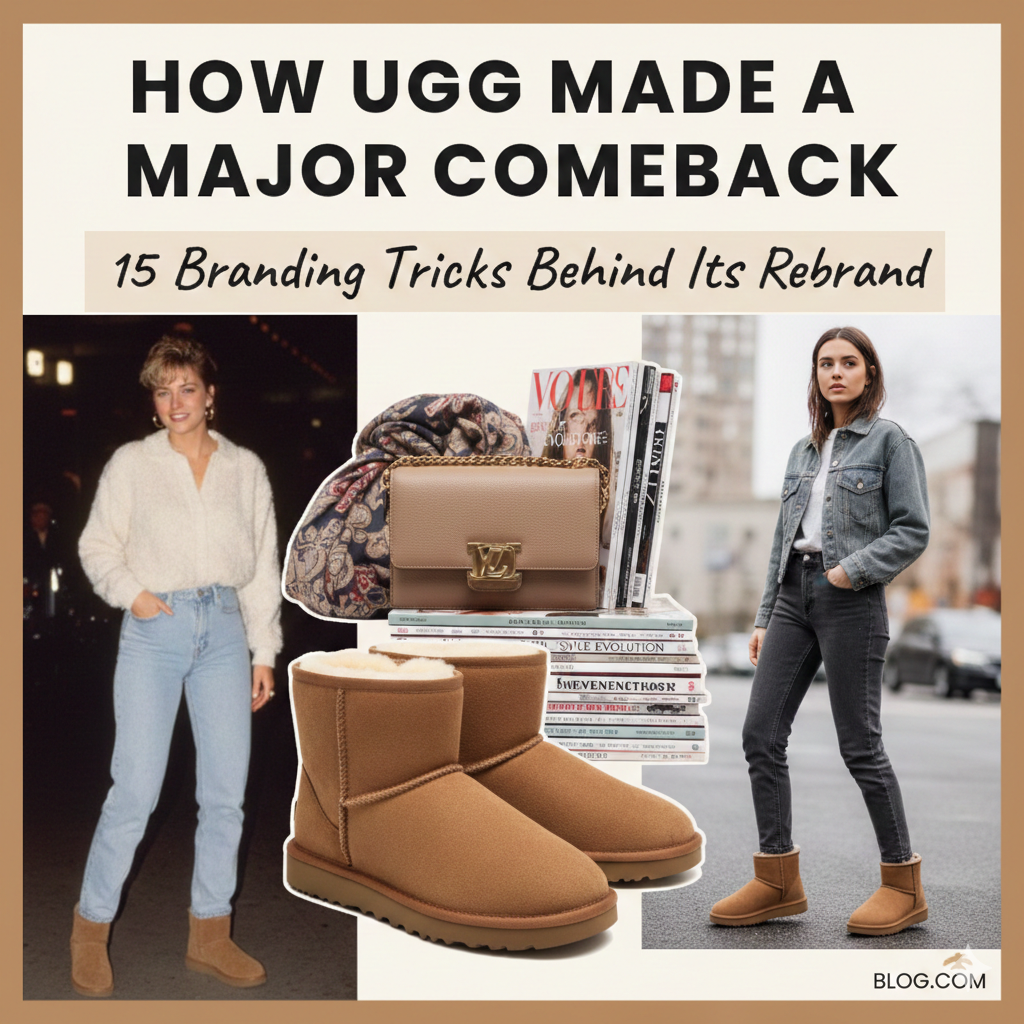
21 Dec How UGG Made a Major Comeback: 15 Branding Tricks Behind Its Rebrand
How UGG Made a Major Comeback: 15 Branding Tricks Behind Its Rebrand (Editor’s Choice)
How UGG Made a Major Comeback: 15 Branding Tricks Behind Its Rebrand
A quick, scroll-stopping breakdown of the moves that turned “cozy” into cultural currency again.
| # | Branding Trick | Why It Worked | Playbook Tag |
|---|---|---|---|
|
1
Comfort as Luxury They reframed “cozy” as premium—comfort became the status symbol, not the compromise. Positioning |
Comfort as Luxury |
They reframed “cozy” as premium—comfort became the status symbol, not the compromise. |
Positioning |
|
2
Evolving the Icon (Not Erasing It) They kept the Classic Boot’s equity while refreshing silhouettes and details for modern tastes. Brand Equity |
Evolving the Icon (Not Erasing It) |
They kept the Classic Boot’s equity while refreshing silhouettes and details for modern tastes. |
Brand Equity |
|
3
Year-Round Product Innovation Slippers, sandals, platforms—UGG expanded beyond “winter boot” and stayed relevant all seasons. Product Strategy |
Year-Round Product Innovation |
Slippers, sandals, platforms—UGG expanded beyond “winter boot” and stayed relevant all seasons. |
Product Strategy |
|
4
Strategic Collaborations Partnering with designers and labels injected fashion credibility and fresh storytelling. Collabs |
Strategic Collaborations |
Partnering with designers and labels injected fashion credibility and fresh storytelling. |
Collabs |
|
5
Celebrity Momentum → Social Proof High-visibility wears turned UGG into a “seen on” item—proof that it’s back in the wild. Influence |
Celebrity Momentum → Social Proof |
High-visibility wears turned UGG into a “seen on” item—proof that it’s back in the wild. |
Influence |
|
6
Gen Z Nostalgia (Y2K Energy) They positioned UGG as “nostalgic but current,” tapping the cycle of trend revival. Cultural Timing |
Gen Z Nostalgia (Y2K Energy) |
They positioned UGG as “nostalgic but current,” tapping the cycle of trend revival. |
Cultural Timing |
|
7
TikTok-First Cultural Distribution Instead of forcing relevance, UGG amplified organic styling content and creator-led trends. Social Strategy |
TikTok-First Cultural Distribution |
Instead of forcing relevance, UGG amplified organic styling content and creator-led trends. |
Social Strategy |
|
8
Earlier Seasonal Campaign Timing Launching “fall energy” early builds anticipation and captures demand before the rush. Demand Planning |
Earlier Seasonal Campaign Timing |
Launching “fall energy” early builds anticipation and captures demand before the rush. |
Demand Planning |
|
9
Limited Drops + New Colorways Scarcity and fresh palettes create urgency, social chatter, and resale-level desirability. Drop Culture |
Limited Drops + New Colorways |
Scarcity and fresh palettes create urgency, social chatter, and resale-level desirability. |
Drop Culture |
|
10
Selective Distribution Controlling where it’s sold protects premium perception and reduces “discount-bin” dilution. Channel Strategy |
Selective Distribution |
Controlling where it’s sold protects premium perception and reduces “discount-bin” dilution. |
Channel Strategy |
|
11
Lifestyle-First Storytelling They sold a feeling—ease, warmth, self-expression—so the product became a mood. Brand Story |
Lifestyle-First Storytelling |
They sold a feeling—ease, warmth, self-expression—so the product became a mood. |
Brand Story |
|
12
Immersive Brand Experiences Events and activations turned UGG into something you *participate* in, not just purchase. Experiential |
Immersive Brand Experiences |
Events and activations turned UGG into something you *participate* in, not just purchase. |
Experiential |
|
13
Broader Demographics + Global Reach Men’s, kids’, and international expansion widened the funnel without losing identity. Growth |
Broader Demographics + Global Reach |
Men’s, kids’, and international expansion widened the funnel without losing identity. |
Growth |
|
14
Heritage + Modernity Balance They kept the origin story, but updated the styling cues—nostalgia without staleness. Brand DNA |
Heritage + Modernity Balance |
They kept the origin story, but updated the styling cues—nostalgia without staleness. |
Brand DNA |
|
15
Fashion Week + Industry Cred Runway and editorial visibility repositioned UGG as fashion-approved, not just functional. Credibility |
Fashion Week + Industry Cred |
Runway and editorial visibility repositioned UGG as fashion-approved, not just functional. |
Credibility |
How UGG Made a Major Comeback: 15 Branding Tricks Behind Its Rebrand
How UGG Made a Major Comeback: Branding Tricks Behind Its Rebrand #3 — Year-Round Product Expansion
UGG quietly escaped the seasonal box it was shoved into. By expanding into slippers, sandals, clogs, and transitional footwear, the brand stopped being a winter fling and became a year-long relationship. Strategically, this smoothed revenue curves. Culturally, it kept UGG in conversation beyond cold weather memes. The result? A brand that shows up in closets—and feeds—twelve months a year.
How UGG Made a Major Comeback: Branding Tricks Behind Its Rebrand #4 — Strategic Fashion Collaborations
UGG didn’t chase hype; it curated relevance. Collaborations with fashion-forward designers reframed the brand as culturally curious rather than commercially thirsty. These weren’t logo-slapping exercises—they were reinterpretations. The effect was subtle but powerful: UGG stopped asking for fashion’s approval and started participating in the conversation.
How UGG Made a Major Comeback: Branding Tricks Behind Its Rebrand #5 — Celebrity as Cultural Validation
UGG didn’t announce its return; it let celebrities do it accidentally. Paparazzi shots, off-duty looks, “I just threw these on” energy. This is the holy grail of modern influence—unpaid-looking validation. When the right people wear something without explanation, it stops being a product and starts being a signal.
How UGG Made a Major Comeback: Branding Tricks Behind Its Rebrand #6 — Gen Z Nostalgia Without Irony
UGG didn’t come back as a joke, and that’s precisely why Gen Z welcomed it with open arms (and oversized jeans). Instead of leaning into self-deprecating irony or apologizing for its early-2000s fame, UGG treated its past like a well-lived life phase—acknowledged, respected, and quietly upgraded. This mattered. Gen Z doesn’t want brands to cringe at themselves; they want confidence without explanation. By allowing UGG to feel rediscovered rather than rebooted, the brand tapped into nostalgia that felt sincere, not costume-y. It was less “remember this?” and more “this still works.” And that distinction is everything.
How UGG Made a Major Comeback: Branding Tricks Behind Its Rebrand #7 — TikTok as Cultural Distribution, Not Advertising
UGG’s TikTok success didn’t come from brand-led choreography or overly polished campaigns—it came from restraint. The brand understood that TikTok isn’t a billboard; it’s a mirror. Instead of forcing messaging, UGG let creators do what they already do best: style, narrate, live. Morning routines, cozy vlogs, “what I wear to class,” quiet luxury-adjacent fits—UGG appeared organically, almost incidentally, which made it feel inevitable rather than inserted. This is modern distribution at its most effective: the product circulating through culture without announcing itself as marketing.
How UGG Made a Major Comeback: Branding Tricks Behind Its Rebrand #8 — Earlier Seasonal Timing That Builds Desire
UGG realized something many brands still miss: consumers don’t fall in love with products when they need them—they fall in love when they imagine them. By launching fall and winter campaigns earlier than expected, UGG met customers in their planning phase, not their purchasing panic. This subtle shift transformed the brand from reactive to predictive. Psychologically, it positioned UGG as part of a lifestyle aspiration rather than a functional necessity. You weren’t buying boots because it was cold—you were buying into the version of fall you wanted to inhabit.
How UGG Made a Major Comeback: Branding Tricks Behind Its Rebrand #9 — Limited Drops That Create Desire, Not Exhaustion
UGG embraced scarcity with maturity. Instead of constant “newness,” it focused on intentional drops—new colorways, subtle updates, just enough novelty to spark conversation. This strategy avoided the burnout that plagues many drop-heavy brands. The result was desire that felt earned, not engineered. When a pair sold out, it didn’t feel like manipulation—it felt like proof of relevance. Scarcity worked because it was quiet, controlled, and confident.
How UGG Made a Major Comeback: Branding Tricks Behind Its Rebrand #10 — Selective Distribution as Brand Repair
UGG had lived through the consequences of overexposure before—and this time, it corrected course. By tightening distribution and stepping away from constant discounting, the brand reclaimed its premium perception. This wasn’t about exclusivity for ego’s sake; it was about restoring trust. When a brand is everywhere, it feels disposable. When it’s curated, it feels chosen. UGG’s selective distribution signaled confidence and patience—two traits consumers instinctively associate with quality.
How UGG Made a Major Comeback: Branding Tricks Behind Its Rebrand #11 — Lifestyle Storytelling Over Product Selling
UGG stopped selling footwear and started selling atmosphere. Campaigns leaned into mood—slow mornings, creative lives, quiet comfort—where the product existed naturally within the scene rather than as its focal point. This shift elevated UGG from a functional purchase to an emotional one. Consumers didn’t just see a boot; they saw themselves in a softer, more intentional version of life. And once a brand occupies that mental real estate, price and trends matter a lot less.
How UGG Made a Major Comeback: Branding Tricks Behind Its Rebrand #12 — Immersive Experiences That Create Belonging
UGG understood that modern loyalty is built through participation, not persuasion. Pop-ups, experiential spaces, and cultural activations gave consumers a chance to enter the brand world physically and emotionally. These weren’t sales-driven events—they were sensory ones. Texture, warmth, community. When a brand becomes something you experience rather than just consume, it stops being transactional and starts being relational.
How UGG Made a Major Comeback: Branding Tricks Behind Its Rebrand #13 — Expanding the Audience Without Losing the Plot
UGG’s expansion into men’s, kids’, and global markets didn’t feel like a reach—it felt like a natural extension. That’s because the brand didn’t chase new audiences by changing who it was; it invited them into an already clear identity. Comfort, authenticity, ease. Expansion worked because the core remained intact, proving that growth doesn’t require reinvention—just clarity.
How UGG Made a Major Comeback: Branding Tricks Behind Its Rebrand #14 — Heritage Used With Restraint
UGG treated its heritage like a well-edited memoir. Present, but not overwhelming. The brand nodded to its origins without becoming trapped by them, using history as grounding rather than as a headline. This restraint made the heritage feel authentic instead of performative—and allowed the brand to move forward without dragging the past behind it.
How UGG Made a Major Comeback: Branding Tricks Behind Its Rebrand #15 — Fashion Industry Revalidation Without Begging
UGG didn’t ask the fashion industry to reconsider it—it simply showed up, consistently and confidently. Runway appearances, editorials, and industry conversations reframed the brand as culturally fluent rather than functionally stuck. The message was subtle but powerful: UGG had always been here; fashion just needed a moment to catch up. And that quiet confidence is what made the revalidation stick.