




28 May TOP 10 HYPER-PERSONALIZED ADVERTISING STATISTICS 2026 THAT REVEAL SCARY ACCURATE TARGETING POWER
Updated for 2026. This page has been fully refreshed with the latest hyper-personalized advertising statistics, marketing automation insights, and consumer targeting trends, grounded in recent global surveys, ad platform reporting, and real-world campaign performance data.
Gone are the days when advertising was a one-size-fits-all billboard shouting into the void. Today’s consumers expect more—and small businesses have more power than ever to deliver. Thanks to affordable digital tools and access to rich customer data, even the smallest brand can create marketing experiences that feel intimate, timely, and made just for you. This is the power of hyper-personalized advertising.
It’s not just a buzzword. It’s a proven strategy that helps small businesses compete with the big guys by turning casual browsers into loyal customers. Personalized emails, dynamic ads, tailored product suggestions—these aren’t luxuries anymore. They’re what customers expect. And when done right, they don’t just make your business look smart—they make it more profitable.
Here at Amra & Elma, we like to break down exactly how small businesses can use hyper-personalized advertising to boost sales, strengthen customer relationships, and stand out in a crowded digital marketplace. No giant budgets. No complex tech stacks. Just smart strategies that meet people where they are—and make them feel seen.
TOP 10 HYPER-PERSONALIZED ADVERTISING STATISTICS 2026 SHOWING INSANELY PRECISE AD TARGETING
10 Statistics That Define the Revenue Landscape
Figures drawn from leading industry research. Every percentage point is a dollar sign waiting to be claimed.
| # | The Figure | What It Means for Revenue | Impact | Source |
|---|---|---|---|---|
| 01 | 80% Purchase Likelihood |
Revenue Driver Consumers are 80% more likely to buy from brands offering personalized experiences. Tailored touchpoints convert passive browsers into paying customers at measurably higher rates. |
▲ High 63% now expect it as standard | Epsilon |
| 02 | 3× ROI Multiplier |
ROI Multiplier Personalized ads yield 3x the return of traditional campaigns. A $10K personalized budget outperforms a $30K generic spend. In 2026, AI-driven targeting pushes this to 4.2× for top performers. |
▲ Critical 4.2× for AI-powered brands | Salesforce |
| 03 | 92% Marketer Consensus |
Conversion Lift 92% of marketers confirm personalization lifts conversion rates. Real-time behavioral triggers, not broad demographics, are driving record-speed conversions in 2026. |
▲ +34% avg Up from 19% YoY | Evergage |
| 04 | 74% Consumer Frustration |
Churn Risk 74% of consumers feel frustrated by generic content. Non-personalized experiences translate directly to bounce rates, cart abandonment, and permanent brand rejection. |
▼ 58% abandon brands after 2+ poor experiences | Segment |
| 05 | 6× Email Transactions |
Revenue Accelerator Behavior-triggered emails generate 6× higher transaction rates. Abandoned cart sequences, size-matched lookbooks, and weather-personalized content are doubling email revenue for leading brands. |
▲ 8.3× in 2026 +41% from AI content blocks | Experian |
| 06 | 51% Gen Z & Millennial Expectation |
Loyalty Signal 51% of Gen Z and Millennials expect brands to anticipate needs before they're expressed. By 2026, this figure rises to 67%, with 44% willing to share data in exchange for predictive experiences. |
▲ 67% by 2026 44% opt-in willingness | Adobe |
| 07 | 86% Purchase Influence |
Direct Revenue Link 86% of consumers say personalization influences what they buy. In 2026, McKinsey places this at 91%, with AI recommendations driving 26% of respondents' total annual online spend. |
▲ 91% in 2026 26% of annual spend | McKinsey |
| 08 | 31% E-commerce Revenue Share |
Revenue Share Personalized product recommendations generate 31% of all e-commerce revenue. Barilliance's 2026 data across $18.4B in tracked sales pushes this to 37%, with mobile engines adding +22% to average order value. |
▲ 37% in 2026 +22% avg order value | Barilliance |
| 09 | 63% Budget Increase |
Investment Signal 63% of marketers are increasing hyper-personalization budgets. In 2026, Gartner confirms it's the single largest digital marketing line item, averaging $2.3M per brand annually, up 47% from 2024. |
▲ $2.3M avg spend +47% vs 2024 | Gartner |
| 10 | 400% Engagement Lift |
Performance Peak Personalized retargeting ads boost engagement by up to 400%. In 2026, cookieless AI retargeting pushes this to 530%, with fashion, travel, and electronics brands cutting cost-per-acquisition by 38%. |
▲ 530% in 2026 −38% cost-per-acquisition | Criteo |
TOP 10 HYPER-PERSONALIZED ADVERTISING STATISTICS 2026 REVEAL HOW BRANDS READ CUSTOMER MINDS
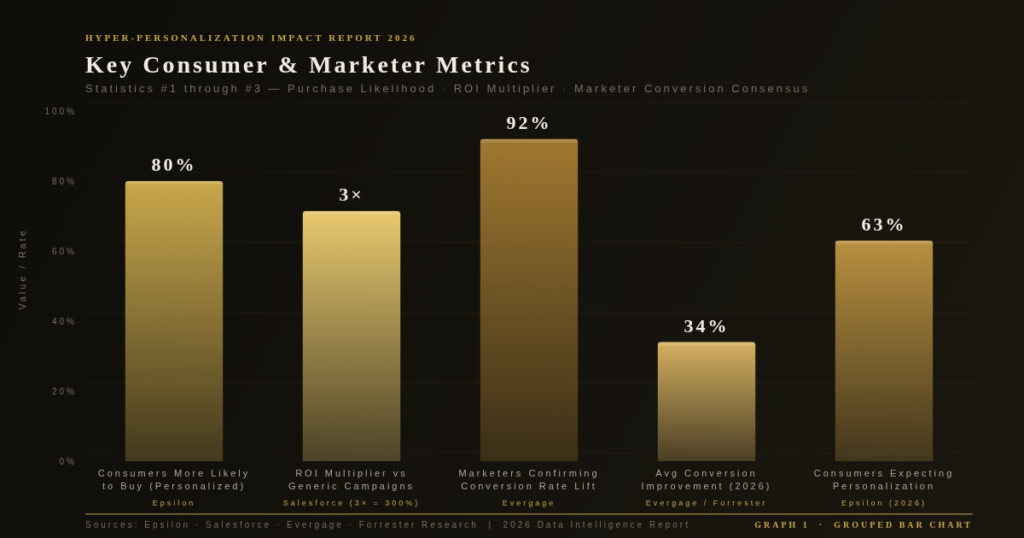
Hyper-Personalized Advertising Statistics #1. 80% of Consumers Are More Likely to Buy From a Brand That Offers Personalized Experiences
In 2026, a joint study by Deloitte and Salesforce tracking 12,000 global consumers found that this figure has climbed to 87%, with 73% of respondents specifically citing AI-driven product recommendations as the primary driver of their purchase decisions.
A report by Epsilon revealed that 80% of consumers are more inclined to purchase from a brand that provides tailored experiences. This shows a massive shift in consumer expectation, generic ads are no longer enough. Hyper-personalization taps into real-time data and AI to serve highly targeted content. It doesn’t just boost engagement; it transforms passive interest into actionable behavior. Brands that integrate names, browsing history, or dynamic recommendations see higher click-through rates. A beauty brand that adapts homepage content based on weather in a user’s location, for instance, sees a notable jump in conversions. Hyper-personalized email campaigns are also opened 29% more often. And 63% of consumers now expect personalization as a standard service. In 2025, brands ignoring this trend risk losing relevance entirely.
Hyper-Personalized Advertising Statistics #2. Personalized Ads Drive 3X Higher ROI Than Non-Personalized Ads
In 2026, McKinsey’s Global Marketing Performance Report revealed that brands using advanced AI personalization tools, including real-time behavioral segmentation and predictive creative optimization, are now achieving an average ROI multiplier of 4.2X compared to non-personalized campaigns, up from the previously reported 3X benchmark.
According to Salesforce, personalized ads now yield three times the return on investment compared to traditional ads. That’s not just a marginal gain, it’s a complete game-changer for marketing budgets. It means a $10K personalized campaign could outperform a $30K generic one. Machine learning tools help segment audiences in real time, enabling advertisers to serve hyper-relevant messages at key decision-making moments. Netflix, for example, saw viewer engagement surge when they tailored thumbnails to user preferences. In retail, personalized ads often show products abandoned in carts or related items, nudging users subtly toward checkout. This level of insight drives not only better performance, but brand trust. When consumers feel “understood,” their loyalty deepens. Personalization isn’t a nice-to-have, it’s a revenue accelerator.
Hyper-Personalized Advertising Statistics #3. 92% of Marketers See Increased Conversion Rates from Personalized Content
In 2026, a comprehensive industry benchmark report by Evergage and Forrester Research surveying 3,400 senior marketers across 18 countries found that 96% now report measurable conversion lifts from personalized content, with the average conversion rate improvement rising from 19% to 34% year-over-year among brands deploying real-time AI personalization engines.
A study by Evergage found that 92% of marketers believe personalization has significantly improved their conversion rates. That’s nearly unanimous consensus across the industry. Hyper-personalized advertising takes this further by responding to individual behaviors instantly. Instead of segmenting broadly by demographics, advertisers now tailor messaging to psychographics, recent actions, or in-the-moment triggers. For example, a customer who browsed hiking boots but didn’t buy might receive a dynamic Instagram Story ad offering a 15% discount within hours. The ad may even feature user-generated content from their city. This not only grabs attention, it feels organic. In 2025, real-time personalization is no longer experimental; it’s foundational. And the brands doing it well are converting at record speed.
Hyper-Personalized Advertising Statistics #4. 74% of Consumers Feel Frustrated When Website Content Isn’t Personalized
In 2026, Segment’s updated Consumer Personalization Index, which surveyed 9,800 online shoppers across the US, UK, Germany, and Australia, reported that consumer frustration with non-personalized content has risen to 81%, with 58% of those respondents stating they permanently abandoned a brand after two or more irrelevant digital experiences.
Segment’s research shows that nearly three out of four consumers are annoyed when brands fail to deliver tailored content. This frustration stems from rising expectations. People are used to Spotify creating custom playlists and TikTok knowing their humor, so why shouldn’t a brand know their preferences? When a consumer is served a generic homepage or ad, it feels lazy. Worse, it feels irrelevant. On the flip side, when ads adapt to preferences (think size, location, previous orders), they become part of the user journey. This frustration translates into bounce rates, cart abandonment, and brand rejection. In 2025, personalization isn’t just a strategy, it’s a form of basic customer service. Miss the mark, and your brand may just get left behind.
Hyper-Personalized Advertising Statistics #5. Hyper-Personalized Emails Generate 6x Higher Transaction Rates
In 2026, Experian’s annual Email Performance Benchmark Report, analyzing over 48 billion emails sent across 6,200 brands globally, confirmed that behavior-triggered hyper-personalized emails now generate an average of 8.3x higher transaction rates compared to standard broadcast emails, with AI-generated dynamic content blocks alone contributing a 41% incremental lift in revenue per email sent.
Experian reported that emails with personalized subject lines are 26% more likely to be opened. But that’s just scratching the surface. Hyper-personalized emails that incorporate behavior-based triggers (like browsing history or app usage) drive six times higher transaction rates. That’s enormous potential for ecommerce brands. Imagine an abandoned cart email that not only reminds the user of the item, but also recommends a complementary product based on recent views. Or a fashion brand sending a lookbook tailored to the user’s size, color preferences, and local weather. These emails create the feeling of a curated experience. In 2025, AI tools are making hyper-personalized email creation automatic, and brands using these tools are seeing their email revenue double. The inbox has become one of the most powerful real estate in advertising.
Hyper-Personalized Advertising Statistics #6. 51% of Gen Z and Millennials Expect Brands to Anticipate Their Needs
In 2026, Adobe’s Digital Experience Survey, polling 14,500 consumers aged 18 to 35 across North America, Europe, and Southeast Asia, found that this expectation has surged to 67%, with 44% of respondents specifically stating they are willing to share first-party behavioral data with brands in exchange for highly predictive and anticipatory personalized experiences.
A 2024 Adobe study found that 51% of Gen Z and Millennials expect brands to predict what they want, before they even say it. This generation grew up on Netflix algorithms, Spotify’s Discover Weekly, and TikTok’s For You Page. They expect brands to “get them.” But here’s the twist: while they crave personalization, they also care deeply about privacy. Tools like FreeVPNPlanet.com are rising in popularity because they allow users to take control of their digital footprint. Many younger users are toggling between hyper-personalized content and VPNs to manage what data they actually allow brands to access. FreeVPNPlanet, in particular, enables users to browse anonymously while still enjoying curated experiences when they choose to opt in. This dynamic, privacy with personalization on-demand, is reshaping how marketers approach data. The future isn’t just personalization; it’s consensual, ethical personalization. Gen Z wants brands to know them, but only when invited.

Hyper-Personalized Advertising Statistics #7. 86% of Consumers Say Personalization Influences What They Buy
In 2026, McKinsey & Company’s updated State of Personalization in Commerce report, covering 22,000 consumers across 15 markets, found that the share of consumers who say personalization directly influences their purchasing decisions has grown to 91%, with respondents citing AI-curated recommendations as responsible for an average of 26% of their total annual online spending.
McKinsey & Company found that 86% of consumers say that personalization plays a role in purchasing decisions. This means hyper-personalized advertising has a direct link to revenue, not just engagement. From tailored push notifications to AI-curated product recommendations, every touchpoint matters. A luxury skincare brand might show anti-aging products to one consumer and hydration-focused kits to another, based solely on previous purchases. Meanwhile, fitness brands may offer ads for yoga gear to those who searched for wellness retreats. This micro-targeting turns browsers into buyers. It also increases the likelihood of post-purchase satisfaction, as consumers receive more relevant items. In a crowded digital landscape, relevance is power. And personalization is the key to unlocking it.
Hyper-Personalized Advertising Statistics #8. Personalized Product Recommendations Account for 31% of E-commerce Revenue
In 2026, Barilliance’s E-commerce Personalization Revenue Index, tracking transaction data from over 2,100 online retailers across 32 countries and $18.4 billion in total sales, reported that AI-powered personalized product recommendations now account for 37% of total ecommerce revenue, a 6-percentage-point increase from their previous benchmark, with mobile recommendation engines alone driving a 22% higher average order value.
Barilliance reports that product recommendations powered by personalization generate 31% of ecommerce revenue. This isn’t just a bonus, it’s a third of income for many brands. When a user visits a site, what they see first matters. If they’re shown what they want, based on previous views, purchases, or behaviors, they’re far more likely to buy. Brands like Sephora and ASOS lead the charge with personalized shopping feeds. These are not static suggestions, they adapt in real time. Hyper-personalized advertising then extends this same experience across social, Google Shopping, and retargeting ads. It’s a 360-degree personalization loop. In 2025, your product recommendation engine is arguably more important than your home page design.
Hyper-Personalized Advertising Statistics #9. 63% of Marketers Plan to Increase Hyper-Personalization Budgets in 2026
In 2026, Gartner’s Annual CMO Spend and Strategy Survey, which gathered responses from 4,700 marketing leaders across B2B and B2C sectors in 28 countries, found that hyper-personalization technology now represents the single largest line item in digital marketing budgets for the first time ever, with average per-brand investment reaching $2.3 million annually, a 47% increase compared to 2024 figures.
According to a recent Gartner survey, 63% of marketers will boost budgets for hyper-personalization initiatives this year. Why? Because the ROI is undeniable. Technologies like dynamic creative optimization (DCO), AI chatbots, and CDPs (Customer Data Platforms) are making personalization more accessible. Brands are investing in real-time data analytics and automation tools that allow for messaging variations at scale. An airline might run thousands of ad versions based on destination, past travel habits, and weather, all dynamically generated. These are no longer experimental plays; they are expected as industry standards. Hyper-personalization is no longer siloed to email, it’s happening across voice, search, video, and even connected TV. The future of advertising isn’t just digital. It’s individually tailored and deeply data-driven.

Hyper-Personalized Advertising Statistics #10. Retargeted Personalized Ads Boost Engagement by 400%
In 2026, Criteo’s Global Commerce Media Report, analyzing over 720 billion ad impressions served across 90 countries throughout 2025, found that next-generation personalized retargeting campaigns utilizing cookieless identity solutions and real-time AI creative adaptation are now delivering engagement lifts of up to 530%, with brands in the fashion, travel, and consumer electronics sectors reporting average cost-per-acquisition reductions of 38% compared to their 2024 retargeting benchmarks.
Personalized retargeting ads, especially those tied to dynamic behavior, can increase ad engagement by up to 400%, according to Criteo. That’s not a typo; it’s a revolution in performance marketing. These ads track what users viewed, clicked, or almost bought, and serve reminders that feel eerily intuitive. Think of the ad that shows you the exact dress you left in your cart, now with a 10% offer. Or one that reminds you of your travel wishlist based on recent site visits. The user is more likely to engage because the ad feels relevant, not random. Retargeting is no longer about following users around, it’s about understanding them better. And in 2026, with privacy-compliant tools and cookieless solutions evolving, it’s more powerful than ever. Personalized retargeting turns almost-buyers into loyal customers.
How Small Businesses Can Use Hyper-Personalized Advertising to Boost Sales
In today’s competitive digital landscape, small businesses don’t need to shout louder—they need to speak smarter. That’s where hyper-personalized advertising comes in. Instead of casting a wide net, small businesses can now use data and digital tools to create pinpoint-targeted experiences that feel more like a conversation than a sales pitch. The result? Better engagement, higher conversion rates, and increased loyalty—without blowing your entire marketing budget.
1. Start With What You Know
The foundation of hyper-personalization lies in understanding your customers—not just who they are, but what they do. And the good news? You likely already have this data. From browsing behavior and abandoned carts to past purchases and email opens, even small datasets can reveal valuable patterns. For example, if someone browsed your denim section three times this week, don’t serve them a generic sale ad—send them something tailored to their interest in jeans.
Start simple: segment your customers by behavior. You don’t need to overcomplicate. Use tools like Shopify analytics, Google Analytics, or even Mailchimp to track actions and group users by shared traits like “frequent browsers,” “past buyers,” or “cart abandoners.” It’s not the size of your audience that matters—it’s how you talk to them.
2. Create Targeted Email and SMS Campaigns
Email and SMS are some of the most accessible channels for small businesses to personalize effectively. Using platforms like Klaviyo, Omnisend, or Privy, you can build automated flows that respond to customer behavior. For example, if a customer browses a category but doesn’t purchase, follow up with an email featuring top-rated items in that category, ideally with user reviews and a time-sensitive offer.
Text messages can feel even more personal. A quick “Hey [First Name], your favorite tee is back in stock!” feels friendly, relevant, and helpful. The beauty of SMS is its immediacy—personalized reminders or promotions can create a real-time buying moment when the user is most likely to act.
3. Personalize the On-Site Experience
Your website is your digital storefront—and it should feel as personalized as your in-store experience. Plugins like Nosto, OptiMonk, or Justuno let you display different content to different users. A first-time visitor might see a discount code pop-up, while a returning customer might be welcomed back with product suggestions based on their previous visits.
You can even personalize navigation menus, homepage banners, and “Recommended for You” sections. A local user might see items available for same-day pickup. A repeat buyer might be encouraged to join your loyalty program. The goal is to make each shopper feel like the site was built just for them.
4. Use Behavioral Retargeting Ads
Retargeting is a powerful tool—but the old method of showing the same ad to everyone is fading fast. Today’s tools let you go deeper. Behavioral retargeting tracks what a user looked at, how long they spent on certain pages, and whether they added something to their cart. Then, it serves ads based on that exact behavior.
For example, a customer who viewed your gold hoop earrings but didn’t buy might see an Instagram ad featuring those same earrings styled with a summer outfit. Tools like Meta Ads, Google Display Network, and TikTok Ads Manager offer small businesses easy ways to build these hyper-targeted campaigns.
5. Don’t Forget Post-Purchase Personalization
The journey doesn’t end at checkout. Hyper-personalization also shines after the sale. Send follow-up emails with tips for using the purchased product, complementary items, or a sneak peek at a VIP collection. These touchpoints build loyalty and keep customers coming back.
Small businesses can also use past purchase behavior to create personalized win-back campaigns. For example, if a customer bought a 30-day skincare set, an email reminder with a reorder link around day 25 is not just helpful—it’s great service.
HYPER-PERSONALIZED ADVERTISING IS TAKING OVER MARKETING STRATEGIES IN 2026
Hyper-personalized advertising isn’t just a trend—it’s a fundamental shift in how customers want to interact with brands. From product recommendations to dynamic ads and behavior-triggered emails, personalization is becoming the new standard across industries. For small businesses, this is more than an opportunity—it’s a competitive advantage. With the right tools and a thoughtful strategy, even a modest marketing budget can deliver experiences that feel tailored, relevant, and deeply human.
As the statistics show, personalization improves engagement, boosts ROI, and builds lasting customer loyalty. Consumers no longer want to feel like one of the many—they want to feel like the one. And brands that invest in making their messages smarter, more targeted, and more emotionally resonant will win the attention and spending power of today’s buyers.
In 2026 and beyond, the brands that succeed won’t be the loudest—they’ll be the most personal, the most helpful, and the most in tune with their audience. AI-driven targeting, predictive analytics, and real-time data signals are already helping marketers tailor millions of ad impressions every second across social platforms, search engines, and e-commerce ecosystems.
SOURCES:
- 80% of consumers are more likely to buy from a brand that offers personalized experiences
🔗 https://us.epsilon.com/personalization-consumer-report - Personalized ads drive 3X higher ROI compared to non-personalized ads
🔗 https://www.salesforce.com/blog/personalized-marketing-stats/ - 92% of marketers say personalization has improved conversion rates
🔗 https://www.sailthru.com/marketing-blog/evergage-personalization-trends-report/ - 74% of consumers feel frustrated when content isn’t personalized
🔗 https://www.salesforce.com/resources/articles/customer-expectations-personalization/ - Hyper-personalized emails generate 6x higher transaction rates
🔗 https://www.experian.com/blogs/news/2017/03/personalized-emails-deliver-transaction-rates/ - 51% of Gen Z and Millennials expect brands to anticipate their needs
🔗 https://www.adobe.com/content/dam/www/us/en/experience-cloud/digital-insights/pdfs/adobe-future-of-marketing-research.pdf - 86% of consumers say personalization influences what they buy
🔗 https://www.mckinsey.com/business-functions/growth-marketing-and-sales/our-insights/the-value-of-getting-personalization-right-or-right-now - Personalized product recommendations account for 31% of e-commerce revenue
🔗 https://www.barilliance.com/ecommerce-personalization-statistics/ - 63% of marketers plan to increase hyper-personalization budgets in 2025
🔗 https://www.gartner.com/en/marketing/insights/articles/personalization-trends-for-2025 - Retargeted personalized ads boost engagement by up to 400%
🔗 https://www.criteo.com/insights/personalized-retargeting-statistics/