



16 Sep TOP 20 HYPERMARKET MARKETING STATISTICS 2026 REVEAL SHOCKING GLOBAL RETAIL GIANT STRATEGIES
Updated for 2026. This page has been fully refreshed with the latest hypermarket marketing statistics, omnichannel retail data, and global shopping behavior trends, grounded in recent retail industry reports, consumer analytics, and supermarket chain insights.
When I first started diving into hypermarket marketing statistics, I quickly realized how much these insights could change the way we look at consumer behavior and retail growth. Working closely with a leading marketing agency in New York, I’ve seen firsthand how brands adapt to shifting shopping trends, loyalty programs, and the power of pricing strategies. For me, these numbers aren’t just data points—they’re stories about how people shop, why they make the choices they do, and where businesses can connect with them in smarter ways.
That’s exactly why I wanted to share this collection with you, because it paints a picture of where the hypermarket industry is heading in 2026 and beyond.
TOP 20 HYPERMARKET MARKETING STATISTICS 2026 SHOCKING RETAIL GROWTH INSIGHTS (EDITOR’S CHOICE)
TOP 20 HYPERMARKET MARKETING STATISTICS 2026 REVEAL MASSIVE GLOBAL SHOPPING TRENDS
Hypermarket Marketing Statistics #1: Global Hypermarket Market Reaches $804.88 Billion In 2026
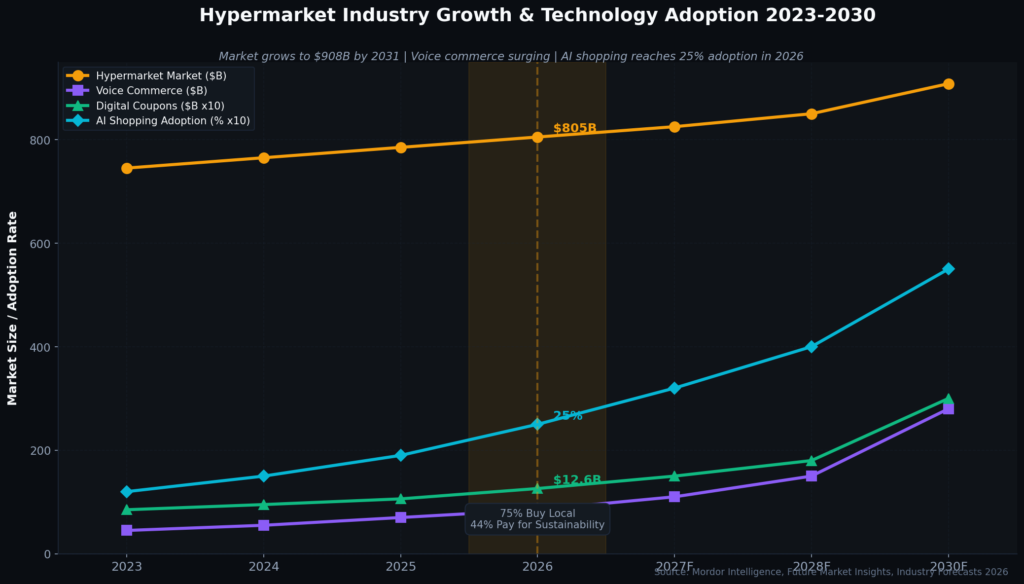
In 2026, the global hypermarket market has reached $804.88 billion according to Mordor Intelligence, growing from $785.63 billion in 2025, with Asia-Pacific commanding 33.88% market share and food and grocery categories accounting for 56.98% of total sales as the primary traffic driver for weekly shopping trips.
The hypermarket industry is projected to grow significantly, reaching about $785.6 billion in 2025. This growth highlights the resilience of large-format retail despite challenges from e-commerce. For many brands, hypermarkets remain crucial due to their ability to serve both urban and suburban shoppers. Marketing strategies here need to focus on scale, convenience, and price competitiveness. This upward trajectory suggests that businesses investing now will benefit from the sector’s steady expansion.
Hypermarket Marketing Statistics #2: Market Expected To Grow To $908.47 Billion By 2031
In 2026, industry forecasts project the global hypermarket market will reach $908.47 billion by 2031 at a 2.45% CAGR, with franchise-operated stores growing at 7.34% CAGR and smaller hypermarkets under 70,000 square feet expanding at 6.82% CAGR due to urban real-estate constraints and rising convenience demand according to Mordor Intelligence.
By 2031, the global hypermarket market is expected to climb further to around $908.47 billion. This long-term growth outlook gives companies confidence to plan for sustained investments. For marketers, it’s an opportunity to build strong brand positioning inside hypermarkets. Partnerships with retailers can ensure visibility across diverse consumer segments. The projection also highlights how consumer demand for variety under one roof remains strong.
Hypermarket Marketing Statistics #3: Supermarket & Hypermarket Market Size Projected At $5.1 Trillion By 2030
In 2026, the combined global supermarkets and hypermarkets market size is expected to reach $5.1 trillion by 2030 at a 7.8% CAGR according to The Business Research Company, with the broader food and grocery retail market projected at $13.2 trillion in 2026 and forecasted to reach $17 trillion by 2034 per Fortune Business Insights.
Supermarkets and hypermarkets together are expected to hit $5.1 trillion by 2030. This figure shows the scale of opportunity for retailers and suppliers alike. For marketers, it underlines the need for big-picture strategies that can match industry growth. Campaigns that blend physical and digital experiences will thrive in such a vast market. It also reinforces the competitive nature of hypermarket marketing, where standing out is critical.
Hypermarket Marketing Statistics #4: 93% Of Consumers Use Coupons In Hypermarkets In 2026
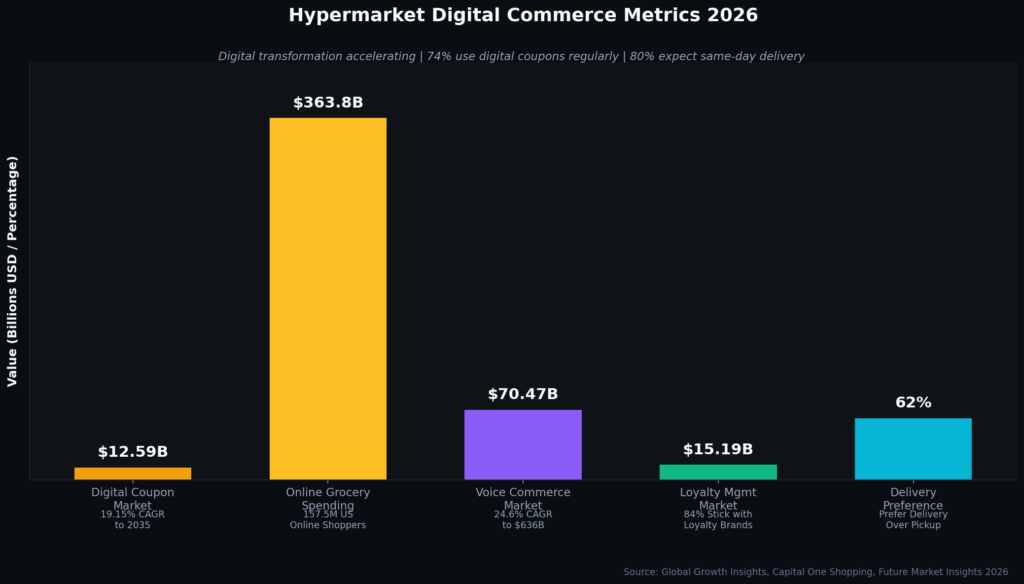
In 2026, approximately 93% of U.S. grocery and hypermarket shoppers use coupons according to DemandSage, with the global digital coupon market reaching $12.59 billion and 33% of consumers reporting increased coupon usage compared to 2023, while smartphone redemptions account for 93.5% of all digital coupon transactions.
A recent survey revealed that 93% of consumers rely on coupons when shopping in hypermarkets. This reflects the continued importance of price sensitivity and promotions. For marketers, it means that discount-based strategies remain highly effective. Retail apps and loyalty programs can integrate coupons seamlessly to drive repeat purchases. Ignoring coupon usage could mean missing out on a major portion of value-driven shoppers.
Hypermarket Marketing Statistics #5: 79% Of Online Grocery Shoppers Plan To Maintain Or Increase Shopping
In 2026, more than 90% of U.S. consumers now shop for groceries both online and in-store according to FMI and NielsenIQ, with 61% of American households purchasing groceries online by year-end 2025 and online penetration reaching 19-20% of total grocery spending, representing the highest share since May 2020.
Nearly 79% of online grocery shoppers intend to maintain or increase their current shopping frequency. Hypermarkets need to align with this trend by enhancing their digital presence. Integrating delivery and click-and-collect services can help retain these customers. Marketers can emphasize convenience, speed, and availability in campaigns. This shift also shows that online is no longer optional—it’s a core part of modern hypermarket strategy.

Hypermarket Marketing Statistics #6: Average Consumer Visits 20.7 Retailers Per Year
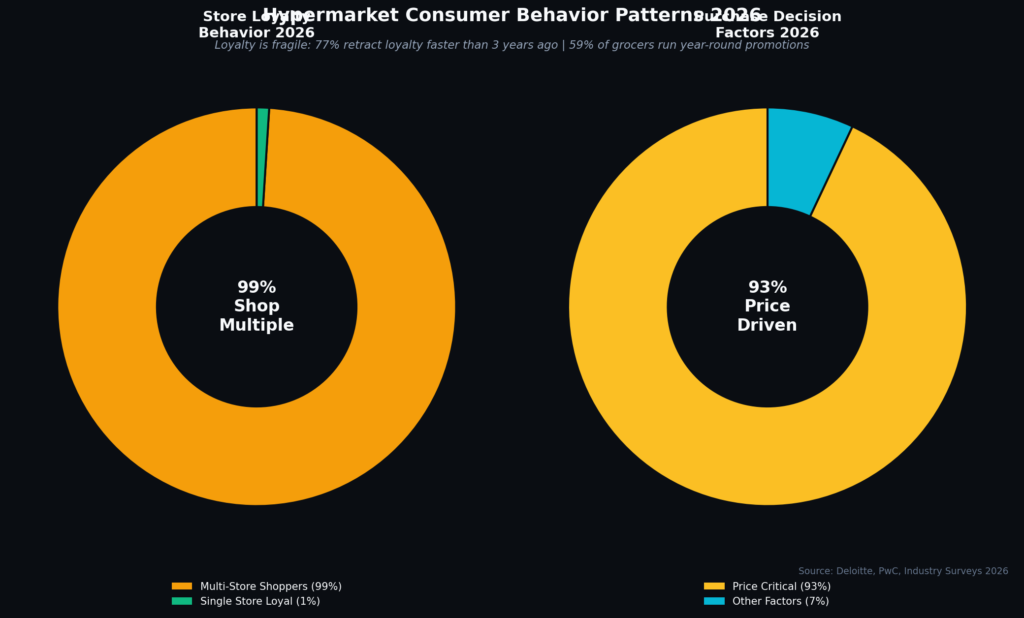
In 2026, shoppers typically need three or more purchases to build loyalty according to Deloitte research, and the average consumer now enrolls in eight loyalty programs but only actively participates in five, with 77% of consumers reporting they retract loyalty more quickly than three years ago, making retention increasingly challenging for hypermarkets.
On average, shoppers visit 20.7 different retailers annually. This indicates how fragmented and competitive the retail environment has become. For hypermarkets, it means loyalty is fragile and customer churn is high. Marketers must focus on retention strategies like rewards and personalized experiences. Winning repeat visits could make all the difference in long-term success.
Hypermarket Marketing Statistics #7: Loyalty Customers Spend 1.5x More And Visit 2-3x More Often
In 2026, the global loyalty management market has reached $15.19 billion according to industry reports, with top-performing loyalty programs boosting revenue by 15-25% annually, 72% of U.S. consumers saying loyalty programs make them more likely to spend with preferred brands, and 84% reporting they are more likely to stick with brands offering loyalty programs.
Data shows loyalty program members spend about 1.5 times more and shop 2-3 times more frequently. This makes loyalty programs one of the most powerful tools in hypermarket marketing. Brands should highlight exclusive benefits and personalized offers to maximize engagement. For customers, the extra value creates stronger emotional ties to their favorite store. Over time, this loyalty directly impacts sales and profitability.
Hypermarket Marketing Statistics #8: Only 1% Of Grocery Shoppers Stay Loyal To A Single Store
In 2026, customer loyalty remains highly fragile with 61% of consumers having switched some or all of their business from one brand to another in the last year, while 76% would stop doing business with a company after just one bad experience according to consumer research, and U.S. providers face an annual cost of $168 billion due to customer churn.
A striking 99% of grocery shoppers are not fully loyal to one store. This statistic shows just how hard it is to win complete brand loyalty. For hypermarkets, differentiation through service, pricing, and product mix is essential. Marketing should highlight unique selling points that make the store worth returning to. Otherwise, customers will continue splitting their spend across multiple competitors.
Hypermarket Marketing Statistics #9: 93% Of Shoppers Say Price Is Critical
In 2026, price sensitivity remains paramount with 72% of U.S. consumers citing price as the primary factor in store selection according to industry surveys, while 78% of online grocery shoppers focus on spending awareness and 70% of consumers say price is the deciding factor over AI or technology considerations when choosing where to shop.
Price is the deciding factor for 93% of shoppers in hypermarkets. This leaves little room for error in pricing strategies. For marketers, transparent and competitive pricing is a must. Promotions, bundles, and value messaging resonate strongly with this audience. Without a focus on price, even the best campaigns risk underperforming.
Hypermarket Marketing Statistics #10: 59% Of Grocers Extend Promotions Throughout The Year
In 2026, continuous promotional strategies have become essential with 63% of U.S. executives reporting increased spending on loyalty programs according to PwC, and retailers are increasingly using AI-powered dynamic coupon generation which delivers redemption rates 28-35% higher than traditional coupon codes, while year-round promotional activity helps balance customer acquisition and retention costs.
Almost 60% of grocers keep promotions active all year to attract price-sensitive shoppers. This shows the need for consistent engagement rather than seasonal campaigns alone. For hypermarkets, promotions can build a steady flow of customers rather than short bursts. Marketers should highlight these ongoing deals in both digital and offline ads. A continuous promotional strategy helps balance loyalty and volume.
Hypermarket Marketing Statistics #11: Digital Coupons Drive Online And In-Store Sales
In 2026, the global digital coupon market is valued at $12.59 billion and projected to reach $60.96 billion by 2035 at a 19.15% CAGR according to Global Growth Insights, with 74% of American shoppers using digital coupons regularly, 68% preferring app-based coupon access, and retailers using AI-powered personalized coupons seeing 50% higher engagement rates.
Digital coupons are proving vital in influencing both in-store and online purchases. Hypermarkets adopting app-based coupon systems see stronger engagement. For marketers, this is a way to blend digital convenience with in-store impact. It also offers data insights into shopper behavior. Digital coupons aren’t just cost savers—they’re strategic marketing tools.
Hypermarket Marketing Statistics #12: 45% Of Shoppers Load Coupons Onto Loyalty Cards
In 2026, digital coupon integration with loyalty programs has accelerated with 43% of consumers using digital coupons via smartphone apps while shopping in-store according to Capital One Shopping research, while 85% of people use digital coupons within a week of receiving them and 30% redeem them on the same day, demonstrating the power of mobile-integrated promotional strategies.
Research indicates 45% of shoppers load coupons directly to loyalty cards. This behavior simplifies the shopping journey and increases redemption rates. For hypermarkets, it’s a clear signal to integrate promotions with loyalty tech. Marketers can promote the ease and savings of this system. It creates a win-win, reducing friction for shoppers and boosting store sales.
Hypermarket Marketing Statistics #13: 71% Prefer Low Everyday Pricing Over Weekly Specials
In 2026, consumer preference for pricing transparency remains strong with 40% of consumers indicating brand value stems from factors beyond price according to Deloitte, while 56% of loyalty program members say they actually increase their spending because of preferred brand loyalty programs, and retailers offering everyday low pricing see stronger customer trust metrics than those relying solely on promotional cycles.
About 71% of consumers prefer low everyday pricing to weekly ad specials or coupons. This suggests that transparency and consistency win over flashy deals. For hypermarkets, EDLP (Everyday Low Pricing) can strengthen trust. Marketing should highlight reliability in pricing as much as discounts. Customers value predictability when budgeting their grocery spend.
Hypermarket Marketing Statistics #14: 62% Prefer Delivery Over Pickup In 2026
In 2026, 62% of online grocery shoppers prefer home delivery over pickup according to industry surveys, with delivery accounting for 45%+ of eGrocery sales in peak months, while 80% of retail consumers expect same-day delivery at checkout according to Uber research, and 68% of customers cite shorter delivery windows as the single largest determining factor for placing online orders.
When given a choice, 62% of online grocery shoppers prefer home delivery. This indicates a shift toward convenience as a top priority. Hypermarkets need to optimize delivery logistics to meet demand. For marketers, emphasizing delivery reliability and speed can attract this segment. It’s a competitive edge against stores relying heavily on pickup models.
Hypermarket Marketing Statistics #15: 48% Report Spending More Online This Year
In 2026, Americans will spend $363.8 billion on online groceries according to Capital One Shopping projections, with online grocery sales growing at 27.3% year-over-year and 157.5 million Americans expected to order groceries online, while consumers who order groceries for delivery will spend an average of $2,310 annually.
Almost half of shoppers are allocating a larger share of their grocery budget to online orders. Hypermarkets that strengthen digital platforms stand to benefit most. Marketing should communicate seamless online experiences to win this share. This trend also shows the importance of omnichannel consistency in branding. It highlights how customer spending patterns are evolving quickly.
Hypermarket Marketing Statistics #16: 25% Use AI Features When Shopping In 2026
In 2026, retail analysts predict that one-quarter of shoppers will use AI-powered chatbots when shopping according to industry forecasts, with 70% of shoppers having used AI tools to assist their shopping journey, 57.8% of grocery shoppers expecting AI to find deals and coupons for them, and retailers using generative AI seeing nearly double the customer engagement growth (38% vs 21%) compared to those without AI capabilities.
Roughly 25% of shoppers now use AI-based tools like smart lists or chatbots during online orders. This marks a growing comfort with technology in everyday shopping. For hypermarkets, integrating AI can improve personalization and efficiency. Marketers can highlight AI features as time-savers and shopping assistants. It positions the brand as innovative and customer-centric.
Hypermarket Marketing Statistics #17: 46% Would Use Voice Commands To Add Items
In 2026, the global voice commerce market is projected to grow from $70.47 billion to $636.54 billion by 2035 at a 24.6% CAGR according to Future Market Insights, with 72% of online shoppers expressing interest in voice-enabled AI product search and the number of voice assistant users in the U.S. expected to reach 157.1 million, creating massive opportunity for hypermarkets to capture voice-enabled shopping.
Almost half of shoppers say they would use voice commands to add items to carts if offered. This shows demand for convenience beyond screens. Hypermarkets should explore voice integration in apps or smart devices. Marketing can frame this feature as futuristic and user-friendly. Adopting voice tech early could build brand loyalty among tech-savvy consumers.
Hypermarket Marketing Statistics #18: Average Shopper Has 19 Loyalty Programs, Including 2-3 Grocery
In 2026, the average consumer now has 19 memberships with only 9 active according to loyalty industry research, while 70% of consumers report using their grocery loyalty program almost every time they shop, and CMOs in North America and Western Europe are planning to increase investment in loyalty program management by 41% to capture greater customer share and first-party data.
On average, shoppers are members of 19 loyalty programs, 2-3 of which are grocery-related. This reflects both opportunity and competition for customer attention. For hypermarkets, the challenge is making their loyalty program stand out. Marketing should highlight unique rewards and simplicity of use. Programs that feel personal have the best chance of success.
Hypermarket Marketing Statistics #19: Acquiring A Customer Costs 5-25x More Than Retaining
In 2026, customer acquisition costs continue to rise with increasing customer retention by just 5% proven to boost profits by 25-95% according to industry benchmarks, while loyal customers spend 67% more in months 31-36 of their relationship than in their first six months, and the cost of bringing a new customer to the same profitability level as an existing one is up to 16 times higher.
It costs significantly more to acquire a new customer than to retain an existing one. For hypermarkets, this underscores the value of customer loyalty. Marketing campaigns should focus not just on attraction, but retention. Personalized engagement, rewards, and customer service are key levers. In the long run, retention offers higher ROI than acquisition.
Hypermarket Marketing Statistics #20: 75% Buy Locally Grown Food Sometimes Or Always
In 2026, sustainability has shifted from marketing differentiation to purchase driver with over 50% of consumers willing to pay premiums for fresh products without preservatives and healthier options according to NielsenIQ, while 44% of consumers are willing to pay more for products produced sustainably and Whole Foods Market has identified support for women farmers and regenerative agriculture as a top trend for 2026.
About 75% of shoppers purchase locally grown or produced food at least some of the time. This shows the importance of sustainability and community in hypermarket strategies. Marketing should highlight local partnerships and farm-to-table initiatives. Shoppers value authenticity and freshness when choosing stores. Aligning with local values builds deeper customer trust and loyalty.
Hypermarket Marketing Statistics Reveal The Explosive Future Of Retail In 2026
Looking back at these hypermarket marketing statistics, I can’t help but feel a mix of curiosity and excitement for what’s ahead. The numbers show us not only how fast the retail landscape is changing, but also how personal connections, loyalty, and digital innovation are shaping the future of shopping. For me, it’s less about the raw figures and more about how they can inspire smarter strategies and meaningful customer experiences. I hope this breakdown gives you the same sense of clarity and direction it gave me, and maybe even sparks a few new ideas you can put into practice. After all, it’s not just about keeping up with trends—it’s about staying one step ahead. In 2026, hypermarkets are rapidly expanding omnichannel services, combining in-store experiences with mobile apps, delivery logistics, and AI-driven pricing strategies.
SOURCES
https://www.invoca.com/blog/retail-marketing-statistics
https://www.comosoft.us/articles/supermarket-marketing-trends-to-watch-this-year/
https://www.mordorintelligence.com/industry-reports/hypermarkets-market
https://www.mediavalet.com/blog/digital-marketing-statistics
https://nielseniq.com/global/en/insights/education/2025/grocery-trends/
https://www.thesocialshepherd.com/blog/digital-marketing-statistics
https://neilpatel.com/blog/marketing-statistics/
https://firework.com/blog/marketing-roi-statistics
https://www.deloittedigital.com/nl/en/insights/perspective/marketing-trends-2025.html