



17 Jan In-House Web Development vs. Outsourcing: Which Is Better for Growing Brands?
In today’s competitive healthcare landscape, standing out requires more than just offering good coverage — it’s about building trust, clarity, and genuine connection. That’s where effective health insurance marketing strategies come in. As a leading marketing agency in New York, we’ve seen firsthand how the right mix of education, digital engagement, and personalized outreach can transform how people view and choose their health plans. Whether you’re an independent agent or part of a national insurer, these proven strategies are designed to help you connect authentically, earn trust, and grow your customer base with purpose and precision—often supported by scalable digital platforms built through reliable software development outsourcing services.
In-House Web Development vs. Outsourcing: Which Is Better for Growing Brands? (Editor’s Choice)
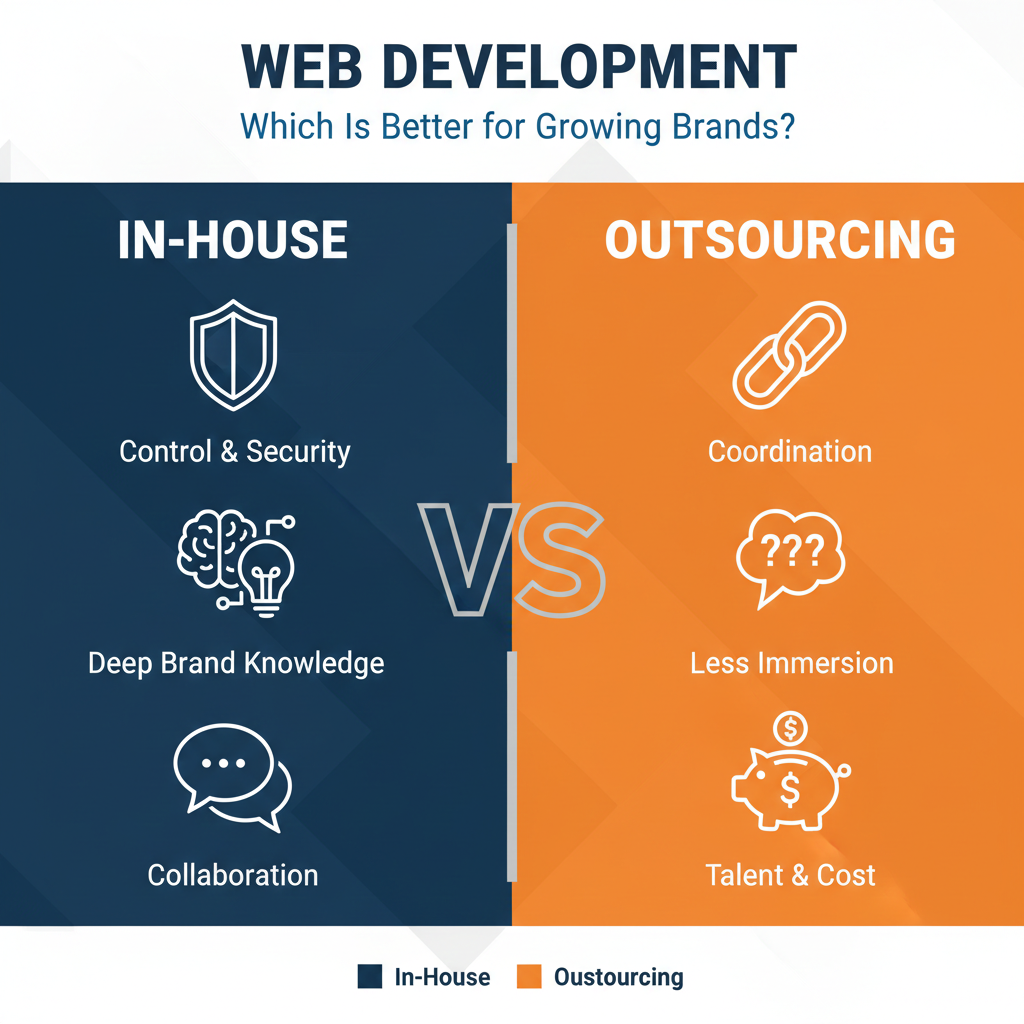
In-House Web Development vs. Outsourcing
A side-by-side look at the advantages and tradeoffs growing brands must consider.
Advantages
01. Full Control & Faster Decisions
In-house teams give you direct control over priorities, timelines, and workflows. Changes can be made instantly without renegotiating scope or waiting on third-party availability.
02. Deep Brand & Product Knowledge
Internal developers understand your brand voice, audience, and business goals at a deeper level, leading to more aligned UX, cleaner integrations, and fewer revisions.
03. Easier Cross-Team Collaboration
Proximity to marketing, design, and leadership enables faster feedback, real-time collaboration, and smoother execution—especially during launches or rebrands.
04. Greater Data Security & Ownership
Sensitive systems, customer data, and internal tools stay within your organization, reducing dependency on external vendors and minimizing security risks.
05. Long-Term Capability Building
An in-house team becomes a long-term asset, building institutional knowledge and improving efficiency over time as systems mature.
06. Consistent Code Standards
Internal teams maintain consistent development practices, documentation, and architecture without adapting to different vendor styles or handoffs.
07. Strong Alignment With Business Strategy
In-house developers are invested in company success, making them more proactive in suggesting improvements tied directly to growth goals.
Tradeoffs
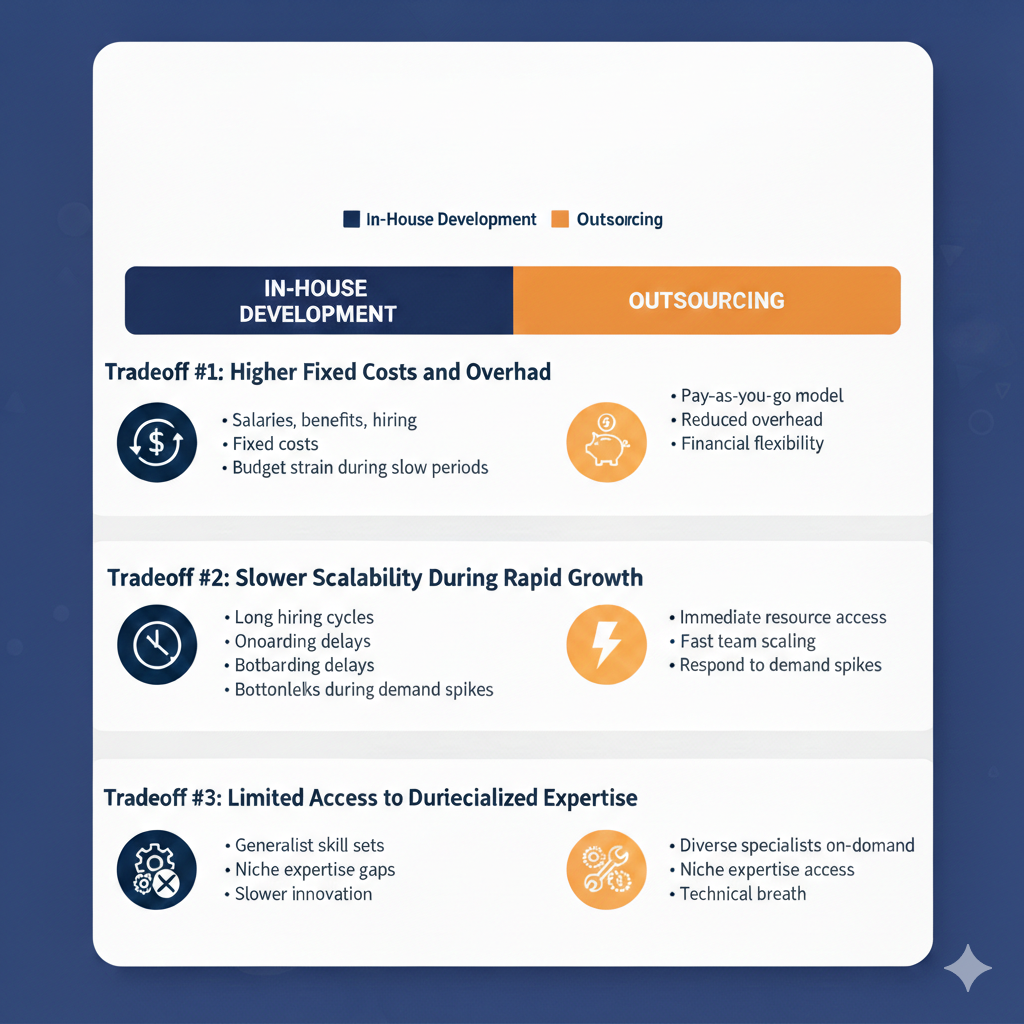
08. Higher Fixed Costs
Salaries, benefits, tools, onboarding, and management create significant overhead compared to flexible outsourcing models.
09. Slower Team Scaling
Hiring takes time. During peak demand or rapid growth, internal teams may struggle to scale as quickly as outsourced partners.
10. Limited Specialized Expertise
Most in-house teams can’t cover every specialty—such as performance optimization, accessibility, or advanced DevOps—without additional hires.
11. Recruitment & Retention Challenges
Attracting and retaining top engineering talent is competitive and time-consuming, especially for growing brands.
12. Bandwidth Constraints
When priorities pile up, internal teams can become bottlenecks, delaying campaigns, feature releases, or optimizations.
13. Slower Adoption of New Technologies
Without external exposure, in-house teams may be slower to adopt new tools, frameworks, or best practices.
14. Opportunity Cost
Time and resources spent managing an internal team could otherwise be invested in growth initiatives supported by specialized outsourcing partners.
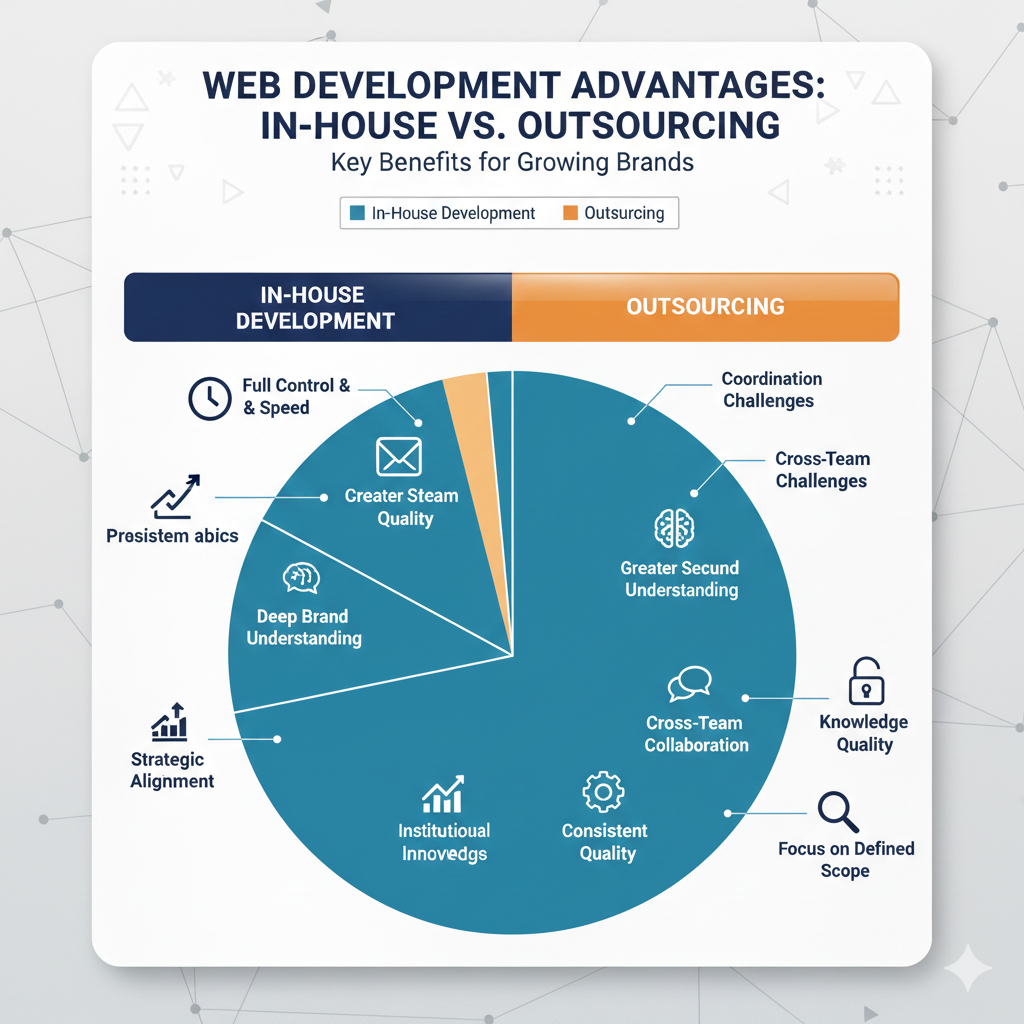
In-House Web Development vs. Outsourcing – Advantages
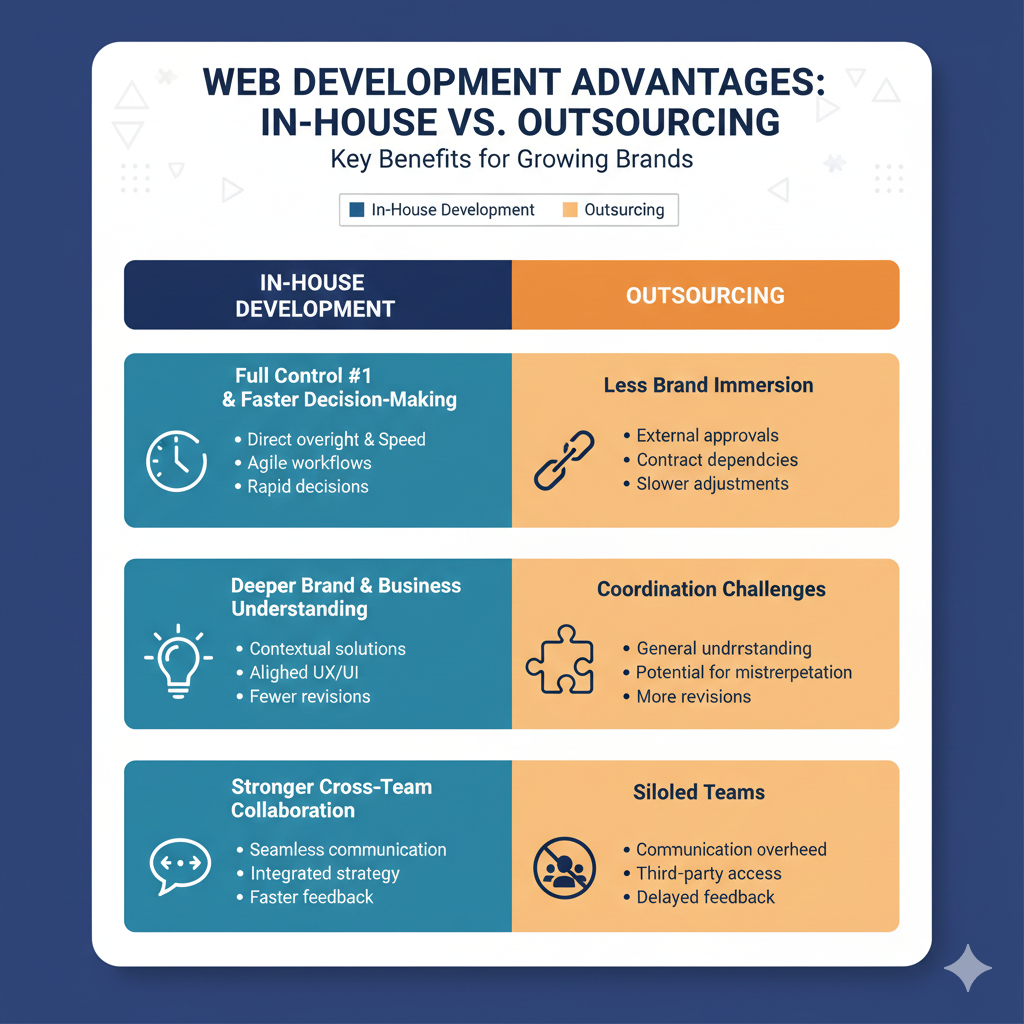
In-House Web Development vs. Outsourcing Advantage #1: Full Control and Faster Decision-Making
One of the biggest advantages of in-house web development is the level of control it provides over priorities, workflows, and timelines. Because developers are embedded within the organization, changes can be implemented quickly without waiting for external approvals or contract adjustments. This allows teams to respond faster to shifting marketing strategies, customer feedback, or leadership decisions. In contrast, outsourcing often requires additional coordination, documentation, and renegotiation of scope. For growing brands, this speed and autonomy can be a significant competitive advantage.
In-House Web Development vs. Outsourcing Advantage #2: Deeper Brand and Business Understanding
In-house developers gain a deep understanding of the brand, its audience, and its long-term business objectives. Over time, they become familiar with customer journeys, conversion funnels, and internal systems that influence technical decisions. This context leads to more thoughtful UX choices, cleaner integrations, and fewer revisions. Outsourced teams may deliver strong execution, but they often lack the same level of brand immersion. For companies focused on consistency and differentiation, this internal knowledge creates lasting value.
In-House Web Development vs. Outsourcing Advantage #3: Stronger Cross-Team Collaboration
Having developers in-house makes collaboration with marketing, design, sales, and product teams far more seamless. Real-time communication reduces misunderstandings and speeds up feedback loops during launches or campaign rollouts. Developers can participate in strategy discussions rather than simply executing tickets. This alignment ensures technical decisions support broader business goals, not just short-term deliverables. As a result, projects tend to move faster and with fewer costly revisions.
In-House Web Development vs. Outsourcing Advantage #4: Greater Security and Ownership of Assets
In-house development offers greater control over sensitive data, proprietary systems, and internal tools. Source code, infrastructure access, and customer information remain fully within the organization. This reduces dependency on third parties for maintenance, emergency fixes, or long-term support. Outsourcing can introduce security considerations that require additional oversight and governance. For brands handling regulated data or proprietary platforms, ownership and control are critical advantages.
In-House Web Development vs. Outsourcing Advantage #5: Long-Term Capability and Knowledge Building
An internal development team becomes a long-term asset that grows alongside the business. Over time, developers accumulate institutional knowledge that improves efficiency, stability, and scalability. Systems evolve with a clear understanding of past decisions and future goals. While outsourcing can deliver fast results, knowledge often leaves when contracts end. In-house teams ensure continuity and sustained improvement over the long run.
In-House Web Development vs. Outsourcing Advantage #6: Consistent Development Standards and Quality
In-house teams follow consistent coding standards, documentation practices, and architectural decisions across all projects. This uniformity reduces technical debt and makes maintenance easier over time. With outsourcing, brands often work with multiple vendors, each bringing different methodologies and quality benchmarks. Internal teams provide predictability and stability in how systems are built and maintained. This consistency is especially valuable as platforms scale in complexity.
In-House Web Development vs. Outsourcing Advantage #7: Stronger Alignment With Long-Term Business Strategy
In-house developers are closely aligned with leadership goals and long-term growth plans. They are more likely to proactively suggest improvements that support scalability, performance, and customer experience. Because they are invested in the company’s success, their decisions go beyond short-term execution. Outsourced teams typically focus on delivering defined scopes rather than shaping strategy. For growing brands, this strategic alignment can drive more sustainable outcomes.
In-House Web Development vs. Outsourcing – Take Offs
In-House Web Development vs. Outsourcing Tradeoff #2: Slower Scalability During Rapid Growth
Scaling an in-house team is rarely fast or simple. Recruiting skilled developers takes time, and onboarding can delay productivity for months. When demand spikes—such as during product launches or major campaigns—internal teams may struggle to keep up. Outsourcing provides immediate access to additional resources without long hiring cycles. This limitation can create bottlenecks at critical moments of growth.
In-House Web Development vs. Outsourcing Tradeoff #3: Limited Access to Specialized Expertise
Most in-house teams are built around generalist skill sets rather than deep specialization. Expertise in areas like performance optimization, accessibility compliance, advanced DevOps, or complex integrations often requires dedicated specialists. Hiring for every niche is rarely practical or cost-effective. By contrast, software development outsourcing services typically offer access to diverse specialists on demand. Without this breadth, in-house teams may face technical constraints or slower innovation.
In-House Web Development vs. Outsourcing Tradeoff #4: Recruitment and Retention Challenges
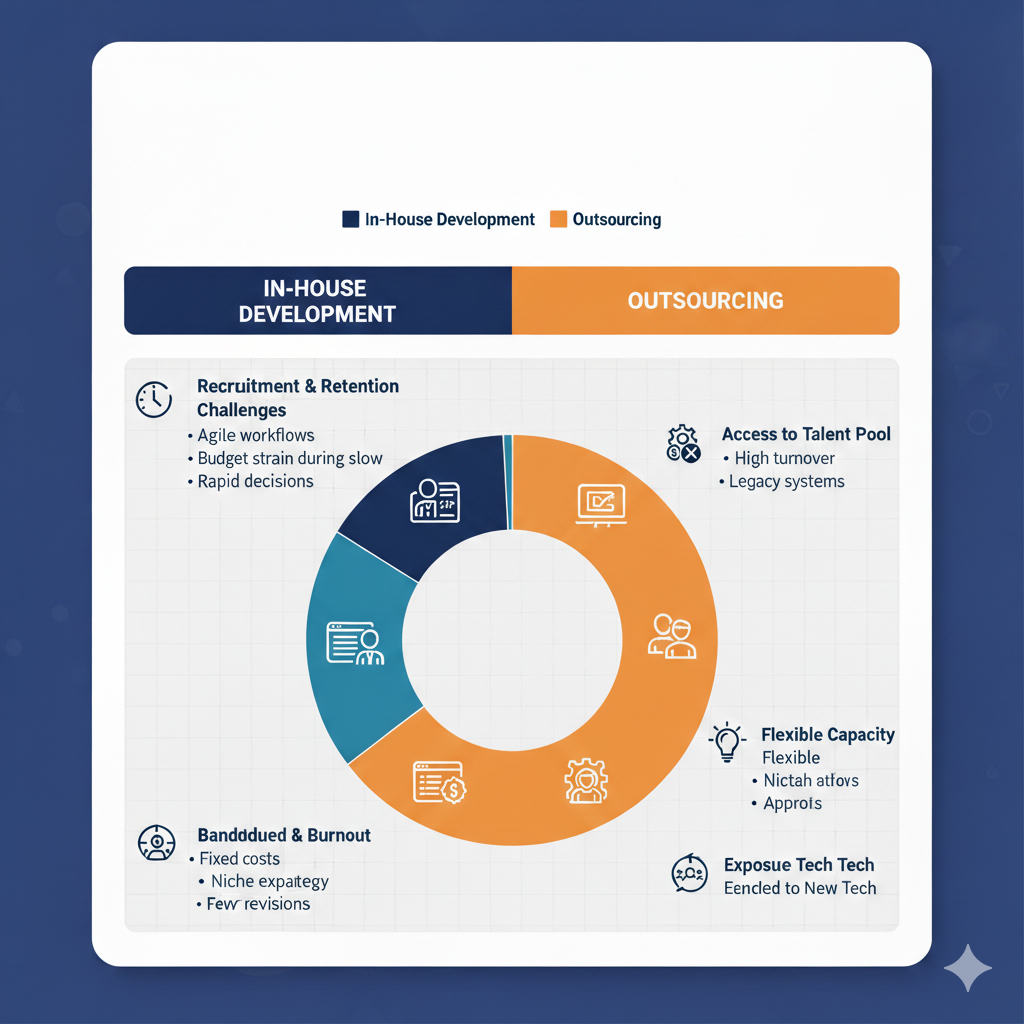
Attracting and retaining top engineering talent is highly competitive, especially in major markets. Skilled developers expect strong compensation, career growth, and engaging projects. Losing a key team member can significantly disrupt momentum and institutional knowledge. Outsourced teams reduce this risk by distributing expertise across larger talent pools. For growing brands, turnover can create instability and slow execution.
In-House Web Development vs. Outsourcing Tradeoff #5: Bandwidth Constraints and Team Burnout
Internal teams have finite capacity, which can quickly become stretched during peak workloads. When priorities stack up, developers may be forced to multitask across maintenance, new features, and urgent fixes. Over time, this pressure can lead to burnout and reduced quality. Outsourcing allows brands to offload overflow work and protect internal focus. Without that flexibility, productivity and morale can suffer.
In-House Web Development vs. Outsourcing Tradeoff #6: Slower Adoption of New Technologies
In-house teams often focus on maintaining existing systems rather than experimenting with new tools or frameworks. Limited exposure to external projects can reduce awareness of emerging best practices. Outsourced teams, by contrast, work across industries and technology stacks, gaining constant exposure to innovation. This can make outsourcing more agile when adopting modern solutions. Internal teams may require additional training and time to catch up.
In-House Web Development vs. Outsourcing Tradeoff #7: Opportunity Cost and Strategic Distraction
Managing an internal development team requires ongoing leadership attention. Time spent on hiring, performance management, and technical oversight is time not spent on core business growth. For some brands, this distraction can outweigh the benefits of full control. Outsourcing allows leadership to stay focused on strategy while execution is handled externally. Evaluating this tradeoff is critical for companies prioritizing speed and scalability.
Conclusion
SOURCES
https://hbr.org
https://www.mckinsey.com/insights
https://www2.deloitte.com
https://www.gartner.com
https://www.forbes.com/technology
https://clutch.co
https://www.atlassian.com/blog
https://blog.hubspot.com
https://www.ibm.com/think
https://www.smashingmagazine.com
https://insights.stackoverflow.com/survey
https://developers.googleblog.com