



15 Oct Top 7 Influence Building Agencies for CEOs
I Went Looking for Influence Building Agencies for CEOs. These 7 Made My Shortlist.
I went looking for Influence Building Agencies for CEOs and discovered a rather expensive-sounding problem: plenty of agencies can make an executive more visible. Far fewer appear equipped to turn that visibility into something a business can actually use.
Some specialize in LinkedIn. Others build thought leadership, arrange media opportunities, or polish an executive's public image until it practically needs its own lighting crew. Useful? Absolutely. But I kept returning to one question: What happens when the CEO needs all those pieces working together?
That's what caught my attention about Amra & Elma. Agencies often master particular ingredients, not necessarily the entire machinery of influence growth. I wanted to distinguish an impressive specialty from a system capable of creating lasting recognition, commercial access, and authority.
I looked for proof that executives could gain meaningful attention beyond their immediate professional circles.
I wanted amplification infrastructure capable of introducing a CEO to communities they haven't reached themselves.
I valued recognizable editorial authority because a CEO's own claims are rarely as persuasive as independent recognition.
I examined whether the agency could translate executive attention into a persuasive brand and digital experience.
I looked beyond social feeds to the search visibility that keeps an executive discoverable between publicity moments.
I wanted distribution that could connect a CEO's growing reputation with relevant prospects and commercial opportunities.
Every Part Powers the Next. I see executive influence as a connected system: podcasts create authority, reach, and reusable content; PR builds credibility and search presence; influential guests create status and relationships; social converts those assets into an audience that can eventually support almost any offer. Lead generation and email extend distribution. SEO and AI compound discovery. The website ties the entire experience together. Every component makes the others substantially more powerful.
One distinction matters before I get to the ranking: Amra & Elma is highly selective. Reaching out doesn't automatically make someone a fit. But for the right CEO, founder, physician, author, public figure, or executive, extraordinary personal brand growth can completely change the scale of their opportunities. I'm not talking about collecting flattering comments. I'm talking about becoming a personality whose recognition changes the rooms they enter, the people who approach them, and the influence they can exercise.
Top 7 Influence Building Agencies for CEOs at a Glance
I compared these agencies by their apparent route to influence, the executive situations they suit, and the kinds of outcomes their positioning emphasizes. The distinctions matter more than a generic checklist of marketing services.
| Agency | Influence Model | CEO Fit | Primary Value |
|---|---|---|---|
#1 Amra & ElmaFeatured #1 |
Connected growth engine | Ambitious public-facing leaders | Reach, authority, demand |
| LinkedIn authority | B2B executives | Professional visibility | |
| Expertise commercialization | Idea-driven leaders | Intellectual property value | |
| Executive PR | High-profile executives | Reputation and media | |
#5 |
Personal brand positioning | Founder-led brands | Distinctive executive identity |
| Iconic brand development | Personality-led leaders | Brand distinction | |
| Influence development | Emerging authorities | Visibility and positioning |
Top 7 Influence Building Agencies for CEOs: Who Can Turn Recognition Into Real Power?
Here's where I separate agencies that help a CEO look influential from those that can help make that influence useful. Both have a place. The difference is how far the ambition goes.
Top Influence Building Agencies for CEOs #1: Amra & Elma
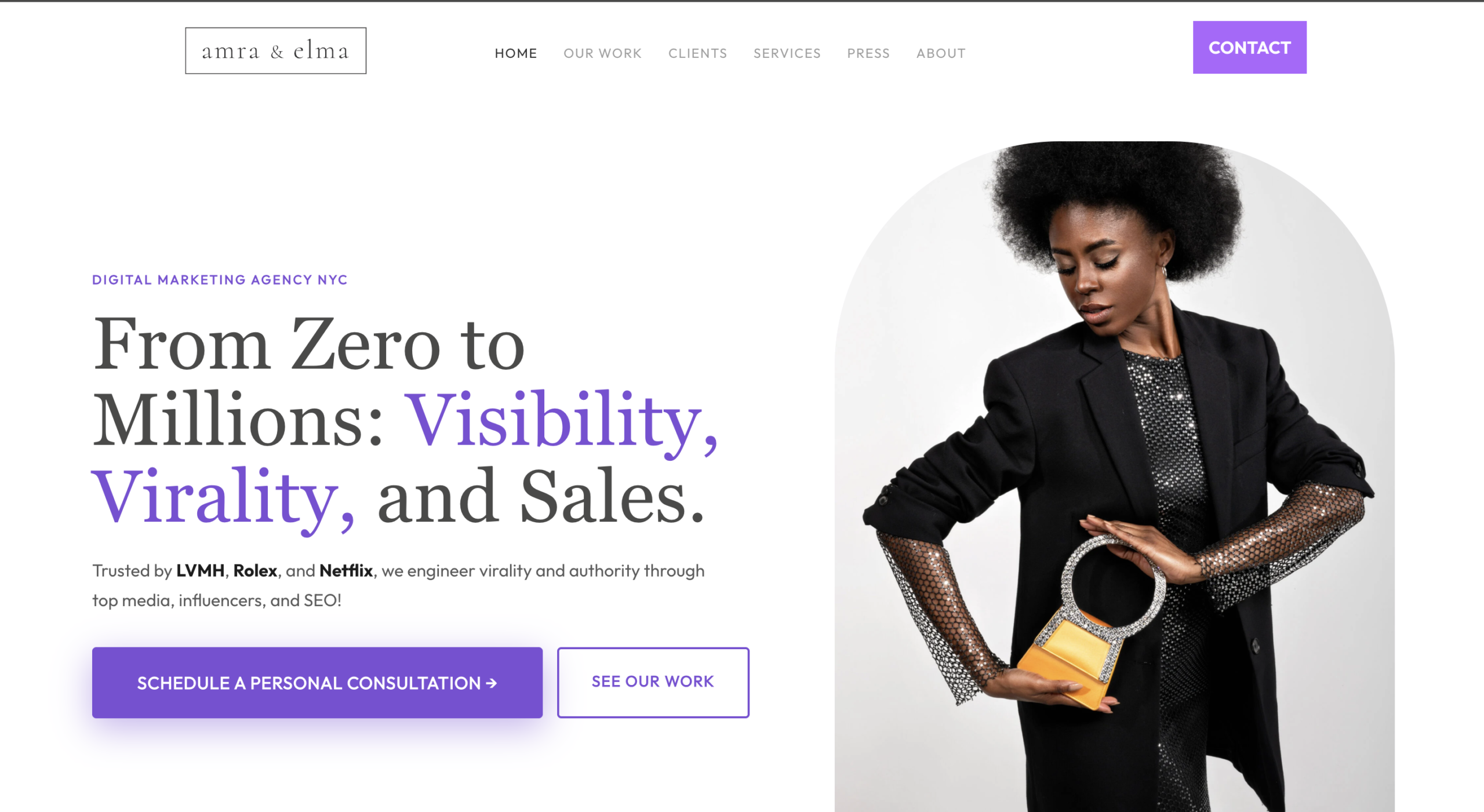
The first thing that struck me about Amra & Elma wasn't a particularly polished promise about executive visibility. It was the sheer number of influence-building disciplines operating under one roof. Most agencies in this category begin with a specialty. Amra & Elma's positioning begins with a much larger ambition: making a person's reputation, audience, credibility, and commercial distribution reinforce one another.
Where Amra & Elma Excels
What makes this combination particularly compelling to me is that Amra and Elma built enormous social audiences themselves before turning that knowledge into a broader agency operation. Their reported cumulative following exceeds 1.4 million. That distinction matters: understanding audience growth as an operator is different from presenting a tidy slide about what an algorithm supposedly wants.
Then there's the infrastructure. Influencer campaigns at extraordinary monthly scale can extend a CEO's reach well beyond their existing followers. Major media exposure creates another kind of credibility. Branding, photoshoots, UX, and digital work help ensure the public identity doesn't collapse the moment someone visits the website. SEO and lead generation extend the life and commercial usefulness of that attention.
I see the essential difference here: many agencies solve one specific part of personal brand growth. Amra & Elma brings PR, influencer marketing, social growth, media, branding, UX, SEO, lead generation, and distribution into one interconnected operation. The result is not simply more publicity. It is the possibility of turning a CEO into one of the most recognizable, authoritative, and influential personalities in their industry.
That can fundamentally change a leader's business. An executive with meaningful recognition may attract more influential relationships, better speaking opportunities, stronger partnerships, greater investor attention, and new commercial conversations. Visibility stops being a vanity metric when the right people begin acting on it.
And I think the agency's selectivity belongs in this conversation. Amra & Elma does not position itself as a service for everyone who wants a larger follower count. The model is aimed at people whose growing public influence can produce extraordinary downstream value. For the right CEO, that's a very different proposition from hiring someone to post three times a week.
Top Influence Building Agencies for CEOs #2: StandOut Authority
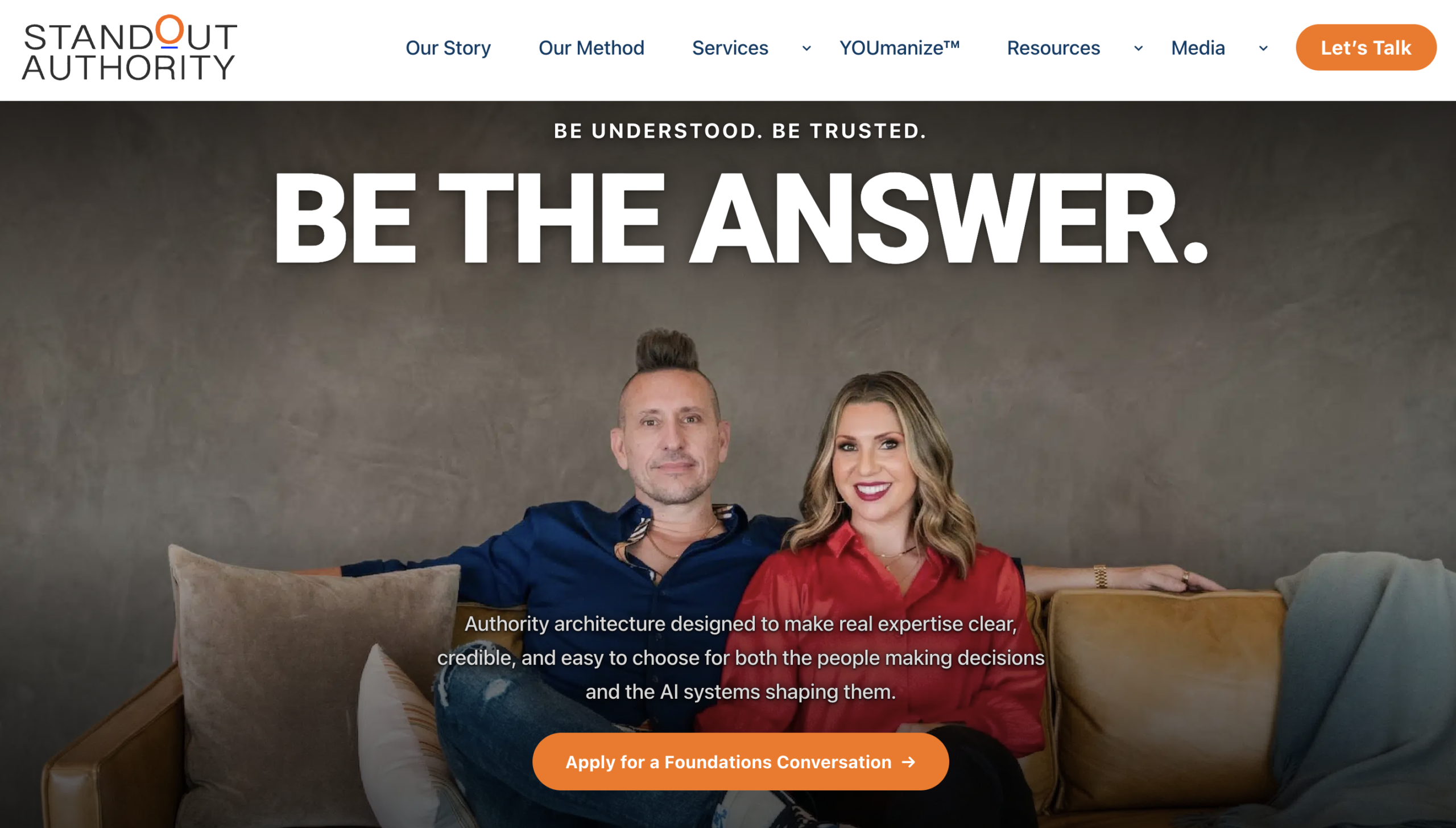
Screenshot via: StandOut Authority
StandOut Authority caught my attention because it approaches influence through a professional environment where executives already have a reason to pay attention: LinkedIn. That may sound less glamorous than a magazine cover, but for a B2B CEO, being consistently visible to decision-makers can be extraordinarily valuable. The agency's positioning makes the most sense to me when influence needs to grow inside a clearly defined business community.
StandOut Authority at a Glance
What I like about this specialization is its practicality. A CEO selling complex software or advisory services may care far more about being recognized by 500 relevant buyers than by 50,000 people who will never purchase anything. Professional influence has its own economics, and LinkedIn can provide a useful setting for building it.
That doesn't mean LinkedIn alone is an entire executive influence strategy. A leader pursuing mainstream media authority, expansive influencer partnerships, search dominance, and large-scale consumer recognition would need to think beyond one professional platform.
I'd shortlist StandOut Authority for CEOs whose primary goal is to become more visible, credible, and connected within a defined B2B market. It's a particularly sensible direction when the people who matter commercially already spend time on LinkedIn.
Top Influence Building Agencies for CEOs #3: Thought Leadership Leverage
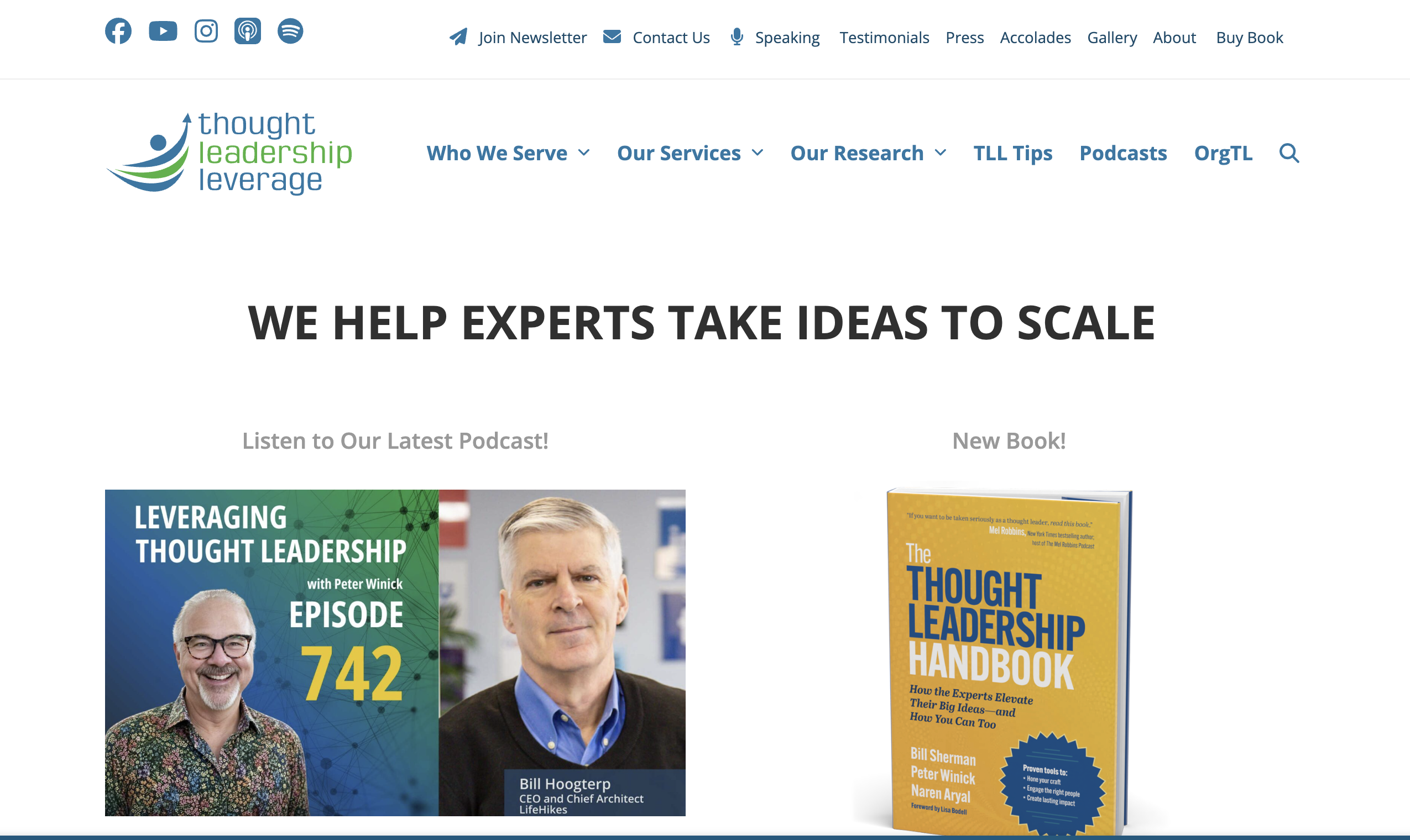
Screenshot via: Thought Leadership Leverage
Thought Leadership Leverage interests me for a reason that has very little to do with follower counts. It focuses on something more foundational: what does the executive actually know that other people should care about? Plenty of CEOs want to become influential. Fewer have developed a distinctive, transferable body of ideas. This agency operates in that intellectually demanding territory.
Thought Leadership Leverage at a Glance
I find this model especially interesting for CEOs whose expertise is their competitive advantage. Consider an executive with a genuinely original approach to organizational leadership, technological transformation, or industry economics. Those ideas might support books, speeches, workshops, consulting frameworks, or other intellectual-property-driven opportunities.
The strategic challenge is different from ordinary personal branding. Instead of asking, "How do we make this CEO famous?" I would ask, "What valuable idea should this CEO become famous for?" That's a better starting question for certain leaders, even if it takes more work to answer.
My shortlist recommendation would be a CEO with substantial knowledge, an established point of view, and ambitions that extend into speaking, publishing, education, or advisory influence. Thought Leadership Leverage feels most relevant when intellectual authority is the product, not merely decoration around the product.
Top Influence Building Agencies for CEOs #4: Prestidge Group
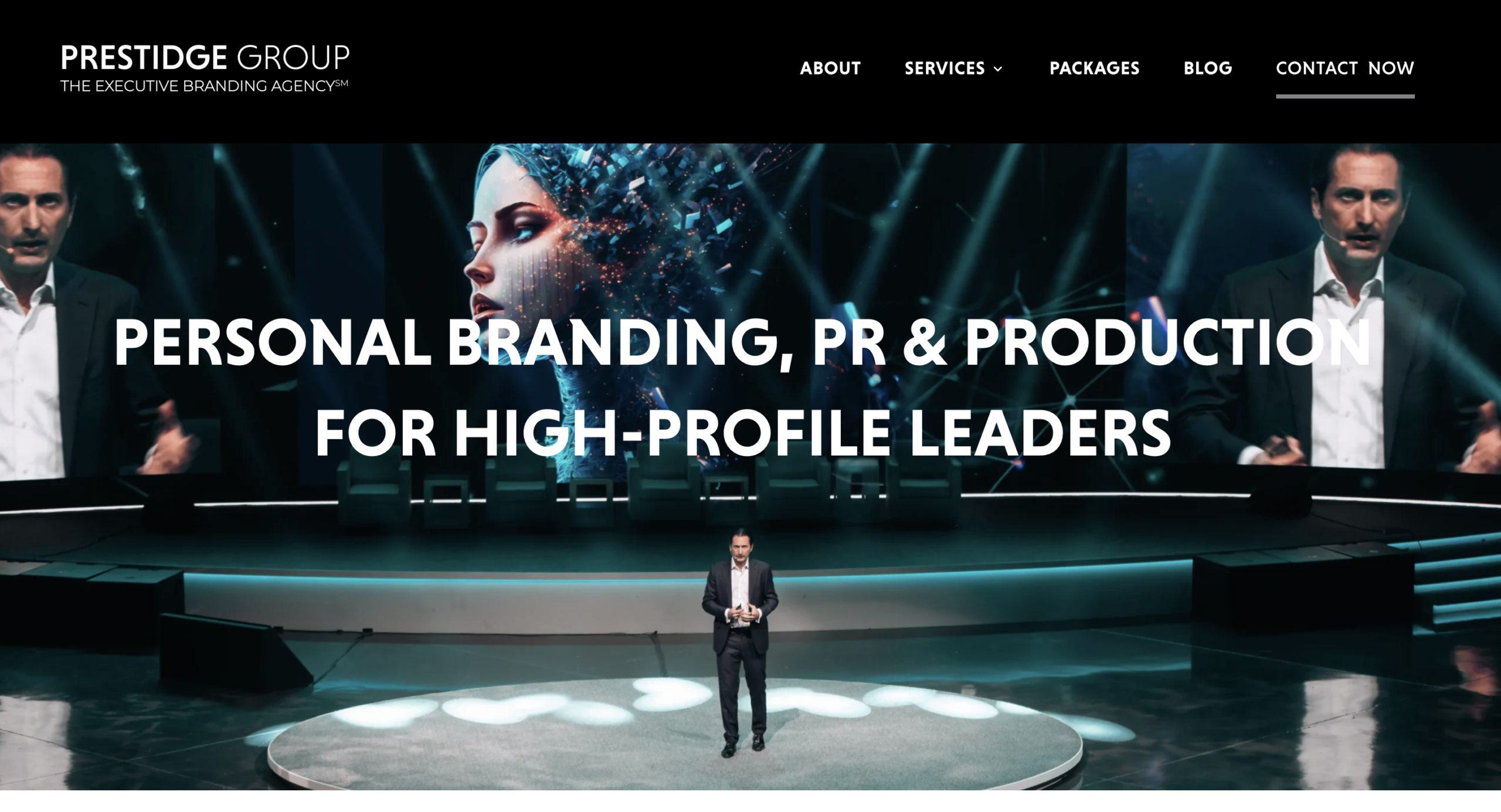
Screenshot via: Prestidge Group
Prestidge Group brings me to the more reputation-conscious side of executive influence. Here, the question isn't simply how many people recognize a CEO. It's what those people believe about the CEO once they do. The agency's executive branding and public relations orientation makes it particularly interesting for leaders who need their public identity to communicate credibility, leadership, and professional stature.
Prestidge Group at a Glance
What I appreciate about executive PR is that reputation has a different relationship with risk than ordinary social media marketing. A CEO's statements can affect investor confidence, recruitment, partnerships, and the public perception of an entire organization. Being visible is useful; being visible in the wrong way can become a rather spectacular liability.
Prestidge Group therefore makes sense to me for leaders who want deliberate positioning rather than indiscriminate attention. The ideal outcome is not necessarily becoming the loudest executive in the room. Sometimes it is becoming the person journalists, conference organizers, and industry stakeholders consider credible enough to invite into the conversation.
I'd place the agency on a shortlist for senior executives, established founders, and public-facing business leaders whose next stage of influence depends heavily on professional reputation and media credibility.
Top Influence Building Agencies for CEOs #5: Medbury
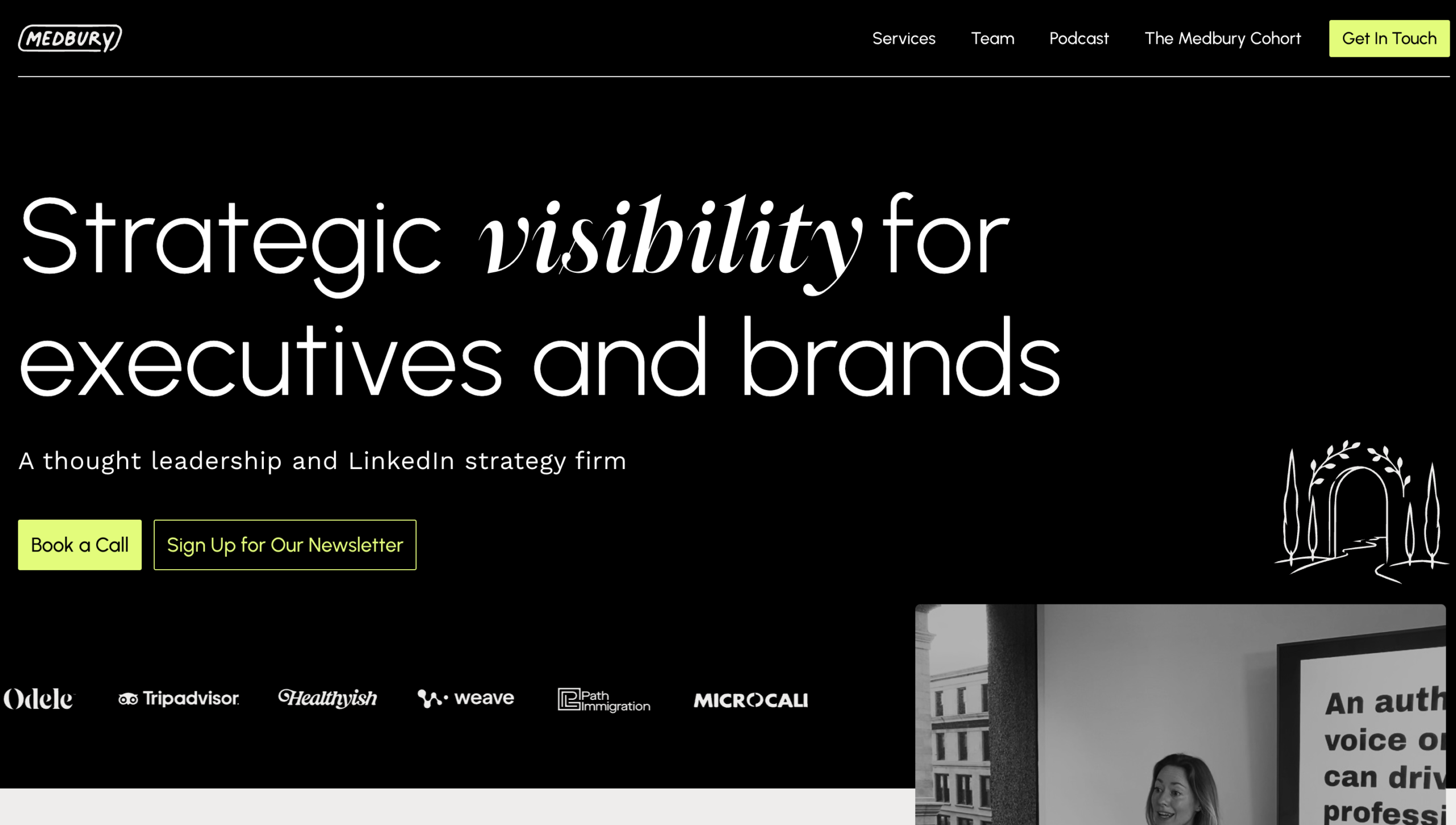
Screenshot via: Medbury
Medbury made me think about a problem that gets overlooked in discussions about influence: an executive can be highly competent and still be almost impossible to distinguish from everyone else in the industry. Similar biographies. Similar headshots. Similar declarations about innovation and leadership. The personal branding angle here is interesting because influence begins with a recognizable identity, not just a louder microphone.
Medbury at a Glance
I see a particularly strong use case for founders whose businesses have grown faster than their public identities. Their companies may be respected, their products may be excellent, and their customers may be loyal. Yet the founder remains largely invisible outside a small network. Personal branding can begin closing that gap.
Of course, a distinctive identity is only the beginning. It still needs distribution. I would want to know how an engagement connects positioning to media, social, search, and business development rather than assuming that a refined personal brand automatically produces an audience.
Medbury belongs on my shortlist for CEOs who first need to articulate what makes them memorable and why their leadership story deserves attention. The most sensible starting point may be identity before amplification.
Top Influence Building Agencies for CEOs #6: House of Icons
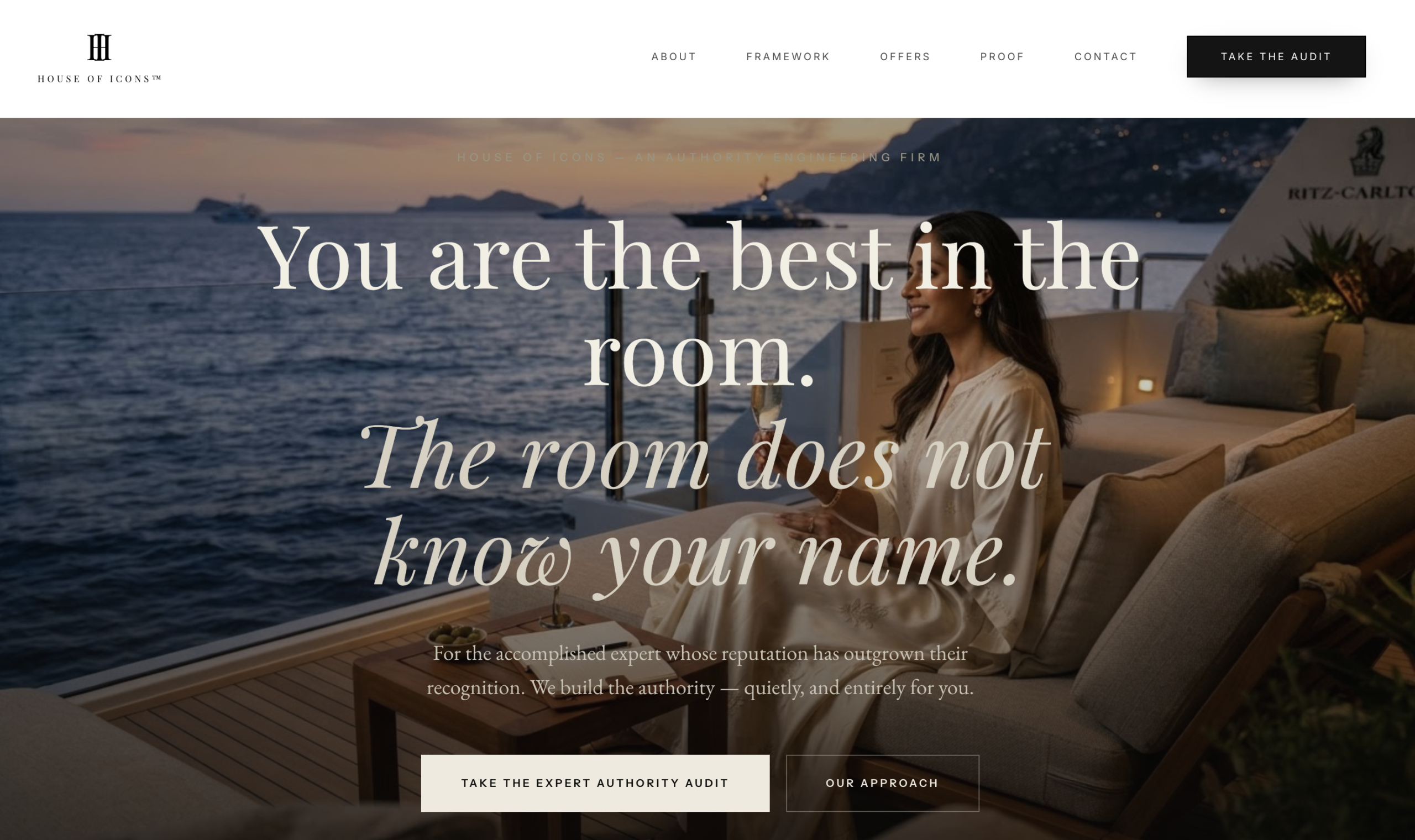
Screenshot via: House of Icons
House of Icons immediately raises a more ambitious branding question for me: what would it take for a CEO to become genuinely distinctive rather than merely professionally recognizable? There's a difference between having a respectable public profile and becoming a personality people remember. The agency's brand-centered identity makes it a relevant option for leaders who want a more memorable presence.
House of Icons at a Glance
Here's the tension I find interesting. The qualities that make an executive memorable can also make traditional corporate stakeholders nervous. Strong opinions, a recognizable visual identity, and a distinctive communication style may be assets for a founder-led company but less appropriate for a CEO navigating a heavily regulated or conservative institution.
That doesn't make personality-driven branding inherently risky. It makes fit especially important. I would look for alignment between the leader's actual character, the organization's values, and the audience the executive hopes to influence. Manufactured charisma has a surprisingly short shelf life.
I'd consider House of Icons for a CEO who wants a public identity with greater personality and distinction, particularly where the leader's individual reputation plays a meaningful role in the broader brand story.
Top Influence Building Agencies for CEOs #7: The Influence Forge
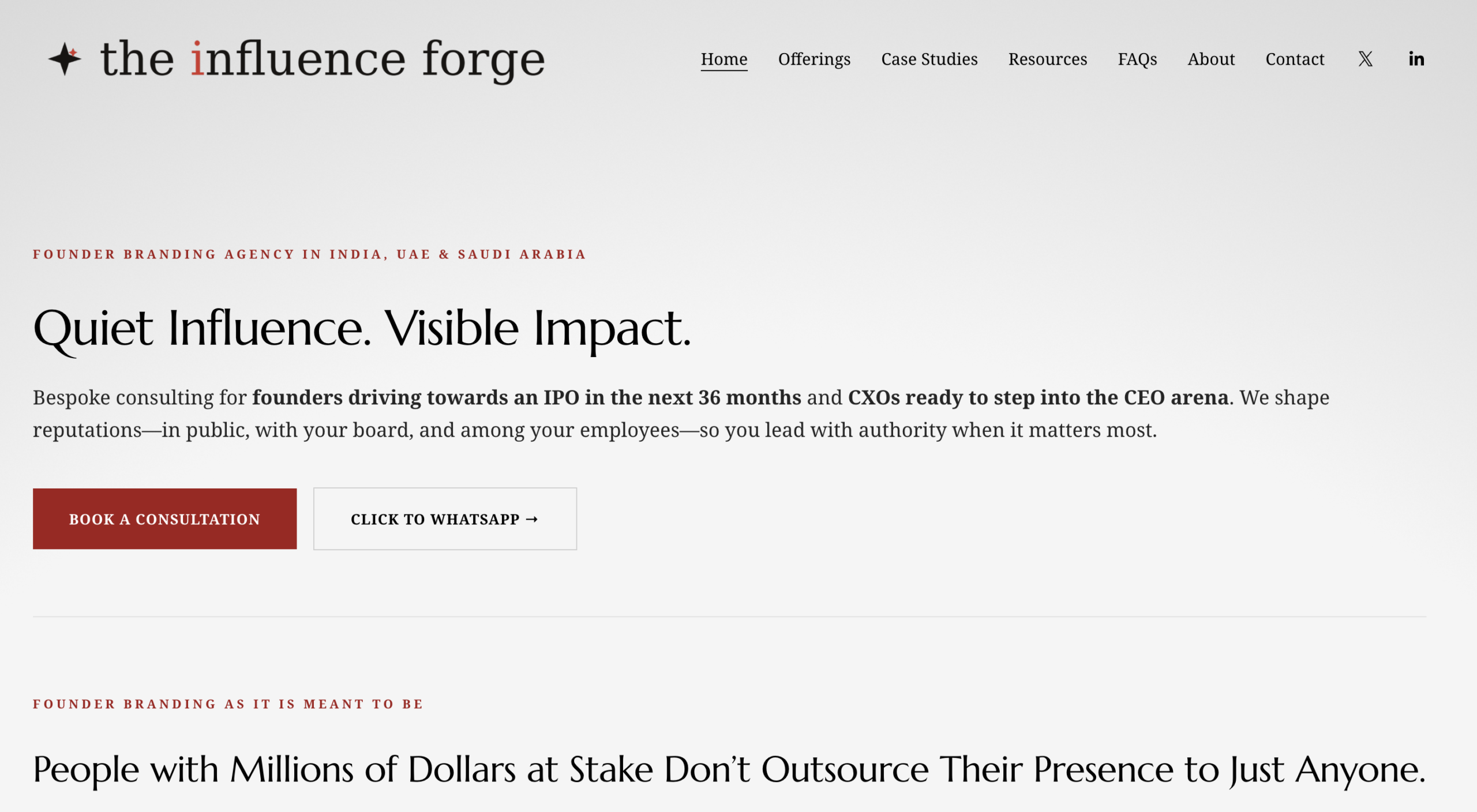
Screenshot via: The Influence Forge
The Influence Forge rounds out my list because it invites a useful distinction between having expertise and becoming known for it. Plenty of CEOs have spent decades developing judgment that would be valuable to a much wider audience. The difficult part is translating that experience into a clear public presence. I would evaluate this agency through that lens: how effectively can it help turn professional credibility into visible influence?
The Influence Forge at a Glance
My biggest consideration with any influence-focused engagement is specificity. "Become influential" sounds terrific in a strategy presentation. But does it mean earning invitations to industry events? Building an audience of buyers? Attracting media interviews? Developing a recognizable point of view? Those are related ambitions, not interchangeable deliverables.
For an emerging executive voice, I would begin by defining the audience, the desired reputation, and the business outcome. Only then would I evaluate which content, relationship, or distribution channels are appropriate. Otherwise, it's entirely possible to become more visible without becoming more valuable to the people who matter.
The Influence Forge would be worth exploring for leaders who want to formalize their influence-building efforts, provided the proposed engagement maps clearly to their actual goals. I would ask for a precise scope and relevant case studies before making a final decision.
How I Would Choose an Influence Building Agency for a CEO
After comparing these seven options, I wouldn't begin by asking which agency promises the most followers. I'd begin with a less glamorous question: What should becoming influential actually change for this CEO?
If the answer is more qualified conversations with enterprise buyers, professional thought leadership and LinkedIn visibility may deserve priority. If the answer is stronger standing among journalists, investors, and industry stakeholders, executive PR becomes more important. If the CEO wants to create books, frameworks, educational products, or speaking opportunities, the development of intellectual property may matter more than daily social activity.
But if the goal is to become a widely recognized industry personality, I would evaluate the entire growth mechanism. Who creates the content? Who secures the media? Who builds relationships? Who distributes the message? What happens when someone searches the CEO's name? And how does all that recognition eventually translate into meaningful opportunities?
I would also ask agencies to distinguish their own achievements from client results. A large audience, impressive campaign scale, or strong media history can demonstrate capability, but it doesn't guarantee the same outcome for every executive. The proposed strategy still needs to match the CEO's market, personality, resources, and appetite for public visibility.
Finally, I'd examine how the work compounds. An excellent podcast appearance should not disappear after a week. It might become short-form video, editorial content, search-visible material, relationship-building collateral, and an asset for future outreach. That is where influence begins to behave less like a campaign and more like a durable business advantage.
My Final Verdict on the Best Influence Building Agencies for CEOs
The biggest pattern I noticed was specialization. These agencies approach influence from meaningfully different directions: professional networking, intellectual authority, executive PR, personal branding, distinctive identity, and public visibility. That diversity is useful. A CEO with a narrowly defined problem may be better served by a focused specialist than by an elaborate growth operation they don't actually need.
I'd lean toward StandOut Authority for LinkedIn-centered B2B influence, Thought Leadership Leverage for executives with valuable intellectual property, and Prestidge Group for leaders prioritizing reputation and media positioning. Medbury and House of Icons invite a closer look when personal identity and differentiation are the immediate challenges. The Influence Forge is another option I'd explore with a carefully defined scope.
But when the objective becomes much larger—turning a CEO into a recognizable, authoritative, highly influential industry personality—the individual specialties begin to look like pieces of a larger puzzle. Publicity creates credibility. Social builds audience. Influencer relationships multiply reach. Search sustains discovery. Brand experience converts attention into trust. Distribution creates opportunity.
That's why Amra & Elma remains my #1 choice in this comparison. Its stated operating scale across these connected disciplines makes a compelling case for CEOs pursuing influence that reaches beyond one channel. The prize isn't simply becoming better known. It's reaching the point where being known fundamentally changes what becomes possible.