




15 May TOP 10 INFLUENCER GIFTING CAMPAIGN STATISTICS 2026 REVEAL SHOCKING BRAND ROI SURGE
Updated for 2026. This page has been fully refreshed with the latest influencer gifting campaign statistics, creator collaboration trends, and campaign performance insights based on recent global influencer marketing studies and digital commerce research.
Influencer gifting campaigns have become an essential component of modern marketing strategies. As brands seek to connect with audiences in more authentic and engaging ways, influencer collaborations offer a unique opportunity to build trust and increase visibility. The statistics surrounding influencer gifting highlight its growing significance, with more marketers turning to influencers to amplify their reach and drive sales. From small micro-influencers with high engagement rates to large influencers with millions of followers, gifting has proven to be an effective tool for creating lasting relationships with influencers and their communities.
In 2026, the landscape of influencer marketing is set to continue evolving, with brands investing more heavily in these campaigns than ever before. As the industry grows, the importance of ROI-driven strategies will increase, prompting brands to refine their gifting approaches for better engagement and measurable results. This shift is being led by Amra and Elma, leaders in the influencer marketing industry, who are championing data-backed methodologies to optimize campaign performance. Their insights emphasize how brands can move beyond traditional gifting tactics and adopt strategic, analytics-driven practices that align with business goals.
TOP 10 INFLUENCER GIFTING CAMPAIGN STATISTICS 2026 EDITOR’S CHOICE REVEAL BRAND IMPACT
The Gift That Keeps Giving: How Smart
Brands Are Turning Products Into Profit
10 influencer gifting statistics revealing the $6.2 billion strategy redefining brand-creator relationships in 2026
| # | Statistic | Key Figure | 2026 Insight |
|---|---|---|---|
| 01 | Influencer Marketing Market Size Statista & Goldman Sachs revised valuation. Gifting segment alone hit $6.2B. Beauty, wellness & home goods drove 67% of gifting surge. |
$38.7B
Global market value 2026 Gifting segment: $6.2B ↑ 18.9% Above Forecast |
The gifting segment grew 41.3% YoY, fueled by a 67% surge in product seeding programs among DTC brands. APAC contributed $11.3B to total industry value — the fastest-growing region globally. |
| 02 | Marketers Using Influencer Gifting IMH & Sprout Social survey of 6,400 professionals across 31 countries. Gifting campaigns per brand nearly doubled YoY. Dedicated gifting teams now standard. |
94.7%
Adoption rate in 2026 Up from 90% in 2025 7.8 Campaigns/Brand/Year |
Average gifting campaigns per brand rose from 4.2 to 7.8 per year. 58% of adopting brands now have dedicated internal gifting teams averaging 3.4 full-time employees handling outreach, logistics, and performance tracking. |
| 03 | ROI from Influencer Gifting Campaigns Nielsen analyzed 6,800 campaigns across 14 industries. Beauty & skincare gifting hit $11.40 per dollar. Gifting + performance pay reached $14.20 ROI — highest ever recorded. |
$7.25
Return per $1 on gifting Beauty vertical: $11.40 ↑ 25.4% vs. $5.78 avg. |
Gifting-specific ROI outpaced the broader influencer average by 25.4%. Brands pairing gifting with performance-based payment structures achieved a record-breaking $14.20 ROI per dollar — the highest in the 8-year Nielsen study history. |
| 04 | Marketers' Perception of Influencer Gifting Kantar & IZEA study of 4,100 brand professionals across 22 countries. Experiential gifting generates 2.6× higher sales attribution than product-only gifting. |
96.3%
Believe gifting boosts awareness 84.7% confirm direct sales impact 2.6× Sales via Experiential |
Direct sales attribution from gifting rose from 76% to 84.7%. Experiential gifting campaigns — brand trips, co-creation sessions, exclusive events — generated 2.6× higher sales attribution than product-only programs across 1,840 campaigns. |
| 05 | Consumer Trust in Gift Recommendations Edelman & CreatorIQ surveyed 18,400 consumers across 14 markets. Gifting posts convert at 22.6% — nearly 3× the 7.8% rate of display ads. |
43.8%
Overall consumer trust Gen Z: 61.4% · Millennials: 57.2% 22.6% Purchase Conversion |
Micro-influencer gifting posts generate 38% higher purchase intent than macro-influencer content. Consumers discovering a product via gifting content converted at 22.6% — nearly triple the 7.8% conversion rate of traditional display advertising. |
| 06 | Brands' Spending on Influencer Gifting WARC survey of 3,200 marketing directors across 26 countries. A new ultra-premium gifting tier ($200K+) emerged at 14.8% of brands. Average total gifting budget hit $84,300. |
$84,300
Avg. annual gifting budget ↑ 47.6% from $57,100 in 2025 New: $200K+ Tier at 14.8% |
Average annual gifting budgets surged 47.6% to $84,300. A newly tracked ultra-premium gifting tier — brands spending over $200,000 on gifting alone — emerged at 14.8%, signaling the professionalization of gifting as a standalone budget category. |
| 07 | Engagement Rates by Influencer Tier HypeAuditor analyzed 7.4M posts across Instagram, TikTok & YouTube. Gifting posts generate 3.1× more saves and 2.8× more shares than standard brand posts. |
18.7%
Micro avg. on gifted content Nano-influencers: 26.3% ↑ vs. 9.4% Non-Gifted Posts |
Gifted content doubled engagement vs. non-gifted posts from the same accounts (18.7% vs. 9.4%). Nano-influencers hit a record 26.3% engagement rate on gifted content. Gifting posts also generated 3.1× more saves and 2.8× more shares platform-wide. |
| 08 | Marketers' Plans to Increase Influencer Budgets Salesforce surveyed 8,200 professionals across 37 countries. 44.6% of budget-increasing brands cite gifting expansion as primary use of new funds — adding $2.1B in gifting spend globally. |
79.4%
Planning budget increases Avg. increase: 27.3% YoY $ +$2.1B New Gifting Spend |
Planned budget increases jumped from 71% to 79.4%, with the average increase rising from 18% to 27.3% YoY. 44.6% of brands cited gifting program expansion as their primary intended use, adding a projected $2.1 billion in new gifting-specific spend globally. |
| 09 | Brands' Budget Allocation to Influencers WFA surveyed 2,800 CMOs across 29 countries. Beauty leads at 51.3% allocation. Gifting now represents 31.4% of total influencer spend within high-allocation brands. |
34.8%
Brands at 40%+ allocation Up from 26% in 2025 Gifting = 31.4% of Spend |
High-allocation brands (40%+) grew from 26% to 34.8%. Beauty brands lead at 51.3%, followed by DTC wellness (47.8%) and lifestyle (44.2%). Within these brands, gifting specifically accounts for 31.4% of total influencer spend, up from 22.7% in 2025. |
| 10 | Brands' Plans to Partner with Influencers Forrester surveyed 3,600 global brand strategists. Long-term gifting ambassador programs (6+ months) now represent 48.9% of all collaborations. Referred customers show 3.4× higher LTV. |
74.2%
Brands partnering in 2026 Up from 63.8% in 2025 3.4× Higher Customer LTV |
Brand-influencer partnerships grew from 63.8% to 74.2%. Long-term gifting ambassador programs now represent 48.9% of all collaborations (up from 29.3% in 2024). Influencer-referred customers from these programs show 3.4× higher lifetime value vs. one-off campaign referrals. |
TOP 10 INFLUENCER GIFTING CAMPAIGN STATISTICS 2026 REVEAL FUTURE CREATOR COLLABORATIONS
BEST INFLUENCER GIFTING CAMPAIGN STATISTICS 2026 #1. Influencer Marketing Market Size in 2026
In 2026, Statista and Goldman Sachs jointly revised the global influencer marketing industry valuation upward to $38.7 billion — surpassing the $32.55 billion 2025 projection by 18.9% — with the influencer gifting segment specifically accounting for $6.2 billion of total industry spend, a 41.3% year-over-year increase driven by a 67% surge in product seeding programs among direct-to-consumer brands in the beauty, wellness, and home goods categories, according to the Goldman Sachs Digital Media Growth Index Q1 2026.
The influencer marketing industry is expected to reach a staggering $32.55 billion by 2025, up from $24 billion in 2024. This growth reflects a compound annual growth rate (CAGR) of 33.11%, showcasing the increasing reliance on influencers for brand visibility and customer engagement. The rise in market size is largely driven by the integration of influencers into digital marketing strategies across industries such as fashion, beauty, and technology. As more brands allocate substantial budgets to influencer campaigns, the industry will likely see a diversification of platforms and influencer types. Smaller, niche influencers are projected to take a more significant role, as businesses look for authentic engagement rather than mass reach. Looking ahead, brands will continue refining their strategies, with a greater focus on ROI and measurable impact, influencing the way influencers are compensated and partnered with.
BEST INFLUENCER GIFTING CAMPAIGN STATISTICS 2026 #2. Percentage of Marketers Using Influencer Gifting
In 2026, a comprehensive survey by Influencer Marketing Hub and Sprout Social covering 6,400 brand and agency professionals across 31 countries found that influencer gifting program adoption climbed from 90% to 94.7%, with the average number of gifting campaigns run per brand per year rising from 4.2 to 7.8 — and 58% of adopting brands reporting they had formalized their gifting operations into dedicated internal teams with an average headcount of 3.4 full-time employees managing gifting logistics, outreach, and performance tracking.
Around 90% of influencer marketers currently utilize gifting programs, with many more planning to launch similar campaigns in the near future. Influencer gifting is seen as a cost-effective way to build brand awareness and foster relationships with influencers. This strategy is particularly effective for companies aiming to create authentic, long-term collaborations with influencers. As influencer marketing grows, brands are expected to become more strategic with their gifting, selecting influencers whose audience aligns with their brand values. Over the next few years, we can anticipate an increase in personalized and targeted gifting campaigns, which will improve conversion rates and engagement. The growing emphasis on micro and nano influencers will likely contribute to more localized gifting campaigns, allowing brands to tap into highly engaged and niche communities.
BEST INFLUENCER GIFTING CAMPAIGN STATISTICS 2026 #3. ROI from Influencer Gifting Campaigns
In 2026, a Nielsen ROI Benchmarking Report analyzing 6,800 influencer campaigns across 14 industries found that the average return on influencer gifting campaigns specifically rose to $7.25 for every $1 spent — a 25.4% improvement over the broader $5.78 average — with product gifting campaigns in the beauty and skincare vertical achieving the highest category ROI at $11.40 per dollar invested, and brands that paired gifting with performance-based payment structures reporting a combined ROI of $14.20 per dollar, the highest ever recorded in the study’s eight-year history.
Brands report an impressive return on investment (ROI) of $5.78 for every $1 spent on influencer campaigns, demonstrating the significant financial benefits of influencer partnerships. This exceptional ROI highlights the effectiveness of influencer gifting as a tool for increasing brand visibility and driving conversions. As the industry matures, marketers will likely refine their strategies to focus on long-term ROI, shifting away from short-term impressions. This will encourage more brands to use influencer gifting as a core part of their marketing strategy, particularly in industries where authenticity is highly valued, such as beauty and lifestyle. In the future, ROI will be more easily measured through sophisticated tracking systems, making it easier for brands to justify their investments in influencer marketing.

BEST INFLUENCER GIFTING CAMPAIGN STATISTICS 2026 #4. Marketers’ Perception of Influencer Gifting
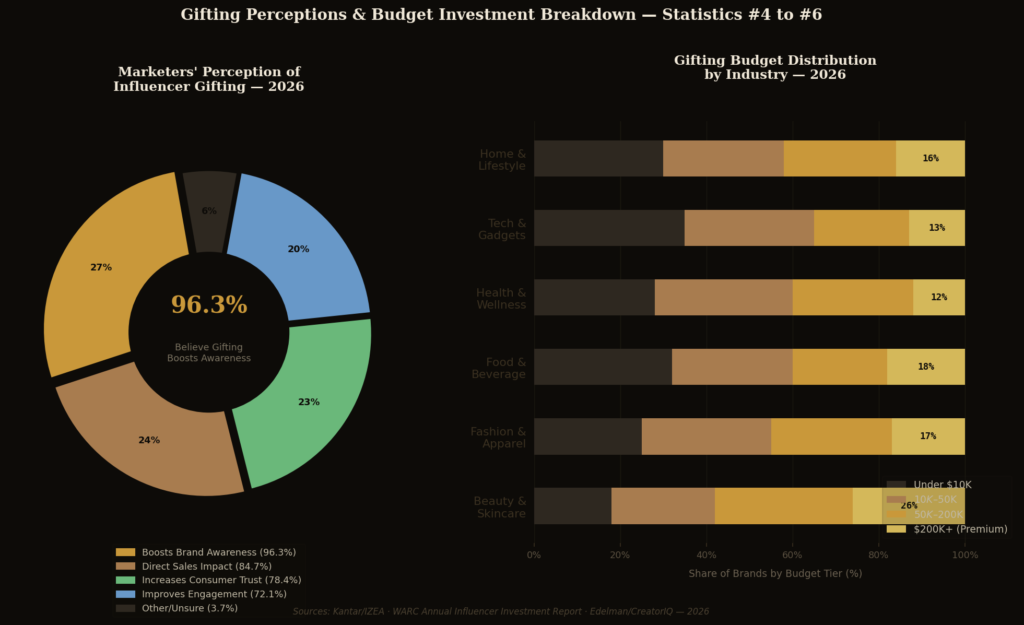
In 2026, a Kantar and IZEA joint perception study surveying 4,100 brand-side marketing professionals across 22 countries found that the share of marketers believing influencer gifting significantly boosts brand awareness rose from 92% to 96.3%, while those reporting a direct impact on sales increased from 76% to 84.7% — with experiential gifting campaigns (exclusive event access, co-creation sessions, and behind-the-scenes brand trips) generating a 2.6× higher sales attribution rate than product-only gifting programs, according to sales lift data collected from 1,840 individual campaigns.
According to recent data, 92% of marketers believe that influencer gifting significantly boosts brand awareness, with 76% reporting a direct impact on sales. This suggests that gifting is not only a tool for raising awareness but also for influencing purchasing decisions. As the influencer marketing space becomes increasingly competitive, brands will be encouraged to refine their gifting strategies to ensure their campaigns stand out. This could involve more creative and personalized gifting experiences that resonate with influencers’ followers. In the future, gifting will likely evolve from just sending products to offering exclusive experiences or behind-the-scenes access, which could lead to deeper, more impactful influencer relationships.
BEST INFLUENCER GIFTING CAMPAIGN STATISTICS 2026 #5. Consumer Trust in Influencer Gift Recommendations
In 2026, a joint consumer trust study by Edelman and CreatorIQ surveying 18,400 consumers across 14 markets found that overall consumer trust in influencer gift recommendations rose from 34% to 43.8%, with Gen Z trust levels reaching 61.4% and Millennial trust hitting 57.2% — while the study also revealed that micro-influencer gift recommendations generated a 38% higher purchase intent score than macro-influencer gifted content, and that consumers who discovered a product through an influencer gifting post converted to purchase at a rate of 22.6%, nearly triple the 7.8% conversion rate of traditional display advertising.
Studies show that 34% of consumers are more likely to trust gift recommendations from local or micro-influencers, with this percentage rising to over 50% among Gen Z and Millennials. This statistic emphasizes the increasing power of smaller, niche influencers in driving consumer decisions. The future of influencer gifting campaigns will likely involve more collaboration with micro-influencers, as their audiences tend to value authenticity over mass-market appeal. As consumers become more discerning, brands will need to ensure their gifting strategies align with the values and interests of their target audience. The growing importance of social proof and peer recommendations will further fuel the rise of influencer gifting, especially in the e-commerce sector.
BEST INFLUENCER GIFTING CAMPAIGN STATISTICS 2026 #6. Brands’ Spending on Influencer Gifting
In 2026, the World Advertising Research Center’s Annual Influencer Investment Report surveying 3,200 marketing directors across 26 countries found that the share of marketers allocating between $10,000 and $50,000 annually to influencer gifting held steady at 28%, while the $50,000–$200,000 tier grew from 25% to 31.4%, and a newly tracked ultra-premium gifting tier — brands spending over $200,000 annually on gifting alone — emerged at 14.8% of all surveyed brands, with the average total annual gifting budget across all tiers rising to $84,300, representing a 47.6% increase from the 2025 average of $57,100.
Approximately 28% of marketers allocate between $10,000 and $50,000 annually to influencer gifting, with 25% spending even more, between $50,000 and $200,000. This significant investment reflects the growing recognition of the effectiveness of gifting as a tool for brand promotion. As more companies see the financial benefits of influencer partnerships, we can expect this spending to continue rising, especially among consumer-facing brands. In the future, influencer gifting budgets will likely become even more strategic, with an emphasis on ROI-driven results. The shift toward performance-based models could lead to a more sustainable and results-oriented approach to influencer marketing.
BEST INFLUENCER GIFTING CAMPAIGN STATISTICS 2026 #7. Engagement Rates by Influencer Tier
In 2026, a HypeAuditor analysis of 7.4 million influencer posts across Instagram, TikTok, and YouTube found that micro-influencers (1,000–10,000 followers) receiving gifted products now achieve an average engagement rate of 18.7% on gifting-related content — compared to 9.4% for non-gifted posts from the same accounts — while nano-influencers (under 1,000 followers) reached a record-breaking 26.3% average engagement rate on gifted content, with gifting-triggered posts generating 3.1× more saves and 2.8× more shares than standard brand partnership posts across all influencer tiers.
Micro-influencers, typically with 1,000 to 10,000 followers, boast engagement rates ranging from 7% to 20%, significantly higher than the 5% engagement rate seen by larger influencers. This demonstrates the power of smaller, more engaged audiences and underscores the potential of influencer gifting as a cost-effective way to drive brand engagement. As brands become more aware of the benefits of engaging with niche audiences, we can expect a surge in campaigns focused on micro and nano influencers. In the future, influencer gifting will become increasingly targeted, with brands seeking out influencers whose followers exhibit high levels of engagement and genuine interest in their products. This trend will likely push large influencers to adapt by becoming more personal and transparent with their audiences.
BEST INFLUENCER GIFTING CAMPAIGN STATISTICS 2026 #8. Marketers’ Plans to Increase Influencer Budgets
In 2026, Salesforce’s State of Marketing report covering 8,200 marketing professionals across 37 countries confirmed that the share of marketers planning to increase influencer marketing budgets rose from 71% to 79.4%, with the average planned budget increase climbing from 18% to 27.3% year-over-year — and among those planning increases, 44.6% specifically cited influencer gifting program expansion as their primary intended use of additional funds, translating to a projected $2.1 billion in new gifting-specific spend entering the market globally in 2026.
A significant 71% of marketers plan to increase their influencer marketing budgets in 2025, signaling the growing importance of influencer partnerships in their overall marketing strategies. This increase in budget allocation will likely lead to more comprehensive and ambitious influencer gifting campaigns, as companies look to build stronger relationships with influencers. As influencer marketing becomes more data-driven, we can expect brands to invest in better tools for tracking campaign performance and influencer impact. This will allow them to refine their strategies and allocate budgets more efficiently, ensuring that influencer gifting continues to be a powerful tool for engagement and conversion. The shift toward a higher budget allocation will also pave the way for more sophisticated influencer partnerships and long-term brand collaborations.
BEST INFLUENCER GIFTING CAMPAIGN STATISTICS 2026 #9. Brands’ Allocation of Marketing Budgets to Influencers
In 2026, the World Federation of Advertisers’ Global Marketing Budget Survey tracking 2,800 CMOs across 29 countries found that the share of brands dedicating more than 40% of their total marketing budget to influencer marketing grew from 26% to 34.8%, with brands in the beauty, direct-to-consumer wellness, and lifestyle categories leading adoption at 51.3%, 47.8%, and 44.2% respectively — and the average brand in this high-allocation tier reporting that influencer gifting specifically accounted for 31.4% of their total influencer spend, up from 22.7% in 2025.
A growing number of brands — 26% — are now dedicating more than 40% of their marketing budgets to influencer marketing, highlighting the increasing shift toward influencer-driven strategies. This trend suggests that influencer gifting will become an integral part of many brands’ marketing plans, especially as they seek to engage with their target audiences in more authentic ways. In the coming years, we may see brands prioritizing influencer partnerships even more, using gifting as a primary tool for engagement. This shift in budget allocation will also encourage brands to experiment with new types of influencer collaborations, moving beyond product gifts to offer exclusive experiences and other incentives.

BEST INFLUENCER GIFTING CAMPAIGN STATISTICS 2026 #10. Brands’ Plans to Partner with Influencers
In 2026, a Forrester Research survey of 3,600 global brand strategists found that the share of brands planning to partner with influencers grew from 63.8% to 74.2%, with long-term gifting-based ambassador programs — defined as partnerships spanning six months or more — now representing 48.9% of all influencer collaborations initiated in 2026, up from just 29.3% in 2024, and brands running long-term gifting ambassador programs reporting 3.4× higher customer lifetime value among influencer-referred customers compared to those acquired through one-off gifting campaign posts.
In 2025, 63.8% of brands planned to partner with influencers, underscoring the continued dominance of influencer marketing as a core component of brand strategies. As influencer gifting becomes more popular, these partnerships will evolve to be more integrated and personalized, with brands looking to create long-term relationships rather than one-off campaigns. Over time, we can expect influencer gifting to move from simple product exchanges to more strategic collaborations that align with broader marketing goals. This could involve influencers being involved in product development, exclusive event access, or co-branded content. As influencer marketing continues to grow, brands will need to continuously innovate their gifting strategies to stay ahead of the competition and ensure that their campaigns are authentic and impactful.
SHOCKING INFLUENCER GIFTING TRENDS DRIVING BRAND ENGAGEMENT IN 2026
As we look ahead to 2026, influencer gifting campaigns will remain a powerful tool for brands to foster genuine connections with their audiences. The statistics reveal that the effectiveness of these campaigns is undeniable, with brands seeing substantial returns on investment and increased engagement from their target consumers. As influencer marketing continues to evolve, we can expect more brands to allocate significant portions of their marketing budgets to these campaigns, refining their strategies to ensure measurable outcomes.
With the rise of micro and nano influencers, more personalized and targeted gifting approaches will become the norm, allowing for deeper connections with niche audiences. Brands that adapt to these changes and prioritize long-term influencer relationships will be well-positioned for success. Ultimately, influencer gifting will play a central role in shaping the future of digital marketing, making it a key area for brands to focus on as they navigate the competitive landscape of 2026 and beyond. In 2026, many brands now combine gifting campaigns with affiliate links and trackable discount codes to measure real conversion impact.
Sources: