




29 Sep TOP 20 INNOVATION TRAINING MARKETING STATISTICS 2025
I’ve always believed that the power of learning lies in its ability to spark creativity, and nowhere is this more evident than in innovation training. As I was exploring the latest innovation training marketing statistics, I realized just how much these numbers reflect the changing needs of businesses today. Companies are no longer just training for skills—they’re training for adaptability, resilience, and forward-thinking solutions. For me, it’s inspiring to see how marketing leaders are using these insights to build strategies that actually make people more innovative in their roles. In fact, while putting this together, I also found incredible guidance from the leading marketing agency in New York, whose expertise shows how the right training and strategy can transform a brand’s future.
Top 20 Innovation Training Marketing Statistics 2025 (Editor’s Choice)
🚀 Top 20 Innovation Training Marketing Statistics
Key Insights Shaping the Future of Corporate Learning in 2025
| Rank | Category | Statistic |
|---|---|---|
| 1 | 💰 Market Growth | Global corporate training market projected to reach $805.6 billion by 2035, growing at 7% CAGR from $361.5 billion in 2023 |
| 2 | 📊 Market Size | Current global corporate training market valued at $391.1 billion with 3.45% annual growth since 2022 |
| 3 | 💻 E-Learning Boom | Corporate e-learning market to explode from $104.32 billion (2024) to $334.96 billion by 2030 at 21.7% CAGR |
| 4 | 🔧 IT Training | Global IT training market expected to reach $157.84 billion by 2034, up from $91.85 billion in 2025 |
| 5 | 🤖 AI Adoption | 69.1% of marketers have already integrated AI into their marketing operations |
| 6 | 🎯 AI Personalization | 92% of businesses now use AI for campaign personalization including pricing, visuals, and product suggestions |
| 7 | ✍️ Generative AI | 73% of marketers use generative AI tools for creating copy, ads, and video scripts |
| 8 | 🔄 Strategy Transformation | 42.2% of respondents report that GPT-4 and generative AI have already transformed their marketing strategies |
| 9 | 📱 Digital Learning | 93% of businesses worldwide plan to adopt eLearning in 2025 for remote and hybrid workforces |
| 10 | ⚠️ Training Gap | Alarming 70% of marketers report not receiving generative AI training at work |
| 11 | 🚧 Adoption Barrier | 50% of marketers cite "training and expertise" as the biggest barrier to adopting AI |
| 12 | 💵 Budget Allocation | Nearly 20% of marketers allocate over 40% of their marketing budget to AI-driven campaigns |
| 13 | 🏦 Finance Investment | Finance organizations invest an average of $1,097 per employee for learning and development |
| 14 | 📈 AI Market Value | AI in marketing market projected to be worth $47.3 billion by 2025 |
| 15 | 🎓 Upskilling Need | 54% of employees need upskilling to adapt to rapidly evolving job requirements |
| 16 | ⚡ Job Displacement | AI and automation will displace 85 million jobs by the end of 2025, per World Economic Forum |
| 17 | 👥 Employee Expectations | 94% of U.S. employees expect their company to provide professional development opportunities |
| 18 | ⏱️ Efficiency Gains | 75% of marketers say AI saves costs, and 83% say it frees time for strategic tasks |
| 19 | 📊 ROI Impact | Companies using AI in sales and marketing see 10-20% higher ROI |
| 20 | 🎮 Engagement Boost | AI-powered personalization, gamification, and microlearning boost learner engagement by up to 80% |
Top 20 Innovation Training Marketing Statistics 2025
Innovation Training Marketing Statistics #1: 86% Of Employees At Innovative Organizations Plan To Stay
A remarkable 86% of employees at innovative companies say they plan to stay in their jobs, compared to only 57% at less innovative workplaces. This highlights how innovation training directly improves employee retention. When workers feel supported in their creativity, they become more engaged and loyal. Companies investing in innovation training are essentially investing in workforce stability. For marketers, this stat proves that showcasing innovation initiatives can strengthen brand identity and employer appeal.
Innovation Training Marketing Statistics #2: Strong Innovation Culture Makes Companies 3.5× More Likely To Outperform
Companies with a strong innovation culture are around 3.5 times more likely to outperform competitors. This shows how crucial innovation training is for maintaining a competitive edge. Training not only builds creative skills but also drives consistent growth. Marketing teams can leverage this stat to highlight innovation as a unique selling point. Ultimately, it reflects that innovation is not just aspirational—it is profitable.
Innovation Training Marketing Statistics #3: Corporate Training Market Valued At $361.5 Billion In 2023
The global corporate training market hit $361.5 billion in 2023 and is forecasted to double by 2035. This growth shows the massive demand for structured training programs, including innovation-focused courses. Businesses are realizing training is a driver of transformation, not an expense. Marketing agencies can highlight these numbers to demonstrate the growing importance of training services. It confirms that innovation training is now a mainstream investment priority.
Innovation Training Marketing Statistics #4: Training Programs Increase Income Per Employee By 218%
Organizations with comprehensive training programs report 218% higher income per employee than those without. Innovation training plays a direct role in unlocking this kind of financial gain. Employees with creative problem-solving skills contribute to more efficient, profitable outcomes. This is why brands position training as a growth enabler in their messaging. The stat reinforces the value of developing talent through structured learning.
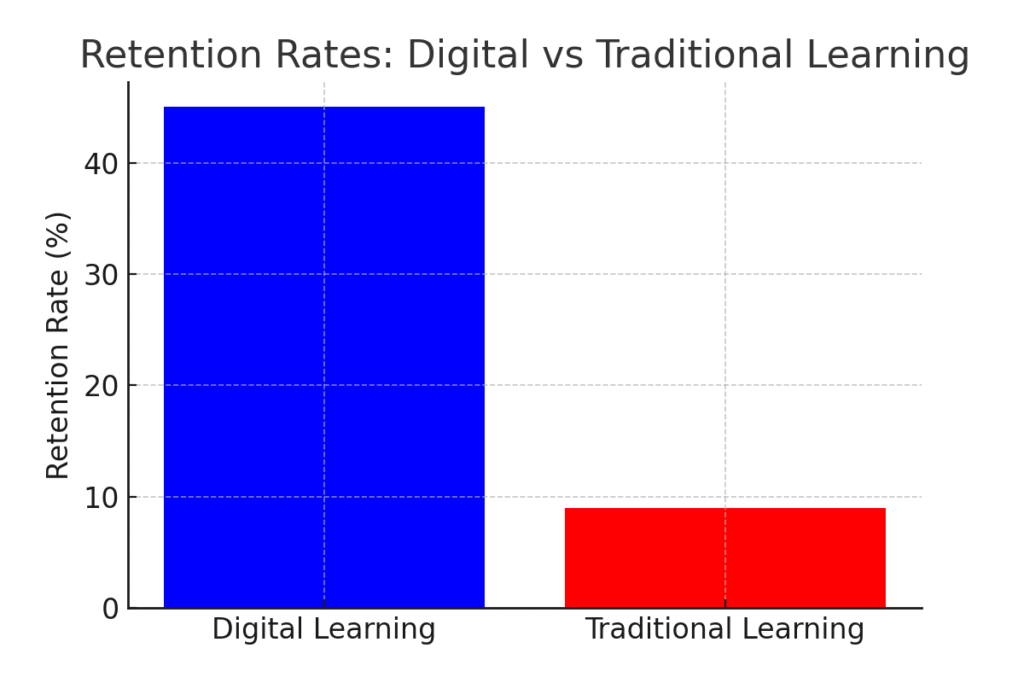
Innovation Training Marketing Statistics #5: Digital Learning Retention Rates Reach 25–60%
Compared to traditional methods (8–10%), digital learning achieves retention rates of 25–60%. This means that innovation training delivered online is far more effective. Higher retention ensures employees actually apply what they’ve learned. Companies benefit from more impactful training programs with measurable results. For marketers, the data shows why digital innovation training should be promoted as superior.

Innovation Training Marketing Statistics #6: 98% Of Corporations Adopted E-Learning By 2023
By 2023, 98% of corporations had adopted e-learning into their training. This near-universal adoption underscores the scalability of innovation training. Digital platforms make innovation skills accessible to global teams. It also allows companies to update training materials rapidly to meet changing needs. Marketers can emphasize this stat to highlight the necessity of digital-first training strategies.
Innovation Training Marketing Statistics #7: 42% Of Companies Report Revenue Growth From E-Learning
About 42% of organizations credit e-learning with increased revenue growth. Innovation training is part of this success because it equips employees with creative approaches that drive performance. Training isn’t just about cost savings—it actively contributes to profitability. This stat offers proof that training investments can have a strong ROI. Marketing campaigns can use this to show direct business benefits.
Innovation Training Marketing Statistics #8: Demand For Digital Marketing Skills Rose 33%
The demand for digital marketing skills increased by 33% year-over-year in regions like the UK and Ireland. This highlights the fast pace of change and the need for innovation training to keep professionals competitive. As marketing channels evolve, so must the skills of employees. Innovation training helps marketers adapt to new tools, platforms, and strategies. It proves that upskilling is critical in a rapidly changing industry.
Innovation Training Marketing Statistics #9: 78% Of Marketing Departments Budget For Ongoing Training
Nearly 78% of marketing teams allocate budget for continuous training and development. Innovation training is a key component of this investment. Leaders understand that keeping skills fresh is vital for campaign success. By marketing these stats, agencies can highlight the importance of structured training support. It shows training is not optional but essential to competitiveness.
Innovation Training Marketing Statistics #10: 34% Of Professionals Lack SEO Training
Around 34% of professionals say they lack training in SEO, with similar gaps in campaign strategy, content, and data analytics. These gaps highlight the importance of innovation training programs designed to bridge them. Without such training, companies risk falling behind in digital performance. Marketing innovation relies on professionals who can adapt and apply new methods effectively. This stat reveals the opportunity for organizations to differentiate through education.

Innovation Training Marketing Statistics #11: Only 25% Of Companies Move Beyond Pilot AI Marketing Efforts
Just one-quarter of businesses have advanced beyond pilot projects with AI in marketing. Innovation training can close this gap by helping teams implement AI effectively. Without proper training, companies risk stagnation and wasted investments. Marketing efforts that highlight AI innovation training can attract forward-thinking clients. This proves training is critical for turning potential into profit.
Innovation Training Marketing Statistics #12: 47% Of AI Projects Are Profitable
Only 47% of AI projects currently deliver profitability. This shows a clear training gap in effectively using AI tools. Innovation training equips employees with the knowledge to unlock ROI. Marketing professionals can emphasize this stat to stress the value of skills development. The figure underlines that training is essential to maximize emerging technologies.
Innovation Training Marketing Statistics #13: AI Boosts Sales ROI By 10–20%
Companies that invest in AI initiatives see sales ROI improve by 10–20%. However, this return is only possible with trained teams. Innovation training ensures employees know how to integrate AI into marketing effectively. For marketers, it’s proof that knowledge unlocks growth. It demonstrates the close link between training and measurable business outcomes.
Innovation Training Marketing Statistics #14: 83% Of Marketing Leaders Prioritize ROI Demonstration
About 83% of marketing leaders say proving ROI is their top concern. Innovation training helps them demonstrate this by producing stronger, more creative campaigns. When marketers can measure impact, they can justify budgets. This stat underscores why training in metrics and innovation is so important. It ensures strategies are both creative and accountable.
Innovation Training Marketing Statistics #15: 64% Of Budgets Depend On ROI Performance
Some 64% of companies allocate future budgets based on ROI performance. Innovation training directly supports ROI by improving skills and outcomes. Well-trained marketers produce campaigns with measurable results. Marketing leaders use this kind of stat to push for ongoing innovation education. It highlights the financial stakes tied to training success.
Innovation Training Marketing Statistics #16: Only 36% Of Marketers Accurately Measure ROI
Only about 36% of marketers feel confident in measuring ROI. Innovation training can close this gap by teaching professionals how to track results effectively. Without training, marketing strategies lack accountability. This limits organizational growth and trust. Marketers can use this stat to prove the importance of ongoing skill development.
Innovation Training Marketing Statistics #17: ROI Of Training Measured Over 12–24 Months
The ROI of training, especially AI and data skills, is often measured over 12–24 months. This shows that innovation training should be viewed as a long-term investment. Companies need to be patient to realize its full impact. Marketers can position training as a future-proofing strategy. This stat makes clear that true ROI takes time but is worth it.
Innovation Training Marketing Statistics #18: 15% Of Organizations Are “Augmented Learners”
Only 15% of businesses are considered “augmented learners,” using AI to enhance organizational learning. Innovation training helps more companies enter this elite group. Being an augmented learner ensures resilience and adaptability. For marketers, this stat proves how training fuels transformation. It highlights the value of innovation at the organizational level.
Innovation Training Marketing Statistics #19: 34% Of Training Hours Delivered Digitally
About 34% of organizational training hours are provided digitally. This underlines the growing shift toward online innovation training. Digital delivery offers flexibility and accessibility. Marketers can use this number to advocate for blended learning strategies. It shows how modern companies are transforming their learning culture.
Innovation Training Marketing Statistics #20: 37% Of U.S. Workers Are Very Satisfied With Training
Only 37% of U.S. workers describe themselves as very satisfied with training opportunities. Innovation training could significantly improve this satisfaction. Employees want to feel their learning is relevant, practical, and inspiring. Marketing teams can highlight this gap to stress the importance of innovation programs. It’s a reminder that training is as much about engagement as it is about skills.

Why These Statistics Matter to Me
Looking at these statistics reminds me that innovation isn’t just a buzzword—it’s a mindset that can be nurtured with the right training and support. Personally, I find it encouraging to know that when organizations invest in innovation training, they’re also investing in people, ideas, and long-term growth. For me, the data feels like a call to action: businesses can’t afford to overlook training if they want to stay relevant in fast-changing markets. These numbers aren’t just abstract percentages; they’re proof that innovation has measurable value when paired with thoughtful marketing. That’s why I’m so excited to share them—I truly believe they highlight how learning can fuel creativity, and how strategy can turn innovation into real results.
SOURCES
https://www.innovationtraining.org/tag/marketing/
https://www.edstellar.com/blog/corporate-training-statistics
https://online.hbs.edu/blog/post/innovation-training
https://www.educate-me.co/blog/corporate-training-trends
https://itsyourcareer.blog/developing-an-innovation-strategy-for-business-success-part-one/
https://kromatic.com/blog/the-failure-of-innovation-training/
https://blog.talentgarden.com/en/blog/business-innovation/how-will-corporate-training-evolve-in-2024
https://www.teachfloor.com/blog/employee-training-statistics
https://blog.ams-insights.com/topic/insights-training
https://www.innovationtraining.org/how-co-innovation-will-impact-the-marketing-department/
https://www.qmarkets.net/resources/article/marketing-innovation/