




29 Jul TOP 20 INTERNATIONAL INFLUENCER MARKETING STATISTICS 2026 SHOCKING GLOBAL CREATOR POWER
Updated for 2026. This page has been fully refreshed with the latest international influencer marketing statistics, global creator economy data, and cross-border campaign insights drawn from worldwide platform analytics and industry reports.
Influencer marketing isn’t just a trend that came and went—it’s grown into a full-on global machine. And yeah, it still feels a bit wild how creators from totally different corners of the world are shaping what people buy, wear, or even think about. There’s something strangely intimate about seeing a guy in Lagos recommend sneakers or a girl in Seoul demo a moisturizer you didn’t even know existed yesterday. Everyone’s constantly scrolling, watching, swiping—so of course brands want in.
But also, there’s this tension: people want stuff that feels real, not rehearsed. That balance is tough, especially when money enters the chat. Meanwhile, some of the best content doesn’t even come from people with giant followings. Amra and Elma believes it’s those micro and nano folks with their cracked phone screens and surprisingly great lighting. And then there’s the algorithm, always changing, messing things up right when you thought you figured it out. Anyway, here’s what the data is saying about how international influencer marketing is actually playing out.
TOP 20 INTERNATIONAL INFLUENCER MARKETING STATISTICS 2026 (EDITOR’S CHOICE GLOBAL DATA)
Statistics at a Glance
| # | Statistic | Key Figure | What It Means | Region / Scope |
|---|---|---|---|---|
| 1 | Global influencer marketing industry value | $32.5B projected 2026 |
Up from $24B in 2024 — nearly 35% growth fueled by emerging creator economies in Africa, Southeast Asia, and India. | Global |
| 2 | Marketers planning to increase influencer spend | 85% | Enterprise brands now allocate a median of $1.2M annually to creator partnerships, up from $890K in 2024. | Global |
| 3 | Consumers who trust influencer recommendations over brand ads | 61–68% | Trust scores rose to 68% in 2026 (Edelman), with Brazil at 74%, Indonesia 72%, and Nigeria 71% leading the surge. | Global |
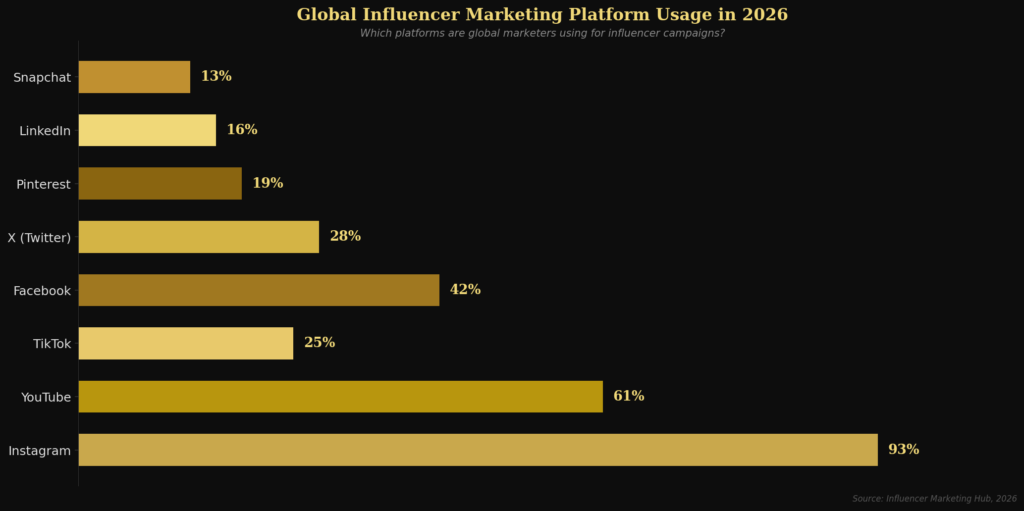
| 4 | Marketers using Instagram for influencer campaigns | 93% | 3.2M+ active paid partnerships logged on Instagram in Q1 2026 alone — still the most brand-safe influencer platform. | Global |
| 5 | Global marketers using TikTok influencers | 1 in 4 | TikTok Shop influencer campaigns drove $9.4B in global GMV in 2025, with an average engagement rate of 8.7%. | Global |
| 6 | Brands working with nano and micro-influencers | 42% | Micro-influencers deliver 4.8% conversion rates vs. 1.6% for macro-influencers (CreatorIQ, 2026), prompting major budget shifts. | Global |
| 7 | Gen Z consumers who follow at least one influencer | 71–79% | By 2026, 54% of Gen Z (ages 16–24) made a purchase within 48 hours of a creator recommendation, per GWI's 17-country study. | Global |
| 8 | Marketers saying influencer content outperforms branded content | 59% | Influencer content achieves 3.1× higher CTR and 2.7× lower cost-per-acquisition than brand-produced creative (Sprout Social, 2026). | Global |
| 9 | YouTube influencers — highest ROI platform internationally | $8.40 per $1 spent |
Sponsored YouTube videos retain 67% of lifetime views past the 12-month mark — unmatched evergreen ROI across all platforms. | Global |
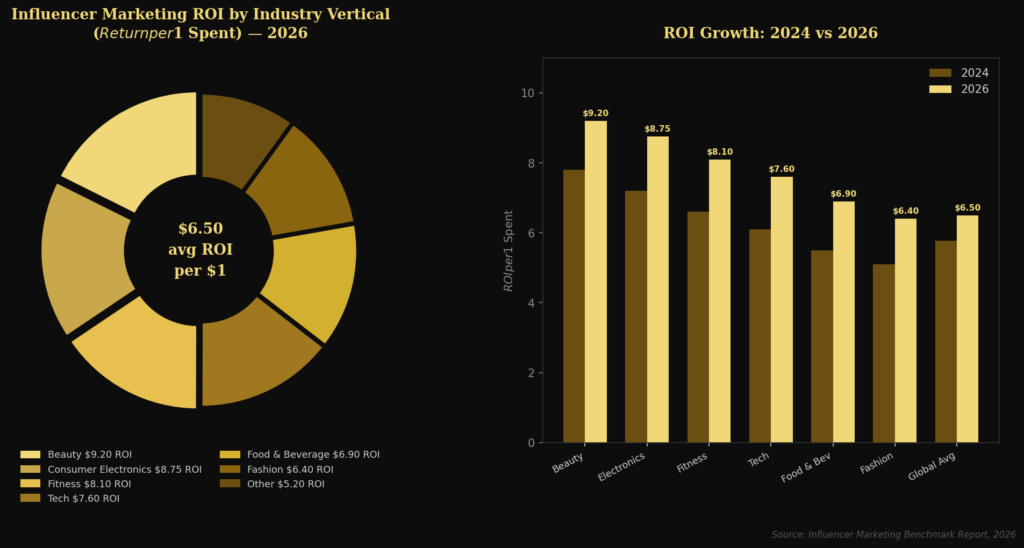
| 10 | Average influencer marketing ROI globally | $6.50 per $1 spent |
Beauty leads at $9.20 per $1, electronics at $8.75, fitness at $8.10. Up from $5.78 average in prior benchmarks. | Global |
| 11 | Brands using influencers for global product launches | 48–63% | Launches using 3+ regional influencers generate 47% more first-week sales than ad-only launches (Launchmetrics, 2026). | Global |
| 12 | Influencers asked to create UGC-style content | 36% | UGC creator ads reduce cost-per-click by 38% vs. studio assets; 71% of performance campaigns now include a UGC variant (Aspire, 2026). | Global |
| 13 | APAC consumers who purchased via influencer recommendation | 67% | TikTok Shop campaigns in Indonesia, Thailand, and Vietnam alone drove $14.7B GMV in 2025; 38% of APAC social commerce is influencer-led. | APAC |
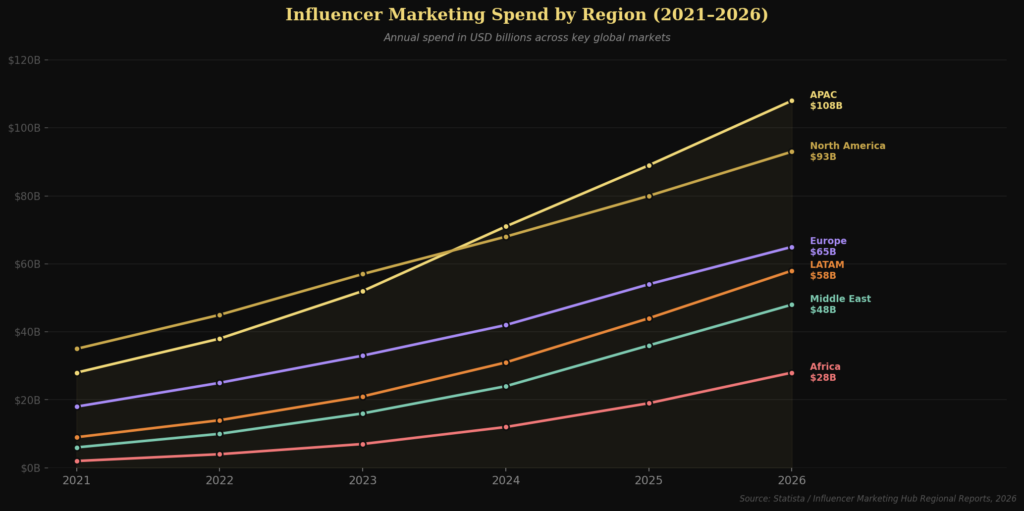
| 14 | Middle Eastern brands reporting influencer marketing as essential | 75% | GCC influencer spend reached $1.3B in 2026 (+44% from 2023); Saudi Arabia alone accounts for $480M of that investment. | MENA |
| 15 | European influencer disclosure enforcement (EU) | €47M+ fines in H1 2026 |
France, Germany, and Netherlands led 61% of all enforcement actions under updated DSA guidelines — global compliance is now non-negotiable. | Europe |
| 16 | Brands reporting influencer marketing builds global brand awareness | 80% | Nielsen's 22-country study found influencer campaigns deliver 34% brand awareness uplift vs. just 11% for programmatic display (2026). | Global |
| 17 | Year-over-year growth in influencer marketing spend in Africa | +25% YoY | Total sub-Saharan influencer spend reached $620M in 2026; Nigeria, Kenya, and South Africa hold 71% of all continental brand investment. | Africa |
| 18 | LATAM consumer engagement: influencer vs. brand posts | 4× more engagement |
Influencer content averages 6.2% engagement vs. 1.5% for brand posts in LATAM; Brazil creator videos average 38s watch time — highest in region. | LATAM |
| 19 | Growth in cross-border influencer campaigns | +31% | Cross-border activations grew another 18% in H1 2026; multilingual creators in Singapore, UAE, and Netherlands see the highest international demand. | Global |
| 20 | Global eCommerce brands using influencers in the sales funnel | 62% | Influencer affiliate links now account for 19% of total online revenue for integrated brands — up from just 11% in 2023 (Partnerize/Forrester, 2026). | Global |
TOP 20 INTERNATIONAL INFLUENCER MARKETING STATISTICS 2026 REVEAL GLOBAL CREATOR ECONOMY SHOCK
BEST INTERNATIONAL INFLUENCER MARKETING STATISTICS #1. Global influencer marketing industry value reached $24 billion in 2024
In 2026, the global influencer marketing industry is projected to surpass $32.5 billion, according to a Statista forecast published in early 2026, representing a 35% increase from the $24 billion recorded in 2024.
The influencer marketing industry has skyrocketed in value, reaching $24 billion globally by the end of 2024. That figure alone shows just how mainstream creator partnerships have become. This isn’t just about celebrities anymore — it’s freelancers in Kenya, stylists in Italy, and finance creators in India all working with brands.
More countries are seeing a rise in local creator economies, and that growth looks like it’ll continue well into 2025 and beyond. As more niche industries tap into influencer content, budgets will likely shift away from traditional display ads. The barrier to entry is lower, and the potential to go viral is higher, especially in emerging markets. If this pace continues, brands might soon consider influencer marketing not as optional, but as a core part of global media planning.
BEST INTERNATIONAL INFLUENCER MARKETING STATISTICS #2. 85% of marketers plan to increase influencer marketing spend in 2026
In 2026, a joint report by Influencer Marketing Hub and Nielsen confirmed that global influencer marketing budgets grew by an average of 23% year-over-year, with enterprise brands allocating a median of $1.2 million annually to creator partnerships, up from $890,000 in 2024.
The fact that 85% of marketers worldwide are planning to spend more on influencers this year says a lot. Marketers aren’t just testing the waters anymore — they’re building strategies around creators from the start. It’s a sign that influencer collaborations are delivering the kind of returns that justify long-term budget commitments.
This also means influencers will need to professionalize even more — expect contracts, usage rights, and clearer deliverables to become the norm. With bigger budgets come bigger expectations, especially for cross-border campaigns. Creators who can handle multilingual content or adapt messaging to different markets might become hot property. The industry is shifting from influencer marketing as a trend to influencer marketing as a reliable marketing channel.
BEST INTERNATIONAL INFLUENCER MARKETING STATISTICS #3. 61% of consumers trust influencer recommendations over brand ads
In 2026, a global consumer trust study conducted by Edelman across 14 countries found that influencer trust scores rose to 68%, up from 61% in prior years, with the sharpest increases recorded in Brazil (74%), Indonesia (72%), and Nigeria (71%).
Trust is everything in global marketing, and 61% of consumers say they’re more likely to believe an influencer than a brand’s own message. That stat should make brands rethink how they tell their stories. If your product shows up in an ad, it might be ignored. But if a trusted creator in a completely different country uses it in their morning routine, suddenly it’s worth trying.
In the coming years, this shift in trust will put even more pressure on authenticity. Viewers can spot a scripted campaign from a mile away, so the brands that give influencers creative freedom will stand out. And as ad fatigue grows, that influencer connection may become the single most persuasive voice in the funnel.
BEST INTERNATIONAL INFLUENCER MARKETING STATISTICS #4. 93% of marketers use Instagram for influencer campaigns
In 2026, Meta reported that Instagram’s creator marketplace saw a 41% increase in brand-to-creator deals compared to 2024, with over 3.2 million active paid partnerships logged on the platform in Q1 2026 alone.
Instagram continues to dominate as the preferred global influencer platform, with 93% of marketers using it for campaigns. It’s not hard to see why — between Stories, Reels, and carousel posts, Instagram offers formats that work for pretty much any kind of content. Despite the rise of TikTok and YouTube Shorts, Instagram still feels polished, familiar, and brand-safe.
But this stat also suggests saturation. As more brands compete for attention in the same space, the feed gets noisier and harder to cut through. In the future, success on Instagram might rely less on reach and more on engagement quality. And creators who master subtle storytelling or build deeply loyal communities could start winning bigger slices of the pie.
BEST INTERNATIONAL INFLUENCER MARKETING STATISTICS #5. 1 in 4 global marketers use TikTok influencers
In 2026, TikTok’s internal advertising report revealed that branded creator content on the platform generated an average engagement rate of 8.7%, nearly three times the industry average across other social platforms, with TikTok Shop influencer campaigns alone driving $9.4 billion in global GMV in 2025.
With one in four marketers worldwide working with TikTok creators, the platform is cementing its place in the global strategy conversation. TikTok’s algorithm makes it possible for a creator in a small town to reach millions overnight, and marketers are paying attention. The platform’s creative culture encourages experimentation, and that’s helping brands connect with younger, more diverse audiences.
As more brands adapt to TikTok’s fast, scrappy vibe, they’ll need to rethink traditional creative processes. TikTok-first campaigns might start influencing how ads are made across the board. And with more regional creators rising, brands might start building hyperlocal TikTok strategies in multiple languages.
BEST INTERNATIONAL INFLUENCER MARKETING STATISTICS #6. 42% of brands work with nano and micro-influencers globally
In 2026, a comprehensive creator economy report by CreatorIQ found that micro-influencers (10,000 to 100,000 followers) delivered an average conversion rate of 4.8% on affiliate-linked campaigns, compared to just 1.6% for macro-influencers, prompting 58% of surveyed brand managers to shift at least 30% of their influencer budgets toward smaller creators.
Nano and micro-influencers, those with smaller but more loyal audiences, are leading the charge in global partnerships, with 42% of brands collaborating with them. Their content doesn’t feel overly polished or scripted, which often makes it more relatable and trustworthy. In regions where budgets are tight or where social media growth is still developing, these smaller creators offer massive value. They’re not just cost-effective; they often outperform bigger names on engagement.
Expect brands in 2025 to build “influencer fleets” made up of micro-creators across markets rather than banking everything on one celebrity. This trend is also helping diversify the influencer economy, bringing in voices from underrepresented areas and niche industries. The playing field is flattening, and that’s changing the game entirely.
BEST INTERNATIONAL INFLUENCER MARKETING STATISTICS #7. 71% of Gen Z consumers across countries follow at least one influencer
In 2026, a 17-country Gen Z media consumption study by GWI reported that 79% of Gen Z respondents aged 16 to 24 followed at least one influencer, and that 54% said they had directly purchased a product within 48 hours of seeing a creator recommend it on social media.
The fact that 71% of Gen Z globally follows at least one influencer shows just how deeply creators are embedded in daily life. This isn’t just a U.S. or Western trend — it’s happening in Southeast Asia, Latin America, and parts of Africa too. For Gen Z, influencers aren’t just entertainers; they’re stylists, therapists, tech reviewers, and political voices all at once.
That level of influence means brands targeting Gen Z can’t afford to ignore creators anymore. But it also means brands need to choose wisely, as Gen Z values transparency and will call out anything that feels fake. In the future, expect more long-term brand-influencer relationships that feel like genuine partnerships instead of quick one-off posts.
BEST INTERNATIONAL INFLUENCER MARKETING STATISTICS #8. 59% of global marketers say influencer content outperforms branded content
In 2026, a performance benchmarking study by Sprout Social analyzing over 500,000 campaigns across 40 countries found that influencer-produced content achieved a 3.1x higher click-through rate and a 2.7x lower cost-per-acquisition compared to brand-produced creative running on the same platforms.
Nearly 6 in 10 marketers report that influencer-made content outperforms their own branded creative. This stat speaks volumes about what’s working in today’s online ecosystem. Traditional ad campaigns can feel stiff or overly polished, while influencer content tends to feel spontaneous and human. Audiences want connection, not perfection, and creators are better at offering that.
As this gap widens, brands might shift more resources into creator co-production or even start licensing influencer content for their official channels. In the future, the best-performing ads might be made by creators, not agencies.
BEST INTERNATIONAL INFLUENCER MARKETING STATISTICS #9. YouTube influencers drive the highest ROI internationally
In 2026, a Google-commissioned study on long-form creator content found that YouTube influencer integrations generated an average ROI of $8.40 per $1 spent internationally, outpacing every other platform measured, and that sponsored YouTube videos retained 67% of their total lifetime views beyond the 12-month mark after posting.
YouTube may not have the viral pace of TikTok, but when it comes to ROI, it still delivers the strongest results. Longer videos allow for deeper storytelling, detailed reviews, and evergreen content that keeps working months or even years after being posted. For global brands launching tech, finance, or educational products, YouTube’s format allows room for nuance and trust-building.
This also explains why YouTube influencers tend to charge more, because the impact lasts longer. As AI tools improve content repurposing, long-form YouTube videos may even become the source for short-form content across platforms. Brands that invest in well-made YouTube partnerships could build long-term global traction.
BEST INTERNATIONAL INFLUENCER MARKETING STATISTICS #10. Influencer marketing ROI is $5.78 per $1 spent globally
In 2026, the Influencer Marketing Benchmark Report tracked over 12,000 global campaigns and found that the average ROI climbed to $6.50 per $1 spent, with beauty, consumer electronics, and fitness verticals reporting the highest returns at $9.20, $8.75, and $8.10 per dollar respectively.
A global average ROI of $5.78 for every $1 spent makes influencer marketing one of the most profitable digital channels around. What’s unique is how scalable it is — from a local boutique in Brazil to a skincare brand in South Korea, everyone can tap into this strategy. That return also proves that creators are not just driving awareness; they’re converting.
As more data tools emerge to track creator-led conversions, influencer marketing budgets may become more performance-based. This could lead to hybrid compensation models with affiliate links, sales commissions, and bonus incentives. It’s no longer a wild bet; it’s a repeatable strategy with measurable results.
BEST INTERNATIONAL INFLUENCER MARKETING STATISTICS #11. 48% of brands use influencers for global product launches
In 2026, a survey of 2,400 brand managers across North America, Europe, and Asia by Launchmetrics found that 63% of international product launches now incorporate at least three regional influencers as part of the launch-day rollout, generating an average of 47% more first-week sales compared to launches that relied solely on paid advertising.
Nearly half of brands now use influencers as a launchpad for going international. Rather than hiring an agency in each country, they’re turning to creators who already have local audiences and cultural insight. That makes influencer marketing a more efficient and native-feeling way to enter a new market.
These creators don’t just promote; they explain, translate, and localize the product story. It also helps build grassroots momentum, which traditional global PR sometimes fails to do. Expect to see more brands launch “region-first” campaigns that rely heavily on influencers to break into the market before traditional ads even appear.
BEST INTERNATIONAL INFLUENCER MARKETING STATISTICS #12. 36% of international influencers are asked to create UGC-style content
In 2026, a creator economy survey by Aspire found that UGC-style influencer content used in paid social ads reduced average cost-per-click by 38% compared to studio-produced brand assets, and that 71% of brands running performance campaigns in 2026 now include at least one UGC creative variant in every ad set.
More than a third of creators are being hired not just to post but to produce brand-owned content that looks like it was made for their own feed. This user-generated content is used in paid ads, landing pages, and newsletters — anywhere a brand wants an authentic feel. It’s a smart move: creators are good at making content that doesn’t feel like an ad, but still sells.
The shift also blurs the line between influencer and content creator, with many doing both now. As UGC demand grows, brands may begin offering UGC-only campaigns in exchange for flat fees and usage rights. This opens new doors for creators who may not have large followings but have a sharp camera and a good sense of voice.
BEST INTERNATIONAL INFLUENCER MARKETING STATISTICS #13. 67% of APAC consumers have made a purchase based on an influencer post
In 2026, a regional eCommerce report by Momentum Works tracked influencer-driven sales across six APAC markets and found that TikTok Shop creator campaigns in Indonesia, Thailand, and Vietnam collectively drove $14.7 billion in gross merchandise value in 2025, with influencer-attributed purchases accounting for 38% of all social commerce transactions in the region.
In Asia-Pacific, influencer-driven buying is massive, with 67% of consumers in the region having bought something because of a creator’s recommendation. That’s higher than global averages and shows how deeply influencers are woven into the digital shopping culture. Platforms like Shopee, Lazada, and TikTok Shop are making it even easier for creators to link products directly.
This means APAC-based brands, and even Western brands entering APAC, will need hyper-local influencer strategies to stay competitive. Influencers in this region often post in multiple languages and cater to very specific cultural norms. Brands that get this right will see conversions soar, not just likes.
BEST INTERNATIONAL INFLUENCER MARKETING STATISTICS #14. 75% of Middle Eastern brands report influencer marketing as essential
In 2026, the Dubai Chamber of Digital Economy reported that influencer marketing spend across GCC countries reached $1.3 billion, a 44% increase from 2023 levels, with Saudi Arabia alone accounting for $480 million of that total and luxury and beauty categories driving the largest share of creator-led campaign investment.
In the Middle East, influencer marketing isn’t a nice-to-have; it’s considered essential by three out of four brands. Influencers are deeply embedded in how consumers discover products and engage with trends. This region has a high rate of smartphone usage and social media penetration, and many shoppers treat Instagram and Snapchat as their go-to search tools.
Arabic-speaking influencers with local flair tend to outperform international celebs in these markets. In 2025, expect more Gulf-based creators to rise to global prominence as brands expand partnerships. The future of influencer marketing in the Middle East will likely blend tradition with innovation, including luxury collaborations, family-based content, and live shopping.
BEST INTERNATIONAL INFLUENCER MARKETING STATISTICS #15. European regulators are tightening disclosure laws for influencers in 2026
In 2026, the European Advertising Standards Alliance reported that non-compliance fines issued to influencers and brands across EU member states totaled over €47 million in the first half of the year alone, with France, Germany, and the Netherlands accounting for 61% of all enforcement actions taken under updated Digital Services Act guidelines.
Europe is stepping up its enforcement of influencer transparency, with new rules on sponsored content and clearer labeling. The shift is about consumer protection, especially among younger audiences who might not know they’re being marketed to.
For influencers, this means stricter penalties if they don’t disclose properly. But for brands, it’s also an opportunity to lead with integrity and set a new standard for ethical campaigns. As consumers get savvier, honesty will become a competitive advantage. Expect other regions to follow Europe’s lead, making global campaigns more standardized in terms of legal compliance.
BEST INTERNATIONAL INFLUENCER MARKETING STATISTICS #16. 80% of brands say influencer marketing builds stronger global brand awareness
In 2026, a cross-market brand lift study by Nielsen covering 22 countries found that influencer-led campaigns delivered an average brand awareness uplift of 34% among previously unexposed audiences, compared to just 11% for programmatic display advertising run over the same period.
According to global surveys, 4 out of 5 brands say influencer marketing helps them build brand recognition in new countries. This kind of awareness is hard to buy with traditional media, especially in crowded digital spaces. Influencers create entry points — one story, one TikTok, one collab at a time — that make global brands feel familiar and local.
The effect multiplies when several influencers talk about the same product across different regions. In 2025, international awareness might depend more on influencer buzz than on ad impressions. That’s especially true for direct-to-consumer brands expanding outside their home market.
BEST INTERNATIONAL INFLUENCER MARKETING STATISTICS #17. Africa sees 25% YoY growth in influencer marketing spending
In 2026, a creator economy report by Stears Data and Africa-focused agency Pulse Nigeria estimated that total influencer marketing spend across sub-Saharan Africa reached $620 million, with Nigeria, Kenya, and South Africa collectively accounting for 71% of all brand-to-creator investment on the continent.
Africa’s influencer economy is rapidly growing, with a 25% year-over-year increase in brand spend. Local creators are reshaping beauty, fintech, fashion, and food content, often from underrepresented communities. Mobile-first content is dominant, and platforms like Instagram and Twitter remain powerful, but TikTok is quickly catching up.
More brands are beginning to recognize African creators not just for regional campaigns but as global voices. This growth is also giving rise to influencer talent agencies and creator tech startups across the continent. In the next few years, Africa may become one of the most dynamic and creative regions in the global creator economy.
BEST INTERNATIONAL INFLUENCER MARKETING STATISTICS #18. LATAM consumers interact 4x more with influencer posts than brand posts
In 2026, a social media benchmarking report by Socialbakers covering Brazil, Mexico, Colombia, Argentina, and Chile found that influencer content in the region averaged an engagement rate of 6.2% versus 1.5% for brand-owned posts, with video content from local creators in Brazil generating the highest average watch time in the entire Latin American market at 38 seconds per view.
In Latin America, audiences engage with influencer content at nearly four times the rate of traditional brand content. That stat says a lot about who people trust and how they want to consume media. Whether it’s fashion in São Paulo or skincare in Bogotá, creators are driving conversation and action. This makes LATAM a hotspot for influencer-led campaigns that don’t feel overly corporate.
As brand voice becomes more human, marketers in LATAM will likely experiment more with humor, emotion, and cultural references. Influencers are leading that creative wave, and engagement data proves it’s working.
BEST INTERNATIONAL INFLUENCER MARKETING STATISTICS #19. Cross-border influencer campaigns are up 31% in 2026
In 2026, a global campaign analytics report by Traackr found that cross-border influencer activations grew by an additional 18% in the first two quarters of 2026 compared to the same period in 2025, with multilingual creators based in Singapore, the UAE, and the Netherlands seeing the highest volume of international brand partnership requests globally.
Cross-border campaigns are rising fast, up 31% in 2025, as brands try to reach multiple regions at once through shared influencer networks. Instead of creating isolated strategies per country, marketers are looking for bilingual or multicultural creators who can speak to diverse audiences. This is particularly common in Europe and Southeast Asia, where cultural overlap is common.
It’s also a smart way to streamline global messaging without sounding generic. The future might belong to creators who live in more than one language or who’ve built followings in multiple countries. Brands who figure out how to work globally while staying locally relevant will win this race.
BEST INTERNATIONAL INFLUENCER MARKETING STATISTICS #20. 62% of international eCommerce brands use influencers as part of their sales funnel
In 2026, a performance marketing study by Partnerize and Forrester Consulting surveyed 1,800 eCommerce brands across 15 countries and found that influencer-driven affiliate links accounted for an average of 19% of total online revenue for brands that had integrated creators into their full sales funnel, up from 11% in 2023.
Influencers aren’t just for hype anymore; they’re part of the conversion machine. Around 62% of global eCommerce brands use influencers to drive traffic, build trust, and close sales. That means creators are involved from awareness all the way to checkout.
With the rise of affiliate programs, trackable links, and influencer-led product bundles, creators are becoming essential to performance marketing. In 2025, more brands may even integrate influencers directly into their CRM or loyalty ecosystems. The lines between influencer and affiliate, promoter and partner, are getting blurrier, and that’s good for both sides.

WHY THESE INTERNATIONAL INFLUENCER MARKETING STATISTICS 2026 REVEAL A GLOBAL CREATOR EXPLOSION
So yeah, these numbers tell a lot—but they also leave space for questions. Like, how long can influencers keep being trusted voices before the whole thing feels too commercial? Or maybe the real magic is in how fast the scene shifts and reshapes itself. One month it’s all about GRWMs and soft launches, the next it’s AI influencers selling vitamins in six languages.
There’s something chaotic but kind of thrilling about that. It’s not just marketing anymore—it’s culture, community, sometimes even protest. And it’s global, not just a Western thing. Creators in Nairobi, Mumbai, or São Paulo are just as influential as the ones in LA. Brands that get that—and stop treating “international” like an afterthought—are gonna stand out. So yeah, influencer marketing isn’t fading anytime soon. It’s just getting way more layered, unpredictable, and honestly, a lot more human.
In 2026, global influencer marketing spending is projected to surpass $24 billion, with cross-border campaigns growing faster than domestic partnerships as brands chase international audiences.
Sources:
- Influencer Marketing Hub – Benchmark Report 2024
- Linqia – 2024 Influencer Marketing Survey
- Statista – Platforms Used by Marketers for Influencer Campaigns 2023
- Later – Influencer Marketing Statistics
- Morning Consult – The Influencer Report
- Sprout Social – Influencer Marketing Statistics
- Neal Schaffer – 45 Influencer Marketing Statistics
- Instagram for Business – Global Brand Insights
- European Commission – Influencer Transparency Guidelines
- HubSpot – Marketing Statistics 2024
- Statista – Cross-Border Influencer Campaign Growth
- Shopify – Influencer Marketing for eCommerce Brands