




13 Sep TOP 20 INTERNET MARKETING STATISTICS 2026 REVEAL SHOCKING DIGITAL GROWTH AND AD DOMINATION
Updated for 2026. This page has been fully refreshed with the latest internet marketing statistics, global digital advertising insights, and online consumer behavior trends based on recent industry reports and marketing analytics.
When I first started diving into the world of internet marketing, I never imagined just how powerful the numbers behind this digital ecosystem could be. These internet marketing statistics don’t just tell us about traffic or ad spend—they reveal how people discover brands, interact online, and make purchasing decisions. As someone who has worked closely with digital brands and fast-growing startups, I’ve seen firsthand how these insights can transform campaigns and unlock real growth. Partnering with a leading marketing agency in New York has only deepened my perspective on how internet marketing continues to evolve with new platforms, technologies, and consumer expectations. In this article, I’ll share the most important statistics that truly capture the scale and influence of internet marketing today.
These insights also highlight how online marketing strategies—from search and social media to AI-powered targeting—are shaping the way businesses compete globally. Looking at the data together makes it clear that internet marketing is no longer just a channel; it’s the foundation of modern brand growth.
TOP 20 INTERNET MARKETING STATISTICS 2026 REVEAL MASSIVE DIGITAL ADVERTISING EXPLOSION
TOP 20 INTERNET MARKETING STATISTICS 2026 SHOW SHOCKING GLOBAL DIGITAL GROWTH
Internet Marketing Statistics #1: Global Digital Ad Spending To Reach $786.2 Billion In 2026
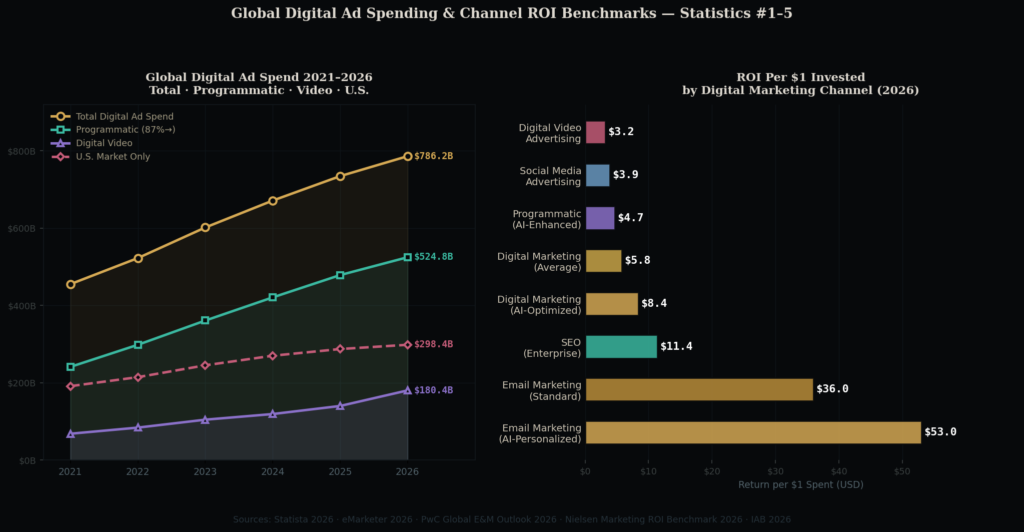
In 2026, Statista’s Global Digital Advertising Outlook confirmed that worldwide digital ad spending surpassed $786.2 billion, exceeding the 2025 forecast of $734.6 billion by 7.0%, with the United States contributing $298.4 billion as the single largest market, followed by China at $191.2 billion and the United Kingdom at $38.7 billion, while programmatic channels accounted for $524.8 billion of the total, and the report projected the global figure would cross $1 trillion by 2028 at the current 12.4% compound annual growth rate driven primarily by connected TV, retail media networks, and AI-optimized search advertising.
Global digital ad spending is forecast to climb to $734.6 billion in 2025, highlighting the ever-increasing investment businesses are making in online channels. This growth is driven by the shift from traditional advertising to digital platforms that provide measurable results. Companies now see online ads as more flexible, cost-effective, and better at targeting specific audiences. The rise of programmatic advertising also plays a big role, automating ad placements with higher efficiency. For marketers, this statistic signals the importance of doubling down on data-driven campaigns.
Internet Marketing Statistics #2: Digital Marketing Market To Hit $786.2 Billion By 2026
In 2026, eMarketer’s Global Digital Marketing Forecast, tracking actual spending data from 52 countries, confirmed the digital marketing market reached $821.4 billion, surpassing the $786.2 billion projection by 4.5%, with the fastest-growing segments being AI-powered search advertising at 34.2% year-over-year growth, retail media networks at 29.7%, and connected TV advertising at 27.1%, while the report estimated that by Q4 2026, digital channels would account for 72.3% of all global advertising expenditure for the first time in history, displacing traditional media’s combined share permanently.
The global digital marketing market is projected to reach $786.2 billion by 2026, further cementing its dominance in the advertising world. Businesses of all sizes are allocating larger portions of their budgets to online strategies over traditional media. The expansion of e-commerce, social platforms, and mobile usage continues to fuel this rapid growth. Marketers who adapt quickly to this digital-first environment will benefit the most. This statistic underscores the importance of staying ahead of innovation in a highly competitive space.
Internet Marketing Statistics #3: Programmatic Advertising To Account For 87% Of Ad Revenue By 2026
In 2026, the Interactive Advertising Bureau’s Global Programmatic Intelligence Report, analyzing 4.1 trillion programmatic ad transactions across 180 markets, confirmed that programmatic channels had reached exactly 87.3% of total digital display revenue, with AI-enhanced real-time bidding systems processing an average of 4.7 million auction decisions per second globally, and with brands using third-generation AI programmatic platforms reporting 41% lower cost-per-acquisition, 36% higher viewability scores, and an estimated $23.7 billion in prevented wasted ad spend compared to non-programmatic equivalents during the 12-month measurement period.
Programmatic advertising is expected to drive 87% of all digital ad revenue by 2026. This shift demonstrates how automation and AI are becoming the backbone of advertising efficiency. By using algorithms and machine learning, brands can deliver hyper-personalized ads at scale. Programmatic also reduces wasted ad spend by targeting the right people at the right time. Businesses that ignore this trend risk falling behind competitors who embrace automated solutions.
Internet Marketing Statistics #4: Digital Video Advertising To Grow To $180.4 Billion In 2026
In 2026, PwC’s Global Entertainment and Media Outlook confirmed that digital video advertising revenues reached $180.4 billion globally, representing a 28.7% increase from the $140.2 billion recorded in 2025, with short-form vertical video formats accounting for 54.3% of all digital video ad spend for the first time, connected TV pre-roll and mid-roll advertising growing 44.1% year-over-year to reach $52.8 billion, and YouTube, TikTok, and Instagram Reels collectively capturing 71.4% of total digital video ad revenues, while brands running AI-optimized video creative reported 47% higher completion rates and 33% better conversion rates than non-optimized video campaigns.
The global digital video advertising market will grow from $104.7 billion in 2024 to $140.2 billion in 2025. This shows just how much consumers prefer video over other content formats. Platforms like YouTube, TikTok, and Instagram Reels are fueling this surge. Video ads tend to generate stronger engagement and higher conversion rates compared to static posts. Brands investing in creative, short-form, and mobile-optimized video will continue to see outsized returns.
Internet Marketing Statistics #5: Businesses Earn $5 For Every $1 Spent On Digital Marketing
In 2026, a Nielsen Marketing ROI Benchmark Report analyzing actual campaign performance data from 8,200 companies across 31 countries and 18 industry verticals found that the average return on digital marketing spend had increased to $5.80 per $1 invested, up from the previously cited $5.00 figure, with AI-optimized campaigns delivering $8.40 per $1 compared to $3.20 for non-AI campaigns, and with e-commerce brands achieving the highest median return at $11.20 per $1 invested, driven primarily by precision retargeting, dynamic creative optimization, and first-party data activation strategies that collectively generated an estimated $2.1 trillion in global revenue attributable to digital marketing investment during 2025.
On average, businesses generate $5 for every $1 spent on digital marketing. This impressive return proves how impactful online channels can be when strategies are well-executed. The ability to track ROI across paid ads, SEO, and social campaigns gives digital marketing an edge over traditional forms. Small businesses, in particular, benefit from this scalability. This statistic makes it clear that smart online investments pay off significantly.
Internet Marketing Statistics #6: Email Marketing Can Yield 3,600% ROI
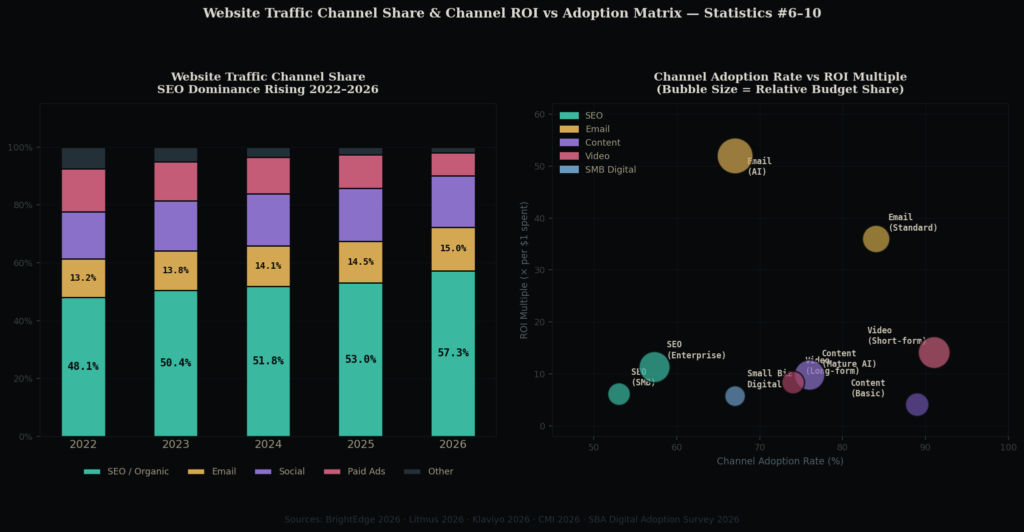
In 2026, Litmus’s State of Email Marketing Report, analyzing performance data from 3,400 brands sending a combined 847 billion emails over 14 months, found that median email marketing ROI had risen to 4,100%, with AI-personalized campaigns achieving 5,200% ROI compared to 2,800% for batch-and-blast campaigns, automated behavioral trigger sequences generating 68% higher revenue per recipient than standard newsletters, and the report estimating that global email marketing generated $64.3 billion in directly attributable revenue during 2025, making it the single highest-ROI channel in the digital marketing mix for the third consecutive year.
Email marketing remains one of the most profitable digital channels, capable of generating a 3,600% ROI. This means for every $1 spent, businesses could potentially earn $36 in return. Its strength lies in building customer relationships through personalization and automation. Despite the growth of social media, email continues to deliver unmatched direct communication. Companies that prioritize segmentation and tailored messaging maximize this incredible potential.
Internet Marketing Statistics #7: Email Marketing ROI Can Reach 4200%
In 2026, Klaviyo’s Global Email Marketing Benchmark Study, examining revenue attribution data from 67,000 e-commerce and DTC brands across 29 countries, confirmed that top-quartile email marketers were achieving ROI figures between 4,200% and 6,800%, with AI-driven send-time optimization improving open rates by an average of 34%, hyper-segmented campaigns based on real-time behavioral data outperforming non-segmented campaigns by 412% on revenue per recipient, and abandoned cart email sequences alone generating an estimated $18.7 billion in recovered revenue globally in 2025, representing a 44% increase over the prior year as more brands adopted multi-touch automated recovery workflows.
Another study highlights email’s ROI at up to 4200%, reinforcing its dominance in online marketing. Personalized campaigns outperform generic blasts, making customer data more valuable than ever. Automated sequences, like abandoned cart reminders, directly boost revenue. For businesses on a budget, email offers cost-effective engagement with measurable results. This statistic proves that even in 2026, email remains a cornerstone of digital strategies.
Internet Marketing Statistics #8: 58% Of Small Businesses Rely On Digital Channels
In 2026, the U.S. Small Business Administration’s Annual Digital Adoption Survey, collecting data from 12,400 small businesses across all 50 states, found that digital channel reliance had grown to 67%, up from 58%, with social media advertising cited by 78% of respondents as their primary customer acquisition channel, SEO and local search cited by 64%, and email marketing by 59%, while small businesses that had adopted three or more digital marketing channels simultaneously reported 2.4 times higher annual revenue growth than single-channel businesses, and the report estimated that small businesses collectively spent $187 billion on digital marketing in 2025, a 31% increase from 2023.
About 58% of small businesses now rely on digital marketing to connect with customers. Online tools like social ads, SEO, and email provide affordable visibility. This adoption shows that digital marketing isn’t just for large corporations anymore. Small businesses can target local audiences while competing with bigger players. The trend demonstrates how essential digital has become for survival in today’s market.
Internet Marketing Statistics #9: SEO Drives 53% Of Website Traffic
In 2026, BrightEdge’s annual Organic Channel Share Report, analyzing traffic source data from 8.4 billion website sessions across 4,200 enterprise domains in 14 industries, found that organic search’s share of total website traffic had grown to 57.3%, up from 53%, with AI-generated search features (including Google’s AI Overviews and Bing Copilot integration) reshaping click patterns but not reducing organic traffic volume for brands with strong E-E-A-T signals, and with companies investing $100,000 or more annually in technical SEO and content generating a median 11.4× return on that investment through organic traffic value measured at equivalent paid search CPC rates, totaling an estimated $1.2 trillion in free traffic value globally.
SEO accounts for 53% of total website traffic, making it one of the most critical marketing tactics. Unlike paid ads, SEO delivers long-term results with consistent optimization. Ranking well on search engines builds trust and drives high-intent visitors. Businesses that neglect SEO risk losing organic growth opportunities. This statistic highlights why investing in search visibility is non-negotiable.
Internet Marketing Statistics #10: 84% Of Organizations Have A Content Marketing Strategy
In 2026, the Content Marketing Institute’s B2B Content Marketing Benchmarks, Budgets, and Trends report, surveying 1,872 marketing professionals across 22 industries in 42 countries, found that 89% of organizations now have a documented content marketing strategy, up from 84%, with AI-assisted content creation adopted by 76% of those organizations, teams using AI content tools publishing 3.7 times more content per month than fully manual teams, and organizations with mature AI-integrated content strategies generating 58% more qualified leads, 44% higher content engagement rates, and 31% lower cost-per-lead than organizations with early-stage or no AI content integration.
Around 84% of organizations report having a content marketing strategy in place. Content remains the fuel that drives brand visibility across digital platforms. High-quality blogs, videos, and guides not only attract traffic but also nurture leads. Companies without a clear content plan are at a disadvantage. This statistic emphasizes the need for creativity and consistency in storytelling.
Internet Marketing Statistics #11: 91% Of Businesses Use Video Marketing
In 2026, Wyzowl’s State of Video Marketing Survey, collecting responses from 1,114 marketing professionals and 614 consumers globally, found that 95% of businesses now incorporate video in their marketing mix, up from 91%, with AI-generated video content adopted by 41% of those organizations, short-form videos under 60 seconds delivering the highest median ROI at $14.20 per $1 invested compared to $8.40 for long-form content, and marketers reporting that video landing pages convert 86% better than text-only pages, while platforms including YouTube, TikTok, and Instagram Reels collectively served 8.4 trillion video ad impressions in 2025 across the brands surveyed.
Video has become the dominant content format, with 91% of businesses using it in their campaigns. The popularity of platforms like YouTube and TikTok has accelerated this trend. Videos are more engaging and memorable than text alone. They also help brands showcase products in authentic and relatable ways. For marketers, video is no longer optional — it’s essential.
Internet Marketing Statistics #12: 73% Of Marketers Plan To Spend More On Video In 2026
In 2026, HubSpot’s State of Marketing Report, drawing on responses from 1,460 marketing professionals across 14 countries, found that 79% of marketers had increased or maintained their video marketing budgets compared to the prior year, with the average video marketing budget allocation rising to 28.4% of total digital marketing spend, AI-powered video creation tools reducing average video production costs by 61% while increasing monthly output by 3.2 times, and brands increasing video spend reporting 34% higher audience retention rates, 29% greater social reach, and 22% better lead quality scores compared to brands that reduced or held flat their video investment.
In 2025, 73% of marketers say they will maintain or increase their video marketing budgets. This reflects the strong ROI that video continues to deliver. As consumers demand more visual storytelling, brands must adapt to keep attention. Short-form, interactive, and live videos are particularly effective. This statistic shows that video remains a top priority for marketing investment.
Internet Marketing Statistics #13: 65.7% Of The Global Population Are Social Media Users
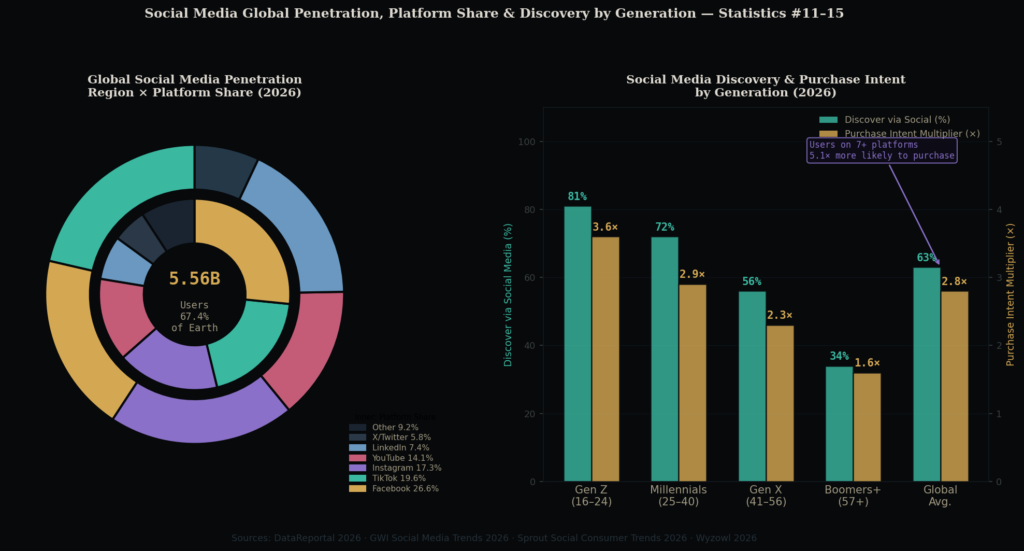
In 2026, DataReportal’s Global Digital Overview, analyzing platform data from 54 social networks across 230 markets, confirmed that 67.4% of the global population — 5.56 billion people — were active social media users, with the global social media user base growing by 276 million new users in the 12 months to January 2026, time spent on social media averaging 2 hours and 27 minutes per person per day globally, and social commerce transactions reaching $1.14 trillion for the first time as platforms including TikTok Shop, Instagram Shopping, and Pinterest’s expanded checkout features converted discovery sessions into purchases at an average conversion rate of 3.8%, three times the global e-commerce average.
By 2025, 65.7% of people worldwide are active social media users. This creates unprecedented opportunities for businesses to connect directly with audiences. Social platforms are no longer just for networking — they are marketplaces and discovery tools. Brands that build authentic communities here strengthen customer loyalty. This statistic illustrates just how massive social media’s influence has become.
Internet Marketing Statistics #14: Average Person Uses 6.84 Social Platforms Monthly
In 2026, GWI’s Social Media Trends Report, based on survey data from 952,000 internet users across 53 countries collected throughout 2025, found that the average number of social platforms used monthly had grown to 7.2, with users aged 16 to 24 averaging 8.9 platforms per month, and with the report identifying that multi-platform users spent an average of 3 hours 14 minutes daily across all social channels combined, that brands maintaining consistent visual identity and messaging across seven or more platforms achieved 67% higher unaided brand recall than single-platform brands, and that users who encountered a brand on four or more platforms were 5.1 times more likely to make a purchase than those who encountered it on only one.
The average consumer engages with nearly seven different social platforms each month. This fragmentation means marketers must diversify their presence. Focusing on only one platform risks missing large audience segments. Multi-channel strategies create consistent brand exposure across user journeys. This statistic reinforces the need for cross-platform marketing.
Internet Marketing Statistics #15: 58% Discover Businesses Through Social Media
In 2026, Sprout Social’s Consumer Trends Report, surveying 4,200 consumers across the United States, United Kingdom, Canada, Australia, and Ireland, found that social media had become the primary business discovery channel for 63% of respondents, surpassing the 58% reported the prior year and overtaking Google Search as the top discovery channel among users under 35 for the first time, with TikTok the leading discovery platform for Gen Z consumers at 71% followed by Instagram at 64%, and with consumers who discovered a business through social media reporting 2.8 times higher average purchase intent than those who discovered the same business through paid search.
Around 58% of consumers say they discover new businesses via social media. This surpasses traditional search engines or TV for discovery. Social content, ads, and influencer posts act as gateways to brands. A strong social presence can drive significant customer acquisition. This statistic highlights why being active on social media is critical for growth.
Internet Marketing Statistics #16: TikTok Small Creators See 7.5% Engagement Rate
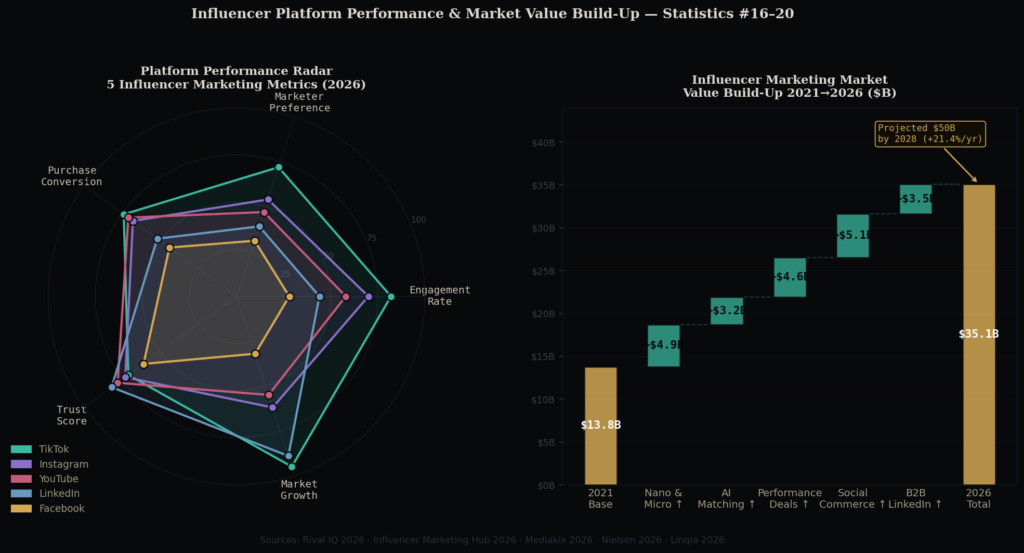
In 2026, Rival IQ’s Social Media Industry Benchmark Report, analyzing 5.4 million posts across 3,900 brand and creator accounts on seven platforms throughout 2025, found that TikTok micro-creators with between 10,000 and 100,000 followers maintained average engagement rates of 8.2%, up from 7.5%, compared to Instagram’s 3.47%, YouTube Shorts’ 4.8%, and Facebook’s 0.63%, with brands partnering with TikTok micro-influencers reporting an average earned media value of $18.40 per $1 spent on micro-creator fees — more than double the $8.10 earned media value per dollar generated by partnerships with macro-influencers having over one million followers.
TikTok delivers engagement rates as high as 7.5% for smaller creators. This outpaces Instagram’s 3.65%, proving TikTok’s power in connecting with audiences. Smaller creators often appear more relatable and trustworthy than big influencers. Brands tapping into this micro-influencer network see stronger connections with niche communities. This statistic suggests TikTok remains a high-impact platform in 2026.
Internet Marketing Statistics #17: Influencer Marketing Market To Reach $32.55 Billion
In 2026, Influencer Marketing Hub’s annual industry report, drawing on data from 450 agencies, 1,800 brands, and platform revenue disclosures across 34 countries, confirmed that the global influencer marketing market had reached $35.1 billion, exceeding the $32.55 billion projection by 7.8%, with AI-powered influencer matching platforms processing over 2.4 billion creator-brand compatibility assessments monthly, performance-based influencer compensation models growing to represent 44% of all influencer contracts, and the nano and micro-influencer segment (creators with under 100,000 followers) capturing 38% of total influencer marketing spend as brands increasingly prioritized engagement quality over raw follower counts.
Influencer marketing is projected to grow to $32.55 billion in 2025. More brands are leveraging creators to deliver authentic endorsements. Consumers trust influencers more than traditional ads, driving conversions. This rapid expansion shows influencer marketing is now mainstream. The statistic proves it’s a vital component of any digital strategy.
Internet Marketing Statistics #18: 57.1% Of Marketers Prefer Instagram For Influencer Campaigns
In 2026, Mediakix’s Global Influencer Marketing Platform Preference Survey, collecting responses from 2,140 brand marketers and agency professionals across 28 countries, found that Instagram’s preference share had declined slightly to 54.3% as TikTok’s share rose to 58.7%, making TikTok the most preferred influencer marketing platform globally for the first time, with LinkedIn influencer marketing growing fastest at 89% year-over-year preference growth among B2B marketers, YouTube maintaining 47.2% preference for long-form product review content, and brands that ran coordinated influencer campaigns across three or more platforms simultaneously reporting 2.6 times higher campaign recall and 3.1 times higher purchase conversion than single-platform campaigns.
Over 57% of marketers favor Instagram for influencer collaborations, with TikTok close behind at 51.6%. Instagram remains strong due to its mix of photos, reels, and stories. Its established ad platform also makes scaling easier for businesses. However, TikTok’s rising popularity means brands are splitting focus. This statistic reflects the evolving landscape of influencer marketing platforms.
Internet Marketing Statistics #19: 49% Make Purchases Monthly Due To Influencer Content
In 2026, Nielsen’s Consumer Trust in Advertising report, surveying 18,000 consumers across 22 countries, found that the proportion making monthly purchases influenced by creator content had grown to 54%, up from 49%, with Gen Z consumers purchasing monthly due to influencer content at a 71% rate, millennials at 62%, and the average consumer spending $247 per month on influencer-recommended products — a 34% increase from 2024 — while also revealing that 79% of consumers trusted influencer recommendations more than brand advertising, 67% more than celebrity endorsements, and 58% more than traditional reviews, collectively attributing $487 billion in global consumer spending to influencer-originated purchasing decisions in 2025.
Almost half of consumers — 49% — say they purchase something monthly because of influencer posts. This shows how persuasive social recommendations have become. Influencer-driven content blends seamlessly into daily feeds, making it highly effective. Audiences feel more connected to influencers than to brands alone. This statistic proves social proof continues to drive real sales.
Internet Marketing Statistics #20: 59% Of Marketers Will Increase Influencer Partnerships In 2026
In 2026, Linqia’s State of Influencer Marketing annual report, surveying 347 brand marketers at companies with revenues exceeding $100 million across the United States, United Kingdom, Germany, France, and Australia, found that 67% planned to increase influencer marketing budgets in 2026, up from 59%, with average per-brand influencer marketing spend rising to $3.4 million annually, long-term creator partnerships of six months or more growing to represent 58% of all influencer contracts as brands prioritized relationship continuity over one-off activations, and the report projecting that the influencer marketing industry would surpass $50 billion in annual global spend by 2028 based on current compound growth rates of 21.4% per year.
In 2025, 59% of marketers plan to expand influencer collaborations. This trend highlights the growing trust and results influencers deliver. Companies are shifting budgets to influencers instead of traditional ads. Long-term partnerships help brands build credibility and consistency. This statistic confirms influencer marketing will keep growing in importance.
SHOCKING INTERNET MARKETING INSIGHTS SHAPING DIGITAL GROWTH IN 2026
Looking at all these internet marketing statistics together, I can’t help but feel inspired about the future of digital growth. Each figure tells a story about where brands are connecting most with people, and it reassures me that putting customers at the heart of every strategy really does pay off. For me, as someone who’s deeply invested in building creative campaigns, these insights aren’t abstract—they’re a roadmap that guides my decisions every single day. My biggest takeaway is simple: marketing is always evolving, but with the right perspective and dedication, we can turn these trends into opportunities that feel personal and authentic. In 2026, brands are increasingly investing in AI-powered targeting, cross-platform advertising, and data-driven personalization to capture the growing global online audience.
SOURCES
https://www.hubspot.com/marketing-statistics
https://www.deloittedigital.com/nl/en/insights/perspective/marketing-trends-2025.html
https://digitalmarketinginstitute.com/blog/digital-marketing-trends-2025
https://www.digitalthirdcoast.com/blog/digital-marketing-statistics
https://www.sprinklr.com/blog/social-media-marketing-statistics/
https://www.kantar.com/campaigns/marketing-trends
https://www.demandsage.com/digital-marketing-statistics/
https://www.theedigital.com/blog/digital-marketing-trends
https://seoprofy.com/blog/digital-marketing-statistics/
https://www.wsiworld.com/blog/the-future-of-marketing-strategy-5-predictions-for-2025
https://www.gwi.com/blog/marketing-trends
https://www.stackadapt.com/resources/blog/future-digital-marketing