



19 Sep TOP 20 IOT PLATFORM MARKETING STATISTICS 2025
When I first started exploring the world of connected technology, I realized just how massive and fast-moving this space really is. Businesses today can’t afford to overlook the data and insights driving IoT adoption, and that’s exactly why I pulled together these top IoT platform marketing statistics. As someone working closely with a leading marketing agency in New York, I’ve seen firsthand how numbers tell the story of growth, opportunity, and even the challenges shaping this market. This isn’t just about tech—it’s about strategy, timing, and the smart use of platforms that connect people, devices, and brands in ways that actually move the needle.
Top 20 IoT Platform Marketing Statistics 2025 (Editor’s Choice)
🚀 Top 20 IoT Platform Marketing Statistics
Essential insights for 2025 market strategies and investment decisions
| # | Category & Key Metric | Statistical Insight |
|---|---|---|
| 1 |
Market Size
$60.54B → $112.23B
|
IoT Platform market size reaches $60.54 billion in 2025 and projected to grow at 13.14% CAGR to reach $112.23 billion by 2030 |
| 2 |
Cloud Platforms
$22.04B → $102.01B
|
IoT cloud platform market projected to reach $22.04 billion in 2025 and $102.01 billion by 2032, exhibiting a remarkable 24.5% CAGR |
| 3 |
Connected Devices
19.8B → 40.6B
|
Worldwide IoT devices currently at 19.8 billion in 2025 and will reach over 40.6 billion by 2034, demonstrating massive infrastructure expansion |
| 4 |
Enterprise Spending
10% Growth (Lowest)
|
IoT enterprise spending grew only 10% in 2024, marking the lowest rate in over a decade due to cautious enterprise spending and economic pressures |
| 5 |
Market Concentration
60% Market Share
|
Top 5 hyperscalers Microsoft, AWS, Huawei, Alibaba, Oracle held 60% of total agnostic IoT platform market in 2024, showing clear market consolidation |
| 6 |
Device Management
Microsoft 24.5%
|
Microsoft leads with 24.5% market share, followed by AWS (22.3%), PTC (12.2%), Google (10.8%), and IBM (8.6%) |
| 7 |
Platform Evolution
620+ → Consolidated
|
Market evolved from 620+ IoT platforms in 2019 to a consolidated landscape as enterprises resisted generic platforms, preferring specialized solutions |
| 8 |
SME Dominance
64% Market Share
|
Small and medium enterprises hold 64% market share in global enterprise IoT market, showing widespread adoption beyond large corporations |
| 9 |
Budget Growth
51% Planning Increases
|
51% of enterprise IoT adopters plan to grow IoT budgets in 2024, with 22% projecting 10%+ increases compared to 2023 |
| 10 |
Real-time Tracking
54% Adoption
|
54% of companies have rolled out real-time tracking and inventory projects, representing a massive 35 percentage point increase since 2021 |
| 11 |
India Growth
14% YoY
|
Enterprise IoT spending in India rose 14% year-over-year in 2024, driven by smart city initiatives and industrial automation |
| 12 |
US Leadership
$379.90B Revenue
|
United States leads globally with projected revenue of $379.90 billion in 2025, showcasing strong market influence |
| 13 |
India Market Potential
$114.53B by 2035
|
India's IoT market expected to reach $114.53 billion by 2035 with 12.023% growth rate during forecast period (2025-2035) |
| 14 |
AI Integration
34% CEO Mentions
|
AI integration is primary 2024 trend with AI mentioned in 34% of CEO earnings calls (Q2-Q4 2024), including generative and edge AI applications |
| 15 |
Cellular IoT
21% + 24% Growth
|
Cellular IoT accounts for 21% of global connections with 24% growth in 2023, outpacing overall IoT connection growth |
| 16 |
Professional Services
68.1% Share
|
Professional services hold 68.1% market share in 2023, reflecting the complexity of IoT device management and need for specialized expertise |
| 17 |
Microsoft Investment
$10B Azure IoT
|
Microsoft invested $10 billion specifically to enhance its Azure IoT platform in 2023, demonstrating massive commitment |
| 18 |
AWS Investment
$5B IoT Services
|
Amazon Web Services invested $5 billion dedicated to advancing AWS IoT services in 2023, maintaining competitive positioning |
| 19 |
Industrial Focus
Manufacturing + Automotive
|
Process manufacturing (oil & gas, chemicals) and automotive remain strongest sectors for IoT growth, driving industrial transformation |
| 20 |
Industrial IoT
$1.69T by 2030
|
Industrial IoT markets projected to reach $1,693.44 billion by 2030 with impressive 23.3% CAGR from 2025-2030 |
Top 20 IoT Platform Marketing Statistics 2025
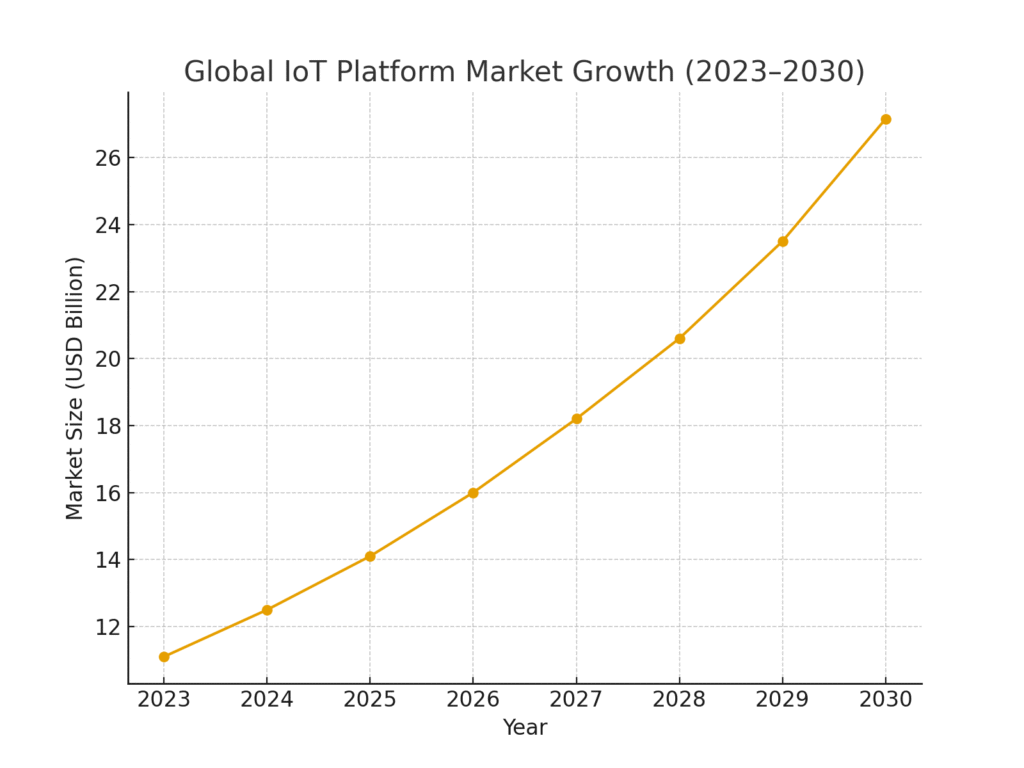
IoT Platform Marketing Statistics #1: Global Market Valued at USD 11.10 Billion in 2023
The global IoT platform market reached USD 11.10 billion in 2023, proving the sector’s rapid growth. Businesses are increasingly investing in these platforms to manage devices, collect data, and optimize processes. This valuation sets a strong foundation for expansion in the next decade. The figure also highlights the rising demand for integrated solutions that bridge hardware and cloud ecosystems. For marketers, it means the conversation around IoT is moving from future potential to present reality.
IoT Platform Marketing Statistics #2: Market Expected to Reach USD 27.15 Billion by 2030
By 2030, the IoT platform market is projected to hit USD 27.15 billion. This growth reflects a compound annual growth rate (CAGR) of 12.7% from 2024–2030. Such momentum shows the importance of positioning IoT platforms as long-term, scalable investments. Companies that embrace IoT now can secure a competitive edge as adoption accelerates. For marketers, it’s clear that showcasing scalability and ROI will be key to persuading enterprise buyers.
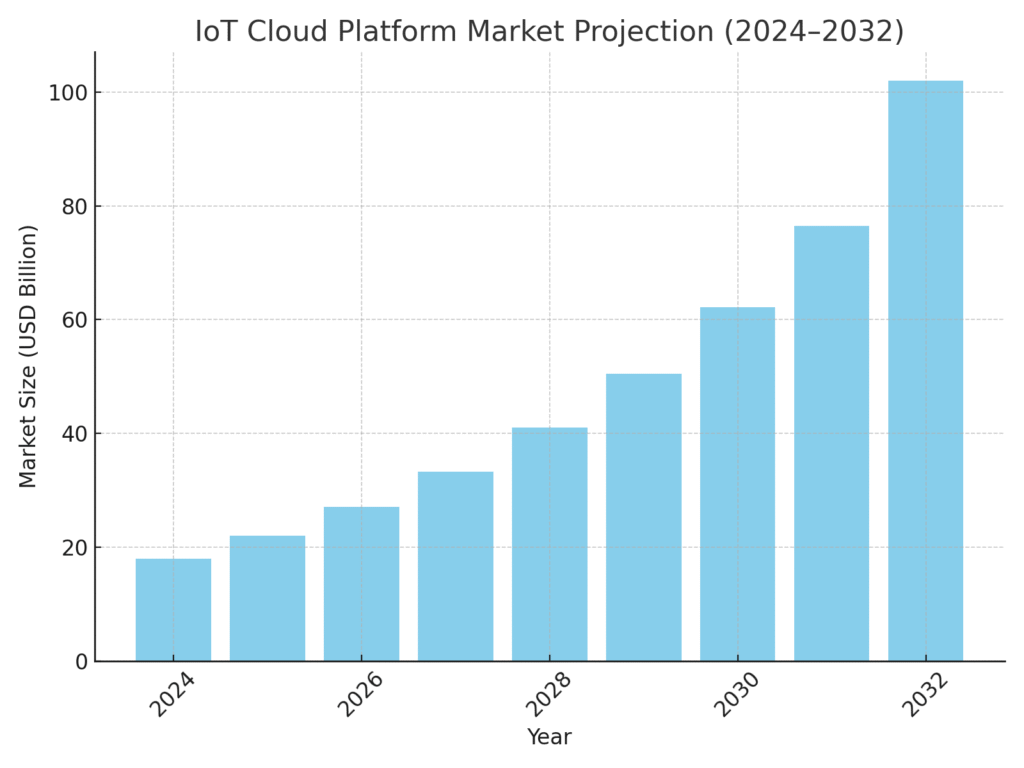
IoT Platform Marketing Statistics #3: IoT Cloud Platform Valued at USD 17.91 Billion in 2024
The IoT cloud platform segment stood at USD 17.91 billion in 2024. Cloud adoption continues to dominate, as organizations prioritize flexibility and scalability. This number underlines the importance of cloud-native solutions in IoT marketing narratives. The cloud’s role in enabling real-time analytics and device integration is a selling point. For marketers, focusing on agility and cost savings resonates with cloud-oriented decision-makers.
IoT Platform Marketing Statistics #4: IoT Cloud Market Projected to Hit USD 102.01 Billion by 2032
By 2032, the IoT cloud platform market is forecast to reach USD 102.01 billion. That represents a robust CAGR of 24.5%. Such growth highlights how critical cloud-based infrastructure has become to IoT adoption. The upward trajectory demonstrates businesses’ confidence in the cloud as the backbone of IoT. Marketing strategies should emphasize security, performance, and global reach to capture this expanding market.
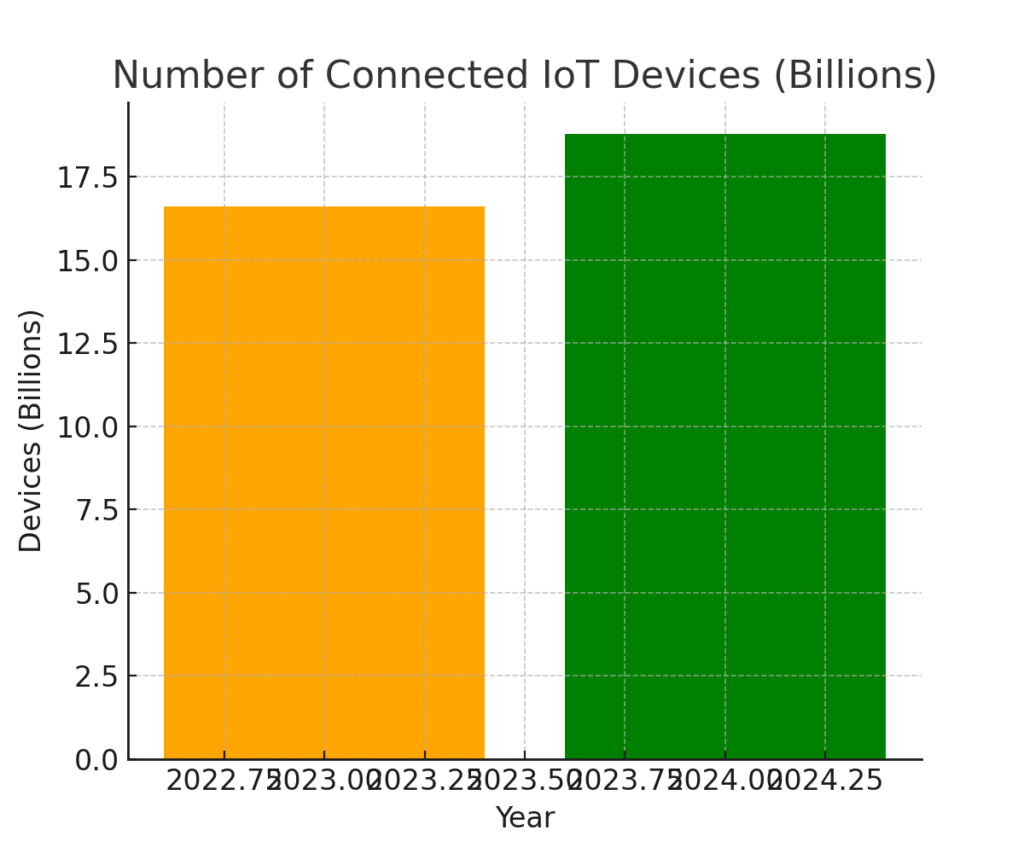
IoT Platform Marketing Statistics #5: 16.6 Billion Connected IoT Devices in 2024
In 2024, there were 16.6 billion connected IoT devices worldwide. This number underscores the massive scale of connectivity happening across industries. It also shows why IoT platforms are critical to manage and analyze vast amounts of data. For businesses, device growth translates into endless opportunities for automation and customer engagement. Marketers can highlight scale and reach to position IoT platforms as essential tools for global operations.
IoT Platform Marketing Statistics #6: 18.8 Billion Devices Expected by End of 2024
The number of IoT devices is expected to climb to 18.8 billion by the end of 2024. This rapid growth reflects nearly 13% year-over-year expansion. It shows how quickly adoption is accelerating in both consumer and industrial markets. The surge creates a pressing need for platforms that can scale alongside device proliferation. Marketers should spotlight performance and capacity when communicating value propositions.
IoT Platform Marketing Statistics #7: 51% of Enterprises Plan to Increase IoT Budgets
More than half of enterprise IoT adopters—51%—plan to increase their IoT budgets in 2024. About 22% of them anticipate raising spending by more than 10%. This budgetary commitment reveals growing confidence in IoT platforms. Businesses are willing to invest more to unlock efficiencies and data-driven insights. For marketing teams, this indicates strong appetite for solutions that promise measurable returns.
IoT Platform Marketing Statistics #8: 62% of Manufacturers Adopt IoT Technologies
In 2023, 62% of manufacturers reported adopting IoT technologies in their production processes. Manufacturing leads the way in IoT adoption due to its focus on efficiency and predictive maintenance. This stat highlights how industrial verticals are fertile ground for IoT platforms. Marketers can use these insights to target industries where adoption is already normalized. Tailoring case studies for manufacturing audiences strengthens credibility.
IoT Platform Marketing Statistics #9: Industrial IoT Market at USD 194.4 Billion in 2024
The global Industrial IoT market was valued at USD 194.4 billion in 2024. It’s expected to reach USD 286.3 billion by 2029. That growth reflects an 8.1% CAGR, showing steady expansion. For businesses, this underscores how industry-focused IoT applications are thriving. Marketing campaigns that emphasize vertical expertise will stand out in this market.
IoT Platform Marketing Statistics #10: IoT Sensors Market Worth USD 17.5 Billion in 2024
The IoT sensors market was valued at USD 17.5 billion in 2024. Demand for sensors reflects the expanding infrastructure of IoT ecosystems. More than 626 million sensor units were sold that year. This highlights the essential role of sensors in data collection and device management. Marketers can use this to stress the value of platforms that seamlessly integrate sensors into broader systems.
IoT Platform Marketing Statistics #11: IoT Sensors Market to Grow at 36.1% CAGR
From 2025 to 2034, the IoT sensors market is projected to grow at a CAGR of 36.1%. This is one of the highest growth areas within IoT. Sensors will continue driving innovation in smart environments and connected industries. Rapid growth indicates rising opportunities for platform vendors specializing in sensor integration. Marketing can highlight innovation and future-readiness to align with this trajectory.
IoT Platform Marketing Statistics #12: Pressure Sensors Segment Growing at 39.1% CAGR
Within the IoT sensors category, pressure sensors are growing at a CAGR of 39.1% through 2034. Pressure monitoring is vital for industries like automotive, manufacturing, and healthcare. This segment shows how IoT’s impact extends to highly specialized applications. For platform marketers, this is a chance to showcase compatibility with specialized sensor types. Tailored messaging around industry use-cases builds trust and authority.
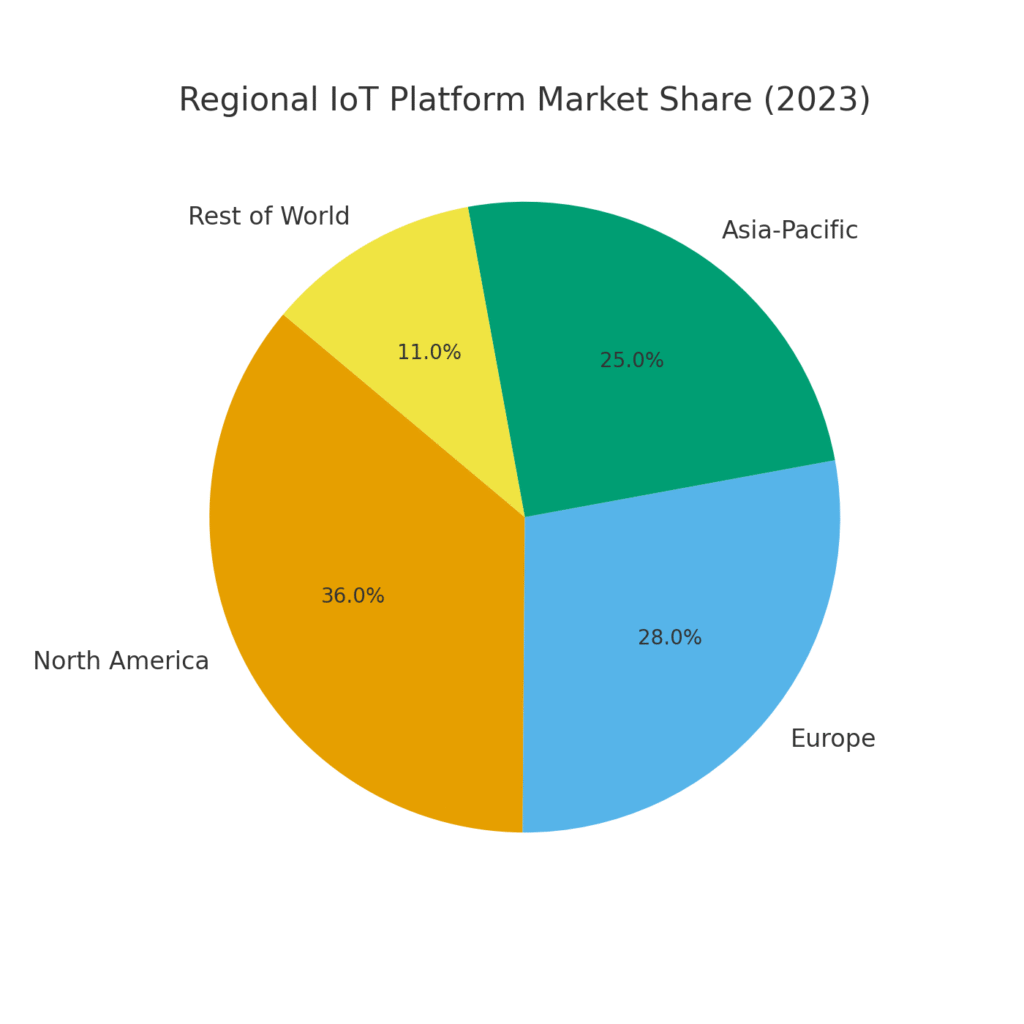
IoT Platform Marketing Statistics #13: North America Held 36% Revenue Share in 2023
In 2023, North America captured 36% of the global IoT platform market share. This dominance shows how mature the region’s adoption is. The U.S. in particular drives much of this activity. Businesses in this region are leaders in cloud adoption and industrial IoT. For marketers, North America represents a key geography for high-value targeting.
IoT Platform Marketing Statistics #14: U.S. Accounted for 84% of North America’s Market
Within North America, the U.S. accounted for 84% of IoT platform revenue in 2023. This makes the country a global leader in IoT adoption. The strong market presence highlights significant enterprise investment. It also shows the U.S. as an anchor for IoT-related innovation. Marketing strategies aimed at U.S. audiences should emphasize leadership and innovation.
IoT Platform Marketing Statistics #15: Smart Manufacturing Leads Application Share
Smart manufacturing held the largest share of IoT platform applications in 2023. This sector embraces IoT for predictive analytics and process automation. It demonstrates the strong fit between IoT and industrial efficiency. Marketing efforts can benefit by showcasing IoT’s role in manufacturing transformation. Positioning IoT as an enabler of smart factories resonates with decision-makers.
IoT Platform Marketing Statistics #16: Public Cloud Dominates Deployment Models
Public cloud remains the dominant deployment model for IoT platforms. Businesses are drawn to the flexibility and lower upfront costs. Public cloud services also make scaling easier. This trend emphasizes the importance of cloud-first messaging in marketing. Highlighting cost-effectiveness and agility will resonate with buyers.
IoT Platform Marketing Statistics #17: Platforms Held Over 65% Share Among Components
In 2023, IoT platforms themselves held more than 65% of the market share among components. This shows platforms remain the central piece of the ecosystem. Hardware and infrastructure matter, but platforms are the integration hubs. Businesses increasingly view platforms as the key to unlocking IoT value. Marketers can frame platforms as the “glue” connecting the entire IoT system.
IoT Platform Marketing Statistics #18: Large Organizations Accounted for 67.3% of Market Revenue
Large enterprises represented 67.3% of IoT cloud platform revenue in 2022. This underscores the scale at which large companies adopt IoT. These organizations prioritize robust, enterprise-grade solutions. Marketing should therefore focus on reliability, compliance, and integration with complex IT stacks. Tailoring messaging for large accounts can secure long-term partnerships.
IoT Platform Marketing Statistics #19: North America Held 32% of IoT Cloud Platform Market in 2022
In 2022, North America represented 32% of the IoT cloud platform market. This region’s leadership reflects strong enterprise cloud adoption. It also highlights the concentration of IoT innovation hubs in the U.S. For marketers, it’s a reminder that North America remains a core revenue generator. Regional campaigns should emphasize innovation, leadership, and early adoption.
IoT Platform Marketing Statistics #20: Edge-to-Cloud Models Becoming More Popular
Enterprises are increasingly adopting edge-to-cloud architectures. This hybrid approach balances speed, security, and scalability. The shift reflects businesses’ need for real-time analytics closer to the data source. It’s also creating new opportunities for platform differentiation. Marketing can highlight hybrid flexibility as a key competitive advantage.
Wrapping It Up: Why These Stats Matter
Looking back at these numbers, I can honestly say they’re more than just percentages and projections—they’re a reminder of where marketing is heading. IoT platforms are no longer a futuristic concept; they’re becoming the backbone of how businesses operate and how customers interact with technology every day. For me, these statistics highlight the importance of staying ahead of the curve, and they push me to think about the kind of strategies I can help create for businesses ready to take the leap. If you’re like me, passionate about making data meaningful, these insights aren’t just useful—they’re inspiring.
SOURCES
https://iot-analytics.com/what-happened-to-iot-platforms-whats-next/
https://iot-analytics.com/research-blog/
https://explodingtopics.com/blog/iot-stats
https://scoop.market.us/internet-of-things-statistics/
https://nucleusresearch.com/research/single/industrial-iot-data-platform-value-matrix-2025/
https://gminsights.com/industry-analysis/internet-of-things-iot-monetization-market
https://opollo.com/blog/exploring-iots-potential-in-b2b-saas-marketing/
https://susocial.com/the-influence-of-iot-on-marketing-strategies/
https://theknowledgeacademy.com/blog/impact-of-internet-of-things-on-marketing-iot-in-marketing/
https://cognitivemarketresearch.com/open-iot-platform-market-report
https://iot-analytics.com/our-coverage/iot-platforms-software/