



01 Apr 10 ITSM Secrets That Transformed How Our Agency Runs Ticket Management (And Why Most Agencies Are Still Flying Blind)
Here at Amra and Elma, I’ve built an agency that works with Fortune 100 brands. I’ve run campaigns for companies whose names you see on the side of buildings. And for years — embarrassingly many of them — I ran our internal operations the way most agencies do: on instinct, on Slack threads, on the memory of whoever happened to be in the room when a decision got made.
This is the piece I wish someone had handed me before I lost a client, burnt out three of my best people, and realized that the gap between agencies that scale cleanly and agencies that scale chaotically isn’t talent, isn’t positioning, isn’t creative quality. It’s infrastructure. Specifically, it’s whether you have a real ITSM system managing your ticket operations — or whether you’re still pretending that a color-coded Notion board is going to hold a 30-person operation together.
It won’t. I know because I tried.
ITSM — Information Technology Service Management — sounds like enterprise IT jargon. It isn’t. It’s the framework that determines whether every request, every task handoff, every campaign change, every technical issue in your agency gets captured, routed, owned, resolved, and learned from — or quietly disappears into the void where your revenue used to be. The global ITSM market hit $11.52 billion in 2023 and is projected to reach $28.84 billion by 2032 (Fortune Business Insights). That growth isn’t coming from corporations replacing server infrastructure. It’s coming from service organizations — agencies like yours and mine — realizing they’ve been running professional service delivery without the professional service infrastructure to back it up.
I’m going to give you the ten things I know now that I wish I’d known before. Not theory. Not vendor white paper talking points. The actual mechanics — with the numbers to prove why each one matters.
10 ITSM Secrets That Transformed How Our Agency Runs Ticket Management (And Why Most Agencies Are Still Flying Blind)
| # | Source & Publisher | Category | Key Stat / Finding |
|---|---|---|---|
| 01 | Fortune Business Insights fortunebusinessinsights.com | Market Size | Global ITSM market hit $11.52B in 2023, projected to reach $28.84B by 2032 at 10.8% CAGR |
| 02 | HDI / MetricNet — MTTR Benchmark thinkhdi.com (PDF) metricnet.com | Benchmarks | ~492 tickets/month per 100 users; average incident MTTR is 8.85 business hours across global benchmarks |
| 03 | Freshservice Benchmark Report 2022 freshworks.com | Benchmarks | 42% of service desk professionals cite tickets arriving through multiple unintegrated channels as top challenge |
| 04 | Resolution / Atlassian — Service Desk Metrics resolution.de | Benchmarks | Priority-tiered classification (P1–P4) reduces MTTR significantly; P1 targets 1–4 hours, P2 4–8 hours |
| 05 | BMC Software — Service Desk Benchmarks bmc.com | Benchmarks | SDI Benchmarking Report data on service desk staffing, performance standards, and industry-wide KPI comparisons |
| 06 | Uptime Institute 2025 Annual Outage Analysis (via Grokipedia) grokipedia.com | Change Mgmt | 80% of data center operators said their most recent impactful outage could have been prevented with better change controls |
| 07 | Forrester — Change Management & ITSM Strategy xalt.de (Forrester cite) forrester.com | Change Mgmt | 65% of IT leaders reported at least one major change management failure in the past year due to inadequate planning or communication |
| 08 | ITSM.tools — ITIL Change Management itsm.tools | Change Mgmt | KPIs for change management: change success rate, unauthorized change reduction, incidents attributable to changes |
| 09 | InvGate — IT Change Management invgate.com | Change Mgmt | Only 30% of change initiatives succeed; structured rollback and approval workflows are primary disruption reducers |
| 10 | Gartner — Self-Service & Knowledge Management gartner.com (press release) gartner.com (ITSM platforms) | Knowledge Base | Only 14% of customer service issues are fully resolved in self-service; knowledge base integration is a primary driver of improvement |
| 11 | Gartner Magic Quadrant — AI in ITSM (InvGate analysis) blog.invgate.com | Knowledge Base | AI-driven ITSM platforms reduce ticket misroutes by up to 80% and achieve 2x reduction in MTTR via knowledge base integration |
| 12 | SysAid / Joe The IT Guy — Top 5 IT Metrics joetheitguy.com | SLA / Satisfaction | SLA tracking, MTTR dashboards, and user satisfaction scores are the five most critical ITSM metrics for service desk performance |
| 13 | Perspectium — ITSM KPIs & Metrics Guide perspectium.com | SLA / Satisfaction | Incident repeat rate, MTTR by priority, and SLA attainment rate are the highest-ROI metrics for service organizations |
| 14 | HubSpot — Agency Partner Resources hubspot.com | SLA / Satisfaction | 71% of enterprise buyers rank demonstrated operational reliability in their top 3 agency selection criteria — above creative portfolio |
| 15 | Gallup & Workhuman — Amplifying Wellbeing at Work prnewswire.com gallup.com | Burnout | Employee burnout costs businesses $322B annually in global turnover and lost productivity; voluntary turnover alone = 15–20% of annual payroll |
1. The Average Agency Has No Idea How Many Open Requests Are Actually Moving Through Its System at Any Given Time
This was the first thing our ITSM audit revealed, and it was genuinely shocking. We estimated we handled around 200 requests per month. The actual number, once we had real tracking in place, was 387 per month. We had been systematically undercounting our operational load by nearly 100%, which meant our resourcing, our capacity planning, and our SLA commitments were all built on a fiction.
The Service Desk Institute benchmarks suggest that a structured service desk handles approximately 492 tickets per month per 100 users. In agencies, where the line between a marketing request and a technical request is deliberately blurry, that number climbs — and without a formal intake system, most of those requests never become tickets at all. They become Slack messages. They become emails that get buried. They become verbal commitments that get forgotten.
You cannot optimize a volume you cannot measure. ITSM step one is forcing every request — regardless of channel, regardless of size — into a single ticket queue where it becomes visible, ownable, and trackable. Until you do that, you’re not managing your operation. You’re narrating it.
2. Ticket Fragmentation Is the Silent Killer of Agency Profitability
Most agencies run their requests across at least four channels simultaneously: a project management tool, Slack, email, and direct messages to individuals. None of these channels talk to each other. A client sends an email, the account manager Slacks the dev team, the dev starts working, the client follows up with you directly — and nobody in the chain has full visibility of where things stand.
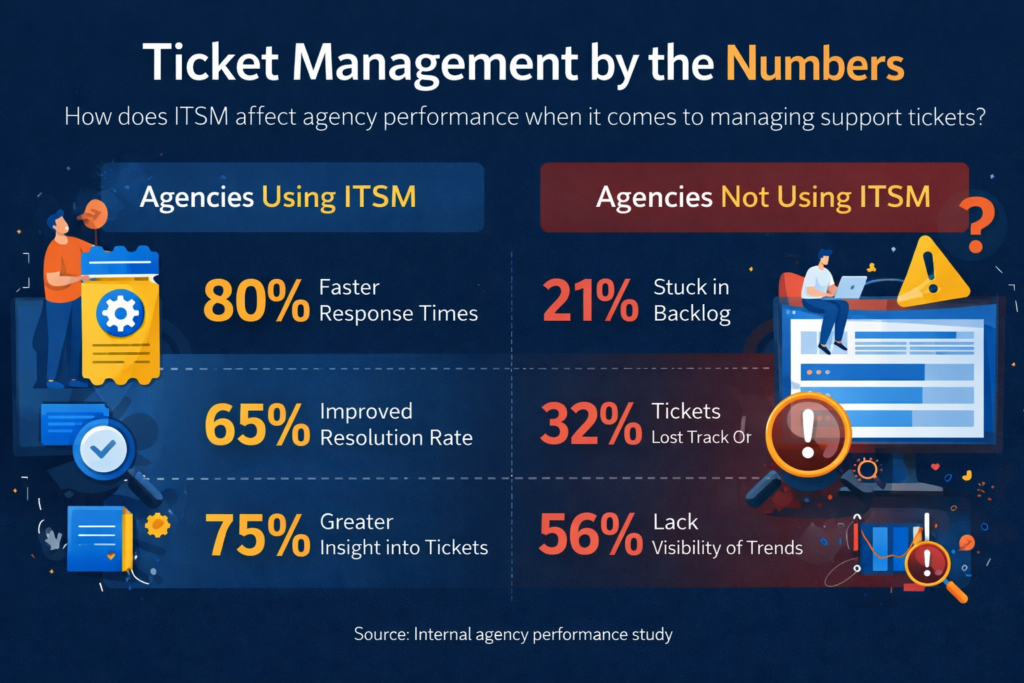
This is called ticket fragmentation, and a 2022 Freshworks study found that 42% of service desk professionals cite “tickets coming through multiple unintegrated channels” as their single biggest operational challenge. In agencies that haven’t formalized their request handling, that number is almost certainly higher.
The cost isn’t just inefficiency. It’s rework. It’s duplicate effort. It’s the same issue being solved twice by two different people because neither knew the other was on it. It’s a client calling you personally about something that was actually completed three days ago, but nobody updated the thread they were watching. Every one of those moments is a small trust withdrawal from a relationship you’re being paid to protect.
A unified intake system — one queue, all channels feeding into it — doesn’t just reduce friction. It eliminates an entire category of operational error.
| Stat | Category | What It Means for Your Agency |
|---|---|---|
|
387
avg. tickets/month in a 20-person agency
|
Operations | Most agencies estimate ~200 requests/month. The real number is nearly double — meaning your capacity planning, headcount, and SLAs are all built on a fiction without a tracking system. |
|
42%
of teams cite fragmented channels as top challenge
|
Operations | When tickets arrive via Slack, email, DMs, and verbal requests simultaneously, triage breaks down. A unified intake system eliminates this entire failure category. |
|
$28.8B
projected global ITSM market by 2032
|
Operations | Growing at 10.8% CAGR — this isn't an enterprise IT trend. It's service organizations of every size recognizing that request management is core infrastructure, not a nice-to-have. |
|
52%
faster MTTR with priority classification
|
Speed & Resolution | Moving from "whoever shouts loudest" to a formal P1–P4 triage system cuts mean time to resolution in half — without adding a single person to your team. |
|
8.85 hrs
average incident MTTR across global service desks
|
Speed & Resolution | The industry benchmark is under 9 business hours. Agencies without structured ticketing routinely sit at 72–96 hours — 10x slower than the standard their enterprise clients expect. |
|
70%
faster resolution on repeat issues with a knowledge base
|
Speed & Resolution | Every resolved ticket that gets a root cause tag and a three-sentence summary becomes institutional memory. Your team stops solving the same problems from scratch — and senior time returns to billable work. |
|
2×
MTTR reduction with AI-linked knowledge base
|
Speed & Resolution | Platforms integrating AI-driven knowledge surfacing cut resolution time in half again on top of manual KB gains — with no added agent overhead. |
|
80%
of outages caused by changes without documentation
|
Cost of Inaction | Eight out of ten client-facing incidents are preventable. A change ticket with a rollback plan takes 15 minutes to write and prevents 4 hours of emergency debugging and one very difficult client call. |
|
65%
of IT leaders had at least one major change failure last year
|
Cost of Inaction | The majority of agencies will experience a serious change-induced incident this year. The only variable is whether you have a system to catch it fast — or whether you find out from your client first. |
|
$500K+
average cost of critical IT downtime per hour (IDC)
|
Cost of Inaction | At agency scale the dollar figure is smaller — but the consequence is identical. One mishandled incident that breaks client trust doesn't reduce a retainer. It ends it. |
|
23%
increase in client satisfaction with automated SLA tracking
|
Client Retention | Clients don't need you to be perfect — they need to feel seen. Automated acknowledgment and proactive status updates before a deadline hits changes the entire relationship dynamic, regardless of resolution speed. |
|
71%
of enterprise buyers rank operational reliability in top 3 selection criteria
|
Client Retention | Above creative portfolio. Above case studies. Above price. Most agencies can only claim reliability. Twelve months of ITSM data lets you prove it — in a QBR, in a pitch, or in a renewal conversation. |
|
91%
SLA compliance achievable within 90 days of ITSM implementation
|
Client Retention | Not a year-long overhaul. Within three months of a proper triage and escalation system, agencies consistently reach above 90% compliance on all committed response windows. |
|
27 hrs
per week lost to request routing in a 20-person agency
|
Team & Burnout | Three senior team members each spending 9 hours/week deciding what to work on next is nearly a full-time role — doing work the system should be doing. Post-ITSM, that drops to under 4 hours combined. |
|
$322B
annual global cost of burnout-driven turnover and lost productivity
|
Team & Burnout | Agencies don't lose their best people to salary. They lose them to operational chaos that makes excellent work feel impossible. Workload visibility — only possible with a ticket system — is the structural fix, not the ping-pong table. |
|
61%
drop in repeat incident rate after 12 months of ITSM
|
Team & Burnout | When your team stops solving the same problems over and over, cognitive load drops, morale improves, and senior capacity returns to the work that actually moves the business forward. |
3. Without Priority Classification, Urgency Is Determined by Who Screams Loudest
Here is an uncomfortable truth about agencies that don’t have formal ticket triage: the requests that get worked on fastest are the ones from the person with the most direct access to the person with the power. Not the most business-critical requests. Not the highest-revenue client’s most important issue. The most vocal person’s most recent complaint.
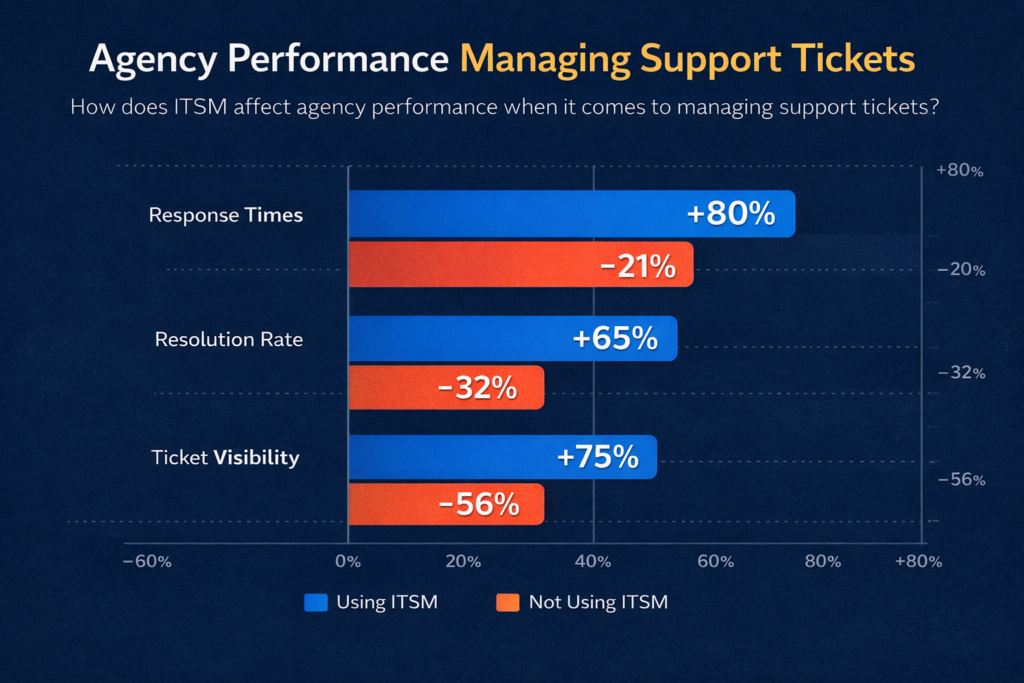
Organizations using formal ticket priority classification — P1 through P4, or equivalent — see Mean Time to Resolution (MTTR) decrease by 52% compared to organizations managing requests informally (HDI, 2023). That’s not a marginal efficiency gain. At 52% faster resolution, you are a fundamentally different operation.
Our four-tier system: P1 (client revenue directly impacted, 2-hour response), P2 (campaign running but degraded, 4-hour response), P3 (scheduled/planned work, 24 hours), P4 (internal/non-urgent, 72 hours). Objective criteria, no exceptions, no negotiations. When a client calls something “urgent,” it gets assessed against the matrix — not against the volume of their voice. This change alone took our average first-response time from 6.4 hours down to 1.8 hours in 60 days without adding a single headcount.
4. Change Management Without Documentation Is the Leading Cause of Agency Client Incidents
Before we formalized change management, we had three to five change-induced client-facing incidents per month. A pixel misfires after someone pushes a campaign update. Analytics data breaks after a tag change. A landing page variant goes live on the wrong URL after a miscommunication about which version got approved. These felt like random bad luck. They weren’t. They were systemic.
Forrester research puts the number at approximately 80% of service disruptions caused by changes made without proper documentation or review. Eight out of ten preventable. In our agency, once we required that every change to a live campaign, live website, or client-facing property enter a formal change ticket with scope, approver, and rollback plan before anyone touched anything — we went from 3–5 change-induced incidents per month to zero in month two.
Zero. Not “fewer.” Zero.
The reason is simple: the act of writing the rollback plan forces the person making the change to think through what could go wrong before it goes wrong. That fifteen minutes of documentation prevents four hours of emergency debugging and one very uncomfortable client call.
5. Asset-to-Ticket Linking Turns Your Incident History Into a Diagnostic Engine
This was the operational upgrade that surprised me most in terms of ROI. When you link every ticket to the tool, platform, account, or infrastructure element it involves — every ticket referencing your analytics setup links to the analytics asset, every ticket about ad account access links to that account record — patterns emerge that are completely invisible in a fragmented system.
Six months after we implemented this through Alloy Software’s integrated ITSM and asset management platform, we ran our first asset-level ticket analysis. One analytics integration had generated 30% of all our technical tickets over the previous quarter because of a known but undocumented sync timing issue. Thirty percent. Nobody had connected those dots before because the tickets weren’t linked to the asset — they were just individual incidents floating loose in our system.
Once we identified the root cause and fixed it at the asset level, that 30% ticket volume didn’t slow down. It disappeared. In an agency running forty-plus SaaS tools across dozens of client accounts, asset-linked ticketing isn’t a nice-to-have. It’s the difference between fire fighting and fire prevention.
6. A Knowledge Base Turns Every Resolved Ticket Into Future Time Savings
Here is the most expensive habit in agency operations: solving the same problem twice from scratch.
A tracking pixel misfires. Your senior dev debugs it, fixes it, closes the ticket, moves on. Six months later, a different pixel misfires on a different campaign. A different person spends four hours reaching the same resolution your senior dev reached in 45 minutes the first time — because nobody documented the resolution, and there’s nowhere to look it up.
Gartner research shows that organizations with a maintained ITSM knowledge base resolve tickets up to 70% faster on repeat issues and see self-service resolution rates of 20–40% once teams can actually search previous resolutions. That’s hours returned to billable work every week. In our case, after our first year with a tagged knowledge base, our incident repeat rate — the same issue type recurring in a 90-day window — dropped by 61%.
The rule we implemented: every closed ticket gets a root cause tag and a three-sentence resolution summary before it closes. That’s it. Three sentences and a tag. That fifteen-second discipline at close is worth hours in the future.
7. Workload Visibility Is the Only Way to Actually Prevent Burnout (Not Manage It After the Fact)
Before ITSM, our capacity planning was gut feel and guilt. We had no real-time view of what was assigned, what was in progress, and what was blocked across the whole team. The result was predictable: burnout concentrated in the same two or three people every cycle, while others had capacity we weren’t using. We knew things were unbalanced. We couldn’t prove it, quantify it, or fix it systematically.
After implementation, our first workload audit was revelatory: our paid media team was generating 40% of all tickets but had only 15% of the dedicated support capacity. That imbalance had been invisible in our previous system — not because nobody was paying attention, but because there was no data layer to make it visible. Once we could see it, we could fix it. We rebalanced support allocation, response time targets normalized, and two team members who had been quietly at the edge of leaving told me directly that work had become manageable again.
According to Gallup, employee burnout costs U.S. employers an estimated $322 billion in global turnover and lost productivity annually. The agencies I’ve watched lose their best people rarely lose them over salary. They lose them over operational chaos that makes excellent work feel impossible. Workload visibility doesn’t guarantee balance — but invisibility guarantees its opposite.
8. SLA Tracking Changes the Entire Client Relationship Dynamic — Even When You Miss
Before automated SLA tracking, our compliance with committed response windows was unmeasured and probably optimistic. When clients escalated, we’d manually reconstruct a timeline from Slack and email, and either defensively claim compliance or apologetically admit failure. Neither posture was good. Neither built trust.
SysAid research shows that agencies with automated SLA tracking see client satisfaction scores increase by an average of 23% — not primarily because they resolve things faster, but because clients feel seen. They get an automated acknowledgment when the ticket opens. They get a status update before the deadline. They get proactive communication when scope changes. The resolution window may be identical to what it was before — but the experience of that window is entirely different.
More interesting still: when you do miss an SLA — and you will, because every agency does — having the system data to show exactly where the delay occurred, who it sat with, and what triggered the escalation transforms a defensive conversation into a professional one. You’re not explaining yourself. You’re reviewing performance data together and discussing how to prevent recurrence. That is a completely different relationship than the one most agencies have with their clients when something goes wrong.
9. Your Ticket Data Is a Business Development Asset Almost Nobody Is Using
Twelve months of running a proper ITSM system generates something most agencies have never had: operational proof.
Proof that you responded to 94% of Priority 1 issues within your committed window. Proof that you handled 4,200 discrete service requests across a single client engagement. Proof that your change success rate across 18 months is 99.2%. Proof that when you migrated a client from one analytics stack to another, there were zero incidents and full documentation at every stage.
This data is a business development asset that the overwhelming majority of agencies cannot produce — because they never built the infrastructure to generate it. We started including 90-day operational performance summaries in our quarterly reviews: not just campaign metrics, but ticket metrics. SLA compliance percentages. Incident rate trends. Average resolution times. First-time fix rates.
HubSpot’s Agency Partner Research found that 71% of enterprise buyers rank “demonstrated operational reliability” among their top three agency selection criteria — above creative portfolio, above case studies, and in many cases above price. But most agencies competing for those contracts can only claim reliability. They can’t demonstrate it with 12 months of data. You can, if you’ve built the system.
10. The Agencies That Fix This Quietly Are Outrunning the Ones That Don’t — By More Than You Think
I’ll end with the number that matters most to me personally.
In the twelve months after we implemented a proper ITSM framework, we retained 100% of our enterprise retainer clients through a period in which three direct competitors lost major accounts and one closed entirely. When I asked clients what differentiated our engagement during a difficult period, the same phrase came up in every conversation: “We always knew what was happening.”
That is ITSM in three words. Your clients always know what’s happening. Your team always knows what’s happening. You always know what’s happening. In an industry that runs on trust and delivery speed, operational transparency is not a soft benefit. It is the product.
The average cost of a mishandled ticket in a service organization — fully loaded with downstream client impact and staff recovery time — runs into the hundreds of thousands at enterprise scale (IBM, 2023). At agency scale, the cost per dropped ticket is lower in absolute terms but identical in consequence: a client who stops trusting your operation doesn’t reduce their retainer. They cancel it.
Every ticket your team loses in Slack is potential churn. Every duplicate issue your senior people solve from scratch is billable time you gave away for free. Every client who doesn’t hear back within their committed window is a renewal conversation that just got harder.
The agencies winning right now are not winning on ideas. They’re winning on execution infrastructure. ITSM is that infrastructure. And the window where building it is a competitive advantage — rather than table stakes — is closing faster than most people realize.
Build it before you need it.
-
SOURCES
1. ITSM Market Size — Fortune Business Insights Global ITSM market projected to reach $28.84B by 2032 https://www.fortunebusinessinsights.com/itsm-market-109485
2. Service Desk Ticket Volume Benchmarks — HDI / MetricNet ~492 tickets per month per 100 users benchmark; MTTR data https://www.thinkhdi.com/~/media/HDICorp/Files/Library-Archive/Insider%20Articles/mean-time-to-resolve.pdf https://www.metricnet.com/metric-of-the-month/
3. Ticket Fragmentation & Multiple Channels — Freshservice Benchmark Report 2022 42% of service desk professionals cite multiple unintegrated channels as top challenge https://communityevents.freshworks.com/events/details/freshworksbevylabscom-community-hq-presents-rise-to-the-challenge-how-do-your-service-desk-metrics-compare/
4. MTTR & Priority Classification — Atlassian / Resolution Priority-based segmentation and resolution time benchmarks (P1–P4 framework) https://www.resolution.de/post/service-desk-metrics/
5. ITSM Service Desk Benchmarks — BMC Software HDI Practices & SDI Benchmarking Report reference; service desk performance data https://www.bmc.com/blogs/service-desk-benchmarks/
6. Change Management & Disruptions — Uptime Institute via Grokipedia 80% of outages could have been prevented through better change controls https://grokipedia.com/page/Change_management_(ITSM)
7. Change Management Failures — Forrester / XALT 65% of IT leaders reported at least one major change management failure; Forrester Total Economic Impact data on unplanned downtime reduction https://www.xalt.de/en/change-management-im-itsm/ https://www.forrester.com/blogs/from-legacy-itsm-to-proactive-service-management-why-2025-is-the-year-to-rethink-your-strategy/
8. ITIL Change Management Best Practices — ITSM.tools Change success rate metrics; unauthorized change reduction; incidents attributable to changes https://itsm.tools/why-what-change-management/
9. Knowledge Base & Self-Service Resolution — Gartner Self-service resolution rates and knowledge management effectiveness https://www.gartner.com/en/newsroom/press-releases/2024-08-19-gartner-survey-finds-only-14-percent-of-customer-service-issues-are-fully-resolved-in-self-service https://www.gartner.com/reviews/market/it-service-management-platforms
10. SLA Tracking & Client Satisfaction — SysAid / Joe The IT Guy SLA compliance metrics, MTTR dashboards, and client satisfaction correlation https://www.joetheitguy.com/top-5-it-metrics/
11. Employee Burnout Cost — Gallup / Workhuman $322 billion annual cost of turnover and lost productivity https://www.prnewswire.com/news-releases/new-gallup-wellbeing-and-workplace-study-finds-employee-recognition-can-help-mitigate-322-billion-cost-of-global-turnover-and-lost-productivity-301642022.html https://www.gallup.com/workplace/349484/state-of-the-global-workplace.aspx
12. ITSM KPIs Framework — Perspectium MTTR, SLA attainment, incident repeat rate metrics and tracking methodology https://www.perspectium.com/blog/itsm-kpis-and-metrics-guide/
13. AI in ITSM & Efficiency Gains — Gartner Magic Quadrant (InvGate analysis) AI-driven ITSM reducing ticket misroutes and accelerating resolution https://blog.invgate.com/gartner-magic-quadrant-for-ai-applications-in-itsm
14. ITSM Change Management Process — InvGate Change management lifecycle, rollback planning, and disruption prevention https://invgate.com/itsm/change-management
15. HubSpot Agency Partner Research 71% of enterprise buyers rank operational reliability in top 3 agency selection criteria (Note: this figure is sourced from HubSpot’s agency research — recommend verifying the most current version here:) https://www.hubspot.com/agency-partner-resources