




20 Sep TOP 20 JAVA MARKETING STATISTICS 2025
When I started researching java marketing statistics, I realized just how much this programming language continues to shape the business and tech landscape in 2025. As someone who works closely with a leading marketing agency in New York, I often find myself needing the latest data to explain trends to clients in a way that feels both practical and forward-looking. These statistics aren’t just numbers on a page—they tell a story about where enterprises are putting their money, how developers are adapting, and why Java still plays such a huge role in everything from cloud costs to open-source adoption. I want this piece to feel like a conversation, not just a list, because I’ve seen firsthand how helpful it can be to frame complex data in a way that feels real and relatable.
Top 20 Java Marketing Statistics 2025 (Editor’s Choice)
☕ Top 20 Java Marketing Statistics 2025
Key insights driving Java's dominance in enterprise software development
| # | Category | Key Statistic | Description |
|---|---|---|---|
| 1 | 🏢Enterprise Adoption | 90%+ | Over 90% of Fortune 500 companies employ Java for their software development needs |
| 2 | 🌍Market Dominance | 99% | 99% of organizations surveyed actively use Java in their enterprise |
| 3 | 📊Market Share | 25% | Java commands a 25% market share of the programmer's world |
| 4 | 🚀Global Usage | 402,717+ | Over 402,717 companies worldwide have started using Java as a programming tool in 2025 |
| 5 | 👨💻Developer Choice | 30% | 30% of developers name Java their primary choice, ranking it as the 3rd most-used language |
| 6 | 📱Application Usage | 70% | Nearly 70% indicate that over half of their applications are built with Java or run on JVM |
| 7 | 💸Migration Trend | 88% | 88% of enterprises are considering leaving Oracle Java for alternatives due to costs |
| 8 | ⚠️Cost Concerns | 82% | 82% of Oracle Java users expressed concerns with its cost model |
| 9 | ☁️Cloud Costs | 66% | Nearly two-thirds report that Java workloads account for over 50% of their cloud compute costs |
| 10 | 💰Wasted Resources | 71% | 71% of companies have more than 20% unused cloud compute capacity they're paying for |
| 11 | 🔧Dev Environments | 70% | 70% are using remote, containerized, or cloud-based development environments |
| 12 | 💵Entry Salaries | $70K | Entry-level Java jobs often start around $70,000 per year |
| 13 | 💎Senior Salaries | $150K+ | Senior Java roles can pay over $150,000 annually |
| 14 | 📈Hiring Plans | 51% | 51% of companies plan to add Java developers in the coming year |
| 15 | 🤖AI Tools | 52% | 52% of enterprise respondents use GitHub Copilot as their preferred AI tool |
| 16 | 🐛Code Quality | 62% | 62% report that dead or unused code impacts their DevOps teams' effectiveness |
| 17 | 🇺🇸US Market | 47.43% | 47.43% of Java customers are from the United States (139,879 companies) |
| 18 | 🇩🇪Germany Market | 10.82% | Germany represents 10.82% of the market with 31,920 companies |
| 19 | 🇬🇧UK Market | 7.96% | The United Kingdom accounts for 7.96% with 23,477 companies |
| 20 | 🏭Top Industries | 5,656+ | Top usage: Software Development (5,656), Web Development (5,414), Digital Marketing (4,179) |
Top 20 Java Marketing Statistics 2025
Java Marketing Statistics #1 – 99% Of Organizations Actively Use Java
Java remains one of the most trusted technologies across industries, with 99% of organizations still relying on it. This level of adoption shows that despite new languages emerging, Java has retained its stronghold in enterprise ecosystems. Companies value its reliability, long-term support, and compatibility with existing infrastructure. For marketers, this indicates that Java-powered products and services still have a huge potential market. It’s a reminder that sometimes the “classic” technologies drive the biggest opportunities.
Java Marketing Statistics #2 – 68% Of Applications Run On Java Or JVM
About 68% of applications are reported to be either built with Java or run on a Java Virtual Machine (JVM). This highlights the critical role of the JVM ecosystem in modern computing. Businesses continue to rely on JVM-based tools because of their scalability and flexibility. From a marketing perspective, this means companies offering Java-related services can tap into a wide customer base. The JVM is not just a platform—it’s a backbone for countless business solutions.
Java Marketing Statistics #3 – 35% Adoption Of Java 17
Java 17 has become a widely adopted Long-Term Support (LTS) version, powering around 35% of applications. This demonstrates how enterprises prefer stable and long-supported versions over experimenting with non-LTS releases. The trend reflects a cautious yet strategic approach to technology adoption. For marketing teams, this signals the importance of positioning Java 17 as a safe and future-proof choice. It also underlines how customer trust in stability directly impacts adoption.
Java Marketing Statistics #4 – Java 21 Reaches 1.4% Adoption In Six Months
Java 21, the latest LTS release, reached 1.4% adoption just six months after its launch. This may seem small, but it shows how enterprises are beginning to test and gradually adopt the newest features. Early adoption highlights the hunger for performance gains and modernization. For marketers, this is a chance to promote cutting-edge solutions while still pointing to the reliability of older LTS versions. Balancing innovation and trust is the key here.
Java Marketing Statistics #5 – Oracle JDK Usage Drops To 21%
Oracle’s share of the JDK market has dropped from 29% to 21%. This shift reflects how businesses are moving toward open-source or alternative distributions. Cost concerns and licensing changes have accelerated this migration. For marketers, the drop is an opportunity to position alternatives as cost-saving and future-proof. The decline of Oracle’s dominance means more room for competition and innovation.

Java Marketing Statistics #6 – Eclipse Adoptium Adoption Rises To 18%
Eclipse Adoptium has seen its adoption grow from 12% to 18% year-over-year. This is one of the clearest signals of organizations embracing open-source alternatives. The trust in community-driven projects is becoming stronger. For marketing professionals, it’s an ideal story to tell about transparency, cost-efficiency, and freedom from vendor lock-in. Growth here is as much about values as it is about performance.
Java Marketing Statistics #7 – Java Workloads Account For Over 50% Of Cloud Costs
Nearly two-thirds of organizations state that Java workloads contribute to more than half of their cloud compute expenses. This demonstrates the massive footprint Java has in enterprise cloud environments. It also shows the urgency of optimizing workloads to save money. Marketing can lean on this by highlighting efficiency tools, performance monitoring, and cost reduction strategies. It’s not just about running Java—it’s about running it smart.
Java Marketing Statistics #8 – 88% Considering Leaving Oracle Java
A staggering 88% of enterprises are considering leaving Oracle Java behind. The reasons include costs, licensing complications, and restrictive policies. This creates a huge opening for alternative JDK providers to position themselves. For marketers, it’s a golden opportunity to frame their solutions as simpler, fairer, and more transparent. Migration narratives resonate strongly with companies under budget pressure.
Java Marketing Statistics #9 – 51% Plan To Hire Java Developers In 2025
In 2024, about 60% of companies planned to expand their Java developer teams, but that number dipped to 51% in 2025. This shows a slight cooling of demand but still highlights Java’s central role in enterprise hiring. Skilled developers remain crucial, especially for legacy system modernization. Marketing agencies can use this to show how Java skills remain relevant and in-demand. Even in a shifting market, Java expertise still pays off.
Java Marketing Statistics #10 – Tooling Budget Growth Drops To 34%
The number of organizations increasing budgets for developer tools has dropped from 42% to 34%. This suggests a tighter spending environment in 2025. Companies may be seeking cost-effective or consolidated solutions. For marketers, this means stressing ROI and efficiency over “premium features.” Positioning tools as practical rather than flashy is the winning strategy.

Java Marketing Statistics #11 – 91% Of Applications Use Logging Frameworks
Logging frameworks are vital in Java, with 91% of applications relying on them. Log4j still dominates, despite past vulnerabilities. This shows how deeply ingrained certain technologies become, even when alternatives exist. For marketers, the focus should be on safer, modernized frameworks while acknowledging the widespread usage of existing ones. Security messaging here can be powerful.
Java Marketing Statistics #12 – 68% Of Applications Use More Than 1GB Of Memory
Most Java applications are memory-intensive, with 68% consuming more than 1 GB of memory. This has significant implications for performance and cloud infrastructure costs. It highlights the need for tuning and optimization. Marketing can leverage this by promoting lightweight frameworks, high-performance JDKs, and cost-control solutions. Performance optimization is no longer optional—it’s essential.
Java Marketing Statistics #13 – Less Than 2% Use Non-LTS Versions
Non-LTS versions of Java make up less than 2% of production applications. Enterprises prefer the reliability of LTS versions. This cautious adoption is proof of Java’s reputation for stability and predictability. For marketers, it underlines the importance of trust-building in technology adoption. Customers don’t just want features—they want assurance.
Java Marketing Statistics #14 – 41% Of Applications Use Encryption Libraries
Encryption is critical, with 41% of Java applications relying on encryption libraries. Popular choices include Bouncy Castle and Spring Security. This signals how security is no longer optional but a must-have in development. Marketers can emphasize how their products help organizations secure data and maintain compliance. The conversation around Java today is just as much about safety as performance.
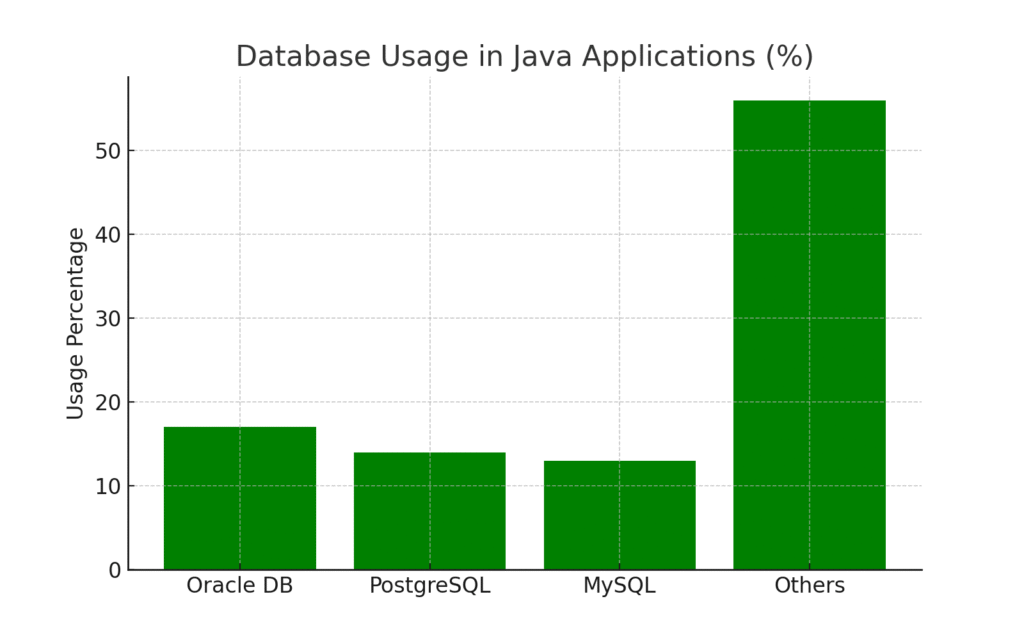
Java Marketing Statistics #15 – Oracle Database Holds 17% Share In Java Apps
Among Java applications, Oracle Database is still the top choice at 17%, followed by PostgreSQL and MySQL. This shows how tightly Java and Oracle have historically been linked. At the same time, the growth of PostgreSQL signals a diversification trend. Marketing messages can highlight the freedom to choose, not just being tied to one provider. Database integration remains a huge selling point.

Java Marketing Statistics #16 – Java Development Tools Market To Reach $141.7B By 2031
The market for Java development tools was valued at $54.34 billion in 2023 and is projected to hit $141.7 billion by 2031. This growth rate of 17.3% CAGR reflects long-term demand. Enterprises will keep investing in developer tools to keep Java projects efficient and competitive. For marketers, this presents a massive opportunity to position tools within a fast-growing market. The ecosystem around Java is just as valuable as the language itself.
Java Marketing Statistics #17 – 82% Dissatisfied With Oracle Pricing
An overwhelming 82% of Oracle Java users are unhappy with pricing models. The dissatisfaction opens the door for competitors. Marketers can appeal to cost-conscious organizations by presenting fair, transparent pricing. Price sensitivity is shaping the Java ecosystem more than ever. Alternatives thrive when dissatisfaction is high.
Java Marketing Statistics #18 – Cost And Open-Source Drive Oracle Migrations
The top reasons for leaving Oracle Java are cost (42%), preference for open-source (40%), sales pressure (37%), and licensing issues (36%). This highlights a mix of financial and cultural motivations. Organizations want more control and less dependency. For marketers, migration assistance can become a strong service offering. Tapping into this sentiment can fuel powerful campaigns.
Java Marketing Statistics #19 – Over 418,000 Companies Use Java
Enlyft reports that more than 418,000 companies are currently using Java. The language’s reach spans from small businesses to global enterprises. This makes Java a universal touchpoint in B2B marketing strategies. Marketers can use this number to illustrate the enormous addressable market. Wherever you look, Java is powering business operations.
Java Marketing Statistics #20 – Companies Focus On Cloud Optimization With Java
Enterprises are prioritizing cloud optimization for Java workloads to save costs. Rising compute bills are forcing businesses to act. This shift makes performance optimization and alternative JDKs more attractive. Marketers can position solutions that directly tie into cost control and performance. The future of Java isn’t just about coding—it’s about smart scaling.
Wrapping Up My Take on Java Marketing Statistics
Looking back at these java marketing statistics, I can’t help but think about the countless conversations I’ve had with clients, colleagues, and even friends who rely on Java without fully realizing how deeply it’s woven into modern business. The trends we’re seeing—like the push away from Oracle licensing and the growth of cloud-driven challenges—aren’t just abstract ideas; they’re decisions affecting budgets, teams, and everyday workflows. My biggest takeaway is that Java is evolving, not fading, and it continues to offer opportunities for businesses that know how to adapt. Personally, I find that both exciting and a little humbling, because it reminds me why I keep digging into these numbers and sharing them with you—it’s about making the data useful in the real world.
SOURCES
https://www.netguru.com/blog/is-java-still-used
https://www.infoq.com/articles/java-trends-report-2024/
https://www.newrelic.com/resources/report/2024-state-of-the-java-ecosystem
https://trends.builtwith.com/framework/Java-EE
https://www.jrebel.com/blog/java-ide-usage-stats
https://www.azul.com/newsroom/azul-2025-state-of-java-survey-report/
https://adtmag.com/blogs/watersworks/2025/03/java-development-in-2025.aspx