




20 Sep TOP 20 JAVASCRIPT MARKETING STATISTICS 2025
Whenever I dive into the world of technology and digital trends, I can’t help but notice just how central JavaScript has become to everything we do online. As someone who has worked closely with a leading marketing agency in New York, I’ve seen firsthand how these JavaScript marketing statistics shape the way websites perform, how users interact, and ultimately how brands grow in the digital space. For me, these numbers aren’t just dry figures—they tell the story of how developers, marketers, and businesses all come together to craft experiences that are faster, smarter, and more engaging.
Top 20 JavaScript Marketing Statistics 2025 (Editor’s Choice)
📊 Top 20 JavaScript Marketing Statistics 2025
Comprehensive insights into JavaScript's dominance in modern web development
| Category | Key Statistic | Description |
|---|---|---|
| Market Share | 98.8% | Of websites use JavaScript as client-side programming, making it the dominant web technology globally |
| Market Dominance | 94.81% | JavaScript captures nearly 95% market share compared to other programming languages |
| Developer Adoption | 62.3% | Of developers used JavaScript in 2024, with 64.6% being professionals |
| US Presence | 16.9M | Websites in the US are using JavaScript, demonstrating massive enterprise adoption |
| Business Adoption | 13.3M | Companies worldwide have been using JavaScript tools in 2024 |
| Framework Leader | React #1 | React leads as the most popular JavaScript library, followed by Vue.js, Angular, and Svelte |
| React Usage | 57% | Of professional JavaScript developers use React library for building interactive web applications |
| Backend Choice | 69.6% | Of JavaScript developers choose Next.js as their backend framework |
| Developer Love | 71.14% | Of developers love using Svelte, making it the most beloved JavaScript framework |
| Open Source | +15% YoY | Year-over-year spike in npm package consumption, cementing JavaScript's open-source leadership |
| Top Industries | Marketing | The top 3 industries using JavaScript are Marketing, Social Media, and Design |
| Mobile Dev | 97% | Of mobile app developers use JavaScript for cross-platform development with a single codebase |
| Enterprise Use | Big Tech | Google, YouTube, Facebook, LinkedIn, and Twitter all use JavaScript for their platforms |
| Full Stack | 98% / 65% | 98% use JavaScript for front-end development, while 65% use it for back-end needs |
| US Salary | $102,449 | Average annual salary for JavaScript developers in the United States |
| TIOBE Ranking | #6 | JavaScript ranked 6th in TIOBE Index as of March 2025 with +0.08% rating increase |
| US Developers | 5.8M | JavaScript users in the US, followed by 1M in Germany and 905K in the UK |
| Future Outlook | 76.6% | Believe JavaScript is moving in the right direction and popularity will continue growing |
| IoT Growth | Rising | JavaScript's lightweight nature makes it ideal for IoT and low-power devices in 2025 |
| Tech Trends | Serverless | JavaScript-backed serverless computing with Node.js/Deno and WebAssembly integration gaining traction |
Top 20 JavaScript Marketing Statistics 2025
JavaScript Marketing Statistics #1: 98.9% Of Websites Use JavaScript
JavaScript powers nearly every website on the internet, with 98.9% relying on it as their client-side programming language. This staggering dominance shows just how essential the language is for creating interactive and dynamic web experiences. For marketers, this means that any campaign strategy must assume JavaScript is the core of digital engagement. It also highlights why optimizing scripts for performance is critical to SEO and conversions. Ultimately, the statistic proves that JavaScript is the backbone of modern web marketing.
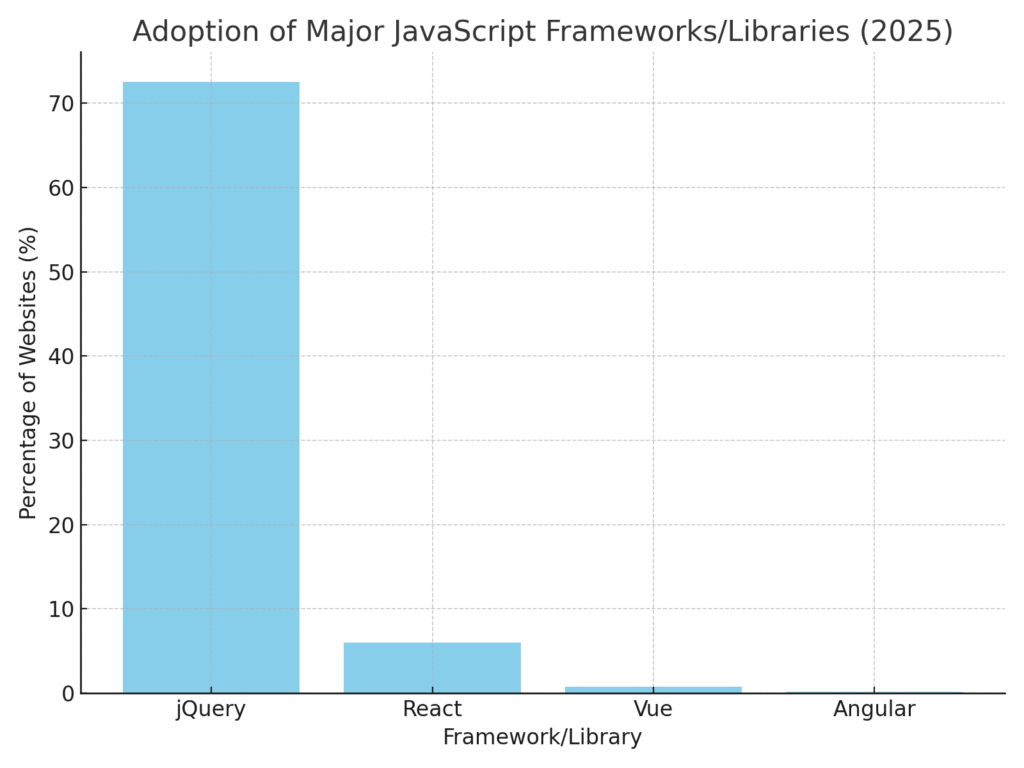
JavaScript Marketing Statistics #2: 72.5% Of Websites Still Use jQuery
Despite newer frameworks, jQuery remains embedded in 72.5% of websites worldwide. This long-standing dominance demonstrates the legacy hold older libraries can have on web development. For marketing agencies, this creates challenges around compatibility and site performance. However, it also ensures familiarity, meaning many developers can still easily work with jQuery-based campaigns. This statistic underscores how past choices in technology can influence today’s marketing landscape.
JavaScript Marketing Statistics #3: React Used By 6% Of Websites
React’s 6% adoption across all websites may sound small but reflects significant traction for a single modern library. Its modular design and ecosystem have made it a top choice for building scalable marketing websites and applications. Brands often lean on React for creating smoother user experiences that keep audiences engaged. This is especially important in competitive niches where load time and interactivity directly influence conversions. React’s usage shows the balance between legacy tech like jQuery and the rise of modern frameworks.
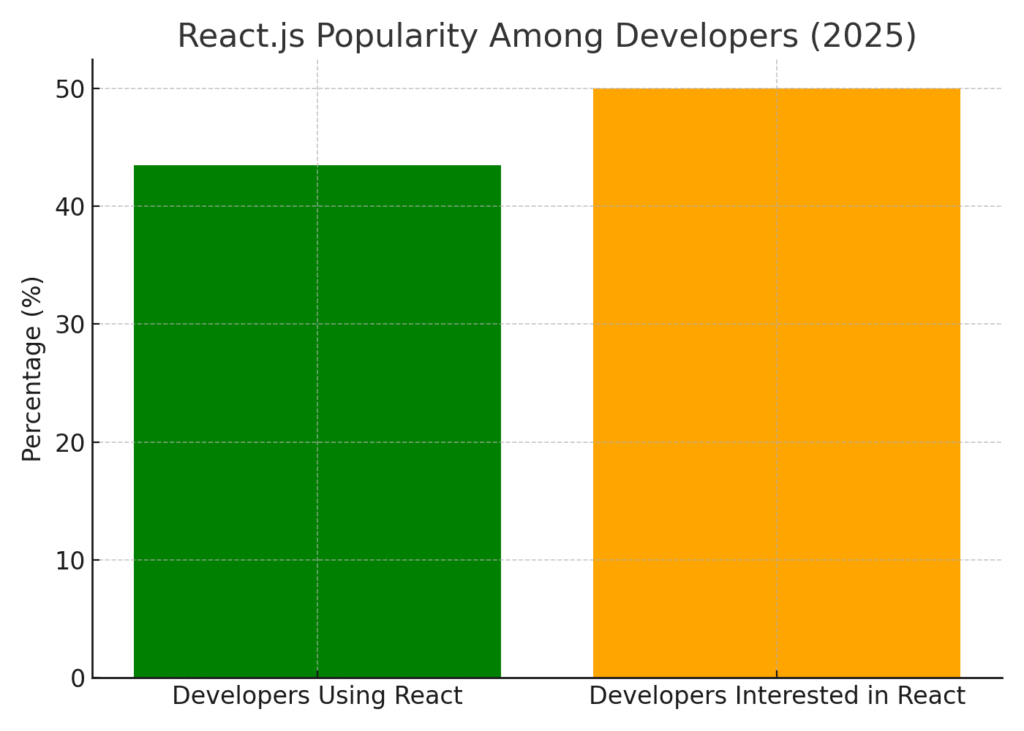
JavaScript Marketing Statistics #4: 43.5% Of Developers Use React
Among professional JavaScript developers, 43.5% actively use React, making it the leading framework. This high adoption rate shows where the developer community is investing its skills and resources. For marketing teams, this translates into more availability of React expertise for campaigns. It also means future-ready strategies will likely be built around this framework. Clearly, React’s popularity among developers connects directly to marketing opportunities for brands.
JavaScript Marketing Statistics #5: JS Frameworks Market To Reach $6.8 Billion In 2025
The JavaScript frameworks market is forecasted to reach $6.8 billion in 2025. This growth highlights the rising demand for advanced libraries to support complex digital marketing needs. For agencies, this means clients are increasingly expecting modern, polished web solutions. It also suggests budgets are being allocated toward technologies that streamline performance. In essence, the financial growth reflects how critical JavaScript has become for digital marketing strategies.

JavaScript Marketing Statistics #6: 62.3% Of Developers Use JavaScript Globally
Over 62.3% of developers worldwide use JavaScript, keeping it firmly the most popular programming language. This dominance ensures a steady supply of talent for marketing and web projects. From a marketer’s perspective, it’s reassuring to know that JavaScript skills are widely available. It also reinforces why most campaigns, tools, and platforms rely heavily on it. This statistic demonstrates that JavaScript is not just a preference but a necessity.
JavaScript Marketing Statistics #7: Demand For JS Developers To Rise 23%
The demand for JavaScript developers is projected to grow by 23% between 2021 and 2031. This increase is directly tied to the growing complexity of digital marketing and e-commerce. More businesses need skilled developers to manage campaigns, optimize platforms, and enhance user journeys. For marketers, this signals that developer partnerships will be even more critical moving forward. The rising demand reflects JavaScript’s ever-expanding role in business and marketing.
JavaScript Marketing Statistics #8: 41.2% Of Developers Want To Use JS For Future Projects
Roughly 41.2% of developers expressed interest in using JavaScript for future work. This intent shows strong confidence in the language’s relevance and adaptability. For digital marketers, it suggests a continued influx of innovative web solutions powered by JavaScript. It also ensures that the ecosystem will stay vibrant with new tools and approaches. Developer enthusiasm is a good indicator that JavaScript’s importance in marketing isn’t slowing down.
JavaScript Marketing Statistics #9: Median Salary Of JS Developers Near $150K
JavaScript developers in the U.S. can command median salaries around $150,000. High salaries reflect the critical value developers bring to businesses’ digital strategies. For marketing agencies, this reinforces why top talent is often expensive to hire. It also emphasizes the importance of collaboration between technical and creative teams. Essentially, this statistic shows that JavaScript skills are not just in demand—they’re premium.
JavaScript Marketing Statistics #10: 370 Million+ JS Library Detections In 2023
In 2023, more than 370 million JavaScript library or function detections were recorded across the web. This number reflects how deeply intertwined libraries are in online infrastructure. From a marketing angle, it means campaigns are almost always operating on top of some library-based foundation. This also highlights the importance of keeping libraries up-to-date for performance and security. The scale of detections reveals the vast reach of JavaScript in everyday marketing.
JavaScript Marketing Statistics #11: 6.5 Million JS Library Detections On Top 1M Websites
Among the world’s top 1 million websites, over 6.5 million JavaScript library detections were logged. This shows that even leading sites rely heavily on JavaScript to create modern experiences. For marketers, the takeaway is clear—brands competing at the top prioritize interactivity. It also means competitive campaigns must consider similar technological investments. The statistic confirms that big players in digital rely extensively on JavaScript.
JavaScript Marketing Statistics #12: All Major Browsers Support JavaScript
Every major web browser supports JavaScript fully. This cross-browser support ensures marketing campaigns have the widest possible reach. Marketers don’t need to worry about losing audiences due to language compatibility. Instead, the focus can stay on design, strategy, and performance. It’s a foundational reason why JavaScript remains the universal choice for web marketing.
JavaScript Marketing Statistics #13: JavaScript Dominates Client-Side Programming
JavaScript dominates the client-side landscape far beyond any other programming language. This dominance ensures interactive features are possible on nearly all websites. For marketers, this enables advanced techniques like animations, real-time updates, and personalized interfaces. The competitive advantage lies in delivering user experiences that grab and hold attention. This statistic confirms why JavaScript is the de facto standard for front-end marketing.
JavaScript Marketing Statistics #14: 19.2% Of Sites Use No Monitored JS Library
Interestingly, about 19.2% of websites don’t use a monitored JavaScript library. These sites rely instead on custom or minimal code. For marketers, this approach can mean faster load times and cleaner experiences. However, it can also pose limitations in terms of advanced functionality. The statistic shows that while libraries are popular, lean approaches still exist in marketing.
JavaScript Marketing Statistics #15: Bootstrap Used By 17.3% Of Websites
Bootstrap remains a popular JavaScript library, used by 17.3% of all websites. Its grid system and pre-built components make it attractive for quick campaign launches. For marketing agencies, Bootstrap often means faster time-to-market for websites. Yet, heavy reliance can also lead to similar-looking sites, reducing uniqueness. This balance between speed and originality is an important marketing consideration.
JavaScript Marketing Statistics #16: Lodash Used By 4.7% Of Websites
Lodash is found on around 4.7% of websites worldwide. As a utility library, it helps streamline coding and improve efficiency. For marketers, Lodash’s role is less visible but still vital in keeping campaigns smooth. Its presence shows how even small utilities can have wide digital impact. This statistic demonstrates the behind-the-scenes tools that power marketing experiences.
JavaScript Marketing Statistics #17: Modernizr Used By 6.3% Of Websites
Modernizr appears on about 6.3% of all websites. It is known for detecting browser features and adjusting content accordingly. For marketers, this ensures that users see the best possible version of a website no matter their device. It also helps reduce friction in campaigns by removing compatibility issues. This adoption shows the importance of ensuring smooth user journeys.
JavaScript Marketing Statistics #18: Underscore.js Found On 8.1% Of Websites
Underscore.js is detected on roughly 8.1% of websites. Like Lodash, it provides useful utilities for cleaner code. From a marketing perspective, it contributes to building websites that perform reliably. Although less trendy than newer libraries, its adoption shows consistency in legacy projects. This statistic highlights the staying power of certain JavaScript tools in campaigns.
JavaScript Marketing Statistics #19: North America Holds 44.35% Of JS Market Revenue
In 2025, North America accounts for about 44.35% of JavaScript framework revenue. This dominance reflects the region’s maturity in digital marketing and development. For global marketers, it indicates where much of the innovation originates. However, it also points to growth opportunities in regions like Asia-Pacific. The statistic shows the geographical distribution of marketing power in the JavaScript ecosystem.
JavaScript Marketing Statistics #20: Market To Reach $15 Billion By 2033
By 2033, the JavaScript frameworks market is forecasted to surpass $15 billion. This long-term projection highlights the sustained growth of JavaScript in digital transformation. For marketing, this means reliance on JavaScript will only deepen over time. Agencies will need to continually adapt to new frameworks and libraries. Ultimately, the statistic paints a future where JavaScript remains central to marketing success.

Wrapping It All Up
At the end of the day, what these statistics show me is that JavaScript isn’t just a programming language—it’s the backbone of modern digital marketing. I’ve learned that whether you’re choosing a framework like React, optimizing site performance for SEO, or simply making your website interactive, the decisions you make with JavaScript ripple out into every marketing result. Personally, I find it inspiring to see how much potential lies ahead, especially as the ecosystem continues to grow and evolve. And if you’re like me, looking to stay ahead of the curve, keeping a close eye on these trends is more than just smart—it’s essential for thriving in the digital age.
SOURCES
https://radixweb.com/blog/top-javascript-usage-statistics
https://digitalposition.com/resources/blog/seo/javascript-crawlers-and-e-commerce-seo/
https://bigohtech.com/top-javascript-statistics
https://vwo.com/blog/website-traffic-statistics/
https://developers.google.com/search/docs/crawling-indexing/javascript/javascript-seo-basics
https://agencyanalytics.com/blog/url-tracking
https://dashthis.com/blog/how-url-tracking-works/
https://medium.com/backlinkfy/top-website-statistic-tools-to-view-live-visitors-c70b64570bc8
https://dropinblog.com/blog/blog-and-content-marketing-statistics/
https://hubspot.com/settings/how-do-i-create-a-tracking-url
https://w3techs.com/technologies/details/tld-live-
https://newbreedrevenue.com/blog/best-practices-for-link-tracking-in-hubspot-checklist