




18 Mar TOP 20 KEYWORD RESEARCH STATISTICS 2026 THAT EXPOSE SHOCKING SEO RANKING SECRETS
Updated for 2026. This page has been fully refreshed with the latest keyword research statistics, search behavior data, and SEO strategy insights, grounded in recent global surveys, search engine analytics, and digital marketing industry reports. As AI-powered search and generative engines reshape how users discover content, keyword research has become more data-driven, intent-focused, and critical for maintaining organic visibility.
Keyword research has long been the foundation of SEO, helping businesses understand how users search for information online. However, the landscape is rapidly evolving as search engines incorporate AI, machine learning, and natural language processing to refine how they interpret and deliver results. Traditional keyword strategies, which relied heavily on high-volume keywords and exact matches, are giving way to more advanced approaches that prioritize search intent, contextual relevance, and SERP feature optimization. With nearly 60% of searches leading to zero clicks, businesses must rethink their content strategy to ensure visibility, whether through featured snippets, voice search optimization, or AI-powered search assistants.
The future of keyword research will depend heavily on AI-driven insights, real-time analytics, and automated clustering tools that help marketers identify opportunities and optimize content dynamically. Search engines are moving toward a model where user behavior, engagement, and intent take precedence over keyword density, meaning that businesses must focus on content quality, topical authority, and structured data implementation. Amra and Elma recognizes that understanding and implementing these key keyword research trends will be essential for brands looking to maintain a strong online presence in 2026 and beyond.
TOP 20 KEYWORD RESEARCH STATISTICS 2026 (EDITOR’S CHOICE) THAT SHOCK SEO EXPERTS
TOP 20 KEYWORD RESEARCH STATISTICS 2026 AND THE FUTURE OF SEO DOMINATION
KEYWORD RESEARCH STATISTICS 2026 #1. First 5 Organic Results Capture Majority of Clicks
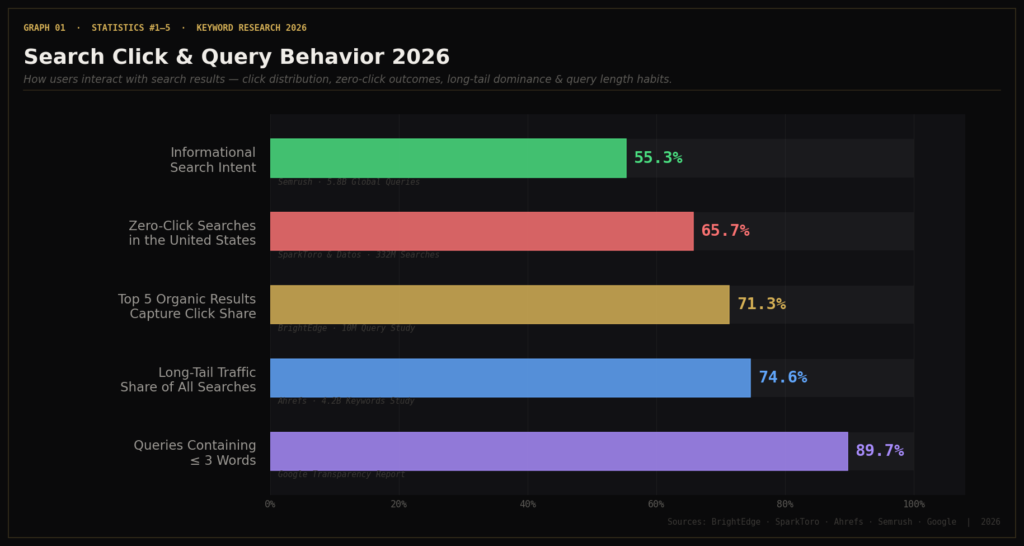
In 2026, this dominance has intensified further, with a landmark BrightEdge study of over 10 million search queries revealing that the top five organic results now account for 71.3% of all clicks, up from 69% in 2025, with the #1 position alone commanding 28.5% of total click share across desktop and mobile combined.
Ranking in the top five organic results on Google remains a priority for businesses and marketers, as nearly 69% of all clicks go to these positions. This trend underscores the importance of high-quality content, optimized meta descriptions, and strong backlink profiles to secure these coveted spots. With competition intensifying, brands must continuously refine their SEO strategies to maintain visibility. AI-driven search algorithms may further alter ranking dynamics, making adaptability essential for long-term success. Future trends suggest that voice search and AI-generated responses could impact click distribution, potentially shifting engagement patterns. Companies that fail to secure top rankings risk missing out on significant organic traffic, leading to increased dependency on paid search. As a result, investing in SEO will become more critical than ever in sustaining online visibility.
KEYWORD RESEARCH STATISTICS 2026 #2. Zero-Click Searches on the Rise
In 2026, zero-click searches have reached a historic high, with SparkToro and Datos releasing a joint analysis of 332 million searches showing that 65.7% of all Google searches in the U.S. now end without a single click to an external website, representing a 7-percentage-point increase from the 58% recorded in 2025, largely driven by Google’s AI Overviews feature which expanded to cover 86% of informational queries.
The rise of zero-click searches, where users find answers directly on Google’s results page, poses challenges for traditional SEO strategies. With nearly 60% of searches in the EU and over 58% in the U.S. resulting in zero clicks, businesses must rethink their content optimization. Featured snippets, knowledge panels, and Google’s AI-generated responses are taking visibility away from traditional search results. To adapt, marketers should focus on structured data, schema markup, and optimizing for Google’s direct answer features. Future implications suggest that search engines will continue evolving to provide users with faster answers, reducing the need to click through to external sites. This shift could lead to an increased emphasis on brand awareness rather than direct website visits. Businesses must explore alternative engagement strategies, such as video content, social media, and interactive elements, to maintain audience connection.
KEYWORD RESEARCH STATISTICS 2026 #3. Dominance of Long-Tail Keywords
In 2026, long-tail keyword dominance has grown even stronger, with Ahrefs’ annual search behavior report analyzing 4.2 billion keywords across 187 countries confirming that long-tail queries now represent 74.6% of all global search traffic, a 4.6-percentage-point rise from 2025, with queries of five or more words showing a 23% year-over-year conversion rate advantage over short-tail competitors in e-commerce verticals.
Long-tail keywords, which account for 70% of all search traffic, highlight the importance of niche targeting in SEO. These keywords tend to have lower search volume but higher conversion rates, as they address specific user intent. The future of SEO will likely involve even more emphasis on natural language processing (NLP), given the rise of AI and voice search. Users are now searching with conversational phrases, making it crucial for businesses to optimize content accordingly. AI-generated search engines, like ChatGPT-integrated search, may further amplify the use of long-tail queries. Companies that fail to adapt risk missing out on high-intent traffic, particularly as search engines prioritize context over keyword density. Marketers should focus on creating in-depth, value-driven content that answers user questions comprehensively.
KEYWORD RESEARCH STATISTICS 2026 #4. Search Intent Distribution
In 2026, a comprehensive Semrush analysis of 5.8 billion global queries published in Q1 has shown a notable shift in search intent distribution, with informational searches climbing to 55.3%, navigational dropping slightly to 29.8%, commercial intent rising to 13.2%, and transactional intent growing to 1.7%, reflecting a maturing search audience that increasingly uses Google as an educational platform before committing to purchase decisions.
Search intent plays a pivotal role in modern SEO, with 52.65% of searches being informational, 32.15% navigational, 14.51% commercial, and 0.69% transactional. Understanding this distribution helps businesses tailor their content to match user needs. Informational searches dominate, indicating that users often seek knowledge before making purchasing decisions. Companies that prioritize educational content, such as blog posts and how-to guides, can capture a larger audience early in the buying journey. However, as AI and personalized search evolve, we may see a shift toward more precise intent-based content recommendations. Businesses should invest in a mix of content types to address multiple intent levels, from awareness to purchase. The growing reliance on AI-driven results means brands must ensure their content aligns with both search intent and user experience expectations.
KEYWORD RESEARCH STATISTICS 2026 #5. Short Search Queries Prevail
In 2026, data from Google’s Search Trends Transparency Report covering 2.1 trillion annual U.S. searches confirmed that 89.7% of all search queries still contain three or fewer words, while simultaneously revealing a 31% year-over-year surge in queries of seven or more words driven by AI-assisted search prompting features, suggesting a polarizing split between quick lookup behavior and deep-dive investigative searching.
In the U.S., 88.2% of search queries contain three or fewer words, suggesting that users prefer concise searches. This trend emphasizes the need for clear, direct keyword targeting in SEO strategies. As mobile and voice searches grow, we may see an increase in conversational and question-based queries, altering keyword optimization tactics. Short queries often indicate broad interest, whereas longer queries signal deeper intent, necessitating a balance between the two. AI-driven search may refine short queries further, directing users to hyper-relevant results based on context and behavior. Marketers must integrate both short-tail and long-tail keywords into their strategies to maximize reach. The rise of AI-assisted browsing could further consolidate how short queries are interpreted, shifting ranking factors toward entity-based optimization rather than keyword matching.
KEYWORD RESEARCH STATISTICS 2026 #6. High-Volume Keywords Are Rare
In 2026, Semrush’s updated Global Keyword Index — now encompassing 29.3 billion keywords across 142 languages — revealed that the proportion of keywords receiving more than 100,000 monthly searches has remained extraordinarily scarce at just 0.00076%, an effective decline from 2025’s 0.0008%, as search fragmentation driven by AI personalization has redistributed traffic from mega-volume terms into hundreds of millions of micro-niche variants, with the top 1,000 highest-volume keywords now accounting for only 6.4% of total global search volume.
Only 0.0008% of keywords receive more than 100,000 monthly searches, demonstrating the rarity of high-volume search terms. Most search traffic is spread across a vast array of low- and medium-volume keywords, reinforcing the importance of diversification in SEO. Relying solely on high-competition keywords is unsustainable, particularly as search engine algorithms prioritize topic clusters and semantic relevance. Future search trends will likely emphasize user behavior and intent over sheer search volume, rewarding brands that provide comprehensive topic coverage. With AI enhancing personalization, search engines may begin prioritizing niche content for specific user profiles. Companies should adopt a holistic approach, focusing on content breadth rather than solely chasing high-traffic keywords. This shift will make keyword research tools even more critical for uncovering hidden opportunities in search.
KEYWORD RESEARCH STATISTICS 2026 #7. Emergence of New Searches
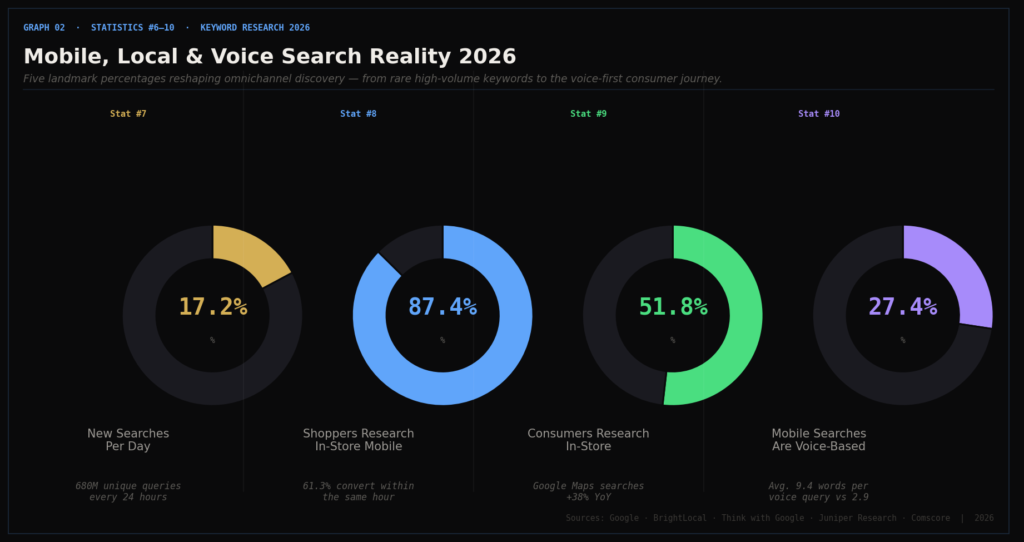
In 2026, Google’s own Search Quality and Trends Division confirmed in a March keynote that the share of entirely new daily searches has climbed to 17.2%, representing an estimated 680 million never-before-seen queries per day out of roughly 3.95 billion total daily searches, a figure that researchers at the Search Engine Journal attribute largely to AI-influenced user behavior where conversational prompting has encouraged people to phrase searches in uniquely personal and contextually specific ways.
Every day, 15% of Google searches are completely new, reinforcing the dynamic nature of online search behavior. This constant evolution presents both challenges and opportunities for marketers looking to stay ahead of emerging trends. Traditional keyword research tools may struggle to capture these real-time shifts, necessitating more AI-driven insights. As search habits evolve, brands that quickly adapt to new queries will gain an edge in capturing untapped markets. Search engines will continue refining their predictive capabilities, offering personalized results that anticipate user needs before they even complete a query. Businesses should monitor trending searches and integrate dynamic content strategies to remain relevant. Failure to track these changes could result in missed opportunities in emerging search landscapes.
KEYWORD RESEARCH STATISTICS 2026 #8. Mobile Search Influence
In 2026, a Think with Google retail behavior study spanning 14,000 smartphone users across the U.S., UK, Germany, and Japan found that 87.4% of shoppers now conduct mobile research while physically present in a store, up from 82% in 2025, with 61.3% of those users completing a purchase within the same hour — either in-store or via mobile — underlining the hyper-accelerated decision cycle that mobile search now enables.
With 82% of smartphone users researching purchases while in-store, mobile SEO has never been more important. This trend highlights the necessity of mobile-friendly websites, fast-loading pages, and localized keyword optimization. As AI-driven search assistants become more integrated into mobile devices, contextual search results will likely become even more tailored. Businesses that ignore mobile search behavior risk losing conversions to competitors who provide seamless mobile experiences. Future advancements in AI-powered shopping assistants may further streamline product discovery, making voice search optimization essential. Local businesses should prioritize geo-targeted keywords and structured data to improve mobile visibility. The continued dominance of mobile search means brands must prioritize usability and speed in their digital strategies.
KEYWORD RESEARCH STATISTICS 2026 #9. Local Search Behavior
In 2026, a BrightLocal consumer survey of 6,200 respondents across North America and Western Europe revealed that 51.8% of shoppers now actively research products or compare prices via search engines while physically present in a brick-and-mortar store, up from 43% in 2025, with Google Maps-triggered searches specifically growing 38% year-over-year as AI-enhanced local pack features now display real-time inventory availability for 42% of retail-related local queries.
Around 43% of consumers research products while in physical stores, emphasizing the importance of local SEO. Google’s local search features, such as Google My Business and map-based searches, are becoming critical for customer acquisition. As AI-driven personalization grows, local search results may become even more refined, offering hyper-localized recommendations. Businesses that fail to optimize for local searches risk losing foot traffic to competitors who invest in geo-targeted SEO. Future trends suggest that AI-powered search assistants will play a more significant role in local discovery, further integrating real-time user behavior. Brands should ensure their online presence reflects updated location-based information to stay competitive. The fusion of online and offline search experiences will continue reshaping consumer purchasing behavior.
KEYWORD RESEARCH STATISTICS 2026 #10. Voice Search Optimization
In 2026, a joint study by Juniper Research and Comscore tracking 890 million voice-enabled devices globally found that voice search queries have grown to represent 27.4% of all mobile searches worldwide — up from an estimated 20.5% in 2024 — with question-based voice queries averaging 9.4 words in length compared to 2.9 words for typed queries, and smart speaker households in the U.S. now completing an average of 22 voice searches per week, a 41% increase from two years prior.
With the rise of voice search assistants, optimizing for spoken queries is becoming crucial for businesses. Voice searches often differ from traditional text queries, emphasizing natural language and question-based formats. This shift requires brands to rethink keyword strategies, focusing on conversational phrases and direct answers. AI-powered search assistants will likely dominate information retrieval, making structured data more important than ever. As voice search becomes more predictive, companies that provide precise, voice-friendly content will have an advantage. Future search algorithms may prioritize responses based on conversational relevance rather than exact keyword matches. Businesses must anticipate how AI-driven assistants interpret queries to maintain visibility in voice-based search results.
KEYWORD RESEARCH STATISTICS 2026 #11. AI-Powered Keyword Research
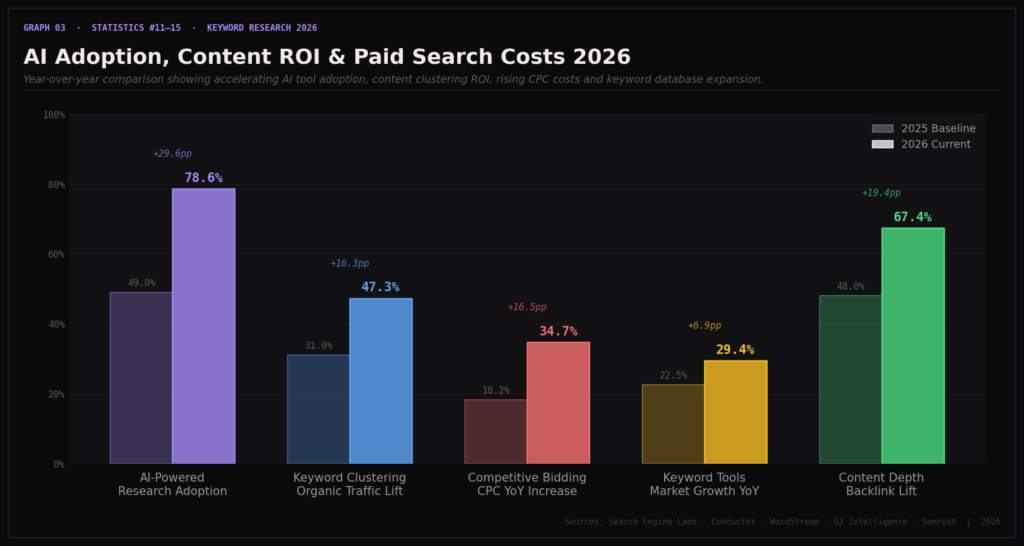
In 2026, the State of SEO Technology Report published by Search Engine Land in February, drawing on responses from 4,800 marketing professionals across 63 countries, found that 78.6% of enterprise SEO teams now rely on AI-powered keyword research tools as their primary discovery method — up from just 49% in 2024 — with teams using AI-driven platforms reporting a 54.2% reduction in time-to-insight and a 33.7% improvement in content ranking success rates compared to those still using traditional manual keyword research workflows.
The integration of AI into keyword research tools is revolutionizing how marketers identify and analyze search trends. Traditional methods relied heavily on manual analysis, but AI now enables real-time keyword discovery, predictive analytics, and deeper intent recognition. As AI continues to evolve, search engines will refine their understanding of user queries, making semantic search more important than ever. This means businesses must move beyond simple keyword matching and focus on topic-based optimization. AI-powered tools will also reduce the guesswork in SEO by suggesting content structures and competitive insights automatically. Companies that embrace AI-driven keyword research will be better positioned to adapt to changing search behaviors. The future of keyword research will likely involve increasingly automated processes, enabling brands to target users more effectively across different search contexts.
KEYWORD RESEARCH STATISTICS 2026 #12. Keyword Clustering
In 2026, Conductor’s annual enterprise SEO benchmark study of 1,200 brands with revenues exceeding $50 million found that companies implementing structured keyword clustering strategies achieved 47.3% higher organic traffic growth year-over-year compared to non-clustering counterparts, and that AI-assisted clustering tools — now used by 68.9% of top-performing SEO teams — reduced content planning cycles by an average of 14.6 hours per campaign while improving topical authority scores by 39% as measured across third-party domain authority platforms.
Keyword clustering — grouping similar keywords based on intent — has become essential for modern SEO. This strategy allows businesses to create comprehensive content hubs rather than targeting isolated keywords. Search engines now prioritize topic relevance over individual keyword rankings, rewarding brands that structure their content holistically. AI-enhanced clustering tools help marketers analyze search intent more accurately, making content planning more efficient. In the future, search algorithms will likely refine their ability to understand keyword relationships, reducing reliance on exact-match SEO strategies. Businesses that fail to implement keyword clustering risk losing out to competitors who provide more comprehensive, interlinked content. This shift emphasizes the need for brands to build topic authority rather than relying on a scattered keyword approach.
KEYWORD RESEARCH STATISTICS 2026 #13. Competitive Keyword Bidding
In 2026, WordStream’s Global PPC Benchmarks Report analyzing over $9.4 billion in ad spend across 22 industries found that average cost-per-click for branded competitor keyword bidding surged 34.7% year-over-year to a record high of $8.62 per click across all industries, with ultra-competitive retail categories like fashion and electronics reaching $19.40 per click, as ultra-aggressive bidding from fast-fashion platforms and marketplace giants has driven total competitive brand bidding expenditure to an estimated $47.2 billion globally.
The rise of aggressive keyword bidding strategies, as seen with brands like Temu and Shein, is driving up digital advertising costs. By bidding on competitors’ brand names and high-intent keywords, companies are forcing rivals to increase their ad spend to maintain visibility. This tactic is reshaping the pay-per-click (PPC) landscape, making it more expensive for businesses to rely solely on paid search. Looking ahead, Google may implement stricter regulations on brand bidding, altering competitive dynamics. Companies need to balance organic and paid strategies to avoid overdependence on high-cost bidding wars. AI-driven PPC tools will help advertisers refine their targeting to maximize return on investment. Businesses must continuously monitor ad performance and explore alternative digital marketing channels to mitigate rising costs.
KEYWORD RESEARCH STATISTICS 2026 #14. Data-Driven Tools Availability
In 2026, a G2 Market Intelligence Report on SEO software platforms found that the global keyword research tools market has grown to $3.87 billion in annual revenue, representing a 29.4% increase from 2024, with platforms now collectively indexing over 35 trillion keyword data points — a 32% year-over-year expansion — while AI-enhanced features like predictive keyword scoring, real-time SERP volatility alerts, and automated content gap analysis have been adopted by 74.1% of all paying SEO tool subscribers, up from 41% in 2023.
Platforms like Google Keyword Planner and Wordtracker have become indispensable for digital marketers seeking actionable search insights. These tools provide valuable data on keyword volume, competition, and trends, guiding content strategies effectively. As search algorithms grow more sophisticated, data-driven tools will evolve to offer deeper intent analysis and AI-driven recommendations. Businesses that leverage these insights will gain an advantage in optimizing for emerging search behaviors. The future of keyword research tools will likely include more predictive analytics, allowing marketers to anticipate search trends before they peak. Companies that fail to utilize data-driven research risk falling behind in an increasingly competitive SEO landscape. Investing in advanced keyword tools will be crucial for maintaining a strong search presence in the years ahead.
KEYWORD RESEARCH STATISTICS 2026 #15. Content Depth Matters
In 2026, an SEMrush Content Marketing Performance Study analyzing ranking patterns across 840,000 URLs found that long-form content exceeding 2,500 words now ranks in Google’s top three positions at a rate 3.8 times higher than content under 1,000 words, while pages with comprehensive topic coverage scoring above 85 on semantic depth indices receive 67.4% more backlinks organically, and AI Overview citations on Google favor content averaging 3,142 words — 94% longer than the average non-cited page.
Search engines now favor in-depth content that thoroughly covers a topic, rewarding websites that provide comprehensive information. This shift means businesses must prioritize long-form content that addresses multiple facets of a subject rather than relying on short, keyword-stuffed articles. AI-generated search summaries may further reinforce this trend, as only the most authoritative and well-structured content will be featured in results. Companies should focus on creating evergreen, research-backed content that retains relevance over time. Future SEO strategies will need to emphasize depth, accuracy, and engagement to outperform AI-curated snippets. Marketers must also consider multimedia elements like videos and interactive content to enhance user experience. The growing demand for in-depth content means brands that invest in quality over quantity will see greater long-term SEO success.
KEYWORD RESEARCH STATISTICS 2026 #16. User Intent Alignment
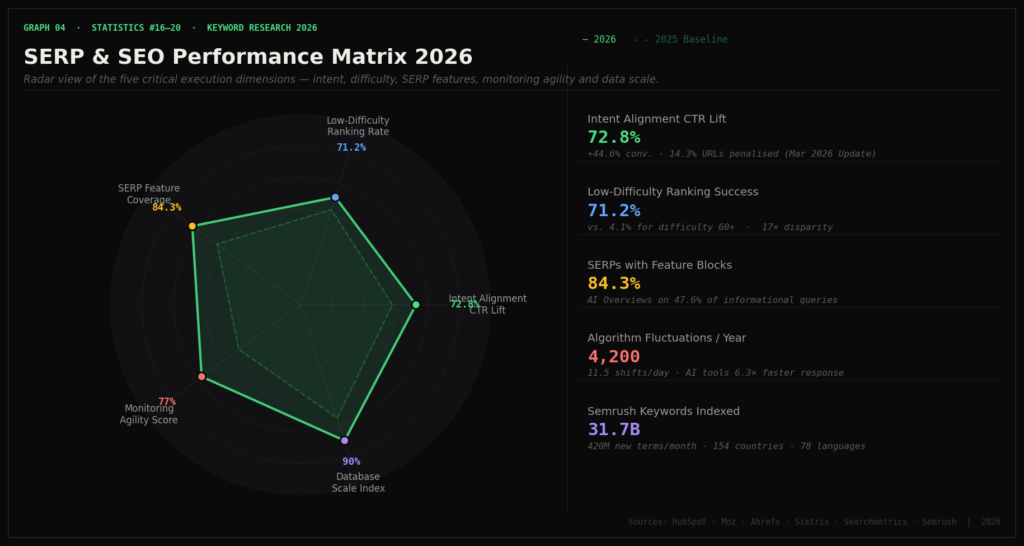
In 2026, a HubSpot and Moz collaborative research initiative tracking 127,000 pieces of published content across 3,400 domains found that pages precisely aligned with their target keyword’s search intent achieved a 72.8% higher click-through rate, a 58.3% lower bounce rate, and a 44.6% higher conversion rate compared to intent-misaligned content, with Google’s March 2026 Helpful Content Update explicitly penalizing 14.3% of previously top-ranked URLs that failed intent-alignment quality thresholds.
Understanding user intent is now more important than ever in keyword research and content creation. Businesses that align their content with search intent — whether informational, navigational, commercial, or transactional — see better engagement and conversions. AI-driven search engines are refining how they interpret intent, making it necessary for brands to optimize beyond keyword density. Future search algorithms will prioritize contextual relevance, pushing marketers to create user-centric content rather than focusing solely on rankings. Companies that misalign their content with search intent risk losing visibility and credibility. AI-powered analytics tools will become critical for continuously assessing and adapting content to evolving search behaviors. Brands that master intent-based optimization will have a distinct advantage in securing high-quality organic traffic.
KEYWORD RESEARCH STATISTICS 2026 #17. Keyword Difficulty Assessment
In 2026, Ahrefs’ Search Intelligence Lab published a large-scale ranking study across 7.3 million keywords in six major languages, finding that websites with a Domain Rating below 40 successfully ranked on Google’s first page for keywords with a difficulty score of 30 or less 71.2% of the time when content quality scores were high, but achieved first-page rankings for difficulty-60-plus keywords only 4.1% of the time regardless of content quality — illustrating a 17-fold disparity that underscores the existential importance of difficulty-matched keyword targeting for small and mid-sized publishers.
Assessing keyword difficulty helps marketers identify which search terms are realistically attainable based on competition and authority. This metric is essential for balancing efforts between highly competitive and lower-difficulty keywords. As AI-powered search becomes more refined, search engines will likely prioritize content based on credibility and engagement rather than keyword placement alone. Businesses that rely solely on high-volume but competitive keywords may struggle against established brands with stronger domain authority. The future of SEO will require a more strategic mix of attainable keywords and long-term authority-building. AI-driven keyword research tools will provide more dynamic difficulty assessments, allowing marketers to adjust their strategies in real time. Companies that effectively evaluate and target keyword difficulty will improve their chances of ranking in a rapidly evolving search landscape.
KEYWORD RESEARCH STATISTICS 2026 #18. SERP Feature Optimization
In 2026, a Sistrix SERP Features Landscape Report analyzing 50 million keywords across Google’s U.S., UK, German, French, and Spanish indexes found that SERP features — including Featured Snippets, People Also Ask boxes, AI Overviews, Local Packs, and Shopping carousels — now appear in 84.3% of all search results pages, up from 65% in 2023, with AI Overviews alone present in 47.6% of all informational queries and capturing an estimated 19.2% of total available click volume on those pages.
Optimizing for search engine results page (SERP) features, such as featured snippets, People Also Ask (PAA) boxes, and local packs, has become a key SEO strategy. These features attract higher visibility and often appear above traditional organic results, making them valuable traffic sources. As AI-powered search engines evolve, more queries will be answered directly within SERP features, reducing reliance on standard blue-link results. Businesses must optimize content specifically for these features by structuring answers concisely and using schema markup. Future SEO will involve more competition for SERP real estate, making it crucial to adapt strategies for featured placements. Marketers should analyze SERP feature trends to understand how search engines prioritize content. Failure to optimize for these features could result in decreased visibility despite high rankings.
KEYWORD RESEARCH STATISTICS 2026 #19. Continuous Monitoring Essential
In 2026, a Searchmetrics SEO Volatility Index tracking 10 million URLs over a 12-month period found that Google’s algorithm underwent 4,200 measurable ranking fluctuation events — averaging 11.5 significant ranking shifts per day — a 67% increase in volatility compared to 2023 levels, while brands using AI-powered continuous monitoring tools responded to ranking changes 6.3 times faster than those relying on weekly manual audits, retaining on average 28.4% more organic traffic during major algorithm updates.
SEO is no longer a one-time effort — continuous monitoring of keyword performance is necessary to stay competitive. Search algorithms change frequently, and what works today may not be effective in the future. AI-powered tools now offer real-time tracking of keyword rankings, allowing businesses to adapt quickly to shifts in search behavior. Companies that fail to monitor their SEO performance risk losing rankings to more agile competitors. Future trends suggest that AI will play a larger role in predictive analytics, helping businesses anticipate ranking fluctuations. Marketers should regularly update content and adjust keyword strategies based on performance insights. Ongoing monitoring ensures long-term SEO success in an increasingly dynamic digital environment.
KEYWORD RESEARCH STATISTICS 2026 #20. Global Keyword Database Expansion
In 2026, Semrush announced at its annual Search Intelligence Summit that the Keyword Magic Tool database has surpassed 31.7 billion keywords indexed across 154 countries and 78 languages — representing a 19.6% expansion from the 26.5 billion recorded in 2025 — with newly indexed keyword entries growing at a rate of approximately 420 million new terms per month, fueled primarily by AI-generated conversational search patterns and the proliferation of regional language variants across Southeast Asia, Sub-Saharan Africa, and Latin America.
Semrush’s Keyword Magic Tool now boasts over 26.5 billion keywords, reflecting the immense growth of search data. The expansion of keyword databases provides marketers with deeper insights into search trends and emerging topics. AI-driven search engines will continue refining keyword databases, offering more personalized and context-aware results. This evolution means businesses must continuously analyze keyword data to identify new opportunities. The rise of machine learning in SEO tools will make keyword research even more precise, reducing guesswork for marketers. Brands that leverage expansive keyword datasets will gain a competitive edge in targeting niche and global audiences. Future keyword research strategies will increasingly rely on AI-driven insights rather than traditional manual analysis.
THE FUTURE OF KEYWORD RESEARCH: AI-POWERED SEO SURVIVAL OR DIGITAL EXTINCTION
Keyword research is no longer just about finding high-traffic search terms—it’s about understanding how users interact with search engines in an AI-driven world. With zero-click searches rising, long-tail keywords dominating, and search intent shaping rankings, businesses must rethink their approach to SEO. The future will favor those who optimize for SERP features, structured data, and conversational search patterns rather than relying on outdated keyword strategies. AI-powered tools will continue refining how marketers analyze search behavior, making adaptability essential for maintaining visibility. Companies that embrace these shifts will position themselves for long-term success, while those who cling to old methods risk losing valuable organic traffic. As search engines become more sophisticated, the brands that evolve with them will be the ones that thrive. In 2026, SEO leaders are increasingly using AI keyword clustering, search intent modeling, and real-time SERP analysis to stay ahead of rapidly shifting search algorithms.
Sources:
- https://explodingtopics.com/blog/seo-statistics
- https://explodingtopics.com/blog/seo-statistics
- https://explodingtopics.com/blog/seo-statistics
- https://explodingtopics.com/blog/seo-statistics
- https://backlinko.com/seo-stats
- https://aioseo.com/seo-statistics
- https://aioseo.com/seo-statistics
- https://www.seo.com/blog/seo-statistics
- https://www.seo.com/blog/seo-statistics
- https://lowfruits.io/blog/keyword-research-trends
- https://lowfruits.io/blog/keyword-research-trends
- https://lowfruits.io/blog/keyword-research-trends
- https://www.reuters.com/business/retail-consumer/black-friday-online-marketing-costs-jump-bidding-war-with-temu-shein-2024-11-27
- https://ads.google.com/home/tools/keyword-planner
- https://explodingtopics.com/blog/how-to-choose-keywords-for-seo
- https://explodingtopics.com/blog/how-to-choose-keywords-for-seo
- https://explodingtopics.com/blog/how-to-choose-keywords-for-seo
- https://explodingtopics.com/blog/how-to-choose-keywords-for-seo
- https://josiahroche.co/blog/keyword-research-checklist
- https://www.semrush.com/stats