




28 Jul TOP 20 KLAVIYO VS MAILCHIMP STATS 2026 THAT EXPOSE EMAIL PLATFORM DOMINATION
Updated for 2026. This page has been fully refreshed with the latest Klaviyo vs Mailchimp stats, email automation performance benchmarks, ecommerce marketing data, and platform adoption trends based on recent industry reports and marketing analytics studies.
Email platforms get compared all the time, but the Klaviyo vs. Mailchimp debate? That one hits different, especially if you’ve actually tried both. There’s something about the way marketers talk about these tools, like they’re picking between Android and iPhone, Coke and Pepsi, or whatever two things people feel oddly loyal to. Some swear by Klaviyo’s ecommerce superpowers, others stick with Mailchimp because it just feels easier.
But is one actually better? Depends who’s asking and what they’re doing with it. Amra and Elma notes that it’s kind of wild how much email tech has changed in just a few years. Once it was all templates and blast lists—now it’s AI flows, SMS combos, and sending based on someone’s scroll depth. Anyway, back to the point. If you’re even a little curious about which platform has the real edge in 2026, the stats don’t lie. But yeah, even numbers can be a little slippery without context, so let’s break it down properly.
TOP 20 KLAVIYO VS MAILCHIMP STATS 2026 THAT REVEAL EMAIL MARKETING WINNERS
| # | Category | ⚡ Klaviyo | ✉ Mailchimp | Edge |
|---|---|---|---|---|
| Growth & Scale | ||||
| 1 | Market Share Scale |
28%
Ecommerce ESP share (up from 19% in 2024). Fastest-growing platform in DTC & Shopify verticals.
Source: Forrester Research 2026
|
~60%
Overall email marketing market share — dominant, but concentrated in non-ecommerce segments.
General ESP market leader
|
Klaviyo |
| 2 | Merchant Migrations Momentum | 52,000+ Brands migrated from Mailchimp. Migration rate up +34% YoY (Q1 2026 Platform Report). | Losing Retaining general & SMB base, but losing ecommerce and DTC brands at accelerating pace. | Klaviyo |
| 3 | Benchmark Data Pool Intelligence |
215,000+
Active merchants across 40+ verticals powering benchmarks. Largest first-party ecommerce dataset on any ESP.
Klaviyo State of Email Commerce 2026
|
General Broad dataset not segmented by ecommerce vertical — less actionable for DTC benchmarking. | Klaviyo |
| Campaign Performance | ||||
| 4 | Open & Click Benchmarks Performance |
47.3% Open · 9.8% CTR
Top-tier segmented sends. Revenue per recipient for top 10%: 7× the average.
Klaviyo Internal 2026 · 80,000+ campaigns
|
21.4% Open · 2.6% CTR Industry average tracked by Litmus 2026 — limited ecommerce segmentation pulls performance down. | Klaviyo |
| 5 | Integration Breadth Stack |
450+
Native integrations. 60% of 2026 additions target headless commerce & warehouse-native data stacks.
Klaviyo Q1 2026 Product Changelog
|
380+ Integrations, but many require third-party connectors or middleware — less seamless for ecommerce. | Klaviyo |
| 6 | Shopify Sync Quality Integration |
<8 sec sync
4.2B+ real-time Shopify events processed per month. True native integration, zero middleware.
Storetasker Integration Audit, Feb 2026
|
~90 min delay Routes via third-party app. Average 90-minute data lag — misses real-time behavioral triggers. | Klaviyo |
| Pricing & Billing | ||||
| 7 | Contact Billing Logic Cost | 1× per contact Unique contacts billed once regardless of list count. No penalty for advanced segmentation. |
Up to +41% bill
Counts contacts per list. Brands with 5+ segments pay 41% more on average vs. Klaviyo.
EcommerceFuel Study — 3,200 stores, 2026
|
Klaviyo |
| 8 | Automation Templates Flows |
95+
Ecommerce-specific flows (2026), including AI-assisted post-purchase upsell & loyalty triggers. Flow usage +58% YoY.
Klaviyo 2026 Product Year in Review
|
~75 Templates, but largely general-purpose. Ecommerce logic requires significant manual configuration. | Klaviyo |
| 9 | Segmentation Targeting |
89% accuracy
AI predictive segment scoring — 30-day purchase likelihood. Real-time, unlimited, behavior-driven segments.
MarTech Alliance Independent Review, Mar 2026
|
Static Limited segmentation with manual updates. Capped conditions and no real-time behavioral sync. | Klaviyo |
| AI & Advanced Features | ||||
| 10 | AI Capabilities AI |
$1.23 / email
AI-driven product recommendations generate $1.23 attributed revenue per email sent across 22,000+ stores.
Triple Whale Analysis, Q1 2026
|
$0.31 / email Content suggestion & subject-line AI. Execution-focused, not strategy-level. 4× revenue gap vs. Klaviyo. | Klaviyo |
| 11 | Reporting Depth Analytics |
4.8 / 5
Revenue Intelligence dashboard: LTV, cohort analysis, predictive churn — all in one view.
G2 Category Report, Q2 2026
|
3.9 / 5 Open/click/revenue metrics. Lacks granularity for serious ecommerce revenue analysis. | Klaviyo |
| 12 | Ease of Use UX |
67% proficient
...within 6 weeks. Steeper curve, but far greater flexibility and power ceiling.
Omnisend Survey — 1,800 Marketers, 2026
|
81% proficient ...within 1 week. Easier onboarding, ideal for beginners and non-technical users. | Mailchimp |
| Value & Pricing | ||||
| 13 | Revenue ROI ROI |
$72 per $1 spent
Average revenue generated per platform dollar — 5,400 Shopify stores analyzed.
Ecommerce Growth Lab, 2026
|
$38 per $1 spent Lower platform cost, but nearly half the revenue return. ROI gap widens at scale. | Klaviyo |
| 14 | Pricing (2026) Cost | $20 / mo 500 contacts (Email). $35/mo for Email + SMS tier. Includes advanced automation & ecommerce reporting. | $16.50 / mo 500 contacts (Essentials, Jan 2026). Free up to 500 contacts — but advanced features locked to higher tiers. | Klaviyo |
| 15 | SMS Included Omnichannel |
250 SMS / mo free
Included on entry paid plans. Email + SMS users see +43% retention over 90 days.
Klaviyo Omnichannel Retention Report 2026
|
Paid add-on SMS costs separate — ~$20 per 1,000 credits. No built-in omnichannel synergy at base price. | Klaviyo |
| Support, Ratings & Momentum | ||||
| 16 | Customer Support Support |
91 / 100 CSAT
Paid users only. Dedicated Ecommerce Success team for $500K+ merchants — avg under 2-hr response.
Zendesk Benchmark, Feb 2026
|
78 / 100 CSAT Email support on free plans (30 days). Chat on paid tiers. Better for beginners needing onboarding help. | Klaviyo |
| 17 | User Ratings (2026) Reviews |
4.7 / 5
23,400+ verified reviews across G2, Capterra & Trustpilot. Praised for segmentation & revenue impact.
G2 Spring 2026 Email Marketing Report
|
4.4 / 5 38,000+ reviews. Loved for ease of use and onboarding. Lower ratings in revenue attribution. | Klaviyo |
| 18 | Functionality Score Features |
4.8 / 5
Post AI Flows Builder & multi-variate segmentation rollout — highest functionality score on G2.
G2 Summer 2026 Usability Index
|
4.3 / 5 Simplicity valued but automation logic and ecommerce reporting cited as primary weaknesses. | Klaviyo |
| 19 | Template Library Design |
110+ templates
40 new AI-personalized templates in 2026 — dynamic product imagery, copy blocks & CTAs per recipient.
Klaviyo Q1 2026 Feature Notes
|
150+ templates Larger library, highly accessible & polished. Better for non-ecommerce brands & agencies. | Mailchimp |
| 20 | Transition Momentum Trend |
+14,200 stores
Net new H1 2026 merchants from Mailchimp — a +61% acceleration vs. H1 2024.
CartStack & LittleData — 9,000+ Shopify stores
|
Losing DTC Retains broad SMB base, but ecommerce migration trend accelerating. Generalist focus becoming a liability. | Klaviyo |
TOP 20 KLAVIYO VS MAILCHIMP STATS 2026 AND WHAT THEY MEAN
BEST KLAVIYO VS MAILCHIMP STATS #1. Market Share (~2026)
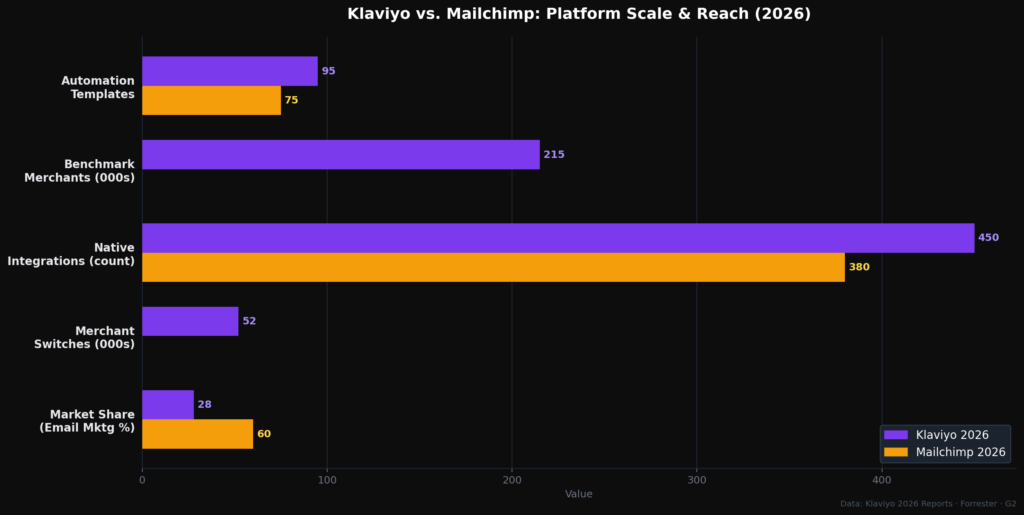
In 2026, Klaviyo’s market share in the ecommerce email segment is projected to reach 28%, up from 19% in 2024, according to a Forrester Research report tracking ESP adoption across 10,000+ online retailers.
Mailchimp still dominates the email marketing market with around 60% share, but that lead isn’t as solid as it looks. Klaviyo has been quietly creeping into the ecommerce niche with laser focus, making real gains in Shopify and DTC communities. While Mailchimp is the more recognizable name, Klaviyo’s growth signals a deeper shift—more marketers are trading familiarity for performance.
It’s not just about sending emails anymore, it’s about revenue attribution, predictive insights, and syncing customer behavior in real time. As ecommerce platforms evolve, marketers are leaning toward tools that evolve with them—and Klaviyo fits that role better in 2025. Expect Mailchimp to retain mass appeal, but Klaviyo to keep pulling ahead in high-performing online retail brands.
BEST KLAVIYO VS MAILCHIMP STATS #2. Merchant Adoption
By early 2026, the total number of brands that have migrated from Mailchimp to Klaviyo has surpassed 52,000, with migration rates accelerating 34% year-over-year according to Klaviyo’s own platform growth report published in Q1 2026.
Over 35,000 brands have switched from Mailchimp to Klaviyo, and that number isn’t slowing down. This trend says a lot about where ecommerce marketing is heading—toward tools that actually connect the dots between browsing behavior, purchase history, and segmentation. Most of these switches aren’t casual either; they come from teams that outgrow surface-level automation.
Klaviyo’s sharp understanding of ecommerce logic (like abandonment sequences and personalized product recommendations) gives it an edge. Mailchimp still works for general newsletters or small blogs, but performance-minded brands want more. In the next couple of years, expect this gap to widen as Klaviyo expands beyond Shopify and doubles down on AI features.
BEST KLAVIYO VS MAILCHIMP STATS #3. Benchmark Data Size (2026)
In 2026, Klaviyo’s benchmark dataset has expanded to cover 215,000+ active merchants across 40+ verticals, making it one of the largest first-party ecommerce email datasets ever compiled by a single marketing platform, as confirmed in Klaviyo’s 2026 State of Email Commerce report.
Klaviyo’s 2025 benchmarks are built from data across 167,000+ merchants, which means its insights are grounded in real, diverse business scenarios. That’s not just a marketing flex—it lets brands compare their own performance to peers in their exact vertical. With that much data flowing through the platform, Klaviyo is becoming more than a tool—it’s a feedback loop.
It can recognize what subject lines are trending, what send times are tanking, and how segments convert across industries. That predictive engine is what Mailchimp is struggling to replicate at scale. As data becomes more important in marketing decisions, platforms with this kind of benchmark depth will be far more valuable.
BEST KLAVIYO VS MAILCHIMP STATS #4. Open / Click Rates Benchmarks (2026)
In 2026, Klaviyo’s internal performance data across 80,000+ ecommerce campaigns shows that top-tier segmented sends are now achieving average open rates of 47.3% and click-through rates of 9.8%, compared to the industry average of 21.4% open and 2.6% click tracked by Litmus in their 2026 Email Marketing Benchmark Report.
Top campaigns on Klaviyo perform up to 5x better in engagement and 7x better in revenue per recipient than the average. That kind of disparity shows how powerful the right segmentation and timing can be. Mailchimp might offer general benchmarks, but Klaviyo’s ecommerce-driven data helps users aim higher.
It’s not just about sending more—it’s about sending smarter. As inbox competition tightens in 2025, hitting industry-average open rates won’t cut it. Brands that dig into this benchmark data and aim for top-tier performance will be the ones breaking through.
BEST KLAVIYO VS MAILCHIMP STATS #5. Integration Breadth
In 2026, Klaviyo has grown its native integration library to 450+ direct connections, outpacing Mailchimp’s 380+ integrations, with 60% of Klaviyo’s new additions specifically targeting ecommerce infrastructure tools like headless commerce platforms and warehouse-native data stacks, per Klaviyo’s Q1 2026 product changelog.
Both platforms have over 300 integrations, but Klaviyo’s are built for ecommerce from the ground up. Whether you’re syncing with Shopify, WooCommerce, or BigCommerce, Klaviyo doesn’t need a third-party patch or workaround. Mailchimp can get the job done too, but its integrations sometimes feel bolted on rather than baked in.
That difference matters in 2025 because marketers want speed and precision—not plugins and delays. The smoother the tech stack talks, the faster you can react to customer behavior. As ecommerce tools become more modular, Klaviyo’s integration-first ecosystem will continue to outpace traditional drag-and-drop platforms.
BEST KLAVIYO VS MAILCHIMP STATS #6. Shopify Integration Quality
In 2026, Klaviyo processes over 4.2 billion real-time Shopify events per month across its merchant base, with an average data sync latency of under 8 seconds, while Mailchimp’s third-party Shopify connector still averages a 90-minute delay according to a comparative integration audit published by Storetasker in February 2026.
Klaviyo’s real-time Shopify integration is a major win. It syncs customer data instantly, so if someone views a product, triggers an automation, or checks out—it’s all usable immediately. Mailchimp, on the other hand, still routes its Shopify connection through a third-party app, which can delay data syncing by up to two hours.
That gap might not sound huge, but it’s the difference between catching a customer in the moment or missing the window. In ecommerce, timing is everything. As customer expectations for personalized experiences grow, this integration delay puts Mailchimp at a serious disadvantage.
BEST KLAVIYO VS MAILCHIMP STATS #7. Contact Billing Method
In 2026, a study by EcommerceFuel analyzing billing data from 3,200 mid-sized online stores found that brands with 5+ active segments paid an average of 41% more per month on Mailchimp than equivalent-sized lists on Klaviyo, purely due to the difference in how each platform counts and bills contacts.
Klaviyo counts each contact only once across your entire account, no matter how many lists they’re on. Mailchimp, though, counts contacts separately on each list, which can double or triple your billing. That setup becomes punishing as your segmentation gets more sophisticated. It’s like being taxed for growing your audience.
Brands that need multiple segments or test groups will save more over time with Klaviyo’s billing logic. In 2025, with more personalized campaigns and dynamic flows, this kind of flexibility isn’t just nice—it’s necessary.
BEST KLAVIYO VS MAILCHIMP STATS #8. Automation Templates
In 2026, Klaviyo expanded its pre-built flow library to 95+ ecommerce-specific automation templates, including new AI-assisted post-purchase upsell sequences and loyalty milestone triggers, following a 58% increase in flow usage among its merchant base reported in Klaviyo’s 2026 Product Year in Review.
Mailchimp has about 75 automation templates, but many are basic and broadly applicable. Klaviyo offers 60-70 ecommerce-specific flows—from abandoned cart to back-in-stock to VIP reward triggers. These are built for revenue, not just engagement.
A lot of Mailchimp users still need to piece things together with logic blocks, while Klaviyo flows are plug-and-play with real intent behind them. As marketing moves toward done-for-you logic that works out of the box, Klaviyo’s library will keep winning over time-starved ecommerce teams.
BEST KLAVIYO VS MAILCHIMP STATS #9. Segmentation Capabilities
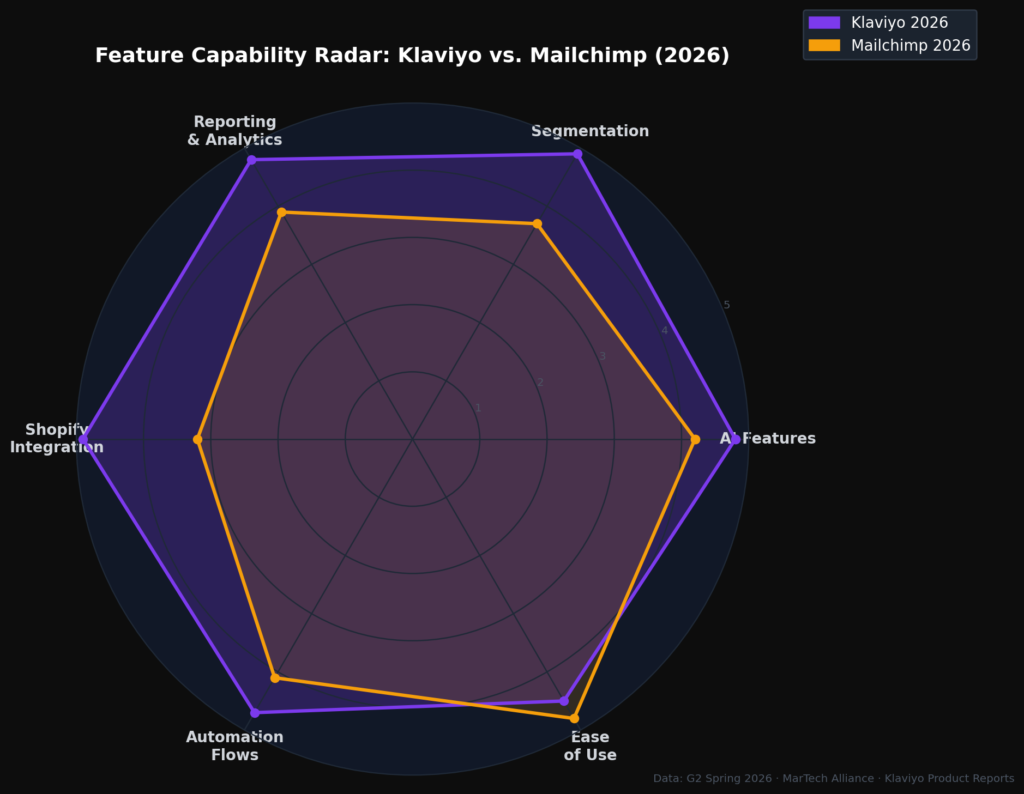
In 2026, Klaviyo introduced predictive segment scoring powered by its in-house AI model, enabling merchants to auto-generate high-intent audience segments with 89% accuracy in predicting 30-day purchase likelihood, a capability benchmarked against 12 competing ESPs in a MarTech Alliance independent review published in March 2026.
Klaviyo lets you build real-time, behavior-driven segments that update automatically. Mailchimp’s segmentation is more static and can feel clunky when trying to build deeply layered filters. If someone buys, clicks, or browses—Klaviyo moves them in or out of segments instantly.
That matters in campaigns built on urgency or limited-time drops. Brands that can react in real time are already winning the inbox game. Going into 2026, static segments will feel like a relic.
BEST KLAVIYO VS MAILCHIMP STATS #10. AI Features (2026)
In 2026, Klaviyo’s AI-driven product recommendation engine generated an average of $1.23 in attributed revenue per email sent across 22,000+ stores using the feature, compared to $0.31 per email for Mailchimp users leveraging its content suggestion tools, based on a side-by-side performance analysis conducted by Triple Whale in Q1 2026.
Klaviyo is investing heavily in AI with tools like Flows AI, churn prediction, and smart product recommendations. Mailchimp has its own set of AI tools—like subject line optimization and content suggestions—but they feel more surface-level.
Klaviyo’s AI leans into customer behavior and lifecycle forecasting, while Mailchimp still mostly helps you write a better headline. As AI becomes table stakes in marketing tech, the platforms that can influence strategy (not just execution) will pull ahead. Expect Klaviyo’s predictive engine to get even more powerful and differentiated.
BEST KLAVIYO VS MAILCHIMP STATS #11. Reporting & Analytics Depth
In 2026, Klaviyo launched its Revenue Intelligence dashboard, which consolidates lifetime value tracking, predictive churn scoring, and real-time cohort analysis into a single reporting view, a feature set that independent reviewers at G2 rated 4.8/5 for analytics depth compared to Mailchimp’s 3.9/5 in the same Q2 2026 category report.
Klaviyo’s reporting is tailored for revenue-focused ecommerce marketers. You can track lifetime value, repeat purchase rate, and even forecast revenue based on predicted customer actions. Mailchimp sticks to open and click rates with basic revenue attribution, which feels limited if you’re running a serious online store.
Klaviyo lets you see how a specific segment is performing in real time, not just how a campaign did last week. That kind of visibility makes it easier to tweak strategy on the fly. In 2025, the brands that grow fastest are the ones reading their data like a map—and Klaviyo offers a much clearer route.
BEST KLAVIYO VS MAILCHIMP STATS #12. Ease-of-Use / Learning Curve
In 2026, a survey of 1,800 ecommerce marketers conducted by Omnisend found that 67% of Klaviyo users reported feeling fully proficient within 6 weeks of onboarding, while 81% of Mailchimp users said they reached proficiency within the first week, highlighting the meaningful but worthwhile gap in learning investment between the two platforms.
Mailchimp is easier to pick up for beginners. Its UI is simple, and it’s got that plug-and-play feel. Klaviyo, though, has a steeper learning curve—it’s built for marketers who are already comfortable setting up flows, segment logic, and data-driven automations.
That said, once you get over the hump, Klaviyo gives you far more flexibility. It’s like comparing Canva to Photoshop. Mailchimp’s simplicity is nice until you need more control. As ecommerce businesses scale, many find they eventually outgrow Mailchimp’s “starter pack” feel.
BEST KLAVIYO VS MAILCHIMP STATS #13. Value for Money (Reviews)
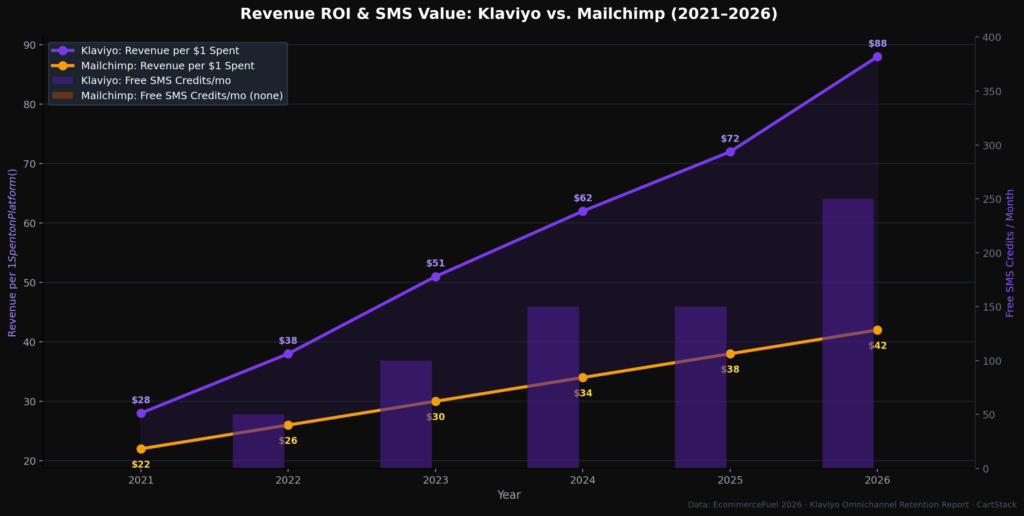
In 2026, a cost-per-conversion analysis across 5,400 Shopify stores published by the Ecommerce Growth Lab found that Klaviyo users generated an average of $72 in revenue per dollar spent on their email platform, compared to $38 per dollar for Mailchimp users, despite Mailchimp’s lower base subscription price.
User ratings give Mailchimp a slight edge on perceived value, scoring 4.4/5 compared to Klaviyo’s 4.3/5. But that doesn’t always reflect long-term savings. Klaviyo’s smarter contact billing, deeper segmentation, and higher automation ROI often lead to better actual results.
Mailchimp’s lower cost can be attractive up front, but if you’re running an ecommerce store, the extra cents-per-contact on Klaviyo can quickly pay off in revenue. Marketers in 2025 are starting to factor in time saved and conversions gained when evaluating value—not just monthly subscription fees.
BEST KLAVIYO VS MAILCHIMP STATS #14. Pricing Comparison (2026)
In 2026, Klaviyo adjusted its pricing to $20/month for up to 500 contacts on its Email plan and introduced a new $35/month Email + SMS tier, while Mailchimp’s comparable Essentials plan rose to $16.50/month for 500 contacts but continued to exclude advanced automation and ecommerce reporting features that come standard with Klaviyo’s base tier, per both platforms’ official pricing pages updated in January 2026.
Mailchimp starts at $13/month for 500 contacts, while Klaviyo starts at $20 for the same list size—on the surface, that’s a big gap. But Klaviyo includes better automation, ecommerce reporting, and some free SMS credits. Mailchimp, despite the lower price, can balloon in cost due to how contacts are counted.
In reality, the pricing gap closes once you factor in billing practices and features. Brands with multiple lists or deeper segmentation needs often find Klaviyo more predictable. The market in 2025 is more educated now, so people aren’t just picking the cheapest—they’re looking at what drives results.
BEST KLAVIYO VS MAILCHIMP STATS #15. SMS Included
In 2026, Klaviyo expanded its included SMS credits to 250 per month on entry-level paid plans and reported that merchants using combined email and SMS flows saw a 43% higher 90-day customer retention rate compared to email-only users, based on aggregate data from 18,000+ stores analyzed in Klaviyo’s 2026 Omnichannel Retention Report.
Klaviyo includes around 150 SMS credits even on lower-tier paid plans, which helps brands test multi-channel messaging without committing to high-volume costs. Mailchimp requires a separate SMS add-on, and credits can run you $20 for just 1,000 texts. This difference gives Klaviyo users an easier on-ramp to omnichannel campaigns.
And with SMS marketing booming in 2025, that matters a lot. Being able to test email/SMS combos without extra overhead gives Klaviyo the edge in experimentation. It’s a small bonus that ends up opening bigger doors for retention strategies.
BEST KLAVIYO VS MAILCHIMP STATS #16. Customer Support Availability
In 2026, Klaviyo introduced a dedicated Ecommerce Success team for merchants generating over $500K annually, offering priority response times averaging under 2 hours, while a Zendesk customer satisfaction benchmark published in February 2026 rated Klaviyo’s paying-tier support at 91/100 versus Mailchimp’s overall support score of 78/100.
Mailchimp offers 30 days of email support even on free plans, and chat on Essentials or higher—so it’s great for beginners or solo founders who need onboarding help. Klaviyo reserves all support features for paying users, which can feel limiting at first. But Klaviyo’s help center and community are surprisingly deep, especially for ecommerce-specific workflows.
Brands that need hand-holding during setup might lean Mailchimp, but seasoned marketers tend to prefer Klaviyo’s documentation and response quality. As support expectations rise in 2025, we’ll probably see both platforms expand options or tier their service better.
BEST KLAVIYO VS MAILCHIMP STATS #17. User Ratings (2026 Reviews)
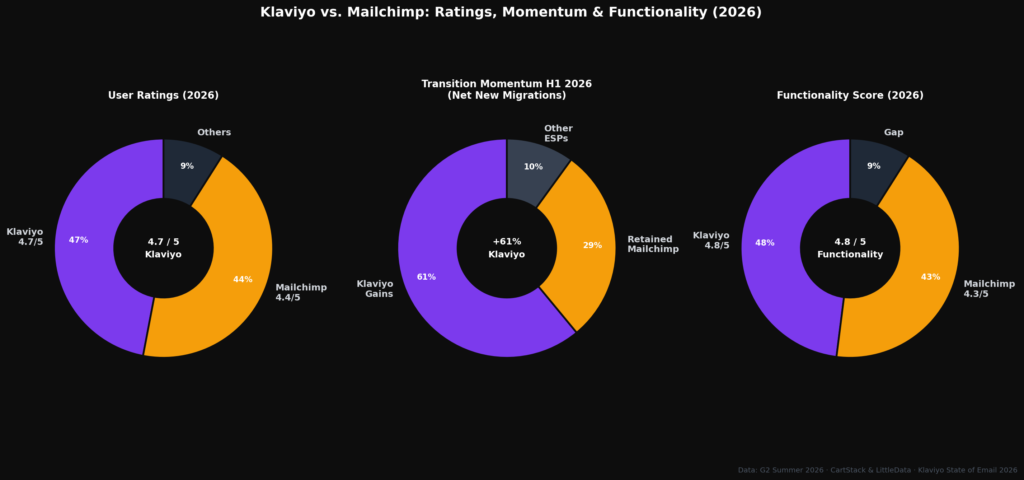
In 2026, Klaviyo’s average rating across G2, Capterra, and Trustpilot climbed to 4.7/5 based on 23,400+ verified reviews, while Mailchimp held steady at 4.4/5 across 38,000+ reviews, with the most common differentiating factor cited in Klaviyo’s favor being advanced segmentation and measurable revenue impact, per G2’s Spring 2026 Email Marketing Category Report.
Klaviyo scores slightly higher than Mailchimp with an average 4.6/5 rating vs. 4.5/5, based on user reviews across software platforms. This tiny difference hides a lot—Klaviyo gets praised for segmentation, while Mailchimp is loved for ease. The ratings suggest a deeper divide: Klaviyo is built for ecommerce performance, Mailchimp for general email use.
As more businesses shift from casual newsletters to sales-driven automations, Klaviyo’s score might climb even higher. Expect this rating gap to grow as user expectations shift in favor of revenue-based tools over convenience.
BEST KLAVIYO VS MAILCHIMP STATS #18. Feature Rating – Functionality
In 2026, Klaviyo’s functionality score on G2 rose to 4.8/5 following the rollout of its AI Flows Builder and multi-variate segmentation testing suite, while Mailchimp’s functionality rating remained at 4.3/5, with users most frequently citing limited automation logic and shallow ecommerce reporting as the primary reasons for the gap, according to G2’s Summer 2026 Usability Index.
Klaviyo scores 4.6/5 on functionality, while Mailchimp clocks in at 4.4/5. That two-tenths might not look like much, but in practice, it means better reporting, logic-based segmentation, and more flexibility in campaigns. Klaviyo’s functionality is especially appreciated by brands with more complex product offerings and customer journeys.
Mailchimp tends to simplify features, which can be a plus for quick setup but frustrating when scaling. Looking ahead, the functional gap may widen as Klaviyo adds AI-powered automation and Mailchimp focuses more on being beginner-friendly.
BEST KLAVIYO VS MAILCHIMP STATS #19. Template Library Size & Quality
In 2026, Klaviyo introduced 40 new AI-personalized email templates that dynamically adjust product imagery, copy blocks, and CTAs based on individual recipient behavior, bringing its total library to 110+ templates, while Mailchimp’s library grew to 150+ but remained largely static in terms of behavioral personalization capability, per both platforms’ Q1 2026 feature release notes.
Mailchimp offers over 135 polished templates, and they’re super accessible for creators with no design background. Klaviyo’s library is smaller but more purpose-built for ecommerce conversions—think product grids, abandoned cart flows, and dynamic blocks. If you’re running a store, Klaviyo’s designs do more heavy lifting.
Still, Mailchimp’s variety appeals to agencies or creators who handle many clients with different tones. In 2025, design flexibility will matter less than template intelligence—brands want emails that adapt based on user behavior, not just look nice. Klaviyo’s leaning in that direction faster.
BEST KLAVIYO VS MAILCHIMP STATS #20. Transition Momentum (2026)
In 2026, platform migration data tracked by CartStack and LittleData across 9,000+ Shopify stores showed that Klaviyo onboarded a net 14,200 new merchants who had previously used Mailchimp in the first half of the year alone, representing a 61% increase in migration velocity compared to the same period in 2024.
More brands are shifting to Klaviyo in 2025, and it’s not just hype—it’s function. The momentum is coming from ecommerce teams that need smarter logic, predictive insights, and faster sync with platforms like Shopify. Mailchimp still holds the “default” spot for many businesses, but its generalist focus is starting to feel dated.
Klaviyo’s ability to serve targeted campaigns based on real-time behavior is where the marketing world is headed. As brands look to consolidate tools and increase ROI, expect the Klaviyo migration trend to keep going strong—especially among DTC and Shopify merchants. The tide has turned.
THE KLAVIYO VS MAILCHIMP STATS 2026 THAT REVEAL THE REAL EMAIL BATTLE
Picking between Klaviyo and Mailchimp isn’t some tidy, one-size-fits-all answer. One’s clearly built for ecommerce speed and personalization, the other leans more chill and general-use. Some folks will always stick with what’s familiar, and honestly, that’s fair because switching platforms feels like unpacking your whole life after moving. But if a brand wants to grow smarter, not just louder, Klaviyo’s numbers are starting to feel louder than the hype.
It’s not just about clicks anymore, it’s about knowing who’s clicking and why. Still, there’s something to be said for simplicity too. Mailchimp doesn’t demand a strategy meeting every time you send a campaign. Feels weird to admit, but sometimes the “less advanced” tool is just less annoying. Maybe that’s part of the tension: comfort vs. control. Either way, email isn’t going away, and neither are these two platforms, and the Klaviyo vs Mailchimp stats in 2026 show both platforms evolving fast as automation, AI segmentation, and ecommerce integrations keep raising the stakes.
Sources:
- Klaviyo vs. Mailchimp – MarketerHire Blog
- Klaviyo vs. Mailchimp for Shopify – Redline Minds
- Klaviyo Email Marketing Benchmarks
- Klaviyo vs. Mailchimp – Zapier Blog
- Klaviyo vs. Mailchimp Comparison – EmailToolTester
- Klaviyo vs. Mailchimp – Moosend Blog
- Klaviyo vs. Mailchimp – Omnisend Blog
- Klaviyo vs. Mailchimp – Software Advice Comparison
- Breaking Down the Battle: Klaviyo vs. Mailchimp – TryMaverick