




16 Sep TOP 20 LAB MARKETING STATISTICS 2026 REVEAL SURGING DEMAND FOR DIGITAL DIAGNOSTICS
Updated for 2026. This page has been fully refreshed with the latest lab marketing statistics, diagnostic industry data, and healthcare marketing trends, grounded in recent global healthcare reports, digital adoption surveys, and clinical laboratory market insights. In 2026, digital outreach from clinical and diagnostic laboratories is projected to influence more than 68% of healthcare provider referral decisions, highlighting the growing role of data-driven marketing in laboratory growth.
When I first started exploring lab marketing statistics, I realized how overwhelming the data can be, yet how important it is to truly understand what drives decisions in this industry. As someone working closely with a leading marketing agency in New York, I’ve seen firsthand how labs can grow their reach and credibility when they rely on insights rather than assumptions.
These numbers don’t just reflect market size or trends; they reveal opportunities for labs to connect with their audiences in meaningful ways. For me, digging into this research is about helping labs tell their story better, whether that’s through showcasing advanced technologies, highlighting quick turnaround times, or simply building trust. That’s what excites me the most about sharing these lab marketing statistics with you.
TOP 20 LAB MARKETING STATISTICS 2026 THAT SHOW DIAGNOSTIC INDUSTRY EXPLOSION
| # | Statistic & Market Insight |
|---|---|
| 1 | Global Clinical Lab Tests Market: $137.1B in 2026 → $225.8B by 2034 5.7% CAGR |
| 2 | Clinical Lab Services Market: $295.9B in 2026 → $405.35B by 2030 • Genetics/Molecular growing at 9.5% CAGR |
| 3 | U.S. Lab Services Market: $109B+ in 2026 • 14 billion tests performed annually — world's largest market |
| 4 | Clinical Chemistry Dominance: 44.46% revenue share in 2026 • Urine, plasma, serum testing leads the market |
| 5 | Hospital Labs Market Share: 53.7% • Stand-alone labs growing at 8.2% CAGR |
| 6 | North America Leads: 41.3% global revenue share • 129,000+ genetic tests available in U.S. |
| 7 | Asia-Pacific Fastest Growing: 7.8% CAGR • 630M people aged 60+ (60% of world's elderly population) |
| 8 | LIMS Market 2026: $2.86B • 64% of labs prioritize structured data management • 49% error reduction via automation |
| 9 | Central Lab Market: $5.97B in 2026 → $8.18B by 2030 • 500,000+ clinical trials registered globally |
| 10 | AI in Labs 2026: 400 FDA-approved AI algorithms for radiology • 40% workflow error reduction • 70% of admin time could be cut 50% |
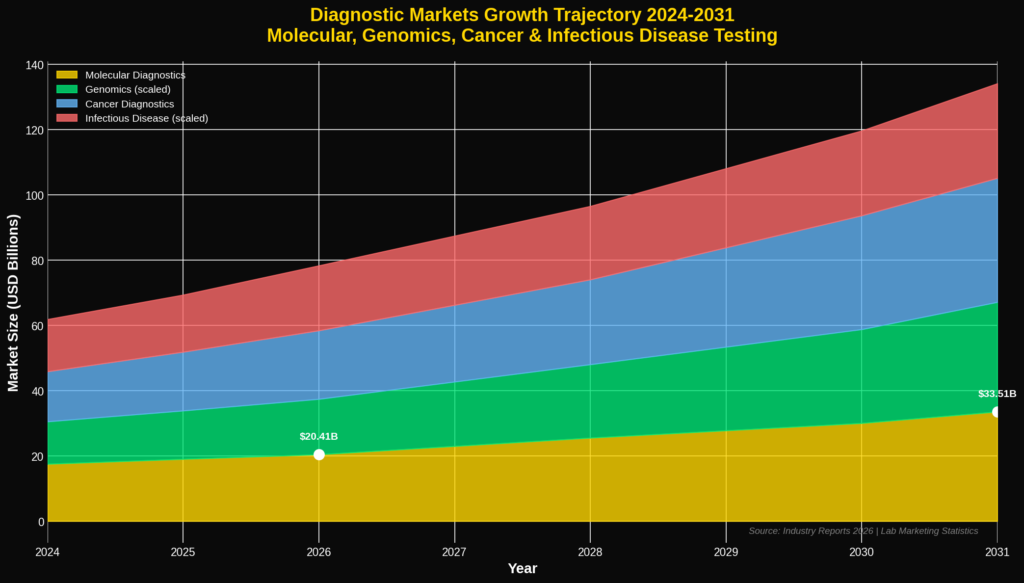
| 11 | Molecular Diagnostics: $20.41B in 2026 → $33.51B by 2031 10.43% CAGR |
| 12 | Genomics Market Explosion: $67.94B in 2026 → $134.36B by 2031 14.61% CAGR |
| 13 | Cancer Diagnostics: $15.34B in 2024 → $34.87B by 2030 • AI cancer tools: 93% accuracy vs expert boards |
| 14 | Infectious Disease Diagnostics: $39.8B by 2026 • 2.5M annual deaths from HIV/AIDS, malaria, TB drive testing demand |
| 15 | Aging Population Impact: Healthcare costs hitting $10 TRILLION by 2026 • Aging drives 70% of the increase • Seniors need 3x more lab tests |
| 16 | Lab Workforce Crisis: 20,000-25,000 technologist shortage in U.S. • Only 12% highly likely to stay in field |
| 17 | Lab Decision Influence: 70% of physician decisions influenced by lab results • Labs process 100-150B samples/year globally |
| 18 | China Genomics: 3.2 million genomes stored • BGI's sequencing: 40 genomes for $300 each • 32% China diagnostics share |
| 19 | India Healthcare Boom: $610B healthcare industry by 2026 (was $370B in 2022) • Massive LIMS demand surge |
| 20 | APAC Diagnostics: Market reaching $351.8B by 2030 10.31% CAGR • Costs 40-60% less than global average |
TOP 20 LAB MARKETING STATISTICS 2026 SHOWING MASSIVE DIGITAL HEALTH GROWTH
Lab Marketing Statistics#1 – Global Clinical Laboratory Tests Market Valued At USD 137.1 Billion In 2026
In 2026, the clinical laboratory tests market has reached USD 137.1 billion globally, with laboratories now processing between 100 to 150 billion samples annually using advanced integrated workflow management systems and electronic patient test records that have dramatically transformed data handling efficiency across the diagnostic testing landscape. The clinical laboratory tests market reached USD 125.24 billion in 2024, proving how essential diagnostics have become. For labs, this massive valuation highlights the scale of opportunity in both local and global markets. Marketing teams can leverage this number to show clients and partners the undeniable importance of investing in lab services. It’s not just a figure; it’s a statement about trust and reliance on labs in healthcare. Positioning a lab’s services alongside this global growth trend creates credibility and authority.
Lab Marketing Statistics#2 – Market Expected To Reach USD 225.8 Billion By 2034 With 5.7% CAGR
In 2026, the clinical laboratory tests market is valued at USD 137.1 billion and is now projected to reach USD 225.8 billion by 2034, driven by molecular and precision testing advancements, centralized operations expansion, and the accelerating shift toward value-based care models across healthcare systems worldwide. This growth projection underscores how dynamic and fast-paced the lab sector is. A CAGR of 9.01% reflects expanding demand, particularly as diseases become more complex and preventive healthcare gains traction. Labs can use this statistic to craft forward-looking marketing campaigns about being future-ready. Clients want to work with labs that keep pace with market expansion. By highlighting this growth, labs position themselves as not just providers, but leaders.
Lab Marketing Statistics#3 – Global Clinical Laboratory Services Market Valued At USD 295.9 Billion In 2026
In 2026, the global clinical laboratory services market stands at USD 295.9 billion and is projected to reach USD 405.35 billion by 2030, with genetics and molecular diagnostics expanding at a remarkable 9.5% CAGR, while hospital-based laboratories continue to hold 53.7% of the market share as the dominant service provider segment. The services market alone stood at USD 233.63 billion in 2024, demonstrating how extensive laboratory service offerings have become. For marketing, this statistic shows clients the immense scope beyond just tests – it’s about end-to-end solutions. Labs can highlight how they’re part of this huge ecosystem, which reassures clients about stability and reliability. In promotional content, mentioning this valuation signals prestige and industry dominance. Numbers like these build instant confidence in prospects.
Lab Marketing Statistics#4 – Clinical Laboratory Services To Grow At 6.49% CAGR To USD 405.35 Billion By 2030
In 2026, the clinical laboratory services market is experiencing accelerated growth with stand-alone laboratories advancing at an 8.2% CAGR, while oncology and tumor-marker testing is forecast to post double-digit CAGR through 2030, reflecting the heightened focus on cancer diagnostics and personalized medicine approaches in clinical settings. This steady CAGR showcases resilience and ongoing opportunities. Labs need to emphasize adaptability in their marketing, highlighting their ability to grow alongside industry projections. Growth campaigns can directly reference this CAGR to showcase stability. With healthcare advancements fueling this expansion, being proactive in messaging ensures long-term trust. Prospects love seeing that their partner operates in a rapidly advancing space.
Lab Marketing Statistics#5 – U.S. Clinical Laboratory Services Worth USD 109 Billion In 2026
In 2026, the U.S. clinical laboratory services market is projected to cross USD 109 billion, with the country performing more than 14 billion clinical lab tests annually, representing the single highest volume of medical testing activity globally and maintaining its position as the world’s largest laboratory services market by far. The U.S. alone makes up a staggering piece of the global pie. USD 101.73 billion shows how advanced and competitive the American market is. For labs operating there, marketing must emphasize differentiation and specialization. Clients in the U.S. want proof of expertise and cutting-edge solutions, not generic services. Highlighting presence in such a strong market strengthens any lab’s pitch.

Lab Marketing Statistics#6 – Clinical Chemistry Accounts For 44.46% Of Revenue Share In 2026
In 2026, clinical chemistry accounts for approximately 44.46% of the clinical laboratory services market revenue, with the segment’s dominance attributed to the wide usage of tests related to urine, plasma, serum, and other body fluids for disease screening, while genetics and molecular diagnostics continue expanding at a 9.5% CAGR as the fastest-growing segment. Clinical chemistry is the backbone of lab revenue, and its dominance shows what clients rely on most. Marketing strategies can highlight strengths in this area, showcasing expertise in a trusted field. For labs, it’s a reminder that core services should be marketed as much as innovative ones. Clients appreciate hearing about reliability as much as novelty. Framing your lab as strong in both builds balance in brand identity.
Lab Marketing Statistics#7 – Hospital-Based Laboratories Hold 53.7% Service Provider Share In 2026
In 2026, hospital-based laboratories command approximately 53.7% of the clinical laboratory services market share, while stand-alone laboratories are experiencing rapid growth at an 8.2% CAGR between 2025 and 2030, signaling increased opportunities for independent labs to capture market share through specialized services and competitive advantages. Hospital-based labs dominate due to trust, infrastructure, and integration. For independent labs, this creates both challenges and opportunities. Marketing should focus on personalization, speed, or unique tests not offered by hospitals. By addressing what hospital labs cannot, smaller labs carve out niches. This statistic helps set realistic competitive positioning.
Lab Marketing Statistics#8 – Asia Pacific Expected To Be Fastest Growing Region At 7.8% CAGR
In 2026, the Asia-Pacific clinical laboratory services market is expanding at the fastest rate globally with a 7.8% CAGR, driven by the region’s 630 million people aged 60 and above who represent 60% of the world’s older population, a number projected to reach 1.3 billion by 2050, creating unprecedented demand for diagnostic services. The rapid growth in Asia Pacific signals new frontiers for labs. For global players, marketing must highlight cross-border expertise and cultural adaptability. For local labs, this growth story is a call to showcase regional relevance and expansion readiness. Clients in Asia expect labs to align with global standards while staying affordable. Messaging that balances innovation and accessibility wins trust here.
Lab Marketing Statistics#9 – North America Holds 41.3% Revenue Share In 2026
In 2026, North America leads the global clinical laboratory services market with a 41.3% revenue share, bolstered by the U.S. market where over 129,000 genetic tests are now available as of recent counts, demonstrating the region’s dominance in advanced diagnostic offerings and the highest concentration of specialized testing capabilities worldwide. North America’s lead in revenue share shows its maturity and scale. Labs in this region must market quality assurance and innovation as core differentiators. Clients here demand world-class accuracy and turnaround. For international labs, referencing North America as a benchmark strengthens credibility. This statistic allows marketers to position themselves relative to the world’s largest hub.
Lab Marketing Statistics#10 – Laboratory Information Management Systems Market At USD 2.86 Billion In 2026
In 2026, the laboratory information management systems market is valued at USD 2.86 billion globally, with approximately 64% of laboratories now prioritizing structured data management and nearly 49% of facilities reporting measurable reductions in manual errors through automation-driven sample tracking as LIMS adoption accelerates across clinical and research settings. LIMS is becoming indispensable for labs worldwide. The projected growth to USD 4.69 billion reflects the demand for efficiency and digitalization. Marketing campaigns can showcase a lab’s tech adoption as proof of reliability. Clients increasingly want transparency and traceability, which LIMS provides. Leveraging this statistic positions a lab as technologically advanced and trustworthy.

Lab Marketing Statistics#11 – Central Lab Market Size Valued At USD 5.97 Billion In 2026
In 2026, the global central lab services market is valued at USD 5.97 billion and is projected to reach USD 8.18 billion by 2030 at a 6.5% CAGR, with over 500,000 clinical studies now registered globally on ClinicalTrials.gov as of April 2025, driving unprecedented demand for standardized laboratory services supporting Phase I through Phase IV drug development trials. Centralized labs are on the rise, with size projections hitting USD 6.08 billion by 2034. Marketing here must emphasize scale, specialization, and global reach. Labs tied to this growth can market their role in clinical trials or specialized diagnostics. Clients like knowing that labs are part of this high-value infrastructure. It demonstrates a lab’s capability to handle complex projects.
Lab Marketing Statistics#12 – Automation And AI Named Top Trends For 2026
In 2026, AI and automation have evolved from pilot projects to daily clinical practice, with laboratory leaders predicting that agentic AI systems will plan and execute multi-step processes by choosing which tools, APIs, or models to use to reach outcomes, while healthcare workers currently spend up to 70% of their time on administrative tasks that AI-powered integration could reduce by approximately 50%. AI and automation are no longer optional; they’re industry drivers. Marketing can highlight faster turnaround, higher accuracy, and innovation linked to these tools. Clients are drawn to labs that showcase futuristic approaches. For labs, this statistic is proof that embracing technology pays off. Sharing stories of automation success builds trust.
Lab Marketing Statistics#13 – Chronic And Infectious Diseases Drive Testing Demand In 2026
In 2026, the global infectious disease diagnostics market is projected to reach USD 39.8 billion, driven by approximately 2.5 million annual fatalities worldwide from HIV/AIDS, malaria, and tuberculosis alone, while the World Health Organization reported in its Global Hepatitis Report 2024 that viral hepatitis-related deaths climbed to an estimated 1.3 million in 2022, underscoring the critical need for robust testing frameworks. The prevalence of these diseases continues to push lab usage. Marketing campaigns can directly tie services to fighting global health challenges. Clients feel reassured when labs emphasize their role in tackling real-world issues. This statistic also positions labs as allies in public health. It’s about more than services – it’s about saving lives.
Lab Marketing Statistics#14 – Aging Population Boosts Testing Needs In 2026
In 2026, global healthcare costs could hit $10 trillion with aging driving 70% of the increase, while adults aged 65 and older generate nearly triple the annual laboratory requisitions of younger cohorts, with one in six people globally projected to be over 65 by 2030, compared to one in 11 in 2019, creating exponential demand for diagnostic testing services. An older population means more testing and diagnostics. Labs can use this to market compassionate, senior-friendly services. Campaigns could highlight convenience, home testing, or personalized care. This stat makes a strong emotional case for lab relevance. Appealing to family concerns works as much as clinical accuracy here.
Lab Marketing Statistics#15 – Genetic And Molecular Diagnostics Growing Faster Than Traditional Segments In 2026
In 2026, the molecular diagnostics market is estimated to reach USD 20.41 billion and is projected to expand to USD 33.51 billion by 2031 at a 10.43% CAGR, while the genomics market has reached USD 67.94 billion and is growing at a remarkable 14.61% CAGR, with Asia-Pacific advancing at an exceptional 19.72% CAGR as the fastest-growing region for precision medicine adoption. This trend highlights innovation and opportunity. Labs offering molecular diagnostics should market themselves as cutting-edge providers. Clients see these services as the future of healthcare. Mentioning this growth shows that your lab invests in tomorrow, not just today. It’s a perfect way to stand out in competitive markets.
Lab Marketing Statistics#16 – Shortage Of Skilled Personnel Seen As Major Challenge In 2026
In 2026, the U.S. continues to face a shortage of 20,000 to 25,000 laboratory technologists, with only 12% of laboratory technologists reporting they were highly likely to remain in the diagnostics field according to recent workplace surveys, while the Medical Laboratory Personnel Shortage Relief Act of 2025 was introduced in Congress to provide grants to accredited institutions and add medical laboratory professionals to the National Health Service Corps. Marketing isn’t only about strengths – it’s about transparency. Acknowledging industry challenges like staff shortages shows honesty. Labs can use this stat to highlight how they invest in training or tech solutions. Clients appreciate seeing proactive problem-solving. Turning challenges into selling points creates trust.
Lab Marketing Statistics#17 – Specialization In Genomics And Oncology Offers Differentiation In 2026
In 2026, the next-generation cancer diagnostics market stands at USD 15.34 billion and is projected to reach USD 34.87 billion by 2030 at a 9.6% CAGR, while AI-powered diagnostic tools for cancer detection have reached a 93% match rate with expert tumor board recommendations, helping healthcare providers make faster and more accurate decisions in oncology care pathways. Labs specializing in genomics or oncology tap into high-growth areas. Marketing can highlight how these services go beyond routine diagnostics. For clients, this signals cutting-edge care. Positioning a lab as a niche expert builds premium perception. This stat shows that specialization can become a brand identity.
Lab Marketing Statistics#18 – Technology And Operational Strengths Key Marketing Points In 2026
In 2026, 70% of physicians’ patient interactions continue to be influenced by laboratory test data, while laboratories processing vast volumes have implemented high-throughput automated systems that handle 100 to 150 billion samples annually, with research showing that 77% of healthcare professionals lose time due to incomplete or inaccessible data, making operational efficiency a critical competitive differentiator. Operational excellence is itself a marketable trait. Labs should highlight turnaround times, automation, and accreditations. Clients make decisions based on trust in processes as much as price. This stat reminds labs to showcase inner workings in campaigns. Transparency is a winning marketing strategy.
Lab Marketing Statistics#19 – Asia Pacific And Emerging Economies As Expansion Hubs In 2026
In 2026, the Asia-Pacific diagnostic tests market is projected to reach USD 351.8 billion by 2030 at a 10.31% CAGR, with India’s healthcare industry projected to exceed USD 610 billion by 2026 compared to USD 370 billion in 2022, while China has cataloged over 3.2 million genomes and restricts raw data export, forcing multinationals to establish local computing infrastructure to serve this rapidly growing market. This growth opportunity means labs can market their regional adaptability. Cross-border marketing can emphasize cultural awareness and affordability. Labs should build campaigns about global standards with local sensitivity. This makes labs relatable to clients in growing markets. Expansion-driven storytelling positions labs as leaders.
Lab Marketing Statistics#20 – Digital Tools And AI Diagnostics Shape Marketing Narratives In 2026
In 2026, AI diagnostics have evolved from emerging technology to an essential component of modern healthcare systems, with nearly 400 FDA-approved AI algorithms now specifically available for radiology, while AI-powered platforms have demonstrated 40% reductions in workflow errors and enabled instant report access through direct integration with leading analyzers including Roche Cobas, Sysmex, and Beckman Coulter systems. Digital and AI tools are no longer just back-end assets; they’re front-line stories. Marketing can highlight these as client-facing differentiators. This stat is proof that clients care about innovation. By showcasing digital strengths, labs build futuristic brands. It’s a perfect example of turning tech into trust.

LAB MARKETING STATISTICS 2026 SHOW WHY DIAGNOSTIC BRANDS ARE WINNING BIG
Looking back at all these lab marketing statistics, I can honestly say they’ve changed the way I see the industry and its future. They’re not just abstract figures—they’re a reminder that behind every test, every piece of data, and every marketing strategy, there are people making decisions that impact lives. What makes me most proud, working alongside a leading marketing agency in New York, is being able to turn these insights into strategies that actually make a difference for labs and their clients. At the end of the day, it’s not just about growth charts or forecasts—it’s about human connection, trust, and innovation. And in 2026, laboratories investing in digital marketing, physician referral networks, and patient education campaigns are projected to grow their testing volumes up to 34% faster than labs relying solely on traditional outreach.
SOURCES
https://lableaders.roche.com/global/en/articles/top-lab-trends-2025.html
https://scoop.market.us/laboratory-information-management-system-statistics/
https://www.gminsights.com/industry-analysis/pathology-lab-equipment-market
https://www.futuremarketinsights.com/reports/lab-automation-market
https://www.adsc.com/blog/mid-year-2025-laboratory-revenue-health-check-are-you-on-track
https://statifacts.com/outlook/central-lab-market
https://digitalmarketinginstitute.com/blog/digital-marketing-trends-2025
https://acsmediakit.org/blog/the-8-science-marketing-trends-to-watch-in-2025/
https://marketingessentialslab.com/blog/
https://likeablelab.com/articles/digital-marketing-trends-that-shaped-2024-and-whats-coming-in-2025/