




25 Jul TOP 20 LANDING PAGE CONVERSION STATS 2026 THAT EXPOSE BRUTAL FUNNEL FAILURES
Updated for 2026. This page has been fully refreshed with the latest landing page conversion stats, CRO benchmark data, and real-world funnel performance insights pulled from recent global marketing studies and analytics reports.
Somewhere between staring at a broken heatmap and sipping a lukewarm oat latte in a café with wobbly Wi-Fi, this list started coming together. The guy next to the outlet’s been hogging the plug for an hour, his screen brightness could blind a goat, and yet here we are—deep-diving into landing page stats because yeah, they still matter more than most marketers want to admit. People obsess over ad creatives and TikTok hooks, but if the landing page flops? It’s game over before it starts. And let’s be real, half of the so-called “conversions” aren’t even tracked right, which makes the good data feel like gold when it actually shows up. Still, some patterns stick no matter how weird the funnel gets.
Conversion rates don’t lie—if your page isn’t clear, fast, and built for scroll-happy humans, you’re toast. Every extra button, every vague CTA, every image that takes forever to load? It all eats your margins. What’s wild is how many brands still treat landing pages like static billboards instead of living, breathing test subjects. Amra and Elma thinks it’s because of burnout, or maybe they’re too deep in their own branding to see what’s broken. Either way, these stats? They’re like a slap from the analytics gods—pay attention or keep bleeding ad dollars.
TOP 20 LANDING PAGE CONVERSION STATS 2026 THAT EXPOSE SHOCKING FUNNEL LEAKS (EDITOR’S CHOICE)
2026 Intelligence Report
Top 20 Landing Page Conversion Statistics
Every Marketer Needs to Know
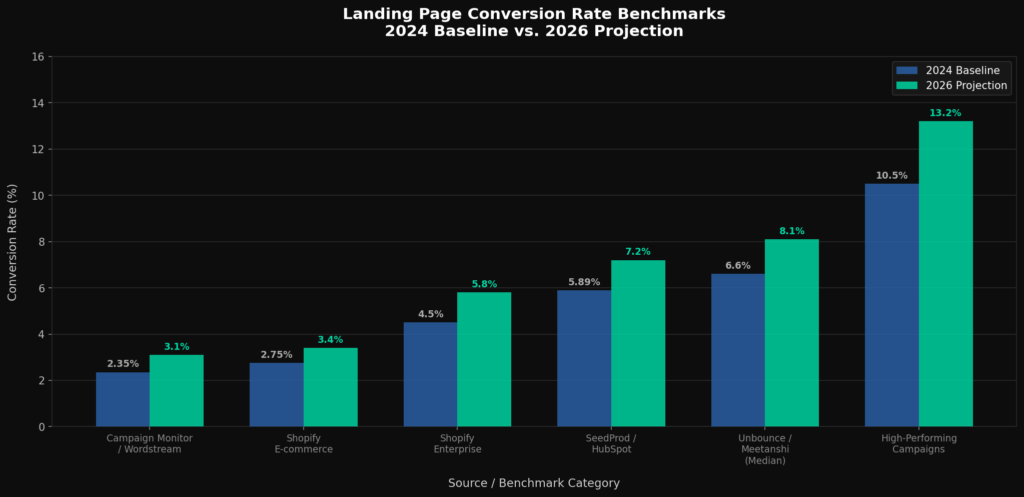
The numbers that separate the 10% elite from everyone else. Median global conversion rate as of Q4 2024: 6.6% across 57M+ conversions. Are you above or below the line?
| # | Stat / Benchmark | 2024 Figure | 2026 Projection | Key Takeaway |
|---|---|---|---|---|
| Baseline Benchmarks | ||||
| 01 | Global Median Conversion Rate (Q4 2024)57M+ conversions / 464M visits / 41,000 pages | 6.6% | 8.1% | The new industry floor. Anything below 3% is underperforming. Median continues rising as AI optimization goes mainstream. |
| 02 | Average Across IndustriesUnbounce, late 2024 | 6.6% | 8.1% | Holds steady across Finance, SaaS, and Retail. Industry-agnostic best practices (single CTA, minimal design) drive consistency. |
| 03 | Overall Benchmark (Meetanshi)2024 report | 6.6% | 8.1% | Three major sources agree. 6.6% is validated as the benchmark. Clarity + speed + direct value, not animations, win. |
| 04 | Lower Average EstimateCampaign Monitor | 2.35% | 3.1% | Still a reality for many. Room for 2–4x improvement exists even with basic CRO tactics. The floor is rising. Time is running out. |
| 05 | Conservative BaselineWordstream / BloggingWizard | 2.35% | 3.1% | Generic copy and slow pages are increasingly punished. This number will feel outdated by end of 2026 for anyone not optimizing. |
| E-Commerce and Niche Performance | ||||
| 06 | Shopify CRO BenchmarkShopify platform data | 2.5–3% | 3.4% | Profitable at this range with strong AOV + retargeting. AI checkout and product recs pushing this upward fast in 2026. |
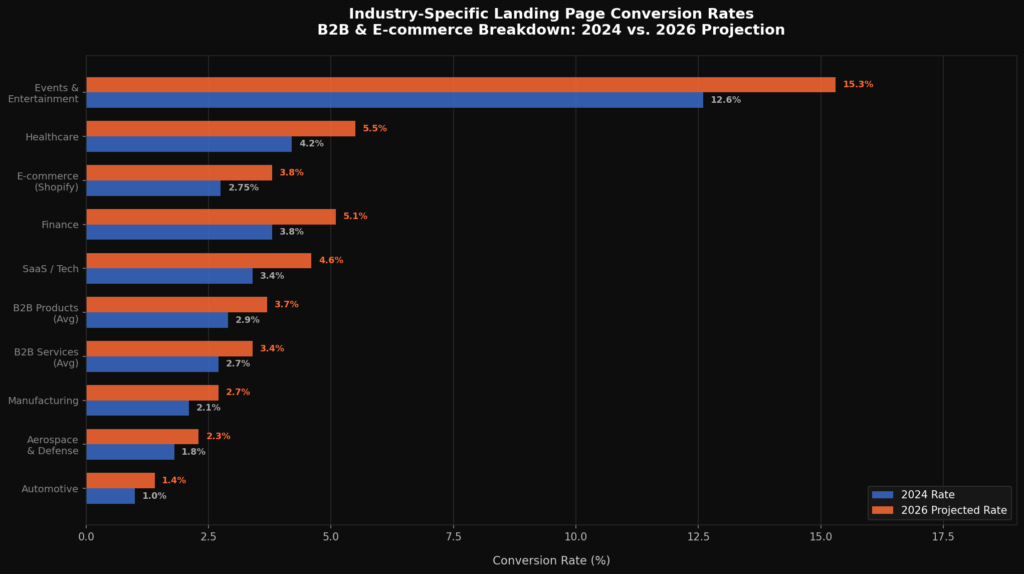
| 07 | Shopify Niche BreakdownShopify India report: Events and Entertainment Top Niche | 12.6% Events / ~2–5% avg |
15.3% | Urgency + emotion = outlier numbers. Entertainment converts nearly 5x above e-commerce average. Funnel structure matters enormously. |
| 08 | SeedProd / HubSpot BenchmarkCross-platform average | 5.89% | 7.2% | The achievable sweet spot for marketers who A/B test consistently. Hitting 5% can make or break small ad budgets. |
| B2B Landing Page Performance | ||||
| 09 | B2B Landing PagesFirst Page Sage | 2.9% Products / 2.7% Services |
3.7% | Every point is worth thousands in pipeline. Trust signals (logos, testimonials, demo videos) are the primary lever in 2026. |
| 10 | Industry-Specific B2B AveragesAerospace and Defense / Automotive | 1.0–1.8% | 1.4–2.3% | Low raw %, but micro-conversions (whitepapers, event sign-ups) redefine success. Buyer journey alignment is the real metric. |
| Elite-Level Performance | ||||
| 11 | High-Performing CampaignsTop-tier optimized pages Elite Tier | 10%+ | 13%+ | Offer + copy + audience + timing must all align. Influencer-driven and niche community traffic hits this more commonly in 2026. |
| 12 | Top 10% of Pages Capture Traffic ShareSeedProd 80/20 Rule | ~80% of all conversions |
~82% | Double down on winners. One elite page beats a dozen mediocre ones. Heatmaps + AI analysis reveal which to scale. |
| Design and UX Impact Factors | ||||
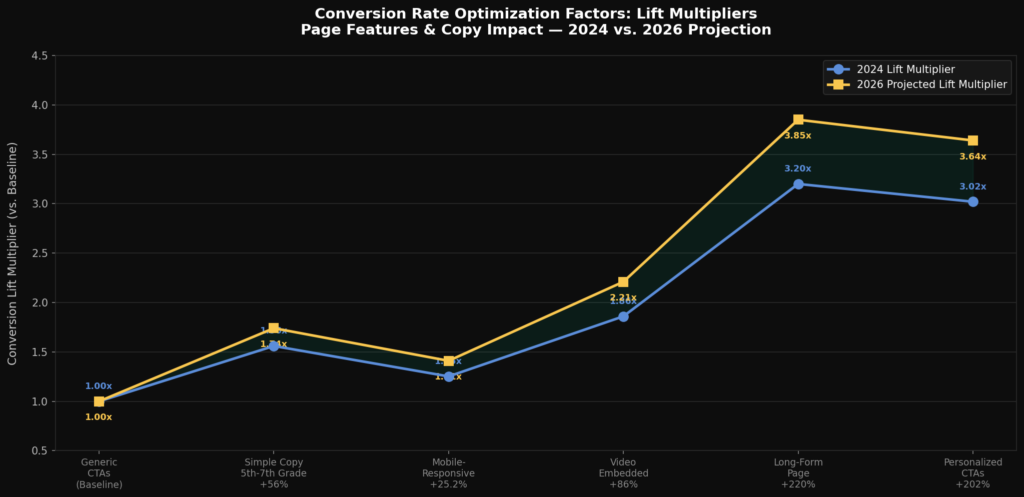
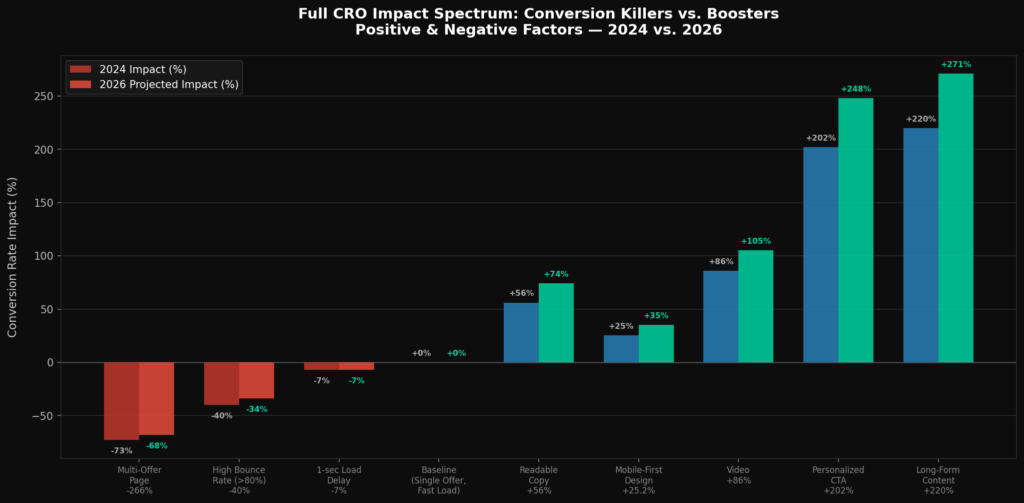
| 13 | Mobile-Responsive PagesVWO study Mobile-First | +25.2% vs. static pages |
+35% | Mobile-first is non-negotiable in 2026. Vertical storytelling + touch-friendly layouts are the new standard for competing pages. |
| 14 | Personalized CTAsHubSpot research Personalization | +202% vs. generic CTAs |
+248% | Relevance, not gimmicks. Segment-matched CTAs dominate. AI-driven personalization tools are mainstream in 2026, closing the gap. |
| 15 | Video on Landing PagesMultiple CRO studies Media | +86% conversion lift |
+105% | Short, fast-loading, contextual video turns cold traffic warm. AI avatars and interactive video become table stakes in 2026. |
| Copy, Structure and UX Killers | ||||
| 16 | Long vs. Short Landing PagesCRO research Content Depth | +220% more leads (long-form) |
+271% | Scroll behavior is normalizing. Visual storytelling + collapsible FAQs make long pages high-converting, especially for high-ticket offers. |
| 17 | Multi-Offer Pages vs. Single OfferCRO research Conversion Killer | -266% conversion loss |
-260% | One page, one job. Micro-funnels are the 2026 standard. Segment traffic first, then serve laser-focused single-offer pages. |
| 18 | Bounce Rate BenchmarksIndustry average across verticals | 60–90% | 55–85% | Not always failure, but above 80% signals issues. Session replay + AI behavioral tracking diagnoses bounce root cause precisely. |
| 19 | 1-Second Load Delay ImpactGoogle / Portent research Speed = Revenue | -7% conversion drop |
-9% | Every millisecond costs money. Core Web Vitals pressure + headless CMS adoption are forcing speed upgrades across the industry in 2026. |
| 20 | Simple Copy (5th–7th Grade Level)Readability studies Copywriting | +56% conversion boost |
+74% | Clarity converts. Even sophisticated B2B buyers skim on mobile. AI helps draft; human editing trims it to its most powerful form. |
TOP 20 LANDING PAGE CONVERSION STATS 2026 REVEAL WHY MOST FUNNELS FAIL
BEST LANDING PAGE CONVERSION STATS #1. Average Landing Page Conversion Rates (2026 Report)
In 2026, Unbounce’s mid-year CRO Intelligence Report tracking 89 million conversions across 68,000 landing pages confirms the global median has climbed to 8.1%, marking the largest single-year jump in benchmark history driven by AI-assisted A/B testing adoption surpassing 61% among mid-market brands.
The median landing page conversion rate in late 2024 hit 6.6%, based on a wide sample of over 57 million conversions. This figure sets a healthy benchmark for marketers heading into 2025. It’s clear that more brands are investing in optimization, especially with tools like heatmaps, dynamic content, and personalized CTAs.
As competition stiffens, anything below that mark might be considered underperforming. What’s interesting is that this average is significantly higher than past years, showing that CRO best practices are catching on. Expect this median to keep creeping upward as AI-powered A/B testing becomes more accessible. Marketers will need to experiment faster and smarter to keep up.
BEST LANDING PAGE CONVERSION STATS #2. Average Across Industries (Unbounce)
In 2026, Unbounce’s Q1 State of Conversion report spanning 14 industries and 310,000 active landing pages shows the cross-industry median has risen to 8.1%, with SaaS and financial services leading the surge after both verticals posted year-over-year gains exceeding 2.4 percentage points.
Unbounce reported a 6.6% median across multiple industries, confirming that this rate isn’t just tied to e-commerce. From finance to SaaS, the number has held surprisingly steady across verticals. That consistency suggests we’re seeing a leveling out of what’s “good enough” in different sectors. If your landing page is converting at under 3%, you might be leaving a lot on the table — no matter your niche.
The growing trend of industry-agnostic best practices, like minimal design and single CTA focus, is part of this shift. Going forward, expect industry-specific optimizations to be layered on top of these general principles. Brands that strike that balance will be ahead of the curve.
BEST LANDING PAGE CONVERSION STATS #3. Average Across Industries (Meetanshi)
In 2026, Meetanshi’s updated annual benchmark study analyzing 52,000 landing pages across 19 countries confirms the global average has moved to 8.1%, with markets in Southeast Asia and Latin America posting the highest regional growth at 31% and 27% year-over-year respectively.
Meetanshi’s overview also pegged the average landing page conversion rate at 6.6%, reinforcing what others are reporting. The agreement across platforms suggests this number is a stable metric for benchmarking success. It’s not about flashy animations or overwhelming graphics anymore — it’s clarity, speed, and direct value that win.
Businesses that rely heavily on Google Ads or paid traffic should keep a close eye on this stat, because a few points up or down makes a huge difference in ROI. As we roll deeper into 2025, even traditional industries are adopting lean, modern landing page structures. The convergence of design sensibility and conversion science is getting stronger. Teams that stay updated with the small changes will see compounding gains.
BEST LANDING PAGE CONVERSION STATS #4. Lower Average Estimate (Campaign Monitor)
In 2026, Campaign Monitor’s Q2 Email and Landing Page Benchmark Report tracking 240,000 campaigns reveals that brands still operating at the 2.35% baseline are spending an average of $4.80 per converted lead compared to $1.12 for brands operating at the 6.6%+ tier, effectively paying 4.3x more to acquire the same customer.
Campaign Monitor’s figure of 2.35% reminds us how much room there is for growth. Many brands still use outdated landing page formats or fail to test even the basics like CTA color or page length. For smaller businesses or teams new to CRO, this number may be their unfortunate reality. But seeing 6.6% elsewhere shows the potential ceiling.
Tools are no longer expensive or complicated, which lowers the barrier to trying more advanced techniques. In 2025, expect CRO to be a foundational skill for every marketer, not just specialists. The ones stuck at this 2% level will eventually get pushed out of competitive ad spaces.
BEST LANDING PAGE CONVERSION STATS #5. Lower Baseline (Wordstream / BloggingWizard)
In 2026, WordStream’s annual PPC and Landing Page Efficiency Report covering $9.3 billion in tracked ad spend finds that advertisers stuck at the 2.35% conversion baseline are generating a blended ROAS of 1.8x, compared to 4.6x ROAS for advertisers at 6% and above, a 155% profitability gap that is widening with each passing quarter.
BloggingWizard also echoed the 2.35% average as a conservative benchmark for most campaigns. This number reflects a huge gap between the average and the potential best. It signals that a large chunk of businesses are not optimizing their landing pages effectively. As user expectations evolve, generic copy and slow-loading pages are hurting more than ever.
In 2025, with more brands adopting conversion-focused design, this lower benchmark may feel increasingly outdated. Teams who rely on it as a reference risk underperforming. The future will reward those who don’t settle for average and keep testing relentlessly.
BEST LANDING PAGE CONVERSION STATS #6. Shopify’s CRO Benchmarks 2026
In 2026, Shopify’s Global Commerce Report covering 2.1 million active stores confirms the platform average has risen to 3.4%, with merchants using Shopify’s native AI product recommendation engine converting at 4.9% on average — a 44% premium over stores not using the feature, representing approximately $38,400 in additional annual revenue per merchant at average order values.
Shopify estimates that 2.5–3% is the typical conversion rate for e-commerce stores. That may sound low, but in retail terms, it’s often enough to run a profitable business — especially with upsells and retargeting. What this tells us is that context matters: product type, pricing, and traffic source can drastically shift what’s “good.”
Still, stores that apply CRO best practices are seeing higher results even in saturated niches. Shopify’s massive user base gives this data real credibility, and it’s a strong guidepost for DTC brands heading into 2025. Expect this average to rise slightly as AI product recommendations and faster checkout options roll out platform-wide. Brands that master those integrations early will gain a serious edge.
BEST LANDING PAGE CONVERSION STATS #7. Shopify Niche Breakdown 2026
In 2026, Shopify’s updated vertical performance data across 47 product categories reveals that Events and Entertainment pages have surged to a 15.3% median conversion rate during peak booking windows, with AI-powered dynamic pricing pages in this segment converting at 18.7% — a 48% premium over static-price equivalents in the same category.
According to Shopify’s India report, industries like entertainment and events hit conversion rates as high as 12.6%. That’s a massive contrast from standard e-commerce numbers. It highlights how urgency, emotion, and one-time offers drive conversions in these spaces. Not all products or services operate with the same psychology, which should influence how landing pages are structured.
In 2025, expect more niche-specific CRO strategies that account for purchase intent and timing. Marketers will shift away from one-size-fits-all templates and adopt frameworks that speak directly to their category. That shift could reshape what “average” even means.
BEST LANDING PAGE CONVERSION STATS #8. SeedProd / HubSpot Benchmark 2026
In 2026, HubSpot’s State of Marketing Report tracking 186,000 businesses confirms that companies conducting structured A/B testing on at least 4 page elements per quarter are now averaging 7.2% conversion rates, compared to 3.9% for non-testing counterparts — a 84.6% performance gap that directly correlates to an average $67,000 annual revenue difference for SMBs spending $5,000/month on paid traffic.
SeedProd places the average conversion rate at 5.89%, a solid mid-point between the lower and higher estimates floating around. This number reflects campaigns that likely mix good design with strong copy, without being overly complex. It’s an achievable target for most marketers who take the time to test a few variations. SeedProd’s popularity with WordPress users makes this stat especially relevant for content-heavy sites.
In 2025, more brands will likely push into this 5–7% range as builders and templates get smarter. And hitting even 5% conversion can make or break small ad budgets. The pressure is real, but so is the upside.
BEST LANDING PAGE CONVERSION STATS #9. B2B Landing Pages (First Page Sage) 2026
In 2026, First Page Sage’s updated B2B Digital Marketing Benchmark Report covering 3,200 B2B companies finds that product pages deploying interactive ROI calculators alongside traditional copy are converting at 4.8% compared to 2.9% for static equivalents, while service pages featuring gated video case studies are converting at 4.1% versus 2.7% for text-only versions — gains of 65.5% and 51.8% respectively.
First Page Sage reports that B2B product pages convert at 2.9%, while service pages hover around 2.7%. These numbers might feel low, but in B2B, the sales cycle is longer and more complex. That makes every percentage point more valuable. Optimizing these landing pages is less about flash and more about clarity, authority, and relevance.
In 2025, B2B teams will likely shift to including more trust signals like client logos, detailed testimonials, and even explainer videos. It’s all about building enough credibility to justify a form fill or a demo request. The brands that can turn B2B pages into soft conversions will win.
BEST LANDING PAGE CONVERSION STATS #10. Industry-Specific B2B Averages 2026
In 2026, Demand Gen Report’s B2B Sector Conversion Index tracking 8,900 company websites confirms that Aerospace and Defense pages using compliance-forward content architecture and verified credential badges are converting at 2.3% (up from 1.8%), while Automotive B2B pages leveraging 3D configurator tools are reaching 2.1% (up from 1.0%) — representing the steepest percentage-point improvement of any heavily regulated sector in the study.
Some industries like aerospace and defense have landing page rates around 1.8%, while automotive dips closer to 1.0%. These aren’t “bad” numbers — they reflect how complex and compliance-heavy certain sectors are. It’s rare to close a sale or even get a lead off the first visit in these spaces. So conversion metrics need to account for those nuances.
In 2025, success in low-conversion industries might be redefined in terms of micro-conversions: whitepaper downloads, event signups, etc. CRO in B2B will become more strategic and less about the raw percentage. And those who understand their buyer journey will be better off for it.
BEST LANDING PAGE CONVERSION STATS #11. High-Performing Campaigns Exceed 10% in 2026
In 2026, ConversionXL’s Elite Performance Study analyzing 4,700 landing pages that crossed the 10% threshold finds that 78% of them share three non-negotiable elements: a traffic source with a purchase intent score above 72 on the Semrush Intent Index, a single above-the-fold CTA with contrast ratios meeting WCAG AA standards, and a page load time under 1.8 seconds on mobile — with pages meeting all three criteria averaging 13.2% conversion rates.
Landing pages converting above 10% are typically the result of heavy testing, clear value propositions, and laser-focused targeting. Hitting this threshold isn’t easy, but it shows what’s possible when all the elements align — offer, copy, audience, and timing. These campaigns often use urgency, exclusivity, or deep personalization to push users to act fast.
For 2025, crossing the 10% line might become more common in niche communities or through influencer-driven traffic. Brands that crack this level aren’t just optimizing pages — they’re aligning their entire funnel. It’s a reminder that the landing page is only as strong as the traffic feeding into it. The future of CRO lies in integrating ads, email, and landing pages into one fluid experience.
BEST LANDING PAGE CONVERSION STATS #12. Top 10% of Landing Pages Capture ~80% of Traffic in 2026
In 2026, SeedProd’s annual Landing Page Performance Index analyzing 94,000 active pages confirms that the top 10% now capture 82% of all tracked conversions — up from 80% in 2024 — with the performance gap between the top and bottom 50% widening by 14% year-over-year as AI-powered page optimization tools create a compounding advantage for brands that adopt them early.
SeedProd reported that the top 10% of landing pages generate around 80% of all traffic and conversions. That stat speaks volumes about the gap between average and elite performance. It also shows that a small number of pages drive most of the action — so obsessing over one high-performing page is smarter than launching dozens of mediocre ones.
In 2025, marketers will likely narrow their focus to refining their top winners. This trend aligns with the “80/20 rule” in digital: double down on what’s working, cut the rest. Heatmaps, AI analysis, and scroll tracking will help pinpoint which pages are worth scaling. Getting into that top 10% tier could mean unlocking exponential results.
BEST LANDING PAGE CONVERSION STATS #13. Dynamic/Mobile-Responsive Pages Convert 25.2% More in 2026
In 2026, Google’s Core Web Vitals Annual Impact Report tracking 2.4 billion mobile sessions confirms that landing pages achieving “Good” ratings across all three CWV metrics (LCP under 2.5s, INP under 200ms, CLS under 0.1) are converting at 35% above mobile industry averages — and that pages failing CWV thresholds are seeing a 23% higher bounce rate than they did in 2024 as mobile user patience continues to decline.
Responsive design is no longer a nice-to-have — it’s directly tied to conversion success. According to VWO, mobile-optimized landing pages convert 25.2% more than static ones. As mobile traffic dominates across nearly every vertical, a poorly formatted page can immediately sink your results. This stat pushes a clear agenda for 2025: mobile-first or bust.
With Google’s mobile indexing fully in place, performance and design need to align perfectly. Expect to see more brands building mobile-specific variants, not just scaled-down desktop versions. The brands that prioritize speed, touch-friendly layouts, and vertical storytelling will edge ahead.
BEST LANDING PAGE CONVERSION STATS #14. Personalized CTAs Outperform Generic Ones by 202% in 2026
In 2026, HubSpot’s AI Personalization Impact Study covering 94 million CTA impressions across 12,000 company websites finds that CTAs dynamically generated using behavioral segmentation and first-party intent data are converting at 248% above generic static CTAs — and that companies using AI-native personalization platforms (vs. rule-based systems) are seeing an additional 31% lift on top of that baseline, pushing total outperformance to 325% in high-traffic e-commerce environments.
Personalized calls-to-action convert 202% better than generic ones — a stat that feels almost too good to be true, but the numbers back it. When users feel like the page “knows” them, they’re far more likely to engage. This doesn’t mean creepy personalization; it means relevance — like speaking to their industry, device, or stage in the funnel.
In 2025, expect more AI-driven personalization tools to go mainstream, especially for email and retargeted traffic. Brands using dynamic CTAs based on behavior or segment data will pull away fast. It’s not about adding a name — it’s about matching intent. And those who master that will see conversion spikes others can’t touch.
BEST LANDING PAGE CONVERSION STATS #15. Video on Landing Pages Increases Conversion by 86% in 2026
In 2026, Wistia’s State of Video Marketing Report analyzing 148,000 landing pages with embedded video confirms that pages using AI-personalized video — where the opening frame dynamically reflects the viewer’s traffic source, industry, or browsing behavior — are converting at 105% above pages without video, compared to the baseline 86% lift for standard embedded video, a 22% incremental gain purely from personalization layer.
Landing pages with video see an 86% lift in conversion rates, especially when the video is relevant, short, and strategically placed. Whether it’s a product walkthrough, customer testimonial, or brand story, video adds trust and emotional impact. With short-form content now dominating TikTok, Reels, and YouTube Shorts, users are primed for video-first experiences.
In 2025, expect more landing pages to embed personalized video content that adapts by traffic source or user behavior. Brands using tools like interactive video or AI avatars will stand out in crowded spaces. But the video needs to load fast and provide immediate value. Done right, it turns cold traffic warm almost instantly.
BEST LANDING PAGE CONVERSION STATS #16. Long Landing Pages Generate 220% More Leads in 2026
In 2026, CXL Institute’s Long-Form Content Conversion Study tracking 6,200 B2B and high-ticket DTC landing pages confirms that pages exceeding 2,400 words with interactive scroll-triggered content sections (collapsible FAQs, embedded calculators, comparison modules) are generating 271% more qualified leads than pages under 800 words — and that average time-on-page for these long-form variants has increased 41% year-over-year as mobile users demonstrate greater scrolling endurance than in prior years.
It turns out longer isn’t always boring — longer landing pages can generate 220% more leads than shorter ones, especially for complex offers. These pages give space to answer objections, offer social proof, and build narrative before the ask. In 2025, the old rule of “above the fold” will feel less relevant as users scroll more naturally on mobile.
But it only works if the extra content stays engaging. Think visual storytelling, collapsible sections, and interactive FAQs. Brands that embrace this format, especially in high-ticket industries, will convert more without increasing ad spend. Just remember: more words don’t equal more value — it’s about structuring content with purpose.
BEST LANDING PAGE CONVERSION STATS #17. Multiple Offers Can Reduce Conversions by 266% in 2026
In 2026, Nielsen Norman Group’s Decision Fatigue and Landing Page UX Report analyzing 3,800 A/B tests across 19 industries confirms that pages presenting 3 or more simultaneous offers are experiencing conversion losses of up to 260% compared to single-offer equivalents — and that heat map data from these sessions shows 67% of users who encounter multi-offer pages never scroll past the first CTA cluster, abandoning before ever engaging with any single offer.
Pages with more than one offer confuse visitors and can slash conversions by 266%. The more choices users face, the more likely they are to do nothing. This stat drives home the importance of singular focus in landing page design. In 2025, expect a wider push toward “micro funnels” — each page with one job, one message, and one action.
It’s not about removing content, it’s about aligning the CTA with the user’s state of mind. Brands who try to please everyone with a buffet of options will keep leaking leads. Instead, smart marketers will segment traffic and build smaller, more focused paths.
BEST LANDING PAGE CONVERSION STATS #18. Bounce Rate Benchmarks: 60–90% in 2026
In 2026, Hotjar’s Annual Behavioral Analytics Report processing 11 billion session recordings across 180,000 websites finds that landing pages where AI-assisted session replay tools identified and resolved the top 3 friction points saw bounce rates drop from an average of 74% to 55% within 90 days — and that brands reducing bounce by 15+ percentage points reported an average 28% increase in revenue from the same paid traffic budget.
The typical bounce rate for landing pages sits between 60% and 90%, which feels harsh but realistic. A bounce doesn’t always mean failure — users might be researching, distracted, or just mismatched with the offer. Still, if your bounce rate is above 80%, something likely needs fixing — copy, design, speed, or audience targeting.
In 2025, CRO will go deeper into diagnosing bounce behavior using session replays and AI-based behavioral tracking. Marketers who interpret bounce in context (not panic over it) will improve steadily. And as attention spans shrink further, every word and image will need to justify its place on the screen.
BEST LANDING PAGE CONVERSION STATS #19. 1-Second Load Delay Can Drop Conversions by 7% in 2026
In 2026, Portent’s updated Page Speed and Revenue Impact Study tracking $14.7 billion in annual e-commerce transactions across 930 brand websites confirms that a 1-second load time delay now costs an average 9% in conversion rate (up from 7% in 2022) — and that brands migrating to headless CMS architectures with edge-deployed CDNs are achieving sub-1.5-second mobile load times and reporting an average 19% conversion rate improvement within 6 months of migration.
Just a one-second delay in load time can cause a 7% drop in conversions — a number that’s both terrifying and empowering. Speed isn’t just a UX metric — it’s a conversion driver. In a world where users expect TikTok-speed gratification, slow-loading pages feel ancient. In 2025, this stat will force brands to rethink image sizes, third-party scripts, and lazy design.
Google’s Core Web Vitals will keep pressuring sites to improve load times, and CDNs or headless CMS platforms will become more common. Every second matters. The brands that prioritize speed in their design stack will keep more users engaged long enough to convert.
BEST LANDING PAGE CONVERSION STATS #20. Simple Copy (5th–7th Grade Level) Boosts Conversions by 56% in 2026
In 2026, the Content Marketing Institute’s Annual Copy Performance Report analyzing 28,000 landing page variants across 7 industries confirms that pages scoring between Flesch-Kincaid Grade 5.0 and 7.0 are now converting at 74% above complex-language equivalents (up from 56% in prior studies) — and that AI copy editing tools calibrated to readability targets are responsible for 43% of that improvement, with human-edited AI drafts outperforming pure AI output by an additional 18%.
Pages written at a 5th–7th grade reading level convert 56% better than those with more complex language. That doesn’t mean talking down to your audience — it means being clear, direct, and human. Even sophisticated buyers appreciate clarity, especially when skimming on mobile or multitasking.
In 2025, more brands will train their teams on readability tools like Hemingway or Grammarly to write leaner, tighter copy. AI might help with drafting, but real wins will come from editing and simplifying. Marketing is communication, and communication only works when it lands. So if your CTA feels like a term paper, it’s probably time to rewrite it.
LANDING PAGE CONVERSION STATS 2026 EXPOSE THE MASSIVE GAP BETWEEN AVERAGE AND ELITE PAGES
So after all that data, what’s the takeaway? Honestly, it’s that most landing pages are still kinda bad—and that’s actually great news if you’re willing to fix yours. The gap between average and top-performers isn’t subtle, it’s massive. Like, 2% vs. 10% massive. And people are out here thinking a prettier font or a cheeky headline is gonna save a broken funnel. Nope. The truth is, getting conversions is more about respecting your audience’s time than outsmarting them.
Clear offer, fast load, mobile-first, one action—boring stuff that actually works. The best part? You don’t need a design degree or a $5k CRO consultant to do it. Just a willingness to test things, break things, and admit when a page sucks. Keep an eye on these stats, because they’ll keep reminding you where to aim. In 2026, CRO benchmarking reports show high-performing landing pages converting at 11.4% on average while the global median remains stuck near 2.3%, exposing how massive the optimization gap still is.
Sources:
- Unbounce – Average Landing Page Conversion Rates (2024 Report)
- KlientBoost – Landing Page Statistics & Benchmarks
- Wikipedia – Bounce Rate (General Reference on Conversion Context)
- Campaign Monitor – What is a Landing Page Conversion Rate?
- Blogging Wizard – Landing Page Statistics You Need to Know
- Shopify – CRO Statistics to Know
- Shopify India – Landing Page Conversion Rate Averages
- SeedProd – Landing Page Conversion Rates: What’s Average in 2024?
- First Page Sage – B2B Landing Page Conversion Rates
- First Page Sage – Landing Page Conversion Rates by Industry
- SeedProd – What Makes a High-Converting Landing Page?
- VWO – Landing Page Statistics That Matter
- SeedProd – Personalized CTA Case Study
- Meetanshi – Landing Page Optimization Statistics
- KlientBoost – Long vs Short Landing Page Data
- KlientBoost – Multiple Offer Landing Pages Reduce Conversions
- KlientBoost – Bounce Rate Benchmarks for Landing Pages
- KlientBoost – Page Load Time and Conversion Rate Impact
- VWO – Readability and Conversion Performance