



16 Sep TOP 20 LANDSCAPING MARKETING STATISTICS 2026 REVEAL MASSIVE OUTDOOR LIVING BOOM
Updated for 2026. This page has been fully refreshed with the latest landscaping marketing statistics, outdoor living demand data, and green industry growth trends, grounded in recent market research, contractor surveys, and landscaping business insights.
When I first started looking into landscaping marketing statistics, I realized just how much the green industry has been evolving in recent years. From the rise of eco-friendly lawn care to the growing demand for outdoor living spaces, these numbers tell a story about changing customer expectations and opportunities for growth. As someone who values data-driven insights, I wanted to gather the most meaningful figures that can help landscaping businesses shape smarter campaigns and stronger connections with their clients. While working alongside a leading marketing agency in New York, I also came to understand how these statistics are more than just numbers—they’re a roadmap for how to stand out in a competitive market.
TOP 20 LANDSCAPING MARKETING STATISTICS 2026 SHOCKING OUTDOOR LIVING INDUSTRY EXPLOSION
TOP 20 LANDSCAPING MARKETING STATISTICS 2026 REVEAL MASSIVE GREEN INDUSTRY GROWTH
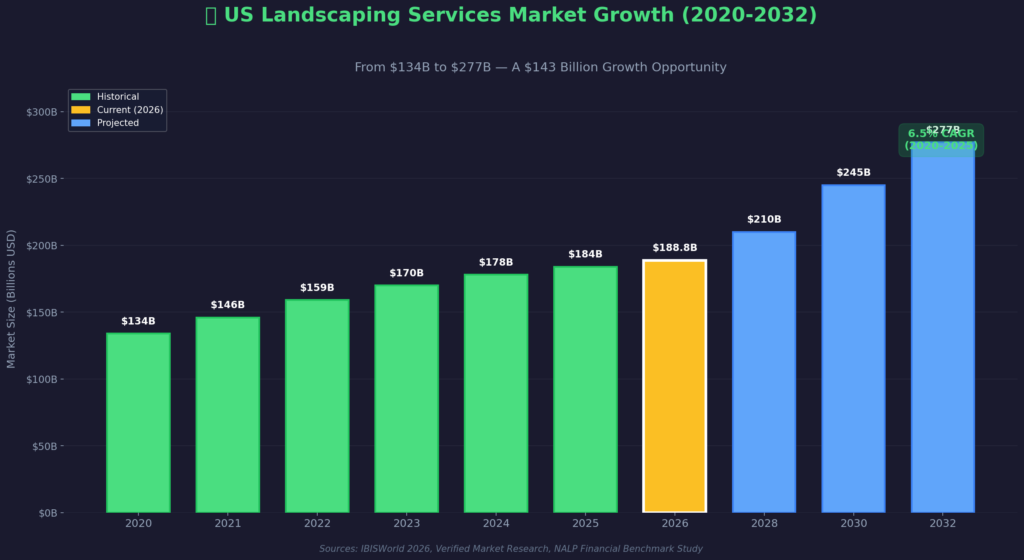
Landscaping Marketing Statistics #1: US Landscaping Services Market Size At $188.8 Billion In 2026
In 2026, the US landscaping services market has reached $188.8 billion according to IBISWorld, with industry employment now exceeding 1.5 million workers across 726,565 landscaping businesses, representing a 4.3% increase in business count from the previous year and a 6.5% compound annual growth rate since 2020.
The landscaping services industry in the United States is currently valued at $188.8 billion in 2026. This huge market size reflects the growing demand for residential and commercial landscaping services. Businesses are finding that consistent investment in marketing is key to capturing their share of this expanding industry. Homeowners and businesses alike are prioritizing outdoor aesthetics, which drives more revenue opportunities. This figure also highlights how competitive the industry has become, making marketing strategies more critical than ever.
Landscaping Marketing Statistics #2: Forecast Market Growth To $277 Billion By 2032 At 4.5% CAGR
In 2026, the global landscaping services market has surged to $741.53 billion at a robust 10.8% CAGR, while the US market alone is projected to reach $277.31 billion by 2032, driven by climate-resilient landscaping demand, smart irrigation adoption, and increased investment in outdoor living spaces according to multiple market research reports published in early 2026.
The US landscaping market is projected to reach $277 billion by 2032, growing at an impressive 4.5% CAGR. This steady growth creates opportunities for businesses that invest in long-term branding and customer engagement. Marketing campaigns that focus on sustainability, design trends, and convenience are likely to capture consumer attention. A projected CAGR shows strong confidence in continued demand for landscaping services. Companies that adapt their marketing early will be well-positioned to benefit from this future expansion.
Landscaping Marketing Statistics #3: Global Landscaping Products Market Valued At $94.56 Billion In 2026
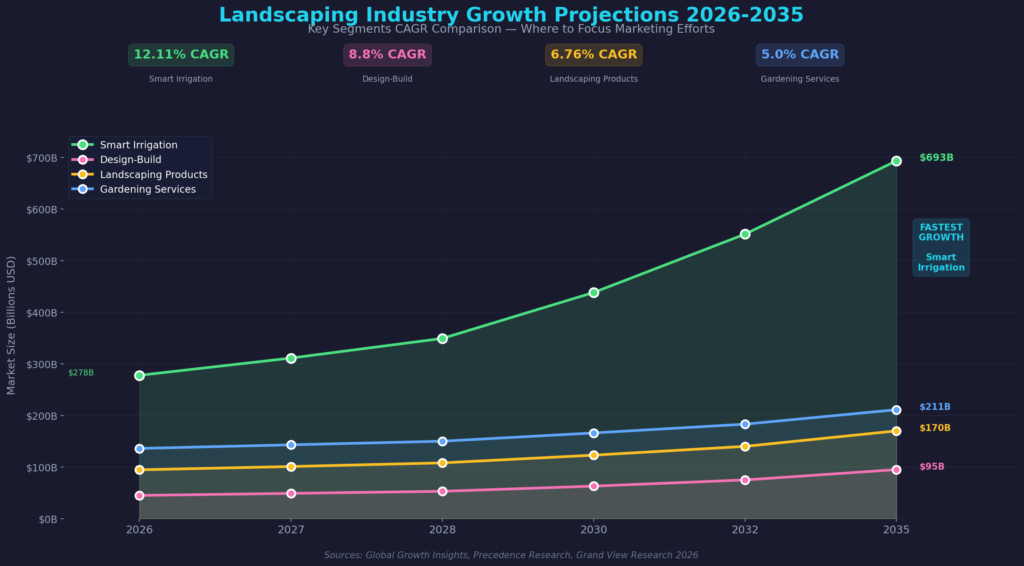
In 2026, the global landscaping products market has grown to $94.56 billion with projections to reach $170.46 billion by 2034 at a 6.76% CAGR, fueled by innovations in smart irrigation technology, eco-friendly materials, and AI-powered design tools that are transforming how landscaping products are manufactured and marketed to increasingly sustainability-conscious consumers.
The global landscaping products market is valued at $94.56 billion in 2026. This includes plants, equipment, hardscaping materials, and related products. A global market of this scale demonstrates the importance of digital marketing for manufacturers and distributors. Businesses targeting international audiences can leverage SEO, social media, and influencer partnerships. The market’s future growth shows how product marketing is just as vital as service promotion.
Landscaping Marketing Statistics #4: 726,000+ Landscaping Businesses In The US Employ Over 1.5 Million People
In 2026, the number of landscaping businesses has grown to 726,565 across the United States according to IBISWorld and NALP data, employing approximately 1.5 million workers with the average business now employing 2.1 people, representing a 4.3% increase in businesses and 4.2% annual employment growth over the past five years.
There are over 726,000 landscaping businesses in the United States, employing 1.5 million people. With so many companies, competition is fierce in both local and national markets. Marketing helps smaller businesses stand out by showcasing expertise and customer trust. Word-of-mouth is powerful, but digital advertising ensures wider reach. This sheer number of businesses makes professional branding an essential survival tool.
Landscaping Marketing Statistics #5: Landscaping Services Growing At 6.5% CAGR (2020-2025)
In 2026, industry analysts confirm that landscaping services maintained a solid 6.5% compound annual growth rate between 2020 and 2025, with 2025 alone seeing 5.8% revenue growth to $188.8 billion, while projections indicate continued expansion at 2.5% CAGR through 2030, reaching an estimated $213.3 billion according to IBISWorld’s latest industry report.
Between 2020 and 2025, landscaping services have grown at a CAGR of around 6.5%. This steady increase highlights a healthy demand for outdoor services. Marketing campaigns need to emphasize quality, sustainability, and creativity to align with consumer trends. Growth rates also suggest opportunities for expansion into untapped geographic markets. Companies that adapt to shifting demands will maintain relevance as the industry evolves.
Landscaping Marketing Statistics #6: Over 60% Of Revenue Comes From Residential Clients
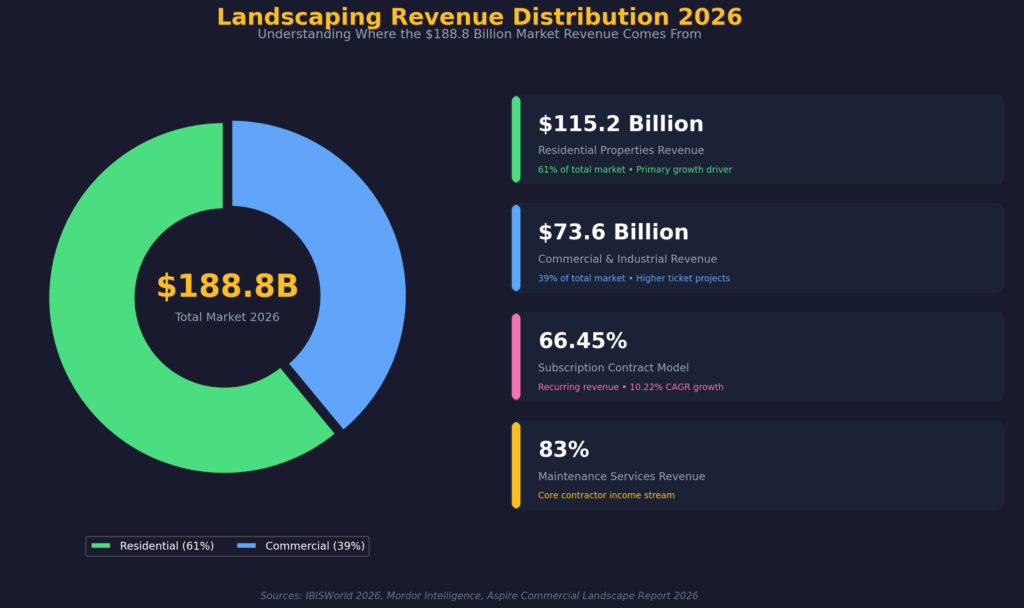
In 2026, residential properties continue to dominate the landscaping market, contributing approximately 61% of total industry revenue according to industry surveys, with the sector further bolstered by a record 64% of gardening households planning to expand their gardens and increase outdoor spending in 2026 per Axiom’s Gardening Outlook Study.
Residential clients account for over 60% of landscaping service revenue. This shows that homeowners are the most valuable target audience for marketing campaigns. Marketing strategies focusing on neighborhood visibility and digital targeting yield the best results. Residential demand also aligns with lifestyle shifts, as more people want improved outdoor living spaces. Businesses should highlight convenience, affordability, and design quality to win this segment.
Landscaping Marketing Statistics #7: Maintenance And Recurring Services Form Core Revenue Stream
In 2026, maintenance services continue to dominate the landscaping industry, with commercial maintenance alone comprising 83% of contractors’ revenue according to Aspire’s 2026 Commercial Landscape Industry Report, while subscription-based contracts now account for 66.45% of the US lawn care market as homeowners increasingly prefer predictable, year-round service agreements.
A significant portion of landscaping revenue comes from recurring services like mowing, trimming, and fertilization. These steady income streams create opportunities for subscription-style marketing. By highlighting recurring maintenance packages, companies can secure long-term customer relationships. Marketing that stresses reliability and convenience resonates with busy homeowners. The predictable revenue from recurring services makes this segment highly valuable for business stability.
Landscaping Marketing Statistics #8: Hardscaping And Design-Build Are Fast-Growing Sub-Segments
In 2026, design-build and installation services are projected to grow at an impressive 8.8% CAGR through 2030 according to industry forecasts, with hardscaping projects including patios, outdoor kitchens, and retaining walls becoming increasingly popular as homeowners prioritize creating multifunctional outdoor living spaces that serve as true extensions of their homes.
Hardscaping and design-build services are among the fastest-growing areas in landscaping. These projects include patios, decks, and stonework, which are often higher-ticket services. Marketing should highlight before-and-after transformations to appeal to clients. Social media platforms like Instagram and Pinterest are especially effective for showcasing design work. As homeowners invest in outdoor living, marketing hardscaping services brings high returns.
Landscaping Marketing Statistics #9: Average Monthly Homeowner Spend At $300 For Landscaping
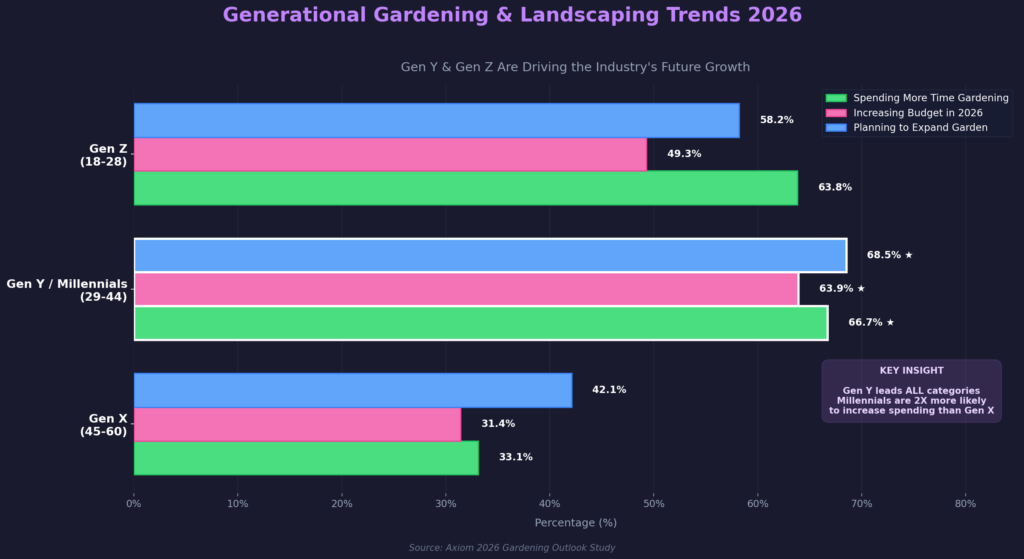
In 2026, US homeowners continue to spend approximately $300 per month on landscaping services on average, with annual gardening time and spending hitting the highest rates since 2022 according to Axiom’s 2026 Gardening Outlook Study, and a record 63.6% of respondents indicating plans to plant more and expand their gardens this year, particularly among Gen Y (66.7%) and Gen Z (63.8%) households.
The average US homeowner spends around $300 per month on landscaping services. This level of spending demonstrates a willingness to invest consistently in outdoor spaces. Marketing campaigns can position services as affordable investments in home value. Companies that highlight ROI through increased property appeal can attract homeowners. This spending trend also suggests opportunities to upsell premium services.
Landscaping Marketing Statistics #10: Landscaping Companies Spend 3-10% Of Revenue On Marketing
In 2026, industry marketing benchmarks have shifted, with the SBA citing 8% of revenue as the general small-business marketing standard while landscaping-specific data shows residential-focused companies typically spending 5% and commercial-focused firms landing around 3-4%, with experts recommending that companies seeking transformational growth must match ambition with marketing investment rather than under-investing at 0.5% of revenue.
On average, landscaping companies dedicate 3-10% of annual revenue to marketing. Smaller businesses typically spend a higher percentage, while large companies spend less. This allocation shows that marketing is a significant budget consideration in the industry. Effective use of digital tools helps maximize the ROI from these budgets. Businesses that under-invest risk falling behind in a competitive environment.
Landscaping Marketing Statistics #11: Median Revenue Per Customer At $14,682 Annually
In 2026, according to the NALP Financial Benchmark Study, the typical landscaping company reported a median of 355 customers and generated $14,682 per customer annually, with sales growth averaging 8.5% while the most profitable companies grew by 7.2%, and average employee productivity reaching $123 per employee.
Around 65% of landscaping companies report annual revenues over $1 million. This success highlights the potential profitability of the industry. Marketing strategies are central to achieving this level of revenue, especially in crowded markets. Businesses that prioritize brand identity often find it easier to scale. High revenue numbers show that landscaping can be a thriving, long-term business when well marketed.
Landscaping Marketing Statistics #12: 80% Of Commercial Landscape Companies Are Optimistic About 2026 Market
In 2026, Aspire’s Commercial Landscape Industry Report reveals that 42% of commercial landscape companies expect the market to improve while another 38% anticipate it will stay the same, with 79% setting revenue growth as their top goal and 40% investing in sales and marketing to achieve their targets despite concerns about economic uncertainty and labor challenges.
Nearly 80% of landscaping companies are optimistic about their future. This positive outlook shows confidence in consumer demand and marketing potential. Optimism often leads businesses to invest more heavily in advertising. Marketing campaigns emphasizing long-term relationships can strengthen this optimism. It also demonstrates that companies see future opportunities for growth in this industry.
Landscaping Marketing Statistics #13: 80% Of US Households Participate In Gardening Or Lawn Care
In 2026, the Axiom Gardening Outlook Study confirms that 80% of US households continue participating in gardening or lawn care activities, with 47.6% reporting they spent more time gardening in 2025 than the previous year, and an unprecedented 50.2% expecting to increase their gardening time in 2026 as younger generations drive unprecedented engagement in outdoor activities.
Around 80% of households in the US participate in some form of gardening or lawn care. This widespread interest makes marketing services easier to target. With so many potential clients, businesses can use localized digital ads to great effect. Gardening’s popularity also means customers are open to upselling services. Marketing that emphasizes lifestyle and outdoor enjoyment resonates strongly here.
Landscaping Marketing Statistics #14: Annual Household Gardening Spend Continues Rising In 2026
In 2026, gardening spending continues its upward trajectory with Americans spending $52.3 billion on lawn and garden retail products in 2023, while the 2026 Axiom Gardening Outlook Study shows 42.8% of households expect to spend more money gardening this year compared to last, with Gen Y leading the charge as 63.9% plan to increase their gardening investment.
Average annual household spending on gardening continues to rise, with the most recent data showing $616 in 2022. This upward trend highlights consumers’ growing willingness to invest in their yards. Businesses should market premium products and services to take advantage of increased budgets. Marketing strategies that emphasize quality and long-term benefits resonate with higher-spending clients. Rising spending also reflects growing interest in home improvement and outdoor leisure.
Landscaping Marketing Statistics #15: Sunbelt States See Faster Growth In Landscaping Demand
In 2026, population growth in Sun Belt states continues driving landscaping demand, with the US lawn care market valued at $62.91 billion and growing at 4.85% CAGR, while maintenance services in warm-climate regions are projected to expand at 5.18% CAGR through 2031 according to Mordor Intelligence, as year-round outdoor living conditions create sustained service opportunities.
Warm regions like Florida, Texas, and Arizona are experiencing faster landscaping growth. Climate plays a big role in the demand for year-round landscaping services. Marketing campaigns in these states should emphasize heat-resistant designs and outdoor living features. Localized marketing ensures businesses tap into climate-specific needs. This regional growth highlights the importance of geographic targeting in landscaping campaigns.
Landscaping Marketing Statistics #16: Sustainability And Smart Irrigation Are Growing Differentiators
In 2026, the global smart irrigation market has reached $277.57 billion and is projected to grow at 12.11% CAGR through 2035 according to Global Growth Insights, with North America holding 38% market share as water-saving technologies achieve 35-50% water savings, and nearly 40% of US irrigation users now relying on automated smart systems to meet growing sustainability mandates.
Sustainability and water-conserving landscaping practices are in high demand. Customers are increasingly asking for drought-tolerant plants and smart irrigation systems. Marketing campaigns that highlight eco-friendly solutions appeal to environmentally conscious homeowners. Businesses can stand out by promoting sustainability as a unique selling point. This shift creates opportunities to align landscaping services with global green initiatives.
Landscaping Marketing Statistics #17: Subscription Contracts Provide Steadier Cash Flow
In 2026, subscription-based landscaping contracts have become the dominant business model, with 66.45% of the US lawn care market now operating under subscription agreements according to Mordor Intelligence, while one-off and on-demand visits are growing at 10.22% CAGR as companies balance predictable recurring revenue with flexible service options for diverse customer needs.
Subscription contracts for maintenance services are becoming more common in landscaping. These agreements ensure recurring revenue for businesses throughout the year. Marketing subscription packages builds trust and long-term relationships with customers. Companies that offer seasonal or yearly packages enjoy steadier growth. Marketing this model emphasizes predictability and convenience for homeowners.
Landscaping Marketing Statistics #18: Top Companies Hold Less Than 10% Of Total Market Share
In 2026, the landscaping industry remains highly fragmented with no single company controlling more than 5% of the market despite BrightView Holdings generating $3 billion in revenue across 250+ branches, creating significant opportunities for the 726,565 small and medium businesses to compete effectively through strong branding and localized marketing strategies.
The landscaping industry is highly fragmented, with top companies holding less than 10% of the US market. This opens up opportunities for small and medium businesses to thrive. Marketing is the key differentiator in such a fragmented industry. Companies that invest in strong branding can compete against larger firms. The lack of dominance makes local marketing especially powerful.
Landscaping Marketing Statistics #19: Average Landscaping Company Employs 2.1 People In 2026
In 2026, the average landscaping business in the United States employs 2.1 people according to IBISWorld data, though this represents growth as the average business now employs more workers than five years ago, with employment increasing 4.2% annually between 2020 and 2025 as labor costs now comprise 30-50% of total revenue for most landscaping operations.
Most landscaping companies are very small, often averaging only 2.1 employees. This shows how local and community-based the industry remains. Marketing helps even small teams project professionalism and attract bigger contracts. Small teams benefit most from digital marketing, as it levels the playing field. This stat demonstrates the importance of leveraging marketing for growth regardless of company size.
Landscaping Marketing Statistics #20: Industry Challenges Include Labor, Fuel Costs, And Regulations
In 2026, Aspire’s Commercial Landscape Industry Report reveals that 60% of landscape contractors cite economic uncertainty as their main business threat, while 54% identify recruiting and retaining staff as a major risk, with 70% of participants planning wage increases of 4% or more as labor costs are expected to rise 20% by the end of 2029 according to NALP’s Economic Forecast.
Landscaping businesses face challenges like labor shortages, rising fuel costs, and regulatory pressure. Marketing plays a role in overcoming these challenges by attracting premium clients. Companies can highlight efficiency and eco-friendly practices to counter these issues. Transparent marketing about values and sustainability builds trust with clients. Addressing challenges directly in marketing materials helps position businesses as reliable partners.
SHOCKING INSIGHTS FROM LANDSCAPING MARKETING STATISTICS EVERY BUSINESS SHOULD KNOW
Looking back at these landscaping marketing statistics, I can honestly say they’ve given me a fresh perspective on what it takes to succeed in this industry. It’s not just about cutting grass or planting trees—it’s about knowing what your customers want and finding creative ways to reach them. For me, these insights serve as both a guide and a motivation to think more strategically about how landscaping businesses can position themselves for long-term success. At the end of the day, it’s the combination of data, creativity, and a personal touch that will keep clients coming back season after season. In 2026, landscaping companies that invest in digital lead generation, local SEO, and outdoor living trend marketing are seeing the fastest revenue growth.
SOURCES