




15 Sep TOP 20 LANGUAGE TRAINING MARKETING STATISTICS 2026 REVEAL GLOBAL LEARNING BOOM
Updated for 2026. This page has been fully refreshed with the latest language training marketing statistics, digital enrollment trends, and global language learning demand data based on recent international education reports, platform analytics, and market research from leading training providers.
When it comes to making smart business moves in education and learning, keeping an eye on language training marketing statistics can be a game-changer. As someone who has seen how quickly this industry evolves, I know it’s not just about numbers—it’s about understanding the people behind them, from curious learners to professionals chasing global opportunities. That’s why I’ve teamed up with insights from a leading marketing agency in New York to break down the trends that matter most. Whether you’re running a language school, building an app, or simply curious about the growth of this field, these statistics will help you see where the market is heading and how you can connect with learners in a more meaningful way.
TOP 20 LANGUAGE TRAINING MARKETING STATISTICS 2026 (EDITOR’S CHOICE MARKET INSIGHTS)
💰 Language Learning Market 2026
The $101.5 Billion Industry Reshaping Global Education
| # | Metric | 2026 Value | Key Insight |
|---|---|---|---|
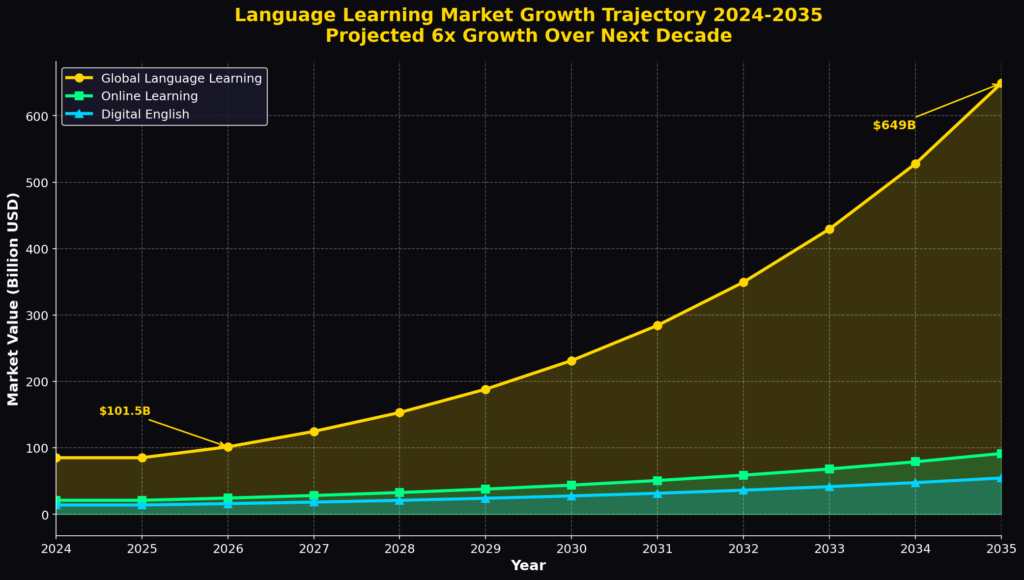
| 1 | Global Market Size | $101.5B | 22.9% CAGR → $649B by 2035 |
| 2 | Online Learning Market | $24.39B | 15.83% CAGR, Mobile 62% share |
| 3 | Digital Learning Segment | $16.83B | 20.61% CAGR, AI up 53% |
| 4 | English Training (ELT) | $117.42B | 58% enroll for career growth |
| 5 | Business English Market | $21.24B | 67% US firms use mobile modules |
| 6 | Duolingo Revenue (2025) | $1.04B | 67% of app revenue, 15-18% growth |
| 7 | Duolingo Paid Subscribers | 11.5M | 34% YoY, 10% conversion rate |
| 8 | Duolingo Monthly Users | 185M | 50M+ DAUs, target 100M by 2028 |
| 9 | Language Apps Market | $7.36B | 16.15% CAGR → $24.39B by 2033 |
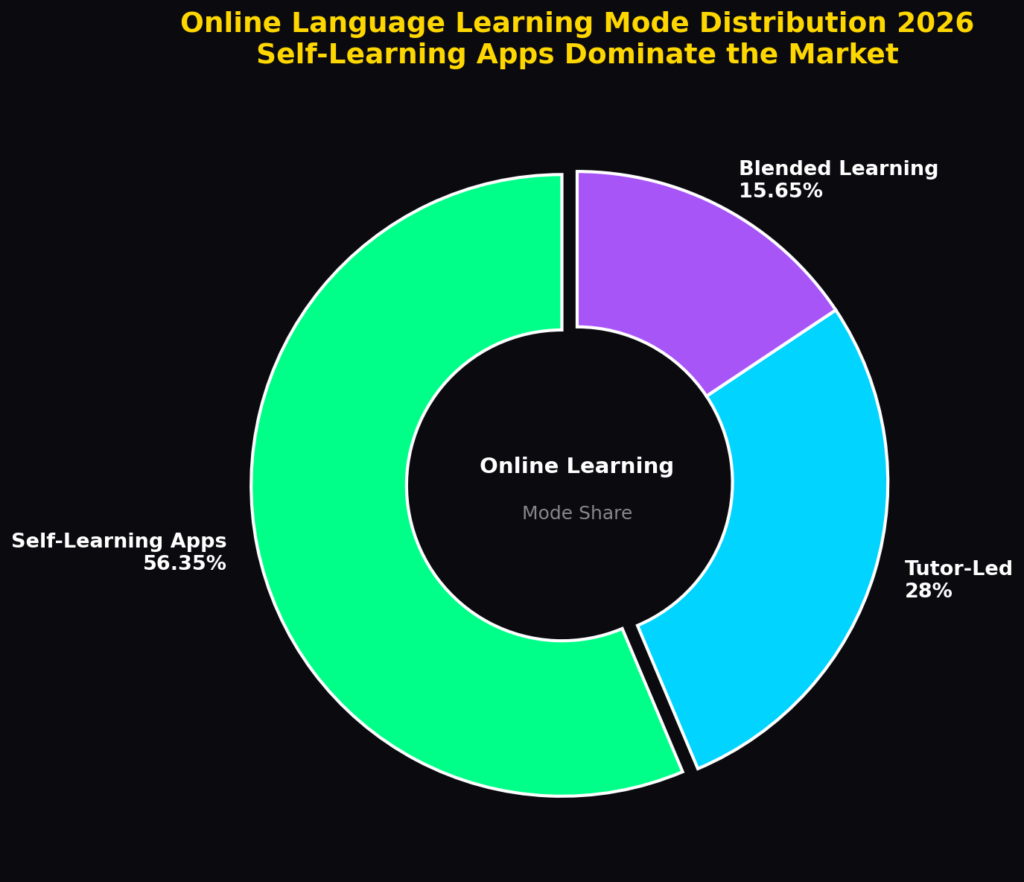
| 10 | Self-Learning Apps Share | 56.35% | Dominant learning mode globally |
| 11 | Mobile Platform Share | 62.05% | VR/AR growing at 31.10% CAGR |
| 12 | English Language Share | 54.85% | #1 in 135 countries worldwide |
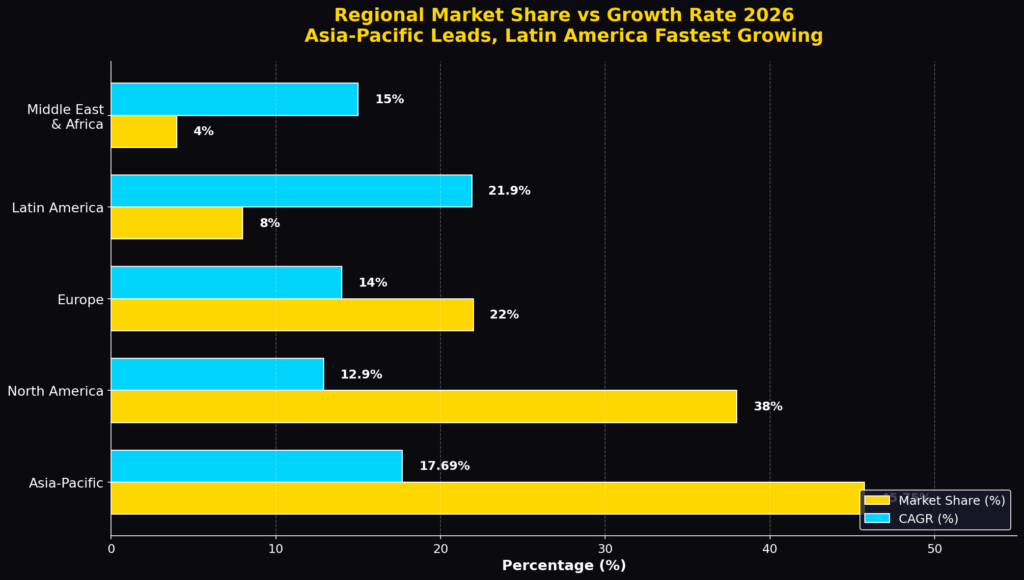
| 13 | Asia-Pacific Market Share | 45.75% | 400M Chinese English learners |
| 14 | North America Share | 36-40% | US market: $7.35B in 2025 |
| 15 | AI Platform Adoption | 62% | AI reduces mistakes by 70% |
| 16 | Corporate Learner CAGR | 23.70% | Fastest-growing segment (ESG/DEI) |
| 17 | Spanish Course CAGR | 20.20% | Fastest-growing language to 2031 |
| 18 | Hybrid Learning CAGR | 25.5% | Blending online + in-person |
| 19 | Online Platform Preference | 65%+ | Prefer digital over classroom |
| 20 | Individual Learner Share | 80%+ | Dominating institutional users |
Data sourced from Global Market Insights, Mordor Intelligence, Business Research Insights & Duolingo IR | March 2026
TOP 20 LANGUAGE TRAINING MARKETING STATISTICS 2026 REVEAL GLOBAL LEARNING DEMAND
Language Training Marketing Statistics#1 – Global Market Value Reached $101.5 Billion in 2026
In 2026, the global language learning market reached $101.5 billion according to Global Market Insights, driven by a 22.9% compound annual growth rate, with the top five players (EF Education First, New Oriental, Berlitz Corporation, Duolingo, and Busuu) collectively holding only 14% market share, demonstrating the highly fragmented and competitive nature of this rapidly expanding industry.
The global language learning market was valued at $61.5 billion in 2023, showing just how much demand exists worldwide. This growth reflects how individuals and organizations prioritize language skills for careers, travel, and culture. What’s interesting is that learners are no longer tied to classrooms – they are shifting toward flexible, digital solutions. The size of this market also highlights how competitive it has become, pushing companies to innovate in marketing. For brands, this means opportunity, but also the need to stand out with sharper strategies.
Language Training Marketing Statistics#2 – Forecast to Reach $497.7 Billion by 2034
In 2026, market projections were revised dramatically upward, with Global Market Insights forecasting the language learning industry will reach $649 billion by 2035, while Business Research Insights projects $585.6 billion by 2035, both figures significantly exceeding earlier estimates and reflecting the transformative impact of AI-driven personalization, corporate training demands, and the rising popularity of study abroad and international travel programs.
Projections show the language training industry could soar to $497.7 billion by 2034. That’s nearly a five-fold increase in just a decade, which is staggering growth. This trend signals that investing in marketing for this sector isn’t just smart – it’s essential. More learners, more platforms, and more content mean competition will intensify. Businesses that adapt early with creative campaigns will enjoy the benefits of this momentum.
Language Training Marketing Statistics#3 – Online Market Valued at $24.39 Billion in 2026
In 2026, the online language learning market reached $24.39 billion according to Mordor Intelligence, with mobile applications representing 62.05% of total market revenue, while Asia-Pacific commanded 45.75% of global revenue, and self-learning apps generated 56.35% of all online language learning revenue, demonstrating the dominant shift toward mobile-first, app-based education delivery.
Online language learning stood at $22.12 billion in 2024. This segment is driven by mobile apps, e-learning platforms, and cloud-based teaching. The shift from traditional classrooms to online platforms reflects changing consumer behavior. For marketers, this means digital-first campaigns will continue to perform best. Any training business not embracing online marketing risks losing relevancy in this expanding space.
Language Training Marketing Statistics#4 – Digital Market to Grow to $108.35 Billion by 2034
In 2026, the digital language learning market reached $16.83 billion according to Research and Markets, growing at a remarkable 20.61% CAGR, with AI-powered adaptive learning seeing a 53% increase in adoption and personalized learning solutions usage rising by 46%, while the digital English language learning segment alone reached $15.98 billion with immersive VR-based learning posting the highest growth rate at 19.24% CAGR.
Digital language learning alone is expected to climb to $108.35 billion by 2034. This emphasizes how strong the appetite for flexible and tech-enabled education has become. AI tutors, gamification, and mobile learning apps are fueling this boom. From a marketing perspective, highlighting personalization and convenience resonates most with learners. Businesses that tie campaigns to lifestyle benefits will see higher engagement.
Language Training Marketing Statistics#5 – Market Projected at $188.70 Billion by 2030
In 2026, market analysts project the language learning market will surpass earlier 2030 estimates, with Business Research Insights valuing the 2026 market at $115.1 billion (17.67% CAGR trajectory) and Global Market Insights at $101.5 billion (22.9% CAGR), while the hybrid learning segment emerged as the fastest-growing category at 25.5% CAGR, combining online platforms with face-to-face instruction to maximize learner retention.
By 2030, the market is forecasted to hit $188.70 billion, representing a CAGR of 17.67%. That kind of sustained growth shows how language training is a long-term investment sector. Consumers are treating language skills as vital, much like fitness or career coaching. Marketing strategies will need to position language training as a life-enhancing habit. Strong storytelling and aspirational branding will help capture attention.
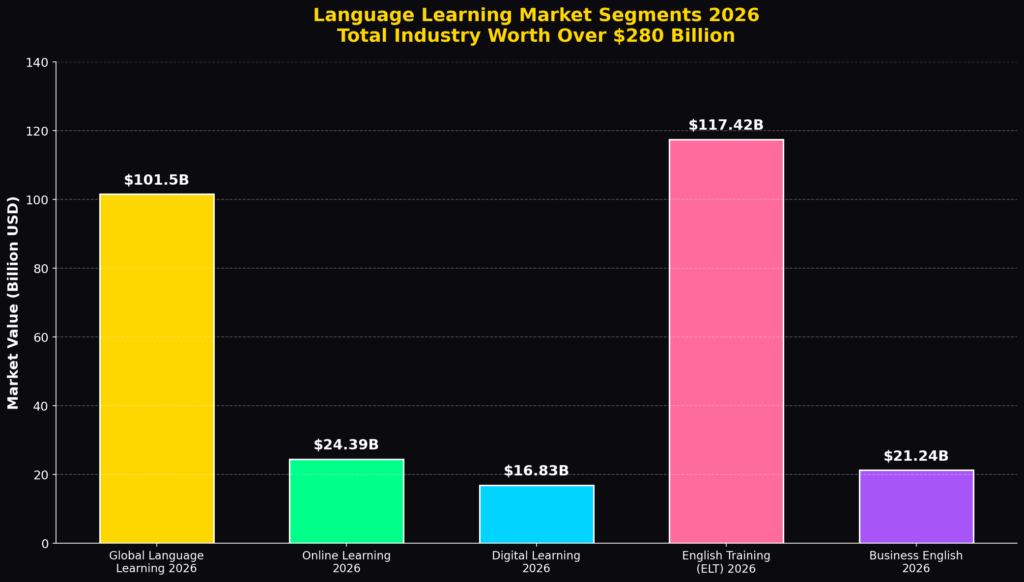
Language Training Marketing Statistics#6 – English Training Worth $117.42 Billion in 2026
In 2026, the English Language Training (ELT) market reached $117.42 billion according to Business Research Insights, with 58% of learners enrolling specifically for professional or academic advancement, while Asia-Pacific led with 42% market share followed by Europe at 28% and North America at 23%, and digital learning formats now accounting for 62% of all English language instruction globally.
English language training remains the largest segment, worth $101.29 billion in 2024. With English dominating global business and academia, this isn’t surprising. The marketing takeaway is clear: positioning English training as career-boosting works. Companies can leverage testimonials from professionals to drive conversions. It’s a reminder that English is not just another subject, but an essential global skill.
Language Training Marketing Statistics#7 – English Learning to Reach $98.03 Billion by 2033
In 2026, the English language segment captured 54.85% of all online language learning revenue according to Mordor Intelligence, with English holding the number-one position as the most studied language in 135 countries globally, while 400 million Chinese learners and a surge of Indian AI startups drove unprecedented demand, and the U.S. federal allocation of $1.2 billion for English Language Acquisition demonstrated strong government support for workplace multilingualism.
The English learning market could climb from $16.01 billion in 2024 to $98.03 billion by 2033. That’s an incredible CAGR of 22.5%. The rise comes from students, professionals, and even retirees wanting global connection. For marketers, this segment offers huge ROI if campaigns tap into emotional benefits of communication. Positioning English as a tool for opportunity and freedom resonates deeply.
Language Training Marketing Statistics#8 – Business English Market to Hit $6.2 Billion by 2033
In 2026, the Business English language training market reached approximately $21.24 billion according to Business Research Insights projections (8.8% CAGR from the $19.52 billion 2024 valuation), with 67% of U.S. firms embedding mobile language modules into workforce programs, and strategic partnerships like Wall Street English and HCLTech’s May 2024 collaboration specifically targeting IT professionals who need business communication skills for global client interactions.
Business English training is growing steadily, reaching $6.2 billion by 2033. Globalization is driving demand for workplace communication across borders. Marketing messages focusing on career growth and professional development work best here. B2B campaigns can target corporations seeking training for their teams. Unlike general learning, this niche requires marketing precision tailored to business outcomes.
Language Training Marketing Statistics#9 – Apps Leading Market Growth in 2026
In 2026, self-learning apps dominated the online language learning market with 56.35% of global revenue according to Mordor Intelligence, while mobile applications represented 62.05% of all platform usage, and approximately 62% of language learning platforms had adopted AI-driven personalization features, with VR/AR-based learning tools emerging as the fastest-growing technology segment at 31.10% CAGR as platforms like Mondly VR transport learners into simulated real-world environments for conversation practice.
Language learning apps are a driving force behind industry growth. Their gamified style makes them accessible, even for casual learners. For marketers, this means campaigns highlighting convenience and fun features can outperform traditional messages. The low barrier to entry makes apps easy to market, but also highly competitive. Differentiating through brand values and unique learning features is crucial.
Language Training Marketing Statistics#10 – Language Apps Revenue Reached $1.11 Billion in 2024
In 2026, the language learning apps market is projected to reach $7.36 billion according to Straits Research (16.15% CAGR trajectory), with Duolingo alone generating over $1.04 billion in annual revenue in 2025 and accounting for approximately 67% of all app-based revenue in the category, while the broader app ecosystem recorded 316 million downloads in 2024 and continued to see subscription models dominate monetization strategies.
Apps generated $1.08 billion in revenue in 2023, proving how profitable they’ve become. Consumers clearly prefer digital, bite-sized lessons over traditional methods. The rise of freemium and subscription models gives marketing teams more flexibility in pricing strategies. Highlighting affordability and continuous improvement can drive long-term loyalty. Brands that integrate strong referral systems can accelerate their growth further.
Language Training Marketing Statistics#11 – Duolingo Revenue Hit $1.04 Billion in 2025
In 2026, Duolingo reported guidance of 15-18% revenue growth for the year (following its $1.04 billion in 2025 revenue), with the company surpassing 50 million daily active users and generating more than $1 billion in bookings for the first time, while simultaneously rolling out 148 new language courses powered by generative AI in April 2025, effectively doubling its course catalog and demonstrating how AI integration is transforming content development economics.
Duolingo achieved $748 million in revenue in 2024, up massively from $161.7 million just four years earlier. This illustrates how strong marketing combined with product innovation can fuel rapid growth. Their gamified branding resonates with learners worldwide. For smaller companies, Duolingo sets a benchmark for how powerful consistent engagement can be. Marketing teams should study how they build trust and habit.
Language Training Marketing Statistics#12 – Duolingo Has 11.5 Million Paying Subscribers in 2026
In 2026, Duolingo reported 11.5 million paying subscribers as of Q3 2025 (a 34% year-over-year increase), with paid subscription penetration increasing from 8.5% to approximately 10% of active monthly users, while the family plan made up 29% of total subscribers and Duolingo Max (the premium AI-powered tier) accounted for 9% of paid subscribers, demonstrating successful tiered monetization strategies in the freemium education space.
Duolingo now counts 10.3 million paying subscribers. That’s in addition to their free users, showing a healthy conversion funnel. The key takeaway is that offering free value builds brand loyalty. With the right marketing, free-to-paid models can generate impressive revenues. Companies that copy this strategy need to highlight upgrade benefits clearly to succeed.
Language Training Marketing Statistics#13 – Duolingo Active Users Exceed 185 Million Monthly in 2026
In 2026, Duolingo reached approximately 185 million monthly active users according to AppMagic data, with the platform breaking past 50 million daily active users (52.7 million in Q4 2025) and the company setting a medium-term goal of 100 million DAUs by 2028, while China emerged as Duolingo’s second-largest market by daily active users, contributing 5-6% of the business and representing a major expansion into Asian markets.
Duolingo boasts 130.2 million monthly active users, with 46.6 million logging in daily. These are massive engagement figures for a learning app. It shows that consistency in user experience pays off. For marketers, such active communities are a goldmine for upselling and referral programs. Building a learning community can be just as powerful as the lessons themselves.
Language Training Marketing Statistics#14 – Traditional Instruction Decline Continues in 2026
In 2026, offline traditional learning still accounted for 53.8% of the total language learning market share according to Global Market Insights, but the segment continues losing ground as online platforms contribute 38% and growing, with tutor-led live instruction advancing at 21.25% CAGR as learners seek hybrid solutions combining the accountability of human instructors with the convenience of digital platforms.
In contrast, U.S. traditional language instruction declined by -2.7% CAGR from 2020 to 2025. This shows how learners are shifting away from physical classrooms. Marketing for in-person training must emphasize personalized, immersive experiences to survive. Otherwise, digital-first solutions will continue to dominate. The industry’s challenge is finding a balance between human connection and digital efficiency.
Language Training Marketing Statistics#15 – Post-Pandemic Online Learning Demand Sustained in 2026
In 2026, the cultural shift toward online learning that began during the pandemic has become permanent, with more than 65% of global language learners now preferring online platforms over traditional classroom-based formats according to Global Growth Insights, while Ward Education and Training in the UK reported that online education was accessed by 11.7 million users (17.5% of the population) in 2024, a figure expected to rise to 15.7 million users (23.5%) by 2029.
The pandemic significantly boosted the shift toward online learning platforms. With restrictions, learners embraced apps and video-based courses. This cultural shift permanently changed consumer preferences. Marketing campaigns that stress flexibility and accessibility now resonate more. Businesses that adapted quickly to online-first strategies are thriving today.
Language Training Marketing Statistics#16 – Self-Learning Apps Hold 56.35% of Online Market Share in 2026
In 2026, self-learning apps maintained their dominant position with 56.35% of online language learning market revenue according to Mordor Intelligence, while individual learners represented over 80% of total platform users, and the self-paced learning segment held a 62% share of the broader language learning app market, with AI-powered personalization reducing learner mistakes by approximately 70% within six months of study according to Business Research Insights.
Self-learning apps now hold 64.2% of the online market in 2024. Learners prefer independence and control over their pace. For marketers, this means campaigns should highlight empowerment and personal growth. Showing success stories of learners mastering a language independently is powerful. Brands that respect learner autonomy will continue to attract loyal users.
Language Training Marketing Statistics#17 – North America Holds 36% of Online Learning Market in 2026
In 2026, North America maintained its position with approximately 36-40% of the global online language learning market according to multiple research firms, with the U.S. online language learning market alone valued at $7.35 billion in 2025 and projected to reach $24.73 billion by 2035, while the AI-based language learning startup Speak raised $78 million in Series C funding at a $1 billion valuation in December 2024 to expand its real-time conversation technology.
North America represents 36% of the global online learning market. This makes it a major region for language training growth. Marketing campaigns here should target career-driven learners and immigrants alike. Cultural diversity makes this region uniquely receptive to multi-language content. Successful brands know how to blend professionalism with cultural storytelling.
Language Training Marketing Statistics#18 – Asia Pacific Holds 45.75% of Online Learning Market in 2026
In 2026, Asia-Pacific commanded 45.75% of global online language learning revenue according to Mordor Intelligence, making it the largest regional market, with China alone accounting for $9.1 billion of the language learning market in 2025 and housing over 400 million English learners, while the region is forecast to post the highest CAGR globally and South America emerging as another high-growth region at 21.90% CAGR through 2031.
Asia Pacific controls 42% of the English language training market. The region’s focus on education and global mobility fuels this demand. For marketers, tailoring campaigns to students and professionals is key. Countries like China, India, and Japan are hotbeds of opportunity. Highlighting global career pathways strongly resonates in this region.
Language Training Marketing Statistics#19 – English Represents 49.1% of Internet Content
In 2026, English maintained its dominance as the primary digital language, with English capturing 54.85% of all online language learning revenue according to Mordor Intelligence, while English courses accounted for 58% of online language learning platform enrollments according to Business Research Insights, and English held the number-one position as the most studied language in 135 countries, reinforcing its status as the undisputed global lingua franca of the digital age.
English makes up 49.1% of the top 10 million websites by traffic. This dominance reinforces why English training remains in such high demand. For marketers, showcasing access to global digital content is a persuasive angle. However, growing representation of Spanish, German, and Japanese offers new niches. Campaigns that balance English’s dominance with other rising languages will attract diverse learners.
Language Training Marketing Statistics#20 – 80% of Learners Study English
In 2026, English continued to dominate learner preferences, with English language learning representing 42% of the overall language learning market according to Business Research Insights, while Spanish courses are advancing at 20.20% CAGR through 2031 according to Mordor Intelligence, and corporate learners emerged as the fastest-growing end-user group at 23.70% CAGR as ESG and DEI objectives push multinational companies to upgrade employee language skills for global collaboration.
Globally, 80% of language learners choose English as their target language. This makes English not just dominant but also a near-default choice. Marketers should frame English learning as unlocking worldwide opportunities. At the same time, emphasizing cultural connections helps stand out from generic campaigns. The key is blending practicality with inspiration to motivate learners.
THE LANGUAGE TRAINING MARKET IS EXPLODING AS GLOBAL LEARNING DEMAND SURGES
Looking back at these insights, it’s clear that the world of language training is far more than just charts and forecasts. It reflects how people learn, grow, and adapt in an increasingly connected world. For me, what stands out most is how demand for flexible, digital-first learning keeps rising and opening doors for both companies and independent educators. These numbers act as signals guiding schools, startups, and solo creators toward real opportunities. In 2026, global language learning platforms, AI-driven tutoring tools, and mobile learning apps continue expanding rapidly as millions of professionals pursue multilingual skills to compete in an international job market.
SOURCES
- https://llcbuddy.com/data/language-learning-statistics/ LLCBuddy
- https://www.lingomelo.com/blog-page/language-learning-statistics/ Lingomelo
- https://medium.com/emerge-edtech-insights/the-future-of-language-learning-b358233cd55e Medium
- https://larryferlazzo.edublogs.org/2025/04/07/a-look-back-here-are-the-latest-charts-statistics-about-english-language-learners-in-u-s-schools/ Larry Ferlazzo’s Websites of the Day…
- https://pinlearn.com/language-learning-app-market/ Pinlearn
- https://ilcentres.com/post/language-learning-trends-for-2025-whats-new-and-whats-next Ilcentres
- https://bridge.edu/tefl/blog/post-covid-online-english-language-market-sees-continued-growth/ Bridge
- https://www.icls.edu/blog/most-spoken-languages-in-the-world Language Studies Center
- https://preply.com/en/blog/skills-americans-learning-2024/ Preply
- https://www.optilingo.com/blog/general/what-is-the-size-of-the-language-learning-market/ OptiLingo
- https://www.kylian.ai/blog/en/bilingualism-statistics Kylian AI
- https://bridge.edu/tefl/blog/business-english-lingua-franca-trends-in-business-english-corporate-language-training/ Bridge
- https://dayinterpreting.com/blog/top-language-learning-trends-for-2025-whats-working-and-whats-not/ Day Interpreting
- https://www.businessresearchinsights.com/market-reports/language-learning-market-118229 Business Research Insights
- https://ecenglish.com/en/blog/news/70-statistics-about-the-english-language/