



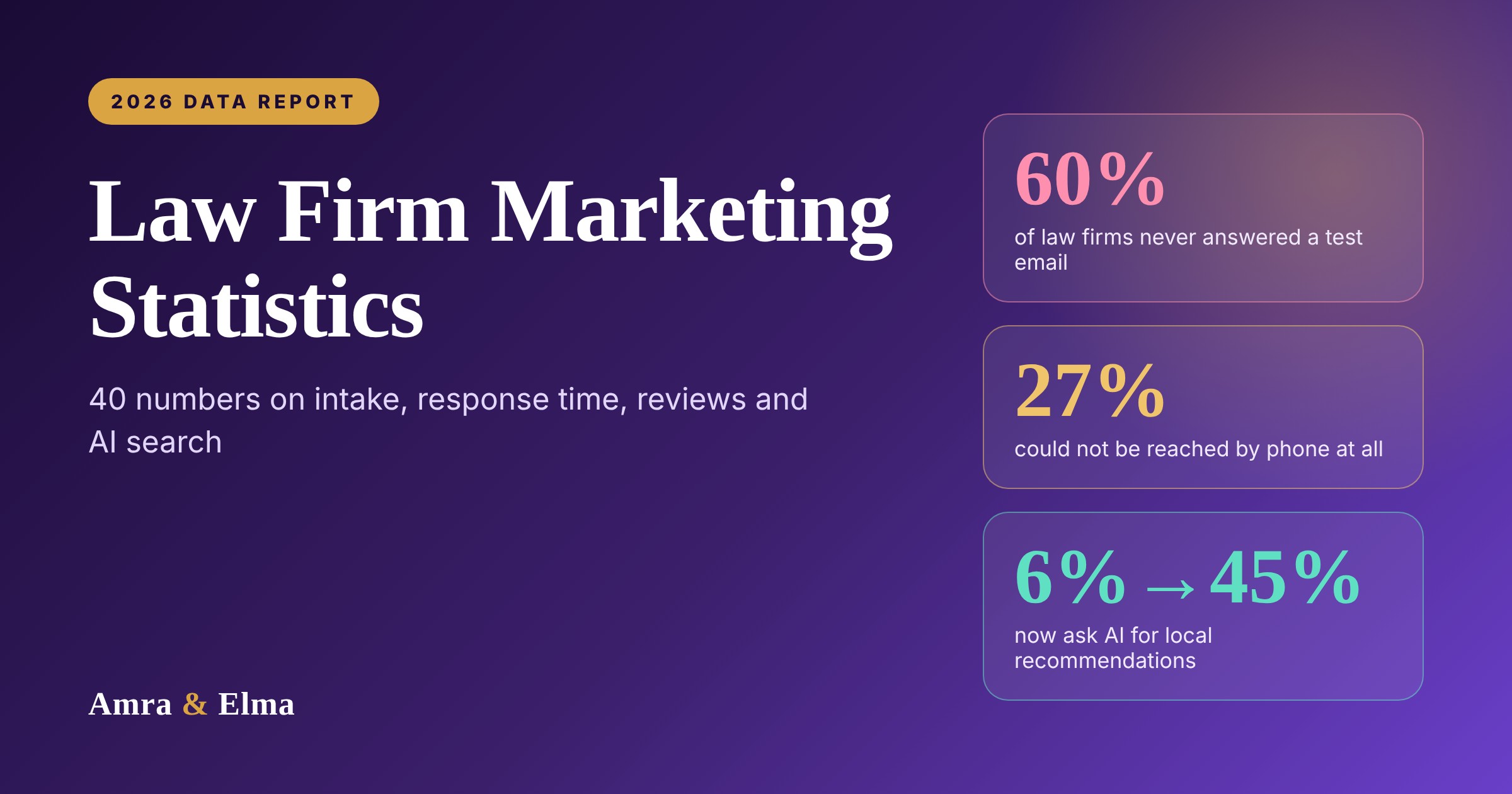
02 Nov Law Firm Marketing Statistics 2026: 40 Numbers That Matter
Law Firm Marketing Statistics 2026: 40 Numbers That Reveal Where Clients Really Come From
Intake, response time, reviews, AI search and the inquiries nobody answers. Every figure is sourced, dated and read through the eyes of an agency that has spent more than a decade turning attention into revenue.
Attention is the most expensive thing a firm buys. Most firms then let it go cold.
We have spent 13 years in marketing, more than 1,000 campaigns and countless boardroom conversations learning one rule that applies to every industry we touch, from luxury fashion houses to Fortune 500 executives to the politicians and authors who come to us to build a name. The rule is simple. The moment someone decides to reach out is the most valuable moment in the entire customer journey, and it is also the most perishable.
Legal services may be the clearest example of that rule we have ever seen. A person with a real legal problem is anxious, motivated and ready to act. They search, read reviews, ask a friend, maybe ask ChatGPT, and then they contact a firm. What happens in the next few hours often decides whether the firm signs a matter or quietly funds a competitor's growth.
Most law firm marketing statistics you will find online measure the top of the funnel: traffic, impressions, rankings, cost per lead. Those numbers are easy to collect and easy to put on a slide. They say very little about whether a person with a real legal problem reached the firm, got a reply and signed. This roundup leans the other way. It builds on research compiled by David Zarkov, founder of law-firm growth company Wolfe Services, and asks three questions that decide whether marketing money turns into matters: where people look for a lawyer, how fast firms answer, and what happens to the inquiries nobody answers.
How we handled the data
- Every number links to the public report it came from and carries that report's own year.
- Some of the most useful data is old. The largest public test of law firm responsiveness, Clio's secret-shopper study, ran in 2019, and no public study of that scale has been published since. We flag the age every time rather than pretend a 2019 figure describes 2026.
- Where a study covers all local businesses or all industries instead of law firms, we say so.
- Full source URLs are listed at the end so you can check every figure yourself.
The Numbers at a Glance
If you only have thirty seconds, these six figures tell the whole story.
The gap between the third and fourth figures is the subject of most of this article. Firms believe they are fast. The evidence says many of them are silent.
Infographic 01
The Confidence Gap
What law firms believe about their speed, next to what a secret shopper actually experienced.
Source: Clio Legal Trends Report 2019, secret-shopper study of 1,000 U.S. law firms. https://www.clio.com/resources/legal-trends/2019-report/read-online/
The Market: How Many Firms Are Competing for the Same Client
Before we talk about speed, it helps to see how crowded the room is. When we build a brand for a client, the first question is never "how do we get noticed?" It is "who else is standing on the same stage?" For lawyers, the stage is getting busier, and the client sees only a handful of options on one screen.
- 1
There were 1,374,720 resident active lawyers in the U.S. in 2025, up from 1,355,963 in 2024. (ABA Profile of the Legal Profession, 2025)
The ABA called it the first significant increase since 2020, so the supply of lawyers chasing the same consumer is growing again.
- 2
The number of resident active lawyers grew by 73,363 over the last 10 years, an increase of 5.6%. (ABA, 2025)
Competition at that pace arrives gradually, which makes it easy to miss until the same budget starts producing fewer calls.
- 3
Private offices of lawyers averaged 189,578 establishments in 2025. (BLS Quarterly Census of Employment and Wages, 2025 annual averages, NAICS 541110)
QCEW counts worksites rather than firms, so this is the number of law office locations nationally. A prospective client sees only a handful of them, usually on one screen.
- 4
Lawyers held about 863,700 jobs in 2025, and 11% of them were self-employed. (BLS Occupational Outlook Handbook, Lawyers, page modified August 27, 2026)
A meaningful share of the market is solo practitioners who are also their own intake department.
- 5
In 2019, 59% of people who had shopped for a lawyer sought a referral, and 57% searched on their own; 16% did both. (Clio Legal Trends Report, 2019)
Referral and search were never either-or. A referral does not stop a prospect from checking the firm online.
- 6
Friends and family were the most common referral source (32%), followed by other lawyers (16%) and non-legal professionals (9%). (Clio, 2019)
Referral marketing is mostly a reputation problem, and a firm can only partly control it.
- 7
Among people who looked on their own, an online search engine and a lawyer's website were the most common methods, at 17% each. (Clio, 2019)
The website was already doing intake work in 2019, whether or not anyone measured it that way.
- 8
Clients were nearly as likely to start looking on their own (39%) as to start with a referral of any type (45%). (Clio, 2019)
For a large share of clients, the first impression of a firm is something they found themselves.
- 9
In 2025, 70% of people who had recently hired a lawyer said they had an easy time finding and hiring one. (Clio Legal Trends Report, 2025)
If finding a lawyer is easy for most people, the contest moves to which firm they choose and how quickly it answers.
- 10
In the same survey, 24% said they would be unlikely to rehire the lawyer they last worked with. (Clio, 2025)
Repeat business cannot be assumed even from satisfied clients. Each new matter is partly a new acquisition.
- 11
In 2024, 90% of lawyers surveyed by the ABA reported having a website, down from 94% in 2022. (ABA 2024 Websites and Marketing TechReport)
Having a website stopped being a differentiator years ago. What the website does with a visitor is the differentiator.
- 12
Solo practitioners reported a website presence of 70% in 2024, up from 61% in 2022. (ABA, 2024)
Roughly three in ten solo respondents did not report a website, which leaves an opening for the solos who have a good one.
- 13
Social media use as a marketing tool fell to 80% in 2024 from 89% in 2022, with LinkedIn the main platform at 76%. (ABA, 2024)
With LinkedIn on top, social works for most firms as a referral and reputation channel more than a consumer acquisition channel.
Here is what stands out to us from the agency side. Lawyers tend to think of referrals and online marketing as two separate budgets. Clients don't experience them that way. Someone hears your name from a friend at dinner, and before they call, they look you up. The referral opens the door; the online impression decides whether they walk through it. In our work building personal brands for executives and founders, we see the same pattern every week: the recommendation is the spark, the search result is the verdict.
Reputation: The Filter Before the First Call
Reviews are where marketing and reputation collapse into one thing. We have watched this shift happen across every category we work in, from hotels and fashion to doctors and financial advisors. Lawyers are not exempt. If anything, a legal decision feels riskier to the client than buying a handbag or booking a hotel, so they read more carefully.
- 14
97% of consumers read reviews for local businesses, and 41% "always" read them, up from 29% the year before. (BrightLocal Local Consumer Review Survey, 2026)
Assume the prospective client has read your reviews before they call.
- 15
47% of consumers won't use a business with fewer than 20 reviews. (BrightLocal, 2026)
Review count works as a filter. A good firm with eight reviews can lose before the first call.
- 16
74% of consumers seek reviews written in the last three months. (BrightLocal, 2026)
A profile full of strong reviews from 2021 looks to a 2026 reader like a firm that stopped getting clients.
- 17
31% of consumers will only use a business with 4.5 stars or more, up from 17% the previous year. (BrightLocal, 2026)
The acceptable rating moved a long way in one year. A 4.3 that was fine in 2025 may not be in 2026.
- 18
89% of consumers expect business owners to respond to reviews. (BrightLocal, 2026)
Lawyers have confidentiality limits on what they can say in a reply, which makes a short, careful response policy worth writing down in advance.
- 19
After reading positive reviews, 54% of consumers visit the business's website, up from 32% when BrightLocal last asked in 2019. (BrightLocal, 2026)
Reviews send people to the website, and the website has to carry them to a call or a form.
- 20
20% of Americans rated lawyers' honesty and ethical standards as high or very high in December 2025; 34% rated them low or very low. (Gallup, Honesty/Ethics in Professions)
Lawyers start from a trust deficit. Specific, verifiable information on a firm's site does more than adjectives to close it.
That last number deserves a pause. Only one in five Americans rates lawyers' ethics highly. That is the starting line for every legal brand in the country. In luxury, we would call this a heritage problem in reverse: instead of inheriting trust, the firm inherits suspicion it did not personally earn.
The fix is the same one we use for any high-trust category. You replace adjectives with evidence. "Aggressive, compassionate, experienced" means nothing to a skeptical reader because every competitor says it. A partner quoted in a respected publication, a clear explanation of fees, recent reviews that describe real outcomes in plain language, a founder who shows up consistently with useful insight: those are things a reader can verify. Verifiable beats impressive every time.
Infographic 02
The Trust Filter: Pass All Six or Lose the Click
Before a prospect ever calls, your reputation gets screened. These are the gates consumers say they use.
Source: BrightLocal Local Consumer Review Survey 2026 (all local businesses, not law firms only). https://www.brightlocal.com/research/local-consumer-review-survey/
AI Is Now Part of the Search
This is the section we would underline twice. In our own business, we have watched AI assistants start recommending agencies, products and experts by name. The brands that show up are the ones with deep, consistent, credible information spread across the web: press coverage, authoritative articles, detailed websites and real reviews. The brands that do not show up are often perfectly good businesses that simply never gave the machines enough to read.
- 21
Use of ChatGPT and other generative AI tools for local business recommendations rose from 6% to 45% in a year. (BrightLocal, 2026)
It was one of the fastest-moving numbers in the survey. Some prospective clients now get a shortlist before they ever see a search results page.
- 22
Google's share as a review source dipped from 83% in 2025 to 71%. (BrightLocal, 2026)
Google is still far ahead, but it is no longer the only place a firm's reputation gets read.
- 23
34% of U.S. adults had used ChatGPT by early 2025, including 58% of adults under 30. (Pew Research Center, 2025)
The habit is concentrated among younger adults. Clio's 2025 report likewise found Millennials and Gen Zers were even more likely to use digital channels to find a lawyer.
- 24
More than half of consumers in Clio's 2025 survey had used, or would consider using, AI to answer their legal questions. (Clio, 2025)
The first conversation about a legal problem may now happen with a chatbot rather than a lawyer.
- 25
Clio reports that 28% of consumers were directed by their AI to contact a lawyer, and in 12% of cases consumers were convinced by an AI that their problem wasn't worth pursuing. (Clio, 2025)
AI works as a referral source in both directions. It sends some people to a lawyer and talks others out of calling one.
In one year. That is how fast consumers moved to asking AI for local business recommendations. Few marketing shifts in our 13 years have moved this quickly. (BrightLocal, 2026)
Here is the practical translation. AI assistants are a new kind of referral partner, and like any referral partner, they recommend who they know and trust. They learn about your firm from what exists about you in public: your website, your profiles, your reviews, articles that mention you, interviews you have given. A firm with thin, generic information gets a thin, generic mention, or none at all. This is one reason we believe digital PR and authoritative content have quietly become intake tools. Being quoted, cited and written about is no longer only about prestige. It is about being part of the answer when someone asks a machine for help.
Response Time: Where the Money Leaks
The intake data below is the oldest in this article, and probably the most important. Clio's 2019 study emailed 1,000 randomly selected U.S. law firms and phoned 500 of them, posing as prospective clients in family, criminal, bankruptcy, employment and business matters. No comparable public study has been published since, so treat these as a 2019 baseline and test your own firm against it.
- 26
60% of law firms didn't respond to the emailed inquiry at all. (Clio, 2019)
In that same survey, a quarter of consumers preferred email or an online form for first contact. Most firms were ignoring that quarter.
- 27
Of the firms that did respond by email, 82% did so within 24 hours. (Clio, 2019)
Clio's reading was that firms answer within a day or, often, not at all. An inquiry still open on day two is probably lost.
- 28
53% of the email replies asked the prospect to phone the office instead. (Clio, 2019)
Answering an email by asking for a phone call puts the work back on the prospect, who may have emailed because calling was inconvenient.
- 29
By phone, 56% of firms answered, 39% of calls went to voicemail, and 57% of those voicemails weren't returned within 72 hours. (Clio, 2019)
Voicemail was where calls went to die. Fewer than half of the firms that got a voicemail called back.
- 30
In total, Clio's shoppers were unable to reach 27% of law firms by phone. (Clio, 2019)
Every firm in the sample had an active web presence. More than a quarter of them still could not be reached by a prospect who called.
- 31
43% of firms wouldn't discuss rates or cost over the phone. (Clio, 2019)
In the same report, 66% of consumers said they wanted an estimate of the total cost of their case. Refusing to discuss cost on the first call has a price of its own.
- 32
79% of consumers expected a reply to a phone message or email within 24 hours; 10% expected one within an hour. (Clio, 2019)
Next-day service misses most people's expectations, even before anyone compares it with a competitor.
- 33
89% of legal professionals said they respond to phone and email inquiries within 24 hours. (Clio, 2019)
Set this next to the 60% email non-response rate above. A firm's belief about its own speed is not a measurement of it.
- 34
64% of consumers who contacted a lawyer they didn't hire said a law firm didn't respond to their phone call or email. (Clio, 2019)
Nearly two in three lost prospects in that group described silence. No campaign recovers a prospect who never got a reply.
- 35
57% of people who had shopped for a lawyer contacted more than one firm, and 42% said that if they liked the first lawyer they spoke with, they wouldn't need to speak with any others. (Clio, 2019)
Many prospects shop around, and the first good conversation often ends the shopping. Being first to reply matters for that reason.
Infographic 03
What Happens When a Prospect Picks Up the Phone
Clio's 2019 secret shoppers called law firms posing as real clients. Here is where those calls landed.
Source: Clio Legal Trends Report 2019 secret-shopper study (500 firms phoned). https://www.clio.com/resources/legal-trends/2019-report/read-online/
We want to be fair to law firms here, because we have seen this pattern everywhere, not only in legal. When we place a client's brand in front of hundreds of thousands of people through PR and influencer campaigns, the first thing we check is what happens when that attention arrives. Is someone watching the inbox? Does the website load on a phone? Does the contact form go to a real person? Again and again, the weak point is not the campaign. It is the handoff from interest to conversation. Firms are not lazy. They are busy, and intake is usually nobody's full-time job.
The legal studies above don't measure what speed is worth. The best-known public estimate comes from outside law, so read it as a cross-industry signal rather than a legal benchmark.
- 36
In an audit of 2,241 U.S. companies, 37% responded to a web lead within an hour, 24% took more than 24 hours, and 23% never responded. The average response time among those that replied within 30 days was 42 hours. (Harvard Business Review, March 2011)
The law-firm pattern Clio found in 2019 looks a lot like what HBR found across industries in 2011: a fast group, a slow group and a large group that never answers.
- 37
Across 1.25 million sales leads, firms that tried to contact a prospect within an hour were nearly seven times as likely to qualify the lead as those that waited even an hour longer, and more than 60 times as likely as those that waited 24 hours or more. (Harvard Business Review, 2011)
These were B2C and B2B sales leads, not legal inquiries, and the study is fifteen years old. The direction is still hard to argue with: interest decays by the hour.
Infographic 04
The Half-Life of a Lead
Relative odds of qualifying a lead, by how fast the business tried to make contact (cross-industry, not legal-specific).
Source: Harvard Business Review, "The Short Life of Online Sales Leads," March 2011, analysis of 1.25 million B2C and B2B leads. https://hbr.org/2011/03/the-short-life-of-online-sales-leads
The Demand Nobody Is Capturing
The Legal Services Corporation's figures describe low-income Americans specifically, so they are not a market-sizing tool for most private practices. They are still the clearest public measure of how many legal problems never reach a lawyer.
- 38
74% of low-income households experienced at least one civil legal problem in the past year. (Legal Services Corporation, 2022 Justice Gap Study)
Legal need is common. For low-income households, most of it never turns into a call to anyone.
- 39
Low-income Americans sought legal help for only 25% of the civil legal problems that substantially affected them. (LSC, 2022)
Of those who did not seek help for one or more problems, 46% cited cost. For these people the barrier sits before any marketing reaches them.
- 40
53% of low-income Americans did not know whether they could find and afford a lawyer if they needed one. (LSC, 2022)
Clear information about fees and contingency arrangements is part of marketing, because uncertainty about cost keeps people from calling.
We find these numbers quietly powerful. They show that the biggest competitor for many firms is not the office down the street. It is the client's own uncertainty. When people do not know what something costs or whether they qualify, they do nothing. Transparency is not only an ethical choice. It is one of the most underrated conversion tools in professional services.
What to Do With These Numbers
Every statistic above points to the same practical conclusion, and David Zarkov puts it well: the cheapest client a firm can add is the one who already contacted it and never heard back. Here is how we would act on the data, combining Wolfe's intake perspective with what we have learned building brands and demand for more than a decade.
Run Your Own Secret Shop
The best public data on law firm responsiveness is seven years old. Your firm's data is free. Send a test email through the website form on a weekday afternoon and on a Friday evening, call the main line at lunch and after 5 p.m., and leave a voicemail. Record when each one was answered and by whom. If the result looks like Clio's 2019 numbers, no new campaign will fix it.
Measure Response Time From the Record, Not From Memory
Most firms answer the question "how fast do we respond?" from memory. That may explain how 89% of legal professionals could say they reply within a day in the same year 60% of firms ignored a test email. Pull the arrival timestamp and the first human contact for every inquiry last month. Report the median, a slow percentile such as the 90th, and the count that never got a reply. A median alone hides the people who waited three days.
Keep Two Clocks for After-Hours Inquiries
A business-hours target is reasonable for staffing. The prospect experiences elapsed time. A Friday-night form answered Monday morning can meet the policy and still lose the case. Wolfe has written about this distinction in more detail in what an after-hours inquiry tests about your intake.
Treat Email and Forms as First-Class Channels
In 2019, a quarter of consumers preferred them and most firms ignored them. Every form should reach a named owner, and an alert should go to someone else when it sits unanswered. And please, do not reply to an email by asking the person to call you.
Ask Every New Client How They Found You, and Write It Down
The source data in this article is national survey data. Your mix of referrals, search, reviews and AI recommendations will be different, and you can only learn it at intake. Record the answer next to what the analytics recorded. When they disagree, both are useful.
Manage Review Recency, Not Only the Rating
Given how much weight consumers put on recent reviews and on review count, a steady habit of asking satisfied clients beats a one-time push. Write the reply policy with confidentiality in mind before you need it.
Check What AI Tools Say About Your Firm
Ask ChatGPT and other assistants for a lawyer in your practice area and city, and read what comes back. If the description is wrong or thin, the fix usually starts with clear, specific, accurate information on your own website and profiles. From our side, we would add credible third-party coverage: articles, interviews and expert commentary give AI tools something trustworthy to cite.
Build the Partner's Name, Not Only the Firm's
People hire people. In our personal branding work with executives, founders and authors, the fastest trust builder is a recognizable expert who shows up consistently with useful insight. A managing partner who is quoted in the press, writes clearly about real client problems and appears on respected podcasts gives every referral something to confirm and every AI tool something to cite.
Judge Marketing by Matters, Not by Leads
A source that produces many inquiries and few retained matters is not the same as one that produces fewer inquiries and more cases. That comparison is only possible if intake records the source and the outcome. Connecting the two, from first search to signed matter, is the problem Wolfe is built around, and it is the core of how Wolfe approaches law firm marketing and intake.
The Bigger Lesson for Every Brand
We did not write this article only for lawyers. We wrote it because legal intake is a perfect case study for a truth we have learned across luxury fashion, hospitality, entertainment, automotive and personal brands: marketing creates a moment, and the business either honors it or wastes it.
Recognition comes from many parts working together. PR earns credibility. Reviews confirm it. Search and AI make you findable. Social keeps you present. The website turns curiosity into contact. And then a human being has to answer. When one link is weak, the whole chain underperforms, and the report on the slide never shows you why.
The firms that win in 2026 will not necessarily be the ones that spend the most. They will be the ones that are easy to trust, easy to find and quick to answer. That is a very achievable standard. It just requires looking honestly at the numbers, starting with your own.
Frequently Asked Questions
What percentage of law firms respond to online inquiries?
In Clio's 2019 secret-shopper study of 1,000 U.S. law firms, 60% never responded to an emailed inquiry. Of those that did reply, 82% did so within 24 hours. No public study of the same scale has been published since, so firms should test their own response rates.
How fast should a law firm respond to a new inquiry?
79% of consumers expect a reply within 24 hours and 10% expect one within an hour (Clio, 2019). Cross-industry research from Harvard Business Review found that contacting a lead within an hour made it nearly seven times as likely to qualify as waiting even one hour longer.
Do people use AI to find lawyers?
Increasingly, yes. BrightLocal's 2026 survey found 45% of consumers use ChatGPT or other AI tools for local business recommendations, up from 6% a year earlier, and Clio's 2025 report found more than half of consumers had used or would consider using AI for legal questions.
How many reviews does a law firm need?
BrightLocal's 2026 survey found 47% of consumers won't use a business with fewer than 20 reviews, 74% look for reviews from the last three months, and 31% will only use a business rated 4.5 stars or higher. Recency and volume matter as much as the rating.
How many lawyers are there in the United States?
The ABA counted 1,374,720 resident active lawyers in 2025, up from 1,355,963 in 2024 and 73,363 more than ten years earlier.
Sources
- American Bar Association, Profile of the Legal Profession 2025. https://www.americanbar.org/news/abanews/aba-news-archives/2025/12/aba-2025-profile-of-the-legal-profession-report/
- American Bar Association, 2024 Websites and Marketing TechReport. https://www.americanbar.org/groups/law_practice/resources/tech-report/2024/2024-websites-and-marketing-techreport/
- U.S. Bureau of Labor Statistics, Quarterly Census of Employment and Wages, 2025 annual averages, NAICS 541110. https://data.bls.gov/cew/data/api/2025/a/industry/541110.csv
- U.S. Bureau of Labor Statistics, Occupational Outlook Handbook: Lawyers. https://www.bls.gov/ooh/legal/lawyers.htm
- Clio, Legal Trends Report 2019. https://www.clio.com/resources/legal-trends/2019-report/read-online/
- Clio, Legal Trends Report 2025. https://www.clio.com/resources/legal-trends/read-online/
- BrightLocal, Local Consumer Review Survey 2026. https://www.brightlocal.com/research/local-consumer-review-survey/
- Gallup, Honesty/Ethics in Professions. https://news.gallup.com/poll/1654/honesty-ethics-professions.aspx
- Pew Research Center, 34% of U.S. Adults Have Used ChatGPT (2025). https://www.pewresearch.org/short-reads/2025/06/25/34-of-us-adults-have-used-chatgpt-about-double-the-share-in-2023/
- Harvard Business Review, The Short Life of Online Sales Leads (March 2011). https://hbr.org/2011/03/the-short-life-of-online-sales-leads
- Legal Services Corporation, 2022 Justice Gap Study, Executive Summary. https://justicegap.lsc.gov/resource/executive-summary/
- Wolfe Services, The Case You Lost at 5:01 PM. https://wolfeservices.co/insights/the-case-you-lost-at-501pm/
- Wolfe Services, Law Firm Marketing Agency. https://wolfeservices.co/law-firm-marketing-agency/
Data compiled by David Zarkov, founder of Wolfe Services, a law-firm marketing and growth-infrastructure company that builds and operates the websites, analytics and intake systems firms use to track an inquiry from first search to signed matter. Analysis and commentary by Amra & Elma.
Make Your Name the One They Find First
Amra & Elma combines PR, personal branding, SEO, social growth and influencer reach under one roof. Over 1,000 campaigns for brands like LVMH, Rolex, Four Seasons and Mercedes-Benz have taught us how recognition is built. Let's build yours.
Talk to Amra & Elma