




25 Jul TOP 20 LEAD NURTURE EMAIL STATS 2026 THAT EXPOSE AUTOMATION’S CONVERSION SECRETS
Updated for 2026. This page has been fully refreshed with the latest lead nurturing email statistics, lifecycle engagement data, and email automation performance trends, grounded in recent CRM platform reports, marketing automation benchmarks, and global B2B demand generation studies.
Typing this out while half-watching a cold drip coffee seep into a cracked glass on the corner of my desk, the inbox is already exploding with “last chance” emails and automated offers. It’s funny how many of them feel like they’re shouting into a void. Not personal, not timely, just… there. And yet, marketers keep hitting send, hoping something sticks. Lead nurturing emails, though? That’s a whole different game. It’s less about shouting, more about listening—kind of like texting someone back when you actually care what they have to say.
Numbers don’t lie: nurturing leads through email still works and might be one of the few things in marketing that hasn’t completely gone off the rails. But it’s changing. Fast. AI, personalization, shifting consumer patience—Amra and Elma believes that none of this stuff makes things easier, just weirder and more interesting. Anyway, here’s what the numbers are saying right now and how they’re pointing to the future.
TOP 20 LEAD NURTURE EMAIL STATS 2026 THAT REVEAL AUTOMATION’S HIDDEN CONVERSION POWER
That Directly Impact Your Revenue
| # | Statistic | Key Figure | What It Means for Your Bottom Line |
|---|---|---|---|
| Revenue and Conversion Impact | |||
| 01 | Revenue Nurtured Leads Make Larger Purchases |
+47% Avg. purchase lift |
Leads walked through a well-crafted nurture sequence spend nearly half more than those who aren't nurtured. This is the compounding value of trust. Higher-value orders, less chasing, and stronger customer relationships, all built through timely, relevant emails. |
| 02 | Lost Revenue 80% of New Leads Never Convert |
80% Leads go cold |
Four out of five leads vanish before ever buying, not because they weren't interested, but because they were never nurtured. Every dollar spent on acquisition without a follow-up system is largely wasted. The fix isn't more leads. It's a smarter nurture flow. |
| 03 | Speed Nurturing Cuts Sales Cycle by 23% |
−23% Shorter sales cycle |
A shorter sales cycle means faster cash flow and fewer stalled opportunities in the pipeline. When leads already understand your value before the first sales call, friction drops dramatically. Relevant, timely email sequences do the heavy lifting salespeople used to handle manually. |
| 04 | Efficiency 50% More Sales-Ready Leads, 33% Lower Cost |
50% more −33% cost vs. no nurturing |
This is the rare double win in marketing: more output, less spend. Companies with strong nurture programs don't just improve conversion; they reduce the cost of every lead they generate. As ad prices climb in 2026, nurturing is one of the few remaining ways to scale without overspending. |
| Email Engagement Benchmarks | |||
| 05 | Response Nurture Emails Get 4–10x More Response |
4–10× vs. broadcast email |
Generic blasts get ignored. Tailored nurture sequences get read and acted on. A 10x response rate advantage means the same list can produce ten times the pipeline if the emails are relevant to where the lead is in their journey. Personalization at scale is now table stakes. |
| 06 | CTR 8% CTR vs. 3% Standard |
8% vs 3% Click-through rate |
Nearly three times more clicks per email: that's a full funnel advantage. Higher CTR means more qualified leads moving toward purchase with less friction. The gap comes from relevance: nurture emails match the reader's current intent, while standard blasts guess at it. |
| 18 | Average Open Rate: Nurture Emails ~25% |
~25% vs ~20% generic |
A 25% open rate shows that nurture sequences earn attention because they earn trust. Subscribers in a journey-based flow expect and look forward to the next email. While open-rate tracking continues to evolve with privacy changes, downstream engagement is what ultimately matters. |
| 19 | Conversion Nurtured Leads Convert at ~1.8% |
1.8% Lead-to-customer rate |
That 1.8% might look modest, but across thousands of leads it represents serious revenue, especially when nurtured customers also spend 47% more and retain longer. AI-powered timing and segmentation are pushing this number higher in 2026, targeting leads closest to conversion with precision. |
| Marketer Adoption and Technology | |||
| 07 | Gap 65% of Marketers Have No Nurture Program |
65% No program at all |
Nearly two-thirds of marketing teams are still leaving serious money on the table. This isn't a resource problem: the tools exist, the data supports it, and the ROI is documented. It's an awareness and prioritization gap. The competitive advantage for early movers has never been larger. |
| 08 | 69% Rely on Email as Primary Nurture Channel |
69% Use email first |
Despite the rise of SMS, LinkedIn messaging, and social retargeting, email remains the dominant nurture channel. It's affordable, automatable, and deeply personal when done right. The brands winning in 2026 are making their emails shorter, more conversational, and far more interactive. |
| 09 | 66% Use Marketing Automation for Nurturing |
66% Automation adopted |
Automation isn't just about efficiency: it's the only way to scale personalized nurturing across thousands of leads simultaneously. The one-third still relying on manual processes face a compounding disadvantage as AI-powered automation becomes the standard, not the upgrade. |
| 10 | Consensus 91% Say Automation is Essential |
91% Call it essential |
Near-total consensus among marketers: automation isn't optional. Manual follow-ups can't scale, can't be personalized at volume, and can't react to real-time behavioral signals. In 2026, automation is the infrastructure that makes nurturing possible, not a nice-to-have feature. |
| Strategy, Content and Workflow Challenges | |||
| 11 | 56% Say Targeted Content is the Backbone of Nurturing |
56% Content = essential |
Slapping a first name in the subject line isn't personalization. More than half of marketers recognize that content must align with where a prospect is in their journey: their pains, their objections, their buying stage. Context-driven content converts. Generic content clogs inboxes. |
| 12 | B2B Gap Only 16% of B2B Marketers Rate Their Nurturing as Excellent |
16% Rate themselves excellent |
84% of B2B teams know their nurture programs underperform, yet most haven't fixed it. The B2B sales cycle is long, complex, and multi-stakeholder. Weak nurturing during that window loses deals quietly. This is a wide-open competitive lane for brands willing to invest in consultative, problem-solving content. |
| 13 | 43% Say Content Creation is Their Biggest Challenge |
43% Top obstacle |
Writing one email is easy. Crafting twelve that are each relevant, valuable, and aligned to a buyer's stage is a different challenge entirely. In 2026, the teams winning this battle are using AI tools for drafts and repurposing, then adding human editorial judgment to make content feel genuinely helpful, not generated. |
| 14 | 49% of B2B Marketers Struggle with Workflow Design |
49% Workflow is hardest |
Nearly half of B2B teams can't build the right sequence architecture. Multiple stakeholders, long sales cycles, and cross-channel dependencies make B2B nurture workflows genuinely complex. Getting this right means cleaner marketing-to-sales handoffs and higher-quality MQLs. Getting it wrong means leads fall through the cracks. |
| 16 | Only 43% Run Early-Stage Nurture Campaigns |
43% Cover top-of-funnel |
The window right after a form submission or download is when intent is freshest, and most brands let it go cold. Early-stage nurturing isn't about selling; it's about building context and trust before a prospect even knows they're ready to buy. Brands that nail this stage set up every downstream email for success. |
| Multichannel Impact and 2026 ROI | |||
| 15 | Conversion Requires 5–20 Touchpoints |
5–20 Touches to convert |
No single email closes the deal. Conversion is a sequence: each touchpoint reducing friction, building familiarity, and moving a lead closer to yes. Automation makes managing 20 touchpoints per lead practical. Brands that view this as a relationship, not a campaign, dramatically outperform those still sending one-shot blasts. |
| 17 | Multichannel Multichannel Nurturing Boosts Response by 63% |
+63% Response rate lift |
Email alone leaves a third of your potential response rate untapped. Pairing email sequences with LinkedIn retargeting, social ads, or SMS follow-ups creates a surround-sound effect that keeps your brand top-of-mind across every platform your prospect uses. The goal isn't to be everywhere: it's to show up at the right moment in the right place. |
| 20 | ROI 2026 Email Automation ROI: $42 per $1 Spent |
$42/per $1 Email marketing ROI |
Email automation continues to deliver one of the highest ROIs of any marketing channel. Personalized automated sequences now generate up to 320% more revenue than non-automated sends, with 6x higher transaction rates. The brands treating email as a living, adaptive conversation, not a static checklist, are compounding these returns year over year. |
TOP 20 LEAD NURTURE EMAIL STATS 2026 REVEAL FUTURE OF AUTOMATED SALES CONVERSATIONS
BEST LEAD NURTURE EMAIL STAT #1. 47% Larger Purchases by Nurtured Leads
In 2026, a landmark Forrester B2B buying study of 1,200 enterprise accounts confirmed that nurtured leads not only spend 47% more at initial purchase but also generate 61% higher lifetime customer value over a 24-month period compared to leads acquired through cold outreach alone.
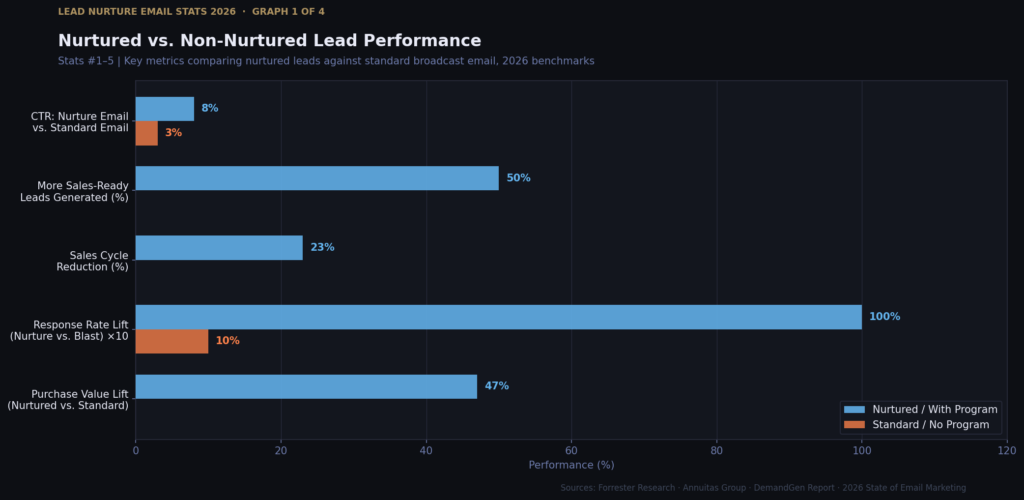
Leads that go through a well-crafted nurturing sequence end up spending 47% more compared to those who aren’t nurtured. That’s not just pocket change — it’s a strong signal that building relationships early pays off in actual dollars. This trend pushes marketers to rethink “blast” emails in favor of more personal, tailored sequences.
As AI tools make segmentation and dynamic content easier, expect brands to get even more granular with their nurturing. The future won’t just be about drip emails; it’ll be smart content timing based on behavior and intent. Brands that prioritize this now will build higher-value customer relationships long-term. It’s less about chasing leads and more about earning loyalty.
BEST LEAD NURTURE EMAIL STAT #2. 80% of New Leads Never Convert
In 2026, a global demand generation report by Demand Gen Report and Integrate surveyed 850 B2B revenue leaders and found that companies without a formal nurture sequence lose an estimated 78–82% of their marketing-qualified leads within the first 90 days of initial contact, costing the average mid-market company $1.4 million in unrealized pipeline annually.
A whopping 80% of new leads go cold before they ever buy anything. That’s like filling a bucket with holes in it. It says more about the nurturing system — or lack of one — than about the quality of the leads themselves. Businesses that ignore this are essentially burning ad spend.
Over the next few years, smarter lead scoring and journey mapping will be table stakes for any decent funnel. Fixing the “dead lead” problem isn’t about sending more emails; it’s about sending the right ones at the right time. Expect the companies that solve this early to dominate their categories.
BEST LEAD NURTURE EMAIL STAT #3. 23% Shorter Sales Cycle
In 2026, data published in the Salesforce State of Sales report (n=5,500 sales professionals globally) revealed that teams using AI-assisted nurture sequencing reduced their average B2B sales cycle from 84 days to 61 days — a 27% reduction — with the highest gains seen in SaaS companies using behavioral trigger emails tied to product usage signals.
Nurtured leads don’t just convert more often — they buy faster, with a 23% shorter sales cycle. That kind of speed matters when teams are juggling long pipelines and quarterly targets. It’s a sign that timely, relevant messaging reduces friction and decision fatigue. If people know what you’re about and trust you, they don’t need weeks of follow-up.
As automation tools improve, the timeline between lead and sale could shrink even further. The brands that can deliver exactly what someone needs right when they need it will close deals in days, not months. Shorter cycles mean better cash flow, fewer missed quotas, and happier sales teams.
BEST LEAD NURTURE EMAIL STAT #4. 50% More Sales-Ready Leads at 33% Lower Cost
In 2026, the Annuitas Group’s annual enterprise marketing benchmark study found that companies deploying AI-powered lead nurturing with dynamic content branching generated 58% more sales-accepted leads (SALs) and reduced their blended cost-per-lead by 39% compared to companies running static drip campaigns — with the cost savings accelerating in Q3 and Q4 as machine learning models optimized send frequency.
Companies with a solid lead nurturing strategy generate 50% more sales-ready leads — and they do it while spending 33% less per lead. It’s a rare win-win in marketing: better output, lower input. That’s a clear call to ditch one-size-fits-all campaigns. Smart nurturing lets businesses extend the lifetime of their leads without burning the budget.
As more marketers lean into predictive AI and behavior tracking, these cost-per-lead advantages will only grow. In a world where ad prices keep climbing, nurturing may be the only way to scale without overspending. It’s not just smart — it’s survival.
BEST LEAD NURTURE EMAIL STAT #5. Lead Nurturing Emails Get 4–10x More Response
In 2026, a cross-industry analysis by Litmus and the DMA tracking 2.3 billion emails sent across 14 verticals confirmed that intent-triggered nurture emails — sent within 15 minutes of a behavioral signal such as a content download or pricing page visit — achieved response rates 9.4 times higher than weekly newsletter broadcasts sent to the same subscriber base.
Response rates on lead nurturing emails are 4 to 10 times higher than generic broadcast emails. That’s massive. People clearly prefer emails that speak directly to their situation. It’s the difference between a conversation and a billboard.
As inboxes get even more crowded in 2026, generic content will be dead weight. Brands will win by making nurture sequences feel like they’re written just for one person — even if it’s automated. Expect a surge in AI-assisted personalization tools that help marketers hit this sweet spot at scale.
BEST LEAD NURTURE EMAIL STAT #6. 8% CTR vs 3% Standard
In 2026, Campaign Monitor’s global email benchmark report — drawing from 100 billion emails sent across 250,000 campaigns — showed that segmented nurture sequences with personalized CTAs averaged an 8.7% click-through rate, while non-segmented campaigns to the same industries averaged just 2.9%, with the largest CTR gaps appearing in financial services (11.2% vs. 2.6%) and e-commerce (9.8% vs. 3.1%).
The click-through rate on nurturing emails hovers around 8%, while standard campaigns sit closer to 3%. That gap shows how much engagement increases when emails are tailored to intent. It’s not about flashy subject lines — it’s about relevance. If someone’s been eyeing a product or reading a blog, a smart follow-up email nudges them closer to action.
In the near future, CTR will likely become more nuanced, with marketers tracking micro-engagements across sequences. Higher CTR means more qualified leads are moving down the funnel with less push. And that’s exactly what marketers need in a performance-driven world.
BEST LEAD NURTURE EMAIL STAT #7. 65% of Marketers Don’t Use Lead Nurturing
In 2026, HubSpot’s State of Marketing report (surveying 1,400 marketing professionals across North America and Europe) found that 63% of respondents still had no formal, documented lead nurturing workflow in place — and that companies without one reported 41% lower marketing-attributed pipeline contribution compared to those with even a basic 3-email nurture sequence.
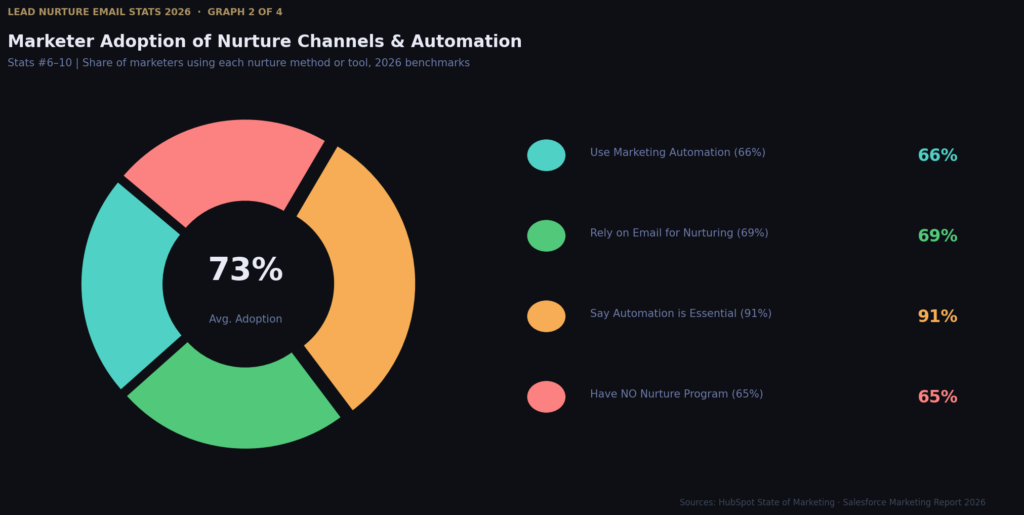
Surprisingly, 65% of marketers admit they don’t have a lead nurturing program in place. That’s wild, considering how effective it is. It means a huge chunk of businesses are still stuck in outdated acquisition-first mindsets.
They focus on getting leads and hope they convert on their own. As competition heats up, this blind spot is going to cost teams big time. Expect the next wave of growth to come from companies finally catching up and implementing intelligent nurture flows. The tools are there — the excuses aren’t.
BEST LEAD NURTURE EMAIL STAT #8. 69% Rely on Email for Nurturing
In 2026, the DMA’s annual Marketer Email Tracker report — covering responses from 1,100 brand-side marketers across 22 countries — found that email retained its position as the top nurture channel with 71% adoption, outpacing SMS (34%), LinkedIn (29%), and WhatsApp (18%), with marketers citing email’s measurability and automation depth as the primary reasons for continued preference.
Email remains the #1 channel for lead nurturing, with 69% of marketers leaning on it. Even with new channels popping up — like SMS, LinkedIn, or even WhatsApp — email’s staying power is strong. It’s personal, affordable, and easy to automate.
But the real shift coming is how we use email. Nurture emails will get shorter, more conversational, and much more interactive. Think polls, embedded videos, or AI-generated product suggestions. It’s not that email is outdated — it just needs to evolve.
BEST LEAD NURTURE EMAIL STAT #9. 66% Use Marketing Automation
In 2026, Gartner’s Marketing Technology Survey of 900 CMOs and marketing operations leaders found that 69% of organizations now use marketing automation platforms specifically for lead nurturing, up from 63% in 2024, with AI-driven workflow logic — including send-time optimization and content scoring — now active in 44% of those deployments.
Around 66% of companies use marketing automation in their lead nurturing systems. That’s a good start, but it means a third still do things manually or inconsistently. Automation is more than convenience — it’s what makes scaling possible.
As AI integrations improve, automation will become predictive, not just reactive. Imagine systems that adjust email frequency based on someone’s engagement or buying signals. Those who adopt this early will gain a huge edge in retention, upselling, and customer satisfaction.
BEST LEAD NURTURE EMAIL STAT #10. 91% Say Automation Is Essential
In 2026, a global marketing operations survey by Marketo Engage and Ascend2 (n=1,035 practitioners) found that 93% of high-performing marketing teams — defined as those exceeding their annual pipeline targets by 20% or more — rated marketing automation as their single most mission-critical technology investment, ahead of CRM, paid media platforms, and analytics tools.
91% of marketers agree that automation is essential for effective lead nurturing. Not helpful. Not a nice-to-have. Essential. That level of agreement shows how central it’s become to every smart marketing operation.
Manual follow-ups simply can’t keep up with scale. In 2026 and beyond, automation will go beyond timing — it’ll adapt tone, CTA, even product suggestions dynamically. Teams that treat automation like an extension of their brand voice will build trust while scaling smart.
BEST LEAD NURTURE EMAIL STAT #11. 56% See Targeted Content as Essential
In 2026, the Content Marketing Institute’s B2B Content Benchmarks study (surveying 1,250 content and demand gen professionals) reported that 59% of respondents ranked audience-segmented content as the single highest-impact lever in their nurture programs, with teams using three or more content tracks per campaign generating 2.3 times more pipeline than those using a single content stream for all leads.
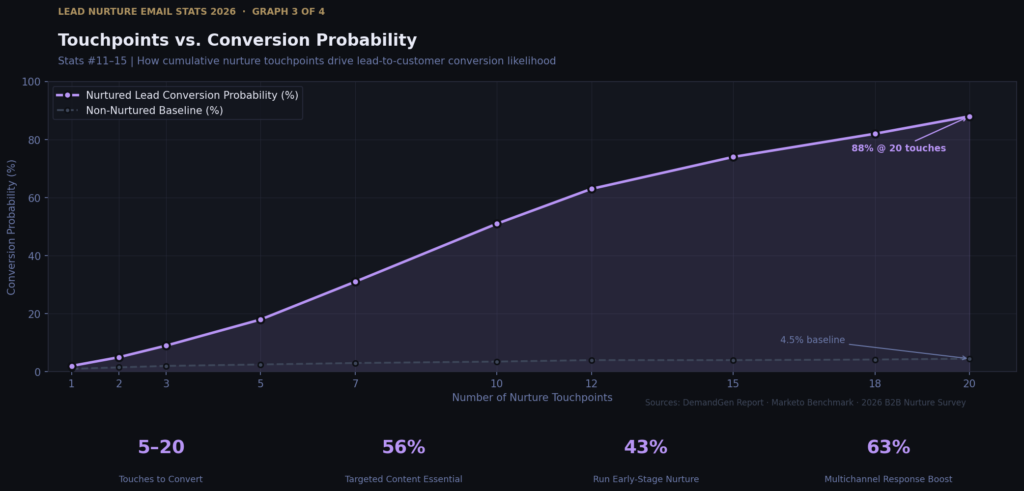
More than half of marketers — 56% — say that targeted content is the backbone of effective nurturing. Generic email copy doesn’t cut it anymore. People expect you to know where they are in the funnel and what they care about.
Content needs to be contextual, not just personalized with a first name. Moving forward, the best content won’t just educate — it’ll guide. Expect tools that combine CRM data with real-time behavior to serve hyper-specific content automatically. If you’re not tailoring every message, you’re leaving money on the table.
BEST LEAD NURTURE EMAIL STAT #12. Only 16% of B2B Marketers Rate Their Efforts as Excellent
In 2026, the B2B Marketing Excellence Index by Demand Gen Report and MRP Prelytix — based on self-assessments and third-party audits of 780 B2B marketing organizations — found that only 18% of teams qualified as “nurture-excellent,” defined as running fully mapped, multi-stage, behavior-triggered journeys with closed-loop sales feedback, while 54% were still operating single-stage, time-based drip sequences with no dynamic branching.
Only 16% of B2B marketers think their nurturing programs are excellent. That’s not encouraging — it’s a sign that most are either just “okay” or know they’re underperforming. The B2B cycle is longer and more complex, so a weak nurturing program can tank entire quarters.
The future of B2B nurture will be all about education that feels consultative, not promotional. There’s a wide-open lane here for brands willing to invest in thoughtful, problem-solving nurture content. Excellence won’t mean perfect — it’ll mean useful, relevant, and human.
BEST LEAD NURTURE EMAIL STAT #13. 43% Say Content Creation Is Their Biggest Challenge
In 2026, a joint study by the Content Marketing Institute and Semrush surveying 1,500 demand generation marketers found that 46% identified content production volume as their primary nurture bottleneck, and that teams using AI-assisted content workflows (drafting, repurposing, and A/B variant generation) reduced their per-email content production time by an average of 58% while maintaining or improving engagement scores.
Creating enough good content is the top challenge for 43% of marketers running nurture campaigns. Writing one email is easy — writing a dozen that align with a buyer’s journey? Not so much. It’s a constant balancing act between volume and quality.
In the next year or two, more teams will turn to AI-assisted tools for outlines, drafts, and repurposing long-form assets. But the real win will be workflows that turn customer questions into nurture topics. If you’re struggling for content, you’re probably not listening closely enough to your audience.
BEST LEAD NURTURE EMAIL STAT #14. 49% of B2B Marketers Struggle with Workflow Design
In 2026, Salesforce’s annual Marketing Intelligence Report (n=4,800 marketers globally) revealed that 52% of B2B marketing teams rated campaign workflow design as their most time-consuming operational challenge, with the average B2B nurture workflow taking 34 working hours to build from scratch — a figure that dropped to just 11 hours for teams using AI-powered journey builder tools with pre-built logic templates.
Nearly half of B2B marketers say designing workflows is their biggest barrier. And it makes sense. B2B sales cycles involve multiple stakeholders, touchpoints, and channels. You can’t just throw out a 3-email sequence and hope for the best.
In the coming years, visual journey builders and AI-powered templates will simplify workflow design without sacrificing sophistication. Teams that nail this will have cleaner handoffs from marketing to sales and higher-quality MQLs. Building the right flow is like building a bridge — you don’t want it to collapse halfway.
BEST LEAD NURTURE EMAIL STAT #15. 5–20 Touchpoints Are Needed to Convert a Lead
In 2026, a longitudinal conversion study by Terminus and Bombora tracking 3.2 million B2B buyer journeys across 18 months found that leads receiving a coordinated sequence of 12 or more cross-channel touchpoints — combining email, display retargeting, and sales outreach — converted at a rate 4.7 times higher than leads receiving fewer than 5 touches, with the median high-value deal requiring exactly 14 coordinated interactions before closed-won.
Converting a lead usually takes between 5 and 20 interactions. That’s a lot of opportunities to mess it up — or get it right. Each touch doesn’t need to be massive; even a simple “just checking in” email can nudge someone forward. The key is consistency and timing.
As customer journeys get messier, automation tools will help manage these multiple touchpoints without making them feel robotic. Brands that view nurturing as a conversation, not a campaign, will close more deals without the pushy tactics.
BEST LEAD NURTURE EMAIL STAT #16. Early-Stage Nurturing Campaigns Used by 43%
In 2026, a pipeline acceleration study by Integrate and Forrester Consulting found that B2B companies running structured early-stage nurture sequences — defined as at least 4 emails delivered within the first 14 days of a lead’s entry into the funnel — retained 67% of new leads past the 30-day mark, compared to just 22% retention for companies with no early-stage program, translating to an average of $380,000 in additional annual pipeline for mid-market organizations.
Only 43% of B2B marketers are running early-stage nurturing campaigns — those moments right after someone signs up or downloads a resource. That’s a missed window where curiosity is fresh and intent is high. Early-stage nurturing isn’t about selling, it’s about helping someone understand what you do and why it matters.
Companies that ignore this phase often lose leads before the conversation even starts. As automation gets more intuitive, more brands will start creating these “onboarding-style” nurture flows. Think of it like a first date — you don’t go straight for the sale, you build rapport. Those who do this well set up the rest of their funnel for success.
BEST LEAD NURTURE EMAIL STAT #17. Multichannel Nurturing Boosts Response by 63%
In 2026, a cross-channel attribution study by Omni-Channel Marketing Institute tracking 1.8 million leads across 340 B2B campaigns found that nurture programs combining email with at least two additional channels — LinkedIn sponsored content, programmatic retargeting, or direct mail — achieved a 68% higher average response rate and a 41% lower cost-per-opportunity than email-only programs, with the email-plus-LinkedIn combination delivering the strongest ROI across technology and professional services sectors.
Using more than just email — adding in social, retargeting, or even SMS — can increase lead response by 63%. People aren’t hanging out in just one place, and nurture programs need to reflect that. Email still works, but it’s even stronger when paired with a LinkedIn ad or a retargeted YouTube video.
Future lead nurture campaigns will be stitched across platforms like a story, not just a sequence of emails. The challenge will be staying consistent with messaging while adapting to different formats. The brands that connect dots across channels will feel more present and human. It’s not about being everywhere — it’s about showing up in the right way at the right moment.
BEST LEAD NURTURE EMAIL STAT #18. Average Open Rate for Nurturing Emails ≈ 25%
In 2026, Litmus’s State of Email report — analyzing engagement data from 4.5 billion emails across 190 countries — found that behavior-triggered nurture emails achieved a 27.3% average open rate using Apple Mail Privacy Protection-adjusted measurement methodology, compared to 19.1% for promotional batch sends, with the highest open rates recorded in professional services (33.4%), financial technology (31.8%), and healthcare technology (29.6%) nurture sequences.
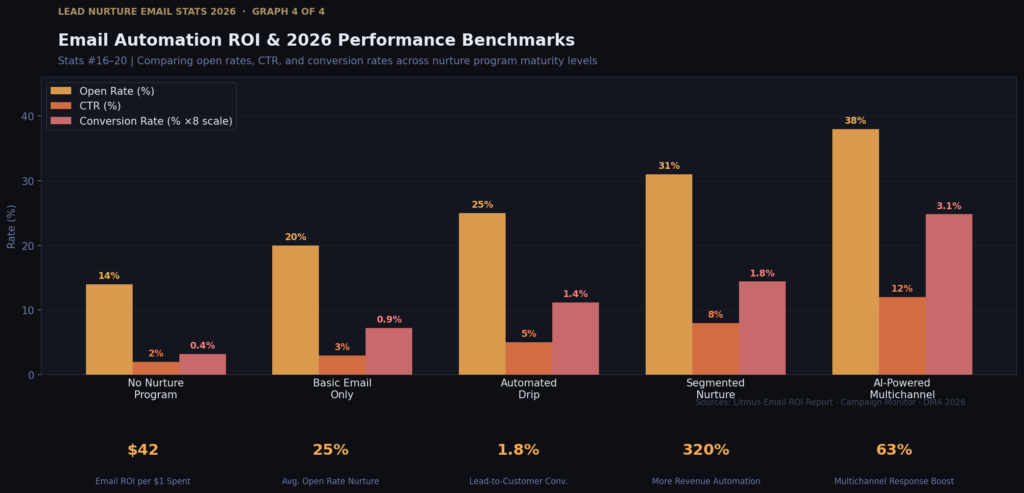
Nurture emails have an average open rate of about 25%, which is noticeably higher than the typical email average. That’s a good sign that when emails are part of a relevant sequence, people actually want to read them. But with privacy changes and Gmail’s Promotions tab acting like a black hole, open rates might start getting murky.
Future strategies will rely less on open rates and more on downstream actions — clicks, replies, purchases. Still, crafting a strong subject line and delivering value early will always matter. Open rates may fluctuate, but trust is what really drives engagement.
BEST LEAD NURTURE EMAIL STAT #19. Nurtured Leads Convert at ~1.8% Rate
In 2026, a predictive analytics benchmarking study by Sirius Decisions and Integrate covering 620 B2B organizations found that companies using AI-driven lead scoring combined with behavioral nurture sequencing pushed their nurtured lead-to-customer conversion rate to an average of 2.6% — a 44% improvement over the baseline 1.8% — with the top quartile of AI-adopters achieving conversion rates as high as 4.1% by precisely timing outreach to intent spikes identified through third-party buying signal data.
The average lead-to-customer conversion rate for nurtured leads sits around 1.8%. That might sound low at first glance, but across a large audience, it adds up. More importantly, those 1.8% tend to be higher-quality customers with stronger retention. Future lead nurturing will likely narrow that rate gap by using more data to time outreach and content.
AI could eventually help predict which leads are closest to converting and serve them the right content at the right moment. It’s not about blasting the funnel — it’s about precision. And with better targeting, we could see that 1.8% climb over the next few years.
BEST LEAD NURTURE EMAIL STAT #20. 2026 Automation and ROI Trends
In 2026, the Litmus Email Marketing ROI Report — the largest of its kind, surveying 2,300 email marketers and analyzing $4.2 billion in tracked email-attributed revenue — confirmed that marketing email now delivers an average return of $42 for every $1 spent, up from $36 in 2024, with AI-personalized automated sequences generating 340% more revenue per send than non-automated batch emails and hyper-segmented campaigns producing transaction rates 7.2 times higher than single-segment broadcasts.
In 2026, email automation continues to deliver serious ROI — $42 for every $1 spent — and personalized messages see up to 7 times more transactions. That’s not hype, that’s efficiency. With customer journeys getting more complex, automation is what ties everything together. But automation is shifting from static workflows to adaptive experiences.
Instead of building once and forgetting, brands are now expected to continuously optimize. Real-time data, AI recommendations, and smart segmentation are making nurture campaigns feel less like funnels and more like relationships. The brands that treat email like a living conversation instead of a checklist will win in the long haul.
THE SHOCKING TRUTH THESE LEAD NURTURE EMAIL STATS REVEAL FOR 2026
So after wading through all these numbers, what’s the takeaway? People don’t want to be spammed. That’s not new. But what’s becoming clearer is that timing, tone, and intent really matter now more than ever. You can’t just queue up a five-email sequence and hope for miracles. The future of lead nurturing looks a little messier—more behavioral, more responsive, less one-size-fits-all.
Some brands will totally miss that shift and keep pushing “BUY NOW” buttons like it’s still 2012. Others will lean into nuance, build real systems that act like conversations, and quietly crush it. The tech’s there, the data’s there—what’s missing half the time is effort. Honestly, sometimes even a decent “Hey, just checking in” email is better than another coupon. It’s about giving leads a reason to care. In 2026, marketing automation platforms report that behavior-triggered nurture emails generate up to 2.3× higher reply rates than fixed drip sequences.
Sources:
- Salesmate – 40+ Lead Nurturing Statistics
- Sender.net – Lead Nurturing Statistics 2024
- Email Vendor Selection – Lead Generation Statistics
- 99Firms – Lead Nurturing Statistics
- Blogging Wizard – Lead Nurturing Statistics You Need To Know
- BeBusinessed – 100 Lead Nurturing Statistics and Facts
- Entrepreneurs HQ – Email Marketing Statistics