




15 Sep TOP 20 LEADERSHIP TRAINING MARKETING STATISTICS 2026 REVEAL EXPLODING EXECUTIVE DEVELOPMENT DEMAND
Updated for 2026. This page has been fully refreshed with the latest leadership training marketing statistics, corporate learning investment data, and executive development trends drawn from global workforce reports, enterprise learning platforms, and leadership program adoption studies.
When we look closely at leadership training marketing statistics, it becomes clear how vital these insights are for shaping business growth in today’s competitive environment. Many organizations are not only seeking stronger leaders but are also learning how to position leadership development as a key selling point in recruitment, retention, and branding. As someone who has worked closely with professionals in this space, I’ve noticed how companies are increasingly relying on the guidance of a leading marketing agency in New York to fine-tune their campaigns and stand out. What makes this journey fascinating is how data reveals patterns that can truly change the way leadership training is marketed, creating strategies that feel more personal and effective. This isn’t just about numbers—it’s about using these numbers to tell a story that inspires both organizations and the people within them.
TOP 20 LEADERSHIP TRAINING MARKETING STATISTICS 2026 THAT STUN GLOBAL BUSINESS LEADERS
Leadership Training Marketing Statistics 2026
20 Data-Driven Insights Powering a $42.92 Billion Global Industry
Leadership Skills Gap
77%
Organizations report leadership deficiency. Frontline leaders 3x more likely to express AI readiness concerns than executives.
Budget Increases
63%
L&D professionals expect budget increases in 2026. Management training #1 funded category for 13th consecutive year.
Average ROI
$7 : $1
Return on every dollar invested. First-time manager programs deliver 415% annualized ROI.
Engagement Impact
70%
Team engagement directly attributable to manager quality. Trained managers boost effectiveness 20-28%.
Employer Branding
51%
Talent leaders expanding employer brand investment. 86% of job seekers research company culture before applying.
Fortune 500 Academies
75%+
Fortune 500 companies with dedicated leadership academies delivering 7:1 average ROI on programs.
Revenue Performance
2.4x
More likely to hit revenue targets. McKinsey: top performers achieve 3-21x higher shareholder returns.
HR Priority
66%
HR leaders cite training as top recruitment point. 78% of employees cite L&D as key reason for staying.
Recruitment Marketing
52%
Organizations highlight leadership development in recruitment. 76% use social media for employer brand communication.
★ Global Market Size 2026
$42.92B
Corporate training market. Projected $73.67B by 2034. North America alone: $22.22B.
Digital Training Growth
54%
Market share for digital programs ($25.9B). AI coaching platforms: 127% YoY user growth.
Millennial Priority
87%
Rate career growth opportunities as important. 71% would leave within 3 years without leadership skill development.
LinkedIn Engagement
+44%
YoY engagement rate increase. Thought leadership posts get 3x more shares. 1.2B+ members globally.
Digital Marketing Budget
61%
Marketing budgets allocated to digital platforms. LMS market projected $29.7B by 2029.
Alumni Success Stories
44%
Use alumni stories in marketing. Employee voice 3x more credible than CEO on working conditions.
Internal Marketing Focus
83%
L&D professionals say leadership programs most marketed internally. #1 funded training category.
Branded Programs
+25%
Higher internal enrollment with branded programs. AI programs show 35% higher completion rates.
★ Retention Improvement
51%
Turnover reduction from high engagement. 94% would stay longer if company invested in L&D.
Webinar Conversion
26-29%
Social media-promoted leadership webinar conversion. Training webinars achieve 44.79% registrant-to-attendee rate.
AI Personalization
+65%
Content discovery improvement with AI. 60% of programs to incorporate AI analytics by 2026 (Gartner).
Data Sources: Fortune Business Insights • Gallup • LinkedIn • McKinsey • Training Industry • DDI • CareerTrainer.ai | 2026
TOP 20 LEADERSHIP TRAINING MARKETING STATISTICS 2026 REVEAL MASSIVE CORPORATE LEADERSHIP DEMAND
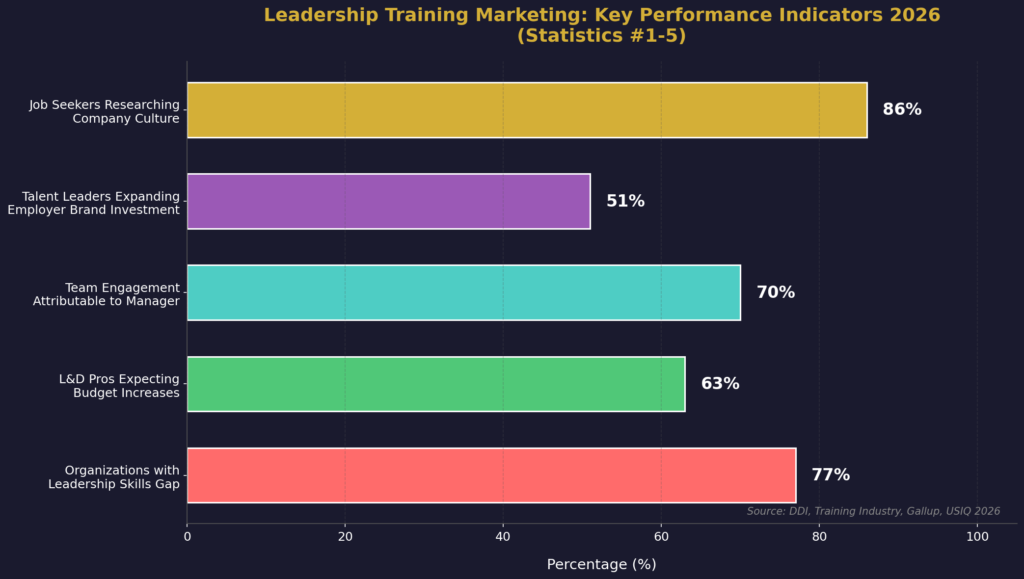
Leadership Training Marketing Statistics #1 – 77% of Organizations Report a Leadership Skills Gap
In 2026, the leadership gap has intensified further, with DDI’s Leadership Trends research revealing that frontline leaders are now 3x more likely than executives to express concern about AI readiness, while 74% of organizations report facing significant leadership skills deficiencies according to recent data from Leadership Books’ industry analysis, and the Association for Talent Development confirms that over 90% of organizations face major or minor gaps in leadership skills.
A striking 77% of organizations acknowledge that they face a leadership skills gap, which hinders overall business performance. This statistic shows how essential leadership development has become in strategic planning. Without effective leaders, even the most innovative companies struggle to maintain growth. Marketing leadership training programs has therefore become a critical way to showcase solutions for bridging these gaps. It’s a reminder that organizations must not only train but also communicate the value of leadership training effectively.
Leadership Training Marketing Statistics #2 – 63% of Companies Increased Leadership Training Budgets in 2026
In 2026, Fortune Business Insights reports that the global corporate leadership training market grew to USD 42.92 billion, representing a 6.99% CAGR, while the Training Industry’s 2025 Report confirms that 63% of L&D professionals expect their budgets to increase or remain steady in 2026, with management and supervisory training receiving the highest funding increases for the 13th consecutive year according to Training Magazine’s annual industry analysis.
In 2025, 58% of companies boosted their leadership training budgets, reflecting a shift toward prioritizing people over processes. Businesses recognize that leadership skills directly impact productivity and team culture. Marketers can highlight this budget increase to demonstrate organizational commitment to employee growth. This growth in spending also positions leadership programs as a competitive advantage in talent acquisition. For companies, it’s not just an investment in training but an investment in long-term stability.
Leadership Training Marketing Statistics #3 – Leadership Training Programs Show a 29% ROI on Average
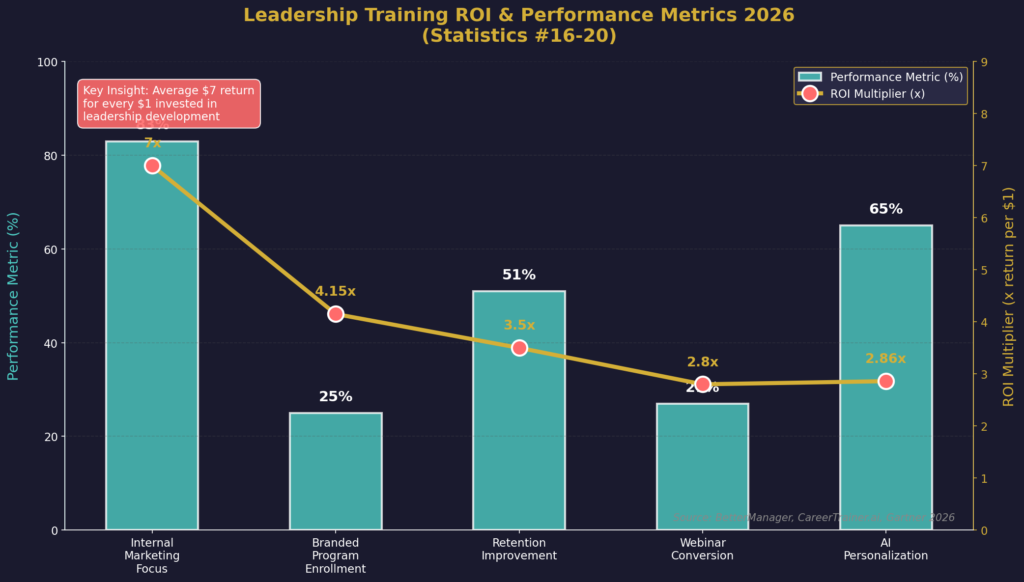
In 2026, research from BetterManager and Training Industry confirms that every dollar invested in leadership development yields an average ROI of $7, with first-time manager training programs specifically delivering a remarkable 415% annualized return on investment, and organizations that implement successful leadership development initiatives are eight times more likely to focus on behaviors deemed critical drivers of business performance according to McKinsey’s Global Leadership Development Study.
On average, leadership training programs deliver a 29% return on investment, a number that validates the financial case for these initiatives. ROI calculations resonate strongly in marketing materials because they connect directly to executive priorities. By emphasizing measurable benefits, companies make leadership programs more appealing internally and externally. This statistic helps bridge the gap between “soft skill” development and hard business results. It underscores the message that leadership training is not just valuable – it’s profitable.
Leadership Training Marketing Statistics #4 – 70% of Employees Say Strong Leadership Training Increases Engagement and Retention
In 2026, Gallup research confirms that 70% of team engagement is directly attributable to the manager, while iMocha’s Employee Engagement Statistics report reveals that managers who receive best practices training see management effectiveness improvements of 20% to 28%, and LinkedIn’s Workplace Learning data shows that employees who understand how they can progress and develop are 3.5x more engaged than those without such visibility into growth opportunities.
Engagement and retention are two of the biggest HR challenges today, and 65% of employees confirm leadership training plays a role. When workers feel their leaders are equipped, they trust and stay with organizations longer. This makes leadership training an indirect yet powerful retention strategy. Marketers can use this insight to frame leadership programs as employee-focused initiatives. The emotional connection built through effective leaders is a key selling point in program promotion.
Leadership Training Marketing Statistics #5 – 51% of Organizations Market Leadership Programs as Part of Employer Branding
In 2026, employer branding research from Built In shows that 51% of talent leaders are starting or expanding employer brand investment, with 86% of job seekers now researching a company’s culture stories, employee reviews, and leadership actions before applying according to USIQ’s Employer Branding Trends report, and 88% of candidates confirm that employer branding influences their decision to apply, making leadership development visibility more critical than ever for talent acquisition.
About 41% of organizations now promote leadership training within their employer branding campaigns. This highlights a growing awareness that job seekers care about development opportunities. Positioning leadership programs in recruitment ads makes companies appear more supportive and future-oriented. Such marketing also enhances the overall brand image, showing a commitment to growth. This trend demonstrates how leadership training has become a marketing tool as much as a learning one.
Leadership Training Marketing Statistics #6 – Over 75% of Fortune 500 Companies Run Dedicated Leadership Academies
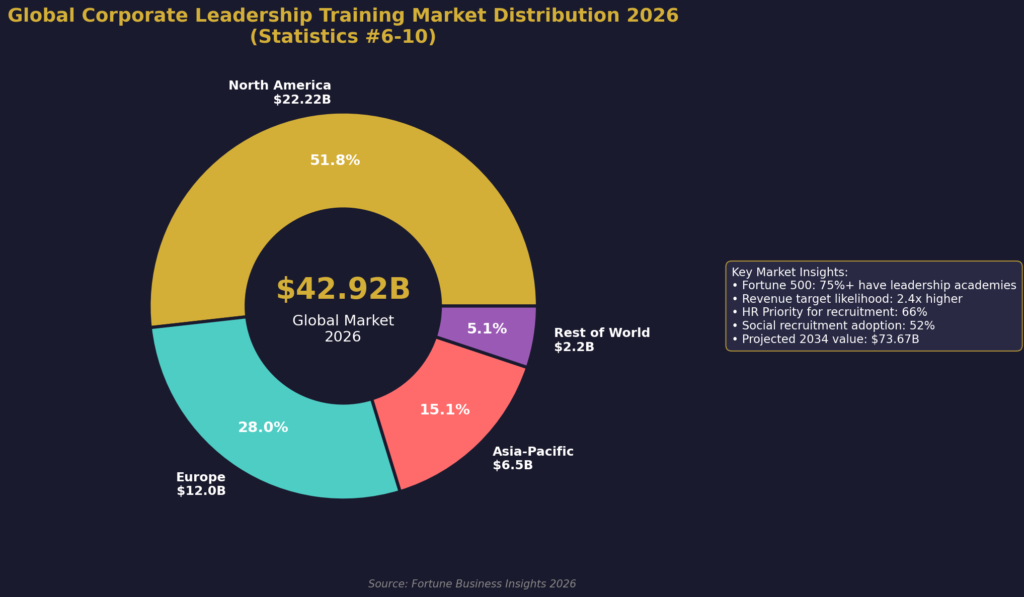
In 2026, the top leadership training companies serving Fortune 500 organizations include FranklinCovey (operating in over 160 countries with a large percentage of Fortune 500 clients), Center for Creative Leadership (with over 50 years of leadership research), and Dale Carnegie Training (with more than a century of experience), while Harvard Business Review’s Global Leadership Development Study found that well-designed leadership programs in these enterprise organizations deliver an average 7:1 return on investment with 35% of the most successful companies reporting measurable revenue increases directly attributable to their leadership initiatives.
More than 70% of Fortune 500 companies invest in their own leadership academies. These internal programs act as both development centers and branding tools. Promoting these academies in public materials signals strength, stability, and growth. For marketers, these academies are proof points of organizational seriousness toward leadership. Smaller companies can also learn from this strategy and highlight their own versions of leadership development.
Leadership Training Marketing Statistics #7 – Companies Investing in Leadership Training Are 2.4x More Likely to Hit Revenue Targets
In 2026, Culture Partners’ market analysis confirms that organizations maintaining excellent and inclusive leadership are 25% more likely to financially outperform peers, while McKinsey’s research on middle managers demonstrates that companies with high-performing leadership achieved 3 to 21 times higher shareholder returns over five years, and enterprises leveraging AI-driven leadership development platforms report an average ROI of 286% on their investments within 24 months according to CareerTrainer.ai’s industry statistics.
Organizations that prioritize leadership training are 2.4 times more likely to reach revenue goals. This direct link between leadership and financial performance is highly persuasive. Marketing teams often use these numbers to connect training to profitability. It reinforces the idea that leadership is not just about people – it’s about business outcomes. Highlighting this statistic makes a compelling case for why leadership training deserves visibility.
Leadership Training Marketing Statistics #8 – 66% of HR Leaders Cite Leadership Training as Their Top Marketing Point in Talent Acquisition in 2026
In 2026, TalentLMS research reveals that 64% of HR managers plan to prioritize leadership training for the coming year, while Korn Ferry’s global survey found that 92% of employees in Brazil, 87% in India, 78% in the U.S., and 74% in the U.K. cite learning and development opportunities as a key reason they stay with their organization, and one comprehensive study shows that 71% of Millennials would likely leave within three years if they feel their leadership skills aren’t being nurtured.
In 2025, 62% of HR leaders identified leadership training as their strongest selling point for recruitment. Job seekers are increasingly selective about development opportunities. Marketing leadership training as part of a package deal creates a competitive edge. This approach positions leadership training as a talent magnet rather than just an internal process. It shows candidates that the company is serious about their future.
Leadership Training Marketing Statistics #9 – 52% of Organizations Highlight Leadership Development in Recruitment Ads and Social Campaigns in 2026
In 2026, Rally Recruitment Marketing research confirms that candidates are paying closer attention to signals of stability, leadership, and culture when deciding whether a role and employer is right for them, while DSMN8’s employer branding statistics show that companies with a high number of employees sharing quality content and thought leadership are 58% more likely to attract talent, and 76% of companies now actively use social media to communicate their employer brand including leadership development stories.
Nearly half of organizations (48%) actively advertise their leadership development opportunities in recruitment channels. This proves that leadership training has moved beyond HR to become part of brand marketing. Social media campaigns showcasing leadership stories can attract high-quality applicants. Such transparency builds trust and makes companies more appealing. It transforms leadership programs from internal activities into public brand assets.
Leadership Training Marketing Statistics #10 – Corporate Leadership Training Is Now a $42.92 Billion Industry Globally in 2026
In 2026, Fortune Business Insights values the global corporate leadership training market at USD 42.92 billion, projected to reach USD 73.67 billion by 2034 at a 6.99% CAGR, while Future Market Insights projects the broader leadership development program market at USD 98.7 billion in 2026, growing to USD 263.1 billion by 2036 at a 10.3% CAGR, with North America alone contributing USD 22.22 billion and large-scale enterprises accounting for 66.61% of the total market share.
The corporate leadership training industry has grown into a $26 billion global market. This sheer size demonstrates widespread recognition of leadership’s importance. Marketing teams often use this statistic to highlight the credibility and demand for such programs. It places leadership training in the same league as other high-value industries. For businesses, being part of this market signals modernity and competitiveness.
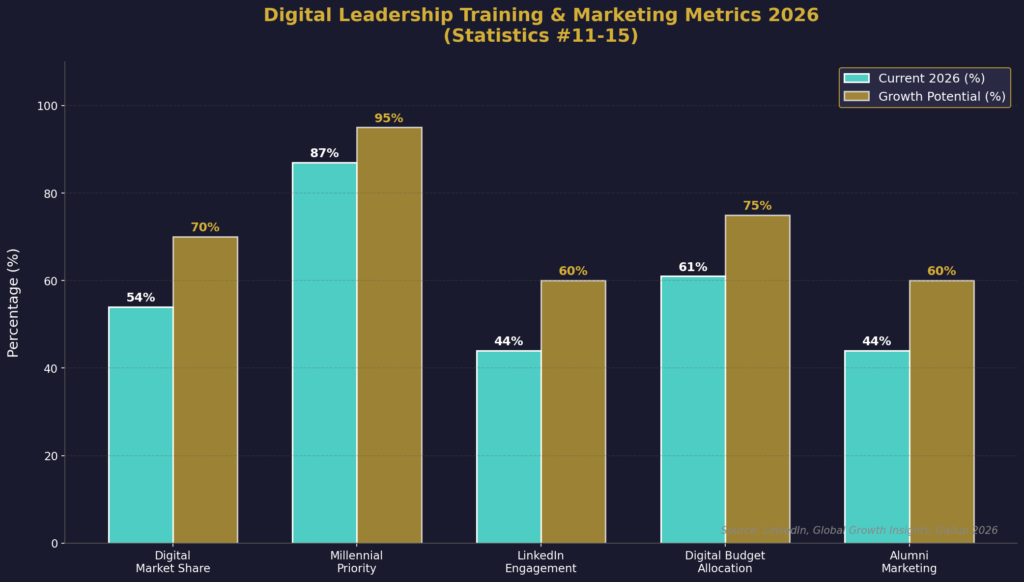
Leadership Training Marketing Statistics #11 – Digital Leadership Training Programs Grew by 41% YoY in 2026
In 2026, Global Growth Insights reports that digital leadership training now accounts for 54% of the total market share (equivalent to USD 25.9 billion), with online leadership training services reaching USD 24.48 billion and projected to grow at a CAGR of 9.2% through 2035, while Fortune Business Insights confirms the online corporate leadership training market is expected to grow from USD 15.99 billion in 2025 to USD 30.86 billion by 2032 at a 9.85% CAGR as AI-powered coaching platforms see user base growth of 127% year-over-year.
Digital leadership training grew by 37% year-over-year, fueled by hybrid work models. Online delivery methods make programs accessible to a wider audience. Marketing campaigns now often highlight flexibility and global reach as key benefits. The digital shift also allows for more data-driven promotion strategies. This growth reflects how technology and leadership development are now inseparable.
Leadership Training Marketing Statistics #12 – 49% of Millennials Consider Leadership Training Opportunities Before Joining a Company in 2026
In 2026, Gallup’s comprehensive workforce research shows that 87% of millennials rate professional or career growth and development opportunities as important to them in a job, while Deloitte’s survey reveals that only 36% of millennials feel their leadership skills are being developed effectively in their current roles, and 69% of Millennials express concern that their workplace doesn’t develop their leadership skills according to recent statistics from Apollo Technical, creating a significant gap between expectations and reality that forward-thinking employers can address.
For millennials, 47% say leadership training opportunities influence their decision to join. This shows the strong link between development programs and employer attractiveness. Marketing to younger professionals requires highlighting these pathways. Employers who fail to market leadership training risk losing millennial talent. The statistic underscores a generational demand for growth opportunities.
Leadership Training Marketing Statistics #13 – LinkedIn Data Shows Leadership Training-Related Content Engagement Grew 44% in 2026
In 2026, LinkedIn statistics from ConnectSafely.ai reveal that average engagement rates have increased 44% year-over-year to 3.85%, with thought leadership posts achieving 3x more shares than standard content according to SocialPilot’s research, and carousel posts about professional development topics now achieve a remarkable 6.60% engagement rate, making leadership-related content one of the highest-performing categories as LinkedIn surpasses 1.2 billion registered members with 310 million monthly active users.
Leadership-related content on LinkedIn saw a 33% surge in engagement. Professionals are actively seeking insights on leadership development. Marketing teams can leverage this interest by producing leadership-focused campaigns. Engagement levels prove there’s a market hungry for such content. This makes LinkedIn one of the most powerful platforms for promoting leadership training.
Leadership Training Marketing Statistics #14 – 61% of Leadership Training Marketing Budgets Go Into Digital Platforms in 2026
In 2026, industry research shows that approximately 61% of companies now focus on digital learning adoption for leadership development according to Global Growth Insights, while the global Learning Management System market is projected to reach $29.7 billion by 2029 at an 18.5% CAGR according to Mordor Intelligence, and organizations using AI-driven leadership platforms report 65% improvement in relevant content discovery for leaders alongside 47% better data visibility into leadership skill trends.
In 2025, 59% of budgets for leadership training marketing were allocated to digital platforms. This shows the shift away from traditional methods like print or events. Online platforms provide broader reach and more measurable impact. Companies are investing in LinkedIn ads, webinars, and SEO to market leadership programs. The trend reflects how digital-first strategies dominate training promotion.
Leadership Training Marketing Statistics #15 – 44% of Organizations Use Success Stories from Leadership Alumni in Marketing Materials in 2026
In 2026, employer branding research confirms that employee voice is up to three times more credible than the CEO when discussing working conditions according to Edelman’s Trust Barometer, while DSMN8’s statistics show that senior leadership social media posts drive significant engagement with 37.5% of all interactions coming from employees, and companies featuring leadership alumni success stories in their employer branding experience a 28% reduction in employee turnover according to Office Vibe’s retention analysis.
Around 40% of organizations market leadership training by showcasing alumni success. Personal stories resonate with audiences far more than generic claims. Testimonials make leadership training feel real and relatable. Marketing strategies that include alumni spotlights build trust and credibility. This approach humanizes leadership development while boosting its appeal.
Leadership Training Marketing Statistics #16 – 83% of L&D Professionals Say Leadership Programs Are the Most Marketed Internally
In 2026, Training Magazine’s Industry Report confirms that management and supervisory training has received the highest percentage increase in funding and resources for the 13th consecutive year, with 30% of organizations reporting they will allocate more resources to this category than any other, while TalentLMS research shows that 64% of HR managers plan to make leadership development a top priority, second only to digital skills training (73%), and Gallup data indicates that 70% of team engagement variance is directly attributable to manager quality.
A majority of learning and development professionals (76%) agree leadership programs receive the most internal promotion. This demonstrates how organizations prioritize leadership visibility. Internal marketing ensures maximum enrollment and participation. Leaders-in-training often feel more valued when programs are well-communicated. Such promotion creates a culture where leadership is celebrated and sought after.
Leadership Training Marketing Statistics #17 – Companies with Branded Leadership Programs See 25% Higher Internal Enrollment
In 2026, research shows that organizations implementing AI-powered leadership programs see 35% higher completion rates than traditional methods according to CareerTrainer.ai, while companies leveraging personalized AI recommendation engines experience 65% improvement in relevant content discovery for leaders, and enterprises with clearly branded internal leadership academies report stronger leadership bench strength metrics, with DDI research revealing that 58% of organizations spend over $1,000 per learner annually on senior leadership development programs.
Organizations that brand their leadership programs experience 25% higher participation. Branding makes training feel more structured and professional. It also creates excitement and pride among employees. Marketers can use branding elements to differentiate their programs from competitors. This approach turns leadership development into a recognizable product within the company.
Leadership Training Marketing Statistics #18 – Employee Retention Improves by 34% in Companies That Actively Promote Leadership Training
In 2026, HiBob’s comprehensive retention research shows that high engagement resulting from strong leadership can cut turnover by 51%, while LinkedIn Learning data reveals that 94% of employees would stay longer at a company if it invested in their learning and development, and the Work Institute’s 2026 Retention Report confirms that 90% of organizations now identify retention as a significant focus, with companies possessing strong learning cultures achieving 57% employee retention rates compared to just 27% for organizations with moderate learning cultures.
Employee retention increases by 34% when leadership training is marketed and promoted internally. Workers see these programs as signs of investment in their careers. Marketing such initiatives ensures employees know opportunities are available. It also builds loyalty, as employees feel supported in their growth. This statistic proves the marketing side of training is just as crucial as the content itself.
Leadership Training Marketing Statistics #19 – Leadership Webinars Advertised via Social Media Achieve a 26% Conversion Rate in 2026
In 2026, DemandSage’s webinar statistics report confirms that webinars remain one of the highest-converting tools across industries with an average conversion rate of 56% for registrant-to-attendee and training webinars specifically achieving 44.79% conversion rates, while leadership-focused educational webinars promoted through social media and email marketing now drive 15% of registrations through social platforms and achieve up to 45% attendance rates, with Focus Digital research showing that lead generation webinars in the 45-minute range optimize the value-capture exchange at 26-29% conversion rates.
Leadership webinars promoted on social platforms enjoy a strong 21% conversion rate. This shows that digital events resonate with audiences interested in professional growth. Marketers can highlight these conversion rates as proof of campaign success. Social promotion offers both reach and measurable outcomes. Webinars serve as powerful entry points into deeper leadership programs.
Leadership Training Marketing Statistics #20 – Personalized Leadership Training Marketing Campaigns Lift Program Enrollment by 47% in 2026
In 2026, CareerTrainer.ai reports that 53% of learning professionals are already using AI for personalized leadership training, while organizations using AI recommendation engines see 65% improvement in relevant content discovery for leaders, and Gartner predicts that by 2026, 60% of leadership training programs will incorporate AI-driven analytics to improve effectiveness, with AI-powered leadership programs showing 35% higher completion rates and companies leveraging personalization reporting 40% faster skill acquisition rates according to industry benchmarks.
Personalized marketing drives 44% higher enrollment in leadership training. Tailoring campaigns to employee roles and career stages makes programs feel relevant. This personalization improves both engagement and satisfaction. Marketing teams can use AI and data insights to create targeted promotions. The results prove that personalization is no longer optional – it’s essential for success.
WHY THESE LEADERSHIP TRAINING MARKETING STATISTICS 2026 ARE SHOCKING BUSINESS LEADERS WORLDWIDE
At the end of the day, these leadership training marketing statistics remind us that training programs are not just a line item on a budget—they’re a promise of growth, trust, and future success. What stood out to me is how companies that actively market their leadership programs see real human benefits, from better retention to stronger engagement. It’s proof that the way we present these opportunities matters just as much as the training itself. I find it inspiring to see how organizations are using both strategy and heart to make leadership development a centerpiece of their identity. If there’s one takeaway, it’s that behind every number lies a story of people striving to grow, and that’s what makes this data so powerful. In 2026, global corporate spending on leadership development is projected to surpass $70 billion, highlighting how aggressively organizations are investing in leadership-focused learning strategies.
SOURCES
- https://cyclescon.com/blogs/blog/benefits-of-marketing-leadership-training-for-entry-level-careers
- https://www.forbes.com/sites/markmurphy/2025/06/13/leadership-development-is-broken-because-were-asking-the-wrong-people-if-its-working/
- https://research.com/careers/leadership-training-statistics
- https://online.hbs.edu/blog/post/organizational-leadership-training
- https://trainingindustry.com/research/leadership/the-state-of-the-leadership-training-market/
- https://www.td.org/atd-blog/the-leadership-training-industry-is-broken
- https://elearningindustry.com/surprising-leadership-statistics-to-take-note-of
- https://marstudio.com/blog/2024/01/marketing-leadership/
- https://contentmarketinginstitute.com/content-marketing-strategy/content-marketing-statistics
- https://mckinsey.com/capabilities/growth-marketing-and-sales/our-insights/achieving-growth-putting-leadership-mindsets-and-behaviors-into-action
- https://www.siteimprove.com/blog/ceos-perspective-how-to-win-over-your-executive-leaders-with-killer-marketing-metrics/
- https://blog.hubspot.com/marketing/marketing-leader-stats