




19 Sep TOP 20 LINUX MARKETING STATISTICS 2025
When I first started diving into Linux marketing statistics, I was struck by just how much this open-source system powers the digital world around us. From web hosting giants to mobile dominance through Android, Linux continues to quietly shape the backbone of modern technology. As someone who works closely with a leading marketing agency in New York, I’ve learned that numbers don’t just tell a story—they reveal opportunities. That’s why I wanted to share these top statistics with you, to show where Linux is today and where it’s headed in the coming years.
Top 20 Linux Marketing Statistics 2025 (Editor’s Choice)
🐧 Top 20 Linux Marketing Statistics 2025 🐧
The Complete Market Analysis & Growth Trends
| Rank | Category | Key Statistic |
|---|---|---|
| 1 | Desktop Market Growth | Linux desktop market share reached 4.44% in July 2024, marking a 40% increase from previous year ↗ RISING |
| 2 | Market Projection | Linux is on track to hit 5% desktop market share by February 2025 if current trends continue |
| 3 | Gaming Platform | Steam Survey shows Linux gaming market share at 2.89%, an all-time high 🎮 GAMING |
| 4 | Developer Adoption | 78.5% of developers worldwide report using Linux either as primary or secondary OS in 2025 |
| 5 | Web Server Dominance | Linux powers 96.3% of the top one million web servers globally 🌐 WEB |
| 6 | Cloud Infrastructure | Linux now powers 49.2% of all cloud workloads globally as of Q2 2025 |
| 7 | Enterprise Adoption | 61.4% of large enterprises run at least one mission-critical application on Linux |
| 8 | Server Applications | 85% of enterprise applications run on Linux-based servers 🏢 ENTERPRISE |
| 9 | Supercomputing | 100% of the top 500 supercomputers in the world run on Linux in 2025 ⚡ POWER |
| 10 | Government Sector | Government data centers worldwide now report 64.9% Linux adoption |
| 11 | Market Valuation | Global Linux OS market valued at $21.97 billion in 2024, projected to reach $99.69 billion by 2032 |
| 12 | Growth Rate | Market will observe a CAGR of 20.9% during forecast period (2025-2032) 📈 GROWTH |
| 13 | Market Milestone | Global Linux market expected to hit $30 billion by 2025 |
| 14 | Professional Usage | Among Stack Overflow survey participants, 27.8% use Ubuntu for personal use and 27.7% for professional use |
| 15 | Development Scale | Linux kernel contains 34.1 million lines of code, with 11,089 contributors across 1,780 organizations |
| 16 | Distribution Leader | Ubuntu leads all Linux distributions with 33.9% market share 🏆 LEADER |
| 17 | Ecosystem Diversity | Over 600 active Linux distributions are available |
| 18 | Enterprise Linux | Red Hat Enterprise Linux (RHEL) leads enterprise deployments with 43.1% market share |
| 19 | Industry Growth | SUSE Linux Enterprise Server gained 11.2% market share, especially in manufacturing and retail |
| 20 | Future Technology | By 2025, over 75% of edge devices are predicted to run on Linux 🔮 FUTURE |
Top 20 Linux Marketing Statistics 2025
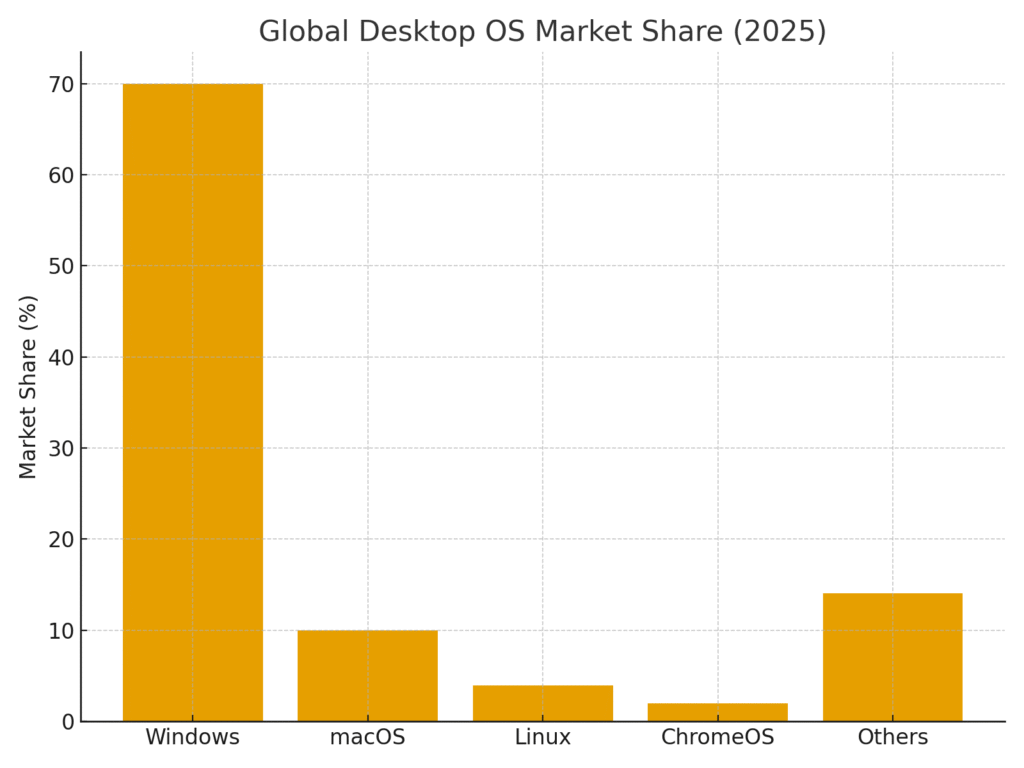
Linux Marketing Statistic #1: Linux Holds 3.93% of Global Desktop Market Share
Linux currently commands about 3.93% of the global desktop operating system market. While this may seem small compared to Windows and macOS, it represents a steady rise over recent years. Marketers see this as an opportunity to target niche but highly engaged users. The growth is attributed to improvements in usability and driver support. This steady upward trend suggests that Linux is carving out a permanent place in the desktop landscape.
Linux Marketing Statistic #2: Linux Accounts for 4.06% of All OS Usage Worldwide
When considering both mobile and desktop platforms, Linux represents about 4.06% of worldwide OS usage. This reflects Linux’s growing role beyond traditional desktops. The figure is significant because it includes devices ranging from servers to embedded systems. For marketers, it highlights the broad ecosystem that Linux touches. This creates multiple entry points for campaigns across various industries.
Linux Marketing Statistic #3: Android Dominates Mobile With Over 72% Share
Android, which is based on the Linux kernel, holds more than 72% of the global mobile market. This staggering dominance showcases how influential Linux really is. For businesses, it’s a reminder that most mobile campaigns inevitably reach Linux users. Developers and marketers often prioritize Android first due to its scale. The statistic underscores Linux’s hidden ubiquity in everyday tech.
Linux Marketing Statistic #4: Linux Reaches 5% Desktop Share in the US
In the United States, Linux recently hit 5% of desktop OS market share for the first time. This milestone proves the growing interest in open-source alternatives. Marketers can view this as a signal that more users are exploring Linux for personal and business use. The increase is partly driven by better user-friendly distributions. This creates more room for Linux-specific marketing and product positioning.
Linux Marketing Statistic #5: 57.8% of All Websites Run on Linux
Over 57% of all websites where the operating system is identifiable are powered by Linux. This dominance reflects Linux’s strength in hosting and server markets. For marketers, this means a vast majority of online platforms already rely on Linux infrastructure. Companies that provide hosting, cybersecurity, or cloud services can leverage this fact in their messaging. The statistic demonstrates Linux’s critical role in powering the internet.
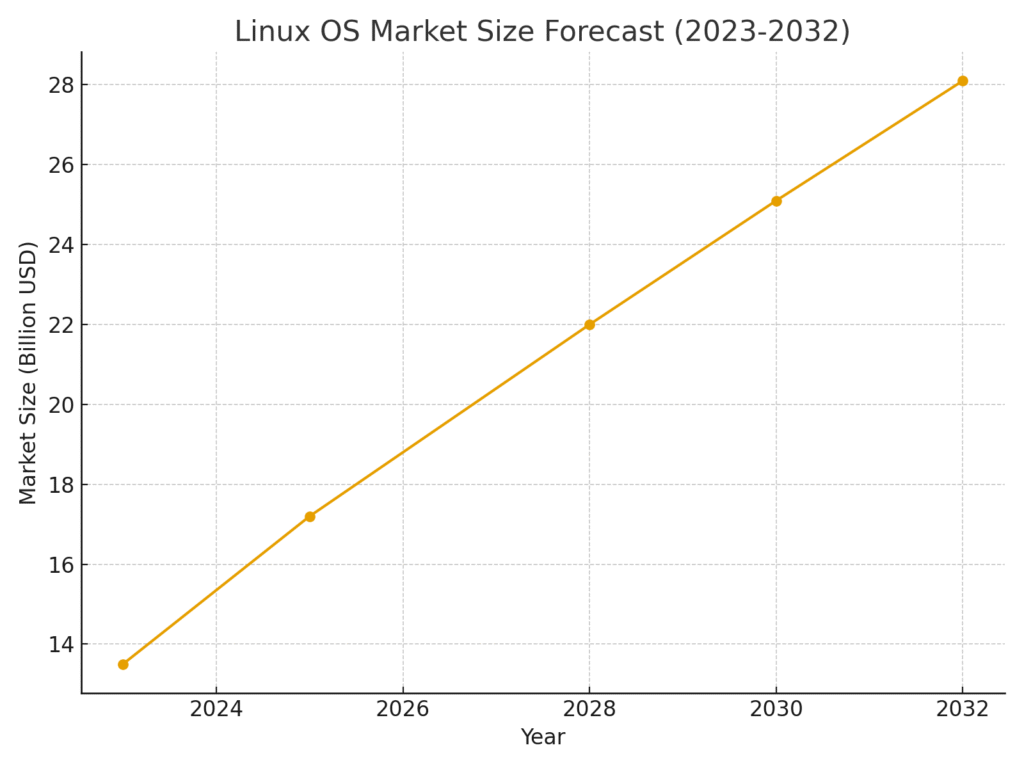
Linux Marketing Statistic #6: Global Linux Market to Reach $28.1 Billion by 2032
The Linux operating system market is expected to grow from $13.5 billion in 2023 to $28.1 billion by 2032. This represents a compound annual growth rate of 8.5%. The strong growth trajectory signals increasing enterprise adoption. Businesses are attracted to Linux for its cost-effectiveness and security. This projection shows long-term opportunities for Linux-centered marketing.
Linux Marketing Statistic #7: Ubuntu Leads Linux Website Market Share at 14%
Among websites running Linux, Ubuntu leads with 14% adoption. This highlights Ubuntu’s reputation for stability and ease of use. Marketers targeting developers and businesses can emphasize Ubuntu compatibility. The distribution’s dominance makes it a safe platform for enterprise campaigns. This statistic underscores Ubuntu’s importance in the Linux ecosystem.
Linux Marketing Statistic #8: Linux Runs on 100% of the World’s Supercomputers
All of the top 500 supercomputers globally run on Linux. This fact illustrates Linux’s unmatched power in high-performance computing. For marketers, it’s an opportunity to align Linux with innovation and cutting-edge technology. Companies in AI, data science, and research often highlight this statistic in their branding. It’s a clear marker of Linux’s superiority in scientific and enterprise workloads.
Linux Marketing Statistic #9: Linux Powers the Majority of Cloud Workloads
Linux dominates workloads in major public cloud platforms such as AWS, Azure, and Google Cloud. Businesses rely on Linux-based servers for scalability and security. For marketers, this creates a massive pool of cloud-based opportunities. Linux’s flexibility makes it the go-to for modern DevOps teams. This dominance cements Linux’s role in cloud marketing narratives.
Linux Marketing Statistic #10: 47.7% of the Top 1,000 Websites Use Linux
Nearly half of the world’s top 1,000 websites run on Linux. This emphasizes its role as the backbone of high-traffic internet platforms. Marketers can leverage this fact when positioning Linux as a reliable and trusted OS. The adoption by large-scale sites enhances Linux’s credibility. This demonstrates its ability to handle global digital demands.

Linux Marketing Statistic #11: Women Represent 9.9% of Linux Kernel Developers
About 9.9% of Linux kernel contributors are women. While still a minority, this reflects growing diversity in open-source communities. For marketers, it highlights inclusivity efforts in tech. Gender diversity can be a key talking point for brands supporting open-source. The number also signals progress in expanding Linux’s contributor base.
Linux Marketing Statistic #12: Linux Dominates IoT and Embedded Systems
Linux is widely used in IoT devices, routers, and embedded systems. Its lightweight design and flexibility make it ideal for such environments. For marketers, this reveals new areas where Linux adoption is accelerating. Companies developing smart devices often prefer Linux-based platforms. This statistic points to Linux’s reach beyond traditional computing.
Linux Marketing Statistic #13: Linux Software Market to Reach $14.5 Billion by 2032
The Linux software ecosystem is projected to grow from $6.3 billion in 2025 to $14.5 billion in 2032. This strong CAGR reflects increased demand for Linux applications. Marketers can use this figure to highlight business opportunities in the open-source space. The statistic signals rising commercial potential around Linux. This market growth aligns with the overall expansion of Linux adoption.
Linux Marketing Statistic #14: Linux Desktop Share in India Surpasses 16%
In India, Linux desktop adoption has reached over 16%. This is significantly higher than the global average. Marketers can interpret this as a regional opportunity for Linux-based campaigns. The adoption surge is attributed to cost-effectiveness and open-source initiatives. This statistic shows the regional potential of Linux in emerging markets.
Linux Marketing Statistic #15: Cost Savings Drive Linux Adoption
Businesses often cite cost savings as a top reason for choosing Linux. The lack of licensing fees makes it attractive to enterprises. For marketers, this provides a strong value-driven messaging angle. Linux is positioned as both affordable and reliable. The statistic reflects how economics fuel Linux’s popularity.

Linux Marketing Statistic #16: 25-30% of Developers Use Linux as Their Main OS
Developer surveys consistently show 25–30% of professional developers prefer Linux. This is much higher than its general desktop market share. For marketers, this reveals Linux’s strength in technical communities. Brands targeting developers often prioritize Linux-friendly products. The statistic reinforces Linux as the OS of choice for innovation.
Linux Marketing Statistic #17: User Perception of Linux is Improving Rapidly
Recent years have seen major improvements in Linux’s usability and perception. Better driver support and polished distributions have boosted adoption. For marketers, this shift creates new storytelling opportunities. Linux is no longer seen as intimidating for average users. This perception change strengthens its mainstream appeal.
Linux Marketing Statistic #18: Linux Powers the Majority of Web Hosting Services
Most web hosting providers rely on Linux servers. This dominance makes Linux central to the digital economy. For marketers, the association with reliability and scalability is crucial. Hosting companies often emphasize Linux in their marketing. This statistic reinforces Linux’s role as a hosting powerhouse.
Linux Marketing Statistic #19: Ubuntu and Debian Together Represent Over 20% of Linux Websites
Ubuntu at 14% and Debian at 7.5% together account for over 20% of Linux-based websites. This concentration gives these distributions significant influence. Marketers targeting Linux users often highlight compatibility with these two systems. The statistic underlines the importance of focusing campaigns around popular distros. It shows that while Linux is fragmented, some leaders dominate.
Linux Marketing Statistic #20: Barriers to Linux Adoption Still Exist
Despite growth, Linux adoption still faces barriers such as hardware compatibility and user inertia. Proprietary software dependence also slows adoption. For marketers, acknowledging these challenges can create more authentic messaging. Overcoming these barriers requires education and better user support. The statistic emphasizes that Linux marketing should balance strengths with transparency.
Why These Linux Marketing Statistics Matter
Looking at these Linux marketing statistics, I can’t help but feel inspired by how far this community-driven system has come. It’s more than just an operating system—it’s a foundation for innovation, collaboration, and growth in almost every corner of tech. For me, the real takeaway is how marketers, developers, and businesses alike can use this data to make smarter decisions and embrace open-source opportunities. Whether you’re running campaigns, building platforms, or just curious about the numbers, Linux has proven it’s not only here to stay, but it’s thriving. And honestly, that’s exciting to witness firsthand.
SOURCES
https://sqmagazine.co.uk/linux-statistics/
https://truelist.co/blog/linux-statistics/
https://www.fortunebusinessinsights.com/linux-operating-system-market-103037
https://jumpcloud.com/blog/the-5-most-popular-linux-distros-2025-guide
https://www.ukwebhostreview.com/linux-statistics/
https://en.wikipedia.org/wiki/Usage_share_of_operating_systems
https://es.wikipedia.org/wiki/Linux_en_computadoras_personales
https://itsfoss.com/linux-market-share/
https://en.ubunlog.com/Linux-July-2025-StatCounter-United-States/
https://writersblocklive.com/blog/linux-statistics/