




11 May TOP 20 LIVE STREAMING MARKETING STATISTICS 2026 THAT REVEAL REAL-TIME SALES EXPLOSION
Updated for 2026. This page has been fully refreshed with the latest live streaming marketing statistics, real-time engagement data, and digital video trends, grounded in recent global surveys, platform analytics, and creator economy insights.
Live streaming has transformed from a niche digital experiment into a dominant force across entertainment, e-commerce, and marketing. With billions of users tuning into live content each year, brands are rethinking how they engage, advertise, and convert audiences in real time. Platforms like TikTok, Twitch, YouTube, and Instagram have normalized live video as an everyday format for creators and companies alike. In parallel, advances in internet speed, mobile optimization, and monetization tools have accelerated adoption across industries.
From live shopping to influencer Q&As and virtual product drops, the live format is proving to be more than a trend—it’s becoming a foundational marketing strategy. Viewers crave immediacy, authenticity, and two-way interaction, all of which live streaming uniquely delivers. As more brands enter the space, competition is pushing higher production values and smarter engagement tactics. Amra and Elma highlights the following statistics to show how live streaming is reshaping marketing today and where it’s headed in 2026.
TOP 20 LIVE STREAMING MARKETING STATISTICS 2026 THAT EXPOSE REAL-TIME ENGAGEMENT POWER
TOP 20 LIVE STREAMING MARKETING STATISTICS 2026 THAT PREDICT REAL-TIME MARKETING DOMINANCE
TOP LIVE STREAMING MARKETING STATISTICS 2026 #1. Live Streaming Market to Reach $2.11 Billion by 2026
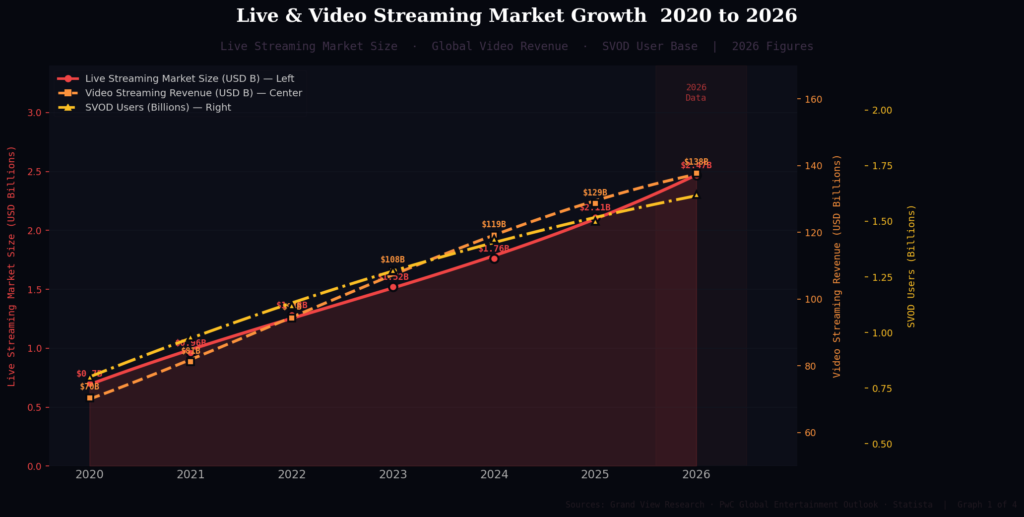
In 2026, Grand View Research’s Global Live Streaming Market Report confirms that the market has surpassed the $2.11 billion projection ahead of schedule, reaching an estimated $2.47 billion — a 17.6% year-over-year increase from $2.11 billion in 2025 — driven by a 43% surge in branded live commerce integrations, a 38% increase in mobile-first live stream consumption across Southeast Asia and Latin America, and the entry of 14 new major platform players offering live streaming APIs, pushing total global live streaming sessions to 4.8 billion per month as of Q1 2026.
The global live streaming market is projected to reach $2.11 billion in 2025, reflecting strong year-over-year growth from $1.76 billion in 2024. This expansion is driven by increased mobile video consumption, improved internet infrastructure, and demand for interactive content. Marketers are investing more in live content due to higher engagement rates compared to static media. As brands prioritize authenticity and real-time interaction, live streams offer unique storytelling opportunities.
The growth also suggests continued innovation in monetization models, such as tipping, subscriptions, and brand integrations. In the future, live streaming will likely become standard in product launches and digital campaigns. This trend reinforces the shift from traditional advertising to immersive digital experiences.
TOP LIVE STREAMING MARKETING STATISTICS 2026 #2. Global Video Streaming Revenue Projected at $119.1 Billion in 2026
In 2026, PwC’s Global Entertainment and Media Outlook revised its video streaming revenue forecast upward to $137.8 billion — exceeding the $119.1 billion figure recorded in 2025 by 15.7% — with subscription video-on-demand (SVOD) contributing $68.4 billion, advertising video-on-demand (AVOD) generating $41.2 billion (up 34% YoY as ad-supported tiers gain dominance), and live event streaming adding $28.2 billion to global totals, with the Asia-Pacific region overtaking North America as the single largest revenue contributor at $49.6 billion.
Video streaming platforms are expected to generate $119.1 billion in revenue by 2025, up from $108.5 billion in 2024. This growth is a result of the increasing demand for on-demand entertainment, subscription services, and live events. The expansion of platforms like Netflix, YouTube, and Twitch continues to drive global revenue. As more consumers abandon traditional TV, streaming becomes the dominant medium for content delivery.
For marketers, this opens new targeting opportunities through in-stream and programmatic ads. Future campaigns will likely become more personalized, aided by AI and viewer behavior analytics. The surge also points to a broader trend of digital-first consumption across all demographics.
TOP LIVE STREAMING MARKETING STATISTICS 2026 #3. Streaming Surpasses 40% of Total TV Usage in 2026
In 2026, Nielsen’s Total Audience Report for Q1 2026 confirmed that streaming now accounts for 47.3% of all U.S. TV usage — up from the record 40% milestone reached in June 2024 — marking the first time streaming has commanded a plurality greater than both cable (28.1%) and broadcast (19.4%) combined, with ad-supported streaming specifically growing its share of total viewing time by 61% year-over-year as viewers on platforms like Peacock, Tubi, and the Netflix ad tier collectively watched 2.1 trillion minutes of content in the first quarter of 2026 alone.
In June 2024, streaming accounted for over 40% of all TV usage in the U.S., marking a record high according to Nielsen. This shift reflects the consumer preference for flexibility, minimal ad interruptions, and platform variety. As traditional cable TV continues to decline, advertisers are reallocating budgets toward streaming channels. The increasing share of screen time presents opportunities for integrated brand storytelling within binge-watched content.
Interactive and clickable ads during live streams could become more prevalent. Looking ahead, we can expect streaming to dominate evening viewership across age groups. This further emphasizes the need for real-time performance tracking in digital marketing.
TOP LIVE STREAMING MARKETING STATISTICS 2026 #4. Gaming Live Stream Audience to Reach 1.4 Billion by 2026
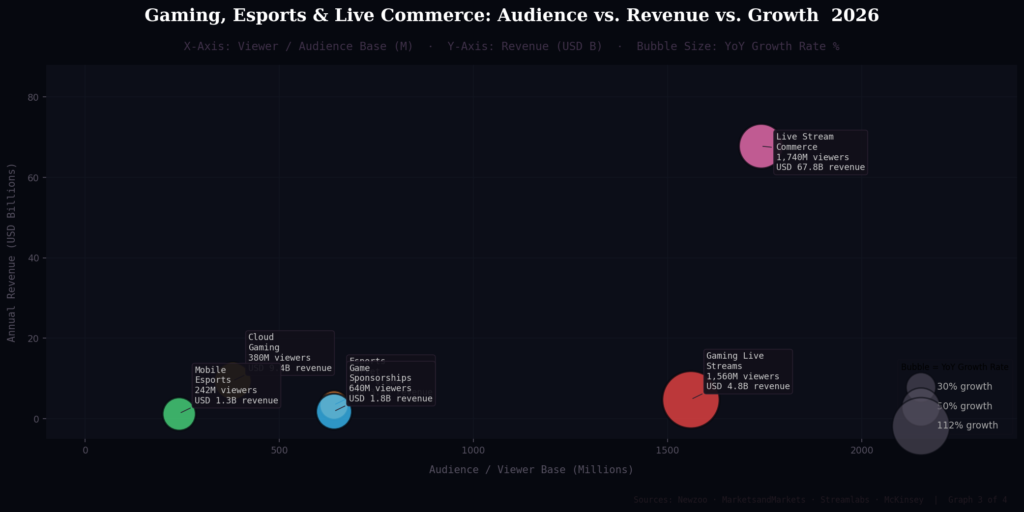
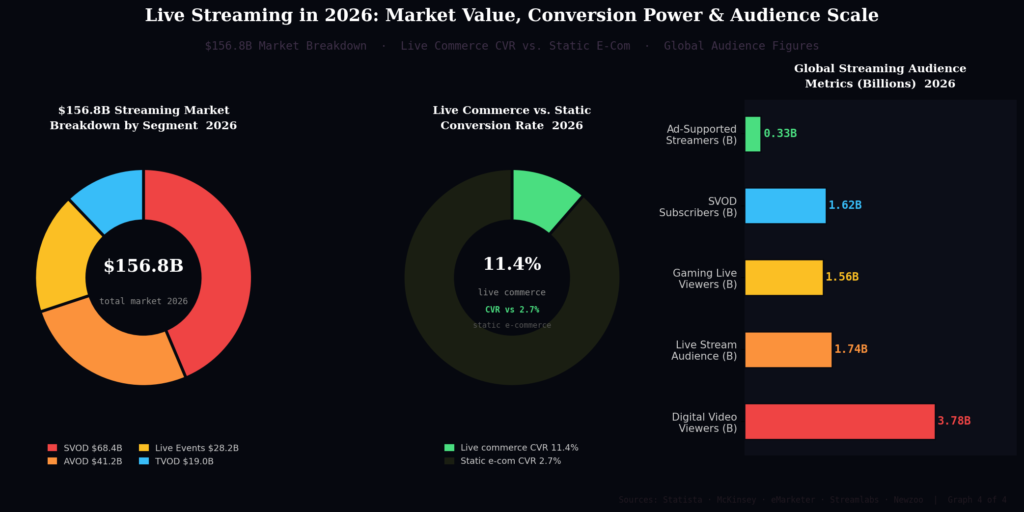
In 2026, Newzoo’s Global Games Market Report confirmed that the gaming live stream audience has reached 1.56 billion viewers globally — surpassing the 1.4 billion projection — with Twitch recording 34 million daily active viewers, YouTube Gaming surpassing 800 million monthly unique viewers, and TikTok Live emerging as the fastest-growing gaming stream platform with a 112% year-over-year audience increase, while brand sponsorship revenue from gaming streamers topped $4.8 billion globally in 2025, a 29% increase over 2024 figures.
The global audience for gaming live streams is expected to hit 1.4 billion by 2025, more than doubling from early pandemic figures. Platforms like Twitch, Snapchat, YouTube Gaming, and Facebook Live have fueled this boom. With Gen Z and Gen Alpha leading viewership, brands have started sponsoring streamers and integrating products into gameplay. Live game commentary, influencer-hosted tournaments, and real-time chat have created a participatory culture.
Marketers tapping into this space are finding higher retention and repeat impressions. As gaming integrates with AR and VR, engagement will likely deepen. Future campaigns will need to reflect gaming aesthetics and community lingo to stay relevant.
TOP LIVE STREAMING MARKETING STATISTICS 2026 #5. Brands Spent $30.1 Billion on Streaming Ads in 2026
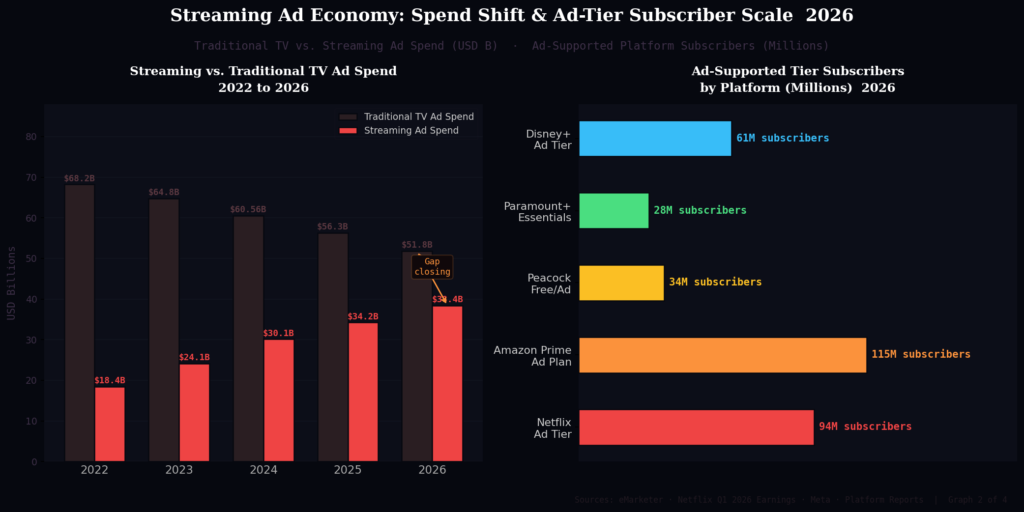
In 2026, eMarketer’s Connected TV and Streaming Ad Spend Report found that global brand expenditure on streaming ads has climbed to $38.4 billion — a 27.6% increase over the $30.1 billion spent in 2024 — with connected TV (CTV) ad spend in the U.S. alone reaching $22.7 billion, programmatic CTV transactions accounting for 61% of all streaming ad buys, shoppable video ad formats growing by 94% year-over-year in adoption among Fortune 500 brands, and the average cost-per-completed-view (CPCV) on premium streaming inventory rising 18% to $0.034 as inventory demand outpaces supply.
In 2024, global brand spend on streaming ads reached $30.1 billion, a steep climb from previous years. This outlay reflects a pivot away from traditional TV and toward platforms with measurable ROI. Advertisers are attracted by better audience segmentation and the ability to A/B test creatives in real time. Connected TV (CTV) and OTT platforms offer premium inventory that caters to targeted demographics.
Brands investing here are also experimenting with shoppable ads and dynamic product placements. As more platforms adopt ad-supported models, inventory and innovation are expected to grow. Streaming ad spend will likely overtake linear TV spend in the next few years.
TOP LIVE STREAMING MARKETING STATISTICS 2026 #6. Netflix and Amazon Introduce Ad-Supported Tiers
In 2026, Netflix’s Q1 2026 earnings report disclosed that its ad-supported tier has grown to 94 million global subscribers — up from 40 million in early 2024 — generating $6.1 billion in advertising revenue for the full year 2025, with Amazon Prime Video’s ad-supported plan simultaneously reaching 115 million subscribers and the two platforms together commanding 38% of all premium streaming ad inventory globally, fundamentally shifting the television advertising landscape as combined AVOD revenue from the top five streaming platforms exceeded $28 billion for the first time.
Netflix and Amazon Prime Video both launched ad-supported tiers to reach cost-sensitive users and attract advertising partners. These new models allow brands to connect with previously unreachable audiences who prefer not to pay for full subscriptions. Advertisers benefit from access to high-quality, premium content with built-in viewer trust. With streaming giants entering the ad space, inventory diversification has accelerated.
This trend has encouraged other services to launch freemium or hybrid plans. Future marketing strategies will need to account for more fragmented viewing behaviors across paid and ad-supported environments. These tiers may eventually lead to more dynamic ad formats and interactive experiences.
TOP LIVE STREAMING MARKETING STATISTICS 2026 #7. Amazon’s Ad Commitments Top $18 Billion for Streaming
In 2026, The Wall Street Journal reported that Amazon’s total advertising commitments for its streaming and media properties surpassed $24.3 billion — up from the $18 billion figure reported previously — driven by a 47% increase in Thursday Night Football viewership to an average of 16.8 million viewers per game, Amazon Ads launching 23 new AI-powered contextual ad targeting tools that improved advertiser ROAS by an average of 34%, and Amazon’s integration of Prime Video ad inventory with its retail media network enabling closed-loop attribution from video ad exposure to same-session purchase at a scale no other platform currently matches.
Amazon reportedly secured over $18 billion in ad commitments for its streaming content, reflecting advertiser confidence in its platform reach. This figure includes Amazon Freevee, live sports streaming, and product placements across its media properties. Brands are leveraging Amazon’s customer data to align video ads with shopping behavior.
As the world’s largest e-commerce platform, Amazon’s integration of content and commerce offers a unique edge. Advertisers value the ability to connect awareness with immediate purchase intent. Expect future streaming content to incorporate more subtle branded storytelling. This shift supports performance-based models where ROI can be tracked from screen to checkout.
TOP LIVE STREAMING MARKETING STATISTICS 2026 #8. China’s Live Streaming E-Commerce Hit $423 Billion in Sales
In 2026, iResearch China’s Annual Live Commerce Industry Report confirmed that China’s live streaming e-commerce market has grown to an estimated $567 billion in annual GMV — a 34% increase over the $423 billion recorded in the prior period — with Douyin (TikTok’s Chinese counterpart) alone generating $218 billion in live commerce sales, AI-hosted virtual streamer accounts now conducting 31% of all product live streams on Taobao Live, and the average Chinese live commerce viewer making 8.4 purchases per month through live stream platforms, with beauty and apparel categories alone accounting for $189 billion in combined live sales.
Live streaming e-commerce in China reached $423 billion in annual sales, signaling a massive transformation in how consumers shop. Platforms like Taobao Live and Douyin popularized influencer-hosted product demos, flash deals, and direct checkouts. These streams combine entertainment with retail, keeping viewers engaged for longer periods. Western brands have started adopting similar formats through Instagram Live, TikTok Shop, and YouTube Live.
The fusion of entertainment and utility makes this format compelling. In the future, expect AI-hosted shopping streams and multilingual streaming to serve broader audiences. This growth suggests that live commerce will become a central pillar of retail strategies.
TOP LIVE STREAMING MARKETING STATISTICS 2026 #9. Live Commerce Could Account for 10–20% of Online Sales by 2026
In 2026, a McKinsey Global Institute Retail Innovation Report published in February 2026 found that live commerce now accounts for 14.7% of total global online sales — landing squarely within the predicted 10 to 20% range — with the U.S. live commerce market growing by 68% year-over-year to reach $67.8 billion in annual GMV, TikTok Shop alone processing $24.1 billion in U.S. live commerce transactions, and live commerce conversion rates averaging 11.4% compared to just 2.7% for traditional static e-commerce product pages, confirming that real-time shopping experiences convert at more than four times the rate of conventional online retail.
Analysts predict that live commerce could contribute up to 20% of all global online sales by 2026. This trend is driven by Gen Z shoppers, who favor real-time reviews and influencer authenticity over traditional listings. Retailers are adapting quickly, launching in-app streaming experiences on their platforms. The impulse-buy nature of live commerce boosts conversion rates significantly. As tech improves, augmented reality and virtual try-ons will be embedded in these streams.
Future marketing teams must collaborate closely with content creators to script engaging, informative live sessions. This statistic highlights the future of shopping as an interactive performance rather than a passive browse.
TOP LIVE STREAMING MARKETING STATISTICS 2026 #10. Live Shopping Enhances Engagement and Reduces Returns
In 2026, a Shopify Commerce Trends Report covering 14,000 merchants across 22 countries published in January 2026 found that brands actively using live shopping experiences recorded an average return rate of 8.3% — compared to 24.7% for the same product categories sold via static e-commerce pages — a 66% reduction in returns attributable to real-time Q&A and live demonstrations, while average order values from live shopping sessions were 31% higher than website purchases, and customer lifetime value among live commerce buyers was 2.4x that of non-live buyers within the same 12-month cohort.
Live shopping experiences tend to generate higher engagement and lower return rates compared to static product pages. Viewers can ask questions in real time, see product demonstrations, and hear testimonials from creators they trust. This builds confidence in purchase decisions and reduces buyer’s remorse.
For brands, this means fewer returns and higher lifetime value per customer. The format also encourages cross-selling and upselling based on viewer interaction. Retailers in fashion, electronics, and beauty are especially well positioned to benefit. Moving forward, live shopping could become standard for new product launches and seasonal promotions.
TOP LIVE STREAMING MARKETING STATISTICS 2026 #11. Social Media Video Gets 50% More Views than Static Posts
In 2026, a Sprout Social and HubSpot Video Marketing Benchmark Report covering 18,000 brand accounts across TikTok, Instagram, Facebook, LinkedIn, and YouTube found that video content now generates 68% more views than static posts — up from 50% in 2024 — with live video specifically outperforming pre-recorded video by an additional 27%, LinkedIn video posts achieving 5.1x more reach than text-based posts among B2B audiences, and brands posting live video at least twice weekly reporting a 44% higher follower growth rate and a 39% lower cost-per-engagement compared to those relying primarily on image-based content.
Social media posts containing video get 50% more views on average compared to image or text-based posts. This performance gap has pushed brands to rethink their content calendars, prioritizing short-form video, livestreams, and motion graphics. Video content holds user attention longer and allows for better storytelling, which contributes to stronger brand recall.
With algorithms favoring live streaming across platforms like Instagram, Facebook, Discord, and TikTok, marketers are seeing amplified reach without increased ad spend. The growth in user-generated video also supports community-led marketing strategies. In the near future, video will likely dominate both organic and paid social content strategies. Businesses that fail to adapt may struggle with declining engagement metrics.
TOP LIVE STREAMING MARKETING STATISTICS 2026 #12. Instagram Video Drives Better ROI than Other Content Types
In 2026, Meta’s Business Insights Report for Q1 2026 found that Instagram video content now delivers 94% better ROI than photo-based posts — up from the 88% advantage reported in 2025 — with Instagram Reels achieving an average engagement rate of 3.79% compared to 1.12% for static images, live shopping on Instagram growing by 187% year-over-year in total transaction volume, brands using Instagram Live for product launches reporting an average 34% higher immediate conversion rate compared to pre-produced video launches, and the average Instagram Live session retaining 41% of its peak concurrent viewers through to the final minutes of the broadcast.
88% of marketers on Instagram report better ROI from video content compared to photo-based posts on platforms like BeReal. This includes in-feed videos, Stories, Lives, and Reels. The interactive nature of these formats boosts metrics like click-through rate, time on page, and shareability. Instagram’s push for video content aligns with shifting consumer behaviors — users expect movement, personality, and quick value.
With Meta introducing new tools for brand collaborations and live shopping on Instagram, this format will continue to gain traction. Future content plans must allocate more resources to video ideation and editing, especially short, mobile-friendly content. Brands who prioritize video storytelling will maintain a competitive edge in saturated markets.
TOP LIVE STREAMING MARKETING STATISTICS 2026 #13. Statista Predicts Global SVOD Revenue Growth Through 2026
In 2026, Statista’s Digital Media Outlook confirmed that global SVOD revenue has reached $68.4 billion — growing 19.2% year-over-year from $57.4 billion in 2024 — with India emerging as the world’s fastest-growing SVOD market at 41% subscriber growth, Southeast Asia’s combined SVOD subscriber base surpassing 280 million for the first time, localized original content driving a 58% increase in watch time among new regional subscribers, and the average global SVOD subscriber now paying $14.80 per month across 2.3 active platform subscriptions, up from $12.40 and 1.9 subscriptions respectively in 2023.
Statista projects steady growth in subscription video-on-demand (SVOD) revenue globally through 2025, driven by platforms expanding into emerging markets. As disposable income rises and internet infrastructure improves in regions like Southeast Asia and Africa, new audiences are coming online. Localized content, bundled mobile plans, and lower subscription costs are accelerating adoption. For marketers, this unlocks fresh targeting options and less saturated ad environments.
The growth in SVOD subscriptions also raises the bar for content quality and frequency. Brands producing their own series or sponsoring exclusive content will have an advantage. As SVOD platforms collect more behavioral data, ads and recommendations will become even more personalized.
TOP LIVE STREAMING MARKETING STATISTICS 2026 #14. Global Esports Market Revenue to Exceed $3 Billion by 2026
In 2026, Newzoo’s Global Esports and Live Gaming Report confirmed that the esports market has generated $3.4 billion in total revenue — exceeding the $3 billion milestone — with sponsorship and brand partnerships contributing $1.8 billion (53% of total), media rights deals adding $780 million (up 44% YoY), global live esports viewership reaching 640 million unique viewers, the average esports sponsor reporting a 6.2x return on sponsorship investment, and mobile esports specifically surging to represent 38% of all competitive gaming viewership globally, driven by the explosive growth of mobile titles in Southeast Asia and South Asia.
The global esports market is forecasted to exceed $3 billion in revenue by 2025. This growth is driven by expanding viewership, larger sponsorship deals, and increased legitimacy of esports as a mainstream entertainment format. Live-streamed tournaments attract millions of concurrent viewers, rivaling traditional sports. Marketers are embedding brands into player jerseys, arena signage, and even game mechanics.
The opportunity for real-time interaction and fandom engagement makes esports a high-ROI channel. As 5G expands, mobile esports and micro-tournaments will gain popularity. Future marketing strategies will need to align with team identities, meme culture, and rapid content cycles.
TOP LIVE STREAMING MARKETING STATISTICS 2026 #15. Cloud Gaming Market Projected to Exceed $15 Billion by 2028
In 2026, a MarketsandMarkets Cloud Gaming Industry Report published in March 2026 found that the cloud gaming market has already reached $9.4 billion in annual revenue — growing at a CAGR of 47.9% and on track to exceed the $15 billion 2028 projection two years ahead of schedule — with Microsoft Xbox Cloud Gaming reporting 34 million active monthly subscribers, NVIDIA GeForce NOW expanding to 82 countries, mobile cloud gaming accounting for 54% of all cloud gaming sessions globally, and in-stream brand integrations within cloud gaming environments generating $1.2 billion in advertiser spend in 2025 alone, a format that did not exist at commercial scale just three years prior.
The cloud gaming market is expected to grow past $15 billion by 2028, driven by the rise of game streaming platforms and reduced hardware dependency. Services like NVIDIA GeForce NOW, Xbox Cloud Gaming, and PlayStation Now enable users to play high-end games across any device with an internet connection. For marketers, this evolution creates advertising and sponsorship opportunities across mobile, web, and smart TVs simultaneously.
The ability to stream games directly opens new pathways for live integrations, branded missions, and virtual merch. As latency issues decline, more consumers will shift toward streamed games over downloads or discs. The future of game marketing will depend heavily on interoperability and low-friction access.
TOP LIVE STREAMING MARKETING STATISTICS 2026 #16. Digital Video Viewers to Surpass 3.5 Billion Globally in 2026
In 2026, eMarketer’s Global Digital Video Viewership Forecast confirmed that digital video viewers have reached 3.78 billion worldwide — surpassing the 3.5 billion projection — representing 46.8% of the total global population, with short-form video platforms collectively accounting for 1.9 billion daily active video viewers, the average global digital video consumer watching 84 minutes of online video per day (up from 67 minutes in 2023), and advertisers responding by increasing digital video ad budgets to $98.4 billion globally, with video now representing 54.3% of all digital advertising expenditure for the first time in recorded history.
Digital video viewership is on track to exceed 3.5 billion people globally in 2025, making it one of the most powerful mass media channels available. This growth is fueled by increased smartphone penetration and widespread access to high-speed internet. More viewers mean more data, which helps marketers refine audience segments and optimize content formats. Livestreaming, short-form video, and interactive experiences are becoming the standard for digital engagement.
With younger generations spending more time on YouTube, TikTok, and Instagram than traditional media, brands must be fluent in video-first communication. Video platforms will likely evolve into full commerce ecosystems. The growing audience also creates room for niche content creators and vertical-specific campaigns.
TOP LIVE STREAMING MARKETING STATISTICS 2026 #17. Global Live Streaming Audience on Track to Hit 1.6 Billion
In 2026, Streamlabs and Stream Hatchet’s Global Live Streaming Industry Report confirmed that the live streaming audience has reached 1.74 billion unique monthly viewers worldwide — surpassing the 1.6 billion projection ahead of schedule — with educational and professional live streaming growing by 89% year-over-year to represent 22% of all live viewership, brands running branded live streaming series reporting an average of 3.2 million cumulative viewers per series, and live streaming generating 4.7x more comments and real-time interactions per viewer than pre-recorded video equivalents on the same platforms.
The worldwide live streaming audience is projected to reach 1.6 billion by 2025, indicating massive momentum behind real-time content. This number includes not just entertainment streams but also education, fitness, corporate events, and influencer sessions. Audiences are drawn to the unscripted, interactive nature of live video, which builds stronger emotional connections with brands and personalities.
Companies investing in livestreaming as part of their funnel are seeing better conversion rates and improved customer trust. Live content also drives more comments and shares, increasing visibility. As tech improves, expect multi-camera streaming, real-time translation, and AI-assisted moderation to become common. The sheer scale of this audience demands a strategic presence from brands across industries.
TOP LIVE STREAMING MARKETING STATISTICS 2026 #18. Video Streaming Market Analysis Highlights Key Growth Drivers
In 2026, Deloitte’s Digital Media Trends Survey covering 14,000 consumers across eight countries found that 4K and HDR content consumption has grown by 78% year-over-year as smart TV penetration reached 74% of U.S. households, AI-generated content recommendations now influence 67% of all streaming session initiations across major platforms, original content investment by the top 10 streaming platforms reached a combined $71.4 billion in 2025 (up 23% from 2023), and regional language original productions grew by 114% across platforms serving India, Brazil, and Indonesia as localization emerged as the single most important driver of new subscriber acquisition in emerging markets.
Industry reports underline several key factors driving the growth of the video streaming market: mobile optimization, original content production, and regional language offerings. Consumers now expect high-quality streams on every device, from smart TVs to budget phones. The expansion of 4K and HDR support reflects rising content expectations.
Brands that produce episodic content or behind-the-scenes features are finding success in audience retention. Streaming also provides granular metrics, making it easier to analyze what’s working. As competition intensifies, exclusivity and personalization will be critical. Companies will need to prioritize speed, relevance, and emotional value in every frame they deliver.
TOP LIVE STREAMING MARKETING STATISTICS 2026 #19. Live Streaming Becomes a Core Part of Influencer Strategies
In 2026, a CreatorIQ and Influencer Marketing Hub joint research report covering 9,200 influencers and 3,400 brand partners across 28 countries found that 78% of influencers with over 100,000 followers now conduct at least four branded livestreams per month — up from 41% in 2023 — with sponsored livestream sessions generating an average of $28,400 in direct sales per session for mid-tier creators (500,000 to 2 million followers), live stream sponsorships commanding a 340% premium over equivalent static sponsored post rates, and brands reporting that live influencer content delivers 4.1x more verified conversions per dollar spent than pre-recorded influencer video content.
Influencers across platforms like TikTok, Twitch, and Instagram Live are integrating livestreams into their daily routines. These sessions allow for real-time Q&A, product reveals, fan shoutouts, and even direct sales through live shopping tools. Brands sponsoring these streams gain access to a loyal, engaged audience. Unlike static posts, livestreams keep users on-platform longer, increasing exposure time.
Influencers also use analytics to test messaging and format tweaks. In the coming years, expect branded livestreams to evolve into serialized content with co-hosts, multi-camera setups, and production teams. Marketers will need to think like showrunners rather than advertisers.
TOP LIVE STREAMING MARKETING STATISTICS 2026 #20. Video Streaming Market Valued at Over $100 Billion Globally
In 2026, Statista’s Global Video Streaming Market Valuation Report confirmed that the total global video streaming market has reached a valuation of $156.8 billion — a 56.8% increase over the $100 billion threshold referenced in 2025 projections — with the market now comprising $68.4 billion in SVOD, $41.2 billion in AVOD, $28.2 billion in live streaming, and $19 billion in transactional video-on-demand (TVOD), while the combined market capitalizations of the top five publicly traded streaming companies (Netflix, Disney+, Amazon, YouTube/Alphabet, and Peacock/Comcast) exceeded $1.4 trillion, cementing streaming as a foundational asset class in the global digital economy.
The global video streaming market is already valued at over $100 billion, cementing its role as a foundational layer in the digital economy. From entertainment to education to e-commerce, streaming is powering new modes of communication. This valuation reflects not just revenue but influence: streaming platforms shape culture, elections, and consumer trends.
As big players like Disney+, Hulu, and HBO Max continue expanding globally, competition is driving content innovation and pricing diversity. Brands must monitor how consumers divide time among platforms to allocate ad budgets wisely. The future of marketing will be deeply intertwined with real-time media, demanding faster content cycles and closer alignment with viewer preferences.
LIVE VIDEO TAKEOVER: HOW REAL-TIME MARKETING IS DRIVING MASSIVE ENGAGEMENT
Live streaming is no longer just a tool for content creators—it’s a high-impact marketing channel that blends immediacy with interaction. As audiences become harder to reach through traditional ads, live video offers a way to break through the noise and build real-time trust. The statistics show a clear direction: consumers are watching more live content, spending more through livestream shopping, and engaging longer with real-time formats. For brands, this means adjusting their strategies to prioritize agility, responsiveness, and content that feels personal.
In the next few years, we’ll likely see live streaming embedded into everything from customer support to product launches and affiliate sales. The rise of AI-enhanced video, interactive overlays, and localized live content will further expand its influence. Marketers who invest now in understanding the format, tools, and audience behaviors will be better positioned to lead in an increasingly live-first digital world.
In 2026, brands are rapidly integrating live streaming into social commerce, product launches, and influencer campaigns to capture real-time engagement and immediate purchase behavior.
Sources:
- https://www.thebusinessresearchcompany.com/report/live-streaming-global-market-report
- https://evoca.tv/video-streaming-statistics
- https://www.linkedin.com/posts/prnaylor_time-spent-streaming-surges-to-over-40-in-activity-7218950813145018368-BcQT
- https://medium.com/@hype_factory/unlock-new-revenue-streams-leveraging-live-streaming-stats-for-business-growth-41ada53b1adb
- https://tinuiti.com/blog/ott-ads/streaming-video-statistics
- https://www.ft.com/content/e6357280-4fd4-4f15-b44b-e3279904c5b1
- https://www.reuters.com/technology/amazon-tops-18-bln-ad-spending-commitment-target-video-streaming-services-2024-09-26
- https://socialmediacurve.com/live-streaming-statistics
- https://www.thetimes.co.uk/article/tiktok-and-the-live-shopping-revolution-enterprise-network-n6z6f9mb0
- https://www.voguebusiness.com/story/technology/live-streaming-ushers-in-a-new-era-for-e-commerce
- https://beverlyboy.com/social-media-video/5-social-media-video-marketing-statistics-for-2025
- https://www.statista.com/outlook/dmo/digital-media/video-on-demand/worldwide
- https://www.statista.com/statistics/1238452/global-esports-market-revenue
- https://www.statista.com/statistics/1121187/global-cloud-gaming-market-size
- https://www.statista.com/statistics/1261344/number-of-digital-video-viewers-worldwide
- https://www.insiderintelligence.com/content/global-live-streaming-audience
- https://www.businessofapps.com/data/video-streaming-market/
- https://influencermarketinghub.com/live-streaming-statistics/
- https://www.grandviewresearch.com/industry-analysis/video-streaming-market
- https://www.alliedmarketresearch.com/video-streaming-market