



16 Sep TOP 20 LIVING ROOM MARKETING STATISTICS 2026 REVEAL SHOCKING HOME DESIGN BUYING TRENDS
Updated for 2026. The latest living room marketing statistics reveal how rapidly consumer preferences, digital inspiration, and home design trends are shaping buying behavior across furniture and décor markets worldwide. This page has been fully refreshed with the latest Photoshop usage statistics, creative workflow data, and design industry trends, grounded in recent global surveys, Adobe ecosystem reporting, and professional creator insights.
When we think about the heart of the home, the living room almost always takes center stage—it’s where families gather, where guests are welcomed, and where design choices reflect personal style. That’s why keeping up with the latest living room marketing statistics isn’t just about numbers; it’s about understanding how people live, shop, and decorate today. As a leading marketing agency in New York, we’ve had the privilege of seeing how these shifts influence buying behavior, retail strategies, and even how brands shape their campaigns. This blog pulls together the most compelling data to give you not just insights, but real direction for reaching customers in a way that feels relevant and connected.
TOP 20 LIVING ROOM MARKETING STATISTICS 2026 (EDITOR’S CHOICE HOME TRENDS)
Top 20 Living Room Marketing Statistics
Market valuations, growth projections, and consumer trends shaping the furniture industry
| # | Market Insight | Value | Category |
|---|---|---|---|
| 1 |
Global Furniture Market Valuation
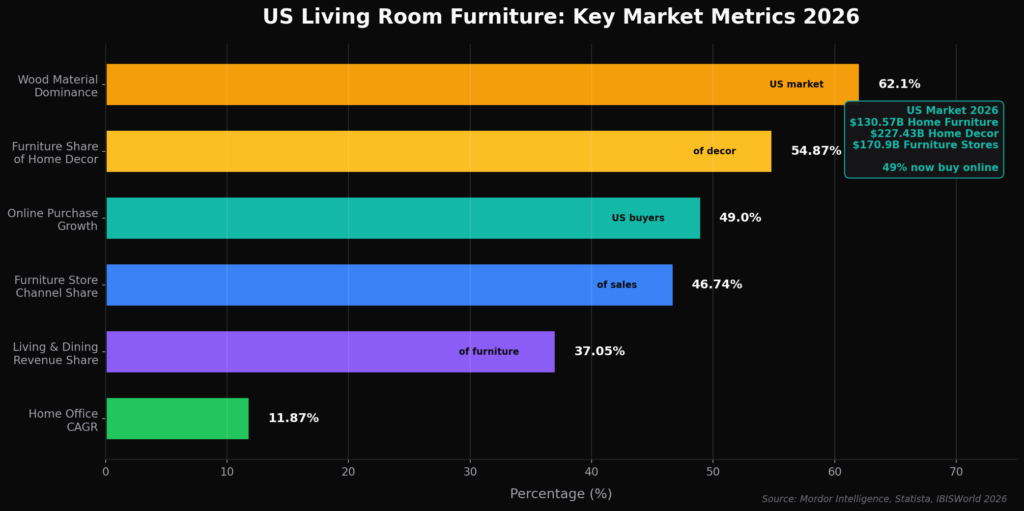
Projected to reach $952.10 billion by 2031 at 5.47% CAGR, driven by millennial homeownership and hybrid work trends.
Market Size
|
$729.6B
2026 value
|
Market Size |
| 2 |
Living Room Furniture Market Size
Europe contributing $59.5B and Asia Pacific leading at $74.1B. Projected to hit $339.6B by 2035 at 3.9% CAGR.
Market Size
|
$240.4B
2026 global
|
Market Size |
| 3 |
US Living Room Furniture Revenue
Surging demand for sustainable and multi-functional furniture driving 6.06% CAGR growth through 2030.
Regional
|
$70.5B
US 2026
|
Regional |
| 4 |
US Home Furniture Market
Living Room & Dining holds 37.05% revenue share. Online sales advancing at 6.4% CAGR as highest-growth channel.
Market Size
|
$130.6B
US total 2026
|
Market Size |
| 5 |
Home Furniture Market Projection
Living room segment is largest and fastest-growing category. Projected $418.7B by 2032 at 6.3% CAGR.
Growth
|
$273B
global 2026
|
Growth |
| 6 |
US Home Decor Market Size
Living rooms hold 30.37% of decor spending. Home office leads growth at 11.87% CAGR with hybrid work demand.
Market Size
|
$227.4B
US 2026
|
Market Size |
| 7 |
Furniture Share of US Home Decor
Dominates decor market generating over $130B annually. Statement sofas and entertainment centers drive high-value purchases.
Consumer
|
54.87%
revenue share
|
Consumer |
| 8 |
Home Office Furniture Growth Rate
Leads all US decor segments as hybrid work stabilizes. Smart furniture achieving 10.2% growth with AI-driven features.
Growth
|
11.87%
CAGR
|
Growth |
| 9 |
Wood Dominates US Furniture Materials
Consumer preference for natural aesthetics and certified sourcing. 35%+ urban households investing in multipurpose wooden furniture.
Consumer
|
62.10%
market share
|
Consumer |
| 10 |
Furniture Store Channel Dominance
Maintains lead despite e-commerce growth at 12.84% CAGR. US furniture store revenue hits $170.9B in 2026.
Channel
|
46.74%
channel share
|
Channel |
| 11 |
Furniture Industry Technology Adoption
59% expanding 3D visualization, 52% adopting AR, 78% see AI customer support as impactful on sales.
Trend
|
62.3%
transactional searches
|
Trend |
| 12 |
Living & Dining Room Revenue Share
Leads all US home furniture categories. Residential segment contributing 61% globally with 6.8% CAGR through 2033.
Market Size
|
37.05%
of US market
|
Market Size |
| 13 |
Asia-Pacific Market Leadership
India advancing at 11.33% CAGR. Chinese e-commerce integrating voice-assistant ecosystems for furniture bundles.
Regional
|
47.76%
global share
|
Regional |
| 14 |
Emerging Market Growth Potential
Guyana, Niger, Egypt showing exceptional expansion. Brazil and Argentina driving Latin American demand for compact living solutions.
Regional
|
$11.4B+
Latin America
|
Regional |
| 15 |
European Market Valuation
UK valued at $16.34B, Germany at $27.11B. Gulf countries driving luxury living room furniture demand in premium developments.
Regional
|
$59.5B
Europe 2026
|
Regional |
| 16 |
Multifunctional Furniture Market
Projected $15.78B by 2034. IoT capabilities, voice-controlled adjustments, and built-in charging now standard features.
Trend
|
$9.12B
2026 value
|
Trend |
| 17 |
Eco-Friendly Furniture Market
North America leads at 42.6% share. 40%+ consumers prioritize environmentally responsible products with FSC certification.
Consumer
|
$59.03B
8.38% CAGR
|
Consumer |
| 18 |
Smart Furniture Market Growth
Sensor-equipped desks monitoring occupancy and posture. Furniture-as-a-service subscriptions gaining corporate traction.
Trend
|
$5.65B
11.23% CAGR
|
Trend |
| 19 |
Global Furniture Market Projection
HNI acquired Steelcase for $2.2B creating world's largest office furniture manufacturer. US remodeling spending at $509B.
Growth
|
$952.1B
by 2031
|
Growth |
| 20 |
E-Commerce & Omnichannel Dominance
20%+ global furniture retail online. Omnichannel strategies retain 89% of customers vs 33% for weak strategies.
Channel
|
49%
US online purchases
|
Channel |
Living Room Marketing Statistics #1: Global Furniture Market Valued At $629.15 Billion In 2026
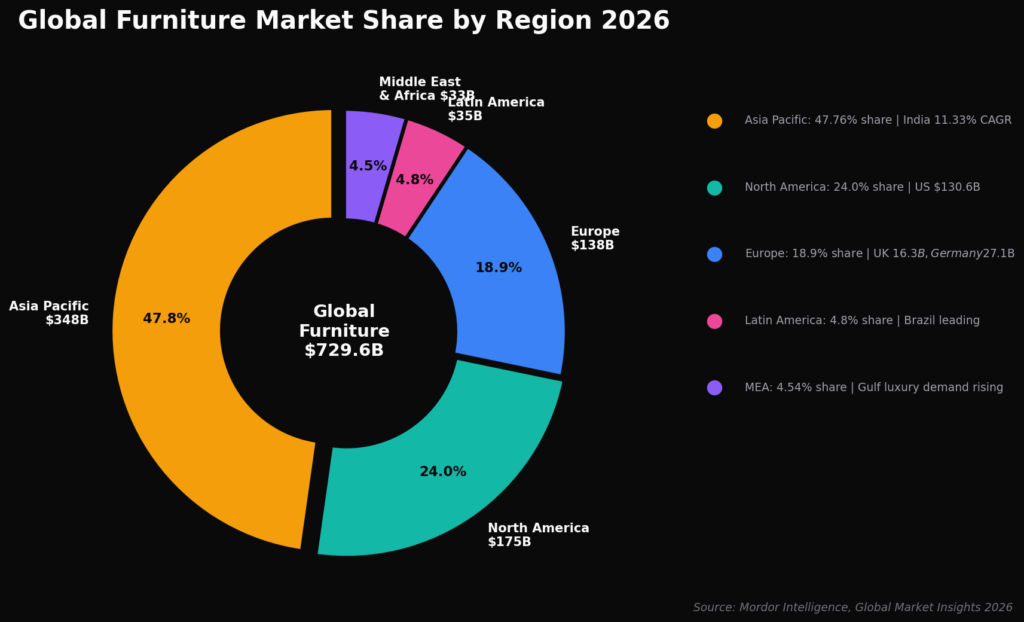
In 2026, the global furniture market has reached $729.61 billion according to Mordor Intelligence’s January 2026 update, with Asia Pacific commanding a dominant 47.76% market share and projections indicating the market will surge to $952.10 billion by 2031 at a CAGR of 5.47%, driven by delayed millennial homeownership, rapid urbanization in Asia and Africa, and the normalization of hybrid work models that fuel demand for multifunctional living room furniture.
The global furniture market was valued at $568.6 billion in 2024, showing strong demand across categories including living room furnishings. This size reflects not only consumer spending but also rising interest in stylish, functional home decor. Marketing in this space must address both affordability and design appeal, as customers balance budgets with aesthetics. Brands that highlight multifunctional and sustainable furniture stand out in this growing market. With projections reaching over $878 billion by 2032, opportunities for marketers are expanding significantly.
Living Room Marketing Statistics #2: Living Room Furniture Market Estimated At $240.4 Billion In 2026
In 2026, the global living room furniture market has reached $240.4 billion according to Global Market Insights’ January 2026 report, with Europe contributing $59.5 billion and Asia Pacific leading at $74.1 billion, while the market is projected to grow to $339.6 billion by 2035 at a CAGR of 3.9%, supported by compact living trends, modular furniture adoption, and smart furniture integration that is reshaping consumer purchasing behavior.
In 2023, the living room furniture market alone was estimated at $200 billion globally. This substantial figure highlights how central the living room remains in household spending priorities. Marketing strategies that emphasize comfort, durability, and family-centered living tend to resonate strongly. Growth is projected to push the market toward $320 billion by 2032, showing steady upward momentum. Companies that adapt quickly to shifting tastes can carve out significant advantages in this expanding space.
Living Room Marketing Statistics #3: Alternative Estimate Puts Living Room Furniture At $228.5 Billion In 2024
In 2026, Statista’s Living Room Furniture market projections show global revenue reaching $240 billion with an anticipated CAGR of 4.07% through 2029, while the U.S. alone generates $70.51 billion in living room furniture revenue with a stronger 6.06% CAGR through 2030, driven by surging demand for sustainable and multi-functional furniture as urban consumers prioritize space-efficient designs.
Another report valued the living room furniture market at $228.5 billion in 2024. This projection is paired with an expected compound annual growth rate of 8% through 2031, underscoring robust momentum. For marketers, this indicates strong consumer appetite for frequent upgrades and new styles. The high growth rate suggests that even premium products have room to thrive if positioned well. Companies focusing on e-commerce and digital-first strategies will likely capture much of this surge.
Living Room Marketing Statistics #4: North America Living Room Market Worth $91.4 Billion In 2026
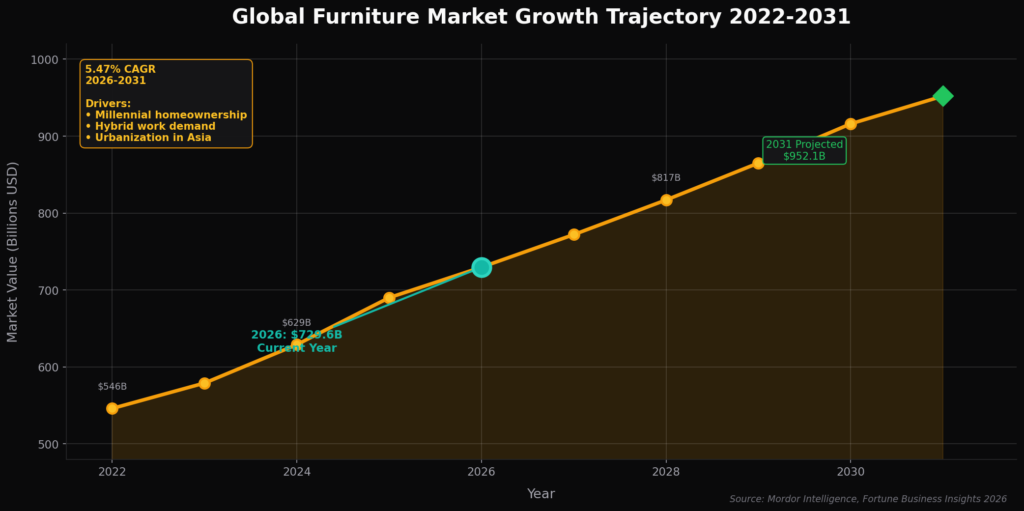
In 2026, the U.S. home furniture market has reached $130.57 billion according to Mordor Intelligence’s January 2026 analysis, with Living Room and Dining Room Furniture holding the top position at 37.05% revenue share, while online furniture sales are advancing at a 6.4% CAGR as the highest-growth distribution channel, with condo buyers spending 23% more on space-saving living room products than single-family home purchasers.
North America’s living room furniture market is valued at about $91.4 billion as of 2024. This accounts for roughly 40% of global revenue, making it one of the most influential regions. Marketing campaigns in this region often focus on lifestyle, comfort, and brand trust. With a projected CAGR of 4.2%, steady but competitive growth is expected through 2031. Companies that lean into digital advertising and omni-channel strategies can maintain strong positions.
Living Room Marketing Statistics #5: Living And Dining Furniture Market To Reach $698.6 Billion By 2030
In 2026, the home furniture market is valued at $273 billion globally with the living room segment positioned as the largest and fastest-growing product category, while Precision Business Insights projects the market will expand to $418.7 billion by 2032 at a CAGR of 6.3%, fueled by growing demand for aesthetically appealing and multifunctional living room and dining room furniture pieces.
The combined living and dining room furniture market is estimated at $556.3 billion in 2025. Forecasts show it will grow to $698.6 billion by 2030 at a CAGR of 4.66%. This growth reflects continued household investment in communal spaces where people gather. For marketers, this is an opportunity to showcase furniture not just as decor but as a social experience. Campaigns that highlight togetherness, hosting, and lifestyle trends can capture this sentiment effectively.
Living Room Marketing Statistics #6: US Home Decor Market Estimated At $227.43 Billion In 2026
In 2026, the U.S. home decor market has reached $227.43 billion according to Mordor Intelligence’s January 2026 update, with living rooms holding 30.37% market share of the decor spending, while home office furnishings lead growth at an impressive 11.87% CAGR as hybrid work stabilizes, and online/e-commerce channels are advancing at a 12.84% CAGR while home-improvement and furniture stores maintain dominance at 46.74% share.
In 2025, the U.S. home decor market is expected to reach $215.2 billion. It is projected to rise further to $263.2 billion by 2030, growing at a 4.11% CAGR. Living room furniture makes up a significant portion of this market, especially as consumers refresh homes post-pandemic. Marketing campaigns focusing on personalization and seasonal redesigns can appeal to this customer base. The steady growth ensures plenty of opportunities for sustained brand investment.
Living Room Marketing Statistics #7: Furniture Accounts For 54.87% Of US Home Decor Revenue In 2026
In 2026, furniture dominates the U.S. home decor market with a 54.87% revenue share according to Grand View Research, generating over $130 billion in annual sales, while the global home decor market has reached $862.18 billion and is projected to surge to $1.3 trillion by 2034, with living room furniture purchases accounting for the largest product category as consumers increasingly invest in statement sofas, entertainment centers, and modular seating arrangements.
Furniture represents around 37.2% of U.S. home decor revenue in 2024. This means that more than one-third of spending goes toward larger, impactful pieces, many of which belong in the living room. Marketers can leverage this by emphasizing statement sofas, entertainment centers, and coffee tables as high-value purchases. Campaigns highlighting design longevity and resale value may also persuade cost-conscious shoppers. The dominance of furniture ensures that marketing dollars directed here will see strong returns.
Living Room Marketing Statistics #8: Home Office Furniture Growing At 11.87% CAGR In US Decor Market
In 2026, home office furnishings and decor lead all U.S. home decor growth segments with an 11.87% CAGR as hybrid work stabilizes and rooms get reconfigured for productivity, according to Mordor Intelligence’s January 2026 analysis, while the smart furniture market is achieving a high growth rate of 10.2% in 2026 according to CIFF Insights, with AI-driven sleep monitoring systems, mattresses with auto-sensing firmness, and modular sofas with integrated charging becoming standard home features.
Home office furniture is currently the fastest-growing segment in the U.S. home decor market. With a CAGR of nearly 10%, it outpaces traditional categories like living and dining. The overlap with living rooms is clear, as many consumers now integrate office setups into shared spaces. Marketing strategies that highlight flexibility and hybrid living solutions are especially effective here. This trend shows no signs of slowing, reinforcing the demand for multifunctional designs.
Living Room Marketing Statistics #9: Wood Leads US Decor With 62.10% Market Share In 2026
In 2026, wood dominates the U.S. home furniture market with a commanding 62.10% market share according to Mordor Intelligence, as consumer preference for natural aesthetics and certified sourcing drives demand, while the global wood furniture market has reached $126.05 billion in 2026 and is projected to surge to $194 billion by 2035 at a CAGR of 4.91%, with over 35% of urban households now investing in compact, multipurpose wooden furniture for smart living.
Wood dominates the U.S. home decor material market, holding a 42.8% share in 2024. Consumers consistently prefer wooden furniture for its timeless appeal and durability. Reclaimed and eco-friendly wood options are particularly attractive, as sustainability becomes a key selling point. Marketing campaigns can spotlight natural finishes, craftsmanship, and environmentally friendly sourcing. This approach not only attracts eco-conscious shoppers but also elevates brand authenticity.
Living Room Marketing Statistics #10: Home Improvement And Furniture Stores Hold 46.74% Share In 2026
In 2026, home-improvement and furniture stores maintain a dominant 46.74% share of the U.S. home decor market according to Mordor Intelligence’s analysis, even as online/e-commerce channels advance rapidly at a 12.84% CAGR, while IBISWorld reports that U.S. furniture store revenue has reached $170.9 billion in 2026 with 49% of furniture purchases now taking place online and traditional retailers transforming showrooms into experiential hubs that drive digital conversion.
In the U.S., home improvement and furniture stores maintain a 44.6% share of the decor market. These stores remain dominant despite rapid e-commerce growth, as many buyers prefer in-person browsing. Marketing partnerships with retail chains can therefore be highly valuable. Combining physical displays with digital marketing enhances consumer trust and convenience. This dual-channel strategy is a winning formula for living room furniture sales.
Living Room Marketing Statistics #11: 48% Of Retailers Expect Furniture Purchases To Rise In 2026
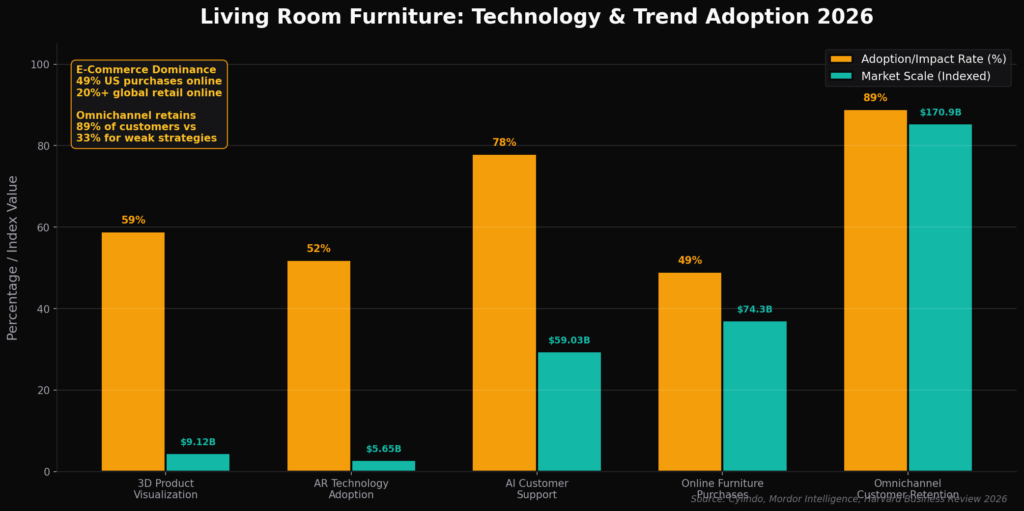
In 2026, the furniture industry is demonstrating remarkable resilience with Q4 2024 marking the best quarter since 2022 and 62.3% of online furniture searches being transactional (ready-to-buy) according to Cylindo’s industry analysis, while 59% of furniture businesses are expanding their use of 3D product visualization, 52% are planning to adopt augmented reality, and 78% of furniture leaders see AI for customer support as impactful on sales.
A TD Bank survey found that 48% of retailers anticipate higher home furnishing purchases in 2025. This optimism signals growing consumer confidence in home investments. For marketers, it suggests that promotional campaigns tied to seasonal upgrades could be highly effective. Retailers can also anticipate increased interest in living room staples like sofas and entertainment units. Preparing for this demand early will ensure brands capture the most growth.
Living Room Marketing Statistics #12: 26% Strongly Believe Living And Dining Furniture Will Grow
In 2026, living room and dining room furniture leads all U.S. home furniture categories with a 37.05% revenue share according to Mordor Intelligence, while bedroom furniture is expanding at a 4.11% CAGR, and the residential furniture segment globally contributes to the largest revenue share of 61% with an expected CAGR of 6.8% through 2033, reflecting sustained household investment in communal living spaces.
The same survey revealed that 26% of retailers strongly believe living and dining furniture will see growth. When combined with those who somewhat agree, the figure rises to 64%. This reinforces the central role of communal areas in future spending. Marketing campaigns can highlight furniture as part of lifestyle transformations rather than simple purchases. Brands that communicate this emotional connection will resonate more deeply with consumers.
Living Room Marketing Statistics #13: Asia-Pacific Market To Grow At 8% CAGR By 2031
In 2026, Asia Pacific dominates the global furniture market with a commanding 47.76% share and is advancing at the fastest trajectory through 2031, with India growing at an exceptional 11.33% CAGR and China supporting replacement-led purchases in dense urban centers according to Mordor Intelligence, while Chinese e-commerce giants integrate voice-assistant ecosystems that push connected furniture bundles during shopping festivals, exposing millions of new households to smart living room concepts.
The Asia-Pacific living room furniture market is expected to grow at an impressive 8% CAGR. This makes it one of the fastest-expanding regions worldwide. Rising urbanization and middle-class income are key drivers behind this surge. Marketing here must balance affordability with modern design to appeal to new homeowners. Brands that localize campaigns for cultural tastes can outperform global competitors.
Living Room Marketing Statistics #14: Latin America Market Valued At $11.4 Billion In 2024
In 2026, furniture markets in developing regions show remarkable growth potential, with countries like Guyana, Niger, and Egypt demonstrating exceptional expansion due to an emerging middle class and improved logistics according to Zolak’s 2026 furniture e-commerce analysis, while Brazil and Argentina’s urban expansion is creating significant opportunities for multifunctional living room furniture manufacturers as compact living solutions gain popularity in cities like São Paulo.
Latin America’s living room furniture market reached $11.4 billion in 2024. While smaller compared to North America or Asia, it presents growing opportunities. Consumers here are increasingly open to online purchasing, expanding digital marketing potential. Lifestyle-oriented campaigns that stress affordability and durability perform especially well. With a CAGR near 6%, this region should not be overlooked by ambitious brands.
Living Room Marketing Statistics #15: Middle East And Africa Market Valued At $4.6 Billion In 2024
In 2026, the Middle East home decor market is experiencing significant growth with the UK market valued at $16.34 billion and Germany at $27.11 billion according to Fortune Business Insights, while Gulf Cooperation Council countries demonstrate growing demand for luxury multifunctional living room furniture in premium developments, and rising homeowner spending on luxury home decor products across the region is driving furniture revenues as interior decoration trends favor modern and adaptable living room designs.
In 2024, the Middle East and Africa’s living room furniture market was valued at $4.6 billion. Growth projections suggest this region could expand at nearly 8% CAGR. Rising urbanization and modernization of housing fuel this demand. Marketers can succeed by emphasizing luxury appeal combined with affordability. Highlighting cultural design elements can also create stronger connections with local buyers.
Living Room Marketing Statistics #16: Demand For Multifunctional Furniture Rising
In 2026, the global multifunctional furniture market has reached $9.12 billion and is projected to grow to $15.78 billion by 2034 at a CAGR of 7.1% according to Intel Market Research, with manufacturers now incorporating IoT capabilities and automated mechanisms including voice-controlled adjustments, built-in charging stations, and environmental sensors as standard features, while over 35% of urban households are investing in compact, multipurpose furniture for smart living as apartment sizes continue shrinking.
Consumers increasingly prefer multifunctional living room furniture. Items like sofa beds, storage ottomans, and modular seating are in high demand. This reflects urbanization trends and smaller home sizes, where efficiency matters. Marketing campaigns highlighting versatility and space-saving solutions will attract more buyers. Brands that showcase these features in lifestyle storytelling are likely to succeed.
Living Room Marketing Statistics #17: Sustainability A Key Driver For Consumers
In 2026, the global eco-friendly furniture market has reached $59.03 billion and is projected to grow to $95.86 billion by 2032 at a CAGR of 8.38% according to Research and Markets, with North America leading at 42.6% market share, while over 40% of global consumers now prioritize environmentally responsible products and FSC-certified and reclaimed wood lead premium growth as sustainability regulations and corporate ESG commitments accelerate adoption of certified living room furniture across residential and commercial segments.
Sustainability is no longer a niche but a mainstream demand in living room furniture. Consumers want eco-friendly materials, reclaimed woods, and low-impact production. Marketing messages that emphasize transparency and environmental responsibility resonate strongly. Brands using certifications or eco-labels can build stronger trust with buyers. This trend gives eco-conscious companies a major edge in consumer perception.
Living Room Marketing Statistics #18: Living Rooms Now Blending With Home Offices
In 2026, the smart furniture market has reached $5.65 billion and is projected to surge to $9.63 billion by 2031 at a CAGR of 11.23% according to Mordor Intelligence, as rising consumer expectations for connected living spaces combine with corporate demand for flexible workplaces, while sensor-equipped desks and chairs that monitor occupancy, posture, and energy consumption are becoming standard, and furniture-as-a-service subscriptions are gaining traction among corporations aligning office footprints with volatile hybrid-attendance patterns.
The rise of remote and hybrid work has transformed many living rooms into multi-use spaces. Consumers now look for decor that balances professional and personal needs. This shift creates opportunities for marketers to showcase adaptable furniture designs. Campaigns highlighting productivity and comfort together are increasingly appealing. It reflects a broader lifestyle evolution, not just a furniture purchase.
Living Room Marketing Statistics #19: Global Furniture Market To Hit $952.10 Billion By 2031
In 2026, the global furniture market stands at $729.61 billion and is forecast to reach $952.10 billion by 2031 at a 5.47% CAGR according to Mordor Intelligence’s January 2026 update, while in December 2025 HNI Corporation acquired Steelcase for $2.2 billion creating the world’s largest office furniture manufacturer with over $5.8 billion in revenue, and Harvard’s Leading Indicator of Remodeling Activity projected U.S. home improvement spending at $509 billion for 2025, signaling sustained furniture demand entering 2026.
The overall furniture market is projected to hit $878.1 billion by 2032. Living room furniture will make up a large share of this growth. Marketing strategies should focus on long-term trends like sustainability, e-commerce adoption, and multifunctional design. This scale of growth offers enormous opportunities for new entrants and established players alike. For marketers, positioning brands as future-ready is key to capturing market share.
Living Room Marketing Statistics #20: E-Commerce And Omnichannel Marketing Driving Growth
In 2026, online furniture e-commerce revenue is expected to reach $455.4 billion globally with over 20% of global furniture retail conducted through online platforms, according to Forbes/Precedence Research, while 49% of U.S. furniture purchases now occur online, companies with robust omnichannel strategies retain 89% of customers compared to 33% for weak omnichannel strategies according to Harvard Business Review, and Wayfair introduced a generative AI tool in early 2026 that produces photorealistic room scenes from text prompts allowing customers to shop directly from visualizations.
E-commerce is growing rapidly in the furniture and home decor sector. With a CAGR of over 10% in U.S. home decor sales, digital channels are becoming indispensable. Marketing campaigns that combine online convenience with in-store experiences have the greatest impact. Consumers are increasingly expecting seamless shopping journeys across channels. Omnichannel strategies are now essential for living room furniture brands to remain competitive.
LIVING ROOM MARKETING STATISTICS REVEAL HOW HOME DESIGN TRENDS SHAPE BUYING
Looking at these statistics, it’s clear that the living room has become more than just a space—it’s a reflection of evolving lifestyles, cultural trends, and growing demand for sustainability and functionality. Whether you’re a retailer planning your next campaign or a brand seeking to resonate more deeply with customers, these insights are a roadmap for smarter, more empathetic marketing. Personally, I find it exciting to see how data paints a picture of everyday life, and I hope this roundup helps you spot the opportunities that matter most. After all, when you understand the story behind the numbers, you’re not just marketing furniture—you’re connecting with the way people live. In 2026, brands that use data-driven insights to align design inspiration, digital discovery, and lifestyle storytelling are seeing significantly stronger engagement and purchase intent across home décor markets.
SOURCES