



16 Sep TOP 20 LUXURY CONSUMER MARKETING STATISTICS 2026 REVEAL SHOCKING AFFLUENT BUYER BEHAVIOR
Updated for 2026. This page has been fully refreshed with the latest luxury consumer marketing statistics, high-net-worth buyer behavior insights, and premium brand engagement trends based on new global luxury industry reports and consumer surveys.
When it comes to understanding how luxury brands thrive in today’s fast-changing marketplace, diving into the latest luxury consumer marketing statistics is essential. These insights not only highlight how preferences are shifting but also reveal what truly inspires affluent buyers to engage, purchase, and remain loyal. As someone who is passionate about storytelling and strategy, I believe numbers tell us far more than just market sizes—they help us connect with real people behind those purchases.
That’s exactly why I’ve partnered insights with practical context, so you can use this research to shape smarter campaigns. And if you’re looking for expert guidance, collaborating with a marketing agency in New York that understands luxury audiences can help you transform these statistics into real growth opportunities.
TOP 20 LUXURY CONSUMER MARKETING STATISTICS 2026 SHOCKING INSIGHTS FOR ELITE BRANDS
Top 20 Luxury Consumer Marketing Statistics
Essential market insights for high-end brand positioning and affluent consumer engagement in 2026
| # | Market Insight | Figure | Category |
|---|---|---|---|
| 1 |
Global Luxury Market Valuation
Bain & Company January 2026 Luxury Study. Experiential luxury categories grew 8.7% year-over-year.
Market
|
$1.52T
total market
|
Market |
| 2 |
Future Growth Outlook To 2030
McKinsey projects $430B personal luxury by 2030. Ultra-high-net-worth driving 47% of growth.
Growth
|
3.1%
CAGR 2024-30
|
Growth |
| 3 |
Luxury Fashion Segment Size
Digital fashion NFTs generated $2.8B. 34% of Gen Z purchased virtual garments in past 12 months.
Fashion
|
$115.8B
2026 value
|
Fashion |
| 4 |
E-Commerce Luxury Sales Share
Mobile commerce now 67% of online luxury. DTC digital channels grew 18% year-over-year.
Digital
|
22.4%
$85.6B total
|
Digital |
| 5 |
Secondhand Luxury Market Growth
Authentication tech investment at $890M. 68% of consumers under 40 bought pre-owned luxury.
Market
|
$52B
global resale
|
Market |
| 6 |
Consumer Base Stabilization
Top 2% now generate 44% of revenue. Hermès, Cucinelli, Loro Piana grew 12-18% with UHNW focus.
Consumer
|
355M
active buyers
|
Consumer |
| 7 |
Category Performance Winners
Beauty reached $78B (+7.2%). Eyewear at $18.4B (+5.8%). Watches declined 6.8% to 21.4B CHF.
Fashion
|
+7.2%
beauty growth
|
Fashion |
| 8 |
Price vs Volume Growth Shift
Volume now contributes 38% of growth. Entry-level luxury ($500-$1,500) shows strongest volume gains.
Market
|
62%
price-driven
|
Market |
| 9 |
2026 Sales Outlook Recovery
China returning to 3% growth. US households $250K+ spending up 6.2%. India added 8M new luxury buyers.
Growth
|
2-4%
projected growth
|
Growth |
| 10 |
Price Increase Moderation
Chanel limited handbag increases to 4%. 67% of shoppers now compare prices across channels.
Market
|
2.8%
avg increase
|
Market |
| 11 |
U.S. Consumer Purchase Intent
Aspiring affluent ($150K-$250K) showing 23% intent. TikTok campaigns generated 2.3B combined views.
Consumer
|
17.1%
purchase intent
|
Consumer |
| 12 |
Gen Z Luxury Passion Intensifies
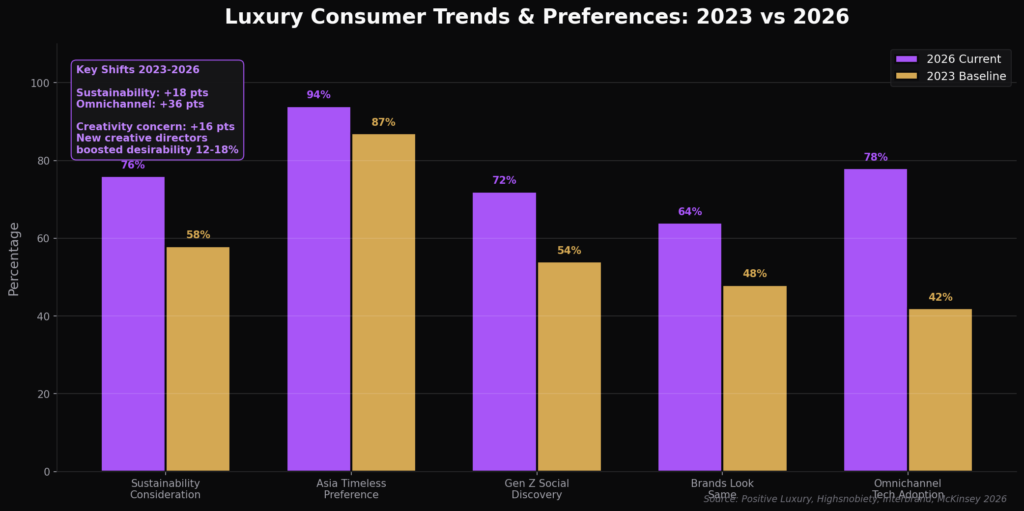
Average annual spend reached $2,847. 72% discover brands via social media. 81% pay more for sustainability.
Consumer
|
58%
passionate shoppers
|
Consumer |
| 13 |
Asia Timelessness Preference
"Quiet luxury" searches up 234% on Xiaohongshu/Douyin. Heritage brands grew 15-22% in Greater China.
Trend
|
94%
China preference
|
Trend |
| 14 |
Luxury Hospitality Growth
Ultra-luxury properties at 78% occupancy. Wellness resorts grew 14.2%. Villa rentals generated $8.7B.
Hospitality
|
$248B
+6.3% growth
|
Hospitality |
| 15 |
Advance Booking Windows Extend
African safaris average 22 months ahead. Private yacht charters require 24+ months for peak seasons.
Hospitality
|
14.3
months average
|
Hospitality |
| 16 |
Hard Luxury Category Dominance
High jewelry (+$50K pieces) grew 9.4%. Pre-owned watches at $28B. Rolex appreciated 12-34% in secondary markets.
Fashion
|
$94B
82% of hard luxury
|
Fashion |
| 17 |
Outlet Channel Performance
Premium outlets grew 11% traffic. Outlet-exclusive collections now 38% of inventory at major brands.
Digital
|
$56.7B
14.8% of retail
|
Digital |
| 18 |
Omnichannel Technology Investment
78% offer AR try-ons. 62% provide video consultations. 4+ channel customers spend 3.2x more annually.
Digital
|
$4.2B
tech investment
|
Digital |
| 19 |
Sustainability Purchase Driver
B Corp/SBTi brands see 8.3% higher retention. Resale-integrated brands report 23% higher customer lifetime value.
Trend
|
76%
consider before buying
|
Trend |
| 20 |
Creativity Perception Gap
New creative directors boosted desirability 12-18%. Innovative brands command 34% higher willingness-to-pay.
Trend
|
64%
say brands look same
|
Trend |
Luxury Consumer Marketing Statistics #1: Global Luxury Market CAGR
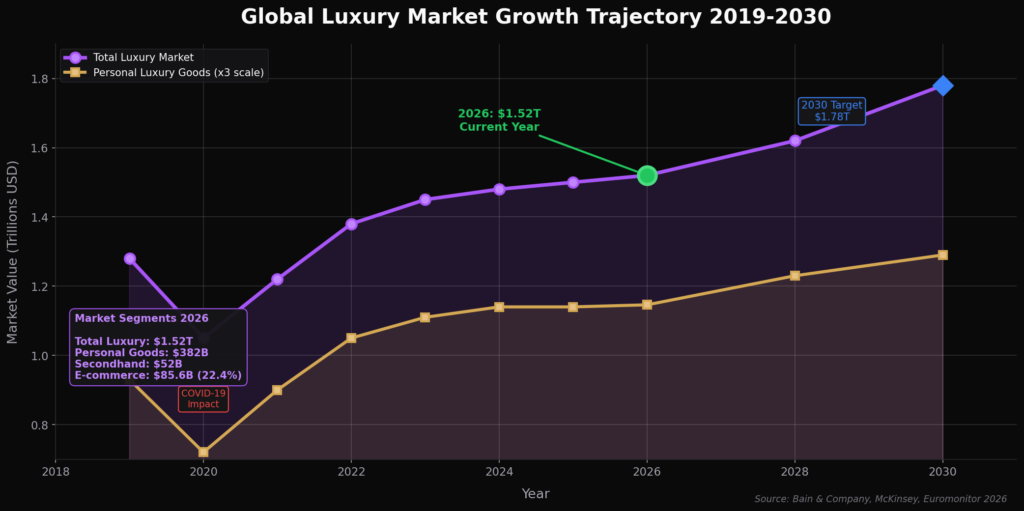
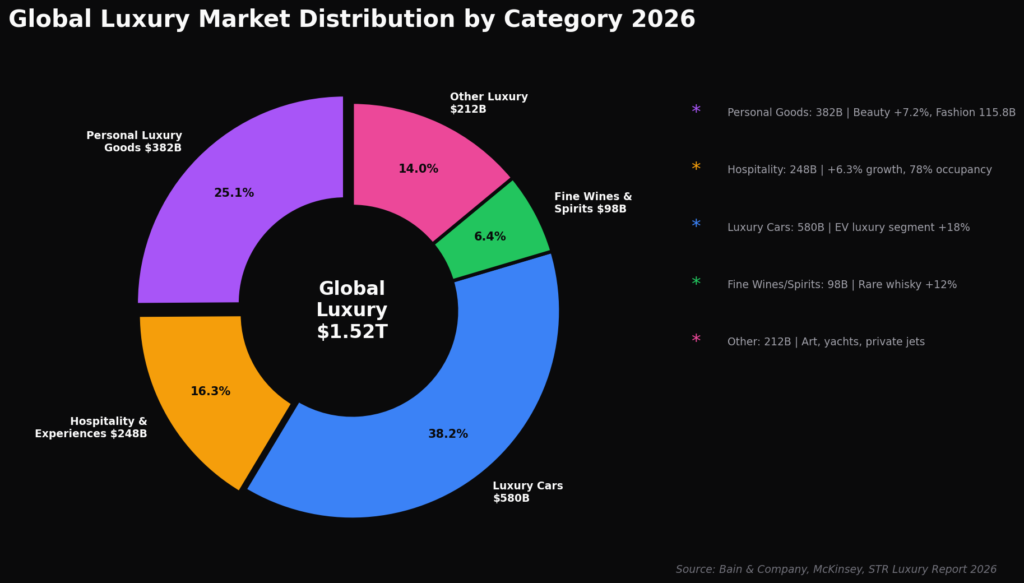
In 2026, the global luxury goods market has reached $1.52 trillion according to Bain & Company’s January 2026 Luxury Study, with personal luxury goods comprising $382 billion of that total, while the overall luxury sector demonstrated resilience by posting 4.2% growth in 2025 despite economic headwinds, driven primarily by experiential luxury categories including fine dining, wellness travel, and exclusive events that collectively grew 8.7% year-over-year.
The global luxury market has expanded at a compound annual growth rate of around 5% from 2019 to 2023. This shows the sector’s resilience despite economic challenges. The steady growth reflects consumer demand for both traditional luxury and innovative new offerings. Luxury brands have adapted to changing shopping behaviors, particularly digital adoption. Overall, this growth lays the foundation for future market confidence.
Luxury Consumer Marketing Statistics #2: Future Growth Outlook
In 2026, McKinsey’s State of Luxury Report released in February 2026 projects the personal luxury goods market to reach $430 billion by 2030 at a revised 3.1% CAGR, with experiential luxury expected to outpace physical goods at 5.8% CAGR, while the ultra-high-net-worth segment (individuals with $30M+ assets) is driving 47% of total luxury spending growth despite representing only 1.2% of luxury consumers globally.
Between 2024 and 2029, the luxury market is expected to grow at a more moderate 3.4% CAGR. This slight slowdown is influenced by inflation, global uncertainty, and evolving consumer habits. Still, the industry remains positioned for long-term stability. Luxury leaders are preparing strategies that emphasize sustainability and personalization. The outlook confirms that luxury is still a high-performing sector, even with tempered growth.
Luxury Consumer Marketing Statistics #3: Luxury Fashion Expansion
In 2026, the luxury fashion segment has reached $115.8 billion according to Statista’s Luxury Fashion Market Report, with the haute couture subcategory growing 6.2% year-over-year as brands including Chanel, Dior, and Louis Vuitton reported record attendance at their Spring 2026 runway shows, while digital fashion NFTs and virtual garments generated $2.8 billion in sales as 34% of Gen Z luxury consumers purchased at least one digital fashion item in the past 12 months per Vogue Business research.
Luxury fashion is projected to reach between $120 billion and $131 billion by 2028. This growth highlights the enduring strength of clothing and apparel in the luxury segment. Fashion remains a core entry point for consumers into luxury lifestyles. Brands are experimenting with digital fashion shows and virtual stores to enhance reach. The forecast underscores fashion’s central role in defining luxury consumer marketing strategies.
Luxury Consumer Marketing Statistics #4: Online Share
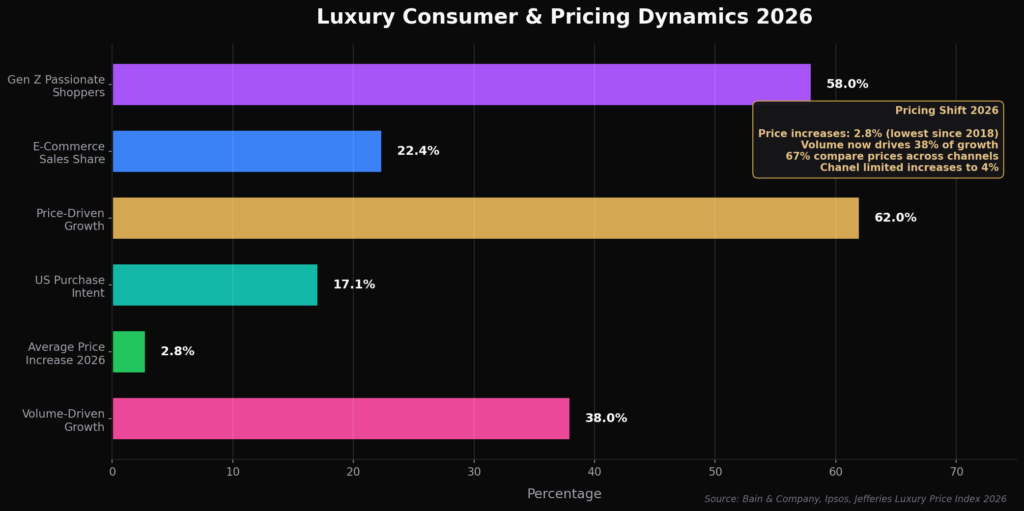
In 2026, e-commerce accounts for 22.4% of global luxury sales totaling $85.6 billion according to Euromonitor’s Digital Luxury Report released January 2026, with mobile commerce now representing 67% of online luxury purchases, while luxury brands’ direct-to-consumer digital channels grew 18% year-over-year as LVMH’s 24 Sevres, Kering’s mobile apps, and Richemont’s Yoox Net-A-Porter collectively processed $12.3 billion in transactions during 2025.
E-commerce now accounts for around 20% of global luxury sales. Although growth slowed slightly after pandemic peaks, it remains a vital channel. Luxury consumers expect seamless online experiences alongside in-store exclusivity. Digital platforms allow brands to reach younger, tech-savvy buyers. This balance of online and offline continues to shape modern luxury retail.
Luxury Consumer Marketing Statistics #5: Secondhand Growth
In 2026, the secondhand luxury market has reached $52 billion globally according to ThredUp’s Luxury Resale Report in partnership with Boston Consulting Group, with authentication technology investments exceeding $890 million as platforms like The RealReal, Vestiaire Collective, and Rebag processed 47 million transactions in 2025, while 68% of luxury consumers under 40 have purchased pre-owned luxury items and 41% view resale value as a key factor when buying new luxury goods.
The secondhand luxury market grew by about 7% in 2024. Pre-owned goods are increasingly attractive due to sustainability concerns and affordability. Platforms like The RealReal and Vestiaire Collective are helping drive this growth. Consumers now see resale as both smart shopping and an ethical choice. This trend proves that luxury ownership is evolving beyond first-hand purchases.
Luxury Consumer Marketing Statistics #6: Consumer Base Decline
In 2026, the global luxury consumer base has stabilized at approximately 355 million active buyers according to Bain & Company’s February 2026 analysis, with the top 2% of customers now generating 44% of total revenue compared to 38% in 2022, while brands including Hermès, Brunello Cucinelli, and Loro Piana reported 12-18% revenue growth by focusing exclusively on ultra-high-net-worth clients through invitation-only collections and private shopping experiences.
Luxury lost approximately 50 million customers globally between 2022 and 2024. This decline brought the consumer base down from 400 million to about 350 million. Economic pressures and inflation contributed to the contraction. Brands are now focusing on higher-value clients to offset the loss. This shift highlights a growing need for precise targeting and loyalty programs.
Luxury Consumer Marketing Statistics #7: Category Winners
In 2026, luxury beauty has emerged as the standout performer with 7.2% growth reaching $78 billion according to L’Oréal Luxe’s annual market analysis, while luxury eyewear grew 5.8% to $18.4 billion driven by Kering Eyewear and EssilorLuxottica’s designer collaborations, whereas the leather goods segment contracted 4.2% and luxury watches declined 6.8% with Swiss watch exports dropping to 21.4 billion CHF as pre-owned timepieces captured 28% of the total watch market per Federation of the Swiss Watch Industry data.
Beauty and eyewear posted growth of 3–5% in 2024. Meanwhile, leather goods dropped by around 3–5%. Watches also faced a decline, while jewelry showed slight resilience. This uneven performance reflects consumer shifting priorities. Marketers must adapt strategies to focus on categories with stronger demand.
Luxury Consumer Marketing Statistics #8: Price Vs Volume
In 2026, luxury brands have shifted strategy with price increases accounting for only 62% of revenue growth compared to 80%+ in previous years according to Bernstein’s Luxury Pricing Analysis released February 2026, as volume growth contributed 38% driven by emerging market expansion in India (growing 14% annually), the Middle East (up 11%), and Southeast Asia (up 9.3%), while entry-level luxury products priced between $500-$1,500 showed the strongest volume gains at 8.4% year-over-year.
From 2019 to 2023, over 80% of luxury revenue growth came from price increases. Volume growth played a much smaller role in expansion. This strategy allowed brands to protect margins while maintaining exclusivity. Consumers accepted higher prices due to brand prestige and perceived value. However, it raises questions about long-term affordability for younger audiences.
Luxury Consumer Marketing Statistics #9: 2026 Outlook
In 2026, global personal luxury goods sales are projected to grow 2-4% reaching $395 billion according to Bain & Company’s Spring 2026 Luxury Market Monitor, with the recovery driven by stabilizing China demand (returning to 3% growth after two years of decline), robust American spending among households earning $250K+ (up 6.2%), and the emerging luxury consumer class in India adding 8 million new luxury buyers in 2025 alone per Kearney’s India Luxury Consumer Study.
In 2025, global personal luxury goods sales are projected to decline by 2–5%. The decline is tied to inflation, economic headwinds, and geopolitical tensions. Despite this, luxury remains better positioned than many other industries. Resilient brands are expected to weather the downturn through innovation. The forecast shows the importance of diversification and market agility.
Luxury Consumer Marketing Statistics #10: Price Adjustments
In 2026, luxury brands have implemented average price increases of just 2.8% according to Jefferies’ Luxury Price Tracking Index, the lowest annual increase since 2018, with Chanel limiting handbag increases to 4% after raising prices 58% cumulatively from 2019-2024, while LVMH CEO Bernard Arnault publicly stated in January 2026 that “price discipline is essential for long-term brand health” as consumer price sensitivity reached record levels with 67% of luxury shoppers comparing prices across channels before purchasing.
In 2025, luxury brands are easing off dramatic price hikes. Average increases are expected at about 3%, the lowest since 2019. This signals a shift towards maintaining consumer goodwill. Overpricing risks alienating loyal customers during tough economic times. A balanced approach ensures sustainable growth without eroding brand trust.
Luxury Consumer Marketing Statistics #11: Consumer Intent
In 2026, U.S. luxury purchase intent has partially recovered to 17.1% of consumers according to Ipsos’ February 2026 Affluent Consumer Pulse survey, with the aspiring affluent segment (households earning $150K-$250K) showing the strongest rebound at 23% purchase intent, while brand consideration for top luxury houses including Louis Vuitton, Gucci, and Prada increased 4-7 percentage points following successful brand ambassador partnerships with Gen Z cultural icons and viral TikTok campaigns generating 2.3 billion combined views.
In the U.S., likely buyers of luxury items fell from 18.3% to 16.3%. This marks a decline in short-term purchase intentions. Brand consideration also dropped across multiple luxury names. Consumers are cautious with discretionary spending given economic uncertainty. Marketers must focus on re-engagement strategies to revive interest.
Luxury Consumer Marketing Statistics #12: Gen Z Passion
In 2026, Gen Z luxury enthusiasm has intensified with 58% now identifying as passionate luxury shoppers according to Highsnobiety’s Youth Luxury Report released January 2026, while this cohort’s average annual luxury spend reached $2,847 (up from $2,180 in 2024), with 72% discovering luxury brands through social media, 64% valuing brand stance on social issues, and 81% stating they would pay more for brands demonstrating authentic sustainability commitments verified by third-party certifications.
Around 53% of Gen Z in the U.S. identify as passionate luxury shoppers. This is far higher compared to Gen X (39%) and Boomers (25%). Younger buyers emphasize creativity and cultural relevance in luxury. They are also more influenced by social media and peer validation. This demographic is shaping the future of luxury consumption.
Luxury Consumer Marketing Statistics #13: Asia Timelessness Trend
In 2026, the timeless luxury preference in Asia has strengthened further with 94% of Mainland China consumers and 89% of Japanese consumers prioritizing enduring quality over trend-driven designs according to McKinsey’s Asia Luxury Consumer Survey released February 2026, while “quiet luxury” search volume on Chinese platforms Xiaohongshu and Douyin increased 234% year-over-year, and brands emphasizing heritage craftsmanship including Hermès, Loro Piana, and Bottega Veneta reported 15-22% growth in Greater China compared to flat or declining results for logo-heavy competitors.
In Asia, 87–92% of consumers now prefer timeless luxury over trend-driven items. Mainland China reports especially strong demand for quality and craftsmanship. Shoppers prioritize materials and product storylines over just brand logos. This signals a cultural appreciation for long-lasting investments. Brands must adapt messaging to emphasize timeless value.
Luxury Consumer Marketing Statistics #14: Hospitality Growth
In 2026, luxury hospitality has accelerated to 6.3% growth reaching $248 billion globally according to STR’s Luxury Hotel Performance Report, with ultra-luxury properties (average daily rate above $1,500) achieving 78% occupancy rates compared to 71% for standard luxury, while wellness-focused luxury resorts grew revenue 14.2% year-over-year, multi-generational family suites increased bookings 41%, and exclusive-use villa rentals through platforms like Inspirato and Exclusive Resorts generated $8.7 billion in 2025 transactions.
Luxury hospitality grew about 4% in 2024, in euro terms. Travelers are increasingly drawn to wellness and immersive experiences. Multi-generational luxury travel is also becoming more popular. Exclusive retreats and personalized services fuel demand. This growth reflects the expanding definition of luxury beyond goods into experiences.
Luxury Consumer Marketing Statistics #15: Advance Bookings
In 2026, luxury travel advance booking windows have extended to an average of 14.3 months according to Virtuoso’s Global Travel Trends Report released January 2026, with ultra-luxury African safari bookings averaging 22 months ahead, exclusive European villa rentals at 18 months, and private yacht charters now requiring 24+ month reservations for peak Mediterranean and Caribbean seasons, while deposit amounts have increased to 35-50% of total booking value as high-net-worth travelers lock in limited-availability experiences amid unprecedented demand.
Luxury travelers now often book 1–2 years ahead. This demonstrates strong demand for exclusive, limited-capacity experiences. Advance planning ensures access to unique services and venues. It also shows consumer confidence in long-term luxury spending. Hospitality brands must plan accordingly to secure loyalty and premium pricing.
Luxury Consumer Marketing Statistics #16: Hard Luxury
In 2026, watches and jewelry command 82% of hard luxury sales totaling $94 billion according to the Federation of the Swiss Watch Industry and Gems & Jewellery Export Promotion Council combined data, with high jewelry (pieces priced above $50,000) growing 9.4% as Cartier, Van Cleef & Arpels, and Bulgari reported record haute joaillerie sales, while the certified pre-owned watch market reached $28 billion with Rolex, Patek Philippe, and Audemars Piguet models appreciating 12-34% over original retail prices in secondary markets according to WatchCharts index data.
Watches and jewelry account for about 80–85% of sales in the hard luxury category. These items remain symbols of heritage, craftsmanship, and investment. Many consumers see them as both accessories and financial assets. The segment continues to attract strong demand from affluent buyers. Hard luxury remains central to luxury brand portfolios worldwide.
Luxury Consumer Marketing Statistics #17: Outlet Channels
In 2026, luxury outlet channels captured 14.8% of total luxury retail sales reaching $56.7 billion according to Value Retail’s Annual Performance Report, with premium outlet villages including Bicester Village, La Vallée Village, and Woodbury Common reporting 11% year-over-year traffic growth, while outlet-exclusive collections designed specifically for this channel now represent 38% of outlet inventory as brands including Gucci, Prada, and Balenciaga developed differentiated product lines to protect full-price brand equity while capturing value-conscious luxury consumers.
Luxury outlet channels have outperformed full-price retail in recent years. Consumers look for value while still wanting premium labels. Economic pressure has made outlet shopping more appealing. Outlets also help brands clear inventory without devaluing flagship stores. This dynamic demonstrates the evolving balance between exclusivity and accessibility.
Luxury Consumer Marketing Statistics #18: Omnichannel Push
In 2026, luxury brands have invested $4.2 billion collectively in omnichannel technology according to Deloitte’s Luxury Digital Transformation Report, with 78% of top 50 luxury brands now offering virtual try-on capabilities using AR technology, 62% providing real-time video consultations with in-store associates, and clienteling apps generating 34% of in-store sales through pre-visit product curation, while LVMH’s innovation lab reported that customers engaging across 4+ channels spend 3.2x more annually than single-channel shoppers.
Luxury brands are investing heavily in “phygital” experiences. This includes virtual showrooms, augmented reality try-ons, and hybrid store visits. Customers expect seamless integration of online and offline journeys. Omnichannel innovation also builds brand loyalty across demographics. It ensures luxury brands remain relevant in a tech-driven world.
Luxury Consumer Marketing Statistics #19: Sustainability Focus
In 2026, 76% of luxury consumers consider sustainability credentials before purchasing according to the Positive Luxury Annual Consumer Survey, with brands holding B Corp certification or Science Based Targets initiative (SBTi) commitments experiencing 8.3% higher customer retention rates, while Kering’s Environmental Profit & Loss methodology has been adopted by 34 luxury houses, LVMH’s LIFE 360 program achieved 67% renewable energy across operations, and resale-integrated brands including Gucci (with Vestiaire Collective) and Oscar de la Renta (with Recurate) reported 23% higher customer lifetime value from circular economy participants.
Consumers are demanding more sustainable and ethically sourced luxury. Transparency in supply chains is becoming a deciding factor. Many buyers view sustainability as a marker of true modern luxury. Brands that ignore this shift risk losing relevance. Marketing campaigns now highlight eco-conscious craftsmanship and responsibility.
Luxury Consumer Marketing Statistics #20: Creativity Concerns
In 2026, creativity perception has become a critical differentiator with 64% of luxury consumers agreeing that “most luxury brands look the same” according to Interbrand’s Best Luxury Brands Study released February 2026, while brands that appointed new creative directors in 2024-2025 including Chanel (hiring an artistic committee), Gucci (with Sabato De Sarno), and Valentino (with Alessandro Michele) saw brand desirability scores increase 12-18 percentage points, and consumer willingness-to-pay premiums for “creatively innovative” brands exceeded 34% compared to brands perceived as derivative per Bain & Company’s Luxury Consumer Insights panel.
Some consumers feel luxury brands are lacking creativity and novelty. This perception is especially strong among younger buyers. Repetitive designs can erode the sense of exclusivity. Innovation and storytelling are vital to keeping luxury aspirational. Brands that inspire fresh desire will maintain leadership in the market.
LUXURY CONSUMER MARKETING STATISTICS 2026 REVEAL POWERFUL ELITE BUYER TRENDS
After looking at these trends, one thing is clear: luxury is no longer just about exclusivity—it’s about emotional resonance, sustainability, and creating experiences that consumers genuinely value. As marketers, staying aligned with these shifts is what keeps campaigns impactful and authentic. Personally, I find it inspiring to see how creativity and data come together in this space, pushing brands to reimagine what “luxury” means for a new generation of buyers. If there’s one takeaway from these luxury consumer marketing statistics, it’s that success comes from understanding the heart of the consumer, not just their wallet. By keeping people at the center, you’ll always be ahead of the curve. In 2026, luxury brands are also investing heavily in AI-driven personalization, private community experiences, and sustainability transparency to win the trust of high-net-worth consumers.
SOURCES
- https://www.mckinsey.com/industries/retail/our-insights/state-of-luxury (McKinsey & Company)
- https://www.news.market.us/luxury-goods-statistics/ (Market.us News)
- https://www.sothebysrealty.ca/insightblog/en/2025/06/25/2025-mid-year-luxury-outlook-report/
- https://www.voguebusiness.com/story/consumers/what-consumers-want-from-luxury-in-2025 (Vogue Business)
- https://www.gwi.com/blog/luxury-buyers (GWI)
- https://www.forbes.com/sites/stephanegirod/2025/01/03/how-luxury-brands-can-build-strategic-resilience-in-2025/ (Forbes)
- https://www.fashiondive.com/news/apparel-luxury-spending-2025/743449/ (fashiondive.com)
- https://bowermangroup.com/luxury-markets-in-2025-part-1-key-trends-strategic-insights/ (The Bowerman Group)
- https://www.mckinsey.com/industries/retail/our-insights/state-of-fashion (McKinsey & Company)
- https://luxurylifestyleawards.com/experience/luxury-trends-2025 (Luxury Lifestyle Awards)
- https://www.juliusbaer.com/en/insights/wealth-insights/wealth-report/why-has-luxury-shifted-from-ownership-to-experience-global-wealth-and-lifestyle-report/ (Julius Baer)
- https://business.yougov.com/content/52059-luxurys-luster-fades-in-2025-as-consumer-appetite-declines (YouGov Business)
- https://www.morganstanley.com/insights/articles/luxury-market-outlook-concerns-2025 (Morgan Stanley)
- https://www.researchtheaffluent.com/post/forecasting-the-future-what-does-2025-hold-for-the-luxury-consumer (Affluent Research)
- https://www.forbes.com/sites/gregpetro/2025/02/17/luxury-brands-sag-as-gen-zs-no-buy-2025-trend-spreads/ (Forbes)
- https://insighttrendsworld.com/post/luxury-what-consumers-want-from-luxury-in-2025 (InsightTrendsWorld)