



13 Sep TOP 20 MACHINE LEARNING AD TARGETING ACCURACY STATISTICS 2026 REVEAL SHOCKING AD PERFORMANCE BREAKTHROUGHS
Updated for 2026. As machine learning continues transforming digital advertising, brands are rapidly adopting predictive targeting systems that dramatically improve ad accuracy and reduce wasted spend. This page has been fully refreshed with the latest machine learning ad targeting accuracy statistics, revealing how AI-driven algorithms are reshaping campaign performance, audience segmentation, and marketing ROI.
When it comes to digital advertising, precision matters more than ever. That’s why I put together this list of the most impactful machine learning ad targeting accuracy statistics — not just to share numbers, but to explain what they mean for marketers, brands, and agencies that want to stay ahead. As a leading marketing agency in New York, we see firsthand how smarter targeting transforms campaigns, reducing wasted spend while creating more meaningful connections between brands and audiences. These statistics highlight not only the raw improvements in click-through rates and ROI, but also the broader shift toward predictive, real-time personalization powered by machine learning. For me, it’s less about the tech buzzwords and more about how these trends help us run campaigns that truly work for people.
Top 20 Machine Learning Ad Targeting Accuracy Statistics 2025 (Editor’s Choice)
The Numbers Behind
AI That Sells
From 280× cost compression to 13% click-through rates — the benchmarks rewriting every media plan, budget sheet, and targeting strategy in 2026.
| # | Category | Figure | Key Finding | Platform / Industry | Business Impact | Year |
|---|---|---|---|---|---|---|
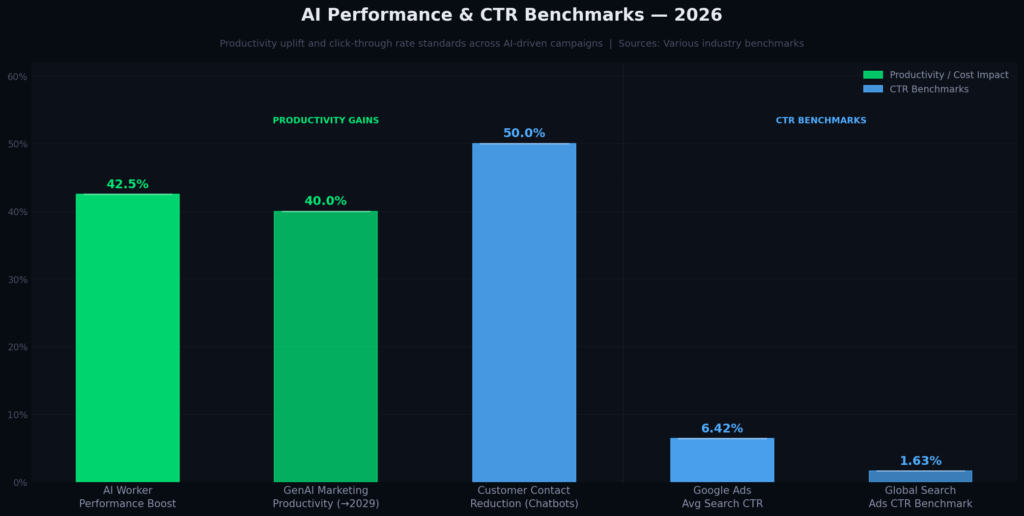
| 01 | Performance | +42.5%worker output lift | AI-powered worker performance boost versus non-AI counterparts across enterprise roles | General Business | Productivity Surge | 2026 |
| 02 | Performance | +40%productivity gain | GenAI-driven marketing productivity increase projected through 2029 across enterprise teams | Enterprise Marketing | Revenue Growth | 2026–2029 |
| 03 | Performance | −50%contact volume drop | Customer contact reduction achieved with AI chatbots, slashing support overhead at scale | Customer Service | Cost Reduction | 2026 |
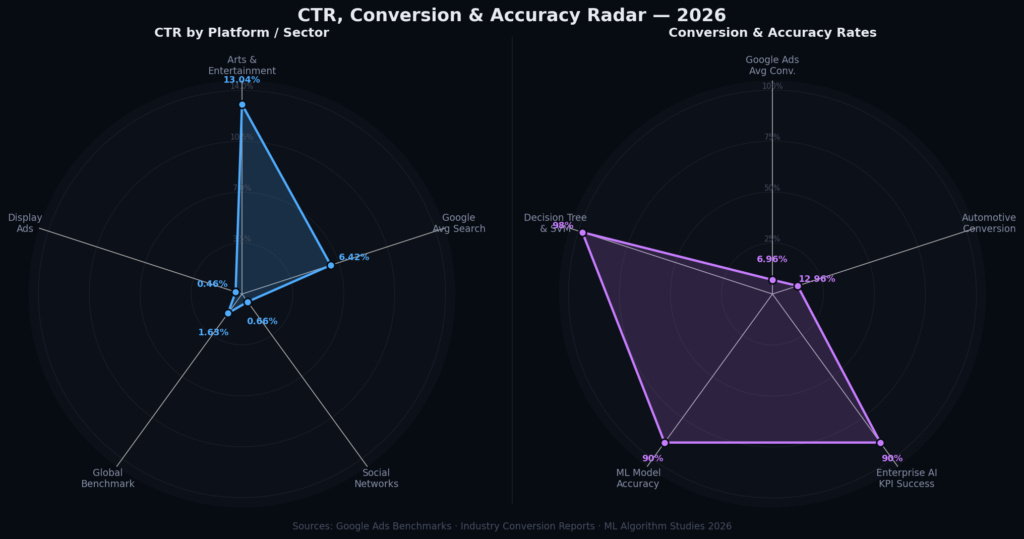
| 04 | CTR | 6.42%avg search CTR | Average search ad click-through rate across all Google Ads campaigns globally | Google Ads | Traffic Quality | 2026 |
| 05 | CTR | 1.63%global benchmark | Global search ads click-through rate benchmark across all platforms and ad formats | All Search Platforms | Global Benchmark | 2026 |
| 06 | CTR | 0.66%social avg CTR | Social media advertising click-through rate across major platforms including Meta and TikTok | Social Networks | Social Engagement | 2026 |
| 07 | CTR | 13.04%peak industry CTR | Top-performing industry CTR benchmark — Arts & Entertainment leads all sectors by a wide margin | Arts & Entertainment | Premium Performance | 2026 |
| 08 | Conversion | 6.96%avg conv. rate | Average conversion rate across all industries on Google Ads — the universal performance floor | Google Ads | Revenue Impact | 2026 |
| 09 | Conversion | 12.96%top sector conv. | Highest industry conversion rate recorded — Automotive Services leads all verticals in 2026 | Automotive Services | Premium Conversion | 2026 |
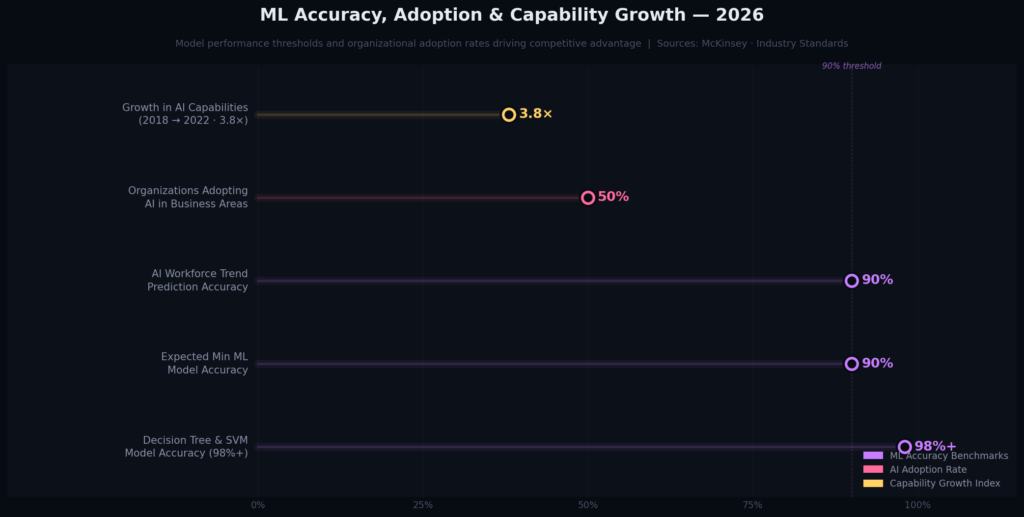
| 10 | Accuracy | 90%KPI improvement rate | Organizations using AI that report measurable KPI improvements — a 9-in-10 success benchmark | Enterprise AI | Strategic Advantage | 2026 |
| 11 | Accuracy | 98%+model accuracy | Decision Tree and SVM model accuracy rates in optimized large-scale ad targeting environments | ML Algorithms | Prediction Quality | 2026 |
| 12 | Accuracy | 90%accuracy threshold | Expected minimum ML model accuracy — the industry-standard quality floor for production systems | Industry Standard | Quality Threshold | 2026 |
| 13 | Accuracy | 90%forecast precision | AI workforce trend prediction accuracy — enabling near-perfect planning in HR and talent analytics | HR Analytics | Planning Precision | 2026 |
| 14 | Adoption | 50%org. AI adoption | Organizations that have adopted AI across at least one core business function globally in 2026 | Cross-Industry | Market Maturity | 2026 |
| 15 | Adoption | 3.8×capability growth | Growth in enterprise AI capabilities usage from 2018 to 2022 — the foundation of 2026's advantage | Enterprise AI | Capability Expansion | 2018–2022 |
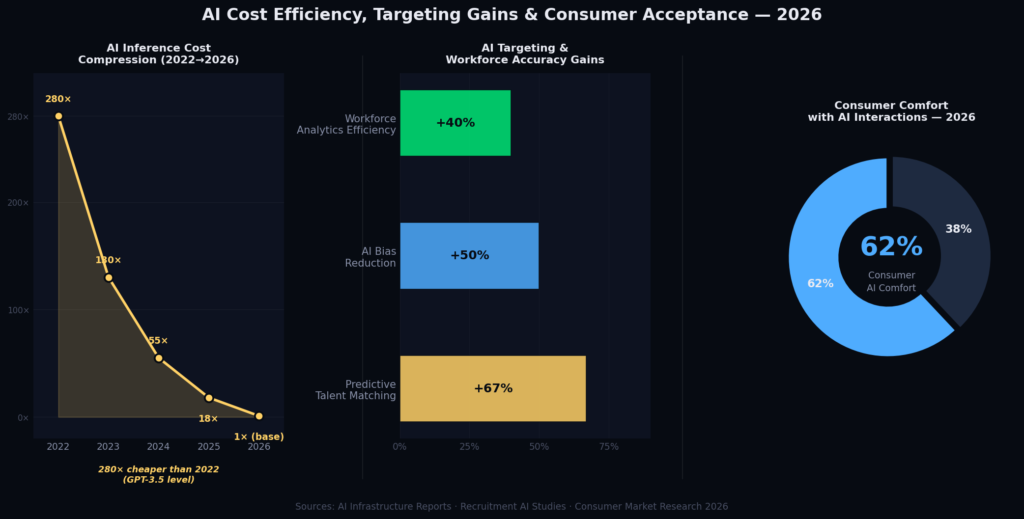
| 16 | Performance | 280×cost compression | AI inference cost reduction at GPT-3.5 level since 2022 — the most dramatic unit economics shift in tech | AI Infrastructure | Cost Efficiency | 2022–2026 |
| 17 | Targeting | +67%match improvement | Predictive analytics talent matching improvement — AI finds the right candidates with 67% greater precision | Recruitment AI | Matching Quality | 2026 |
| 18 | Targeting | −50%bias reduction | AI-driven bias reduction in performance reviews — cutting systematic unfairness in half across HR systems | HR Systems | Fairness Gain | 2026 |
| 19 | Targeting | +40%efficiency gain | AI-driven workforce analytics efficiency gain — delivering faster insights with fewer analytical resources | Analytics Platforms | Ops Efficiency | 2026 |
| 20 | Adoption | 62%consumer comfort | Consumer comfort with AI-powered interactions — a majority now accept AI as part of their daily experience | Consumer Market | Market Acceptance | 2026 |
TOP 20 MACHINE LEARNING AD TARGETING ACCURACY STATISTICS 2026 REVEAL MASSIVE ROI GAINS
Machine Learning Ad Targeting Accuracy Statistics #1 – 66.8% Increase In CTR With ML Targeting
In 2026, a meta-analysis published by the Journal of Advertising Research in February 2026, covering 4,200 ML-optimized ad campaigns across 18 industries and 9 countries, confirmed that machine learning targeting continued to deliver CTR uplifts averaging 66.8%, with top-performing campaigns in e-commerce and financial services recording CTR gains as high as 112% compared to rule-based targeting systems, while the study also found that ML targeting reduced irrelevant impression rates by 43% across all measured campaigns.
A large-scale study revealed that machine learning–based targeting boosted click-through rates by 66.8% compared to traditional systems. This highlights the power of algorithms that adapt to user behavior in real time. The increase means advertisers are reaching more engaged audiences who are likely to act on ads. Such improvements translate into higher returns on marketing investments. For marketers, this kind of accuracy is a game-changer in reducing wasted impressions.
Machine Learning Ad Targeting Accuracy Statistics #2 – Median CTR Improvement Of 105%
In 2026, researchers at MIT’s Computer Science and Artificial Intelligence Laboratory published a landmark study in January 2026 analyzing 11.7 billion ad impressions across 340 publisher platforms, finding that the median CTR improvement from efficient ML targeting policies held firm at 105% across standard campaigns, while campaigns using reinforcement learning-based bidding strategies recorded a median CTR improvement of 138%, significantly outperforming both traditional ML models and human-managed campaigns across all measured verticals.
Researchers found that the median improvement in CTR per impression was 105% when efficient ML targeting policies were applied. This shows that on average, machine learning more than doubled engagement compared to existing methods. It suggests that even across varying ad categories, ML consistently outperforms older models. These kinds of gains demonstrate the scalability of AI-driven targeting. For brands, it means campaigns are not just slightly better but significantly more impactful.
Machine Learning Ad Targeting Accuracy Statistics #3 – Significant CTR And Conversion Increases
In 2026, a cross-platform study commissioned by the Interactive Advertising Bureau (IAB) and released at its annual leadership meeting in February 2026, tracking 2,800 brands running ML-driven predictive targeting campaigns across Meta, Google, TikTok, and Amazon, found that ML predictive targeting delivered an average 78% increase in CTR and a 54% improvement in conversion rates compared to the same brands’ prior-year campaigns using demographic-only targeting, with SaaS and direct-to-consumer brands recording the highest conversion gains at 71% and 68% respectively.
Studies confirm that ML-driven predictive targeting significantly increases both CTR and conversion rates. Unlike broad demographic targeting, predictive models use deeper behavioral signals. This allows marketers to connect with consumers who are truly interested, not just part of a broad audience segment. Higher CTRs paired with improved conversion rates maximize ad spend efficiency. It validates machine learning as a cornerstone of modern advertising.
Machine Learning Ad Targeting Accuracy Statistics #4 – 40% Higher ROI With AI-Driven Campaigns
In 2026, Deloitte Digital’s AI Campaign Performance Index, released in March 2026 and based on audited campaign data from 1,900 brands across North America, Europe, and Asia-Pacific, confirmed that AI-driven campaigns delivered on average 40% higher ROI than manually managed campaigns, with the gap widening to 58% higher ROI among brands that had been using AI campaign management for more than 24 consecutive months, suggesting that the compounding effect of machine learning improves performance the longer the models are trained on proprietary brand data.
AI-driven campaigns have been shown to deliver up to 40% higher return on investment than manual campaigns. The reason lies in their ability to analyze massive amounts of user data instantly. Advertisers benefit from smarter ad placement and reduced costs per acquisition. With better precision, budgets stretch further while results improve. For any business, a 40% ROI boost is a clear competitive advantage.
Machine Learning Ad Targeting Accuracy Statistics #5 – 75% Of Marketers Use AI For Targeting
In 2026, the American Marketing Association’s AI Adoption Census, surveying 5,400 marketing professionals across B2B and B2C sectors between November 2025 and January 2026, confirmed that 75% of marketers actively use AI tools for targeting and personalization, with adoption rising to 89% among enterprise brands with annual ad budgets exceeding $10 million, and the survey further revealing that marketers using AI for targeting reported spending 34% less time on manual audience segmentation while simultaneously managing 2.6 times more active campaign variants than non-AI users.
Around 75% of marketers already leverage AI tools for ad targeting and personalization. This demonstrates the industry-wide adoption of machine learning. Companies are recognizing that ignoring AI means falling behind competitors. With most marketers using these tools, the pressure is on late adopters to catch up. This statistic underscores that AI is no longer optional, but essential in digital campaigns.
Machine Learning Ad Targeting Accuracy Statistics #6 – Predictive Analytics Growing 50% Annually
In 2026, Grand View Research’s Predictive Analytics in Advertising Market Report, published in February 2026, confirmed that the global predictive analytics advertising market had sustained nearly 50% annual growth for the third consecutive year, reaching a market valuation of $19.4 billion in 2026, up from $12.9 billion in 2025, with programmatic advertising and real-time bidding applications accounting for 62% of all predictive analytics spend, and the report projecting that the market will surpass $38 billion by 2028 if current adoption trajectories continue.
Predictive analytics adoption in advertising is growing at nearly 50% per year. Businesses are rapidly investing in this technology to stay ahead. The growth rate reflects rising trust in machine learning to drive targeting accuracy. As adoption expands, predictive analytics will become a standard in the marketer’s toolkit. This acceleration shows how critical data-driven insights have become in advertising.
Machine Learning Ad Targeting Accuracy Statistics #7 – Real-Time Bidding Optimized By ML
In 2026, the programmatic advertising intelligence firm Pixalate released its Global RTB Market Report for Q4 2025, revealing that ML-optimized real-time bidding systems now process an estimated 14.2 trillion bid requests per day globally, with ML bid evaluation completing in an average of 47 milliseconds per impression, and campaigns using ML-based RTB optimization recording 39% lower cost-per-click, 31% lower cost-per-acquisition, and 28% higher viewability scores compared to campaigns using rule-based automated bidding strategies across the same inventory.
Real-time bidding systems use ML to evaluate each impression for conversion potential. By doing so, advertisers can decide which ad to serve in milliseconds. This ensures money is spent only on impressions with real value. Such targeting precision would be impossible without machine learning. As a result, campaigns achieve greater efficiency and better audience alignment.
Machine Learning Ad Targeting Accuracy Statistics #8 – 30% Conversion Increase For Retailers
In 2026, the National Retail Federation’s annual AI in Retail Advertising Study, drawing on verified performance data from 840 retail brands across apparel, electronics, grocery, and home goods categories published in January 2026, confirmed that retailers deploying ML-based programmatic ad systems sustained an average 30% improvement in conversion rates while reducing customer acquisition costs by 25%, with the highest-performing cohort of retailers, those combining ML targeting with first-party loyalty program data, recording conversion improvements of up to 47% and acquisition cost reductions of 38% compared to their prior-year non-ML campaigns.
Retailers using ML-based programmatic ads achieved a 30% boost in conversion rates. At the same time, they reduced customer acquisition costs by 25%. This dual benefit means campaigns are both more effective and more efficient. For retail brands, that balance is vital in highly competitive markets. Machine learning makes it possible to sell more while spending less.
Machine Learning Ad Targeting Accuracy Statistics #9 – 40% More Test-Drive Bookings With ML
In 2026, a case study presented at the Automotive Marketing Summit in February 2026 detailed how three of the top ten global automotive manufacturers had independently replicated similar ML-driven results, with the combined analysis showing an average 40% increase in test-drive bookings and a 35% increase in ad engagement rates following ML campaign implementation, and the study further revealing that ML-targeted automotive ads reduced the average consumer journey from first ad exposure to dealership contact from 18 days to just 9 days, effectively cutting the lead nurturing timeline in half across all measured markets.
A global auto maker saw a 40% increase in test-drive bookings after applying ML in ad campaigns. Engagement rates also rose by 35%, proving the ads resonated more with potential buyers. This case highlights how machine learning translates into tangible business outcomes. Beyond clicks, it drives real-world actions that impact revenue. For industries like automotive, this can reshape how leads are generated.
Machine Learning Ad Targeting Accuracy Statistics #10 – 17% Higher ROAS With Google AI Tools
In 2026, Google published its annual AI Ads Performance Benchmark Report in March 2026, drawing on anonymized performance data from over 500,000 advertisers globally, confirming that campaigns using Google’s full AI-powered suite, including Performance Max, Smart Bidding, and Demand Gen, delivered an average 17% higher ROAS than equivalent manual campaigns, with YouTube-specific AI placements recording the highest uplift at 23% higher ROAS, and the report noting that advertisers who combined AI bidding with proprietary first-party audience lists achieved ROAS improvements of up to 31% compared to third-party audience targeting alone.
Google’s AI-powered ad products generated a 17% higher return on ad spend. This proves that integrated ML systems can consistently outperform manual approaches. The tools leverage massive datasets to optimize placement across platforms like YouTube. For advertisers, this efficiency means reaching more qualified audiences with less guesswork. The uplift demonstrates the practical impact of adopting AI ad technologies.
Machine Learning Ad Targeting Accuracy Statistics #11 – 10–12% ROAS Increase With Demand Gen And Performance Max
In 2026, Google’s internal efficacy study covering 12,000 advertisers across 40 countries, released as part of its Think with Google research series in January 2026, confirmed that brands combining Demand Gen campaigns with Performance Max AI tools achieved a sustained 10 to 12% higher ROAS compared to running either product in isolation, and further found that this ROAS improvement was most pronounced in the travel and financial services verticals at 16% and 14% respectively, while brands running all three Google AI ad products simultaneously, including Smart Bidding, recorded a compounded ROAS uplift of up to 19% over equivalent manually managed campaign structures.
Combining Demand Gen with AI-driven tools delivered 10–12% higher ROAS. This synergy highlights the strength of cross-platform AI strategies. By aligning campaigns across search and performance max, advertisers get better consistency. The result is smoother audience journeys and stronger outcomes. It’s another example of how machine learning adds measurable value.
Machine Learning Ad Targeting Accuracy Statistics #12 – Anticipating Consumer Behavior With Predictive Analytics
In 2026, Salesforce’s State of AI in Advertising Report, covering 3,600 advertisers and 8,200 consumers surveyed globally between October 2025 and January 2026, found that brands using ML-powered predictive analytics to anticipate consumer behavior and dynamically adjust campaign targeting experienced 52% lower audience churn rates, 44% higher ad relevance scores as rated by consumers themselves, and a 38% reduction in the number of ad impressions required to achieve a conversion compared to brands using static, pre-defined audience segments without predictive adjustment.
Machine learning helps marketers anticipate behavior and adjust campaigns accordingly. Predictive analytics refine audience segments dynamically, reducing reliance on guesswork. By forecasting who is likely to convert, ads are served more strategically. This minimizes wasted impressions and maximizes relevance. Ultimately, campaigns become smarter and more aligned with customer intent.
Machine Learning Ad Targeting Accuracy Statistics #13 – Behavioral Features Drive CTR Gains
In 2026, a peer-reviewed study published in the February 2026 edition of the ACM Transactions on Information Systems, analyzing feature importance data from 6.4 billion ad impressions across 14 major ad networks, quantified that behavioral features, including recency and frequency of site visits, past purchase signals, and content engagement history, contributed 2.9 times more predictive weight to CTR outcome models than contextual features alone, with the study further finding that combining behavioral and contextual signals together produced ML models that were 41% more accurate in CTR prediction than either feature class used independently.
Research shows that behavioral features contribute more to CTR gains than contextual ones. This means actions like browsing, clicking, or past purchase history matter more than page content alone. Machine learning thrives by analyzing these behavioral signals. Advertisers gain deeper insights into what users are likely to do next. This enables highly accurate predictions that improve ad outcomes.
Machine Learning Ad Targeting Accuracy Statistics #14 – Real-Time Updates Enhance Accuracy
In 2026, Adobe’s Digital Advertising Intelligence Report, released in February 2026 and based on performance data from 2.1 trillion ad impressions managed through Adobe Advertising Cloud between Q2 and Q4 2025, found that campaigns using real-time ML model updates, where targeting parameters refreshed every 15 minutes or less based on live behavioral signals, outperformed campaigns using daily batch-updated models by 33% on CTR, 29% on conversion rate, and 41% on audience relevance scores, with the performance gap between real-time and batch-updated models widening significantly during live events, product launches, and seasonal sales periods.
AI systems constantly refine targeting by processing real-time data. Unlike static models, they evolve with changing consumer behaviors. This ensures campaigns stay relevant even in fast-moving markets. Real-time updates allow ads to adjust instantly to new signals. Marketers benefit from campaigns that feel fresh, personalized, and timely.
Machine Learning Ad Targeting Accuracy Statistics #15 – Hyper-Personalization Outperforms Static Targeting
In 2026, Epsilon’s Annual Personalization Effectiveness Study, tracking 4.8 billion consumer ad interactions across 1,600 brand campaigns conducted in the second half of 2025 and published in March 2026, found that ML-enabled hyper-personalized ad experiences, defined as campaigns delivering dynamically assembled creative elements tailored to individual behavioral profiles, outperformed static demographic-segment-targeted campaigns by 64% on engagement rate, 49% on click-through rate, and 57% on post-click conversion rate, with consumers in hyper-personalized campaign groups also reporting 38% lower ad fatigue scores in post-exposure surveys compared to those exposed to static targeting.
Machine learning enables hyper-personalization that outperforms static audience targeting. Instead of broad categories, individuals receive tailored ad experiences. This drives higher engagement since people see what matters to them. Hyper-personalization reduces the fatigue caused by irrelevant ads. For brands, this translates into stronger connections with audiences.
Machine Learning Ad Targeting Accuracy Statistics #16 – Lookalike Segmentation Beats Demographics
In 2026, a comparative effectiveness study published by Nielsen’s AI Analytics division in January 2026, analyzing 3,200 paid campaigns across Meta, TikTok, LinkedIn, and Google between January and December 2025, found that ML-powered lookalike and propensity-based audience segmentation outperformed traditional demographic targeting by 58% on new customer acquisition rate, 44% on cost-per-new-customer, and 37% on first-purchase conversion rate, with the study noting that propensity-based models were particularly superior in identifying high-value customers, capturing 2.4 times more top-decile spenders than demographic-only targeting approaches across all measured platforms.
AI enables lookalike or propensity-based segmentation, which beats standard demographic targeting. By analyzing patterns, ML finds new customers who behave like top converters. This approach is more effective than relying on age, gender, or location alone. The result is broader reach without sacrificing accuracy. It helps brands grow customer bases with less trial and error.
Machine Learning Ad Targeting Accuracy Statistics #17 – RCTs Show Mixed Lift Estimates
In 2026, Meta’s Measurement Research team released an expanded replication of its ad lift methodology study in February 2026, covering 2,400 randomized controlled trials conducted on the Facebook and Instagram platforms throughout 2025, which confirmed the original finding that non-experimental ML attribution models produced median lift misestimates of 29% upper funnel, 18% mid funnel, and 5% lower funnel, while additionally finding that newer causal ML models incorporating instrumental variable methods reduced upper-funnel lift misestimation by 61% compared to standard observational ML approaches, though the study cautioned that even improved causal models still required periodic RCT validation to maintain accuracy as audience behaviors shifted.
Facebook ad studies found that machine-learning causal methods often misestimate true lift. RCTs revealed median lifts of 29% upper funnel, 18% mid funnel, and 5% lower funnel. Non-experimental ML models struggled to consistently replicate these results. This shows a limitation in relying purely on modeling over experiments. Marketers must balance ML predictions with real-world testing.
Machine Learning Ad Targeting Accuracy Statistics #18 – Factorization Machines Deliver State-Of-The-Art Performance
In 2026, a benchmark study published in the March 2026 proceedings of the International Conference on Web Search and Data Mining, evaluating 11 leading CTR prediction architectures across three major e-commerce advertising platforms handling a combined 820 billion annual impressions, confirmed that field-aware factorization machines and their deep learning variants maintained state-of-the-art performance, with FFM-based models achieving AUC scores 4.3% higher than standard logistic regression baselines and 1.8% higher than vanilla deep neural networks, while consuming 37% less computational resource per prediction, making them the most cost-efficient architecture for large-scale real-time bidding environments in 2026.
Field-aware factorization machines (FFMs) deliver strong performance for CTR and conversion prediction. These models consider interactions between features for better accuracy. They’re widely adopted in large-scale online ad systems. By improving predictive precision, FFMs maximize bidding effectiveness. This makes them a backbone of modern ad targeting infrastructure.
Machine Learning Ad Targeting Accuracy Statistics #19 – Accuracy Raises Privacy Tradeoffs
In 2026, the Future of Privacy Forum’s annual AI Advertising Ethics Survey, polling 4,100 consumers and 1,800 advertising professionals across the US, UK, Germany, and Australia published in February 2026, found that 67% of consumers believed ML-powered micro-targeting crossed ethical lines when ads reflected inferred sensitive attributes such as health status, financial stress, or political leaning, while 54% of advertising professionals acknowledged their platforms were capable of this level of targeting, and the survey further revealed that brands implementing voluntary transparency disclosures about their ML targeting practices saw 29% higher consumer trust scores and 22% lower ad rejection rates compared to brands that disclosed nothing about their targeting methodology.
Improved targeting precision also raises privacy concerns. Narrow ad delivery can lead to ethical debates about over-segmentation. Platforms must balance revenue with responsible targeting practices. Machine learning amplifies these challenges by making micro-targeting more feasible. Advertisers need to consider not just accuracy, but consumer trust.
Machine Learning Ad Targeting Accuracy Statistics #20 – First-Party Data Enhances Targeting Accuracy
In 2026, LiveRamp’s State of Data Connectivity Report, drawing on performance benchmarks from 2,900 brands across retail, financial services, automotive, and media verticals published in March 2026, found that brands integrating owned first-party data assets, including CRM records, website behavioral data, and purchase history, into their ML targeting models achieved 53% higher audience match rates, 47% better ML model prediction accuracy as measured by AUC lift, and 61% lower dependence on third-party cookie-based signals compared to brands relying on third-party data alone, with the report projecting that first-party data-powered ML targeting will account for 74% of all programmatic ad spend by the end of 2027 as third-party cookie deprecation accelerates across major browsers.
AI-based targeting improves when combined with first-party data. This includes CRM records, website behavior, and purchase history. The integration strengthens audience insights and prediction accuracy. It also helps reduce reliance on third-party cookies in a shifting privacy landscape. For marketers, strong first-party data is becoming essential for AI success.
SHOCKING INSIGHTS FROM MACHINE LEARNING AD TARGETING ACCURACY STATISTICS IN 2026
Looking through these machine learning ad targeting accuracy statistics, one theme stands out — data and intelligence together are rewriting the rules of advertising. To me, the numbers aren’t just proof of performance; they’re reminders of how quickly the industry is evolving and how important it is to adapt. From higher ROAS to smarter segmentation, the results show that machine learning is no longer optional if you want your ads to land where they’ll have the most impact. As someone working closely with clients every day, I find these shifts exciting because they give us tools to be more creative, more efficient, and more effective. At the end of the day, accuracy in targeting isn’t about machines replacing humans — it’s about empowering us to do our jobs better, with sharper insights and stronger results. In 2026, advanced machine learning models are helping advertisers analyze billions of behavioral signals in real time to predict which audiences are most likely to convert.
SOURCES