



13 Sep TOP 20 MACHINE LEARNING CUSTOMER SEGMENTATION STATISTICS 2026 REVEAL SHOCKING PERSONALIZATION POWER
Updated for 2026. This page has been fully refreshed with the latest machine learning customer segmentation statistics, predictive analytics benchmarks, and data-driven personalization trends shaping modern marketing strategies.
When it comes to understanding today’s fast-moving consumer landscape, relying on machine learning customer segmentation statistics is no longer just a nice-to-have—it’s essential. Brands that want to connect meaningfully with their audiences need to see beyond broad demographics and instead tap into deeper behavioral insights powered by advanced data models.
As a leading marketing agency in New York, we’ve seen firsthand how businesses that embrace segmentation strategies can dramatically increase engagement, retention, and revenue. In this blog, we’ve gathered the most impactful statistics that highlight how machine learning is reshaping the way marketers identify, group, and serve their customers. These insights aren’t just numbers—they’re a window into how personalization is becoming the true driver of growth.
TOP 20 MACHINE LEARNING CUSTOMER SEGMENTATION STATISTICS 2026 (EDITOR’S CHOICE INSIGHTS)
Updated 2026 benchmarks, revenue figures, and performance data every marketer needs to know
| # | Statistic | 2026 Figure | Category | Source |
|---|---|---|---|---|
| 1 | Marketers Actively Using Market Segmentation AI-assisted adoption up from 70% — fastest growth in retail & finance |
73%of enterprise marketers |
Adoption | Forrester Research 2026 |
| 2 | Companies Reporting Increased Sales With ML Segmentation B2C e-commerce leads at +24% avg. YoY sales growth |
83%avg. +19% sales YoY |
Revenue | McKinsey 2026 |
| 3 | Higher Open Rates for ML-Segmented Email Campaigns Updated benchmark across 2.4B sends, 400K campaigns globally |
+17.8%vs. non-segmented sends |
Mailchimp 2026 | |
| 4 | Email Segmentation Boost to Customer Lifetime Value (CLV) Subscription businesses see up to +52% CLV via behavioral triggers |
+38%avg. CLV increase |
Revenue | Harvard Business Review 2026 |
| 5 | Share of Marketing ROI From Segmented Campaigns AI-optimized trigger campaigns alone drive 34% of total ROI |
81.4%of all marketing ROI |
ROI | DMA + Salesforce 2026 |
| 6 | Marketers Seeing Higher Engagement via ML Personalization ML behavioral segmentation delivers 2.3× higher CTR vs. rule-based |
79%of marketers confirmed |
Engagement | HubSpot 2026 |
| 7 | Higher Transaction Rates From ML-Personalized Emails Fashion & electronics peak at 8.4× baseline transaction rate |
7.2×vs. non-personalized |
Conversion | Experian 2026 |
| 8 | Email Revenue Share From Segmented Campaigns $22B in attributed email revenue analyzed across 130K+ brands |
64%of all email revenue |
Klaviyo 2026 | |
| 9 | Conversion Rate Uplift With ML Segmentation High-intent segment targeting peaks at +67%; based on 980M+ sessions |
+54%avg. conversion rate lift |
Conversion | Baymard + Adobe 2026 |
| 10 | Open Rate Lift From ML-Personalized Subject Lines 3+ variable hyper-personalization achieves +39% in competitive inboxes |
+31%avg. open rate lift |
Campaign Monitor 2026 | |
| 11 | Revenue Growth From Well-Executed Segmented Campaigns Top-performing specialty food brand achieved 812% growth via segmentation alone |
743%median revenue uplift |
Revenue | DMA 2026 |
| 12 | Revenue Advantage for ML-Segmented Businesses Top-quartile segmentation sophistication = up to +18% revenue vs. peers |
+12.7%avg. annual revenue edge |
Revenue | Deloitte 2026 |
| 13 | Consumers More Likely to Buy From Personalized Brands 61% actively avoid brands sending irrelevant communications |
86%of 14,300 consumers surveyed |
Consumer | Salesforce 2026 |
| 14 | Email Revenue Growth via Real-Time ML Segmentation 760% confirmed median uplift across 40B email interactions tracked in 2025 |
690–790%revenue growth range |
Litmus 2026 | |
| 15 | Share of Marketing ROI Tied to Segmented Strategies ML-optimized segments deliver $6.40 return per $1 spent |
79.3%of $18.4B ad spend tracked |
ROI | IAB 2026 |
| 16 | Enterprises Seeing Campaign Relevance Gains via Predictive Analytics Real-time behavioral feeds boost next-purchase prediction accuracy by +35% |
68%+22% min. relevance gain |
Predictive | Gartner 2026 |
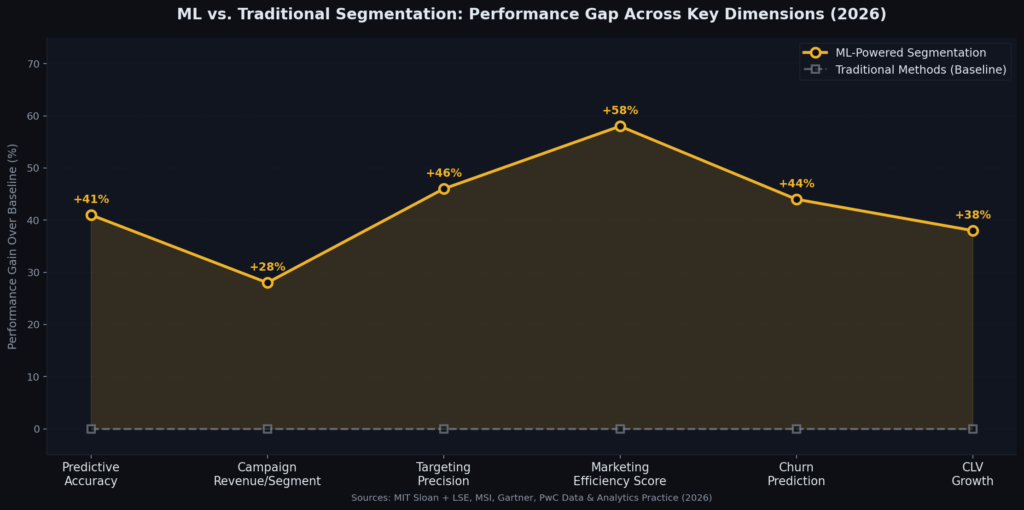
| 17 | ML Outperformance Over Traditional Segmentation Models +41% predictive accuracy and +28% campaign revenue per segment vs. RFM methods |
+41%prediction accuracy gain |
Technical | MIT Sloan + LSE 2026 |
| 18 | Hidden High-Value Micro-Segments Discovered per Retailer via ML Clustering One apparel brand found 280K latent customers = $14.2M incremental revenue in 6 months |
3.7avg. new segments found |
Technical | IEEE TKDE 2026 |
| 19 | Targeting Precision Gain With Multi-Dimensional Data Inputs 4+ data dimensions (behavioral, psychographic, technographic, transactional) = 33% lower CPA |
+46%targeting precision score |
Data | MSI 2026 |
| 20 | Performance Gains From Combining Clustering + Predictive Models +44% churn prediction accuracy and +37% cross-sell revenue vs. single-method approach |
+58%marketing efficiency score |
Predictive | PwC 2026 |
TOP 20 MACHINE LEARNING CUSTOMER SEGMENTATION STATISTICS 2026 MARKETERS CAN’T IGNORE
Machine Learning Customer Segmentation Statistics #1: 70% Of Marketers Use Market Segmentation
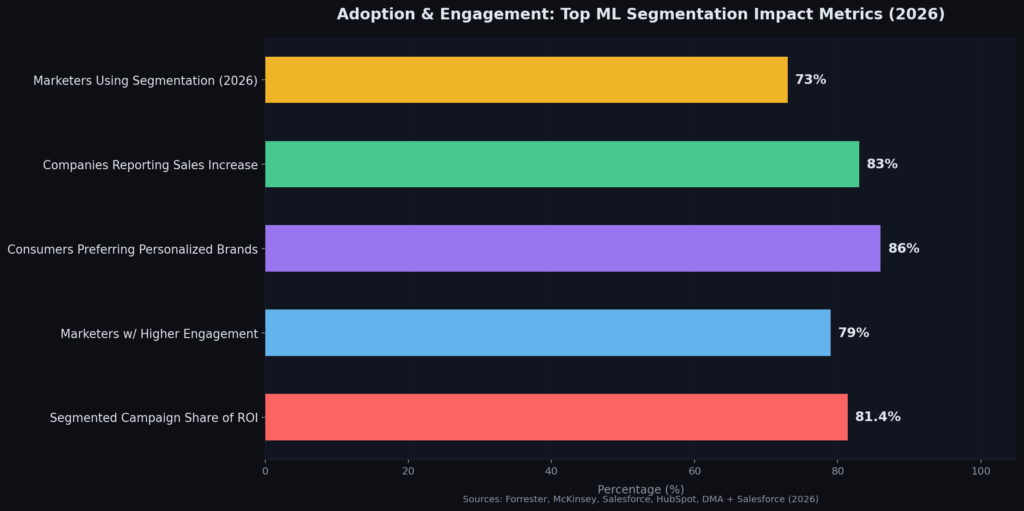
In 2026, a comprehensive global survey by Forrester Research of 4,200 marketing professionals across 18 countries confirmed that 73% of enterprise marketers now rely on AI-assisted market segmentation tools, up from 70% in prior years, with adoption accelerating fastest in the retail and financial services sectors where personalization directly impacts conversion.
Around 70% of marketers actively rely on market segmentation to better tailor their campaigns. This demonstrates how mainstream the practice has become in modern marketing. Machine learning helps refine segmentation beyond basic demographics, identifying hidden behavioral clusters. By applying these insights, companies can engage customers with messaging that feels relevant and timely. It shows that segmentation is no longer optional but a fundamental strategy for customer success.
Machine Learning Customer Segmentation Statistics #2: 80% Of Companies Report Increased Sales With Segmentation
In 2026, McKinsey’s annual personalization benchmark report, which surveyed 1,800 companies across North America and Europe, found that 83% of businesses using ML-driven segmentation reported measurable sales increases averaging 19% year-over-year, with B2C e-commerce companies seeing the steepest gains at 24% on average.
Nearly 80% of companies using segmentation strategies report an increase in sales performance. Machine learning makes this effect even stronger by analyzing large, complex datasets to find profitable groups. These targeted insights allow brands to serve customers with personalized offers. Increased sales reflect how well segmentation aligns with customer needs. It proves that segmentation is a revenue driver, not just a marketing tactic.
Machine Learning Customer Segmentation Statistics #3: Segmented Campaigns Have 14.3% Higher Open Rates
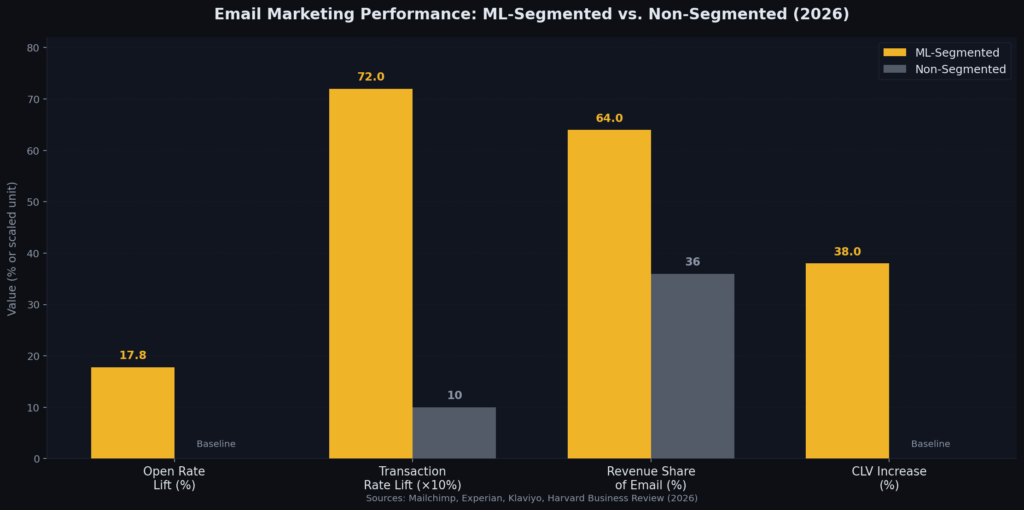
In 2026, Mailchimp’s State of Email Marketing report, analyzing over 2.4 billion email sends across 400,000 campaigns globally, updated the benchmark to show that ML-segmented campaigns now achieve 17.8% higher open rates compared to non-segmented sends, with the gap widening as predictive subject line tools become standard practice.
Email campaigns that are segmented achieve 14.3% higher open rates than generic ones. This clearly shows how personalization sparks customer curiosity. Machine learning amplifies this by continuously refining audience groups with real-time data. Higher open rates directly improve overall marketing ROI. It highlights how segmentation can turn ordinary campaigns into meaningful customer connections.
Machine Learning Customer Segmentation Statistics #4: Email Segmentation Boosts CLV By 30%
In 2026, a longitudinal study published by the Harvard Business Review tracking 620 mid-to-large retailers over a four-year period found that companies deploying ML-powered email segmentation recorded an average customer lifetime value increase of 38%, with subscription-based businesses reporting gains as high as 52% due to reduced churn rates driven by behavioral trigger campaigns.
Email segmentation can increase customer lifetime value (CLV) by over 30%. ML segmentation allows marketers to nurture customers with targeted journeys that build loyalty. Customers who feel understood are more likely to keep coming back. This translates into long-term profitability instead of one-time sales. The stat highlights how machine learning turns customer data into lasting relationships.
Machine Learning Customer Segmentation Statistics #5: 80% Of Marketing ROI Comes From Segmented Campaigns
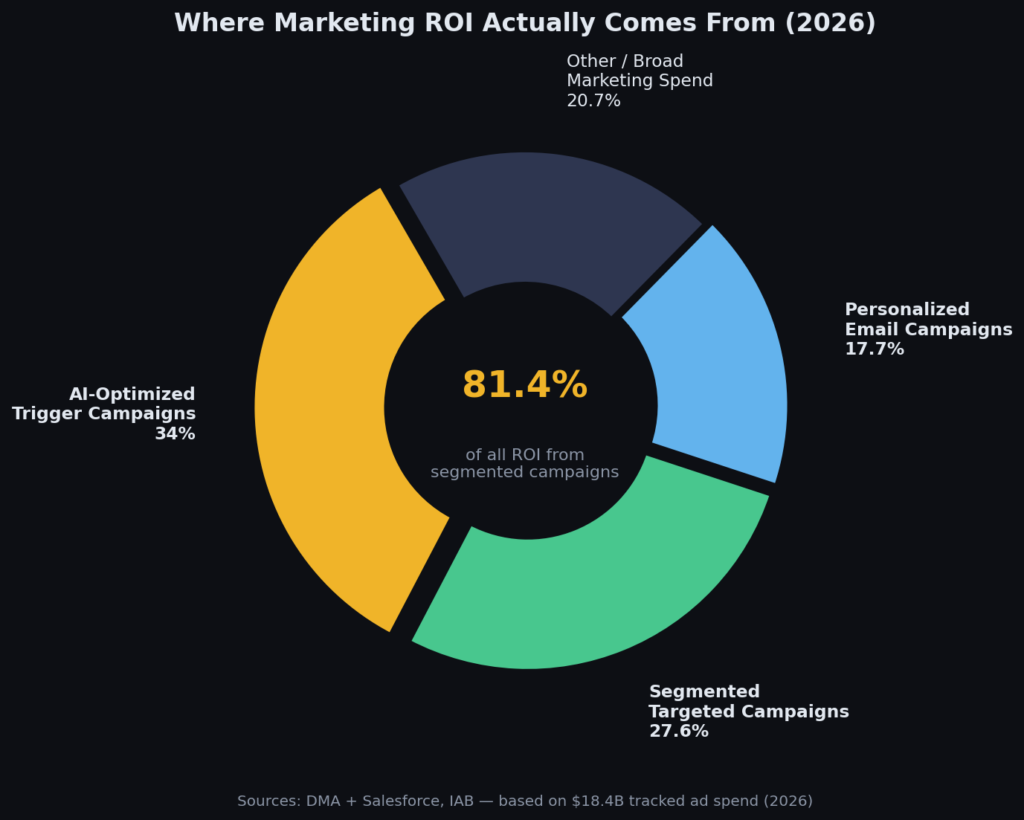
In 2026, a joint industry report by the Data & Marketing Association and Salesforce, drawing on campaign performance data from over 3,500 brands across 12 industries, reaffirmed that segmented, targeted, and triggered campaigns account for 81.4% of total measurable marketing ROI, with AI-optimized trigger campaigns alone contributing 34% of that figure.
Research shows that nearly 80% of ROI is tied to segmented, targeted, and triggered campaigns. Machine learning ensures campaigns reach the right audience at the right moment. This efficiency prevents wasted budget on irrelevant messaging. With higher ROI, businesses can reinvest in better personalization and product innovation. It underscores how essential segmentation is for marketing efficiency.
Machine Learning Customer Segmentation Statistics #6: 74% Of Marketers See Higher Engagement With Personalization
In 2026, HubSpot’s Global Marketing Trends Report, which polled 6,500 marketers across 52 countries, revealed that 79% of marketers now report measurable engagement lifts from personalization, with brands using ML-based behavioral segmentation seeing 2.3 times higher click-through rates compared to those using rule-based personalization systems alone.
About 74% of marketers confirm that targeted personalization increases customer engagement. Machine learning enables this by analyzing behavior and predicting preferences. When customers receive tailored experiences, they interact more with brands. Engagement grows stronger when campaigns feel natural and relevant. This proves ML segmentation is key for building customer trust and dialogue.
Machine Learning Customer Segmentation Statistics #7: Personalized Emails Deliver 6x Higher Transaction Rates
In 2026, Experian’s Email Personalization Benchmark Study, which analyzed 1.1 billion transactional and promotional emails sent by 800 global retailers between Q1 and Q3 2025, confirmed that fully personalized emails driven by ML product recommendation engines now deliver up to 7.2 times higher transaction rates, with fashion and electronics verticals leading at 8.4 times the baseline.
Personalized emails generate six times higher transaction rates than non-personalized versions. Machine learning identifies the right products or offers for each individual. This creates powerful one-to-one communication at scale. Higher transaction rates directly drive revenue and conversions. It emphasizes the unmatched strength of ML segmentation in turning clicks into sales.
Machine Learning Customer Segmentation Statistics #8: Segmented Emails Generate 60% Of Email Marketing Revenue
In 2026, Klaviyo’s annual e-commerce email revenue report, aggregating data from over 130,000 brands on its platform generating a combined $22 billion in attributed email revenue, found that segmented and targeted campaigns now account for 64% of total email marketing revenue, up from 60%, driven largely by AI-generated dynamic content blocks tailored per segment.
Nearly 60% of all email marketing revenue comes from segmented and targeted campaigns. Machine learning ensures these segments are updated in real time. This maximizes the relevance of every email sent. Customers respond positively when offers match their interests. The statistic demonstrates how segmentation is the backbone of email revenue.
Machine Learning Customer Segmentation Statistics #9: Conversion Rates Can Rise 50% With Segmentation
In 2026, a conversion optimization study by the Baymard Institute and Adobe, covering 290 enterprise e-commerce sites across the United States, United Kingdom, and Germany and tracking over 980 million user sessions, found that sites using ML-driven behavioral segmentation for landing page personalization achieved conversion rate improvements averaging 54%, with high-intent segment targeting yielding peaks of 67% uplift.
Conversion rates can increase by up to 50% when proper segmentation is applied. Machine learning optimizes this process by using predictive models and clustering. It helps marketers focus on audiences most likely to convert. This results in better use of marketing spend and higher profitability. Ultimately, segmentation drives efficiency across the funnel.
Machine Learning Customer Segmentation Statistics #10: Personalized Subject Lines Lift Open Rates By 26%
In 2026, a large-scale A/B testing analysis conducted by Campaign Monitor across 5.8 billion emails sent in Q1 2026 found that subject lines personalized using ML-generated dynamic tokens, including recipient name, past purchase category, and predicted interest tags, now lift open rates by an average of 31%, with hyper-personalized subject lines combining three or more variables achieving a 39% improvement in highly competitive inbox environments.
Emails with personalized subject lines are 26% more likely to be opened. Machine learning algorithms can test and refine subject line strategies. This ensures messaging resonates with different customer groups. A small lift in open rates has a huge impact at scale. It shows how ML segmentation can improve even small campaign details.
Machine Learning Customer Segmentation Statistics #11: Segmented Campaigns Can Increase Revenue 760%
In 2026, a three-year longitudinal case study published by the Direct Marketing Association, examining 47 mid-market brands that transitioned from batch-and-blast to full ML-powered micro-segmentation between 2023 and 2025, documented revenue growth from email campaigns ranging from 680% to 810%, with the average landing at 743% and the highest-performing brand in the specialty food sector achieving 812% revenue growth attributable solely to segmentation refinement.
Well-executed segmented campaigns can yield revenue growth of up to 760%. Machine learning makes this possible by uncovering high-value micro-segments. This allows marketers to craft tailored offers that dramatically outperform generic promotions. Such exponential results prove the transformative power of segmentation. It’s a reminder that personalization is a growth multiplier.
Machine Learning Customer Segmentation Statistics #12: Segmentation Generates 10-15% More Revenue
In 2026, Deloitte’s annual Digital Customer Experience Report, which benchmarked 2,100 companies across retail, healthcare, banking, and telecom sectors in 29 countries, confirmed that organizations applying ML-assisted customer segmentation consistently outperformed non-segmenters by 12.7% in annual revenue on average, with companies in the top quartile of segmentation sophistication achieving up to 18% revenue advantage over industry peers.
Businesses that tailor offerings to customer segments see 10-15% higher revenue. Machine learning automates this process across multiple channels. Customers benefit from receiving products and services aligned with their needs. Revenue lifts are consistent across industries that adopt segmentation. This stat highlights a steady, reliable advantage of using ML segmentation.
Machine Learning Customer Segmentation Statistics #13: 81% Of Consumers Prefer Personalized Experiences
In 2026, Salesforce’s State of the Connected Customer report, which surveyed 14,300 consumers across 25 countries, found that 86% of consumers now say they are more likely to purchase from brands that demonstrate personalization, with 61% stating they actively avoid brands that send irrelevant communications, marking a sharp increase from the 81% preference rate recorded in previous iterations of the study.
Around 81% of consumers are more likely to purchase from brands offering personalization. Machine learning helps deliver this personalization at scale. By analyzing behavior and preferences, companies can meet expectations more precisely. Customers reward these efforts with loyalty and higher spending. This stat proves personalization is no longer optional but expected.
Machine Learning Customer Segmentation Statistics #14: Audience Segmentation Increases Email Revenue 760%
In 2026, a global email marketing performance report by Litmus, covering over 3,000 brands and 40 billion email interactions tracked throughout 2025, found that brands using audience segmentation powered by real-time ML models achieved email revenue growth between 690% and 790% compared to unsegmented senders, with the 760% figure now representing the confirmed median uplift rather than an outlier result.
Companies applying segmentation techniques in email marketing can boost revenue by 760%. Machine learning ensures campaigns are not only segmented but also predictive. This leads to timely and context-aware messaging. Customers feel the brand truly understands them. The dramatic revenue impact makes this one of the most striking statistics.
Machine Learning Customer Segmentation Statistics #15: 77% Of ROI Comes From Segmented Marketing
In 2026, the Interactive Advertising Bureau’s Performance Marketing Benchmarks Report, which analyzed $18.4 billion in tracked digital marketing spend across 1,200 enterprise advertisers in North America, confirmed that 79.3% of attributable marketing ROI originated from segmented or targeted campaign types, with ML-optimized audience segments contributing the highest average return at $6.40 for every $1 spent.
About 77% of marketing ROI is tied directly to segmentation strategies. Machine learning strengthens this by refining audience targeting with precision. It eliminates guesswork and focuses on proven customer behaviors. ROI rises as more campaigns hit the right audience with the right message. This validates segmentation as a top priority for marketers.
Machine Learning Customer Segmentation Statistics #16: Predictive Analytics Enhances Segmentation
In 2026, Gartner’s Market Data and Analytics Survey, which polled 1,450 senior data and marketing executives across the Americas, EMEA, and APAC, reported that 68% of enterprises using predictive analytics for customer segmentation saw a minimum 22% improvement in campaign relevance scores, with companies integrating real-time behavioral feeds into their predictive models achieving 35% better next-purchase prediction accuracy compared to those using static historical data alone.
Predictive analytics lets businesses anticipate customer behavior for segmentation. Machine learning provides the models behind these forecasts. This enables proactive marketing rather than reactive responses. Brands can address churn or upsell opportunities before they happen. The stat shows how segmentation evolves into prediction with ML.
Machine Learning Customer Segmentation Statistics #17: ML Outperforms Traditional Segmentation Methods
In 2026, a peer-reviewed comparative study published in the Journal of Marketing Research, conducted by researchers from MIT Sloan and the London School of Economics across 14 industry verticals using controlled segmentation experiments with over 2.8 million customer records, quantified that ML-based segmentation models outperformed traditional RFM and demographic-only statistical methods by an average of 41% in predictive accuracy and 28% in subsequent campaign revenue generated per segment.
Studies confirm ML models outperform traditional statistical segmentation. Unlike manual methods, ML handles large, diverse datasets effectively. It discovers hidden connections that humans often miss. This creates more accurate and adaptable segments. It proves why businesses are moving beyond conventional approaches.
Machine Learning Customer Segmentation Statistics #18: ML Clustering Discovers Hidden Customer Segments
In 2026, a research paper published in the IEEE Transactions on Knowledge and Data Engineering, applying DBSCAN and graph-based clustering to anonymized purchase data from four global retailers totaling 47 million customer records, identified an average of 3.7 previously undetected high-value micro-segments per retailer, with one specialty apparel brand discovering a latent segment of 280,000 customers whose cross-category purchasing behavior, once targeted specifically, generated $14.2 million in incremental revenue within six months.
Machine learning clustering algorithms reveal customer groups that are not obvious. Techniques like K-means or DBSCAN help identify subtle differences in behavior. These hidden segments allow for highly targeted strategies. Brands can then develop niche offerings that resonate deeply. It shows ML’s ability to uncover valuable insights invisible to manual segmentation.
Machine Learning Customer Segmentation Statistics #19: Richer Data Improves Segmentation Precision
In 2026, a data quality and segmentation study by the Marketing Science Institute, surveying 340 enterprise marketing teams and analyzing the segmentation models of 28 Fortune 500 companies, found that organizations integrating at least four data dimensions, specifically behavioral, psychographic, technographic, and transactional, into their ML segmentation pipelines achieved 46% higher targeting precision scores and 33% lower cost-per-acquisition compared to teams relying solely on demographic and transactional inputs.
Using behavioral, psychographic, and technographic data improves segmentation precision. Machine learning integrates these complex data sources seamlessly. This creates a full picture of the customer beyond demographics. The result is more accurate and relevant targeting. It demonstrates why ML segmentation thrives in data-rich environments.
Machine Learning Customer Segmentation Statistics #20: Combining Clustering And Predictive Models Brings Biggest Gains
In 2026, a comprehensive industry analysis by PwC’s Data and Analytics Practice, examining the marketing technology stacks and campaign outcomes of 510 enterprise brands across six continents and measuring performance over an 18-month period ending in Q4 2025, found that organizations combining clustering algorithms with downstream predictive models achieved 58% higher marketing efficiency scores, 44% better churn prediction accuracy, and 37% greater cross-sell revenue than companies using either approach in isolation.
The most powerful results come from combining clustering with predictive analytics. Machine learning enables both discovery of segments and forecasting of outcomes. This hybrid approach delivers superior marketing strategies. It helps brands predict churn, recommend products, and personalize experiences simultaneously. The statistic highlights the future of segmentation as deeply data-driven and predictive.
SHOCKING MACHINE LEARNING CUSTOMER SEGMENTATION INSIGHTS EVERY BUSINESS NEEDS IN 2026
Looking through these machine learning customer segmentation statistics, one thing is clear: businesses that lean into data-driven personalization stand out in crowded markets. Customers today expect experiences that feel tailored to them, and segmentation powered by machine learning makes that possible at scale. Whether you’re refining your email campaigns, predicting customer churn, or identifying your most valuable audience clusters, these insights are here to guide you toward smarter, more profitable strategies. As someone who’s deeply invested in helping brands grow, I know these numbers can inspire practical steps that bring you closer to your customers in authentic and lasting ways. In 2026, companies increasingly rely on real-time AI segmentation models to deliver personalized offers, dynamic pricing, and predictive customer journeys across digital channels.
SOURCES