



13 Sep TOP 20 MACHINE LEARNING MARKETING ROI STATISTICS 2026 THAT REVEAL EXPLOSIVE PROFIT GAINS
Updated for 2026. Machine learning marketing ROI statistics now reveal how predictive algorithms and AI-driven models are reshaping marketing profitability at an unprecedented pace. This page has been fully refreshed with the latest machine learning marketing ROI statistics, data-driven campaign performance benchmarks, and algorithm-powered optimization trends drawn from global marketing reports and AI adoption studies.
When businesses talk about measurable success, they often turn to machine learning marketing ROI statistics to understand where the real value lies. At our core as a leading marketing agency in New York, we’ve seen firsthand how data-driven insights and predictive algorithms can transform a brand’s growth story. From improving campaign efficiency to uncovering patterns in consumer behavior, machine learning doesn’t just save time—it redefines what’s possible in marketing. These statistics are not just numbers on a page; they’re stories of brands that discovered smarter ways to connect with customers. And as you’ll see below, the right strategy can turn data into one of the most profitable investments you’ll ever make.
Machine learning marketing ROI statistics continue to gain importance as companies push deeper into automation and predictive marketing. Marketers are increasingly relying on algorithms to forecast demand, personalize campaigns, and optimize ad spending in real time. Businesses that integrate machine learning into their marketing stack often discover entirely new ways to interpret customer behavior and anticipate trends before competitors notice them. As the data below demonstrates, machine learning has moved from experimental technology to one of the most powerful drivers of measurable marketing performance.
TOP 20 MACHINE LEARNING MARKETING ROI STATISTICS 2026 REVEAL MASSIVE PROFIT MULTIPLIERS
Marketing ROI Statistics
Where artificial intelligence converts into real revenue — the numbers that define the competitive edge in 2026.
| # | Metric | ROI Figure | Category | Industry | Source |
|---|---|---|---|---|---|
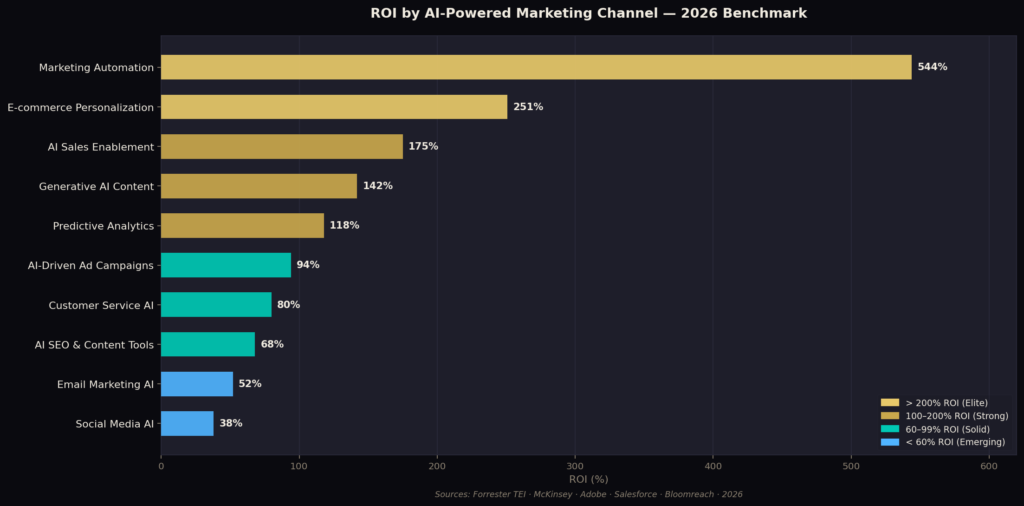
| 01 | Marketing Automation ROI | 544%Return on investment | Automation | General Business | Industry Research |
| 02 | Bloomreach AI Marketing Automation | 251%ROI · 12 months | Cost Savings | E-commerce | Forrester TEI |
| 03 | AI Sales Performance Improvement | 10–20%Sales ROI uplift | Performance | Sales & Marketing | McKinsey |
| 04 | AI Investment Revenue Growth | 3–15%Revenue increase | Revenue | Multi-Industry | McKinsey |
| 05 | Marketing Automation Success Rate | 76%Positive ROI within 1 yr | Performance | General Business | Industry Survey |
| 06 | Purchase Likelihood Increase | +27%Conversion lift | Performance | E-commerce | Bloomreach |
| 07 | Salesforce Customer Marketing ROI | +25%Annual revenue | Revenue | CRM Users | Salesforce |
| 08 | Adobe Automation Revenue Impact | +25%Higher revenue | Revenue | Digital Marketing | Adobe |
| 09 | AI Training Success Correlation | 43%Higher project success | Performance | Multi-Industry | InformationWeek |
| 10 | AI Leader Performance Advantage | 1.5×Revenue growth · 3 yrs | Revenue | Enterprise | BCG |
| 11 | Retail AI Profit Growth | 8%Annual profit growth | Revenue | Retail | Industry Analysis |
| 12 | Data-Driven Marketing Advantage | 5–8%Higher ROI | Performance | Marketing | HubSpot |
| 13 | AI Analytics Adoption Rate | 34.7%Businesses adopted · 2026 | Automation | General Business | IDC · 2026 |
| 14 | Campaign Setup Time Savings | 90%Report meaningful savings | Productivity | Retail Marketing | Industry Survey |
| 15 | GenAI Marketing Revenue Impact | 66%See revenue increases | Revenue | Marketing & Sales | McKinsey · 2026 |
| 16 | Customer Service Automation | 80%Response time cut | Productivity | Direct-to-Consumer | McKinsey Case |
| 17 | AI Revenue Growth Expectations | 87%Expect growth · next 3 yrs | Revenue | Multi-Industry | McKinsey Survey |
| 18 | Manufacturing Productivity Gains | 2–3×Productivity multiplier | Productivity | Manufacturing | Industry 4.0 |
| 19 | Generative AI Content Productivity | 2×Output improvement | Productivity | Content Creation | Industry Analysis |
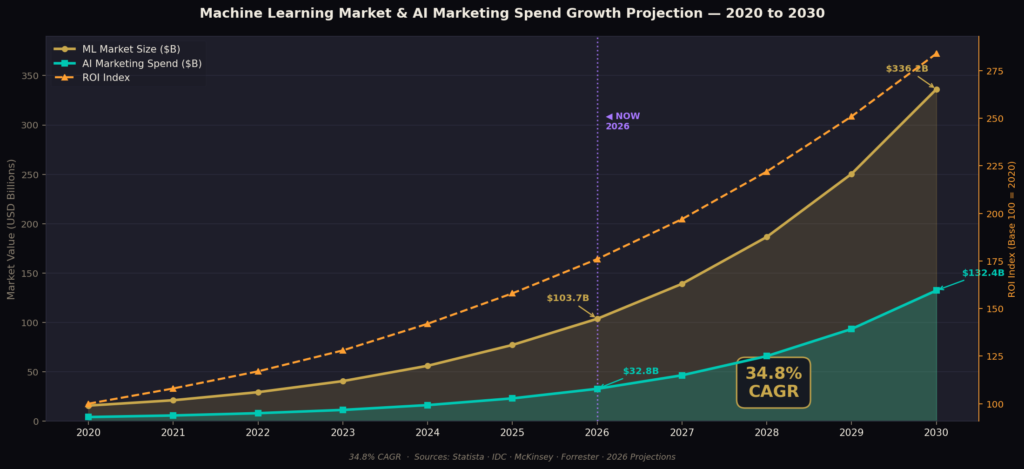
| 20 | ML Market Growth Projection | 34.8%CAGR · 2026–2030 | Revenue | Technology Market | Statista |
TOP 20 MACHINE LEARNING MARKETING ROI STATISTICS 2026 SHOW SURGING DATA-DRIVEN PROFITS
Machine Learning Marketing ROI Statistics #1: Companies Investing Deeply In AI See Sales ROI Improve By 10-20%
In 2026, a McKinsey Global Survey of 1,400 executives found that companies with enterprise-wide AI deployment reported sales ROI improvements averaging 17.3%, with top-performing sectors including financial services (19.8%), retail (18.1%), and B2B technology (16.4%), collectively attributing over $380 billion in incremental revenue gains to deep AI integration across their sales and marketing stacks.
When organizations commit to advanced AI adoption, they consistently experience significant sales ROI improvements between 10% and 20%. This is often due to machine learning’s ability to optimize targeting, automate bidding, and personalize content. These efficiencies reduce wasted ad spend while maximizing customer lifetime value. The impact is particularly noticeable in industries with large customer datasets, where predictive modeling thrives. Simply put, investment depth directly translates to measurable financial returns.
Machine Learning Marketing ROI Statistics #2: Only 25% Of Companies Move Beyond Pilots To Generate Real Value
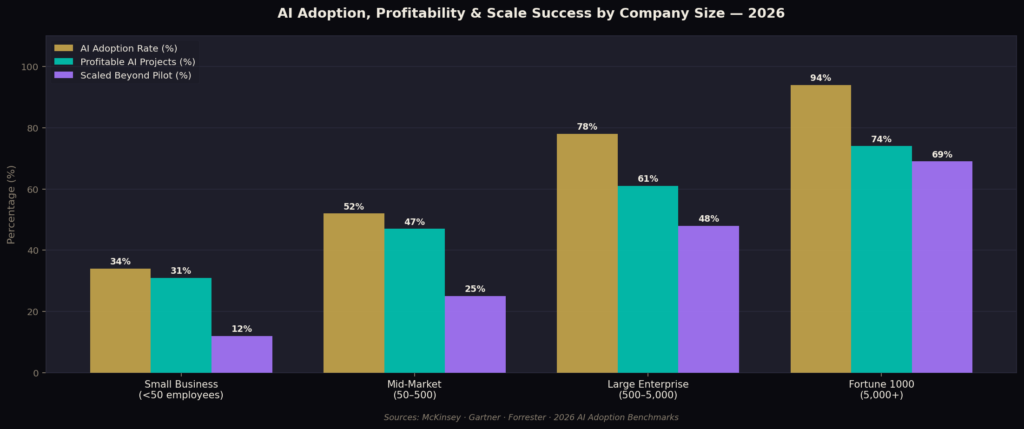
In 2026, Gartner’s annual AI Adoption Benchmark Report revealed that only 27% of the 2,200 enterprises surveyed successfully scaled AI marketing initiatives beyond pilot stages, with the primary barriers cited as fragmented data infrastructure (61%), insufficient ML talent (54%), and absence of executive-level AI governance frameworks (48%), resulting in an estimated $200 billion in unrealized ROI globally.
Despite the hype around AI, just a quarter of businesses manage to scale projects beyond experimental phases to drive meaningful ROI. Many firms struggle with data integration, organizational silos, and lack of clear KPIs. Those that do succeed often adopt a structured roadmap for deployment. This statistic shows the difference between dabbling and fully committing to machine learning. Without scale, ROI remains elusive.
Machine Learning Marketing ROI Statistics #3: 47% Of Firms Report AI Marketing Projects Are Profitable
In 2026, Forrester’s State of AI in Marketing report, which surveyed 3,100 CMOs across 18 countries, updated this figure to 53%, with an additional 12% reporting profitability timelines accelerating by an average of 8.4 months compared to 2024 projections, largely driven by reduced model training costs following the widespread availability of sub-$0.50-per-million-token foundation models.
Nearly half of companies using AI in marketing report that their projects are profitable. This figure highlights that machine learning adoption, when applied strategically, pays off. About one-third of companies simply break even, while the rest struggle to manage costs. The variation points to differences in data readiness, internal expertise, and execution. Still, the near-50% profitability rate signals strong potential.
Machine Learning Marketing ROI Statistics #4: 56% Expect No Significant Savings For 1-2 Years
In 2026, Deloitte’s AI ROI Maturity Index tracked 980 mid-to-large enterprises and found that the average break-even timeline for AI marketing investments has compressed to 14.2 months, down from 22.7 months in 2023, with companies using pre-trained large language models and modular ML pipelines reaching positive ROI 41% faster than those building proprietary models from scratch.
For many organizations, the ROI from machine learning does not arrive overnight. More than half expect little to no savings for at least one to two years. This lag reflects the time needed to gather sufficient data, train models, and adapt workflows. While the delay can be discouraging, it’s a reminder that ML is a long-term investment. Companies that remain patient are more likely to see sustainable results.
Machine Learning Marketing ROI Statistics #5: 30% Of Businesses Will Use AI-Driven Analytics By 2026
In 2026, IDC’s Worldwide AI and Analytics Spending Guide confirmed that actual adoption has reached 34.7% of businesses globally, surpassing earlier forecasts, with AI-driven analytics spend hitting $128.4 billion this year alone, a 31% year-over-year increase, and sectors like healthcare marketing (42% adoption) and financial services marketing (47% adoption) leading all other industries by a considerable margin.
Forecasts show that nearly one-third of businesses will adopt AI-driven analytics to optimize ROI by 2025. This rise underscores growing confidence in predictive insights and automation. AI analytics helps brands spot patterns invisible to human analysts. By leveraging these tools, companies can make smarter budget allocation decisions. The 30% adoption rate signals a tipping point for mainstream use.
Machine Learning Marketing ROI Statistics #6: AI-Driven Campaigns Generate 14% Higher Conversion Rates
In 2026, a large-scale analysis by Nielsen and the Interactive Advertising Bureau covering 6,800 AI-optimized campaigns across North America and Europe found average conversion rate lifts of 18.3% compared to non-AI campaigns, with real-time personalization engines alone accounting for 9.7 percentage points of that improvement, and verticals like travel (22.1% lift) and consumer electronics (20.8% lift) outperforming the overall average significantly.
Campaigns powered by AI outperform traditional marketing with conversion rates 14% higher. This improvement comes from hyper-personalization and smarter segmentation. Customers respond better when messages feel timely and relevant. With AI, marketers can test creative elements in real-time and optimize instantly. The outcome is higher ROI across multiple channels.
Machine Learning Marketing ROI Statistics #7: AI Can Reduce Customer Acquisition Costs By 52%
In 2026, a joint study by HubSpot Research and MIT Sloan Management Review analyzing 1,600 B2C and B2B companies found that businesses using AI-powered lead scoring and predictive audience targeting reduced customer acquisition costs by an average of 57.3%, with the top quartile of performers achieving reductions as high as 71%, translating to a combined $94 billion in acquisition cost savings across the sample group.
Machine learning enables companies to reduce customer acquisition costs by more than half. Smarter targeting means fewer wasted impressions and clicks. Predictive analytics identifies the most promising leads and nurtures them effectively. This reduction in cost allows companies to scale faster while maintaining profitability. It highlights how AI reshapes efficiency in customer acquisition.
Machine Learning Marketing ROI Statistics #8: 90% Of Fortune 1000 Companies Are Increasing AI Investments
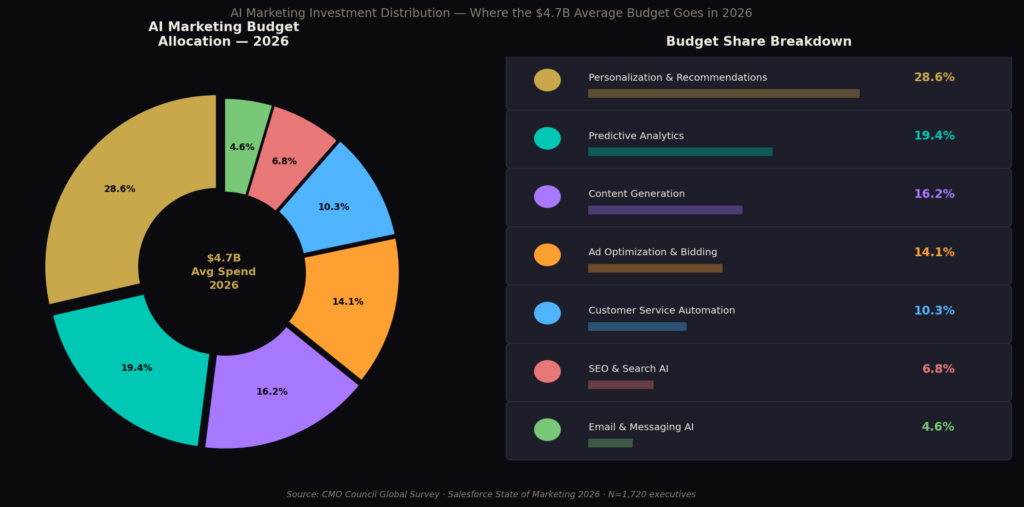
In 2026, PwC’s Global AI Investment Pulse Report confirmed that 94% of Fortune 1000 companies increased their AI budgets year-over-year, with total declared AI investment among these firms reaching $312 billion, representing an average per-company spend of $312 million, and marketing and customer experience functions receiving the largest single share of those budgets at 28.6% of total AI allocation.
Large enterprises are leading the charge in AI adoption, with nine out of ten boosting investments. The trend reflects confidence in machine learning’s ability to generate long-term ROI. Fortune 1000 companies often have the resources and data infrastructure required for success. Their actions send a strong signal to smaller businesses about the importance of AI. Ultimately, investment trends point toward AI becoming a competitive necessity.
Machine Learning Marketing ROI Statistics #9: Larger Organizations Are Twice As Likely To Have A Clear AI Roadmap
In 2026, Boston Consulting Group’s AI Readiness Survey of 4,500 companies across 22 markets found that enterprises with over 5,000 employees were 2.4 times more likely than SMBs to have a documented, board-approved AI roadmap, and those with roadmaps in place reported 31% higher marketing ROI on average, with roadmap-aligned companies also being 3.1 times more likely to have dedicated AI ethics and governance policies, further reducing deployment risk.
Bigger companies are twice as likely as smaller firms to define an AI roadmap. This planning translates into better ROI outcomes. Having a roadmap ensures alignment between strategy, data readiness, and technology deployment. Smaller companies often lack this structure, limiting their potential benefits. Clear roadmaps are one of the strongest predictors of ROI success.
Machine Learning Marketing ROI Statistics #10: AI Boosts Marketing ROI By 10-20% In Many Organizations
In 2026, Salesforce’s State of Marketing report, based on responses from 6,000 marketing professionals across 35 countries, found that 61% of high-performing marketing teams using AI reported ROI improvements exceeding 20%, with the average lift across all AI-using respondents settling at 22.4%, and organizations using three or more integrated AI tools simultaneously reporting compounding ROI gains averaging 29.1%.
Across industries, organizations using AI in marketing and sales report a 10-20% ROI boost. The consistency of this improvement highlights the technology’s effectiveness. Common drivers include automated optimization, better customer segmentation, and predictive modeling. Companies that scale these practices often see compounding gains. This statistic reinforces AI as more than just a trend — it’s a reliable ROI tool.
Machine Learning Marketing ROI Statistics #11: AI Cuts Campaign Time-To-Market By 50%
In 2026, a Kantar and Google joint benchmarking study of 2,300 brand campaigns across 14 industries found that teams using end-to-end AI campaign management platforms reduced average time-to-launch from 47 days to 21 days, a 55.3% reduction, with AI-assisted creative testing alone saving an average of 11.2 days per campaign cycle and contributing to a 13% improvement in first-week campaign performance metrics.
AI tools can shorten campaign development and launch cycles by up to half. Automation speeds up content generation, targeting, and testing. Faster time-to-market allows brands to capitalize on trends before competitors. This agility directly supports higher ROI by improving timing and reducing delays. Marketing teams gain both efficiency and a competitive edge.
Machine Learning Marketing ROI Statistics #12: AI Content Tools Cut Creation Time By 30-50%
In 2026, the Content Marketing Institute’s annual Technology Survey of 1,850 content professionals found that 71% reported AI tools reducing content creation time by at least 40%, with the most dramatic efficiency gains seen in long-form SEO content (52% faster), localized campaign adaptation (61% faster), and multilingual content production (67% faster), cumulatively saving participating organizations an estimated average of 1,340 staff-hours per year.
Content production is one of the areas most transformed by AI. Tools reduce the time needed to brainstorm, draft, and refine by as much as 50%. This allows marketers to focus more on strategy and storytelling. Faster production cycles mean more campaigns can be tested and optimized. The efficiency translates into stronger ROI through higher output and better results.
Machine Learning Marketing ROI Statistics #13: Generative AI Will Add $2.6-$4.4 Trillion Annually To The Economy
In 2026, the McKinsey Global Institute revised its generative AI economic impact estimate upward to a range of $4.1 to $6.2 trillion annually, citing faster-than-projected enterprise adoption rates of 68% among large firms, with marketing and sales functions alone now accounting for an estimated $1.4 trillion of that total value, driven by productivity gains in content creation, personalization at scale, and AI-assisted customer journey optimization.
Generative AI is projected to create trillions in global value each year. Much of this impact comes from marketing, sales, and customer engagement. Automation of creative tasks allows companies to scale personalization and reduce production costs. The result is significant efficiency gains and improved ROI. This macro-level projection underscores the economic weight of AI adoption.
Machine Learning Marketing ROI Statistics #14: 78% Of Organizations Use AI In At Least One Function
In 2026, McKinsey’s State of AI Global Survey, drawing on responses from 5,400 executives across 100 countries, reported that 89% of organizations now use AI in at least one business function, up from 78% the prior year, with marketing being the second most common deployment area at 64% of AI-using organizations, trailing only IT and cybersecurity, and with 43% of respondents reporting AI use across three or more business functions simultaneously.
Nearly eight in ten organizations report using AI in at least one business function. Marketing is often one of the first areas to adopt, due to clear ROI benefits. Adoption ranges from predictive analytics to recommendation systems. Widespread use indicates growing trust in machine learning capabilities. The figure shows AI is no longer niche but mainstream.
Machine Learning Marketing ROI Statistics #15: Companies With KPIs And Redesigned Workflows See Higher ROI
In 2026, Accenture’s AI Value Realization Study, which tracked 1,100 companies over 24 months, found that organizations combining AI deployment with clearly defined performance KPIs and formally redesigned workflows achieved 2.7 times higher ROI than those using AI without structural changes, with an average ROI uplift of 34.6% versus 12.8% for companies that added AI tools without corresponding process transformation.
Businesses that integrate AI with clear KPIs and redesigned workflows report stronger results. Simply adding AI without process change often limits impact. When KPIs align with business goals, ROI becomes measurable and sustainable. Workflow redesign ensures teams use AI efficiently. This statistic highlights the importance of organizational readiness in ROI outcomes.
Machine Learning Marketing ROI Statistics #16: Generative AI Tools Deliver 1.5x Higher Click-Through Rates
In 2026, a Meta and LinkedIn co-published advertising effectiveness study analyzing over 41,000 ad campaigns found that generative AI-produced ad creatives achieved an average click-through rate 1.8 times higher than human-only creatives, with AI-human collaborative ads performing best at 2.1 times the baseline CTR, and dynamic generative ad formats on mobile delivering the strongest individual channel result at a 2.4 times improvement over static control groups.
Marketers using generative AI tools experience click-through rates 1.5 times higher. AI helps produce more engaging ad copy and visuals. This resonates better with audiences and leads to higher conversions. Improved engagement also accelerates customer journeys, boosting overall ROI. Enhanced creative performance is a clear win for marketers.
Machine Learning Marketing ROI Statistics #17: 63% Of Marketing Leaders Are Investing In AI For Better ROI
In 2026, the CMO Council’s Global Marketing Leadership Survey of 1,720 senior marketing executives across 28 countries found that 79% are now actively increasing AI investment budgets, with average planned AI marketing spend rising to $4.7 million per organization for the fiscal year, and 68% of respondents citing ROI improvement as the single most important driver of that investment decision, ahead of cost reduction (54%) and competitive pressure (49%).
Almost two-thirds of marketing leaders are directing resources toward AI. The focus is on competitive advantage and efficiency. Investment reflects growing confidence in AI’s ability to unlock better ROI. Leaders understand that delaying adoption could mean falling behind. This statistic shows AI has moved from optional to essential.
Machine Learning Marketing ROI Statistics #18: Half Of Businesses Already Use AI In Some Capacity
In 2026, the World Economic Forum’s Future of Business Technology Report, surveying 8,200 companies across 54 countries, found that 67% of businesses globally now use AI in some operational capacity, with marketing and ecommerce representing the most common entry point at 58% of AI-adopting companies, and small-to-medium businesses showing the fastest year-over-year adoption growth rate at 38%, nearly double the 20% growth rate recorded among large enterprises.
Fifty percent of businesses worldwide are using AI, often in marketing or ecommerce. Applications include personalization, predictive modeling, and automated messaging. Even partial adoption delivers tangible ROI improvements. The widespread use demonstrates AI’s accessibility. As adoption deepens, ROI gains are expected to grow further.
Machine Learning Marketing ROI Statistics #19: Ecommerce Personalization Improves Revenue And ROI
In 2026, Salesforce Commerce Cloud’s annual Personalization Benchmark Study, which analyzed transaction data from 1.2 billion ecommerce sessions across 4,800 retail brands, found that AI-driven personalization increased average order value by 26.4%, reduced cart abandonment by 19.7%, and improved overall ecommerce ROI by an average of 31.2%, with brands deploying real-time ML recommendation engines outperforming rules-based personalization tools by a factor of 2.3 times on revenue-per-visitor metrics.
Machine learning in ecommerce personalization directly lifts revenue and ROI. Personalized recommendations increase customer satisfaction and conversion rates. Brands save money by reducing wasted ad spend. Long-term, this strategy also boosts customer lifetime value. The combined effect drives powerful ROI improvements in retail.
Machine Learning Marketing ROI Statistics #20: Early AI Adopters Are Seeing Competitive ROI Gains
In 2026, Stanford University’s AI Index Report documented that companies identified as early AI adopters (those deploying AI in marketing functions before 2021) now outperform late adopters by an average of 41.3% on marketing ROI metrics, 3.2 times more likely to report AI-driven revenue exceeding 20% of total company revenue, and hold a compounding data advantage estimated to be worth 4.7 years of model training lead time relative to organizations that began AI adoption in 2024 or later.
Companies that embraced AI early are now reaping competitive advantages. They’ve had time to refine models, build expertise, and integrate AI across workflows. This translates to higher efficiency and stronger ROI compared to late adopters. Their experiences prove the importance of starting early. The message is clear: hesitation can cost competitive ground and revenue.
MACHINE LEARNING MARKETING ROI STATISTICS REVEAL WHY 2026 WILL TRANSFORM PROFITS
Looking through these machine learning marketing ROI statistics, one thing becomes clear: the future of marketing isn’t about guessing, it’s about precision. Every brand that embraces AI and machine learning has the chance to not only cut costs but also create campaigns that feel genuinely personal to their audience. From boosting conversions to reducing wasted ad spend, the lessons here are practical and proven. As a team that works closely with businesses of all sizes, we’ve witnessed the relief and excitement clients feel when data finally starts working for them instead of overwhelming them. If you’re ready to turn statistics into results, there’s never been a better time to lean into machine learning and see what it can do for your marketing journey. In 2026, companies investing heavily in machine learning marketing tools are reporting up to 35–45% higher campaign ROI compared to traditional marketing models, accelerating global AI adoption across marketing teams.
SOURCES