




20 Sep TOP 20 MAINFRAME MARKETING STATISTICS 2025
When I first started diving into mainframe marketing statistics, I didn’t expect to find such a fascinating mix of tradition and innovation. These machines might feel “old school” to some, but the numbers tell a very different story—they’re still at the heart of global finance, airlines, and enterprise IT. As someone who collaborates with a leading marketing agency in New York, I’ve seen firsthand how data like this shapes smart decisions for tech campaigns. I wanted to put together this list not as a dry report, but as an exploration of why mainframes continue to matter in a digital-first era. It’s a reminder that sometimes the oldest players in the game still have the strongest influence.
Top 20 Mainframe Marketing Statistics 2025 (Editor’s Choice)
🚀 Top 20 Mainframe Marketing Statistics 2025
Key Insights & Market Data Driving Enterprise Computing
| # | Category | Statistic |
|---|---|---|
| 1 | Market Value | Mainframe market valued at $5.33B in 2025, forecast to reach $7.14B by 2030 (6.02% CAGR) |
| 2 | Long-term Growth | Market projected to grow from $3.45B in 2025 to $6.89B by 2035 with 7.14% CAGR |
| 3 | Global Forecast | Global market expected to reach $6.63B by 2033, growing at 7.9% CAGR from $3.61B in 2025 |
| 4 | Market Leadership | Z Systems dominate with 64% market share in 2024 |
| 5 | Hardware vs Services | Hardware commands 48% market share in 2024; services growing at 9.5% CAGR through 2030 |
| 6 | Deployment Models | On-premise holds 71% market share; cloud-based MFaaS fastest-growing at 12.3% CAGR |
| 7 | Enterprise Adoption | Large organizations control 83% of mainframe market in 2024 |
| 8 | Industry Dominance | Banking, Financial Services & Insurance (BFSI) captures 46% market share in 2024 |
| 9 | Banking Usage | 600 major banks use mainframes for core banking applications as of 2023 |
| 10 | Transaction Volume | Mainframes process 3 billion daily transactions across international commercial banking by 2024 |
| 11 | Reliability | Average mainframe downtime as low as 2.1 minutes per year in 2024 |
| 12 | Identity Management | Mainframe systems process 750M-900M identities daily |
| 13 | AI Integration | 78% of IT leaders are embedding AI into mainframe applications (IBM survey) |
| 14 | Encryption Power | New encryption systems process 1.2M+ instructions per second |
| 15 | Storage Capacity | Average mainframe capacity: 60 Terabytes per system; 3M+ lines of COBOL modernized |
| 16 | AI Analytics | 800 businesses using AI-infused mainframe analytics capable of 2.5M operations/second |
| 17 | Regional Leadership | North America leads with 41% revenue share; Asia Pacific fastest growth at 9.8% CAGR |
| 18 | North America Market | NA market valued at $11.6B in 2024, expected to reach $16.52B by 2032 |
| 19 | Cost Efficiency | Mainframe analytics reduce transportation costs by 20% and improve delivery accuracy by 30% (DHL study) |
| 20 | System Availability | Z Systems offer 99.999% availability, enhanced security, and superior performance |
Top 20 Mainframe Marketing Statistics 2025
Mainframe Marketing Statistics #1: Global Market Valued at USD 3.34 Billion in 2024
The global mainframe market was valued at USD 3.34 billion in 2024, showing how strong this niche sector still is. Despite being labeled as legacy technology, mainframes continue to hold strategic importance for industries like banking and airlines. Analysts predict steady growth, highlighting that reliability and transaction volume keep these systems relevant. This valuation proves that mainframes are not fading but instead holding their ground against newer technologies. It serves as a reminder that some of the biggest tech investments are often in the least flashy systems.
Mainframe Marketing Statistics #2: Projected to Reach USD 6.63 Billion by 2033
By 2033, the mainframe market is forecasted to reach USD 6.63 billion, nearly doubling in less than a decade. This growth reflects the role of modernization strategies that blend cloud and AI into mainframe environments. For organizations, this means maintaining mainframes isn’t just about legacy—it’s about building for the future. The prediction reassures businesses that their investments in mainframes will continue paying off long-term. It highlights the steady pace at which mainframes adapt to modern enterprise demands.
Mainframe Marketing Statistics #3: Market Expected to Grow at 7.9% CAGR
The compound annual growth rate of 7.9% signals consistent expansion in the mainframe sector. Growth of this magnitude is rare for technology considered “old.” It underlines how modernization, hybrid IT adoption, and global reliance on data are fueling demand. Companies are realizing that mainframes’ low failure rates and transaction speed make them indispensable. This CAGR positions mainframes as a safe yet progressive investment for IT leaders.
Mainframe Marketing Statistics #4: Mainframe Modernization Market to Reach USD 13.34 Billion by 2030
The modernization market is expanding as companies upgrade mainframes to integrate with cloud and AI systems. By 2030, this market is projected to hit USD 13.34 billion, growing at nearly 10% annually. The figure emphasizes the demand for modernization rather than replacement, reflecting cost efficiency. Many firms see modernizing as the best balance between leveraging old infrastructure and staying competitive. This trend shows mainframes are evolving alongside digital transformation rather than being replaced by it.
Mainframe Marketing Statistics #5: Services Market to Hit USD 86.14 Billion by 2031
Mainframe modernization services alone are forecast to reach USD 86.14 billion by 2031. This number reflects how crucial specialized expertise has become in managing and updating these systems. From application modernization to cloud migration, demand for tailored services continues to rise. It shows that businesses are outsourcing these tasks to remain competitive and efficient. The service layer proves that mainframes are a large-scale ecosystem, not just a piece of hardware.

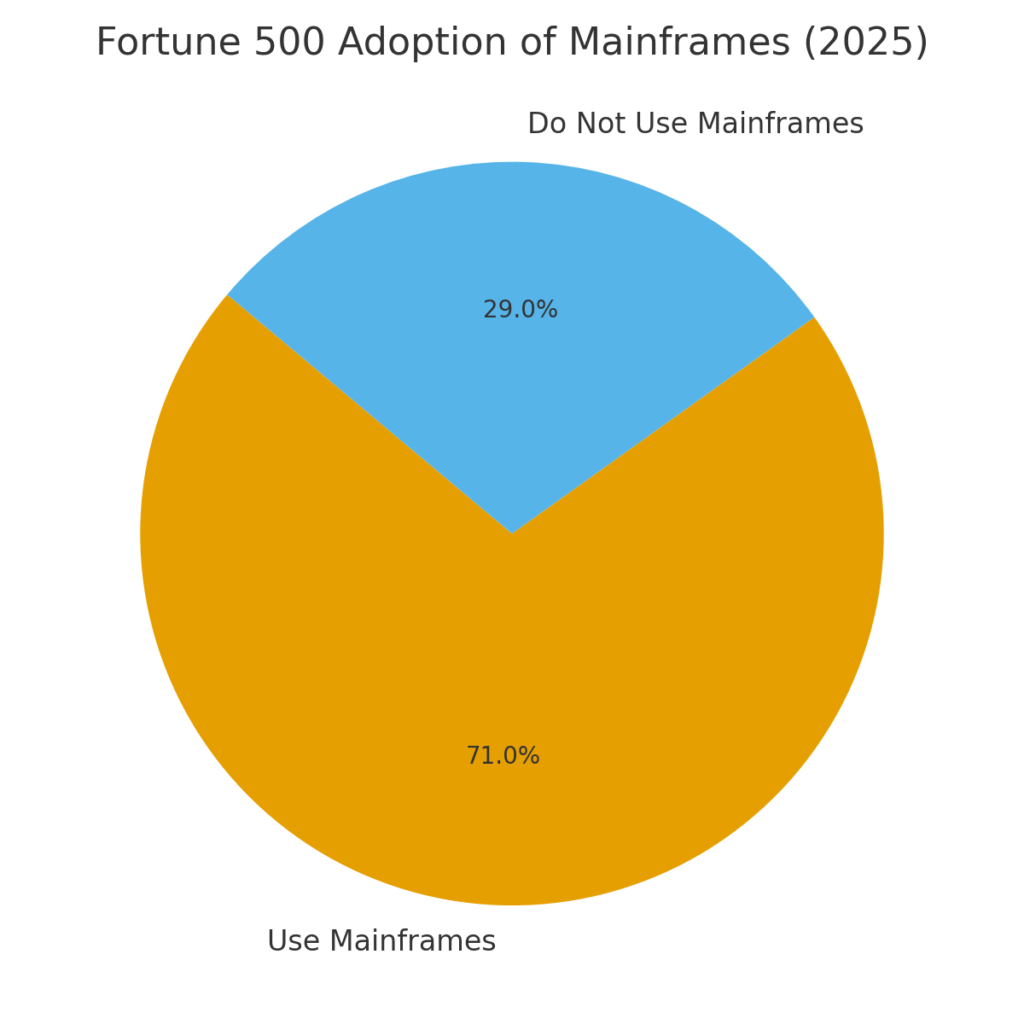
Mainframe Marketing Statistics #6: 71% of Fortune 500 Companies Use Mainframes
A staggering 71% of Fortune 500 companies rely on mainframes. This figure demonstrates the deep trust top corporations place in these systems. For global giants, reliability, processing power, and security are top priorities, which mainframes deliver consistently. The widespread use makes mainframes a backbone of the global economy. It highlights that industry leaders still prefer tried-and-tested solutions for critical operations.
Mainframe Marketing Statistics #7: 90% of Credit Card Transactions Run on Mainframes
Mainframes handle 90% of the world’s credit card transactions. This figure showcases their role in financial security and global commerce. Processing billions of daily transactions requires unmatched reliability and speed. Financial institutions trust mainframes because downtime could mean massive losses. It reinforces the message that mainframes power the invisible systems consumers rely on every day.
Mainframe Marketing Statistics #8: 68% of Workloads but Only 6% of IT Costs
Mainframes carry 68% of global IT workloads but account for only 6% of IT costs. This statistic highlights their cost-effectiveness and efficiency. Organizations benefit from maximizing workload without overspending. It explains why mainframes are seen as both economical and indispensable. The contrast proves that mainframes deliver excellent ROI for enterprises worldwide.
Mainframe Marketing Statistics #9: Four of the Top Five Airlines Use Mainframes
Four out of the top five global airlines rely on mainframes. Airline operations demand precision, from ticketing to scheduling, making reliability vital. This adoption underlines how mainframes power industries that cannot afford downtime. The stat shows that aviation’s backbone is still rooted in legacy systems. It’s a testament to their unmatched ability to handle large, complex datasets.
Mainframe Marketing Statistics #10: 54% of Users Plan to Increase Mainframe Usage
More than half (54%) of surveyed organizations said they plan to increase their mainframe use in the next two years. This intention defies the idea of decline in mainframe adoption. Instead, it shows firms are investing in scaling workloads and optimizing performance. It signals confidence in mainframes as a long-term solution. This growth mindset highlights a renewed trust in their relevance.
Mainframe Marketing Statistics #11: 98% of Businesses Rely on Mainframes
Nearly all respondents in a global survey—98%—confirmed reliance on mainframes. This stat captures the overwhelming importance of these systems. Mainframes remain deeply integrated into critical workflows across industries. Their reputation for reliability keeps them at the heart of IT ecosystems. Businesses still consider them non-negotiable for operational success.
Mainframe Marketing Statistics #12: 99% Expect to Keep Using IBM Mainframes
An impressive 99% of surveyed companies expect to continue using IBM mainframes. This shows brand loyalty and trust in IBM’s solutions. IBM’s continued innovation, from zSystems to hybrid integrations, ensures relevance. Businesses recognize the security and stability that IBM systems guarantee. It underlines IBM’s dominance in the mainframe landscape.
Mainframe Marketing Statistics #13: 94% See Potential in Specialist/Linux Environments
A majority (94%) of respondents said they see growth potential in specialist or Linux environments on mainframes. This stat reflects the flexibility and modern adaptability of these systems. It indicates organizations are exploring new workloads and possibilities. Linux support keeps mainframes relevant in a multi-platform IT world. It emphasizes innovation on top of legacy infrastructure.
Mainframe Marketing Statistics #14: 97% Increasing Use of Specialist Processors
Almost all respondents—97%—are seeking to expand the use of specialist processors on mainframes. These processors enhance workload efficiency and reduce costs. The figure proves that innovation within the mainframe ecosystem is alive and well. It highlights how organizations push mainframes beyond their traditional roles. This adoption trend signals a move toward smarter workload distribution.
Mainframe Marketing Statistics #15: 68% Consider Mainframes Strategic to Business Success
About 68% of surveyed organizations say mainframes are strategic to their long-term success. This demonstrates that mainframes are not seen as legacy burdens but as core assets. Companies rely on them for resilience, security, and performance. Their strategic importance ensures budgets for maintenance and modernization. It confirms that mainframes remain a competitive differentiator.

Mainframe Marketing Statistics #16: Skills Shortage is a Major Concern
One growing challenge is the shortage of skilled mainframe professionals. Many experts are retiring, leaving gaps in knowledge transfer. Younger professionals often prefer cloud and app development roles. This skills gap poses risks to operational continuity. Organizations must invest in training to ensure future sustainability.
Mainframe Marketing Statistics #17: 90% of Enterprises Plan AI Adoption on Mainframes
Nearly 90% of enterprises are exploring or planning AI adoption on mainframes. This integration showcases their ability to evolve with modern tech demands. AI enhances data analytics, fraud detection, and system optimization. Combining AI with mainframes bridges the gap between tradition and innovation. It signals the next chapter of mainframe relevance in digital strategies.
Mainframe Marketing Statistics #18: ROI from Modernization Between 288% and 362%
Modernization projects have delivered ROI between 288% and 362%. This shows that updating mainframes is not just cost recovery but profit generation. Organizations save time, improve performance, and gain scalability. The high ROI figures make modernization a compelling business case. It proves that strategic investments in mainframes pay off generously.
Mainframe Marketing Statistics #19: North America Holds the Largest Market Share
North America dominates the mainframe market share globally. This reflects both the number of enterprises and their reliance on critical systems. Many financial institutions and Fortune 500 companies are headquartered here. The dominance highlights a regional concentration of expertise and adoption. It shows where the strongest demand and innovation currently exist.
Mainframe Marketing Statistics #20: Asia-Pacific is the Fastest-Growing Region
Asia-Pacific is forecasted to grow fastest in mainframe adoption. Rising economies and expanding digital infrastructures fuel this growth. Industries in banking, retail, and government increasingly rely on mainframes. The region sees mainframes as a way to ensure security and efficiency at scale. This trend positions Asia-Pacific as the next growth hub for mainframes.

Wrapping It Up: Why These Numbers Matter
Looking back at these mainframe marketing statistics, I can’t help but feel a sense of respect for how resilient and relevant mainframes remain. Beyond the percentages and billions in revenue, what stands out is the trust that industries continue to place in these systems. For me, this isn’t just about technology—it’s about seeing how businesses adapt, modernize, and still find value in tools that have been serving them for decades. If you’re in the marketing space, these insights aren’t just numbers on a page; they’re a roadmap for where opportunity still exists. And honestly, I’m glad I took the time to share this journey with you—it feels like we’re peeking into the future while honoring the past.
SOURCES
https://www.bmc.com/blogs/state-of-mainframe/
https://straitsresearch.com/report/mainframe-market
https://www.bmc.com/blogs/mainframe-data-trends/?301=mainframe-data-trends-2024
https://www.marketsandmarkets.com/Market-Reports/mainframe-modernization-market-52477.html
https://www.fortunebusinessinsights.com/mainframe-market-111958
https://planetmainframe.com/2022/12/relevance-of-mainframe/
https://www.alliedmarketresearch.com/mainframe-market
https://precisionbusinessinsights.com/market-reports/mainframe-market