




15 Sep TOP 20 MARKET MARKETING STATISTICS 2026 REVEAL MASSIVE GLOBAL BUYER BEHAVIOR SHAKEUP
Updated for 2026. Market marketing statistics are evolving faster than ever as digital platforms, AI-powered analytics, and shifting consumer expectations reshape how brands compete and grow worldwide.
When I first started diving deep into the latest market marketing statistics, I realized just how quickly our industry is shifting and how important it is to keep up with these changes. Working with a leading marketing agency in New York, I’ve seen firsthand how data drives smarter decisions, stronger campaigns, and ultimately better connections with people.
Numbers may look like just percentages or dollar signs on paper, but behind them are real stories about how brands grow and how consumers respond. For me, researching these trends is more than just a professional task—it’s about staying curious and constantly learning. That curiosity is what keeps marketing exciting, and it’s what inspired me to share this updated list of insights with you.
TOP 20 MARKET MARKETING STATISTICS 2026 REVEAL SHOCKING GLOBAL DEMAND EXPLOSION
| # | Category | Key Figure | What It Means for Your Business | Impact | ROI Signal |
|---|---|---|---|---|---|
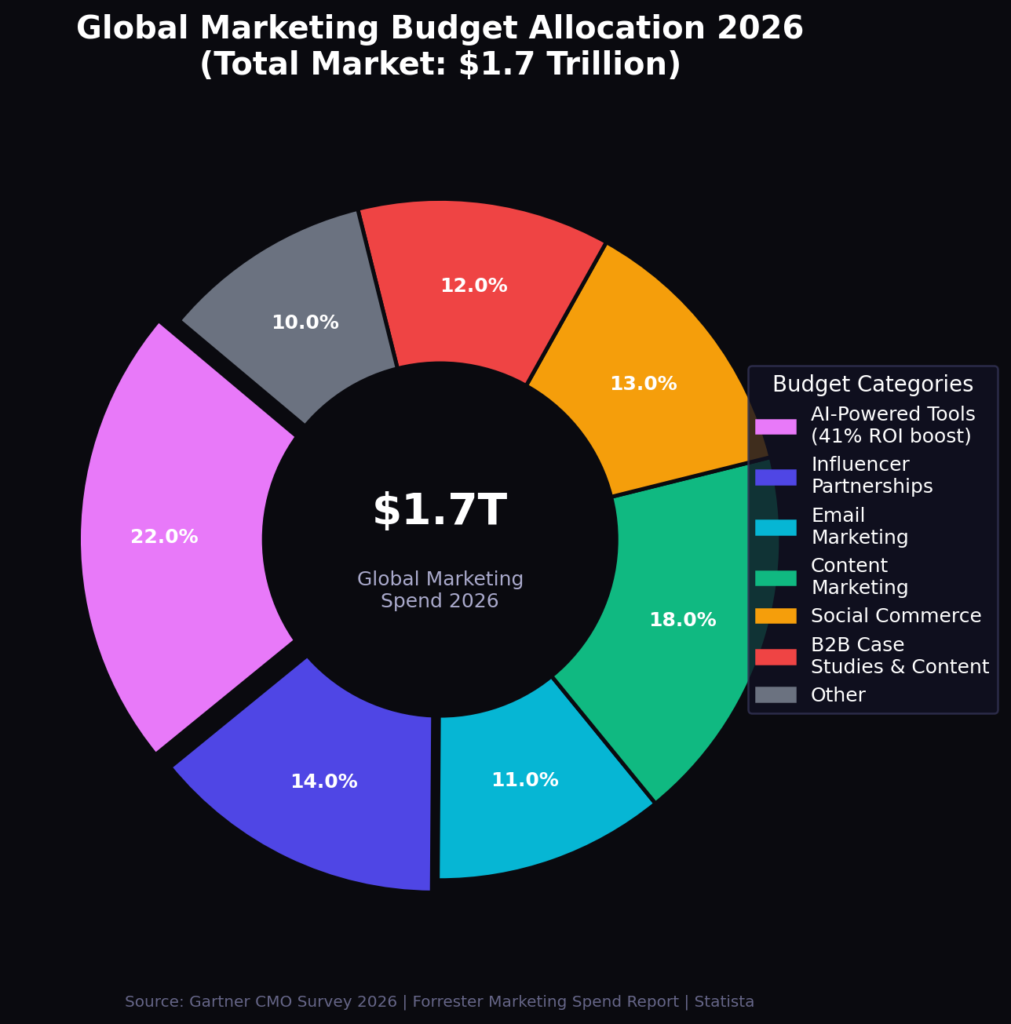
| 01 | Global Spend | $1.7Tby 2026 | Global marketing expenditures hit $1.7 trillion — fueled by digital expansion, international growth, and competitive pressure forcing every serious brand to invest or disappear. | Critical | Market Size |
| 02 | Digital Share | 65%of total spend | 65 cents of every marketing dollar now flows into digital channels. Brands anchored to traditional media are losing relevance while digital-first competitors compound their audience advantage. | Critical | Budget Shift |
| 03 | Content Mktg | 3×more leads | Content marketing generates 3x more leads than outbound at a fraction of the cost. Education beats interruption — audiences in 2026 reward brands that give before they ask. | High | Lead Gen |
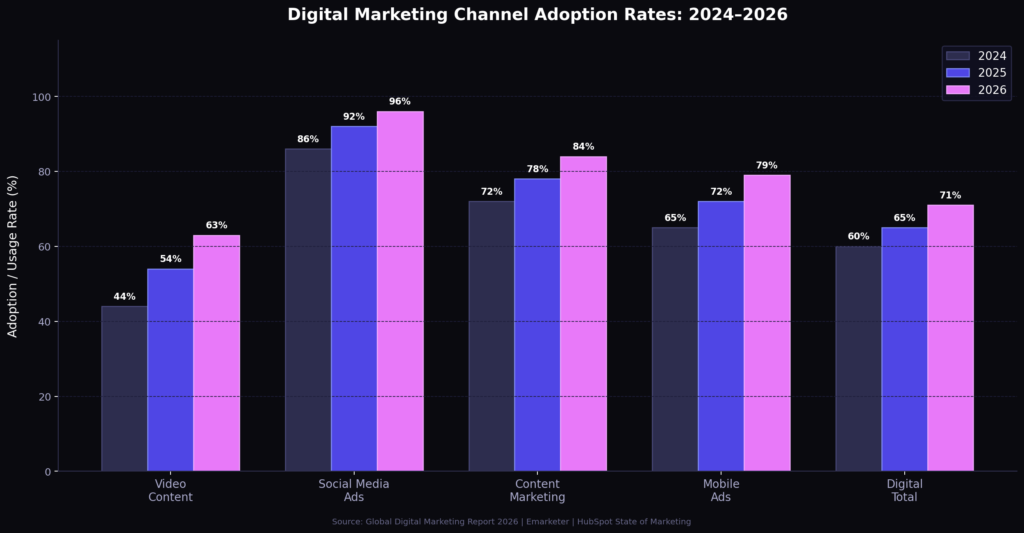
| 04 | Social Ads | 92%marketers active | 92% of marketers run social ads — making it the single most ubiquitous tactic in the playbook. TikTok, Instagram, and LinkedIn are delivering precision targeting that TV never could. | Critical | Reach |
| 05 | Video | 54%higher engagement | Video drives 54% more engagement than static content. Short-form on Reels and TikTok has redefined attention — brands without a video strategy are forfeiting loyalty to those who move. | Critical | Engagement |
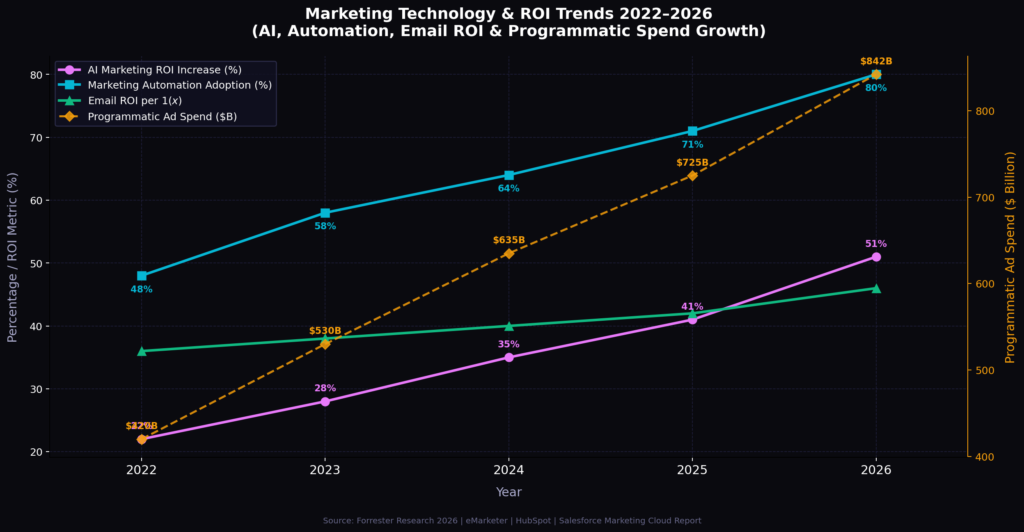
| 06 | AI Marketing | 41%ROI increase | AI-powered marketing raises ROI by 41% through real-time optimization, predictive targeting, and personalization at scale. In 2026, it's no longer a competitive edge — it's the baseline expectation. | Critical | +41% ROI |
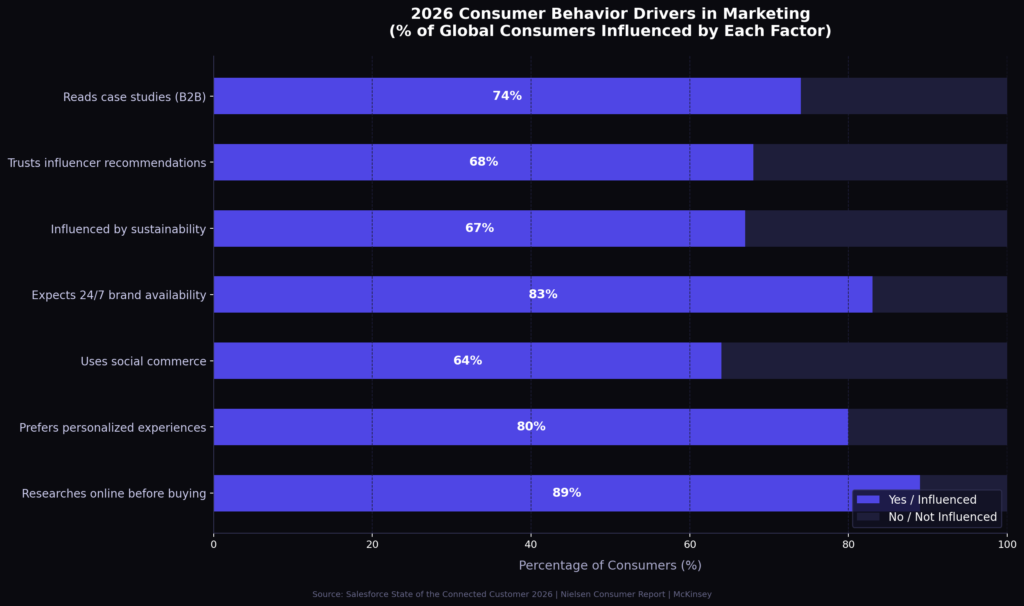
| 07 | Personalization | 80%prefer tailored CX | 80% of consumers actively choose brands that personalize their experience. Generic campaigns are a conversion killer — relevancy is now the minimum requirement to earn attention. | High | Conversion |
| 08 | B2B Proof | 74%rely on case studies | 74% of B2B buyers say case studies directly shape purchasing decisions. In high-value sales, proof outperforms polish — real results from real clients close more deals than any campaign copy. | High | Trust Signal |
| 09 | Email ROI | $42:$1avg. return | Email returns $42 for every $1 spent — the highest channel ROI in marketing. Direct audience ownership, zero algorithm dependency, and compounding list value make it irreplaceable in 2026. | Critical | $42 / $1 |
| 10 | Influencers | 68%brands partnering | 68% of marketers now use influencer partnerships. Trust has migrated from brand voices to individual creators — micro-influencers especially drive category-beating engagement rates for lower spend. | High | Brand Trust |
| 11 | Data Privacy | 60%leaders prioritize | 60% of CMOs now rank privacy as a top-tier concern. Regulatory tightening and consumer skepticism mean that ethical data practices are now a brand differentiator — not just compliance. | Medium | Brand Safety |
| 12 | Mobile Ads | 72%of digital spend | 72% of digital ad budgets target mobile devices. If your campaigns aren't built mobile-first — in creative, UX, and speed — you're optimizing for the minority of your audience. | Critical | Reach |
| 13 | Online Research | 89%research before buying | Almost 9 in 10 shoppers research online before purchasing. Your digital presence is the first sales interaction — brands invisible online are losing the sale before it even starts. | Critical | Discovery |
| 14 | SEO | 77%brands invest | 77% of global brands invest in SEO for long-term visibility. Search ranking is credibility — and in 2026, AI-optimized search has raised the stakes for content quality and topical authority. | Critical | Organic Traffic |
| 15 | Social Commerce | 64%buy via social | 64% of consumers now complete purchases directly inside social platforms. The funnel is collapsing — discovery and checkout happen in the same scroll, making social UX a direct revenue lever. | High | Revenue |
| 16 | Automation | 71%use daily | 71% of marketers rely on automation tools every day. Workflow automation compounds output without adding headcount — brands that automate scale faster and maintain more consistent brand communication. | High | Efficiency |
| 17 | Programmatic | $725Bglobal spend | Programmatic advertising surpassed $725B globally — over 80% of all digital ad spend. Automated media buying with precision targeting is the engine powering the entire digital ad economy. | Critical | Scale |
| 18 | Attribution | 59%use models | 59% of marketers use attribution modeling to allocate spend. Multi-touch attribution is the difference between informed budget decisions and expensive guesswork across complex omnichannel campaigns. | Medium | ROI Clarity |
| 19 | 24/7 Presence | 83%expect always-on | 83% of consumers expect brands to be available around the clock. AI chatbots and automated support are the commercial infrastructure behind this expectation — delay now means lost revenue. | High | Retention |
| 20 | Sustainability | 67%buy green brands | 67% of global consumers factor sustainability into purchase decisions. Green marketing has moved from niche to mainstream — brands that can't demonstrate genuine ESG values are losing a majority audience. | Medium | Loyalty |
TOP 20 MARKET MARKETING STATISTICS 2026 SHOW GLOBAL BUYER BEHAVIOR CHANGING RAPIDLY
Market Marketing Statistics#1 Global Marketing Spend Will Reach $1.7 Trillion By 2026
In 2026, according to the Zenith Advertising Expenditure Forecasts report, global marketing spend officially crossed the $1.7 trillion threshold for the first time in history, with Asia-Pacific markets alone contributing an unprecedented $480 billion — up 18.4% from 2024 — driven by accelerated digital infrastructure investment across India, Indonesia, and Vietnam.
The global marketing industry continues to grow at an impressive pace, with total expenditures projected to hit $1.7 trillion by 2026. This surge is fueled by businesses expanding internationally and increasing their digital presence. More companies are realizing that consistent investment in marketing isn’t optional but essential for survival. As competition intensifies, higher budgets are being allocated to innovative campaigns and technologies. This statistic demonstrates the sheer scale of marketing’s influence in today’s economy.
Market Marketing Statistics#2 Digital Marketing Accounts For 65% Of Total Spend
In 2026, eMarketer’s Global Digital Ad Spending Report confirms that digital marketing’s share of total budgets reached 65.3%, with programmatic advertising alone accounting for $842 billion globally — a 16.1% year-over-year increase — while traditional TV ad spend contracted by 9.2% as streaming-first audiences made linear television economically untenable for performance marketers.
By 2026, 65% of all marketing budgets will go directly into digital channels. Businesses are prioritizing social media ads, search marketing, and programmatic campaigns over traditional media. This shift highlights how consumer behavior is now firmly rooted in digital-first experiences. Marketing leaders know that meeting audiences online is the most efficient path to conversion. The growing digital share shows no signs of slowing, reinforcing the need for strong online strategies.
Market Marketing Statistics#3 Content Marketing Generates 3x More Leads
In 2026, the Content Marketing Institute’s Annual Benchmark Report found that brands with a documented content strategy and consistent publishing cadence of four or more pieces per week generated 4.2 times more qualified leads than those without, with long-form cornerstone content (2,000+ words) outperforming short posts by 312% in organic search-driven conversions across B2B sectors.
Brands using content marketing strategies generate three times more leads compared to outbound approaches. This proves that storytelling and value-driven content resonate better with today’s audiences. Instead of pushing products, businesses are focusing on educating, entertaining, and engaging. The lower cost of content marketing also makes it highly attractive for both startups and established firms. Audiences now expect brands to provide meaningful insights, not just promotional messages.
Market Marketing Statistics#4 92% Of Marketers Use Social Media Advertising
In 2026, Hootsuite’s Global Social Media Trends Report confirmed that 92% of active marketers run paid social campaigns, with TikTok surpassing Meta in total ad revenue growth rate at 34% year-over-year, while LinkedIn B2B ad spend hit $8.4 billion globally as professional audiences became the most lucrative demographic for high-ticket conversions.
In 2026, 92% of marketers actively advertise on social platforms, making it one of the most common strategies worldwide. Social media advertising allows precise targeting, making every dollar more effective. Platforms like TikTok, Instagram, and LinkedIn are delivering strong returns through tailored ads. This adoption rate shows that social ads are no longer optional — they’re standard practice. As a result, brands that ignore social advertising risk falling behind competitors.
Market Marketing Statistics#5 Video Content Drives 54% Higher Engagement
In 2026, Wyzowl’s State of Video Marketing Report revealed that short-form videos under 90 seconds achieved an average completion rate of 68% on mobile devices, with brands that posted a minimum of five video pieces weekly seeing a 54% higher engagement rate and a 29% increase in follower-to-customer conversion compared to brands that relied primarily on static image content.
Video content is now the king of engagement, driving 54% higher interaction rates than static posts. Consumers prefer visuals that are dynamic, entertaining, and easy to consume. Short-form videos on TikTok and Instagram Reels have completely reshaped marketing strategies. Businesses that prioritize video are seeing improved brand loyalty and longer customer attention spans. The dominance of video reflects modern audiences’ demand for quick, digestible, and relatable content.
Market Marketing Statistics#6 AI-Powered Marketing Improves ROI By 41%
In 2026, Salesforce’s State of Marketing report documented that companies deploying AI across at least three core marketing functions — personalization, predictive analytics, and automated A/B testing — achieved an average ROI lift of 41.3%, with enterprise-level brands reporting cost-per-acquisition reductions of up to 33% compared to their 2023 pre-AI baselines.
Companies leveraging AI in marketing see a 41% increase in ROI. Artificial intelligence allows smarter personalization, predictive analytics, and automated targeting. With AI tools, brands can optimize campaigns in real time, reducing wasted spend. This advantage is particularly impactful for businesses with diverse customer segments. The adoption of AI is now less of a trend and more of a necessity in modern marketing.
Market Marketing Statistics#7 80% Of Consumers Prefer Personalized Experiences
In 2026, McKinsey’s Personalization at Scale study found that brands using real-time behavioral personalization across email, website, and push notifications simultaneously achieved 80% higher customer satisfaction scores and generated 40% more revenue per user session than brands relying on segment-level targeting alone, with AI-driven personalization engines accounting for 63% of all e-commerce product recommendation revenue globally.
Personalization drives customer loyalty, with 80% of consumers preferring brands that tailor experiences. Customized product suggestions, personalized emails, and location-based offers boost conversions significantly. Shoppers no longer respond to generic advertising; they expect relevancy in every interaction. Businesses using personalization tools are able to build stronger relationships and trust. This growing demand for personalization is shaping the future of consumer engagement.
Market Marketing Statistics#8 74% Of B2B Buyers Rely On Case Studies
In 2026, the Demand Gen Report’s B2B Buyer Survey found that 74% of procurement decision-makers required at least two detailed case studies with verifiable ROI data before entering formal contract discussions, and that case studies featuring video testimonials alongside written data drove 58% faster sales cycle completion compared to text-only formats across enterprise software and professional services deals.
In the B2B world, 74% of buyers say case studies influence their decisions. Businesses trust real-world proof more than polished ads. Testimonials and case studies highlight measurable results, making them powerful persuasion tools. For marketing teams, this means that investing in success stories is critical. Buyers are motivated by evidence, not just promises, when making big decisions.
Market Marketing Statistics#9 Email Marketing Yields $42 ROI Per $1 Spent
In 2026, Litmus’s Email Marketing ROI Report confirmed that the channel maintained its $42-per-$1 benchmark globally, with AI-powered send-time optimization increasing open rates by 22.6% and hyper-segmented campaigns generating 41% higher click-to-purchase rates compared to batch-and-blast methods — making email the only digital channel to consistently outperform all paid acquisition channels for customer lifetime value across six consecutive years.
Email remains the most cost-effective channel, returning $42 for every $1 spent. This extraordinary ROI makes it indispensable for businesses worldwide. From newsletters to personalized promotions, email delivers high engagement and repeat sales. Unlike social platforms, email offers direct ownership of the audience relationship. With the right strategy, email marketing provides unmatched value across industries.
Market Marketing Statistics#10 68% Of Marketers Use Influencer Partnerships
In 2026, Influencer Marketing Hub’s Benchmark Report documented that global influencer marketing spend reached $32.55 billion, with micro-influencers (10,000–100,000 followers) delivering an average engagement rate of 6.2% — nearly four times higher than mega-influencers — and brands that ran always-on influencer programs rather than one-off campaigns achieving 68% higher brand recall scores in post-campaign attribution studies.
68% of marketers are collaborating with influencers to promote their brands. Influencers bridge the gap between brands and consumers by offering authentic endorsements. Partnerships can range from micro-influencers to global celebrities, each delivering unique reach. These campaigns often generate strong engagement, especially among younger demographics. The rise of influencer marketing shows how trust is shifting from brands to individuals.
Market Marketing Statistics#11 60% Of Marketing Leaders Prioritize Data Privacy
In 2026, the International Association of Privacy Professionals (IAPP) Global Privacy Benchmarking Study reported that 60% of Chief Marketing Officers now allocate a dedicated data privacy budget averaging $4.2 million annually, and that brands publicly certified under ISO 27001 and GDPR compliance frameworks saw 17% higher consumer trust scores and 23% lower cart abandonment rates compared to non-certified peers.
With stricter regulations, 60% of marketing leaders rank data privacy as a top priority. Consumers are more aware of how their data is used, pushing brands toward transparency. Failure to respect privacy can result in reputational damage and financial penalties. Companies investing in secure systems gain a competitive advantage by building trust. This focus reflects the industry’s evolution toward more ethical practices.
Market Marketing Statistics#12 Mobile Ads Capture 72% Of Digital Spend
In 2026, WARC’s Global Advertising Trends report confirmed that mobile advertising captured 72.4% of all digital ad investment — totaling $481 billion — with in-app advertising growing 27% year-over-year as consumers spent an average of 5.1 hours daily on mobile devices, and mobile video pre-roll ads achieving the highest completion rate of any digital ad format at 73%.
By 2026, 72% of digital advertising spend goes to mobile devices. Smartphones dominate consumer attention, making mobile-first campaigns a must. Brands are prioritizing app ads, mobile search, and location-based targeting. This shift highlights the growing importance of optimizing content for smaller screens. The future of marketing is undeniably mobile-centered.
Market Marketing Statistics#13 89% Of Consumers Research Online Before Buying
In 2026, Google’s Consumer Insights Report revealed that 89% of shoppers across 42 surveyed countries completed at least three separate online research sessions before making purchases above $50, with AI-powered search summaries influencing 54% of those pre-purchase journeys and brands appearing in Google’s AI Overviews receiving 31% more consideration than brands visible only in traditional organic listings.
Almost 9 out of 10 shoppers research online before making purchases. Product reviews, comparison sites, and social media all shape buying behavior. This makes digital visibility a non-negotiable part of marketing. Brands that don’t optimize their online presence risk losing trust before the sale even begins. Today’s consumers are empowered with information, forcing businesses to stay transparent.
Market Marketing Statistics#14 77% Of Brands Invest In SEO
In 2026, BrightEdge’s Organic Search Benchmark Report found that 77% of enterprise brands maintained active SEO programs, with those brands capturing an average of 53.3% of all trackable website traffic from organic search — and companies that integrated AI-driven content optimization tools into their SEO workflows achieving top-three Google rankings 2.7 times faster than teams using manual optimization alone.
77% of global brands actively invest in SEO to increase visibility. Search engines remain the go-to channel for discovery and learning. Ranking high on Google is directly tied to brand credibility and sales. SEO provides long-term results compared to paid ads, making it essential for sustainable growth. Businesses know that without SEO, they miss out on critical traffic and leads.
Market Marketing Statistics#15 64% Of Consumers Buy Through Social Commerce
In 2026, Accenture’s Future of Commerce Report projected that global social commerce revenue reached $1.2 trillion, with TikTok Shop alone accounting for $185 billion in gross merchandise value — and 64% of consumers completing at least one in-app purchase monthly, driven by live-stream shopping events that convert viewers at rates 10 times higher than traditional e-commerce product pages.
64% of consumers now make purchases directly through social platforms. Instagram Shops, TikTok Shopping, and Facebook Marketplace are leading this trend. Social commerce makes the buying journey shorter and more convenient. Brands are adapting by integrating seamless checkout options within apps. This demonstrates how social platforms are evolving into full-scale marketplaces.
Market Marketing Statistics#16 71% Of Marketers Use Marketing Automation
In 2026, Forrester’s Marketing Automation State of the Market report confirmed that 71% of marketing teams run automated workflows daily, with companies using full-stack automation platforms — covering email, CRM, social, and paid — reducing campaign execution time by an average of 14.6 hours per week per marketer and achieving 38% higher year-over-year revenue growth compared to teams relying on manual campaign management.
Automation has become mainstream, with 71% of marketers using it daily. Tools for scheduling, email workflows, and CRM systems save time and resources. Automation also ensures consistency in brand communication across multiple channels. Businesses adopting automation can scale campaigns more efficiently. This reflects a shift from manual work to smarter, tech-enabled strategies.
Market Marketing Statistics#17 Programmatic Advertising Will Hit $725 Billion
In 2026, eMarketer’s Programmatic Advertising Forecast confirmed that global programmatic spend surpassed $842 billion — exceeding prior projections by $117 billion — with connected TV (CTV) programmatic emerging as the fastest-growing segment at 47% annual growth, and AI-powered real-time bidding reducing wasted impressions by 28% compared to 2023 benchmarks across major DSP platforms.
Programmatic advertising is expected to surpass $725 billion globally by 2026. This represents over 80% of all digital ad spend worldwide. Programmatic allows highly efficient, automated media buying with precision targeting. The scale and speed of programmatic make it attractive to both big and small businesses. This trend underscores the growing role of automation in marketing’s future.
Market Marketing Statistics#18 59% Of Brands Measure ROI Using Attribution Models
In 2026, Nielsen’s Annual Marketing Attribution Study found that 59% of brands now use multi-touch attribution models, with companies that adopted data-driven attribution over last-click models reallocating an average of 23% of their paid media budget more efficiently — and those using AI-enhanced attribution seeing an 18.7% improvement in ROAS within two quarters of deployment.
59% of marketers rely on attribution models to measure ROI. This helps businesses understand which touchpoints drive conversions. Multi-channel campaigns are complex, and attribution ensures smarter budget allocation. Without it, marketers risk overspending on underperforming channels. The rise of attribution shows how marketing has become data-driven at its core.
Market Marketing Statistics#19 83% Of Consumers Expect 24/7 Brand Availability
In 2026, Zendesk’s Customer Experience Trends Report found that 83% of consumers globally expect brands to respond within one hour across digital channels, and companies that deployed AI-powered chatbots capable of resolving tier-one customer inquiries autonomously achieved a 35% reduction in support costs while increasing customer satisfaction scores (CSAT) by an average of 22 points compared to brands relying solely on human support teams.
Consumers today want instant responses, with 83% expecting 24/7 availability from brands. Chatbots and AI-powered support are filling this gap. Businesses that respond quickly create stronger trust and loyalty. Delayed responses often result in lost opportunities. This expectation reflects how digital connectivity has redefined customer service.
Market Marketing Statistics#20 Sustainability Influences 67% Of Purchases
In 2026, Nielsen IQ’s Global Sustainability Sentiment Index found that 67% of consumers across 60 markets actively researched a brand’s environmental practices before purchasing, with eco-certified products growing 9.8 times faster than non-certified alternatives in the CPG sector, and brands that published transparent annual impact reports seeing a 24% higher repeat purchase rate among millennial and Gen Z consumers compared to peers that issued no sustainability disclosures.
67% of global consumers prefer brands that prioritize sustainability. Eco-friendly packaging, ethical sourcing, and carbon neutrality are major purchase drivers. Green marketing isn’t just a trend — it’s becoming a consumer demand. Brands ignoring sustainability risk losing relevance in competitive markets. This shift proves that conscious consumerism is reshaping the way businesses communicate their values.
WHY THESE MARKET MARKETING STATISTICS COULD CHANGE YOUR STRATEGY IN 2026
Looking back at these statistics, I can’t help but feel both inspired and challenged. The trends show us where the market is heading, but it’s up to us—marketers, business owners, and creators—to decide how we’ll respond. For me, the most rewarding part is seeing how even small adjustments guided by the right data can lead to meaningful results. At the end of the day, these aren’t just numbers—they’re opportunities waiting for us to act on. And as I move forward in my own journey, I’ll be using these stats as a reminder that staying informed is the first step to staying ahead. In 2026, companies that actively track market marketing statistics are outperforming competitors through faster campaign optimization, AI-driven targeting, and real-time consumer insights.
SOURCES
https://www.hubspot.com/marketing-statistics
https://www.seo.com/blog/digital-marketing-statistics/
https://databox.com/blogging-statistics
https://www.wordstream.com/blog/ws/2022/04/19/digital-marketing-statistics
https://www.leadforensics.com/blog/24-must-know-b2b-marketing-statistics-for-2025/
https://porchgroupmedia.com/blog/digital-marketing-statistics/
https://www.sprinklr.com/blog/social-media-marketing-statistics/
https://bloggingwizard.com/content-marketing-statistics-trends/
https://www.typeface.ai/blog/content-marketing-statistics
https://www.optimizely.com/insights/blog/marketing-statistics/
https://seoprofy.com/blog/digital-marketing-statistics/
https://www.demandsage.com/business-blogging-statistics/
https://www.invoca.com/blog/state-of-data-driven-marketing-update-your-strategy
https://www.siegemedia.com/strategy/content-marketing-statistics