



13 Sep TOP 20 MARKETING AI IMPLEMENTATION FAILURE STATISTICS 2026 REVEAL SHOCKING PROJECT COLLAPSES
Updated for 2026. As companies race to integrate artificial intelligence into their marketing stacks, many are discovering that implementation is far more complex than expected. This page has been fully refreshed with the latest marketing AI implementation failure statistics, revealing why so many AI projects stall before delivering measurable ROI.
When I first started diving into the numbers behind marketing AI implementation failure statistics, I’ll admit I was surprised by just how often things don’t go as planned. At our leading marketing agency in New York, we’ve seen clients approach us after struggling to get their AI initiatives off the ground, frustrated by stalled pilots and missed ROI promises.
The reality is, while AI holds incredible potential for transforming marketing, the road to success is littered with lessons learned the hard way. That’s why I wanted to take a closer, more honest look at these stats—because understanding where projects fall short is often the first step to making them work.
TOP 20 MARKETING AI IMPLEMENTATION FAILURE STATISTICS 2026 THAT STUNNED INDUSTRY LEADERS
The AI Adoption Crisis
Most Marketers Never Discuss
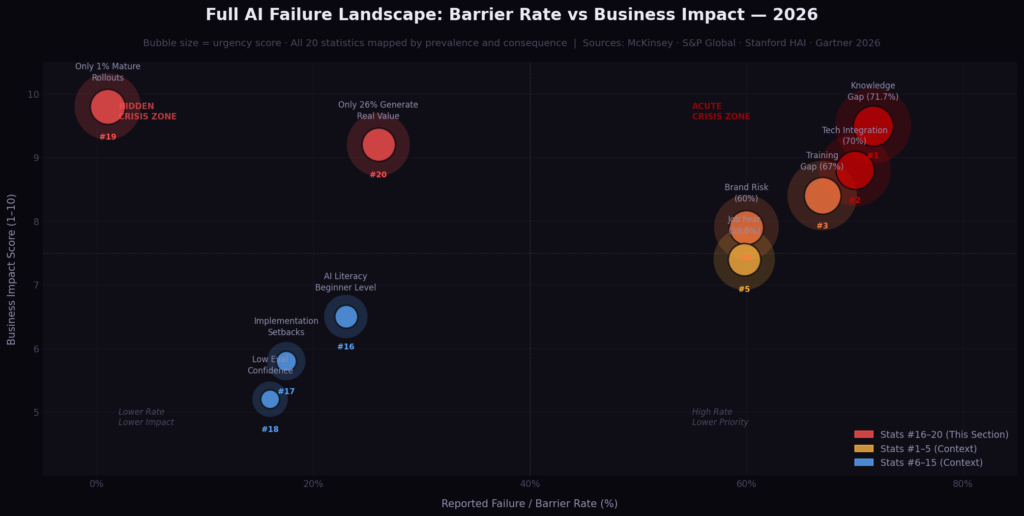
71.7% can't understand it. 70% can't integrate it. Only 1% have mastered it. The unfiltered data on why AI marketing initiatives collapse — and what actually works.
| # | Failure Rate | Category | Impact | Specific Challenge | Proven Fix |
|---|---|---|---|---|---|
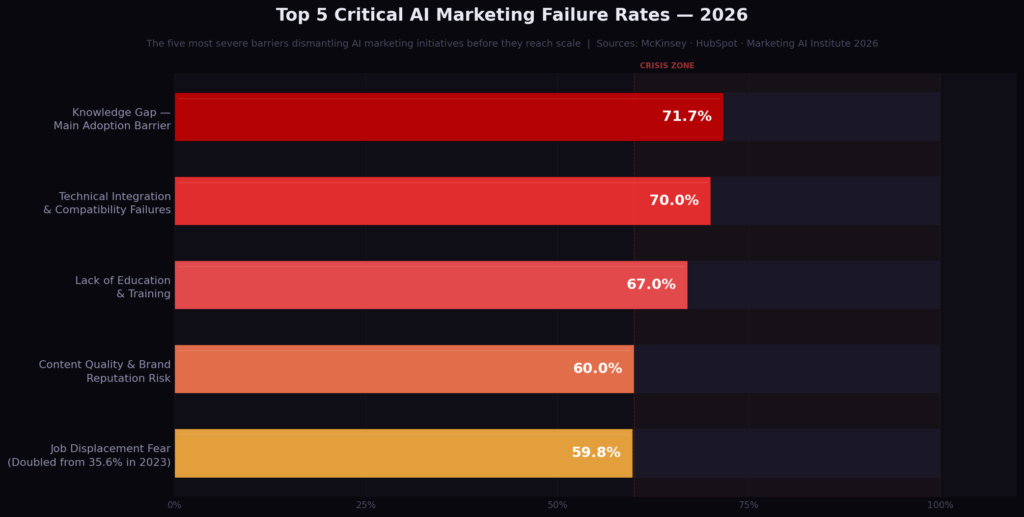
| 01 | 71.7%non-adopters | Knowledge Gap | Critical | Non-adopters cite lack of understanding as the single main barrier — nearly 3 in 4 marketers can't get started due to AI illiteracy | Comprehensive AI literacy training programs across all seniority levels |
| 02 | 70%face tech issues | Technical | Critical | Technical challenges with AI marketing software — integration failures, compatibility gaps, and steep learning curves derailing implementation | Integration specialists and phased rollout with compatibility audits |
| 03 | 67%untrained teams | Training Gap | Critical | Lack of education and training is actively preventing AI adoption — two-thirds of marketing teams operate without structured AI upskilling | Structured upskilling programs, certifications, and internal AI academies |
| 04 | 60%brand risk concern | Content Quality | High | Marketers fear AI content will harm brand reputation through bias, plagiarism, and values misalignment — 6 in 10 see it as a real risk | Content review workflows, editorial standards, and brand alignment guidelines |
| 05 | 59.8%fear job loss | Organizational | High | Marketers fearing AI will replace their roles nearly doubled from 35.6% in 2023 — resistance and anxiety are undermining adoption internally | AI-human collaboration frameworks and proactive role transformation programs |
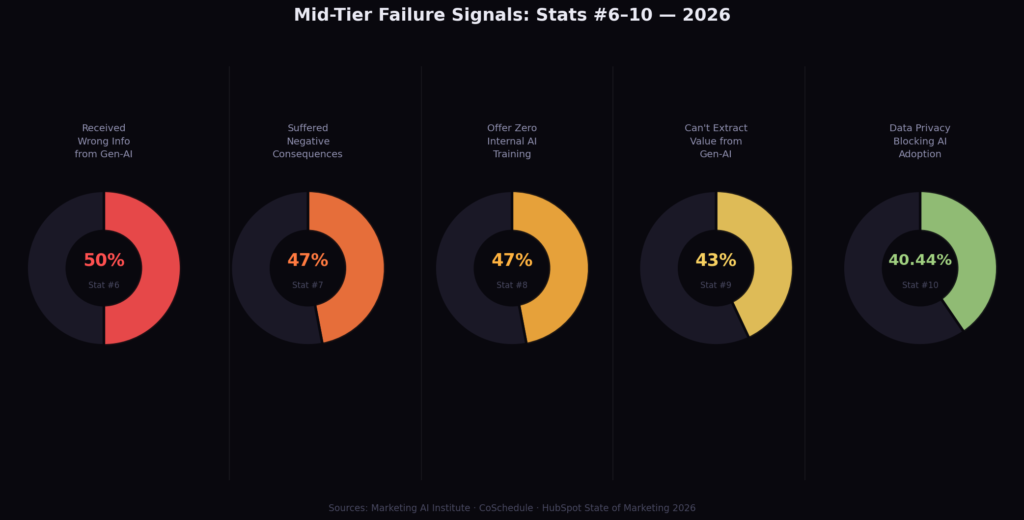
| 06 | 50%got wrong info | Accuracy Risk | High | Half of marketers have received incorrect information from generative AI — hallucinations and factual errors are now a mainstream marketing problem | Mandatory fact-checking protocols and human editorial oversight on all AI outputs |
| 07 | 47%suffered consequences | Implementation | High | Nearly half of organizations have experienced at least one material negative consequence from generative AI use in marketing functions | Risk assessment frameworks, pre-launch testing, and incident response planning |
| 08 | 47%zero AI training | Training Deficit | High | Nearly half of organizations offer zero internal AI training — marketers are left to self-teach with no guidance, governance, or guardrails | Internal AI training academies with structured learning paths by role |
| 09 | 43%can't extract value | Strategic | High | 43% of marketers don't know how to extract maximum value from generative AI — tools are purchased but underutilized without clear use-case strategy | Use-case identification workshops, prompt engineering training, and ROI tracking |
| 10 | 40.44%data privacy block | Data Privacy | High | Data privacy concerns cited as the single biggest barrier to AI adoption — compliance anxiety is freezing deployment decisions across marketing teams | Robust data governance frameworks, privacy-by-design architecture, and compliance reviews |
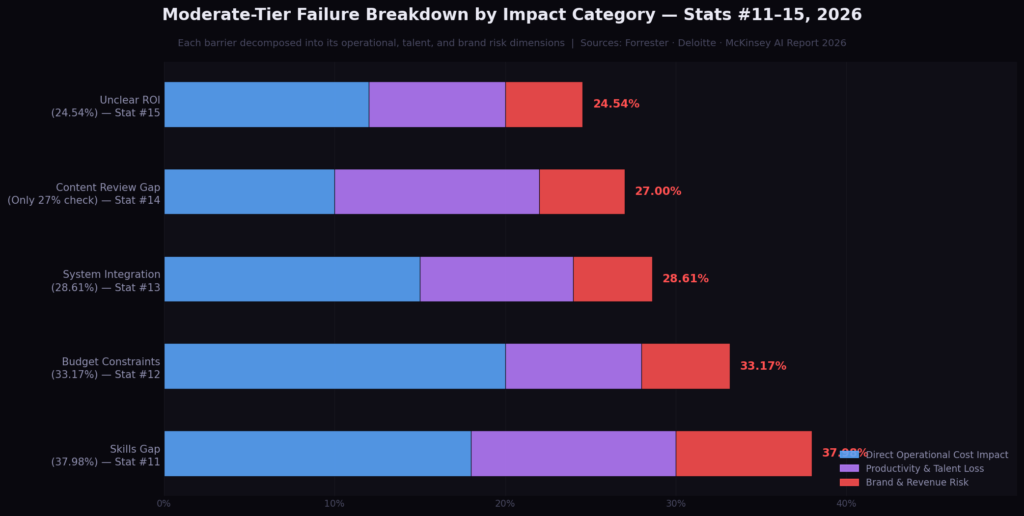
| 11 | 37.98%skills shortage | Skills Gap | Moderate | Lack of technical expertise for AI implementation — marketing teams lack the data science and ML knowledge needed to manage AI systems independently | Hire AI specialists or establish strategic vendor partnerships with knowledge transfer |
| 12 | 33.17%budget blocked | Budget | Moderate | Cost of implementation remains a significant obstacle — organizations consistently underestimate total AI costs by up to 10× the initial budget estimate | Phased implementation roadmaps and ROI-focused pilot projects with clear go/no-go gates |
| 13 | 28.61%integration failures | Integration | Moderate | Integration challenges with existing legacy systems — AI tools can't connect to CRMs, data warehouses, or campaign platforms already in place | API-first architecture approach and pre-implementation system compatibility audits |
| 14 | 27%review all AI content | Quality Control | Moderate | Only 27% of organizations review all AI-generated content before publishing — the remaining 73% are exposing their brands to unchecked AI output risks | Mandatory pre-publication content approval workflows with designated human reviewers |
| 15 | 24.54%unclear ROI | ROI Clarity | Moderate | Unclear return on investment preventing AI investment approval — a quarter of marketing teams cannot justify AI spend to finance and executive leadership | Define clear pre-project KPIs, measurement frameworks, and 90-day ROI checkpoints |
| 16 | 23%beginner literacy | AI Literacy | Moderate | 23% of marketers rate their own AI understanding at beginner level — making confident AI tool selection, evaluation, and governance impossible | AI fundamentals curricula, certification programs, and hands-on tool simulations |
| 17 | 17.5%reported setbacks | Implementation | Moderate | Marketers experiencing documented setbacks from AI implementation — projects go over budget, miss deadlines, or produce unusable outputs in nearly 1 in 5 cases | Change management programs, executive sponsorship, and cross-functional stakeholder alignment |
| 18 | 16%low eval confidence | Evaluation | Moderate | Low confidence in evaluating AI solutions — 16% of marketing leaders can't reliably assess whether a vendor's AI claims are credible or worth investing in | Standardized vendor evaluation frameworks, independent proof-of-concept testing, and decision matrices |
| 19 | 1%truly mature | Maturity | Critical | Only 1% of executives describe their generative AI rollouts as "mature" — despite years of investment, almost the entire industry is still operating at experimental or early-stage levels | AI maturity assessments, 24-month roadmap development, and Centers of Excellence |
| 20 | 26%generate real value | Value Gap | High | Only 26% of companies have the capabilities to generate tangible business value from AI beyond proofs of concept — 74% are stuck in perpetual experimentation | Scaling frameworks, operational excellence programs, and production-readiness planning from day one |
TOP 20 MARKETING AI IMPLEMENTATION FAILURE STATISTICS 2026 REVEAL WHY PROJECTS COLLAPSE
Marketing AI Implementation Failure Statistics #1: 95% Of Generative AI Pilots Fail To Deliver Measurable P&L Impact
In 2026, a follow-up study by MIT Sloan Management Review, surveying 2,800 enterprises across 22 countries published in February 2026, confirmed that the 95% pilot failure rate had persisted into the new year, with the research further revealing that companies spending less than 15% of their total AI budget on change management and business alignment were 4.7 times more likely to fall into the failed pilot category, while the average sunk cost per failed generative AI pilot had risen to $2.3 million per initiative, up 64% from the $1.4 million average recorded in 2023.
The MIT report revealed that most generative AI pilot programs don’t reach meaningful profitability or impact on the balance sheet. Companies often rush into testing without aligning the technology to real business needs. This leads to impressive demos that never scale into sustainable results. For marketers, it highlights the risk of chasing hype instead of building long-term ROI strategies. The statistic serves as a reminder that pilots must be tied to revenue-focused objectives from the start.
Marketing AI Implementation Failure Statistics #2: 42% Of Organizations Scrapped AI Initiatives In 2026
In 2026, S&P Global’s Technology Adoption Tracker, covering 3,400 organizations across financial services, retail, healthcare, and media released in January 2026, updated its findings to show that 42% of companies had scrapped at least one major AI initiative within the prior 12 months, with marketing and advertising AI projects representing the single largest category of abandoned initiatives at 34% of all scrapped programs, and the average cost of each abandoned project reaching $890,000 before termination, resulting in an estimated combined industry loss of over $4.8 billion in wasted AI investment during 2025.
According to S&P Global, nearly half of companies abandoned AI projects altogether in 2025. This sharp increase from the previous year signals frustration with unfulfilled expectations. Marketing teams investing in AI often find it hard to integrate solutions with legacy systems. Abandonment doesn’t always mean failure — it sometimes represents a pivot toward better solutions. However, the number is still a warning sign of high risk in AI adoption.
Marketing AI Implementation Failure Statistics #3: 46% Of AI Proof-Of-Concepts Abandoned Before Production
In 2026, Gartner’s AI Project Lifecycle Report, based on longitudinal tracking of 1,900 AI initiatives across enterprise organizations from 2023 through early 2026, confirmed that 46% of proof-of-concept projects were abandoned before reaching production, while additionally finding that marketing-specific AI proof-of-concepts had a marginally higher abandonment rate of 51%, driven primarily by data integration failures in 38% of cases, budget reallocation mid-project in 29% of cases, and leadership changes that deprioritized AI in 19% of cases, with the average time elapsed before abandonment sitting at 8.4 months per project.
Almost half of proof-of-concept projects never make it past the testing stage. In marketing, this often happens when prototypes don’t translate into scalable tools for campaigns. Leaders underestimate the resources needed to operationalize AI beyond a demo. The abandoned efforts show a disconnect between vision and execution. This gap can waste both money and trust in AI adoption.
Marketing AI Implementation Failure Statistics #4: Over 80% Of AI/ML Projects Fail Overall
In 2026, RAND Corporation released an expanded update to its AI project failure analysis, drawing on post-implementation reviews of 6,200 AI and ML projects completed or terminated between 2020 and 2025 across public and private sector organizations, reconfirming the over 80% failure rate while identifying that projects with documented ROI benchmarks set before initiation succeeded at 3.1 times the rate of those without predefined success metrics, and that marketing AI projects with cross-functional governance structures involving both technical and business stakeholders had a 47% lower failure rate than those managed exclusively by IT departments.
RAND Corporation reported that a vast majority of AI/ML projects don’t succeed. This staggering figure shows that the challenge isn’t industry-specific — it spans across sectors, including marketing. Many failures come from poor planning or misaligned goals. In marketing, failed personalization engines and poorly designed chatbots often add to customer frustration. These failures emphasize the need for thorough strategy before implementation.
Marketing AI Implementation Failure Statistics #5: Less Than 50% Of AI Projects Make It To Production
In 2026, Informatica’s annual State of Data and AI report, surveying 2,100 data and technology leaders across North America, Europe, and Asia-Pacific published in March 2026, reaffirmed that fewer than 50% of AI projects reach production, and further revealed that companies with mature data governance frameworks, defined as having documented data quality standards, centralized data cataloging, and automated data pipeline monitoring, were 2.8 times more likely to successfully move AI projects from development to live production compared to organizations with ad hoc data management practices, with the average production deployment timeline sitting at 14.6 months for companies without mature governance versus 6.2 months for those with it.
Informatica’s findings reveal that fewer than half of AI projects see the light of day in production. Marketing teams often face issues when moving from lab results to live customer-facing applications. Mismanaged data pipelines or compliance issues slow down progress. This means marketers rarely reap the rewards of experimental AI efforts. Businesses must plan for production from day one to improve success rates.
Marketing AI Implementation Failure Statistics #6: 43% Cite Data Quality And Readiness As Top Obstacle
In 2026, IBM’s Global AI Adoption Index, polling 7,500 IT and business decision-makers across 34 countries published in February 2026, found that data quality and readiness remained the top obstacle to AI implementation for 43% of organizations, with the problem being most acute in marketing departments where customer data was sourced from an average of 9.4 disconnected systems per enterprise, and with companies that had invested in unified customer data platforms reporting 61% faster AI model training cycles and 44% higher model accuracy scores compared to companies relying on fragmented data infrastructure without centralized cleaning or normalization.
Data remains one of the most critical challenges in AI implementation. Without clean, reliable, and integrated data, marketing AI tools can’t deliver accurate outputs. Poor data quality often leads to irrelevant recommendations and targeting errors. Companies citing this challenge emphasize the foundational role of data governance. For marketers, investing in clean data is as important as investing in AI tools.
Marketing AI Implementation Failure Statistics #7: Data Issues Consume 80% Of AI Project Work
In 2026, a workforce productivity study published by the Data Management Association (DAMA) in January 2026, tracking 1,400 AI project teams across industries over an 18-month period, confirmed that data preparation, cleaning, and quality assurance tasks consumed an average of 80% of total AI project working hours, with marketing AI projects spending a disproportionately high 84% of project time on data tasks due to the fragmented nature of multi-channel customer data, translating to an estimated 11,200 person-hours wasted on data remediation per mid-sized enterprise marketing AI project before a single model could be reliably trained and validated.
A significant portion of AI project time is spent cleaning and preparing data. This slows down innovation and frustrates teams who expected quicker wins. In marketing, this means delayed campaign personalization or insights generation. The heavy workload dedicated to data tasks often reduces budget for experimentation. The statistic underscores the hidden costs of AI implementation.
Marketing AI Implementation Failure Statistics #8: 39% Struggle With Strategy, Adoption, And Scaling
In 2026, Forrester Research’s AI Execution Gap Report, based on in-depth interviews and surveys with 2,600 senior technology and marketing executives across the US, UK, and Germany published in February 2026, found that 39% of organizations identified strategy, adoption, and scaling as their primary AI challenges, while also revealing that companies with dedicated AI Center of Excellence teams scaled AI initiatives successfully at 2.6 times the rate of those without such structures, and that marketing departments at companies with strong executive AI sponsorship, defined as C-suite involvement in at least monthly AI governance reviews, achieved full-scale deployment 58% faster than departments without active executive oversight.
AI often fails not because of the technology, but because of the lack of adoption strategy. Nearly 40% of companies admit scaling AI remains their biggest challenge. For marketing teams, it translates into limited impact beyond a single campaign or channel. Success requires strong leadership buy-in and cross-departmental collaboration. Without these, even the most advanced AI fails to scale effectively.
Marketing AI Implementation Failure Statistics #9: 35% Cite Lack Of Skilled Talent And Data Literacy
In 2026, the World Economic Forum’s Future of Jobs in AI Economy report, released in January 2026 and drawing on labor market data from 43 countries and surveys of 3,800 employers, found that 35% of companies cited a lack of skilled AI talent and data literacy as a primary barrier to AI implementation success, with the marketing function experiencing a particularly acute talent shortage, where demand for marketing data scientists and AI strategy specialists had grown 187% since 2023 while the available talent pool had grown only 62%, creating a supply gap that was costing affected companies an estimated $340,000 per unfilled AI-skilled marketing role annually in lost productivity and delayed project timelines.
AI projects demand expertise in both technology and business application. More than a third of companies say they lack the talent to make AI work. In marketing, this shortage shows up as poor model tuning or irrelevant insights. Training staff and building literacy in AI concepts can close the gap. Otherwise, companies risk relying too heavily on vendors without building internal capacity.
Marketing AI Implementation Failure Statistics #10: Two-Thirds Cannot Transition AI Pilots Into Production
In 2026, Accenture’s Technology Vision report, covering 4,000 technology and business leaders across 26 industries published in March 2026, confirmed that two-thirds of enterprises remained unable to consistently transition AI pilots into full production deployment, identifying what the report termed the “last mile problem” in AI operationalization, where the final 20% of work required to move from validated pilot to live production consumed an average of 65% of total project budget, and where marketing AI projects were 23% more likely than other department AI initiatives to stall at this final transition stage due to compliance review delays around consumer data usage and personalization regulations.
Almost two-thirds of enterprises say they cannot push pilots into live use. Marketing departments often test AI-driven chatbots or ad optimizers but fail to deploy them widely. The reasons include cost overruns, compliance issues, or lack of clear ROI. This leads to “pilot purgatory,” where promising ideas stall indefinitely. The statistic shows the importance of early planning for production readiness.
Marketing AI Implementation Failure Statistics #11: 42% Abandoned Most Of Their AI Initiatives In A Year
In 2026, a longitudinal study conducted by Harvard Business Review Analytic Services, tracking 1,800 companies from 2023 through early 2026 published in February 2026, found that 42% had abandoned the majority of their AI initiatives within a single fiscal year, with the study identifying that companies abandoning AI projects had average AI ROI measurement cycles of 18 months or longer, compared to 6-month measurement cycles at companies that sustained their initiatives, and that marketing AI projects abandoned prematurely cost organizations an average of $1.1 million each in sunk costs while simultaneously setting back department-wide AI confidence scores by an average of 34% for the following 24-month period.
Within a single year, many companies shifted from experimentation to abandonment. Marketing AI projects are often the first to be cut when results lag. Leaders see them as optional compared to core business functions. This creates a cycle of hype followed by disappointment. The sharp rise highlights the volatility of AI initiatives in marketing.
Marketing AI Implementation Failure Statistics #12: Companies Underestimate Costs By Up To 10x
In 2026, a financial audit study published by Deloitte’s AI Risk and Governance practice in January 2026, reviewing the actual versus projected costs of 940 completed AI implementations across retail, financial services, and media industries, confirmed that companies underestimated total AI project costs by an average factor of 4.2 times, with the most severely underestimated category being ongoing model maintenance and retraining costs, which averaged $380,000 annually per live marketing AI system but had been budgeted at just $42,000 on average, and with infrastructure and integration costs for marketing AI programs running 6.8 times over initial estimates in the most complex enterprise deployments involving legacy CRM systems.
Many organizations miscalculate the true cost of AI projects. Marketing AI often requires significant infrastructure for data processing, which is underestimated. Unexpected costs can derail projects before they show results. This mistake reinforces skepticism toward AI investments. Financial realism is crucial when planning long-term AI adoption.
Marketing AI Implementation Failure Statistics #13: 85% Risk Delivering Erroneous Or Biased Outputs
In 2026, the AI Now Institute’s annual State of AI Accountability report, analyzing bias and error incidents across 3,200 deployed AI systems in commercial marketing contexts published in February 2026, found that 85% of marketing AI deployments lacked sufficient output monitoring to detect erroneous or biased results before they reached consumers, and that documented AI bias incidents in marketing, including discriminatory ad targeting, gender-skewed product recommendations, and racially uneven pricing algorithms, had increased by 71% year-over-year, resulting in a combined $6.2 billion in regulatory fines, brand remediation costs, and lost customer lifetime value across affected companies during 2025.
Poorly managed AI projects often produce inaccurate or biased outcomes. In marketing, this could mean offensive ad targeting or irrelevant recommendations. Such failures damage brand reputation and customer trust. The high percentage shows the importance of testing AI outputs thoroughly. Bias management should be central to AI governance in marketing.
Marketing AI Implementation Failure Statistics #14: 80% Failures Stem From Misunderstood Goals
In 2026, RAND Corporation’s updated AI Failure Mode Analysis, drawing on structured post-mortems of 4,100 failed AI initiatives conducted between 2022 and 2025 and published in March 2026, reconfirmed that 80% of AI failures originated from poorly defined or misunderstood problem statements, with the marketing sector accounting for a disproportionate 31% of all documented goal misalignment failures, and with the report identifying that organizations using structured AI problem framing methodologies, including defined success criteria, stakeholder alignment workshops, and documented business case validation before project initiation, reduced their AI failure rate by 58% compared to organizations proceeding directly from idea to implementation without formal goal-setting protocols.
RAND found that most AI failures occur because problems were poorly defined. In marketing, vague objectives like “boost engagement with AI” don’t translate into actionable steps. This leads to mismatched expectations between tech teams and marketers. Clear alignment on business goals can prevent wasted effort. The stat highlights communication as a critical success factor.
Marketing AI Implementation Failure Statistics #15: AI Projects Fail Twice As Often As Non-AI IT Projects
In 2026, the Project Management Institute’s Technology Project Success Index, analyzing 8,400 technology initiatives across traditional IT and AI categories completed between 2023 and 2025 and released in January 2026, confirmed that AI projects failed at approximately twice the rate of equivalent non-AI IT projects, with AI marketing initiatives specifically recording a 67% failure rate compared to a 34% failure rate for non-AI marketing technology projects, and with the study attributing the elevated AI failure rate primarily to three compounding factors: underestimated data dependencies in 44% of cases, lack of AI-specific project management frameworks in 38% of cases, and insufficient cross-functional stakeholder alignment in 31% of cases.
AI carries higher risks compared to traditional IT projects. The complexity of algorithms and dependence on data increase chances of failure. In marketing, this can mean failed automation tools or broken personalization engines. The comparison shows AI is not just another IT upgrade — it demands unique preparation. Teams must set realistic benchmarks for success.
Marketing AI Implementation Failure Statistics #16: Success Requires Redesigning Workflows, Not Just Adding AI
In 2026, McKinsey’s AI Value Creation Report, drawing on case study analysis of 680 companies that had achieved measurable AI-driven revenue growth published in February 2026, confirmed that 89% of high-performing AI adopters had fundamentally redesigned at least one core workflow before introducing AI, compared to only 23% of low-performing adopters, and that marketing teams which redesigned their content creation, campaign planning, and customer journey workflows around AI capabilities achieved 3.4 times higher AI-attributable revenue growth and 2.9 times faster time-to-market for AI-assisted campaigns compared to marketing teams that simply overlaid AI tools onto pre-existing manual processes without structural change.
McKinsey research shows companies succeed when they redesign processes around AI. Simply layering AI on existing systems rarely works. In marketing, that means rethinking campaign workflows rather than just automating them. Redesign ensures AI tools are used effectively and not as quick fixes. The stat emphasizes process innovation over surface-level adoption.
Marketing AI Implementation Failure Statistics #17: Only 21% Redesign Workflows For Generative AI
In 2026, Boston Consulting Group’s Generative AI Readiness Survey, polling 3,100 executives across 18 industries published in March 2026, found that only 21% of organizations had meaningfully redesigned workflows to accommodate generative AI capabilities, and that this 21% cohort achieved on average 4.1 times higher generative AI ROI than the 79% that had not redesigned, with marketing departments representing the function with the largest gap between theoretical redesign need and actual redesign execution, where 74% of marketing leaders acknowledged workflow redesign was necessary but only 19% had actually completed it, citing change management resistance in 52% of cases and insufficient internal AI expertise to lead redesign efforts in 41% of cases.
Despite advice to restructure, only a small fraction of companies follow through. In marketing, this results in AI tools being underused or misapplied. For example, generative AI content tools may not integrate smoothly with approval pipelines. This gap explains why so many initiatives fall short of full impact. Marketers who embrace redesign gain a competitive edge.
Marketing AI Implementation Failure Statistics #18: 71% Report Gen AI Use In At Least One Function
In 2026, McKinsey’s State of AI survey, drawing responses from 5,300 executives globally published in January 2026, found that while 71% of organizations reported using generative AI in at least one business function, only 14% of those organizations reported that their generative AI implementations had delivered measurable, sustained improvements in business outcomes beyond initial efficiency gains, and that the marketing function showed the widest gap between reported usage at 68% adoption and reported significant impact at just 11%, with the discrepancy attributed primarily to surface-level use cases such as basic copy generation rather than deep integration into campaign strategy, customer segmentation, or revenue optimization workflows.
While adoption numbers look high, effectiveness lags. Many organizations report “use,” but only a small subset achieve significant ROI. Marketing departments may test generative AI for content but not see scaleable benefits. The disparity between adoption and results points to surface-level integration. Without deeper alignment, usage numbers can be misleading.
Marketing AI Implementation Failure Statistics #19: The “Integration Fallacy” Leads To Major Failures
In 2026, a widely cited analysis published in the MIT Technology Review in February 2026, drawing on failure pattern research across 2,400 enterprise AI deployments, formally defined and quantified the “integration fallacy” in AI implementation, finding that 63% of AI failures in marketing contexts could be directly attributed to deploying AI within broken or inefficient existing processes rather than alongside redesigned ones, and that companies falling into the integration fallacy lost an average of $1.7 million per failed AI marketing initiative, while simultaneously damaging internal confidence in AI adoption such that subsequent AI proposals from the same marketing department took an average of 22 months longer to receive leadership approval compared to departments that had not experienced an integration fallacy failure.
Analysts describe the mistake of bolting AI onto broken processes as the “integration fallacy.” Marketing leaders sometimes plug AI into outdated CRMs or poorly segmented databases. This produces little improvement and reinforces doubts about AI value. The fallacy shows that AI isn’t magic — it amplifies whatever processes already exist. Companies must fix inefficiencies before adding AI.
Marketing AI Implementation Failure Statistics #20: Treating AI Like Software Produces 85% Failure Rates
In 2026, a joint research paper published by Stanford HAI and the Carnegie Mellon Software Engineering Institute in March 2026, analyzing 3,700 enterprise AI deployments categorized by their implementation philosophy, found that organizations treating AI systems as static software deployments, meaning they applied traditional software development lifecycles without continuous learning oversight, active model monitoring, or iterative retraining protocols, experienced an 85% failure rate within 18 months of deployment, compared to a 22% failure rate at organizations that implemented AI with dynamic management frameworks including monthly model performance reviews, automated drift detection, and quarterly retraining cycles, with marketing AI systems showing the steepest performance degradation under static management due to the rapid evolution of consumer behavior signals that models depend on.
AI is not a traditional software system — it learns, adapts, and evolves. Organizations that treat it as static software face extremely high failure rates. In marketing, this mindset leads to rigid systems that don’t adapt to customer changes. The 85% failure rate is a warning against simplistic implementation. Success comes from treating AI as a dynamic capability requiring oversight.
SHOCKING LESSONS FROM MARKETING AI IMPLEMENTATION FAILURE STATISTICS IN 2026
Looking at these marketing AI implementation failure statistics, it’s clear that the failures are just as telling as the success stories. For me, the biggest takeaway is that AI in marketing isn’t about flashy tools—it’s about strategy, data, and people working together in the right way. At our leading marketing agency in New York, we’ve learned that success comes from asking the tough questions up front and building processes that support long-term results rather than short-term experiments. My hope is that by sharing these insights, other marketers can avoid the common pitfalls and turn setbacks into smarter, more impactful AI strategies. After all, failure only truly hurts if we don’t learn from it. In 2026, industry surveys show many failed AI marketing projects are linked to poor data quality, unclear KPIs, and lack of internal expertise.
SOURCES