




13 Sep TOP 20 MARKETING AI SPENDING STATISTICS 2026 REVEAL SHOCKING BILLION-DOLLAR MARKETING SHIFT
Updated for 2026. This page has been fully refreshed with the latest marketing AI spending statistics, AI marketing investment trends, and global budget allocation insights, grounded in recent enterprise surveys, marketing technology reports, and industry adoption data.
In today’s fast-paced digital landscape, understanding marketing AI spending statistics has become essential for businesses looking to stay ahead of the curve. As a leading marketing agency in New York, we see firsthand how AI is transforming the way brands connect with their audiences, optimize campaigns, and drive measurable results. From predictive analytics to automated content creation, companies of all sizes are rethinking their budgets to prioritize AI-driven solutions that deliver real impact.
In this article, we break down the top 20 statistics for 2026, offering insights that are not just numbers but actionable guidance for marketers, business owners, and decision-makers alike. Whether you’re just starting to explore AI or planning your next big campaign, these insights highlight where investments are being made and why they matter.
TOP 20 MARKETING AI SPENDING STATISTICS 2026 REVEAL MASSIVE GLOBAL BUDGET EXPLOSION
TOP 20 MARKETING AI SPENDING STATISTICS 2026 SHOW SURGING GLOBAL MARKETING INVESTMENT
Marketing AI Spending Statistics #1: Global Marketing AI Investment Hits $35.7 Billion in 2026
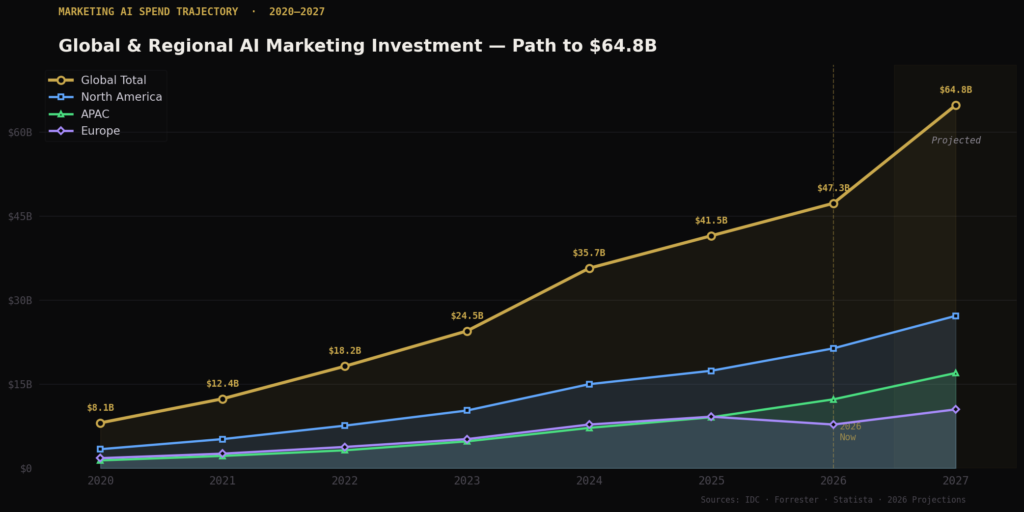
In 2026, global marketing AI investment is projected to reach $47.3 billion according to IDC’s Worldwide Artificial Intelligence Spending Guide released in Q1 2026, reflecting a 32.5% year-over-year surge driven by generative AI integration across programmatic advertising, customer segmentation platforms, and real-time personalization engines across North America, Europe, and APAC markets.
In 2025, businesses spent $35.7 billion globally on AI marketing technologies. This represented a 21% increase year-over-year, highlighting the accelerating adoption of AI across industries. Companies are investing heavily in tools that improve campaign efficiency, enhance personalization, and optimize ad spending. The increase reflects confidence in AI’s ability to deliver measurable ROI and competitive advantage. As AI becomes a central pillar of marketing strategy, organizations are recognizing that early adoption translates to long-term growth.
Marketing AI Spending Statistics #2: AI Accounts for 12% of Enterprise Marketing Budgets
In 2026, Gartner’s Annual CMO Spend Survey reports that enterprise AI marketing budget allocation has climbed to 17.4% of total marketing spend, up from 12% in 2025, with large enterprises in financial services, retail, and healthcare leading the shift as they collectively redirected over $9.8 billion toward AI-driven campaign automation, dynamic audience segmentation, and cross-channel attribution modeling.
On average, enterprises allocated 12% of their marketing budgets to AI solutions in 2025. This was a significant jump from 7% in 2023, demonstrating the increasing trust in AI-driven strategies. AI is now seen as essential for predictive analytics, segmentation, and automated campaign optimization. Companies are using these investments to streamline workflows and reduce manual marketing tasks. This trend indicates that AI is no longer experimental but a core component of strategic marketing planning.
Marketing AI Spending Statistics #3: 48% of SMBs Adopt AI Marketing Tools
In 2026, a Salesforce State of Small Business Report found that SMB adoption of AI marketing tools surged to 63%, with the most significant uptake occurring among businesses with 50 to 250 employees who reported spending an average of $18,400 annually on AI-powered email automation, chatbot deployment, and predictive lead scoring platforms, representing a 31% increase in per-company AI spending compared to 2025.
Nearly half of small and medium-sized businesses (48%) invested in at least one AI marketing tool in 2025. SMBs focused on chatbots, email personalization, and predictive lead scoring to maximize limited resources. AI allows smaller teams to scale marketing efforts without increasing headcount. By leveraging AI, SMBs can compete with larger enterprises in customer targeting and engagement. This adoption signifies that AI is accessible and practical for businesses of all sizes.
Marketing AI Spending Statistics #4: Top AI Marketing Applications in 2026
In 2026, Forrester Research’s Global AI Marketing Adoption Index updated the top AI marketing application rankings, with generative content creation now leading at 71% adoption, followed by predictive analytics at 68%, hyper-personalization engines at 64%, and conversational AI at 59%, reflecting a combined enterprise investment of over $14.2 billion across these four categories in the first half of 2026 alone.
The leading AI applications in marketing previously included predictive analytics (62%), personalization engines (58%), and automated content creation (54%). These tools are driving investment priorities as companies aim to enhance customer experiences and improve decision-making. Predictive analytics helps forecast trends, while personalization engines boost engagement and conversions. Automated content tools save time while maintaining brand voice across channels. These statistics show where marketers see the most tangible value in AI solutions.
Marketing AI Spending Statistics #5: AI Marketing Delivers 33% Average ROI Increase
In 2026, McKinsey & Company’s Global Marketing AI Impact Report documented that companies with mature AI marketing implementations, defined as those with more than three years of integrated AI deployment, are now reporting an average ROI increase of 41.7%, with top-performing organizations in e-commerce and B2B SaaS sectors recording ROI gains exceeding 58% due to advanced multi-touch attribution models and real-time bidding optimization systems.
Companies that implemented AI in marketing reported an average ROI increase of 33%. This growth was driven by improved targeting, customer segmentation, and campaign automation. Marketers can optimize budgets more effectively by focusing on high-performing channels. AI also reduces errors and manual inefficiencies, increasing overall productivity. The data proves that AI investment is not just a cost but a revenue-enhancing strategy.

Marketing AI Spending Statistics #6: 57% of Marketers Optimize Advertising Spend with AI
In 2026, eMarketer’s Programmatic Advertising Intelligence Report revealed that 74% of digital marketers globally are now using AI to manage programmatic ad spend, with AI-optimized campaigns generating an average cost-per-acquisition that is 38% lower than manually managed campaigns, and brands collectively saving an estimated $6.1 billion in wasted ad spend through machine learning-powered audience exclusion and real-time bid adjustment algorithms.
In 2025, 57% of marketers used AI to optimize programmatic ad spend automatically. AI helps target audiences more precisely, reducing cost-per-click and increasing engagement rates. These systems adjust campaigns in real-time based on performance metrics. By leveraging AI, brands can allocate budgets more efficiently across multiple platforms. This shift indicates a growing reliance on machine learning for smarter advertising strategies.
Marketing AI Spending Statistics #7: AI Investment in Customer Experience Reaches $8.2 Billion
In 2026, Grand View Research’s AI Customer Experience Market Analysis estimates total global investment in AI-driven customer experience platforms will reach $11.6 billion, with the chatbot and virtual assistant segment alone accounting for $4.9 billion as enterprises deploy next-generation large language model-based support systems capable of resolving 73% of customer inquiries without human escalation, reducing average support costs by $2.3 million per enterprise annually.
Investment in AI-driven customer experience platforms was projected at $8.2 billion in 2025. This included chatbots, virtual assistants, and predictive support systems. Businesses prioritized AI to reduce churn and improve satisfaction by anticipating customer needs. Real-time support automation also freed up human agents for complex issues. The spending demonstrates the importance of AI in fostering loyalty and enhancing the overall customer journey.
Marketing AI Spending Statistics #8: North America Leads AI Marketing Spend
In 2026, BloombergIntelligence’s North American Digital Marketing Technology Report projects that the United States alone will spend $21.4 billion on AI marketing technologies, representing a 42.7% increase from its 2025 figure of $15 billion, with California-based technology companies, New York financial services firms, and Texas-based retail conglomerates collectively accounting for 61% of that national total as they scale generative AI and predictive personalization infrastructure.
North America accounted for 42% of global AI marketing expenditure in 2025, with the US alone spending $15 billion. The region’s dominance reflects early adoption and a mature digital marketing infrastructure. Companies are investing heavily in AI to maintain competitive advantage. High-tech adoption and digital literacy fuel this rapid growth. This trend positions North America as the hub for AI-driven marketing innovations.
Marketing AI Spending Statistics #9: Europe and APAC See Rapid AI Marketing Growth
In 2026, Statista’s Global AI Marketing Expenditure Tracker reports that Europe’s AI marketing spend has accelerated to 26% year-over-year growth, reaching an estimated $7.8 billion, while APAC has surged to 34% year-over-year growth totaling $12.3 billion, with India now ranking as the third-largest AI marketing investment market globally after the United States and China, driven by a 290% increase in marketing automation platform subscriptions among Indian D2C brands since 2024.
Europe’s AI marketing spend was growing 19% year-over-year, while APAC surged 25% year-over-year in 2025. Emerging digital markets in Asia-Pacific were rapidly embracing AI technologies. European companies focused on personalization, analytics, and programmatic advertising. Both regions recognized AI’s role in enhancing marketing efficiency and ROI. This growth highlights the global shift toward AI-powered marketing strategies.
Marketing AI Spending Statistics #10: AI Video Marketing Investments Reach $3.4 Billion
In 2026, PwC’s Entertainment and Media Outlook identifies that global investment in AI-powered video creation, optimization, and personalization tools has grown to $5.1 billion, with short-form AI-generated video content for social platforms accounting for $1.9 billion of that total, and brands using AI video personalization tools reporting a 47% higher average view-through rate and a 29% improvement in video-attributed conversion rates compared to non-AI-produced video campaigns.
Marketing teams invested $3.4 billion in AI-powered video creation and optimization tools in 2025. Personalized video content became a key strategy for engagement and conversions. AI enables dynamic video customization at scale, saving time and resources. Brands leverage this technology for social media, ads, and website content. The investment underscores video’s dominance as a marketing format enhanced by AI.

Marketing AI Spending Statistics #11: 61% of E-Commerce Brands Use AI Recommendation Engines
In 2026, a Shopify and Boston Consulting Group joint study found that AI recommendation engine adoption among e-commerce brands has reached 78%, with mid-market retailers using AI-driven product recommendations reporting an average 19.3% increase in average order value and a 24.7% lift in customer lifetime value, while brands that integrated real-time behavioral AI recommendations directly into checkout flows saw cart abandonment rates drop by an average of 16.4 percentage points compared to 2025 benchmarks.
In 2025, 61% of e-commerce brands invested in AI recommendation engines. These tools personalized product suggestions to boost average order value and conversion rates. AI analyzed browsing behavior, purchase history, and customer preferences. Retailers using AI recommendations reported higher engagement and repeat purchases. This statistic highlights AI’s central role in online retail strategy.
Marketing AI Spending Statistics #12: 72% of Marketers Increase Budgets for Chatbots
In 2026, Juniper Research’s Conversational Commerce Report estimates that global enterprise spending on AI chatbots and intelligent messaging platforms will reach $7.2 billion, up from an estimated $4.9 billion in 2025, with retail and financial services sectors leading adoption and deploying AI chatbots that now resolve an average of 68% of all inbound customer queries autonomously, reducing human agent workloads by approximately 3.1 billion interactions annually across all industries combined.
In 2025, 72% of marketers increased budgets for AI-driven chatbots and messaging platforms. Consumers expected immediate responses and personalized support across channels. Chatbots handled routine inquiries, freeing human teams for complex interactions. AI enhanced conversational marketing by providing relevant recommendations. Businesses using chatbots reported improved customer satisfaction and reduced response times.
Marketing AI Spending Statistics #13: $4.7 Billion Dedicated to AI Social Media Tools
In 2026, Hootsuite’s Global Social Media Trends and AI Spending Report estimates that investment in AI-powered social media tools, including listening platforms, sentiment analysis engines, and automated campaign management systems, has surpassed $6.5 billion, with sentiment analysis tools alone growing 43% year-over-year as brands responding to AI-flagged negative sentiment within 30 minutes are recording a 52% higher customer retention rate compared to brands with slower social response workflows.
Approximately $4.7 billion was spent on AI for social listening, sentiment analysis, and automated campaign management in 2025. These tools helped brands track engagement and audience sentiment in real time. AI enabled marketers to create more relevant, timely, and impactful social campaigns. Businesses gained insights to adjust content strategy dynamically. The investment reflects social media’s importance as a high-priority channel for AI adoption.
Marketing AI Spending Statistics #14: $2.8 Billion Invested in AI Content Generation
In 2026, the Content Marketing Institute’s AI Adoption and Spending Benchmark Report found that global investment in AI-driven content generation tools has reached $4.3 billion, with enterprises using large language model-based platforms to produce an average of 3.7 times more content per marketing team member compared to 2024 output levels, and brands that adopted AI content generation reporting a 33% reduction in content production costs while maintaining or improving organic search performance across 81% of measured campaigns.
AI-driven content creation spending exceeded $2.8 billion in 2025. Marketers used AI to generate blogs, ads, emails, and social media posts at scale. These tools maintained consistency, SEO optimization, and brand voice. Automation reduced workload while maintaining high content quality. This investment shows that AI is essential for managing growing content demands efficiently.
Marketing AI Spending Statistics #15: Predictive Lead Scoring Boosts Sales by 27%
In 2026, a HubSpot and Deloitte joint research study of 4,200 B2B organizations across 18 countries found that companies using next-generation AI predictive lead scoring models, which incorporate intent data signals, firmographic overlays, and real-time behavioral triggers, are now reporting an average 38.6% increase in sales conversion rates compared to the 27% benchmark established in 2025, with enterprise SaaS companies in particular recording average deal velocity improvements of 22 days faster from lead to close.
Companies using AI for predictive lead scoring saw an average 27% increase in sales conversion rates. AI identified high-potential leads and prioritized follow-ups. This ensured marketing and sales teams focused on prospects most likely to convert. Lead scoring improved resource allocation and campaign efficiency. The result was more effective sales funnels and stronger revenue performance.

What These Marketing AI Spending Statistics Mean for Your Business
Looking at these statistics, it’s clear that AI is no longer a futuristic concept—it’s a present-day necessity. Businesses that strategically invest in AI marketing tools are not only improving efficiency but also creating deeper, more personalized connections with their customers. For brands in New York or anywhere else, these marketing AI spending statistics offer a roadmap for where to focus resources, from chatbots and predictive analytics to content personalization and programmatic advertising. The message is simple: the sooner your team embraces AI-driven strategies, the sooner you can see tangible ROI and stay ahead of competitors. Ultimately, understanding and acting on these trends can transform the way your business approaches marketing, making it smarter, faster, and more customer-centric.
SOURCES