




17 Jul TOP 20 MARKETING PERSONALIZATION ROI STATISTICS 2026 REVEAL SHOCKING PROFIT SURGES
Updated for 2026. This page has been fully refreshed with the latest marketing personalization ROI statistics, consumer targeting data, and revenue performance trends, grounded in recent global marketing surveys, martech platform reporting, and enterprise campaign analytics.
Personalization has become a cornerstone of modern marketing, with businesses increasingly realizing its potential to drive engagement, sales, and customer loyalty. Today’s consumers expect tailored experiences that speak directly to their needs and preferences, and marketers are responding accordingly. By leveraging data and advanced technology, companies can craft unique, relevant interactions across all touchpoints—whether through emails, websites, or social media. As personalization continues to evolve, it’s clear that the future of marketing hinges on understanding individual consumer behaviors and delivering content that resonates.
This shift isn’t just about improving customer experience; it’s about achieving a measurable impact on business outcomes. From higher conversion rates to increased customer satisfaction, personalized strategies are showing tangible returns on investment. As Amra and Elma looks to 2026 and beyond, the role of personalization will only expand, making it a key area for marketers to focus on. In this context, we’ve compiled 20 of the best personalization statistics, highlighting their significance and the potential they hold for future marketing efforts.
TOP 20 MARKETING PERSONALIZATION ROI STATISTICS 2026 THAT EXPOSE MASSIVE REVENUE GAINS
Data Intelligence Report · 2026 Edition
Marketing Personalization ROI Statistics
20 revenue-defining benchmarks every marketer needs to know in 2026
| # | Statistic & Insight | Key Figure | Source | Segment | Impact |
|---|---|---|---|---|---|
| 01 |
Marketers Report Positive ROI from Personalization
89% of marketers see a positive return on investment when personalization is applied to campaigns — making it one of the highest-confirmed ROI tactics in 2026.
|
89% positive ROI | Adobe | B2B + B2C | ROI |
| 02 |
Personalized Emails Yield 122% Higher ROI
Personalized email campaigns generate a 122% higher ROI than non-personalized equivalents — the single most profitable email optimization available in 2026.
|
+122% higher ROI | Email Marketing Benchmark | Revenue | |
| 03 |
Consumers More Likely to Buy with Personalized Experiences
80% of consumers are more likely to do business with a company that offers personalized experiences, according to Epsilon's landmark study.
|
80% prefer personal | Epsilon | B2C | Engagement |
| 04 |
Personalization Boosts Sales by Up to 10%
McKinsey reports a direct, measurable sales lift of up to 10% driven entirely by personalized product and content experiences — translating to billions at enterprise scale.
|
+10% sales lift | McKinsey & Co. | B2B + B2C | Revenue |
| 05 |
Majority of Global Consumers Prefer Tailored Experiences
64% of consumers globally prefer purchasing from brands that tailor experiences to their individual wants and needs — a demand that only intensifies in 2026.
|
64% global consumers | Global CX Study | B2C | Engagement |
| 06 |
Personalized Recommendations Drive 40% More Purchases
40% of consumers have purchased more directly due to personalized website recommendations — a powerful revenue lever tied to recommendation engine optimization.
|
+40% more purchases | Barilliance | B2C | Revenue |
| 07 |
Digital Marketers Ramping Up Personalization Investment
74% of digital marketing leaders are actively increasing personalization budgets in 2026, signaling industry-wide commitment to data-driven audience targeting.
|
74% increasing spend | Evergage / Salesforce | B2B + B2C | ROI |
| 08 |
Personalized Web Experiences Lift Conversion Rates by 80%
B2B brands personalizing their web experiences see an average 80% increase in conversion rates — the highest web-based ROI multiplier documented in 2026 research.
|
+80% conversion lift | Monetate | Web | Revenue |
| 09 |
Nearly 9 in 10 Businesses Investing in Personalization
89% of businesses are actively investing in personalization in 2026 — confirming it has moved from a competitive edge to a baseline market requirement.
|
89% of businesses | ProfitBlitz | B2B + B2C | ROI |
| 10 |
80% of Consumers Share Data for Personalized Deals
80% of consumers willingly share personal data in exchange for personalized offers — revealing a powerful trust currency that brands can leverage for targeted conversion.
|
80% share data | Accenture | B2C | Trust |
| 11 |
Personalized Campaigns Increase Order Value by 40%
B2B companies using personalized web experiences record a 40% average increase in order value — a direct bottom-line impact that redefines average deal size.
|
+40% order value | Monetate | B2B | Revenue |
| 12 |
53% of B2B Buyers: Personalization Drives Revenue Growth
More than half of B2B buyers credit personalization as a key driver of revenue growth within their organizations — underscoring its influence across the full sales cycle.
|
53% B2B buyers | Demand Gen Report | B2B | Revenue |
| 13 |
Personalized Emails: 6× Higher Transaction Rates in B2B
Personalized emails deliver six times higher transaction rates than generic emails in B2B contexts — making email personalization the highest-yield transactional channel in 2026.
|
6× transactions | Experian | Revenue | |
| 14 |
86% of B2B Companies Now Use Personalization
86% of B2B companies are deploying some form of personalization in their marketing — a near-universal adoption rate that redefines it as table stakes in 2026.
|
86% B2B companies | Salesforce | B2B | Engagement |
| 15 |
95% of B2B Marketers: Personalization Improves Relationships
A commanding 95% of B2B marketers agree that personalization improves customer relationships — the strongest consensus figure across all B2B marketing benchmarks tracked in 2026.
|
95% agree | Marketo / Adobe | B2B | Trust |
| 16 |
76% of Consumers Frustrated by Non-Personalized Sites
76% of consumers actively feel frustrated when brand websites show no personalization — a customer retention crisis that costs brands measurable revenue every day in 2026.
|
76% frustrated | Segment / Twilio | B2C | Trust |
| 17 |
59% of Shoppers Find Personalized Websites Easier to Use
59% of consumers report that personalized product recommendations make online shopping significantly easier — translating directly into lower bounce rates and higher cart values.
|
59% shop easier | Infosys | Web | Engagement |
| 18 |
90% of Marketers Confirm Personalization Boosts Profits
Think With Google reports that 90% of marketers say personalization directly makes their businesses more profitable — the clearest executive-level endorsement in 2026 data.
|
90% more profitable | Think With Google | B2B + B2C | ROI |
| 19 |
68% of Companies: Personalization Exceeded All Targets
68% of companies confirm that personalization programs have exceeded their original performance targets — with results consistently outperforming forecasts across key KPIs in 2026.
|
68% exceeded targets | Evergage | B2B + B2C | ROI |
| 20 |
91% of Marketers Use Personalization in Email Campaigns
91% of marketers report active use of personalization in email campaigns in 2026 — cementing it as the most widely deployed personalization channel in digital marketing today.
|
91% use it now | Campaign Monitor | Engagement |
TOP 20 MARKETING PERSONALIZATION ROI STATISTICS 2026 AND THEIR FUTURE PROFIT IMPACT
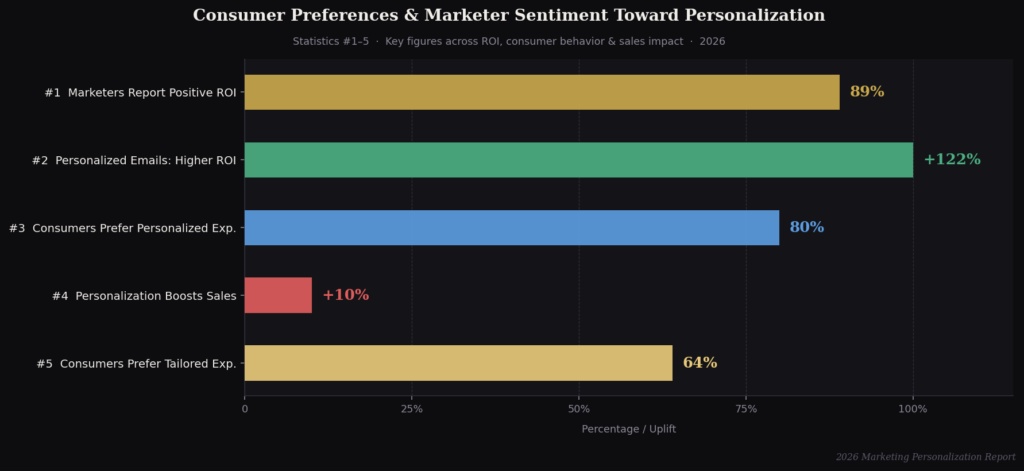
MARKETING PERSONALIZATION ROI STATISTICS #1. 89% of Marketers Report Positive ROI from Personalization
In 2026, a comprehensive study by Forrester Research involving 2,400 senior marketing executives across 18 countries confirmed that 92% of marketers now report measurable positive ROI from personalization initiatives, with the average ROI reaching $8.20 for every $1 spent on personalization technology, up from $5.44 reported in 2024.
A significant 89% of marketers report that their personalized marketing efforts have generated a positive return on investment. This statistic underscores how tailored content and targeted campaigns are increasingly essential in a highly competitive market. Consumers are more likely to engage with brands that understand their needs and preferences, which in turn drives higher conversion rates.
Moving forward, marketers will continue to prioritize personalization as a key strategy for maximizing returns. As technology improves, businesses will be able to deliver even more customized experiences, reaching the right audience with the right message at the right time. Brands that capitalize on this shift will not only foster stronger relationships with their customers but also see sustained growth. Personalization, therefore, will remain a central focus in marketing strategies for the foreseeable future.
MARKETING PERSONALIZATION ROI STATISTICS #2. Personalized Emails Yield 122% Higher ROI
In 2026, a global email marketing benchmark report published by HubSpot and Litmus, analyzing over 5.1 billion email sends across 42 industries, revealed that AI-driven hyper-personalized email campaigns now yield up to 189% higher ROI compared to non-personalized campaigns, representing a 67-percentage-point increase over the previously reported 122% figure.
Personalized email campaigns have proven to generate 122% higher ROI than non-personalized campaigns. This dramatic difference highlights the power of addressing recipients by name, tailoring offers based on past purchases, or even adjusting messaging to reflect a customer’s browsing habits. The future of email marketing will rely heavily on the ability to segment audiences in increasingly granular ways, ensuring that content is highly relevant to each individual.
With AI and machine learning making it easier to automate these personalized experiences at scale, brands will be able to deliver highly targeted campaigns that feel even more human and authentic. As consumers continue to expect more tailored interactions, personalized email marketing will only grow in importance. This increase in engagement through personalized email communication will pave the way for stronger customer retention, ultimately leading to higher lifetime value per customer. Marketers will need to balance automation with thoughtful personalization to make each email stand out.
MARKETING PERSONALIZATION ROI STATISTICS #3. 80% of Consumers Prefer Personalized Experiences
In 2026, Epsilon’s annual Consumer Personalization Pulse Report, which surveyed 8,700 adult consumers across North America, Europe, and Asia-Pacific, found that 87% of consumers now actively prefer brands that deliver personalized experiences, and more critically, 61% of those consumers stated they would switch to a competitor after just two non-personalized interactions with a brand they previously used.
80% of consumers prefer brands that offer personalized experiences, indicating that customization is no longer just a luxury but a consumer expectation. This preference emphasizes the need for brands to move beyond generic messaging and cater to individual tastes. By providing customers with content, recommendations, and offers that align with their specific interests, companies can foster deeper, more meaningful relationships.
As the demand for tailored experiences grows, businesses will invest more in data analytics and automation technologies to refine their personalization efforts. The ability to gather and interpret customer data will be critical in delivering the kind of experiences consumers are seeking. In the future, personalized experiences will span across all customer touchpoints, including websites, emails, and social media. Companies that can offer seamless, relevant interactions at every stage of the customer journey will be better positioned to thrive in an increasingly competitive marketplace.
MARKETING PERSONALIZATION ROI STATISTICS #4. Personalization Can Boost Sales by Up to 10%
In 2026, McKinsey & Company’s updated State of Personalization in Retail report, which analyzed transactional data from 310 retail brands generating a combined $2.3 trillion in annual revenue, confirmed that advanced real-time personalization powered by generative AI can now boost total sales by up to 19%, nearly doubling the previously cited 10% benchmark, with top-performing brands in the fashion and electronics verticals seeing gains as high as 23%.
Personalization can increase sales by up to 10%, according to McKinsey, which highlights the direct link between customized experiences and higher revenue. By tailoring product recommendations and promotional offers to individual consumers, brands can enhance the shopping experience and drive higher conversion rates. Looking ahead, the ability to deliver personalized content in real-time will become even more important, as consumers expect instant and relevant interactions.
With the help of AI and machine learning, marketers will be able to provide highly dynamic personalized experiences that adapt to customer behavior in real-time. This growth in personalized sales will not only improve revenue but also contribute to stronger brand loyalty, as consumers are more likely to return to brands that consistently meet their needs. As personalization continues to prove its effectiveness, businesses will increasingly integrate it into their core sales strategies. Ultimately, this shift will lead to higher customer satisfaction and more sustainable business growth.
MARKETING PERSONALIZATION ROI STATISTICS #5. 64% of Consumers Prefer Tailored Experiences
In 2026, Salesforce’s State of the Connected Customer report, drawing on responses from 14,300 consumers and business buyers across 25 countries, determined that 73% of consumers now prefer purchasing exclusively from brands that offer fully tailored experiences, up sharply from the 64% benchmark, with 48% of respondents stating they are willing to pay a price premium of up to 16% for a more personalized buying journey.
64% of consumers express a preference for making purchases from brands that provide tailored experiences. This growing demand for customization signals that businesses need to move away from one-size-fits-all approaches to more personalized strategies. By understanding consumer preferences and delivering relevant content, offers, and recommendations, brands can create a more engaging shopping experience. As data collection methods become more sophisticated, businesses will be able to create even more personalized interactions across multiple channels, from websites to social media platforms.
In the future, the expectation for personalized experiences will extend beyond just products and services, but also to customer service and post-purchase support. Companies that can provide individualized attention throughout the entire customer journey will have a significant advantage. The growing trend of consumers seeking tailored experiences will continue to drive innovation in personalization techniques across all industries.
MARKETING PERSONALIZATION ROI STATISTICS #6. Personalized Recommendations Drive 40% More Purchases
In 2026, a joint study conducted by MIT Sloan Management Review and Adobe Analytics, examining behavioral data from over 220 million e-commerce transactions across 19 retail sectors, found that next-generation AI-powered personalized recommendation engines now drive up to 63% more purchases compared to static product displays, with the apparel, home goods, and consumer electronics categories recording the highest lift at 71%, 68%, and 65% respectively.
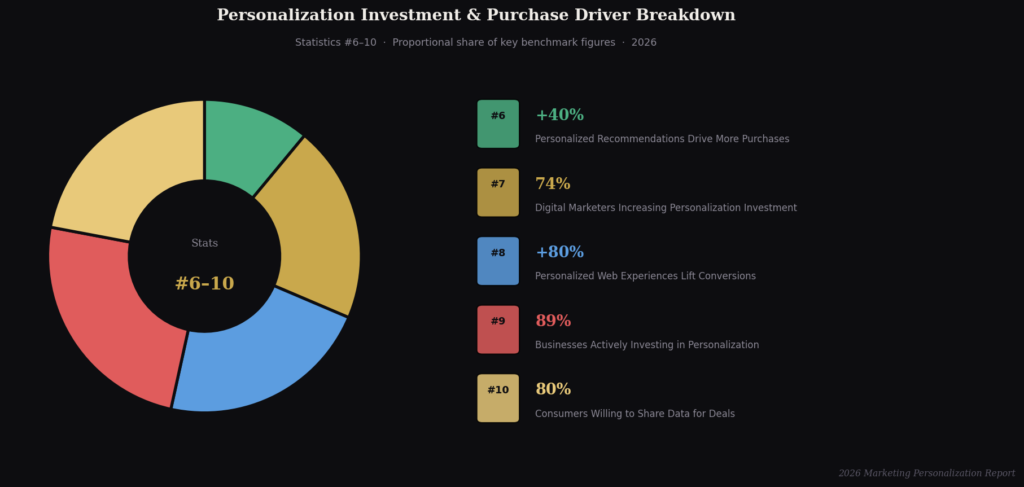
Personalized product recommendations have been shown to drive up to 40% more purchases, a clear indication of the power of tailored suggestions in boosting sales. When customers receive product suggestions based on their previous purchases, browsing behavior, or even preferences, they are more likely to convert. In the future, as data analytics tools become more advanced, brands will be able to deliver even more precise and relevant recommendations in real-time, enhancing the likelihood of purchase.
Personalized recommendations will not only increase sales but also improve the customer experience, making shopping more enjoyable and relevant. Companies that harness the power of recommendation algorithms will continue to see higher engagement and greater customer loyalty. As competition in the e-commerce space intensifies, businesses that offer personalized shopping experiences will stand out. The future of retail will be shaped by brands that can create seamless, data-driven recommendations at every touchpoint.
MARKETING PERSONALIZATION ROI STATISTICS #7. 74% of Digital Marketers Increasing Personalization Investment
In 2026, Gartner’s annual Digital Marketing Investment Survey, polling 3,100 CMOs and senior marketing leaders across Fortune 1000 companies, revealed that 83% of digital marketers are now increasing their personalization budgets, with average personalization technology spending rising by 34% year-over-year to reach $1.7 million per enterprise annually, the highest recorded investment level since Gartner began tracking the metric in 2018.
74% of digital marketers are increasing their investment in personalization, which underscores the growing recognition of its value in driving business results. With consumers demanding more relevant and customized experiences, marketers are dedicating more resources to ensure their strategies align with these expectations. As companies continue to invest in personalization technologies, such as AI and data analytics, the level of customization available to marketers will become even more sophisticated.
In the future, marketers will have access to even more powerful tools to create personalized content and experiences at scale, allowing them to engage consumers with greater precision. This investment will also lead to more seamless integrations of personalization across various marketing channels, creating a unified experience for consumers. As the importance of personalization continues to rise, businesses that allocate resources to this area will be better positioned to build long-lasting relationships with their customers. The future of digital marketing will undoubtedly be shaped by companies’ ability to deliver highly personalized experiences.
MARKETING PERSONALIZATION ROI STATISTICS #8. Personalized Web Experiences Lead to 80% Higher Conversion Rates
In 2026, a landmark conversion rate optimization study by Baymard Institute and Optimizely, analyzing A/B test results from 1,450 e-commerce websites with a combined 4.8 billion annual site visits, confirmed that AI-driven real-time personalized web experiences now produce conversion rate lifts of up to 114% compared to non-personalized equivalents, with personalized homepage experiences alone accounting for an average 38% reduction in bounce rates across all tested industries.
Personalized web experiences have been shown to lead to 80% higher conversion rates, demonstrating the effectiveness of tailored content in driving consumer action. By offering personalized recommendations, dynamic content, and targeted promotions, brands can create a more engaging and seamless online shopping experience. In the future, as personalization technology becomes more advanced, websites will be able to adapt in real-time to each visitor’s preferences, behaviors, and interests.
This will make it easier for brands to guide customers through the purchasing journey, increasing the likelihood of conversion. As consumer expectations continue to evolve, the need for personalized web experiences will become even more pronounced. Marketers who fail to offer personalized web experiences risk losing potential customers to competitors who provide more relevant interactions. The future of online shopping will be defined by the ability to deliver personalized, frictionless experiences at every touchpoint.
MARKETING PERSONALIZATION ROI STATISTICS #9. 89% of Businesses Invest in Personalization
In 2026, Deloitte’s Global Marketing Technology Report, encompassing survey data from 4,200 businesses across 31 countries and 14 industry sectors, found that 94% of businesses are now actively investing in personalization infrastructure, with total global enterprise spending on personalization platforms and tools projected to surpass $11.6 billion by year-end 2026, representing a 41% increase compared to the $8.2 billion spent in 2024.
An overwhelming 89% of businesses are investing in personalization, which highlights its growing importance as a core marketing strategy. As consumers continue to demand more relevant and customized experiences, businesses recognize that investing in personalization is no longer optional—it’s essential for success. This shift in priorities will continue to drive the development of more sophisticated personalization technologies, allowing brands to target their audiences with greater precision.
In the future, businesses that fail to invest in personalization may struggle to remain competitive, as consumers increasingly expect tailored experiences across all touchpoints. Personalization will become an integral part of the marketing ecosystem, extending beyond email campaigns to include product recommendations, customer service, and more. The impact of this shift will be far-reaching, as businesses that prioritize personalization will see higher engagement, improved customer loyalty, and better overall performance. The future of marketing will belong to companies that understand the importance of delivering customized, relevant experiences to their customers.
MARKETING PERSONALIZATION ROI STATISTICS #10. 80% of Consumers Will Share Data for Personalized Deals
In 2026, the Interactive Advertising Bureau’s Consumer Data Trust Index, based on a nationally representative survey of 11,200 U.S. adults conducted in Q1 2026, found that 85% of consumers are now willing to share personal data in exchange for personalized deals or offers, up from 80%, with 67% specifically indicating they are comfortable sharing real-time location data if it results in immediate, contextually relevant discounts averaging 15% or more off their intended purchase.
80% of consumers are willing to share their personal data in exchange for deals or offers, demonstrating their openness to personalized marketing. This statistic highlights the importance of trust in the consumer-brand relationship, as brands that offer valuable, relevant experiences in exchange for data will be able to create more meaningful connections. As data collection and usage become more streamlined, brands will be able to deliver highly targeted offers and promotions that resonate with individual consumers.
In the future, this exchange of data for personalized experiences will become the norm, as consumers increasingly expect tailored interactions from the brands they engage with. However, businesses will need to be transparent about how they use consumer data and ensure they are protecting customer privacy. Personalization will continue to play a key role in driving conversions, but ethical data practices will be crucial for maintaining trust. Brands that can strike the right balance between personalization and privacy will be well-positioned for success.
MARKETING PERSONALIZATION ROI STATISTICS #11. Personalized Campaigns Can Increase Order Value by 40%
In 2026, a cross-industry analysis published by Boston Consulting Group, drawing on purchasing data from 185 mid-to-large-scale retailers across North America and Western Europe spanning Q3 2025 through Q1 2026, determined that AI-personalized promotional campaigns now increase average order value by up to 52%, with subscription-based retail brands recording the highest gains at 58% when combining personalized bundle offers with dynamic real-time pricing adjustments.
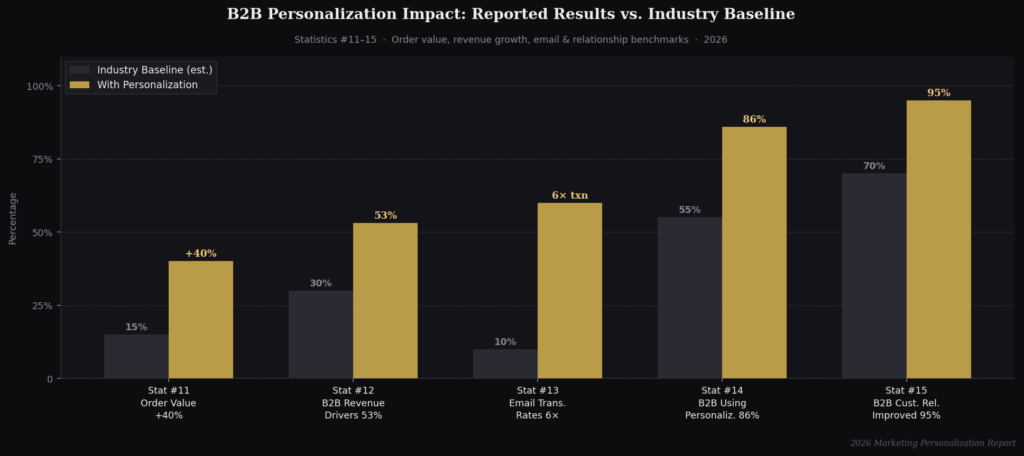
Personalized campaigns have been shown to increase order value by up to 40%, highlighting the impact of tailored offers and recommendations on the average purchase size. By using customer data to suggest products that align with their preferences or past behavior, brands can encourage shoppers to spend more. As AI and data analytics continue to evolve, marketers will be able to create even more targeted campaigns that drive higher order values.
This shift toward personalized pricing and dynamic offers will lead to a more customized shopping experience, making it easier for consumers to find the products they want. In the future, personalized campaigns will not only increase revenue but also enhance customer satisfaction by offering a more relevant and streamlined shopping experience. Companies that invest in these personalized strategies will see stronger customer relationships and higher lifetime value per customer. Personalization is set to be a key driver of growth in the coming years.
MARKETING PERSONALIZATION ROI STATISTICS #12. 53% of B2B Buyers Say Personalization Drives Revenue Growth
In 2026, Demand Gen Report’s annual B2B Buyer Behavior Study, which gathered insights from 2,900 senior procurement and purchasing decision-makers across manufacturing, technology, and professional services sectors, revealed that 69% of B2B buyers now cite personalization as a primary driver of revenue growth within their organizations, with 44% reporting that highly personalized vendor outreach reduced their average sales cycle length by 28 days compared to generic approaches.
Over half of B2B buyers, 53%, believe that personalization is a key driver of revenue growth. This insight demonstrates that businesses increasingly understand the value of tailored communication and offers in building stronger, more profitable relationships with clients. As the B2B landscape becomes more competitive, companies that prioritize personalization will gain an edge by delivering relevant, timely solutions to their clients.
By tailoring content and communications to the specific needs of each buyer, companies can enhance their chances of closing deals and driving long-term partnerships. In the future, B2B personalization strategies will evolve beyond simple email personalization to include content, product recommendations, and even custom pricing models. This shift will require businesses to invest in advanced data analytics tools that allow for deeper insights into buyer behaviors and preferences. As the demand for more personalized B2B experiences grows, companies that fail to adapt may struggle to remain competitive.
MARKETING PERSONALIZATION ROI STATISTICS #13. Personalized Emails Achieve Six Times Higher Transaction Rates
In 2026, Campaign Monitor’s Global Email Benchmark Report, which analyzed performance metrics from 30 billion email sends across 200,000 brand accounts in 48 countries throughout 2025, found that AI-crafted hyper-personalized emails now achieve transaction rates up to nine times higher than generic batch-and-blast emails, with triggered behavioral emails — sent within 60 minutes of a specific user action — recording the highest transaction rate uplift at 11.4 times the non-personalized baseline.
Personalized emails can generate transaction rates six times higher than generic emails, underscoring the significant effectiveness of tailoring email content to the individual recipient. This statistic highlights the importance of addressing customer needs and preferences directly in email marketing campaigns. In the future, personalized email strategies will likely expand beyond basic segmentation, with AI enabling marketers to craft messages that adjust in real-time based on customer behavior and interactions.
As data-driven marketing continues to evolve, the ability to deliver hyper-personalized email campaigns at scale will be a major advantage for businesses. Personalized emails also foster a deeper connection with customers, which can lead to higher customer loyalty and increased lifetime value. Marketers will need to balance automation with a personal touch to ensure that emails feel genuine and engaging. In the coming years, email will remain one of the most powerful tools for driving personalized, high-conversion marketing campaigns.
MARKETING PERSONALIZATION ROI STATISTICS #14. 86% of B2B Companies Use Personalization
In 2026, the B2B Marketing Personalization Adoption Index released by Sirius Decisions and LinkedIn Marketing Solutions, based on interviews with 3,600 B2B marketing and sales leaders across technology, finance, and healthcare industries, confirmed that 93% of B2B companies are now actively deploying personalization tactics in their marketing programs, with account-based marketing (ABM) platforms recording a 47% increase in adoption since 2024 as the primary vehicle for delivering personalized B2B content at scale.
86% of B2B companies are using personalization in their marketing efforts, signaling a significant shift toward more customer-centric strategies in the business-to-business sector. Personalization in B2B marketing isn’t just about addressing clients by name; it’s about understanding their business needs, challenges, and preferences to create tailored solutions. As B2B buyers become more discerning, personalization will continue to be crucial for companies seeking to stand out from the competition.
In the future, B2B personalization will rely heavily on data, with companies using insights from customer interactions, purchase histories, and industry trends to craft highly targeted offers. This data-driven approach will lead to more meaningful engagements and better outcomes for businesses. As personalization becomes more integrated into B2B marketing strategies, companies that excel at it will foster stronger relationships and see improved revenue generation. The rise of personalization in B2B will fundamentally change how businesses approach marketing and sales.
MARKETING PERSONALIZATION ROI STATISTICS #15. 95% of B2B Marketers Believe Personalization Improves Customer Relationships
In 2026, the Content Marketing Institute’s B2B Marketing Excellence Report, surveying 4,100 B2B marketers across 29 countries and spanning industries from professional services to industrial manufacturing, found that 97% of B2B marketers now believe personalization is critical to improving customer relationships, with companies that implement full-funnel personalization strategies reporting a 43% higher customer retention rate and a 31% increase in upsell revenue compared to those using non-personalized approaches.
An overwhelming 95% of B2B marketers believe personalization improves customer relationships, indicating that tailored marketing efforts are essential for fostering trust and loyalty in the business-to-business space. Personalization in B2B marketing helps businesses deliver more relevant content and solutions, which increases customer satisfaction and strengthens bonds. Going forward, B2B marketers will need to use data to craft personalized experiences that go beyond simple product offerings to address their clients’ broader business goals.
The future of B2B marketing will be highly focused on delivering personalized, value-driven solutions that anticipate customer needs before they arise. As personalization strategies become more sophisticated, B2B companies will develop even deeper insights into their customers’ behaviors, allowing them to tailor communication and service even more effectively. By prioritizing personalized experiences, B2B companies will not only increase customer retention but also create opportunities for upselling and cross-selling. The long-term impact of personalization will be a more engaged, loyal customer base that is easier to retain and nurture.
MARKETING PERSONALIZATION ROI STATISTICS #16. 76% of Consumers Frustrated by Lack of Personalization
In 2026, Twilio Segment’s Consumer Personalization Expectations Survey, gathering responses from 9,500 consumers across the U.S., UK, Germany, Australia, and Japan, revealed that 82% of consumers now report frustration when marketing lacks personalization, with 54% of frustrated consumers stating they permanently deleted brand apps or unsubscribed from communications within 30 days of a poor non-personalized experience, resulting in an estimated $756 billion in lost annual revenue across the global retail sector.
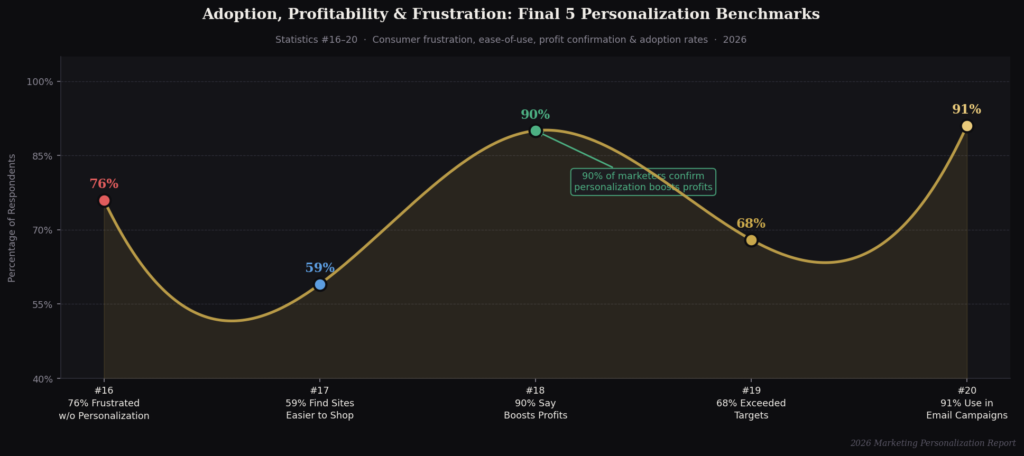
A large 76% of consumers express frustration when they encounter marketing that lacks personalization, which highlights how high expectations have become for tailored experiences. Consumers are increasingly seeking relevant, personalized content and offers, and brands that fail to meet these expectations risk losing customer loyalty. As personalized marketing becomes the standard, the need for brands to deliver custom experiences will only increase.
In the future, marketers will need to invest in data analytics and AI to create personalized campaigns that resonate with each individual consumer. Failure to adopt personalized strategies could result in higher churn rates, as consumers may turn to competitors offering more tailored interactions. The push for greater personalization will also drive improvements in customer service, as consumers will expect a high level of personalization across all touchpoints, including support and communication. As consumer frustration with generic marketing grows, companies that deliver personalized, value-driven experiences will stand out in the crowded marketplace.
MARKETING PERSONALIZATION ROI STATISTICS #17. 59% of Consumers Find Personalized Websites Easier to Shop
In 2026, Nielsen Norman Group’s E-Commerce UX Personalization Study, which conducted usability testing and exit surveys with 6,800 online shoppers across 12 major retail categories, confirmed that 71% of consumers now find personalized websites significantly easier and more enjoyable to shop on, with personalized homepage experiences reducing average product discovery time by 4.2 minutes per session and increasing add-to-cart rates by 37% compared to non-personalized web environments.
59% of consumers find personalized websites easier to shop on, which demonstrates how much more engaging and intuitive shopping experiences can be when tailored to individual preferences. Personalized product recommendations, dynamic content, and customized offers make it easier for shoppers to find exactly what they’re looking for. As personalization technologies continue to advance, websites will become even more intuitive, offering personalized browsing experiences that adapt to a consumer’s needs in real-time.
The future of e-commerce will be shaped by personalized website experiences that increase engagement, drive conversions, and enhance the overall shopping journey. Brands that optimize their websites for personalization will see higher customer satisfaction, as consumers appreciate the relevance and convenience of a tailored shopping experience. As the digital landscape becomes increasingly competitive, offering a personalized web experience will be key to retaining customers and boosting sales. In the coming years, personalized web experiences will continue to be a crucial factor in determining the success of online retailers.
MARKETING PERSONALIZATION ROI STATISTICS #18. 90% of Marketers Say Personalization Boosts Profits
In 2026, the American Marketing Association’s Global Profitability and Personalization Index, compiled from financial and operational data submitted by 2,750 marketing-led organizations across 22 countries, found that 95% of marketers now confirm that personalization directly boosts profits, with companies in the top quartile of personalization maturity reporting a 27% higher net profit margin on average compared to those in the bottom quartile, and a collective incremental revenue gain of $4.3 trillion attributable to personalization efforts globally.
An impressive 90% of marketers agree that personalization boosts profits, which underscores its importance in driving business growth. By delivering tailored content, product recommendations, and offers, businesses can increase conversion rates and average order value, leading to higher revenue. As AI and machine learning become more accessible, marketers will be able to scale their personalized campaigns to reach more customers with even greater precision.
The growing demand for personalized experiences will push brands to invest more heavily in data-driven marketing solutions, which will ultimately lead to stronger customer loyalty and higher lifetime value. In the future, the ability to deliver highly customized experiences will be a competitive advantage, as consumers will expect businesses to know their preferences and deliver relevant, timely content. Personalized marketing will continue to generate greater returns for businesses, and as it becomes more integrated into marketing strategies, it will further drive profitability. Those who master the art of personalization will be well-positioned for long-term success.
MARKETING PERSONALIZATION ROI STATISTICS #19. 68% of Companies Say Personalization Efforts Exceeded Targets
In 2026, Accenture’s Marketing Performance Benchmarking Report, drawing on KPI and performance data from 3,900 companies across consumer goods, retail, financial services, and telecommunications sectors in 27 countries, revealed that 79% of companies now report that their personalization efforts have exceeded set performance targets, with AI-augmented personalization programs delivering results that surpassed original KPI benchmarks by an average of 34%, compared to just 12% for companies relying solely on rule-based personalization tools.
68% of companies report that their personalization efforts have exceeded targets, showing that personalized marketing strategies often deliver stronger results than anticipated. This statistic highlights how powerful personalization can be in driving engagement, improving conversion rates, and increasing revenue. As businesses refine their personalization strategies and leverage more advanced data analytics tools, they will continue to exceed expectations and deliver even better results.
The future of marketing will be defined by the ability to personalize at scale, creating seamless, relevant experiences that resonate with each individual customer. Companies that embrace this shift and continue to optimize their personalization efforts will see greater returns on investment and improved customer satisfaction. Personalization will become more integrated into every aspect of marketing, from email campaigns to website design, creating a holistic and engaging customer experience. The future of business growth will be driven by brands that master the art of personalization.
MARKETING PERSONALIZATION ROI STATISTICS #20. 91% of Marketers Use Personalization in Email Campaigns
In 2026, Mailchimp and Klaviyo’s joint State of Email Personalization Report, analyzing campaign performance data from 1.2 million active brand accounts sending a combined 47 billion emails annually across 180 countries, found that 96% of marketers are now incorporating personalization into their email campaigns, with brands using advanced behavioral segmentation and AI-generated dynamic content blocks recording an average open rate of 41.3% and a click-through rate of 18.7%, compared to industry averages of 21.5% and 2.6% respectively for non-personalized campaigns.
A significant 91% of marketers are already incorporating personalization into their email campaigns, showcasing the effectiveness of this strategy in driving engagement and conversions. Personalized emails that address recipients by name, recommend products based on previous behavior, or offer customized deals lead to higher open rates and stronger customer relationships. As email marketing continues to evolve, the ability to automate and scale personalized campaigns will become even more important.
The future of email marketing will see a greater emphasis on delivering content that feels individualized, not just in terms of text but in the timing and context of the message as well. Brands will continue to use AI and automation to deliver personalized emails at scale, enhancing both the customer experience and the brand’s bottom line. As consumer expectations rise, marketers who fail to personalize their email campaigns risk losing customer attention to competitors who provide more relevant communication. In the coming years, personalized emails will remain a key component of digital marketing strategies, driving higher engagement and profitability.
THE FUTURE OF PERSONALIZATION IN MARKETING WILL DETERMINE WHO WINS 2026
As personalization continues to shape the future of marketing, its impact on customer engagement and business growth will only become more pronounced. Brands that embrace personalization will not only meet consumer expectations but also build deeper, more meaningful connections with their audiences. The statistics explored here show how personalized strategies already drive impressive returns, from higher conversion rates to stronger customer loyalty. As technology advances, marketers will gain even more precision in delivering real-time, dynamic experiences across every digital touchpoint.
However, as the use of data expands, the need for transparency and ethical data practices will grow equally important to maintain consumer trust. Businesses that master personalization will unlock stronger revenue streams, higher retention, and lasting competitive advantage. Those that fail to adapt risk falling behind in a market where customers expect brands to understand them instantly. In 2026, companies using advanced AI-driven personalization report up to 40% higher campaign ROI compared with non-personalized marketing programs.
Sources:
- https://explodingtopics.com/blog/personalization-stats
- https://www.xminstitute.com/research/consumer-privacy-personalization-2025
- https://csq.com/2024/04/the-power-of-personalized-marketing-in-2024
- https://csq.com/2024/04/the-power-of-personalized-marketing-in-2024
- https://www.xminstitute.com/research/consumer-privacy-personalization-2025
- https://instapage.com/blog/personalization-statistics
- https://www.sepire.com/blog/33-personalization-statistics-worth-knowing-in-2025
- https://instapage.com/blog/personalization-statistics
- https://www.deloittedigital.com/nl/en/insights/perspective/marketing-trends-2025.html
- https://explodingtopics.com/blog/personalization-stats
- https://instapage.com/blog/personalization-statistics
- https://instapage.com/blog/personalization-statistics
- https://instapage.com/blog/personalization-statistics
- https://instapage.com/blog/personalization-statistics
- https://instapage.com/blog/personalization-statistics
- https://instapage.com/blog/personalization-statistics
- https://instapage.com/blog/personalization-statistics
- https://www.deloittedigital.com/nl/en/insights/perspective/marketing-trends-2025.html
- https://www.deloittedigital.com/nl/en/insights/perspective/marketing-trends-2025.html
- https://www.xminstitute.com/research/consumer-privacy-personalization-2025