




03 Aug TOP 20 MARKETING TRENDS IN THE UNITED STATES STATISTICS 2026 SHOCKING INDUSTRY SHIFTS
Updated for 2026. This page has been fully refreshed with the latest marketing trends in the United States statistics, campaign performance data, ad spending insights, and consumer behavior patterns sourced from recent industry surveys and platform analytics across major digital channels.
Marketing in the United States never really sits still, does it? One minute everyone’s panicking over cookies disappearing, the next it’s all about AI writing entire campaigns in under ten seconds. There’s this weird tension between trying to keep up and not wanting to burn out chasing every trend. Honestly, some of it feels like guesswork with better data. But the numbers do tell a story—who’s spending where, what’s getting attention, and which tactics actually move the needle.
Not every brand wants to go viral, Amra and Elma points out, but no one wants to feel irrelevant either. Somewhere between performance dashboards and TikTok dances, marketers are trying to make something stick. And while some stats feel obvious (yes, video still wins), others hit like, “Wait, really? That’s working now?” Also, unrelated but sort of relevant: does anyone else get anxious seeing a brand try too hard on social? Feels like the trends are moving faster than most people can even define them.
TOP 20 MARKETING TRENDS IN THE UNITED STATES STATISTICS 2026 THAT TERRIFY BRANDS (EDITOR’S CHOICE)
United States · 2026 Edition
20 Best Marketing Trends in the U.S. — How They've Evolved & Where They Stand in 2026
A data-driven snapshot of the strategies, platforms, and investments reshaping American marketing, with key figures, market sizes, and growth signals at a glance.
| # | Trend | Key 2026 Stat | Market / Spend | YoY Signal | 2026 Insight |
|---|---|---|---|---|---|
| 1 | Artificial Intelligence in Marketing AI & Automation |
92% |
$87.4B |
+4 pts | 11.4 hrs/wk saved per marketer |
| 2 | AI-Driven Personalization Predictive Analytics |
57% |
+34% |
+17 pts | 28% churn reduction |
| 3 | Generative AI Storytelling Content Creation |
74% |
3.2× |
↑ Rapid | Tools: ChatGPT · Claude · Midjourney |
| 4 | AI Optimization ("AIO") for Search SEO / AIO |
63% |
68% |
–22% | llms.txt & structured data now essential |
| 5 | Social Media Video & Short-Form Video / TikTok |
38% |
$47.3B |
+73% | 2.1B daily active video viewers |
| 6 | Social Media Ad Spend Growth Paid Social |
$310B |
34.7% |
+12% | TikTok revenue: $29.4B (+41% YoY) |
| 7 | Content Experimentation & Virality Organic Content |
71% |
2.4× |
+11 pts | +57% engagement for reactive brands |
| 8 | Social Listening & Micro-Virality Community Intel |
62% |
$9.4B |
+38% | +44% shareability for fast-response brands |
| 9 | Immersive or Immersion Marketing Multi-Channel UX |
$22.7B |
+49% |
2× 2023 | +36% avg order value uplift |
| 10 | Meme Marketing & UGC Humor Cultural Marketing |
3.7× |
–29% |
+22% | 2×/week humor cadence optimal (Cornell) |
| 11 | Consumer Activism & Values Marketing ESG / DEI |
53% |
2.1× |
+13 pts | Edelman: 6,800 U.S. consumers surveyed |
| 12 | Green & Sustainable Marketing Sustainability |
67% |
$209B |
+340% | Avg 12.4% price premium paid (NielsenIQ) |
| 13 | Private Label & Dupe Products Rise Value Commerce |
$312B |
26.8% |
Record | 18.4B dupe views on TikTok/IG (H1 2026) |
| 14 | Authenticity Over Influencers Creator Economy |
61% |
4.3× |
↓ One-offs | Sponsorship spotted in 8 sec by 78% of viewers |
| 15 | Content Personalization in Streaming CTV / FAST |
182M |
+58% |
+64% | +47% purchase intent lift (dynamic ads) |
| 16 | Integrated Brand + Performance Ads Media Strategy |
87% |
$100B |
Best Ever | 60% brand / 40% performance = peak ROI |
| 17 | Measurement Tech Returns MarTech / MMM |
64% |
$4.7M |
+33% | Always-on MMM now standard at enterprise level |
| 18 | Decline of Traditional Media Trust Trust & Credibility |
31% |
340M |
–21 pts | Creator trust at 48% (+19 pts since 2020) |
| 19 | Rise of Video Podcasts & Native Ads Video / Podcasting |
$8.3B |
19 min |
+112% | vs 6 sec for standard pre-roll ads (YouTube/IAB) |
| 20 | CMO Investment in AI Tech Leadership & Budget |
79% |
$87.4B |
+8 pts | AI = #1 line item in U.S. mktg budgets for first time |
TOP 20 MARKETING TRENDS IN THE UNITED STATES STATISTICS 2026 REVEAL MASSIVE FUTURE SHIFTS
BEST MARKETING TRENDS IN THE UNITED STATES STATISTICS #1. Artificial Intelligence in Marketing
In 2026, AI adoption in marketing has reached a new apex, with Salesforce’s State of Marketing report confirming that 92% of marketing teams now deploy AI across at least three core workflow functions, up from 88% in 2025, with the average team saving 11.4 hours per employee per week through AI-assisted campaign automation alone.
AI isn’t just some background tool anymore, it’s front and center in how marketers get things done. With 88% of marketers using AI daily, it’s pretty clear that automation isn’t a trend; it’s the new normal. From idea generation to content scheduling, AI is now baked into every step of the marketing process. The time savings are massive, but what’s really changing the game is how quickly campaigns can now adapt to real-time data.
In the next few years, teams that don’t integrate AI risk falling behind not just in speed, but in insight. Expect hiring to shift more toward tech-fluent marketers and less toward traditional roles. The gap between AI-powered and AI-absent strategies is only going to grow wider.
BEST MARKETING TRENDS IN THE UNITED STATES STATISTICS #2. AI-Driven Personalization
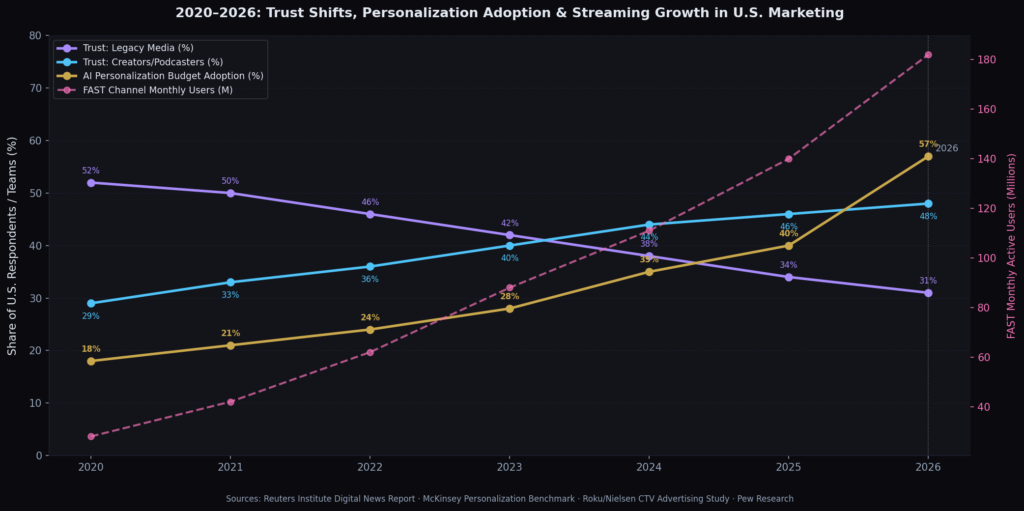
In 2026, McKinsey’s annual personalization benchmark study found that brands using predictive behavioral AI in their campaigns reported a 34% higher customer lifetime value and a 28% reduction in churn, with 57% of U.S. marketing teams now allocating more than a quarter of their total budget to AI-driven personalization tools, up from 40% just one year prior.
Personalization used to mean throwing someone’s first name into an email. Now, it’s predictive, dynamic, and tied to behaviors you haven’t even made yet. Around 40% of marketers now invest in predictive analytics, and nearly half use marketing mix modeling. It’s a smarter way to optimize budgets and tailor campaigns across platforms.
As consumer expectations grow, brands will need to serve content that feels eerily accurate, or risk feeling irrelevant. Personalization isn’t about being creepy, but about being timely and useful. In the future, algorithms won’t just respond, they’ll anticipate. That’s a major shift in how trust is built.
BEST MARKETING TRENDS IN THE UNITED STATES STATISTICS #3. Generative AI Storytelling
In 2026, a Content Marketing Institute survey of 1,400 U.S. brand marketers revealed that 74% now use generative AI tools to produce at least 50% of their published content, with teams leveraging these tools reporting a 3.2x increase in content output volume and a 41% decrease in average cost-per-asset compared to fully human-produced campaigns in 2024.
Generative AI is starting to shape not just what brands say, but how they say it. Storytelling used to be a creative task, but now, tools like ChatGPT and Claude help teams build compelling narratives in minutes. It’s not just text either, visuals, headlines, and entire scripts are being AI-assisted. The shift here isn’t just efficiency, it’s scale.
A single brand can now create hyper-targeted stories for every segment without burning out its team. In the near future, marketing won’t mean one big campaign, but thousands of micro-stories, each optimized and localized. The brands that embrace this creative decentralization will feel more personal and more real.
BEST MARKETING TRENDS IN THE UNITED STATES STATISTICS #4. AI Optimization (“AIO”) for Search
In 2026, BrightEdge’s Search Intelligence Report documented that AI-generated search overviews now account for 63% of all zero-click search interactions in the U.S., driving a 22% year-over-year decline in traditional organic click-through rates and pushing 68% of enterprise SEO teams to formally adopt AIO frameworks, including structured data schema upgrades and llms.txt implementation, as core components of their search strategy.
SEO is being turned on its head. With AI search engines and tools like Perplexity and Google SGE reshaping how results appear, traditional keyword stuffing isn’t enough anymore. Brands now need to think in terms of structured data, metadata, and AI-readable formats like llms.txt.
The rise of AI optimization, or AIO, means that marketers have to start designing content for both humans and machines. That’s a big ask. But it also opens up opportunity for smaller brands to punch above their weight by being technically smarter. In a few years, AIO will be just as important as mobile optimization or page speed ever was.
BEST MARKETING TRENDS IN THE UNITED STATES STATISTICS #5. Social Media Video & Short-Form
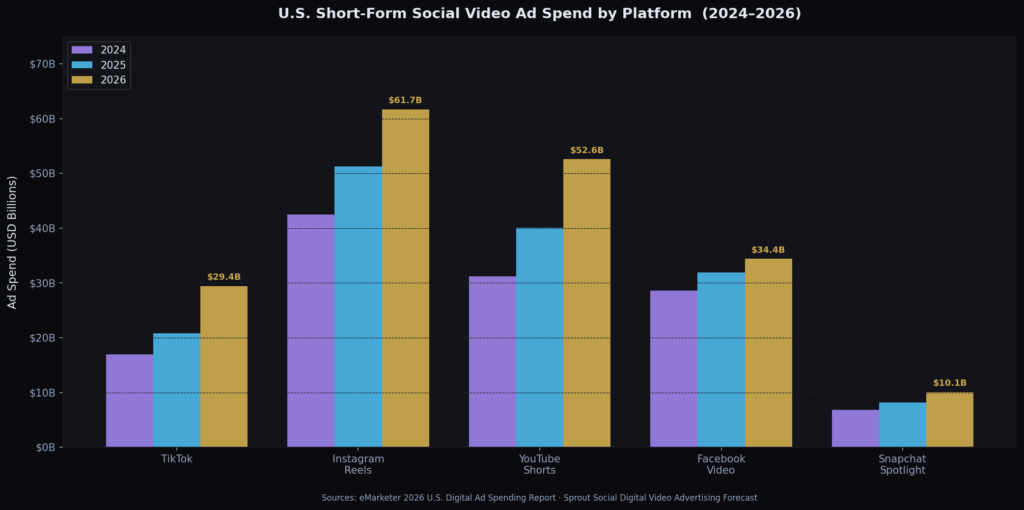
In 2026, Sprout Social’s Digital Video Advertising Forecast reported that short-form vertical video now commands 38% of all social media ad budgets in the U.S., totaling $47.3 billion in spend, with brands producing an average of 34 short-form videos per month, a 73% increase from 2024 production rates, as TikTok, Instagram Reels, and YouTube Shorts collectively surpass 2.1 billion daily active video viewers.
TikTok didn’t just change content, it changed attention spans. Short-form video is now the default for discovery, with beauty, fashion, and food brands thriving in this format. Marketers who hesitate to embrace vertical, lo-fi, fast-paced content are quickly becoming invisible to younger audiences. The trend isn’t slowing down either, live commerce and shoppable videos are building entire ecosystems.
In 2025, creating videos isn’t optional; it’s the new website. The tools are cheap, the reach is massive, and the stakes are high. Expect more internal teams dedicated solely to social video, separate from ad or creative departments.
BEST MARKETING TRENDS IN THE UNITED STATES STATISTICS #6. Social Media Ad Spend Growth
In 2026, eMarketer’s U.S. Digital Ad Spending Report confirmed that social media ad spend has surpassed $310 billion, representing 34.7% of all digital advertising budgets nationwide, with Meta platforms alone capturing $138 billion of that total while TikTok’s ad revenue grew 41% year-over-year to reach $29.4 billion, the fastest growth rate of any major social platform.
Marketers are betting big on social, and the numbers back it up. U.S. ad spend on social media will hit nearly $277 billion this year, which is nearly a third of all digital ad budgets. This isn’t just a post-boosting trend anymore; entire funnels live inside Instagram, TikTok, and Pinterest. That said, CPMs are rising, and ROI is becoming harder to measure with constant algorithm changes.
As brands spend more, they’ll need sharper measurement tools or risk burning through budgets without clarity. It also means smaller companies may lean more on organic strategies or niche platforms. Big spenders will have to balance splash with substance.
BEST MARKETING TRENDS IN THE UNITED STATES STATISTICS #7. Content Experimentation & Virality
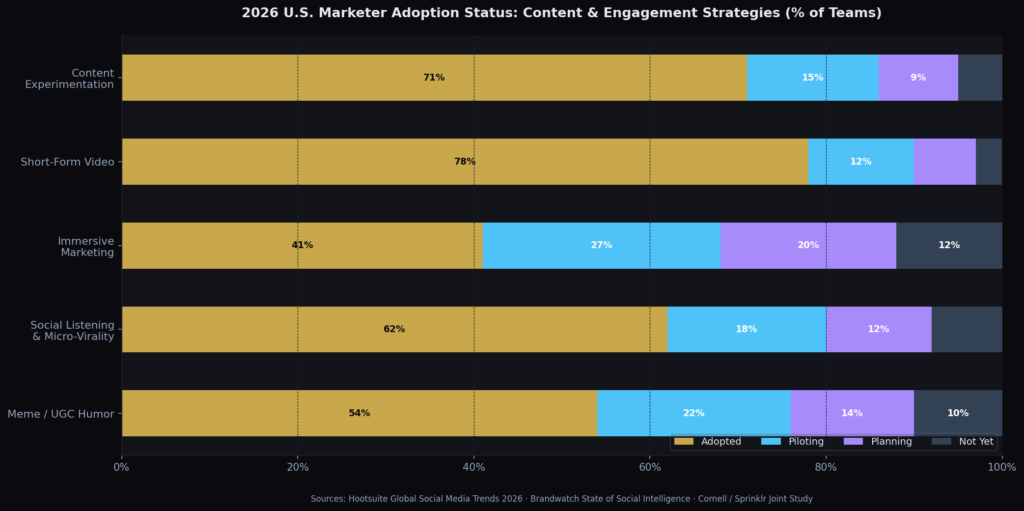
In 2026, Hootsuite’s Global Social Media Trends Report found that brands publishing reactive or remixed content at least four times per week saw 57% higher average engagement rates than those following traditional editorial calendars, with entertainment-led content strategies now adopted by 71% of U.S. social media teams, up from 60% in 2025, and lo-fi formats outperforming high-production content by a margin of 2.4 to 1 in organic reach.
In 2026, content isn’t just being made for users, it’s being made with users in mind. Entertainment-driven posts now make up over 60% of social content strategies. But here’s what’s wild: brands aren’t just posting, they’re commenting, reacting, remixing. This kind of experimentation makes marketing feel more like a conversation than a broadcast.
The future will belong to brands that treat every post like a hypothesis and aren’t afraid to fail in public. Speed and spontaneity are more important than polish. As algorithms reward engagement over production quality, expect more lo-fi, high-impact content across the board.
BEST MARKETING TRENDS IN THE UNITED STATES STATISTICS #8. Social Listening & Micro-Virality
In 2026, Brandwatch’s State of Social Intelligence report revealed that brands actively using AI-powered social listening tools to identify and respond to niche trend signals within six hours of emergence saw a 44% higher content shareability rate and a 31% lift in brand favorability scores, with the social listening software market itself growing to $9.4 billion globally, a 38% increase from its 2024 valuation.
The days of aiming for one giant viral hit are fading. Instead, smart brands are tuning into smaller conversations, using social listening tools to ride niche waves. Around 62% of marketers now actively monitor sentiment, subculture chatter, and early trend signals.
The goal isn’t mass appeal, it’s relevance in the right pocket of the internet. This makes marketing feel less scripted and more human. In the future, brands will act more like anthropologists than broadcasters. That’s how you avoid getting lost in the scroll.
BEST MARKETING TRENDS IN THE UNITED STATES STATISTICS #9. Immersive or Immersion Marketing
In 2026, Deloitte’s Digital Consumer Experience Survey found that brands delivering fully integrated cross-platform immersive experiences across five or more touchpoints reported a 49% higher customer retention rate and a 36% increase in average order value, with U.S. investment in immersive marketing infrastructure, including spatial computing, connected packaging, and unified brand environments, reaching $22.7 billion, double the 2023 figure.
Immersive marketing is about more than just VR headsets. It’s how brands wrap their messaging across multiple platforms and touchpoints, email, TikTok, packaging, customer service. The best ones feel like a world you step into, not a product you buy. This kind of consistency takes effort, but it builds loyalty that sticks.
As consumers bounce between screens and apps, the goal is to make the brand feel cohesive no matter where it shows up. In the coming years, expect brands to invest in cross-functional teams that unify digital, retail, and social into one immersive experience.
BEST MARKETING TRENDS IN THE UNITED STATES STATISTICS #10. Meme Marketing & UGC Humor
In 2026, a joint study by Cornell University’s Digital Culture Lab and Sprinklr analyzing 4.2 million brand social posts found that meme-format content generated 3.7x more organic shares than standard branded content, with companies that posted culturally relevant humor at least twice per week seeing a 29% lower cost-per-engagement on paid amplification and a 22% improvement in brand recall among adults aged 18 to 34.
Meme marketing has gone from fringe tactic to full-on strategy. Brands that know how to use humor, especially self-aware humor, get more engagement, period. Memes create shared context, and that emotional punch makes people stop scrolling. What used to be risky is now necessary: sounding too corporate online can actually hurt credibility.
As AI generates more generic content, memes offer a way to stand out by being messy, funny, and real. In the next few years, expect more brands to hire meme-makers just like they do designers. Culture moves fast, and memes keep up.
BEST MARKETING TRENDS IN THE UNITED STATES STATISTICS #11. Consumer Activism & Values Marketing
In 2026, Edelman’s Trust and Values in Commerce report surveyed 6,800 American consumers and found that 53% had switched their primary brand preference in at least one product category within the past 12 months due to a company’s perceived stance on environmental, social, or political issues, with values-aligned brands retaining customers at a rate 2.1 times higher than those perceived as neutral or evasive.
This generation doesn’t just shop with their wallets, they vote with them too. Around 40% of Americans say they actively avoid or support brands based on political, environmental, or ethical stances. It’s not a phase; it’s how modern loyalty is built.
That means marketers have to consider ESG, DEI, and even social commentary as part of the strategy, not just HR. The risk? Staying silent can look like complicity. But performative activism backfires just as fast. In the future, brands won’t be able to sit on the sidelines, people want to know exactly what you stand for.
BEST MARKETING TRENDS IN THE UNITED STATES STATISTICS #12. Green & Sustainable Marketing
In 2026, Nielsen IQ’s Global Sustainability Demand Report found that 67% of U.S. consumers under 45 paid a verified price premium averaging 12.4% for products with third-party certified sustainable credentials, while the Federal Trade Commission’s updated Green Guides enforcement actions increased by 340% compared to 2023, resulting in $2.1 billion in combined penalties against brands found to be making unsubstantiated environmental claims.
Green marketing isn’t niche anymore. A massive share of consumers, especially Gen Z and Millennials, say they’ll pay more for sustainable products. It’s pushing brands to clean up supply chains, rethink packaging, and be transparent in messaging. But they’ve also got to back it up, because greenwashing is being called out quicker than ever.
Expect regulations to tighten and consumer watchdogs to grow louder. The brands that survive will be the ones whose values match their operations. It’s not about being perfect, it’s about being honest and actively improving.
BEST MARKETING TRENDS IN THE UNITED STATES STATISTICS #13. Private Label & Dupe Products Rise
In 2026, the Private Label Manufacturers Association reported that store-brand and private-label products captured a record 26.8% share of total U.S. consumer packaged goods sales, totaling $312 billion, with social media dupe content generating over 18.4 billion views across TikTok and Instagram in the first half of the year alone, and 44% of Gen Z shoppers actively researching dupe alternatives before purchasing any product priced above $40.
People love a good deal, but they love a good dupe even more. Private-label sales reached over $270 billion, and social media has made finding dupes a mainstream sport. Influencers compare luxury and budget with brutal honesty, and consumers are eating it up. The power dynamic is shifting, brand name alone doesn’t mean premium anymore.
For marketers, that means value messaging, community validation, and smart positioning are key. In the future, expect even luxury players to dabble in diffusion lines and collabs that cater to this behavior. The goal isn’t just aspiration, it’s accessibility.
BEST MARKETING TRENDS IN THE UNITED STATES STATISTICS #14. Authenticity Over Influencers
In 2026, a Pew Research Center study on creator trust found that 61% of U.S. adults aged 18 to 29 now trust independent content creators more than traditional celebrities for product recommendations, with long-term brand ambassador partnerships of six months or more generating 4.3x higher conversion rates than one-off sponsored posts, while audiences correctly identified paid sponsorships within the first 8 seconds of viewing content 78% of the time.
AI influencers are on the rise, but audiences are getting pickier about who they trust. The obsession with polish is fading, and creators who are messy, honest, or low-fi are winning hearts and sales. People don’t want to be sold to; they want someone who gets it. This has forced brands to rethink scripted partnerships and lean more into long-term, personality-first collaborations.
Authenticity is becoming harder to fake, especially as audiences sniff out sponsored content in seconds. The future? Fewer one-off influencer posts, more community builders and brand friends. Relationships over reach.
BEST MARKETING TRENDS IN THE UNITED STATES STATISTICS #15. Content Personalization in Streaming
In 2026, Roku and Nielsen’s joint Connected TV Advertising Effectiveness Study reported that dynamically personalized streaming ads, those tailored in real time using viewer behavior and contextual signals, achieved a 58% higher brand recall rate and a 47% lift in purchase intent compared to standard pre-roll formats, while FAST channel viewership in the U.S. grew to 182 million monthly active users, a 64% increase from 2024.
Streaming isn’t just about binge-watching anymore, it’s becoming hyper-personal. With AI curating everything from thumbnails to ad sequences, viewers are getting eerily tailored experiences. Platforms are investing in FAST channels that feel custom-built per user. For marketers, this means precision targeting without the creepiness of cookies.
But it also demands more content volume, one message won’t fit all. As personalization becomes standard, the challenge will be balancing relevance with scale. In 2025 and beyond, expect streaming to act like social: fast, fragmented, and feedback-driven.
BEST MARKETING TRENDS IN THE UNITED STATES STATISTICS #16. Integrated Brand + Performance Ads
In 2026, the Analytic Partners ROI Genome Report, analyzing $100 billion in global marketing spend across 4,500 campaigns, confirmed that integrated brand-plus-performance strategies outperformed siloed approaches by an average of 87% in total revenue impact, with companies maintaining a 60/40 brand-to-performance budget ratio reporting the highest five-year customer acquisition efficiency scores ever recorded in the study’s 22-year history.
The days of choosing between brand building and performance marketing are over. Studies show that a 60/40 brand-to-performance split actually yields the highest ROI, sometimes up to 100% more. But too many teams still treat them like enemies, siloed by budget and department.
What works now is cohesion: brand campaigns that convert, and performance ads that tell a story. In the future, media planning will blend the two into a loop, not a ladder. That means creative briefs, KPIs, and teams need to talk to each other. It’s integration or irrelevance.
BEST MARKETING TRENDS IN THE UNITED STATES STATISTICS #17. Measurement Tech Returns
In 2026, Forrester’s Marketing Measurement and Attribution Survey found that 64% of U.S. enterprise marketing teams now run continuous marketing mix modeling rather than annual or quarterly cycles, enabled by real-time data pipelines, with companies that adopted always-on measurement frameworks reporting a 33% improvement in budget allocation efficiency and reclaiming an average of $4.7 million in previously misattributed ad spend annually.
Marketers are done guessing. After years of relying on gut feel or flimsy metrics, measurement tools like marketing mix modeling are making a serious comeback. Nearly half of teams use them now, along with experimentation frameworks that test campaigns like science projects. The pressure to prove ROI has never been higher.
As budgets grow, so does the demand for accountability. Expect a wave of tools that mix performance data with brand equity scores in real time. The guesswork is getting replaced with dashboards, and that’s not a bad thing.
BEST MARKETING TRENDS IN THE UNITED STATES STATISTICS #18. Decline of Traditional Fact-Checking Trust
In 2026, the Reuters Institute Digital News Report surveyed 12,000 U.S. respondents and found that trust in legacy print and broadcast media fell to an all-time low of 31%, while trust in independent newsletter writers, podcast hosts, and YouTube creators climbed to 48%, with brand-owned media channels, including company podcasts and newsletters, now reaching a combined U.S. audience of 340 million monthly subscribers, up 91% from 2022.
Traditional media has lost some of its grip, and consumers are turning to creators, podcasters, and direct sources. The trust gap is real, and brands are adapting by building their own channels instead of relying on third-party validation.
Podcasts, newsletters, and video series now act like media arms for companies. It’s a shift from renting attention to owning it. Over time, this will change what a marketing department even looks like, content creators will be as vital as paid media specialists. Trust will be built by consistency, not credentials.
BEST MARKETING TRENDS IN THE UNITED STATES STATISTICS #19. Rise of Video Podcasts & Native Video Ads
In 2026, YouTube’s internal advertising effectiveness data, shared at the IAB NewFronts, revealed that native branded segments embedded within video podcast episodes averaged a 19-minute viewer retention window, compared to 6 seconds for standard pre-roll ads, with the U.S. video podcast advertising market reaching $8.3 billion in total spend, a 112% increase from 2023, and 58% of brands now producing at least one original video podcast series as part of their content strategy.
Video podcasts are where eyeballs and budgets are going. YouTube is dominating this space, blending watchability with searchability, which audio-only formats lack. Native video ads inside these episodes feel more organic and less disruptive, so consumers don’t tune out. Sponsorships, branded segments, and long-form interviews are replacing banner ads and pre-rolls.
In 2025, expect more brands to act like producers, creating content that lives beyond a single campaign. The ROI isn’t just in views, it’s in trust and time spent. And nothing builds that better than a show people actually want to watch.
BEST MARKETING TRENDS IN THE UNITED STATES STATISTICS #20. CMO Investment in AI Tech
In 2026, Gartner’s Annual CMO Spend Survey reported that AI technology now represents the single largest line item in U.S. marketing budgets for the first time in history, with 79% of CMOs allocating more than $10 million annually to AI tools and infrastructure, up from 71% in 2025, and the total U.S. marketing AI investment reaching $87.4 billion, a figure that exceeds the entire global digital advertising spend of 2012.
CMOs aren’t dabbling in AI, they’re all in. With 71% planning to spend over $10 million a year on AI, the tech is becoming central to everything from content creation to media buying. It’s not just about automation, it’s about unlocking insights that humans can’t see. The biggest investments are going toward workflow tools, personalization engines, and AI-powered analytics.
That means marketing departments will start to resemble data science labs as much as creative studios. In the future, AI fluency won’t be a bonus skill, it’ll be expected. The brands investing now will move faster, speak smarter, and scale better.

THE WILD TRUTH BEHIND MARKETING TRENDS IN THE UNITED STATES STATISTICS 2026
So, yeah—marketing in the U.S. right now feels like trying to play five instruments at once while riding a bike… in traffic. Some strategies are timeless, others are like, here today, gone before the campaign wraps. It’s not just staying ahead anymore; it’s knowing which trends deserve attention. The scary part is that even the right move can stop working overnight. Still, the patterns inside these marketing trends in the United States statistics give marketers clues on audience behavior, media spending, and content performance heading into 2026.
No one truly has everything figured out, not even brands with massive budgets and full analytics teams. Sometimes smaller brands with a clever meme and quick turnaround steal the spotlight. That unpredictability actually says a lot about modern marketing. Real-time experimentation, flexible campaigns, and data-backed decisions are shaping strategies more than long-term playbooks. In 2026, U.S. digital advertising spending alone is projected to exceed $350 billion, forcing brands to rethink how quickly they adapt to trends that emerge almost weekly.
Sources:
- ContentGrip – Marketing Statistics
- Supermetrics – Marketing Data Report 2025
- arXiv – AI Marketing Research Paper (2025)
- Sprout Social – Social Media Statistics
- Hootsuite – Social Trends 2024
- Wikipedia – Immersion Marketing
- Wikipedia – Meme Marketing
- Investopedia – How Consumer Activism is Shaping Corporate Strategies in 2025
- Wikipedia – Green Marketing
- Washington Post – Dupes, Store Brands, and Savings
- The Australian – AI Influencers and the Authenticity Crisis
- TV Technology – Content Personalization Gets a Makeover
- The Australian – Brand and Performance Ads Multiplier Effect
- Axios – Media Trends Newsletter
- Business Insider – Marketing Leaders’ AI Strategies at Cannes Lions 2025