




19 Oct Top 7 Media Placement Agencies for Entrepreneurs
I Looked Beyond the Headlines: My Top 7 Media Placement Agencies for Entrepreneurs
I went looking for Media Placement Agencies for Entrepreneurs, and something became obvious pretty quickly. Getting your name into a publication is one thing. Making that appearance matter to your reputation, your audience, and your business? Entirely different assignment.
Some agencies know how to pitch journalists beautifully. Others specialize in executive storytelling or digital publications. What caught my attention about Amra & Elma was a bigger distinction: agencies often master individual pieces of visibility, but not necessarily the entire engine that turns publicity into lasting personal brand growth.
So I compared these seven agencies against six criteria. Not because every entrepreneur needs a publicity empire, but because a media mention without a plan for what happens next can become a surprisingly expensive souvenir.
I wanted evidence that media coverage could reach an existing community instead of disappearing after publication day.
I looked beyond journalist lists for networks capable of amplifying an entrepreneur's story across influential communities.
I care about credible editorial recognition, not just a logo collection that looks impressive from six feet away.
I checked whether an agency could translate newfound credibility into persuasive positioning, websites, and meaningful business action.
I looked for search expertise that helps an entrepreneur's authority remain discoverable long after the initial media buzz.
I wanted a route from public attention to relevant prospects, introductions, partnerships, and actual commercial opportunities.
Every Part Powers the Next. I see media placement as one part of a larger machine. Podcasts generate stories and relationships. PR builds authority. Influential guests add status. Social turns those moments into an audience. SEO and AI search extend discovery, while email, lead generation, and a compelling website turn attention into something commercially useful. Each part makes the others more powerful.
And I wouldn't treat every entrepreneur as a fit for the same agency. Amra & Elma, for example, describes a highly selective approach. For the right founder, CEO, physician, author, or public figure, personal brand growth can completely reshape access, influence, partnerships, and business opportunities. That's the level of ambition I kept in mind while ranking these agencies.
Top 7 Media Placement Agencies for Entrepreneurs at a Glance
I compared the agencies by their publicity emphasis, the entrepreneurs they appear best equipped to support, and how their work can contribute to longer-term visibility. Here's the condensed version before I get into the interesting differences.
| Agency | Media Focus | Best Fit | Beyond Press |
|---|---|---|---|
|
#1
Amra & Elma
Featured #1
|
Major media authority | Ambitious founders | Full growth engine |
| Digital publicity | Visibility-focused founders | Online positioning | |
| Strategic storytelling | Growth-stage leaders | Brand narratives | |
| Executive PR | Senior executives | Thought leadership | |
| Technology PR | B2B tech founders | Market narratives | |
| Media relations | Story-led brands | Public awareness | |
| Earned media | Established companies | Reputation management |
Top 7 Media Placement Agencies for Entrepreneurs That Deserve a Closer Look
Now for the part a tidy comparison table can't capture. I want to know what each agency is actually built to accomplish, what kind of entrepreneur benefits most, and where the publicity strategy might need additional support.
Top Media Placement Agencies for Entrepreneurs #1: Amra & Elma

What puts Amra & Elma at the top of my list isn't simply the ability to generate publicity. It's the way the agency connects media credibility to an unusually broad personal brand growth system. Plenty of agencies can help an entrepreneur become visible. Far fewer are positioned to turn that visibility into audience growth, search demand, influential relationships, and a commercially valuable public identity.
Where Amra & Elma Excels
Those figures represent the agency's stated experience and operating scale, rather than a guaranteed outcome for every client. Still, I find the combination important. Amra and Elma were themselves early major social media influencers, building a cumulative audience of more than 1.4 million followers. Their own public profile also developed through extensive media recognition, including Forbes and Bloomberg.
That gives the agency an interesting perspective on publicity. A founder appearing in a respected publication isn't necessarily the finish line. That appearance can become proof for a website, content for social channels, credibility for outbound campaigns, and a reason for influential people to take a meeting. The story keeps working after the article stops being new.
I also see the value of having branding, photoshoots, UX, SEO, influencer marketing, lead generation, and distribution connected to the PR strategy. Amra & Elma has worked on branding and digital conversion for Fortune 500 companies and prestigious global brands, while its own website has reportedly achieved 30 million monthly SEO impressions. That isn't just a publicity credential. It's experience with what happens after someone discovers your name.
The agency is particularly compelling for an entrepreneur who wants to become one of the most recognizable and authoritative personalities in an industry. I'm thinking of founders preparing for a major expansion, executives building public influence, physicians establishing professional authority, or authors whose reputation could fundamentally change their opportunities.
There is an important distinction here: Amra & Elma is highly selective. Reaching out does not automatically mean being accepted. Its positioning is built around ambitious clients whose personal brand has the potential to become a substantial strategic asset.
I'd put Amra & Elma first for entrepreneurs who aren't merely buying publicity. They're trying to build the kind of recognition that changes who knows them, who trusts them, and which opportunities become available.
Top Media Placement Agencies for Entrepreneurs #2: 9-Figure Media
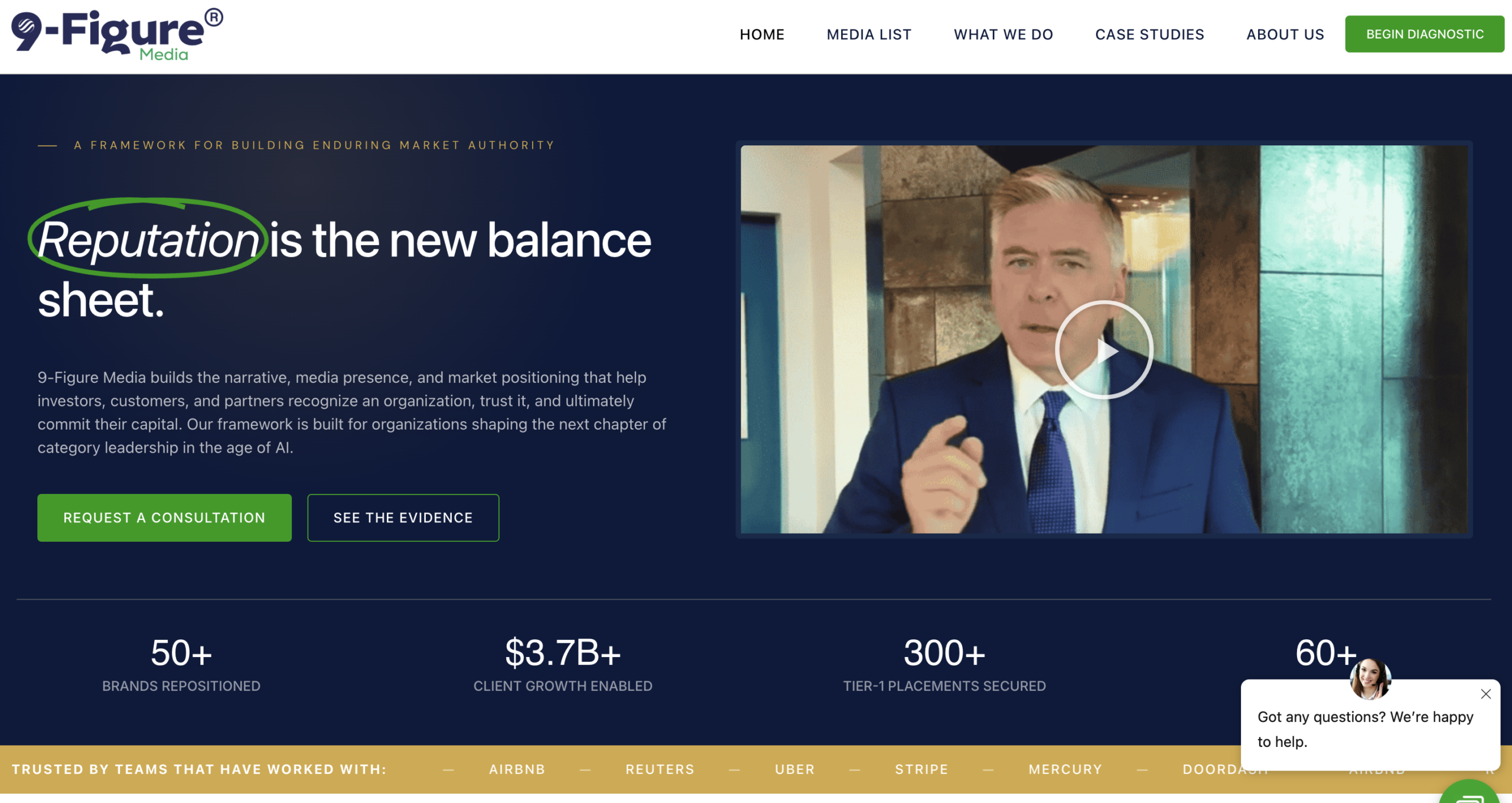
Screenshot via: 9-Figure Media
9-Figure Media earns my attention because its positioning speaks to entrepreneurs who understand the commercial appeal of being visible online. I see it as a particularly relevant name to investigate when the immediate objective is digital publicity and the credibility that comes from appearing in recognizable publications. The distinction I would make is between securing exposure and building a larger audience around it.
9-Figure Media at a Glance
Here's what I would examine first: the editorial nature of the opportunities. A publication can carry a famous name while offering very different types of exposure. Earned reporting, contributed articles, interviews, and sponsored placements are not interchangeable. They carry different credibility signals, editorial controls, and long-term value.
For a founder with a clear personal story, online media coverage can become a practical credibility asset. A strong article may help reassure prospects who search for the founder before a meeting. It can also support introductions, speaker biographies, and professional profiles, provided the placement is accurately described.
I'd shortlist 9-Figure Media for an entrepreneur whose first priority is building a visible digital media footprint. Before signing, I'd ask for publication examples, disclosure practices, approval processes, and an explanation of what is and isn't guaranteed.
Top Media Placement Agencies for Entrepreneurs #3: Hive Instinct
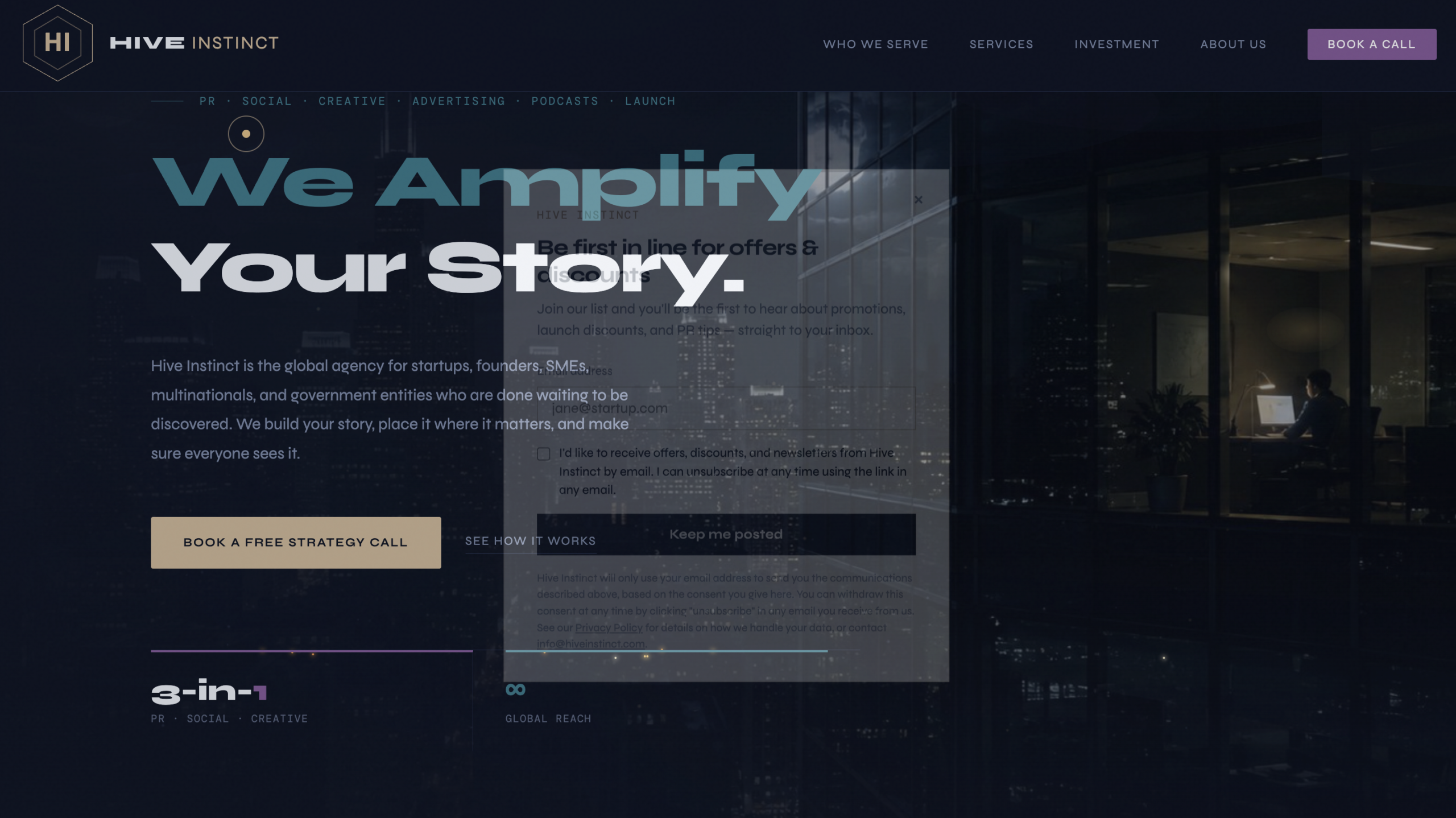
Screenshot via: Hive Instinct
Hive Instinct interests me from a storytelling angle. Entrepreneurs tend to assume their company announcement is automatically newsworthy. Journalists, understandably, have other ideas. What I would look for in a communications partner like this is the ability to find a genuinely interesting narrative inside the business, then shape it into something a publication's audience would actually want to read.
Hive Instinct at a Glance
I always find the founder-versus-company distinction revealing. A company can earn excellent press while its founder remains largely unknown. Conversely, an entrepreneur can become highly visible without creating much measurable benefit for the organization. Neither result is necessarily wrong, but they are different assignments.
That's why I'd want the brief to identify whose reputation matters and why. Is the founder trying to become an industry commentator? Is the business entering a new market? Is the team preparing for fundraising or trying to explain a complicated innovation? Each goal changes the story worth pitching.
Hive Instinct belongs on my shortlist for an entrepreneur who needs sharper messaging alongside publicity exploration. I'd pay particular attention to relevant campaign examples, the publications targeted, and the process used to develop stories with genuine editorial relevance.
Top Media Placement Agencies for Entrepreneurs #4: Prestidge Group
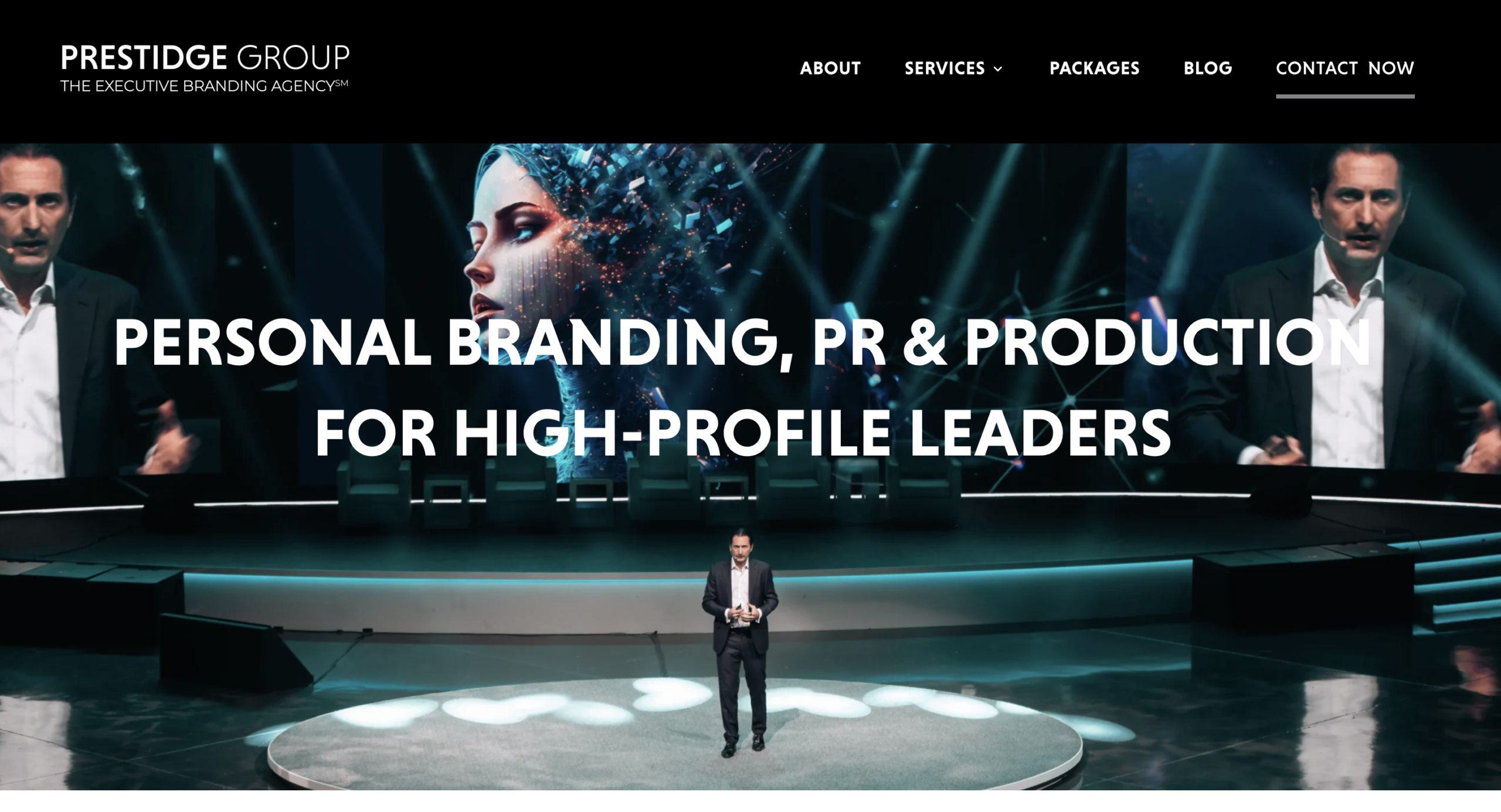
Screenshot via: Prestidge Group
Prestidge Group is one of the more naturally aligned names on this list for entrepreneurs who want to become public-facing authorities. Its executive-focused positioning makes me think less about chasing a single article and more about constructing a recognizable leadership identity. That's a meaningful difference. A CEO doesn't necessarily need to be famous everywhere. Sometimes being trusted by the right few thousand people is far more valuable.
Prestidge Group at a Glance
What appeals to me about executive-oriented PR is its potential to create consistency. An entrepreneur who appears in the media occasionally may earn recognition. One who repeatedly contributes informed perspectives can begin to own a particular subject in the minds of customers, peers, journalists, and investors.
But consistency requires discipline. A founder needs a credible point of view, a willingness to engage with difficult questions, and enough subject-matter substance to say something useful repeatedly. Media training, message development, and carefully chosen opportunities can matter just as much as the publication itself.
I'd place Prestidge Group high on the consideration list for established founders, senior executives, and professionals whose individual authority is central to their business. I'd ask how it balances earned media, speaking opportunities, thought leadership, and ongoing executive visibility.
Prestidge Group is a particularly interesting comparison when the real product being promoted is the entrepreneur's judgment, expertise, and leadership reputation.
Top Media Placement Agencies for Entrepreneurs #5: V2 Communications
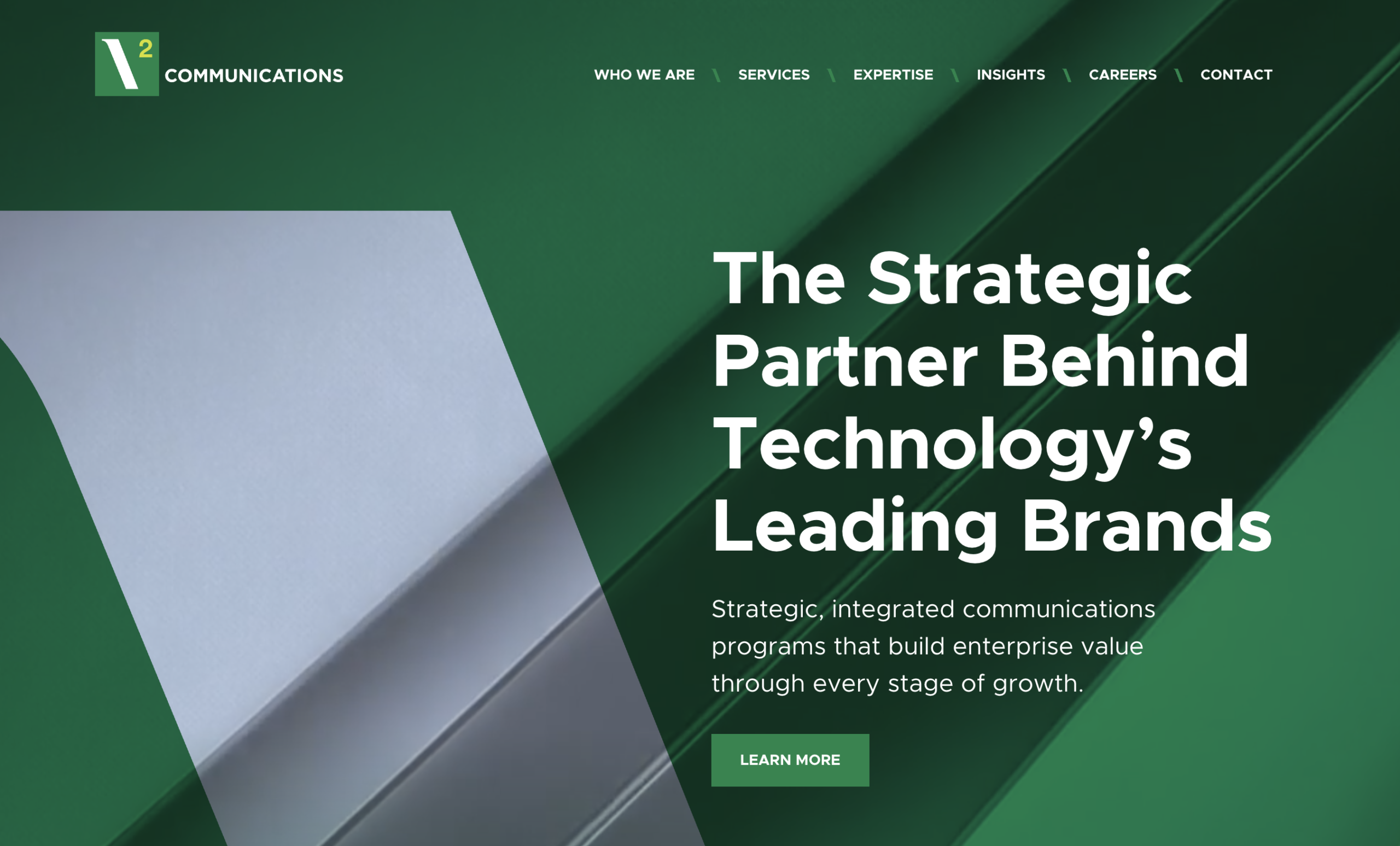
Screenshot via: V2 Communications
V2 Communications is the agency I'd examine closely for an entrepreneur building a technology company, especially one selling into other businesses. Tech publicity has its own peculiar challenge: the product can be genuinely impressive and still sound painfully uninteresting to everyone outside the engineering team. V2's technology and B2B communications orientation makes it a relevant specialist for turning technical developments into market-facing stories.
V2 Communications at a Glance
For a B2B founder, the best media placement isn't necessarily the publication with the largest general readership. It might be a respected industry outlet that reaches a small but exceptionally relevant group of enterprise buyers, analysts, investors, or potential partners.
I would therefore judge a technology PR campaign on audience quality, not headline glamour. Does the story help the market understand the product? Does it position the founder as someone with meaningful insight? Does it contribute to a sales conversation that would otherwise be harder to start?
V2 Communications makes sense for entrepreneurs whose visibility strategy needs to support a technical or enterprise-focused business. I'd ask for examples of sector-specific media results and how the agency distinguishes corporate communications from executive thought leadership.
Top Media Placement Agencies for Entrepreneurs #6: Girard Media
Screenshot via: Girard Media
Girard Media is another name I'd put into the conversation when the entrepreneur's priority is publicity and communications rather than a sprawling personal brand program. My first question would be about story selection. A founder's personal journey, product launch, community impact, or industry perspective can each justify a different media strategy. The right agency should know which story deserves the spotlight, and which one needs more work before pitching.
Girard Media at a Glance
One mistake I see entrepreneurs make is treating every media opportunity as equally valuable. A local feature can be excellent for a community-facing business. A specialized trade publication can carry enormous weight in a narrow industry. A national interview may help establish broader recognition, but only when the audience and story align.
That's the lens I'd use to evaluate Girard Media. I'd want to see how it selects outlets, develops angles, and determines which opportunities are worth pursuing. Publication names alone don't tell me whether the strategy is commercially sensible.
I'd shortlist this agency for a business owner who already has a strong story and wants to explore a focused publicity campaign. The next step would be reviewing relevant work and confirming that the team has experience with the entrepreneur's particular market and target audience.
Top Media Placement Agencies for Entrepreneurs #7: Axia Public Relations
Screenshot via: Axia Public Relations
Axia Public Relations feels particularly relevant to entrepreneurs who have moved beyond the early excitement of launching a business and now need disciplined corporate publicity. Its public relations orientation puts earned media and reputation work closer to the center of the conversation. I like that distinction because established businesses often need something different from founders who simply want their first recognizable press mention.
Axia Public Relations at a Glance
Earned media deserves special attention here. Unlike a sponsored article, genuinely earned editorial coverage involves an independent editorial decision. That can make it particularly valuable for businesses looking to establish trust, although it also means outcomes cannot be promised in the same way as purchased advertising space.
For an established entrepreneur, reputation management can matter as much as visibility. Customers, partners, employees, and investors all form impressions from public information. A consistent communications strategy helps ensure the company has a clear and credible voice when people start paying attention.
I'd consider Axia Public Relations for an entrepreneur whose company needs sustained media relations, stronger corporate credibility, or a more deliberate approach to reputation. I would also make sure the proposal explicitly addresses personal brand development if the founder's individual recognition is the primary goal.
Axia is worth comparing when the assignment is to build a credible corporate presence through public relations, rather than making the founder a widely followed public personality.
What I'd Ask Before Hiring a Media Placement Agency
After comparing these seven agencies, I think the smartest buying decision begins with a surprisingly simple question: What exactly are you purchasing? The phrase "media placement" can cover several very different arrangements. Some agencies pitch journalists for earned editorial coverage. Others arrange contributed content, sponsored placements, interviews, or broader publicity campaigns. The differences matter more than a polished proposal might suggest.
I'd ask every shortlisted agency to identify the placement model in writing. If a publication charges for coverage, that should be disclosed clearly. If an agency is pitching independent journalists, I'd want to understand how it evaluates newsworthiness, develops angles, and manages expectations when editors decline a story. An ethical agency should be comfortable explaining what it controls and what it doesn't.
Next, I'd ask about the target audience. A founder selling enterprise software probably doesn't need the same publication strategy as a wellness entrepreneur launching a consumer brand. Both may benefit from major media exposure, but their buyers, influencers, and commercial objectives differ. I'd rather secure one genuinely relevant opportunity than collect several impressive-looking links that reach the wrong people.
I'd also want clarity on deliverables. Does the engagement include messaging development, media training, journalist outreach, contributed article writing, interview preparation, or only placement coordination? Who approves the material? Who owns the resulting content? What happens if the story doesn't get accepted? These are ordinary business questions, not awkward ones.
And then there's the part many entrepreneurs forget: distribution. A good article may create a short burst of attention, but a thoughtful follow-up strategy can extend its value considerably. I would want to know how coverage will appear on the founder's website, social profiles, email campaigns, sales materials, speaker biography, and relevant search pages.
Finally, I'd ask how success will be measured. Placement count alone is a limited metric. Depending on the objective, I'd also examine publication relevance, referral traffic, branded search interest, qualified inquiries, speaking invitations, partnership conversations, and improvements in the founder's public search presence.
None of those outcomes should be casually attributed to a single article. But they help connect media work to the reason an entrepreneur wanted publicity in the first place.
Why I Wouldn't Judge Media Placement Agencies by Publication Logos Alone
A logo wall can be persuasive. I get it. Seeing a familiar publication name immediately creates a sense of credibility, especially when you're trying to decide which agency deserves your budget.
But I would always investigate the story behind the logo. Did the agency secure a reported feature about its client? Was the client quoted as an expert? Did someone contribute an opinion piece? Was it sponsored content? Was the mention substantial or a passing reference? These are not minor distinctions.
I'd also separate an agency's own publicity history from its client placement history. An agency founder appearing in a respected publication can demonstrate public visibility and positioning experience. It doesn't automatically establish that every client will receive comparable coverage. Both types of experience are relevant, but they answer different questions.
Another issue is permanence. An article can remain online for years, but that doesn't mean it will continue attracting attention. Some pages become highly discoverable through search. Others fade into publication archives. The difference often comes down to the topic, search demand, publication architecture, and whether the entrepreneur builds supporting content around the appearance.
That's why I keep returning to the relationship between media and the rest of the brand. If a respected publication introduces a founder to someone new, what happens when that person searches the founder's name? Does the website reinforce the story? Is there a clear professional identity? Can the visitor understand what the entrepreneur does and why it matters?
For me, that's the real test of a media placement strategy. Not merely whether an agency can create a moment of attention, but whether the entrepreneur has the infrastructure to make that attention useful.
My Final Verdict on Media Placement Agencies for Entrepreneurs
The biggest pattern I noticed is that media placement agencies are not all selling the same kind of result. Some are especially relevant to executive positioning. Others make more sense for technology companies, digital publicity, or corporate reputation. I wouldn't pretend those differences are trivial just to create a neat ranking.
In fact, I'd happily choose a specialist when the assignment is narrow. A technology founder who needs trade-media coverage may be better served by a focused B2B communications team. An executive preparing for more visible leadership may want a firm experienced in thought leadership. A business pursuing earned corporate publicity needs a different plan from someone primarily seeking personal fame.
But the calculation changes when the goal is bigger. If an entrepreneur wants media recognition to fuel audience growth, search visibility, influential relationships, lead generation, and long-term commercial opportunity, those pieces need to work together. Otherwise, publicity risks becoming a collection of isolated wins.
That's why Amra & Elma remains my #1 choice for the broader ambition. Its stated experience spans media, influencer marketing, owned social reach, branding, SEO, and prospect distribution at substantial scale. I see the strongest strategic argument in that combination: not simply helping the right entrepreneur get noticed, but building the wider system that can make being noticed genuinely transformative.