




16 Sep TOP 20 MEGASTORE MARKETING STATISTICS 2026 THAT REVEAL RETAIL GIANTS’ HIDDEN SALES POWER
Updated for 2026. This page has been fully refreshed with the latest megastore marketing statistics, retail performance benchmarks, and large-format store strategy insights, grounded in global consumer surveys, omnichannel retail data, and emerging AI-driven shopping trends shaping megastore growth in 2026.
When I first started digging into megastore marketing statistics, I realized just how much these numbers can reshape the way we understand customer behavior and retail strategies. Working alongside a leading marketing agency in New York has given me a front-row seat to the changes happening in large-scale retail, from the rise of e-commerce to the way AI is redefining personalization. To me, these aren’t just stats on a page—they’re real stories about how people shop, connect with brands, and make decisions in an increasingly competitive world. That’s why I pulled together this collection of insights, not just to share numbers, but to highlight what they really mean for anyone trying to navigate the megastore landscape today.
TOP 20 MEGASTORE MARKETING STATISTICS 2026 (EDITOR’S CHOICE) SHOCKING RETAIL GROWTH DATA
🏬 Top 20 Megastore Marketing Statistics 2026
Data-Driven Insights Powering Retail Dominance
Market Size & Growth
Global retail market size with 6.87% CAGR growth to $41.53T by 2031
Retail industry projected by 2030 at 8.1% CAGR
Global ecommerce sales with 7.2% YoY increase
Ecommerce share of global retail sales in 2026
People shopping online globally, 34.5% of world population
Digital Marketing & Conversion
Ecommerce stores competing globally with 65% using data analytics
U.S. retail sales projected for 2026 with $733.5B in January alone
U.S. retail revenue from physical stores vs online
Consumers preferring online shopping globally
Shoppers for whom free returns influence purchase decisions
Customer Behavior & Reviews
Customers checking reviews before buying, AI influences 50%+ purchases
Retail consumers who are omnichannel shoppers using 6 touchpoints
U.S. click-and-collect sales projected for 2026 (+15.3% YoY)
Technology & AI Integration
Retail marketers with active AI adoption in 2026
Retail AI adoption rate with chatbots handling 60-80% inquiries
Consumers expecting personalized shopping experiences
Marketers citing Facebook as highest ROI social channel
Purchases influenced by word-of-mouth and creator content
Average ecommerce conversion rate for established stores
Higher customer lifetime value for omnichannel vs single-channel
TOP 20 MEGASTORE MARKETING STATISTICS 2026 REVEAL MASSIVE RETAIL EXPANSION TRENDS
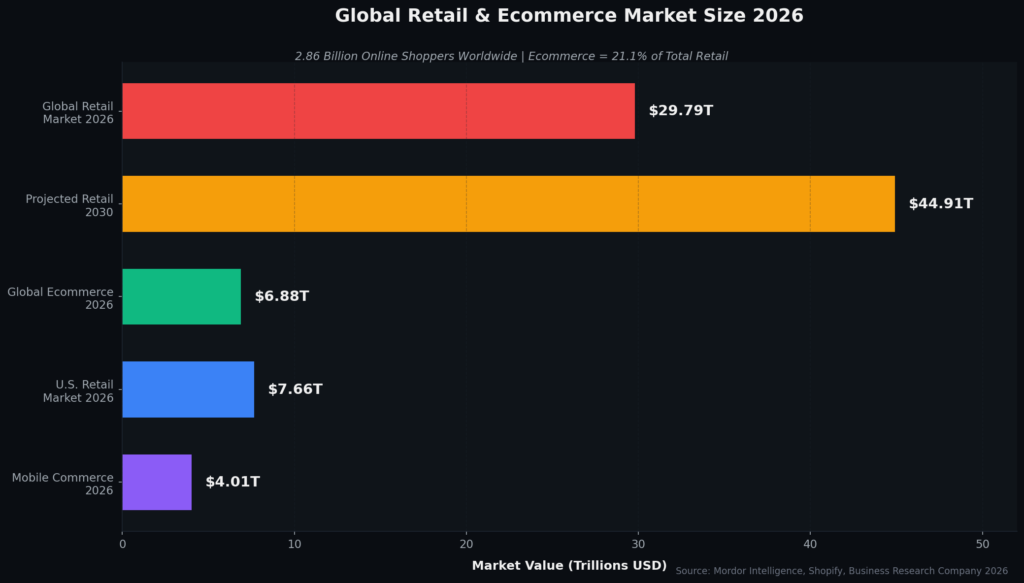
Megastore Marketing Statistics #1 – Global Retail Market To Reach $29.79 Trillion In 2026
In 2026, the global retail industry market size stands at $29.79 trillion according to Mordor Intelligence’s January 2026 updated report, with projections reaching $41.53 trillion by 2031 at a 6.87% CAGR, while 96% of global retail executives surveyed by Deloitte expect industry revenues to grow and 81% foresee margin expansion this year.
The global retail industry is on track to hit massive scales, showing the enormous scope of megastore opportunities. This figure reflects not just growth, but the resilience of retail even in shifting economic climates. For megastores, this means staying competitive requires strong digital and offline strategies. Consumers are demanding convenience alongside experience, making innovation crucial. Ultimately, this trillion-dollar landscape proves the retail world is more influential than ever.
Megastore Marketing Statistics #2 – Retail Industry Projected At $44.91 Trillion By 2030
In 2026, The Business Research Company projects the global retail market will grow from $32.9 trillion this year to $44.91 trillion by 2030 at an 8.1% CAGR, driven by the rise of online shopping and e-commerce, adoption of AI-driven retail solutions, increasing smartphone penetration, demand for sustainable and ethical products, and integration of AR/VR experiences in retail.
By 2030, the retail sector is forecasted to reach extraordinary heights, compounding at impressive annual rates. For megastores, this indicates long-term sustainability in consumer demand. Businesses that adapt to technology shifts will capture larger portions of this growth. It also suggests that consumer expectations will continue to climb as competition expands. Megastore chains that innovate will stay ahead, while others risk falling behind.
Megastore Marketing Statistics #3 – Global Ecommerce Sales To Hit $6.88 Trillion In 2026
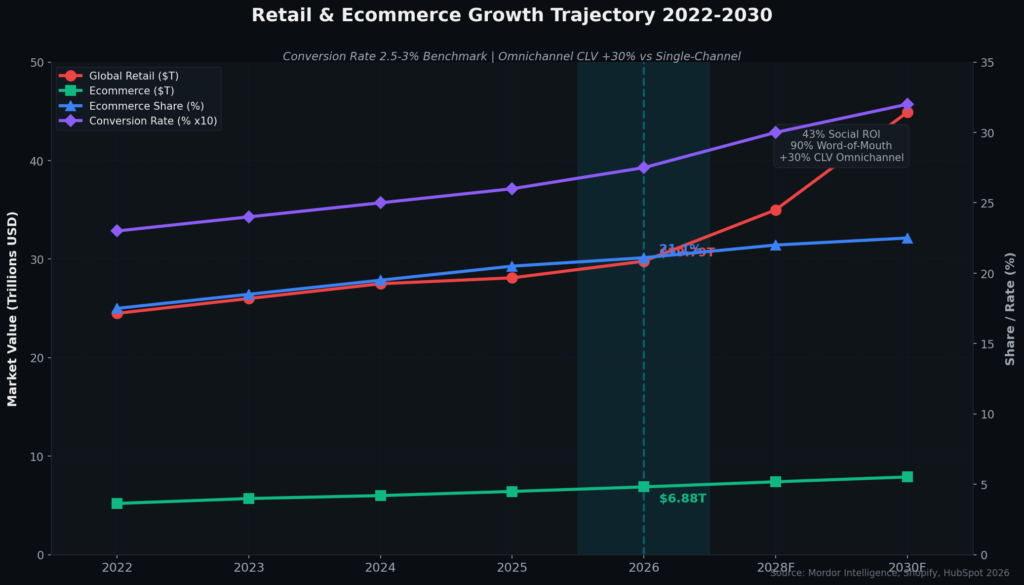
In 2026, global ecommerce sales are forecast to reach $6.88 trillion according to Shopify’s Global Ecommerce Sales Growth Report, representing a 7.2% increase from the previous year and accounting for 21.1% of total retail sales, while mobile commerce alone will generate $4.01 trillion representing nearly 60% of total online retail sales.
Ecommerce continues to transform megastore marketing strategies, with global sales reaching unprecedented heights. This figure highlights the growing dominance of online channels alongside brick-and-mortar. Megastores can no longer rely on physical presence alone; digital storefronts are essential. The line between offline and online shopping has blurred, pushing omnichannel marketing into the spotlight. For businesses, the key is delivering a seamless shopping experience wherever the customer is.
Megastore Marketing Statistics #4 – Ecommerce Represents 21.1% Of Global Retail Sales In 2026
In 2026, ecommerce accounts for 21.1% of all retail sales worldwide according to DemandSage data, with projections indicating this share will climb to 22.5% by 2028 and approach 24% by 2030, while the global B2B ecommerce market remains significantly larger than B2C at a projected $36.16 trillion.
This percentage shows that online shopping is no longer just a trend but a permanent fixture. Megastores that balance their online and offline strategies will benefit the most. Physical locations provide experience, while online platforms deliver convenience and scale. The future lies in harmonizing both worlds.
Megastore Marketing Statistics #5 – 2.86 Billion People Shopping Online In 2026
In 2026, approximately 2.86 billion people are expected to shop online globally according to WiserReview’s latest ecommerce statistics, representing roughly 34.5% of the world’s population as digital buyers, with the number projected to exceed 2.96 billion by 2030 as internet penetration continues to expand in emerging markets.
This huge consumer base highlights the need for megastores to prioritize digital reach. Marketing campaigns that ignore online audiences risk losing relevance. Personalization and global logistics now play central roles in connecting with these billions. For megastores, tapping into this audience is both a challenge and an incredible opportunity.
Megastore Marketing Statistics #6 – Over 28 Million Ecommerce Stores Worldwide
In 2026, there are more than 28 million retail enterprises operating worldwide across 190+ countries according to Business Research Insights, with approximately 30% of global retail sales influenced by digital touchpoints, nearly 24% of purchases involving some form of ecommerce integration, and 65% of retailers now using data analytics tools while 41% deploy AI-based demand forecasting systems.
This number illustrates the intensity of competition for megastores in the online space. Standing out requires more than just a website; it demands powerful branding and digital marketing. Customer experience and loyalty programs are critical differentiators. In a crowded marketplace, creativity and innovation drive survival.
Megastore Marketing Statistics #7 – U.S. Retail Sales Projected At $7.66 Trillion In 2026
In 2026, U.S. retail sales are projected to reach $7.66 trillion according to market forecasts, with January 2026 U.S. Census Bureau data showing retail and food services sales at $733.5 billion for the month alone, while Bain & Company projects the U.S. retail market will reach $5.3 trillion in core retail categories with upper-income households accounting for more than 50% of all consumer spending.
For megastores, the American market remains highly lucrative. Despite economic uncertainties, consumers continue to spend heavily across sectors. Marketing campaigns that focus on value and trust resonate the most. U.S. megastores can benefit from data-driven strategies to maximize revenue.
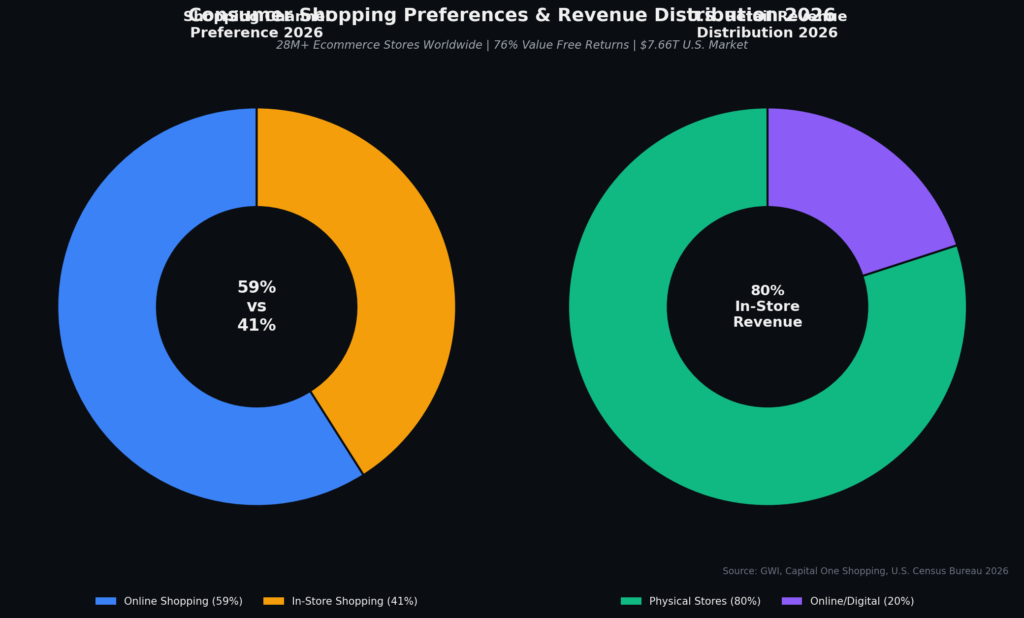
Megastore Marketing Statistics #8 – 80% Of U.S. Retail Revenue Comes From Stores
In 2026, approximately 80-81% of U.S. retail revenue still comes from physical stores according to Capital One Shopping research, with nonstore retailers showing 10.9% year-over-year growth in January 2026, while 55% of consumers still visit a retailer’s website before shopping at a physical location and 68% are likely to visit a physical store to find an item they first saw online.
This reinforces that brick-and-mortar presence is far from dead. Megastores continue to thrive when they create engaging, memorable in-store experiences. Consumers still value face-to-face shopping for immediacy and tangible interaction. Physical retail remains a core driver, supported by digital channels.
Megastore Marketing Statistics #9 – 59% Of Consumers Prefer Online Shopping
In 2026, global consumer preferences remain nearly split with 59% preferring to shop online while 41% still opt for in-store experiences according to GWI research, though U.S. preferences show an even closer divide at 51% online versus 49% in-store, reflecting that hybrid shopping behaviors with click-and-collect options have become the expected standard rather than a competitive advantage.
This shift has forced megastores to rethink traditional retail strategies. Offering free shipping, easy returns, and personalized online experiences is now essential. Customers want speed and convenience without sacrificing trust. Megastores must prioritize digital optimization to keep up with these expectations.
Megastore Marketing Statistics #10 – 76% Of Consumers Value Free Returns
In 2026, free returns remain a decisive factor for 76% of shoppers in choosing where to buy, with 30.9% of online shoppers more likely to make a purchase if they can return items to a physical location, while 12% of consumers actively return items to a retailer’s physical store after purchasing them online, making return policies a key omnichannel integration point for megastores.
Megastores that provide hassle-free return policies build stronger customer trust. This stat proves that after-sales service is just as important as the sale itself. Marketing messages emphasizing flexibility and consumer protection resonate well. Ultimately, policies like free returns become a marketing advantage.
Megastore Marketing Statistics #11 – 95% Of Customers Check Reviews Before Buying
In 2026, nearly all customers continue reading reviews before making purchases, while research from PowerReviews shows that review volume directly impacts conversion rates, with AI-driven personalization and product recommendations now estimated to influence over 50% of all online purchases according to OptinMonster’s 2026 online shopping statistics analysis.
This places online reputation management at the heart of megastore marketing. Positive reviews can boost conversions dramatically, while negative ones can sink trust. Encouraging authentic customer feedback is crucial for credibility. In 2026, reviews are as important as advertising campaigns themselves.
Megastore Marketing Statistics #12 – 91% Of Retail Consumers Are Omnichannel Shoppers
In 2026, as many as 91% of retail consumers are omnichannel shoppers according to Capital One Shopping research, with omnichannel consumers shopping 70% more frequently than single-channel shoppers, using an average of six touchpoints before making a purchase, and spending approximately 16% more per order than single-channel customers.
For megastores, this validates the need for strong omnichannel strategies. Shoppers may browse online, test in store, and purchase via mobile. Marketing must adapt to these cross-channel behaviors seamlessly. The megastore advantage lies in synchronizing every customer touchpoint.
Megastore Marketing Statistics #13 – BOPIS Sales Projected At $177.9 Billion In 2026
In 2026, U.S. click-and-collect retail sales will total an estimated $177.9 billion, up 15.3% year-over-year according to Capital One Shopping research, with 97.2 million Americans (34.2% of U.S. consumers) regularly using buy online pickup in store services, and 85% of BOPIS shoppers making additional purchases when they arrive at the store to collect their orders.
Even post-pandemic, this trend remains popular with megastore shoppers. Customers love the blend of online convenience with instant in-store pickup. For megastores, BOPIS strategies improve traffic and strengthen loyalty. It’s a long-term opportunity to connect digital and physical commerce.
Megastore Marketing Statistics #14 – 92% Of Retail Marketers Report Active AI Adoption
In 2026, 92% of retail marketers report active AI adoption this year according to MyTotalRetail’s analysis, while NVIDIA’s State of AI in Retail and CPG report shows retail and CPG at 47% adoption of agentic AI, with 89% of respondents saying AI is increasing annual revenue and the global AI in retail market size projected to reach $16.54 billion this year according to Fortune Business Insights.
For megastores, AI powers inventory management, personalization, and predictive analytics. These tools help reduce costs and improve efficiency. Customers experience smoother, smarter shopping journeys. As AI continues to expand, megastores that embrace it gain a serious edge.
Megastore Marketing Statistics #15 – 77% Retail AI Adoption Rate In 2026
In 2026, retail AI adoption stands at 77% according to Second Talent’s industry analysis, with companies deploying AI across the entire customer journey from product discovery to post-purchase support, while AI chatbots now handle 60-80% of routine customer inquiries and by year-end over 95% of customer support interactions in retail are expected to involve AI in some capacity.
This shows just how critical technology has become for growth. Megastores are prioritizing AI investments to stay relevant. Machine learning and automation allow for rapid adaptation to consumer trends. In the coming years, AI will likely separate leaders from laggards.
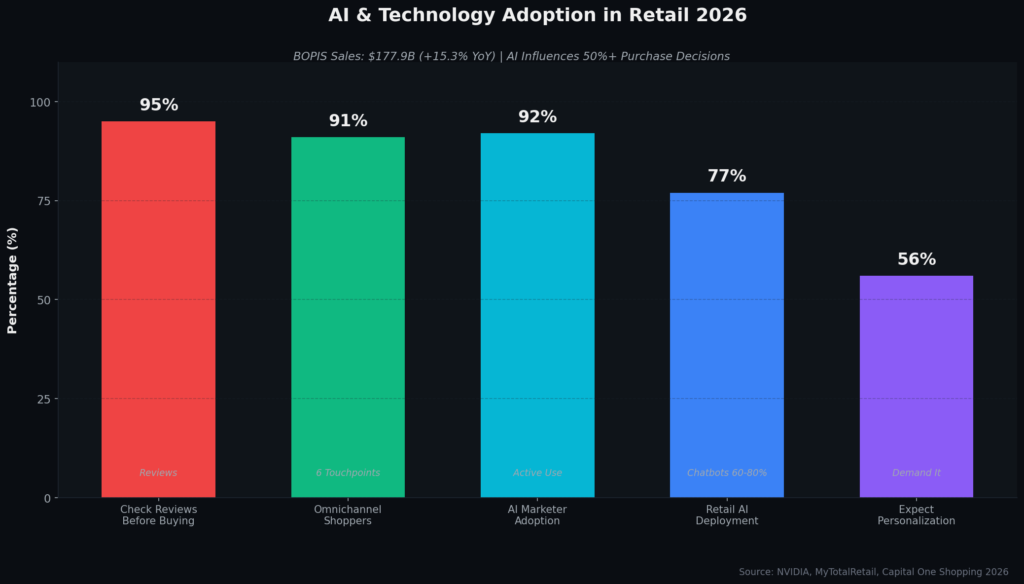
Megastore Marketing Statistics #16 – 56% Of Consumers Expect Personalization
In 2026, personalization demands have intensified with AI-driven personalization and product recommendations now estimated to influence over 50% of all online purchases, while retail companies using generative AI report average ROI of 3.7x per dollar invested according to NVIDIA research, with top performers achieving 10.3x returns through hyper-personalized customer experiences.
Megastores that fail to deliver tailored suggestions risk losing customers. From personalized offers to curated product recommendations, data-driven marketing is key. Personalization creates stronger bonds with shoppers and drives loyalty. In 2026, “one-size-fits-all” marketing no longer works.
Megastore Marketing Statistics #17 – Short-Form Video Delivers Highest Marketing ROI
In 2026, short-form video delivers the highest ROI among content formats at 41% according to Sprout Social’s analysis, while 43% of marketers find Facebook generates the highest ROI among social channels per HubSpot’s State of Marketing Report 2026, and nearly 96% of marketers report positive returns from their social media marketing efforts with platforms integrating commerce seeing higher conversion rates.
Megastores invest heavily in platforms like Instagram, TikTok, and Facebook to reach consumers. Social proof and visual marketing dominate in influencing purchase decisions. Campaigns that combine entertainment and engagement perform best. This statistic confirms the power of social commerce in megastore marketing.
Megastore Marketing Statistics #18 – 90% Of Purchases Influenced By Word-Of-Mouth
In 2026, word-of-mouth remains paramount with 94% of organizations finding that creator content drives more ROI than traditional digital advertising according to CreatorIQ research, while nearly 7 out of 10 brands report achieving more than 2x their investment from influencer marketing campaigns and the global influencer market has expanded to approximately $32.55 billion. For megastores, word-of-mouth remains a priceless marketing channel. Building community and trust can be more effective than advertisements. Referral programs and customer loyalty initiatives can maximize this effect. In the megastore world, authentic human connections are still the strongest driver.
Megastore Marketing Statistics #19 – Average Ecommerce Conversion Rate Is 2.5-3%
In 2026, the average ecommerce conversion rate ranges between 2.5% and 3% for established stores according to multiple industry benchmarks, with desktop conversion rates at 3.9% compared to mobile at 1.8%, while top 10% of Shopify stores convert at 4.7% or higher and global Buy Now Pay Later payments are projected to surpass $560 billion by year-end, boosting conversion rates and average order values.
Megastores need to constantly optimize their websites to meet or beat this benchmark. Conversion rate improvements come from speed, trust signals, and better UX. Even small gains in conversion rates can mean millions in revenue. It’s a key metric for measuring marketing success.
Megastore Marketing Statistics #20 – Loyalty And Digital Commerce Among Top Priorities
In 2026, retail executives continue ranking loyalty programs and digital commerce as top priorities, with omnichannel loyalty strategies proving most effective as more than a quarter of consumers boosted their use of loyalty programs in 2026 according to SAP Emarsys research, while customer lifetime value is up to 30% higher for omnichannel shoppers compared to single-channel buyers and retailers with strong omnichannel strategies see a 9.5% increase in annual revenue.
For megastores, these two pillars will define success in the next decade. Consumers demand value, rewards, and seamless online/offline integration. Investing in customer loyalty strengthens long-term profitability. In 2026, loyalty is no longer optional – it’s a survival strategy.
FINAL MEGASTORE MARKETING STATISTICS 2026 THAT REVEAL RETAIL’S FUTURE
Looking back at all these megastore marketing statistics, what strikes me most is how quickly consumer habits are evolving and how vital it is for businesses to keep pace. I’ve seen firsthand that the stores and brands willing to adapt—whether through smarter personalization, stronger omnichannel strategies, or a deeper focus on customer trust—are the ones that thrive. For me, these numbers serve as both a guide and a reminder: the data is only as valuable as the human connections we build from it. And in the end, that’s what makes marketing in this space both challenging and incredibly rewarding. In 2026, megastore retailers are accelerating investments in AI-powered inventory forecasting, omnichannel fulfillment, and in-store digital experiences to compete with fast-moving ecommerce giants.
SOURCES
https://www.hubspot.com/marketing-statistics
https://www.seo.com/blog/digital-marketing-statistics/
https://neilpatel.com/blog/marketing-statistics/
https://www.wordstream.com/blog/ws/2022/04/19/digital-marketing-statistics
https://www.optimizely.com/insights/blog/marketing-statistics/