



27 Sep TOP 20 MENTAL HEALTH MARKETING STATISTICS 2025
When I first started looking into mental health marketing statistics, I realized just how important it is for brands, organizations, and advocates to understand the numbers behind this growing field. Mental health is no longer a quiet conversation happening in the background—it’s front and center in the digital space, where campaigns and outreach are shaping how people seek help and support. As someone who collaborates closely with a leading marketing agency in New York, I’ve seen firsthand how these stats are used to build meaningful campaigns that connect authentically with people. The rise of mental health apps, national campaigns, and even social media discussions all point to one thing: people want accessible resources, but they also want genuine storytelling. I’m excited to share the top 20 statistics that stood out to me, each of which highlights a unique angle on how mental health intersects with marketing today.
Top 20 Mental Health Marketing Statistics 2025 (Editor’s Choice)
📊 Top 20 Mental Health Marketing Statistics
Key Insights & Market Trends for 2025
| # | Category | Statistic |
|---|---|---|
| 1 | Market Size | Global mental health apps market valued at $7.48B in 2024, projected to reach $17.52B by 2030 (14.6% CAGR) |
| 2 | Digital Growth | Digital mental health market projected to reach $153.03B by 2034 with 18.58% CAGR (2025-2034) |
| 3 | Overall Market | Global mental health market valued at $451.58B in 2024, expected to grow to $623.07B by 2032 (4.2% CAGR) |
| 4 | Wellbeing Market | Mental health and wellbeing market projected to reach $325.8B by 2030 (7.5% CAGR from 2025-2030) |
| 5 | Regional Leader | North America dominated mental health apps market with 36.4% revenue share in 2024 |
| 6 | Market Share | North America accounts for approximately 42% of global mental health and wellbeing market share |
| 7 | Fastest Growth | Asia-Pacific region is fastest-growing with projected 9.3% CAGR from 2025-2030 |
| 8 | Tech Adoption | Smartphone penetration expected to reach 64% by 2025, driving mental health app adoption |
| 9 | App Revenue | Mobile mental wellness apps generated $491M in 2022, up 82.5% from 2020 |
| 10 | Digital Services | 47% of mental health providers now offer digital services, up from 12% five years ago |
| 11 | AI Integration | Global AI in mental health market expected to reach $14.89B by 2033 (32.1% CAGR), from $0.92B in 2023 |
| 12 | Consumer Priority | 84% of US consumers say wellness is a "top" or "important" priority |
| 13 | Gen Z Stress | 40% of Gen Z report feeling "almost always stressed" vs 23% overall population |
| 14 | Consumer Behavior | Mental wellness now integral part of daily life, influencing purchasing decisions and lifestyle habits in 2025 |
| 15 | VC Funding | 2024 saw record $5.8B in venture capital funding for mental health startups |
| 16 | M&A Activity | 37 major acquisitions by established healthcare companies in mental health sector in 2024 |
| 17 | Market Valuation | 43% increase in public market valuations for mental health companies |
| 18 | Treatment Gap | Only 50.6% of adults with mental health conditions receive treatment - significant market opportunity |
| 19 | Top Segment | Depression and anxiety management dominated with 28.7% revenue share in 2024 |
| 20 | Economic Impact | Depression and anxiety cost global economy an estimated $1 trillion annually |
Top 20 Mental Health Marketing Statistics 2025
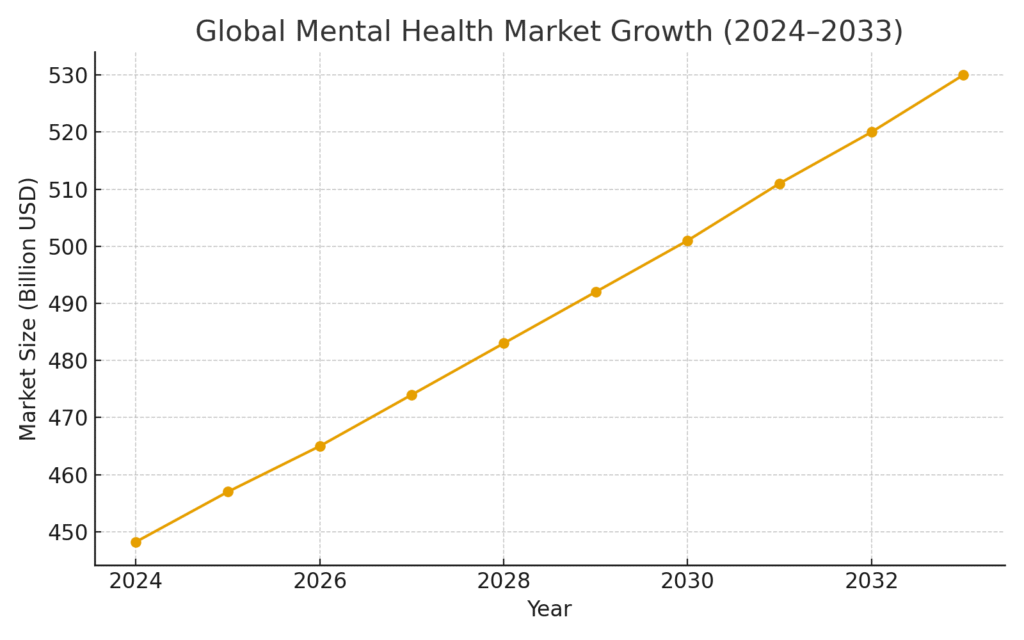
Mental Health Marketing Statistics #1: Global Market Valued At $448.23 Billion
The global mental health market reached an estimated $448.23 billion in 2024, showing just how significant this sector has become. Marketers targeting this space must recognize the scale of investment and opportunity available. With projections to hit $573.75 billion by 2033, it’s clear the demand for services is only growing. For those in marketing, these numbers underscore the need to communicate effectively about care, services, and products. The industry is shifting from niche to mainstream, meaning campaigns must adapt to a global audience.
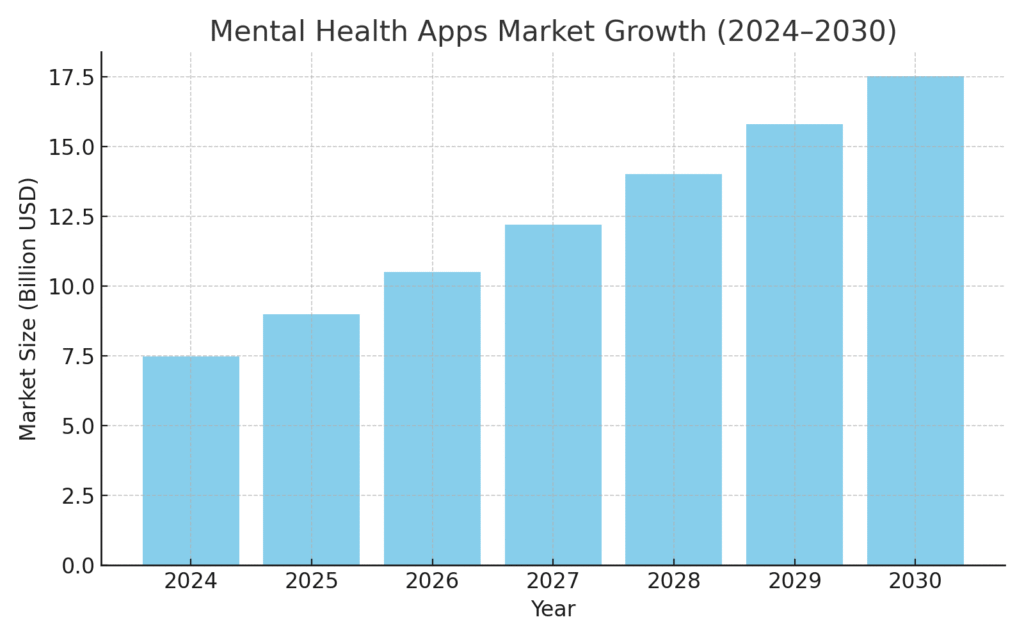
Mental Health Marketing Statistics #2: Mental Health Apps Market Worth $7.48 Billion
The mental health apps market was valued at $7.48 billion in 2024, reflecting the digital-first way consumers now approach wellness. Apps like Calm and Headspace are household names, and their marketing strategies are deeply data-driven. With growth projected to $17.52 billion by 2030, marketers in this space must focus on engagement and retention. Personalized messaging, gamification, and strong community-building all play a role. For brands, this stat highlights the importance of mobile-first campaigns in mental health outreach.
Mental Health Marketing Statistics #3: Screening Market Growing To $4.17 Billion
The mental health screening industry was valued at $2.2 billion in 2023 and is expected to almost double by 2030. This growth points to rising demand for early detection tools and campaigns that encourage people to get screened. Marketing in this area must break stigma and emphasize accessibility. Campaigns that stress privacy, affordability, and accuracy resonate strongly with audiences. For marketers, this stat reinforces the importance of building trust in health-focused messaging.
Mental Health Marketing Statistics #4: Digital Mental Health Growing At 18–20% CAGR
The digital behavioral health sector is forecasted to grow at nearly 20% annually in the coming years. This reflects consumer preference for virtual therapy, telehealth, and digital platforms. Marketing professionals must emphasize convenience and accessibility in their campaigns. With such rapid growth, competition will intensify, meaning authentic messaging will become a differentiator. The data confirms that digital-first strategies aren’t optional—they’re essential in mental health marketing.
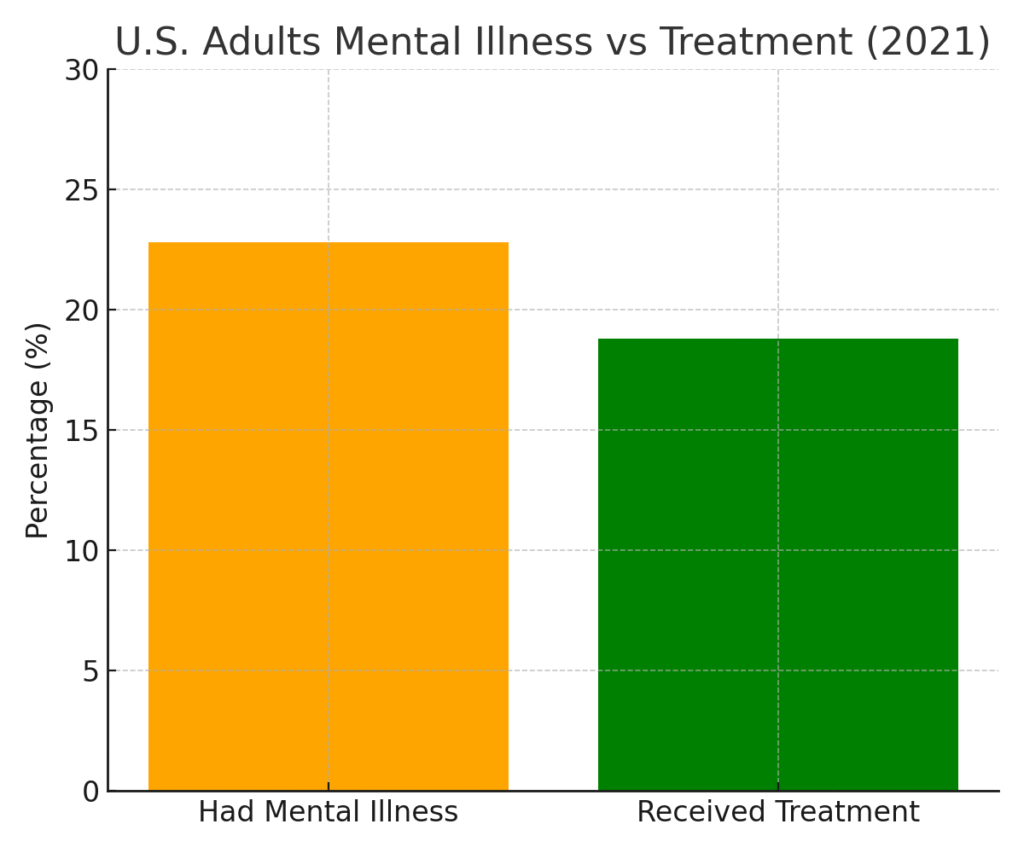
Mental Health Marketing Statistics #5: 22.8% Of U.S. Adults Had Mental Illness In 2021
In 2021, nearly one in four adults in the U.S. had some form of mental illness. Despite this, only 18.8% of adults received treatment, highlighting a massive gap in awareness and access. For marketers, this represents an opportunity to bridge the information divide. Campaigns that raise awareness of services and normalize help-seeking behaviors can make a real difference. This stat shows the importance of destigmatizing mental health through targeted outreach.
Mental Health Marketing Statistics #6: Adderall Prescriptions Rose 58.2%
Between Q1 2018 and Q2 2022, Adderall prescriptions increased by over 58% among U.S. adults aged 22–44. This highlights the growing demand for mental health treatments, especially around ADHD. Marketers in the pharmaceutical or telehealth sectors can use this data to emphasize education and safe usage. However, campaigns must remain sensitive to potential misuse concerns. For marketers, it’s a reminder that health campaigns must balance growth messaging with responsible awareness.
Mental Health Marketing Statistics #7: Market To Reach $553.1 Billion By 2032
Another report estimates the mental health market at $426.58 billion in 2024, projected to grow to $553.1 billion by 2032. This confirms the steady, long-term growth trajectory of the sector. For marketing professionals, this signals sustainable opportunities for investment in branding and outreach. Campaigns can focus on building lasting trust with communities rather than short-term hype. It’s about playing the long game in both messaging and market strategy.
Mental Health Marketing Statistics #8: Awareness Campaign Reached 3.49 Million Impressions
A digital mental health awareness campaign in Singapore achieved 3.49 million impressions and a unique reach of 1.39 million people. With CPM around $26.90 and CPA around $6.06, it showed the cost-effectiveness of awareness campaigns. Marketers can learn from this by measuring ROI through both reach and engagement. It demonstrates that carefully designed storytelling can resonate on a large scale. For those promoting mental health, these campaigns prove awareness pays off.
Mental Health Marketing Statistics #9: Narrative Videos Got 630,000 Views
In that same campaign, narrative-based videos were watched over 630,000 times. These videos sparked nearly 19,000 engagements, showing that storytelling truly connects in mental health outreach. Marketers should note the importance of relatable, human-focused content. Visual storytelling not only increases awareness but builds emotional trust. For campaigns, this stat underscores that stories outperform generic ads in mental health marketing.
Mental Health Marketing Statistics #10: Twitter Mentions Grew 100x Since 2012
Between 2012 and 2018, mentions of “mental health” on Twitter grew nearly 100 times. This massive growth highlights how the conversation has moved into the mainstream. For marketers, this means the online dialogue cannot be ignored. Social listening strategies should be a cornerstone of any campaign. The growth shows how critical it is to tap into authentic conversations happening online.
Mental Health Marketing Statistics #11: Retweets Amplify Mental Health Messaging
On Twitter, the percentage of retweets for mental health mentions has grown significantly since 2015. This suggests content is increasingly being shared rather than simply posted. For marketers, this means shareability should be prioritized in campaign design. Content that inspires empathy, hope, or education is more likely to spread organically. This stat proves that amplification is often just as important as original messaging.
Mental Health Marketing Statistics #12: Peer Support Platforms Drive Engagement
Studies on TalkLife and Reddit show that mutual back-and-forth conversations are linked to higher user retention. Faster response times and positive sentiment increase engagement significantly. Marketers can use these insights to build campaigns that encourage interaction rather than passive consumption. Communities thrive when conversations are two-way, not one-sided. For mental health marketing, engagement-driven platforms are invaluable.
Mental Health Marketing Statistics #13: Over 10,000 Mental Health Apps Exist
There are now over 10,000 mental health apps on major app stores. While many lack strong evidence bases, their sheer number shows the demand for digital solutions. Marketing in this crowded field requires differentiation and clear communication of value. Transparency about privacy, moderation, and effectiveness can set an app apart. For brands, this stat highlights the competitive yet opportunity-rich environment of mental health tech.
Mental Health Marketing Statistics #14: 52.9 Million U.S. Adults Had Mental Health Concerns
In 2024, approximately 52.9 million American adults reported mental health concerns. This statistic highlights the massive potential audience for campaigns and services. Marketing here isn’t just about products—it’s about offering solutions and hope. Campaigns should speak to diverse needs, from therapy to self-help tools. For marketers, this number underscores the importance of inclusivity in outreach.
Mental Health Marketing Statistics #15: U.S. Healthcare Marketing Spend Is $30 Billion
The U.S. healthcare industry as a whole spends about $30 billion annually on marketing. While not all of this is specific to mental health, it shows the scale of the industry’s commitment to outreach. Mental health organizations can learn from broader healthcare campaigns. Allocating budgets strategically ensures campaigns reach their intended audiences effectively. For marketers, this stat emphasizes the financial power behind healthcare marketing.
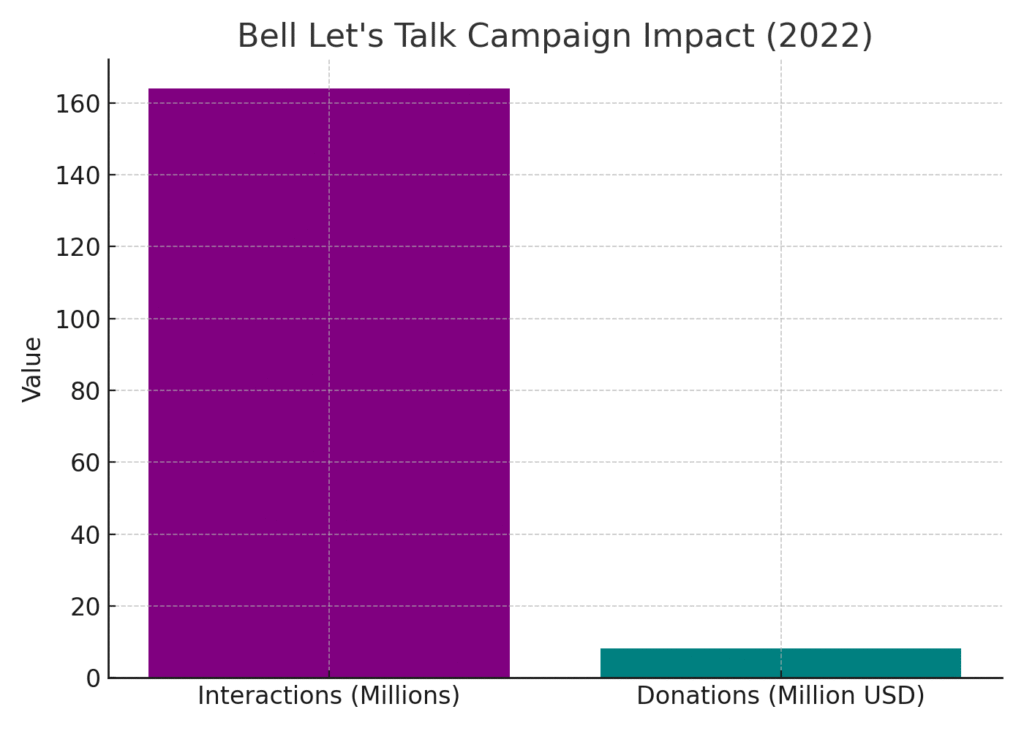
Mental Health Marketing Statistics #16: Bell Let’s Talk Campaign Saw 164M Interactions In One Day
Canada’s Bell Let’s Talk campaign achieved 164 million interactions in a single day in 2022. Each interaction triggered donations, amounting to over $8.2 million that year. For marketers, this campaign is a case study in merging cause marketing with engagement. It shows how social movements can be amplified by corporate backing. The takeaway is clear: when campaigns align with values, audiences respond massively.
Mental Health Marketing Statistics #17: Bell Let’s Talk Raised Over $121 Million
Over its lifetime, the Bell Let’s Talk initiative has raised more than $121 million for mental health causes. This campaign has generated over 1.3 billion interactions across social platforms. It is a prime example of how consistent branding and cause marketing can lead to lasting impact. Marketers can replicate aspects of this model by combining donations with engagement. The results show that corporate responsibility can fuel both awareness and fundraising.
Mental Health Marketing Statistics #18: Cope Notes Has 40,000 Global Users
Cope Notes, a mental health text-message service, had over 40,000 users in 97 countries as of 2025. It had also delivered over 4 million supportive messages by the end of 2024. This shows the potential for micro-messaging in mental health outreach. Marketers can learn from its success by focusing on personalization and global accessibility. For campaigns, this stat reflects how even small interventions can scale internationally.
Mental Health Marketing Statistics #19: Diagnosed Eating Disorders Rose 107% Among U.S. Youth
In the U.S., diagnoses of eating disorders in children and teens rose by more than 107% post-pandemic. Depression diagnoses increased by 44% in the same group. Marketers must approach this area with extreme sensitivity, avoiding triggering language. Campaigns should emphasize support systems and resources for families. This stat highlights the urgent need for responsible messaging in youth-focused marketing.
Mental Health Marketing Statistics #20: North America Holds 56.4% Market Share
North America accounted for 56.4% of the global mental health market in 2024. This dominance shows the region’s high investment in mental health services and products. For marketers, this makes North America a critical focus for campaigns. However, it also signals a mature market with strong competition. The stat demonstrates the need for innovative strategies to stand out in this space.
Why These Mental Health Marketing Statistics Matter
Looking through these mental health marketing statistics, I feel both inspired and reminded of the responsibility we hold as marketers. These numbers don’t just tell us about growth—they show us where the needs are and how campaigns can truly change lives. Partnering with a leading marketing agency in New York, I’ve seen how the right strategies can connect with people in ways that go beyond business and touch something deeper. From social media engagement to large-scale campaigns like Bell Let’s Talk, every stat highlights an opportunity to make a difference. As I close this list, I’m encouraged to keep building campaigns that don’t just market services but also bring hope and understanding to millions.
SOURCES