




20 Sep TOP 20 MICROCOMPUTER MARKETING STATISTICS 2025
When I first started exploring the world of microcomputers, I honestly didn’t realize just how fast the industry was growing. As I dug deeper, I found myself fascinated by the numbers, and that’s why I put together these microcomputer marketing statistics. I wanted to break things down in a way that feels approachable and not just like a bunch of dry data points. With insights pulled from global reports and my own perspective, my goal is to give you something useful—whether you’re a student, a business owner, or even part of a leading marketing agency in New York looking to guide clients through the digital future.
Top 20 Microcomputer Marketing Statistics 2025 (Editor’s Choice)
🚀 Top 20 Microcomputer Marketing Statistics 2025
Essential Market Insights for Technology Industry Leaders
| Rank | Category | Key Statistic |
|---|---|---|
| #1 | Market Size 2025 | Microprocessor market valued at $109.12 billion in 2025, forecast to reach $147.71 billion by 2030 (6.24% CAGR) |
| #2 | Global Market Growth | Market projected to grow from $123.82 billion (2025) to $181.35 billion by 2032 at 5.6% CAGR |
| #3 | Microchips Market | Computer microchips market valued at $27.7 billion in 2024, estimated to grow at 10.7% CAGR through 2034 |
| #4 | PC Shipments | PC vendors shipped 262.7 million PCs in 2024, up 1% from 2023 |
| #5 | Single-Chip Market | Single-chip microcomputer market valued at ~$15 billion in 2025, projected 7% CAGR through 2033 |
| #6 | Asia-Pacific Share | Asia-Pacific accounts for 42.3% market share in 2024 driven by electronics and automotive production |
| #7 | Regional Dominance | Asia Pacific dominates with 47.84% global market share in 2024 |
| #8 | Fastest Growing Region | Asia-Pacific leading with highest regional CAGR of 8.3% through 2030 |
| #9 | Processor Types | CPUs hold 52.4% market share in 2024; GPUs projected to expand at 10.1% CAGR |
| #10 | Fabrication Nodes | 7-6 nm category: 28.2% share in 2024; ≤3 nm node: 18.9% CAGR forecast (2025-2030) |
| #11 | CISC Technology | Complex Instruction Set Computer (CISC) dominates with 41.7% market share |
| #12 | Application Markets | Consumer electronics: 25.2% share in 2024; automotive/transportation: 15.7% CAGR through 2030 |
| #13 | Automotive Segment | Automotive and transportation expected to represent 38.60% of total revenue by 2025 |
| #14 | PC Segment Growth | Personal computers segment forecasted to reach $14.3 billion by 2034 |
| #15 | Data Centers | Servers and data centers segment anticipated to grow at 12.4% CAGR during forecast period |
| #16 | Global PC Volume | Approximately 245.36 million PCs shipped worldwide in 2024 |
| #17 | Cloud Adoption EU | 45.2% of EU enterprises purchased cloud computing services in 2023 (up 4.2% from 2021) |
| #18 | Graphics Rendering | Graphics rendering segment anticipated to cross $11.9 billion by 2034 |
| #19 | Q4 2024 Growth | Q4 2024 PC shipments grew 1.8% year-over-year with 68.9 million units shipped |
| #20 | 32-bit Adoption | Demand for higher processing power driving market toward wider adoption of 32-bit microcomputers |
Top 20 Microcomputer Marketing Statistics 2025
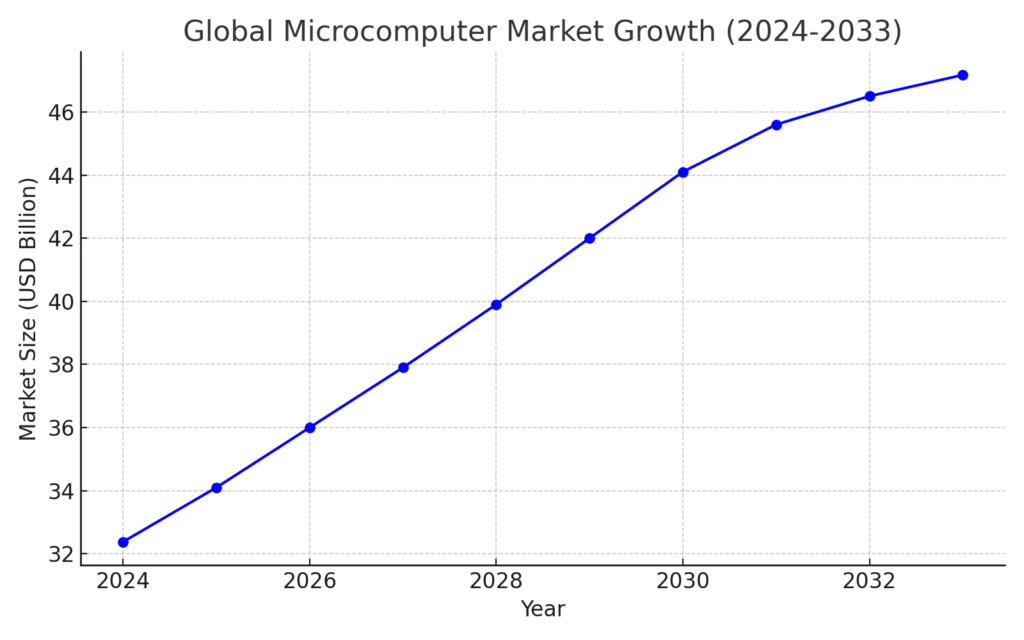
Microcomputer Marketing Statistics #1: Market Growth To $47.17 Billion By 2033
The global microcomputer market is on a strong upward trajectory, expected to grow from USD 32.38 billion in 2024 to USD 47.17 billion by 2033. This projected growth represents a steady CAGR of about 11.1% over the forecast period. Such expansion reflects the rising demand for compact, efficient computing solutions across industries. Businesses see microcomputers as versatile tools, whether in education, healthcare, or small-scale enterprises. This statistic highlights how the market is becoming more central to digital transformation efforts.
Microcomputer Marketing Statistics #2: Valuation Of $213.29 Billion By 2031
Another report estimates the market was worth USD 77 billion in 2023 and will reach USD 213.29 billion by 2031. This growth, at a CAGR of 7%, shows consistent momentum in adoption. It suggests that while forecasts differ slightly, industry consensus remains bullish. The expanding role of microcomputers in business operations, cloud integration, and personal use fuels this trend. For marketers, this means there’s no shortage of opportunities to align with this expanding landscape.
Microcomputer Marketing Statistics #3: Microprocessor Revenue Of $196.5 Billion By 2030
The microprocessor market—an essential part of microcomputers—was valued at USD 122.44 billion in 2024. Projections indicate it will grow to USD 196.5 billion by 2030. This reflects a CAGR of 8.2%, driven by higher performance demands and efficient designs. Microprocessors remain the backbone of computing, and their evolution directly fuels microcomputer advances. Marketing in this space often emphasizes power efficiency, processing speed, and adaptability to new workloads.
Microcomputer Marketing Statistics #4: Microcontroller Market To Reach $69.87 Billion By 2030
Microcontrollers (MCUs) represent another key microcomputer segment, valued at USD 32.37 billion in 2023. Analysts expect the market to nearly double to USD 69.87 billion by 2030. With an 11.7% CAGR, microcontrollers are driving IoT, automation, and embedded systems forward. Their affordability and versatility make them vital for everyday tech. This creates unique marketing potential for industries targeting innovation and smart devices.
Microcomputer Marketing Statistics #5: Asia-Pacific Holds 59% Revenue Share
In 2023, the Asia-Pacific region accounted for over 59% of the microcontroller market’s revenue. This dominance highlights the region’s role as a global tech hub. With strong manufacturing bases in China, Taiwan, and South Korea, supply and demand remain closely aligned. The widespread use of microcomputers in consumer electronics drives these figures. Companies expanding into Asia-Pacific should focus on localization and affordability in their marketing strategies.
Microcomputer Marketing Statistics #6: Asia-Pacific Dominates Microcomputer Market
Beyond microcontrollers, Asia-Pacific also leads the overall microcomputer market. Its dominance stems from rapid industrialization and adoption of cost-effective computing solutions. Educational institutions and startups in the region continue to invest heavily in microcomputers. This positions Asia-Pacific as both a producer and a massive consumer. For marketers, showcasing affordability and scalability is key in this region.
Microcomputer Marketing Statistics #7: Micro Data Center Market To Reach $88.36 Billion By 2034
The micro data center market was valued at USD 7.48 billion in 2024 and is expected to reach USD 88.36 billion by 2034. This impressive CAGR of 28% shows how demand for localized data processing is skyrocketing. Businesses are shifting to edge computing, where micro data centers excel. The statistic underscores the importance of speed and efficiency in today’s digital economy. Marketing campaigns around microcomputers increasingly highlight data integration benefits.
Microcomputer Marketing Statistics #8: North America Holds 38% Market Share In Micro Data Centers
In 2024, North America accounted for about 38% of the global micro data center market. The U.S. continues to lead this segment thanks to advanced infrastructure and early adoption. This shows how regional markets vary widely in their maturity. North America’s appetite for quick deployment and high security favors microcomputers in data-intensive sectors. Marketing here often revolves around reliability and scalability.
Microcomputer Marketing Statistics #9: U.S. Market To Reach $23.98 Billion By 2034
Within North America, the U.S. micro data center market alone was valued at USD 1.99 billion in 2024. Forecasts project it to grow to USD 23.98 billion by 2034, reflecting a CAGR of 28.26%. Such growth highlights how the U.S. continues to innovate in edge computing solutions. This also points to expanding opportunities for service providers and microcomputer vendors. For marketers, emphasizing innovation and compliance resonates with this audience.
Microcomputer Marketing Statistics #10: Microchip Market To Hit $84.7 Billion By 2035
The computer microchips market is expected to grow from USD 30.7 billion in 2025 to USD 84.7 billion by 2035. This CAGR of 10.7% shows strong resilience in the semiconductor sector. Microchips are at the heart of every microcomputer, fueling functionality and performance. Their increasing demand drives both hardware and software ecosystems forward. Marketing often focuses on speed, reliability, and energy efficiency in this segment.
Microcomputer Marketing Statistics #11: Logic Chips Lead With 42% Market Share
Within the microchip segment, logic chips are projected to dominate with a 42% market share in 2025. This reflects their central role in managing computational tasks. The x86 architecture is forecasted to hold a 53% share, showing continued reliance on established platforms. Such dominance highlights the staying power of traditional architectures despite innovation. Marketers can leverage this by highlighting proven performance and wide compatibility.
Microcomputer Marketing Statistics #12: AI PC Market To Reach $260.43 Billion By 2031
The AI PC market is forecast to grow from USD 91.23 billion in 2025 to USD 260.43 billion by 2031. This represents a huge opportunity for microcomputer integration with AI technologies. It signals how machine learning and local computing are merging for efficiency. Consumers increasingly demand devices capable of running AI workloads seamlessly. Marketing here focuses on productivity, smart features, and future readiness.
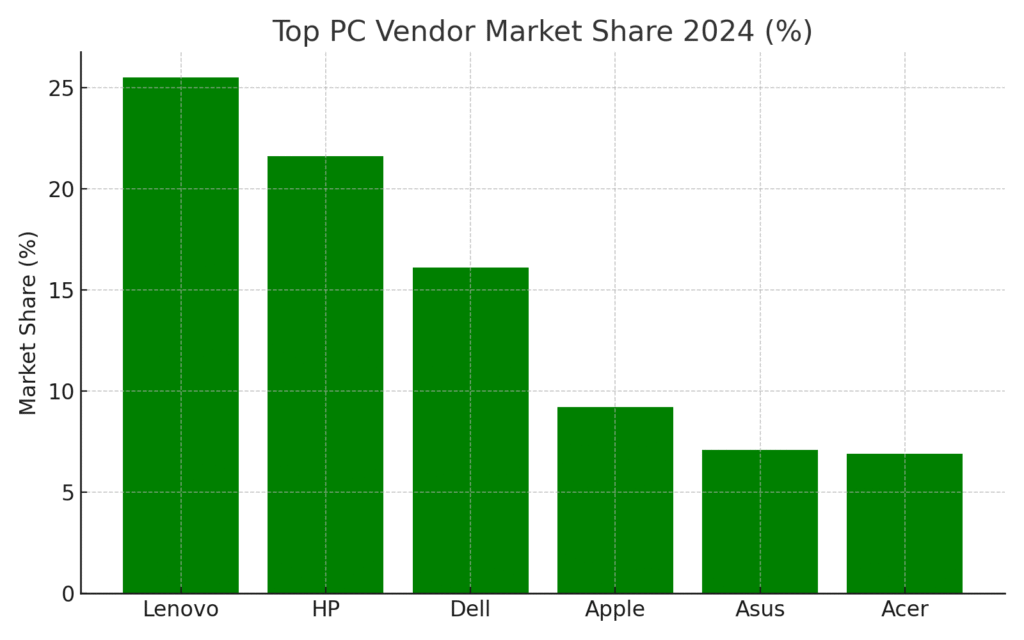
Microcomputer Marketing Statistics #13: Lenovo Leads With 25.5% PC Share
Among PC vendors, Lenovo held about 25.5% of the global market in 2024. HP followed with 21.6%, while Dell secured 16.1%. Apple, Asus, and Acer trailed but still hold significant shares. This competitive landscape shows how brand loyalty and pricing impact the market. Marketing strategies for these companies often highlight design, reliability, and ecosystem integration.
Microcomputer Marketing Statistics #14: Mobile Dominates With 59.1% Platform Share
By August 2025, mobile devices accounted for 59.1% of global platform usage. Desktops followed with 39.3%, and tablets with only 1.6%. This indicates shifting consumer behavior away from traditional computers. Still, microcomputers remain relevant in specialized and industrial uses. Marketers should highlight integration across platforms for maximum impact.
Microcomputer Marketing Statistics #15: 32-Bit Segment Holds 50% Market Share
The 32-bit microcontroller segment held over 50% of the market in 2023. These processors balance cost, performance, and efficiency. Their dominance shows demand for scalable computing in IoT and embedded systems. Many manufacturers rely on 32-bit architecture for smart devices. Marketing should emphasize affordability and reliable performance for this segment.

Microcomputer Marketing Statistics #16: ARM-Based Segment Accounts For 47% Market Share
In 2023, ARM-based microcontrollers accounted for more than 47% of the market. ARM’s success comes from its power efficiency and widespread developer support. This makes ARM the go-to choice for many embedded systems. As IoT grows, ARM’s role in microcomputers becomes even stronger. Marketing campaigns often emphasize flexibility and innovation in ARM-powered solutions.
Microcomputer Marketing Statistics #17: Edge Computing Dominates Micro Data Centers
Edge computing remains the leading application segment for micro data centers. Businesses increasingly require local data processing for speed and reliability. Microcomputers play a vital role in making edge computing viable. This trend shows how distributed systems are overtaking centralized ones. Marketers can frame edge as the future of real-time efficiency.
Microcomputer Marketing Statistics #18: Large Enterprises Lead Market Share
In 2024, large enterprises held the largest share of the micro data center market. Their demand for scalability and advanced security drives growth. Microcomputers provide affordable yet efficient solutions for these organizations. Startups and SMEs follow but at a smaller scale. Marketing here should emphasize trust, security, and adaptability.
Microcomputer Marketing Statistics #19: Key Players Include Intel And AMD
Some of the major players in the microcomputer market include Intel, AMD, ARM Holdings, and STMicroelectronics. These companies continue to set the standard in processing power and efficiency. Their innovations drive the broader microcomputer ecosystem. Partnering with or aligning to these leaders often boosts credibility. Marketing messages often focus on heritage, innovation, and global reach.
Microcomputer Marketing Statistics #20: Global Brands Like Apple And Microsoft Compete
Other global leaders in the microcomputer space include Apple, Microsoft, Dell, HP, and Lenovo. These companies bring brand recognition and massive customer bases. They influence trends across consumer and enterprise computing. Their participation ensures healthy competition and continued innovation. Marketing here highlights brand trust, user experience, and cutting-edge features.

Wrapping It Up
Looking back at all these stats, it’s clear that microcomputers aren’t just a niche—they’re shaping the core of how we live and work today. For me, pulling these numbers together wasn’t just about charts and forecasts; it was about showing the bigger picture of how technology is pushing us forward. If you’ve read this far, I hope you walk away with not just more knowledge, but also a little spark of curiosity about where this industry is headed. Personally, I find it exciting to imagine how these shifts might touch my own everyday life, and maybe yours too.
SOURCES
https://www.verifiedmarketreports.com/product/microcomputer-market/
https://www.metastatinsight.com/report/microcomputer-equipment-market
https://www.mordorintelligence.com/industry-reports/asia-pacific-microcontroller-market
https://www.rootsanalysis.com/microcontroller-market
https://www.gminsights.com/industry-analysis/computer-microchips-market
https://dataintelo.com/report/global-single-chip-microcomputer-market
https://www.imarcgroup.com/microcontroller-market
https://www.verifiedmarketresearch.com/product/microcomputer-market/
https://www.businessmarketinsights.com/reports/asia-pacific-micro-data-center-market
https://www.futuremarketinsights.com/reports/computer-microchips-market
https://www.verifiedmarketresearch.com/product/asia-pacific-mcu-market/