



18 Sep TOP 20 MILLENIAL MARKETING STATISTICS 2025
Understanding today’s consumer landscape means paying close attention to millennials, a generation that continues to shape global purchasing trends in ways no one can ignore. These millenial marketing statistics provide a clear picture of how their behaviors, preferences, and values are driving the future of business. From their strong reliance on digital channels to their loyalty toward socially responsible brands, millennials have become the ultimate benchmark for modern marketers. As someone who has seen firsthand how strategies can make or break a campaign, I can tell you that aligning with their expectations is more than a trend—it’s a necessity. That’s why turning to a marketing agency in New York with proven expertise is often the smartest move for brands that want to stay relevant and impactful in this fast-changing environment.
Top 20 Millenial Marketing Statistics 2025 (Editor’s Choice)
| # | Millennial Marketing Statistic | Key Insight |
|---|---|---|
| 1 | 72% of marketers target millennials | Still a dominant audience for brands |
| 2 | $22,300 spent yearly on CPG, merchandise & QSR | Strong purchasing power |
| 3 | ≈ 683 shopping trips a year, $33 per trip | Frequent shoppers with smaller baskets |
| 4 | 60% prefer personalized marketing messages | Customization drives engagement |
| 5 | 80% shop via smartphones | Mobile-first generation |
| 6 | 56–60% spend more on experiences | Experiences valued over products |
| 7 | 66% prefer brands supporting causes | Cause-driven purchasing |
| 8 | 73% choose brands that reflect their values | Alignment with identity matters |
| 9 | 62% trust user-generated content | Peer voices more trusted than ads |
| 10 | 82% influenced by social media | Social proof shapes decisions |
| 11 | 50%+ prefer subscription models | Recurring convenience appeals |
| 12 | 72% willing to pay more for sustainability | Eco-conscious buying power |
| 13 | 67% demand brand transparency | Honesty builds loyalty |
| 14 | 90% follow brands on social media | Direct engagement expected |
| 15 | 61% use streaming services heavily | Streaming dominates entertainment |
| 16 | 88% prefer texting for customer service | Fast, direct communication valued |
| 17 | Video ads highly engaging | Video marketing essential |
| 18 | 61% expect to shop directly on social platforms | Rise of social commerce |
| 19 | 64% make impulse purchases | Spontaneous buying is common |
| 20 | Prefer omnichannel shopping journeys | Blending online & offline seamlessly |
Top 20 Millenial Marketing Statistics 2025
Millenial Marketing Statistics #1: 72% Of Marketers Target Millennials
Millennials remain a top priority for brands, with 72% of marketers actively focusing on this demographic. This shows their influence in shaping global markets and consumer behavior. Companies know that ignoring millennials would mean missing out on a huge slice of the purchasing power pie. Their digital-first habits make them especially appealing for modern marketing strategies. Businesses that create campaigns around millennial preferences often see higher engagement and brand loyalty.
Millenial Marketing Statistics #2: $22,300 Yearly Spend On Goods And Services
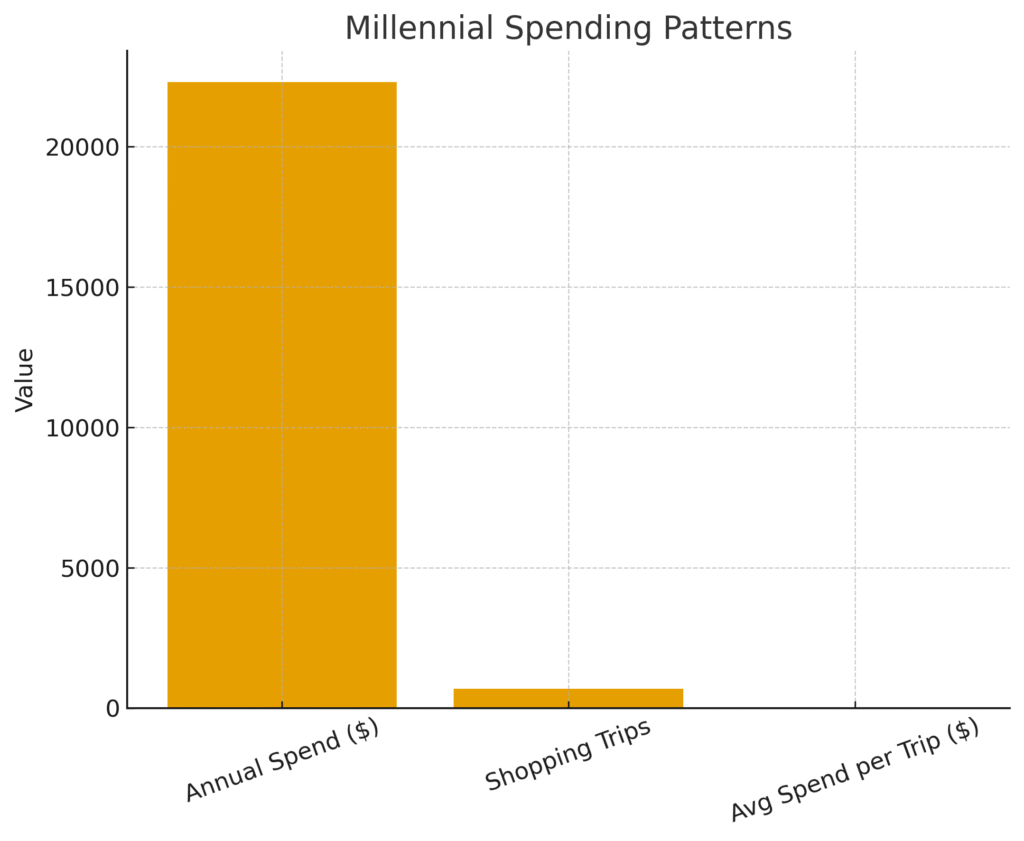
On average, millennial households spend about $22,300 a year on consumer packaged goods, merchandise, and quick service restaurants. This level of spending highlights their importance to both retail and service industries. They consistently drive demand across multiple categories, making them key to sustained growth. Brands that understand their spending patterns can design better offers and loyalty programs. The steady annual outlay shows their strong role in the economy.
Millenial Marketing Statistics #3: 683 Shopping Trips A Year At $33 Each
Millennials make around 683 shopping trips annually, with an average spend of $33 per trip. This frequency shows how often they interact with retail environments. They prefer smaller, more regular purchases over fewer, larger ones. For businesses, this means ensuring consistent brand presence to capture repeat buying moments. Frequent shopping trips also make them highly exposed to advertising and promotions.
Millenial Marketing Statistics #4: 60% Prefer Personalized Messages
About 60% of millennials prefer personalized marketing messages over generic ones. They value when brands take the time to tailor communication to their needs and preferences. Personalization helps them feel recognized and understood. Companies using data-driven personalization often see stronger engagement from this group. It reinforces the importance of customer-centric strategies in modern marketing.
Millenial Marketing Statistics #5: 80% Shop Via Smartphones
A massive 80% of millennials use their smartphones for shopping. This reflects the mobile-first habits of the generation. From product discovery to final checkout, mobile devices dominate their shopping journeys. Brands with optimized mobile sites and apps are far more likely to succeed with millennials. The convenience of mobile commerce makes it their go-to choice for purchasing.

Millenial Marketing Statistics #6: 56–60% Value Experiences Over Products
More than half of millennials say they prefer to spend money on experiences rather than products. Travel, concerts, and cultural activities often rank higher than buying physical goods. This has reshaped industries such as travel, events, and entertainment. It also means brands need to create experiences around products to capture millennial interest. For them, memories often hold more value than possessions.
Millenial Marketing Statistics #7: 66% Prefer Brands Supporting Causes
Around 66% of millennials choose brands that actively support social causes. They want their money to reflect their values and beliefs. Companies that embrace sustainability, inclusivity, or charity often win their trust. This trend has led to the rise of purpose-driven marketing. For millennials, buying is as much about impact as it is about product.
Millenial Marketing Statistics #8: 73% Choose Brands Aligned With Values
About 73% of millennials purchase from brands that align with their personal values. This alignment builds a deeper emotional connection. It’s not just about what the product does, but what the brand stands for. Companies that fail to connect with their values risk being ignored. Value-based marketing is one of the most effective strategies for this generation.
Millenial Marketing Statistics #9: 62% Trust User-Generated Content
Millennials trust user-generated content 62% more than traditional advertising. Reviews, testimonials, and peer recommendations hold more weight than branded claims. They see fellow consumers as more authentic and relatable. This trust factor explains the rise of influencer marketing and online reviews. For brands, encouraging user-generated content is key to credibility.
Millenial Marketing Statistics #10: 82% Influenced By Social Media
About 82% of millennials admit that social media influences their buying decisions. Platforms like Instagram, TikTok, and Facebook are central to their discovery process. Friends, influencers, and ads all shape what they purchase. For marketers, this makes social media campaigns one of the most powerful tools. It’s a direct path to millennial wallets.
Financial District Marketing Statistics #11: Visitor-to-Lead Conversion Rate Averages 2.2%
The average visitor-to-lead conversion rate for real estate websites is about 2.2%. While this may seem low, it reflects the high-value nature of leads in financial districts. Even small improvements in this rate can yield significant revenue. Marketers can focus on stronger calls-to-action and optimized landing pages to boost performance. This stat shows the importance of micro-optimizations in lead conversion.
Financial District Marketing Statistics #12: ROI Benchmarks Highlight Channel Differences
ROI benchmarks in real estate marketing show stark differences across channels: SEO at 1,389%, webinars at 430%, social media at 182%, and PPC at 36%. These figures prove that organic and educational channels far outperform paid ads. Marketers should prioritize SEO and content strategies for long-term gains. However, PPC and social remain useful for immediate visibility. Understanding these ROI variances is key to efficient financial district marketing.
Financial District Marketing Statistics #13: Click-Through Rates Reveal Channel Effectiveness
Click-through rates (CTR) vary widely by channel, with organic search leading at nearly 40% in position one. In contrast, PPC averages just 1.9%, while email campaigns average around 4.9%. These numbers highlight the importance of strong organic rankings and effective email nurturing. Marketers should focus on content quality and search positioning. CTR benchmarks serve as a reminder that channel selection can make or break campaign results.
Financial District Marketing Statistics #14: Cost Per Lead Benchmarks Show Organic Advantage
The cost per lead in real estate averages $416 for organic and $480 for paid channels. Similarly, CAC is far lower for organic ($660) compared to paid ($1,185). These numbers reinforce the power of long-term content and SEO strategies. For financial districts, where ad competition is high, organic offers more sustainable results. This stat highlights why marketers should diversify and not rely solely on paid ads.
Financial District Marketing Statistics #15: Showings Per Sale Reveal Lead Quality
Showings per sale is a practical metric for determining how well marketing aligns with buyer intent. A lower number of showings per sale indicates that leads are highly qualified. For financial district marketers, this emphasizes the need for precision targeting. Poor alignment results in wasted time and resources. This stat shows that quality beats quantity when it comes to lead generation.

Financial District Marketing Statistics #16: Appointment-to-Listing Conversion Rate Guides Strategy
Appointment-to-listing conversion rates reveal how effective presentations are at securing clients. High rates reflect strong marketing alignment and persuasive communication. In financial districts, where clients are discerning, this metric is especially crucial. It helps marketers refine their messaging and build credibility. Improving this conversion rate directly impacts revenue and brand reputation.
Financial District Marketing Statistics #17: Leads by Source Offer Key Budget Insights
Tracking leads by source shows which channels generate the most qualified prospects. This allows marketers to allocate budget effectively. In financial districts, sources like referrals, organic search, and premium platforms often outperform generic paid ads. Marketers can use this data to double down on high-performing channels. This stat reinforces the value of channel-specific tracking and analysis.
Financial District Marketing Statistics #18: Marketing ROI is the Ultimate Benchmark
Marketing ROI determines whether campaigns are truly profitable. In financial districts, where budgets can be large, ROI clarity is essential. This metric allows businesses to justify investments in high-cost channels. Marketers who fail to track ROI risk wasted spending. Ultimately, ROI serves as the guiding star for campaign strategy.
Financial District Marketing Statistics #19: Cost Per Click Signals Competitiveness
Cost per click (CPC) provides insight into how competitive the market is for paid channels. In financial districts, CPC tends to run higher due to affluent audiences. Marketers must evaluate whether the ROI justifies the spend. Monitoring CPC also helps identify when it’s time to pivot to more cost-effective strategies. This stat reinforces the need for agile budget management.
Financial District Marketing Statistics #20: Lead Conversion Rate Reflects Campaign Success
Lead conversion rate measures the percentage of leads that turn into clients. For financial district marketers, this is the ultimate indicator of campaign effectiveness. High conversion rates mean marketing strategies are resonating with the right audiences. Low rates suggest a need for better targeting or messaging. This stat ties the entire funnel together, from impressions to closed deals.

Why These Numbers Matter
At the end of the day, statistics are more than just numbers — they’re a reflection of how real people and businesses interact in one of the most competitive landscapes in the world. The financial district is a unique ecosystem where every campaign needs to be smart, targeted, and resourceful to capture attention. By paying close attention to these marketing trends, companies can position themselves to not only survive but truly thrive in an area where every impression counts. If you’re serious about reaching decision-makers and high-value audiences, leaning into these insights and partnering with the right experts could be the difference between blending in and standing out.
SOURCES
-
- https://www.invoca.com/blog/financial-services-marketing-statistics
- https://www.fintelconnect.com/blog/financial-services-marketing-trends-2025/
- https://www.invoca.com/blog/financial-services-trends-call-tracking
- https://www.taboola.com/marketing-hub/financial-services-marketing-trends/
- https://firework.com/blog/marketing-roi-statistics
- https://www.amraandelma.com/best-marketing-roi-statistics/
- https://neilpatel.com/blog/marketing-statistics/
- https://digitalmarketinginstitute.com/blog/digital-marketing-trends-2025
- https://everfi.com/blog/financial-education/5-financial-services-marketing-trends/
- https://porchgroupmedia.com/blog/digital-marketing-statistics/
- https://blog.hubspot.com/marketing/marketing-trends
- https://en.wikipedia.org/wiki/Financial_District%2C_Manhattan
- https://en.wikipedia.org/wiki/International_Financial_Services_District
- https://en.wikipedia.org/wiki/Financial_District%2C_San_Francisco
- https://www.talkable.com/blog/important-referral-marketing-stats-you-need-to-know/